|
(11) | EP 0 313 661 A1 |

| (12) | EUROPEAN PATENT APPLICATION |
| published in accordance with Art. 158(3) EPC |
|
|
|
|
|||||||||||||||||||
| (54) | PROCESS FOR PREPARING 3-ETHYLBENZOPHENONE |
| (57) A process for preparing 3-ethylbenzophenone, which comprises oxidizing a heavy oil
fraction produced as a by-product in the production of ethylbenzene using ZSM-5 type
synthetic zeolite catalyst, without splitting carbon-to-carbon bonds. 3-ethylbenzophenone
is a starting material for synthesis of medicines, etc. |
- Technical Field -
[0001] This invention relates to a process for preparing 3-ethylbenzophenone. More particularly, this invention relates to a method to produce 3-ethylbenzophenone represented by the following formula (I) which comprises oxidizing a heavy oil fraction produced as a by-product in the preparation of ethylbenzene using ZSM-5 type synthetic zeolite catalyst, without splitting carbon-to-carbon bonds, said 3-ethylbenzophenone is a key starting material for synthesis of medicines and perfumes.
.- Background Art -
[0002] The following method, for example, is known as the process for preparing 3-ethylbenzophenone.
[0003] That is, 3-ethylbenzophenone is obtained by Friedel-Crafts alkylation using benzophenone and diethyl sulfate in the presence of aluminum chloride (Spanish Patent No. 452500). According to this Spanish Patent, ketoprofen (trade name) as a medicine such as anti-inflammatory agent is synthesized. In this method, in spite of the use of highly pure starting materials, the refining is difficult because many kinds of by-products are formed, in addition, its yield is low.
[0004] Furthermore, it is proposed to produce 3-ethylbenzophenone by oxidizing the heavy by-product oil which is obtained from the alkylation of benzene with ethylene using aluminum chloride as an alkylation catalyst. However, it is necessary to carry out intensive oxidation with aqueous nitric acid, which is accompanied by the splitting of carbon-to-carbon bonds because the alkylation catalyst is aluminum chloride and therefore the composition of the - - by-product oil is different from that of the present invention. On account of the intensive oxidation, the yield of the aimed product is low and also it involves a danger of the generation of much explosive nitro compound.
[0005] Accordingly, the object of the present invention is to provide a method for synthesizing highly pure 3-ethylbenzophenone inexpensively.
- Disclosure of Invention -
[0006] The present invention relates to a process for inexpensively preparing highly pure 3-ethylbenzophenone.
[0007] In short, the process for producing highly pure 3-ethylbenzophenone comprises the step of oxidizing a starting material of a fraction containing (3-ethylphenyl)-phenylmethane which is by-produced in the process to prepare ethylbenzene by reacting benzene with ethylene, without splitting carbon-to-carbon bonds.
(Alkylation)
[0009] In the preparation of ethylbenzene, benzene is alkylated with ethylene in the presence of an alkylation catalyst to obtain an alkylation product mainly containing unreacted benzene, ethylbenzene, polyethylbenzene and heavier products. This alkylation can be carried out by well known liquid phase alkylation method or gas phase alkylation method. The molar ratio of benzene to ethylene to be used may be about 25:1 to 1:5, preferably about 10:1 to 1:1.
[0010] The reaction is generally carried out in gas phase. For example, in the gas phase reaction, starting materials for alkylation are reacted by passing them through ZSM-5 type catalyst at a temperature in the range of about 250 to 650°C, preferably about 300 to 550°C and under a pressure in the range of atmospheric pressure to 100 kg/cm2, preferably atmospheric pressure to 70 kg/cm2 and at a space. velocity of WHSV in the range of 1 to 500, preferably 1 to 300.
[0011] As the result of such alkylation, alkylation products of unreacted benzene, ethylbenzene, polyethylbenzene and heavier products are obtained. If desired, the catalyst is previously removed.
[0012] The by-product oil is obtained by removing unreacted benzene, ethylbenzene and at least a part of polyethylbenzene form the alkylation products obtained as the above.
[0013] The synthetic zeolite catalyst used in the present invention is crystalline synthetic aluminosilicate zeolite of 20 or higher in molar ratio of SiO2/Al2O3 and the inlets of main pores thereof are composed of ten-membered oxygen rings. Such a zeolite is exemplified by ZSM-5 type synthetic zeolites having the inlets of main pores composed of ten-membered oxygen rings as well as zeolite zeta 1 and zeolite zeta 2. That is, the zeolites used in the present invention are characterized in that the inlets of main pores are composed of ten-membered oxygen rings. Conventional synthetic zeolites such as zeolite A and erionite have eight-membered oxygen rings, meanwhile, mordenite, zeolite X and zeolite Y have twelve-membered oxygen rings.
[0014] These conventional zeolites having eight-membered oxygen rings or twelve-membered oxygen rings are not suitable for the method of the present invention because the structure of them are different from the one used in the present invention.
[0015] Any of crystalline synthetic aluminosilicates as far as they are 20 or higher in molar ratio of SiO2/Al2O3 and the inlets of main pores thereof are composed of ten-membered oxygen rings can be used as the crystalline synthetic zeolite in the present invention. Especially preferable ones are ZSM-5 type synthetic zeolites known as ZSM-5, ZSM-11, ZSM-22, ZSM-23, ZSM-35, ZSM-38 and ZSM-48. These ZSM-5 type synthetic zeolites have the structural characteristic that the inlets of main pores are composed of-ten-membered oxygen rings. Furthermore, especially preferable synthetic zeolite is ZSM-5. The compositions and methods for preparing these ZSM-5 type zeolites are disclosed in the following patent gazettes.
[0016] The synthetic zeolite having the structural characteristic that the inlets of main pores are composed of ten-membered oxygen rings, has usually a high molar ratio of SiO2/Al2O3 and the value is generally 20 or higher. In some case, the molar ratio of SiO2/Al2O3 is very high, for example, the synthetic zeolite having the molar ratio as high as 1600 can be effective. Furthermore, it is possible to use in some case the zeolite having a value close to infinity in the molar ratio of Si02/A1203 which does not substantially have aluminum. Such "high-silica" zeolites are also included in the definition of the present invention. This molar ratio of Si02/A1203 can be determined by an ordinary analytical method such as atomic absorption spectrum analysis. This ratio is represented as close as possible to the ratio in the hard skeleton in zeolite crystal but the aluminum in cation form or other forms contained in binder or channels are excluded.
[0017] The structure of ten-membered rings in the inlets of main pores generally confirmed by X-ray diffractiometry. For example, ZSM-5 type synthetic zeolite which is suitable as the catalyst in the present invention exhibit characteristic X-ray diffraction patterns particular to them (cf: the foregoing patent gazettes in detail).
[0018] It is, however, possible to use values of constraint indexes in place of the X-ray diffractiometry. That is, the ten-membered oxygen ring in the present invention can be defined as the zeolite having constraint indexes of 1 to 12. By the way, the practical determination method of the constraint index is described in Japanese Laid-Open Patent Publication No. 56-133223. This index shows the degree that the micro pore structure of zeolite crystal restrains the access of molecules having a cross sectional area larger than that of n-paraffin. In the determination, as disclosed in the same reference, n-hexane and 3-methylpentane are adsorbed by zeolite under certain conditions and the index is calculated from the adsorbed values.
[0020] The method for preparing zeolite in the present invention will be described with reference to the synthesis___ of ZSM-5. A mixture containing reactants of tetrapropylammonium hydroxide or tetra-n-propylammonium bromide, sodium oxide, aluminum oxide, silicon oxide and water, is prepared in the first place. The composition may be made with the range as disclosed in the foregoing reference. The reaction mixture is then subjected to hydrothermal synthesis by heating. After the synthesis, the obtained crystal is baked in the air to obtain zeolite ZSM-5 catalyst. Aluminum oxide is used herein, however, it is also proposed to synthesize ZSM-5 containing substantially no aluminum atom. In the above method, tetrapropylammonium hydroxide or tetra-n-propylammonium bromide is used, however, it is also proposed as the method for synthesizing ZSM-5 to use several other organic cations or organic compounds as their precursors in place of them. Such compounds are exemplified by ammonia, trialkylmethylammonium cation, triethyl-n-propylammonium cation, C2 to C9 primary monoalkylamine, neopentylamine, di- and trialkylamine, alkanolamine, C5 to C6 alkyldiamine, C3 to C12 alkylenediamine, ethylenediamine, hexamethylenediamine, C3 to C6 diol, ethylene or propylene glycol, 1,4-dimethoxycyclohexane, hydroquinone, ethylene oxide and ammonia, n-dodecylbenzene sulfonate, cyclopentadienyl phthalocyanine complex, 2-aminopyridine, ethylene glycol dimethyl ether, dioxane, dioxolan, tetrahydrofuran, and carboxylic acids such as tartaric acid.
[0021] Furthermore, it is also proposed that, without adding organic cations or organic compounds as the precursor thereof as described above, ZSM-5 is added as the seeds in crystallization.
[0022] The zeolite used for the reaction contains metallic ions such as sodium ions which come from the reaction materials in synthesis. Besides the alkali metals such as sodium, it is possible to use the ones which are ion exchanged by other metals of alkaline earth metals such as calcium and magnesium and other trivalent metallic ions. Furthermore, crystalline synthetic aluminosilicate zeolite such as ZSM-5 type zeolite which is modified by impregnating it with magnesium, boron, potassium, phosphorus or their compounds, can also be used. These ion exchange and modification can be carried out according to conventional methods.
[0023] As described above, the crystalline synthetic zeolite of the present invention can contain various kinds of metals. However, the synthetic zeolite which is desirable for the method of the present invention is the so-called hydrogen-type zeolite (HZSM-5) or acid-type zeolite in which the metallic ions are exchanged by hydrogen ions. Typical hydrogen-type zeolite is prepared by a process such that the catalyst containing the organic cations used in the catalyst preparation is heated for instance at about 540°C for 1 hour in an inert atmosphere and it is then subjected to ion exchange with an ammonium salt or a mineral acid such as hydrochloric acid, and it is baked, for example, at about 540°C to activate, thereby obtaining the what is called hydrogen-type zeolite.
[0025] Through the above described process, benzene is alkylated with ethylene to obtain a reaction mixture of unreacted benzene, ethylbenzene, polyethylbenzene and heavier components. This heavier components contains (3-ethylphenyl)phenylmethane as well as other tarry substances.
[0026] A fraction containing (3-ethylphenyl)phenylmethane is recovered by distillation, preferably by reduced pressure distillation from the above reaction product directly, or by recovering the heavier components once and then distilling it again. Anyhow, the fraction containing (3-ethylphenyl)phenylmethane is recovered as a fraction mainly containing the components in the range of 288 to ..... 295°C in boiling point (atmospheric pressure basis).
[0027] Incidentally, the above alkylation reaction is exemplified by the ethylbenzene preparation using the zeolite catalyst made by Mobil Oil Corp., which is widely put into practice in industry, and the ethylbenzene is used for preparing styrene by dehydrogenation.
(Oxidation Reaction)
[0028] In the present invention, the fraction containing (3-ethylphenyl)phenylmethane is oxidized with an oxidizing agent to obtain 3-ethylbenzophenone.
[0029] In this oxidation, it is inevitable that the oxidation is carried out without splitting the carbon-to-carbon bonds. In the oxidation which is accompanied by the splitting of carbon-to-carbon bonds, the formation of carbon oxide such as carbon dioxide is observed.
[0030] In the above oxidation, known oxidation methods can be used in which methylene group, especially that of diphenylmethane structure is oxidized to ketone. For example, it is exemplified by the oxidation with molecular oxygen in the presence of an oxidation catalyst and the oxidation using an oxidizing agent such as permanganate, manganese dioxide, chromate, bichromate, lead tetraacetate, periodate, ruthenium tetraoxide, osmium tetraoxide, hydrogen peroxide, selenium dioxide, chlorite or hypochlorite, ozone and the mixtures of them.
[0031] The catalyst used in the oxidation with molecular oxygen are exemplified by the salts of metals and mixtures of them, which metals are selected from the groups VI-B, VII-B and VIII of the periodic table such as chromium, manganese, tungsten; molybdenum, platinum, palladium, cobalt, nickel, iron, rhodium and ruthenium. Among them, the salts of cobalt, iron, manganese and chromium are preferable. As the salts, for example, the salt or complex of saturated carboxylic acid such as naphthenic acid, and diketone such as acetylacetone are preferable. The suitable quantity of a catalyst to be used is 0.05 to 10% by weight relative to the quantity of reactants. As the molecular oxygen, pure oxygen or the air can be used, or it is possible to supply the reaction system with a mixture of pure oxygen and other inert gases.
[0032] The reaction temperature in the oxidation using molecular oxygen is 30 to 250°C, and preferably 50 to 200°C... In the case that the reaction temperature is lower than 30°C, the rate of reaction is very low, while in the case , that the reaction temperature is above 250°C, the selectivity to the aimed product is seriously lowered, both of which are not desirable.
[0033] In order to improve the efficiency in the contact with an oxidizing agent, a solvent can be used. Such a solvent is exemplified by water, acetone, alcohols such as tert-butyl alcohol, glacial acetic acid, acetic acid, isooctane, benzene, chloroform and pyridine and the mixture of them.
[0034] The use quantity of oxidizing agent such as permanganate is at least 1 equivalent, preferably more than 1.5 equivalent, to the raw material. There is not especially the upper limit of the use quantity, however, the quantity of more than 10 equivalent is not desirable because it is only uneconomical. The temperature of oxidation using the oxidizing agent is 0 to 200°C and preferably 30 to 150°C. The reaction cannot proceed at temperatures below 0°C, while by-products are formed and the selectivity to the aimed product is seriously lowered at temperatures above 200°C, both of which are not desirable.
[0035] By this reaction, the methylene group of diphenylmethane structure in (3-ethylphenyl)phenylmethane is oxidized to carbonyl group and 3-ethylbenzophenone is produced in one step reaction, which can be easily refined by distillation.
[0036] As described above, because the raw material fraction of the present invention is the one which is by-produced in the ethylbenzene preparation, (3-ethylphenyl)phenylmethane can be obtained very inexpensively.
[0037] Furthermore, because the material relating to a specific process is used as a starting material, the .. o-isomer of (ethylphenyl)phenylmethane is not contained. Moreover, because the p-isomer can be easily separated by distillation, highly pure (3-ethylphenyl)phenylmethane containing no position isomer (nuclear substitution) can be obtained. Still further, because the raw material fraction in the present invention is recovered as a fraction in the range of 288°C to 295°C in boiling point (atmospheric pressure basis), it inevitably contains impurities such as polyalkylbenzene which is difficultly separated from (3-ethylphenyl)phenylmethane, however, in the oxidation of the mixture, they hardly react or, even when they are reacted, they are converted into compounds which can be easily separated. Meanwhile, (3-ethylphenyl)phenylmethane in the raw material is converted into ketone of 3-ethylbenzophenone by oxidation which can be easily separated. Therefore,, highly pure 3-ethylbenzophenone can be obtained from the specific fraction containing impurities.
[0038] Furthermore, because the the methylene group between 2 phenyl groups of (3-ethylphenyl)phenylmethane is easily and specifically oxidized, the oxidation can be carried out in a high yield without difficulty.
- Best Mode for Carrying Out the Invention -
[0039] In the following, the present invention will be described in more detail with reference to examples, however, the present invention is not limited only to these examples. (Example)
(Alkylation)
1) Preparation of Raw Material Fraction
[0040] To a stainless steel-made continuous flow reaction vessel was added 100 g of a synthetic zeolite ZSM-5 (H-type, Si02/A1203 molar ratio = 60) and alkylation of benzene with ethylene was carried out under the following conditions.
[0041] The obtained reaction mixture was distilled and heavier components were recovered in a yield of 2.5% by distilling off the unreacted benzene, ethylbenzene and polyethylbenzene.
[0042] Then, a fraction of 288 to 293°C in boiling range (atmospheric pressure basis) was obtained from the recovered heavier components by reduced pressure distillation.
[0043] This fraction contained (3-ethylphenyl)phenylmethane. According to analysis, the content of (3-ethylphenyl)phenylmethane was 87% by weight.
(Oxidation)
2) Preparation of 3-Ethylbenzophenone (1)
[0044] In 200 ml of water, 19.7 g of the fraction containing (3-ethylphenyl)phenylmethane obtained in the above alkylation was suspended. With stirring the suspension, 2 liter of an 1.6% aqueous solution of potassium permanganate was dropped. After the dropping, the stirring was continued for about 10 hours at room temperature. After this mixture was acidified with concentrated sulfuric acid, sodium hydrogensulfite powder was added until the reaction mixture became transparent from brown and it was extracted with benzene. After drying the benzene layer with anhydrous magnesium sulfate, 3-ethylbenzophenone was obtained in a yield of 97% by reduced pressure distillation.
3) Preparation of 3-Ethylbenzophenone (2)
[0045] To a 300 ml autoclave with a stirrer were fed 10C g of the fraction containing (3-ethylphenyl)phenylmethane obtained in the above alkylation and 0.2 g of cobalt naphthenate. Reaction was carried out at 150°C in reaction temperature and under the pure oxygen pressure of 10 kg/cm2 for 3 days.
[0046] After the reaction, it was washed with water and and was subjected to reduced pressure distillation to obtain 3-ethylbenzophenone in a yield of 45%.
[0047] Incidentally, in the oxidation of the above Preparations (1) and (2), the generation of carbon dioxide was not substantially observed and the reaction was not accompanied by the splitting of carbon-to-carbon bond.
4) Preparation of 3-Ethylbenzophenone (3)
[0048] Oxidation with molecular oxygen was carried out in the like manner as in Preparation of 3-Ethylbenzophenone (2) by replacing the cobalt naphthenate with the catalysts shown in the following table. The results of the reaction are shown also in the following table.
- Industrial Applicability -
[0049] The present invention relates to the preparation of 3-ethylbenzophenone and, for example, according to the disclosure in Spanish Patent No. 452500, it is possible to prepare ketoprofen (trade name) from the obtained 3-ethylbenzophenone. Furthermore, when 3-vinylbenzophenone is prepared by dehydrogenating 3-ethylbenzophenone, it is converted into the same ketoprofen according to the method disclosed in United States Patent No. 4,329,507. Ketoprofen is a useful medicine as a anti-inflammatory agent or pain-killing agent.
1. A process for preparing highly pure 3-ethylbenzophenone, which comprises the steps
of: obtaining an alkylation product mainly comprising unreacted benzene, ethylbenzene,
polyethylbenzene and heavier components containing (3-ethylphenyl)phenylmethane by
alkylating benzene with ethylene in the presence of ZSM-5 type synthetic zeolite catalyst,
then recovering by distillation a fraction which contains (3-ethylphenyl)phenylmethane
and which mainly comprises the components in the range of 288 to 295°C in boiling
point (atmospheric pressure basis) from said alkylation product, further oxidizing
said fraction without splitting carbon-to-carbon bonds, and then recovering 3-ethylbenzophenone
represented by the following formula (I) by distillation.
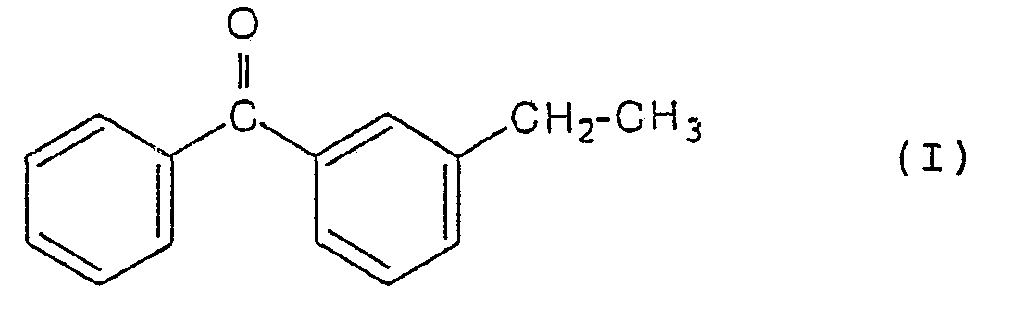
2. The method in Claim 1, wherein said oxidation is carried out with molecular oxygen
at a temperature of 30 to 250°C in the presence of a metallic oxidation catalyst containing
the metals selected from the groups of VI-B, VII-B and VIII in the periodic table.
3. The method in Claim 2, wherein said metal is one member selected from the group
consisting of cobalt, iron, manganese and chromium.
4. The method in Claim 1, wherein said oxidation is carried out at 0 to 200°C in the
presence of an oxidizing agent selected from permanganate, manganese dioxide, chromate,
bichromate; periodate, ruthenium tetraoxide, chlorite or hypochlorite, ozone and mixtures
thereof.
5. The method in Claim 3, wherein at least one equivalent of said oxidizing agent
is used to one mole of (3-ethylphenyl)phenylmethane in the raw material.