|
(11) | EP 0 315 186 B1 |

| (12) | EUROPEAN PATENT SPECIFICATION |
|
|
| (54) |
Microfilled dental composite and method for making it Mit Mikroteilchen gefüllte zahnärztliche Zusammensetzung und Verfahren zu deren Herstellung Matériau dentaire composite utilisant une charge microparticulaire et procédé pour sa production |
|
|
|||||||||||||||||||||||||||||||
|
||||||||||||||||||||||||||||||||
| Note: Within nine months from the publication of the mention of the grant of the European patent, any person may give notice to the European Patent Office of opposition to the European patent granted. Notice of opposition shall be filed in a written reasoned statement. It shall not be deemed to have been filed until the opposition fee has been paid. (Art. 99(1) European Patent Convention). |
Background of the Invention
[0002] Heretofore the fillers in dental composites have been composed of particles from 0.56 to 150 x 10⁻⁶ m (0.56 micron to 150 microns) in diameter. These relatively large particles have resulted in a rougher type of finish than many practitioners desired. Yet, although some manufacturers used a small amount of submicron filler particles, which are typically 2 to 4 x 10⁻⁸ m (0.02 to 0.04 micron) in diameter (to eliminate settling, for example), they have used them only up to about 5% by weight of the composite, and most of the particles remained relatively large.
[0003] Recently, various manufacturers have placed on the market "microfilled" composites in which all of the filler was in the 2 to 4 x 10⁻⁸ m (0.02 to 0.04 micron) range, and a smoother finish was thereby obtained. However, when using these small particle fillers, only about 25% to 50% of the composite could be filler.
[0004] When such a relatively small percentage of filler was added to the typical dental resin, the result was that physical properties, such as tensile strength and water sorption, were severely compromised.
[0005] DE-A-2 462 271 discloses dental composites, in particular artifical teeth and parts for replacement of missing tooth parts, obtained from curable dental compositions which contain microfine inorganic fillers. The microfine inorganic filler is present in about 10 to 90% by wt. and only in particles having a size between about 5 to 700 µm. Preferably, at least 50% of the filler have a particle size in the range of 10 to 40µm. The filler may be silica and the curable resin was a Bis-GMA (a resin on the basis of Bisphenol A and glycidylmethacrylate).
[0006] EP-A- 140 140 discloses a filled-resin composition useful for porcelain repair and as a dental composite as well as to a method for repairing porcelain or teeth. The composition comprises a methacrylate functional resin usable in dental composites, powdered filler-colorant therein, at least one photoinitiator for the resin in an amount sufficient to initiate polymerization and complete it in depth within about half a minute when exposed to a visible-light output of at least 5,000 foot candles and at least one accelerator-free peroxide curing agent for the resin in an effective amount for completing polymerization within about one-half hour of any portion of the resin not receiving sufficient light to effectuate complete cure before then.
Summary of the Invention
[0007] The present invention provides a microfilled dental composite containing from 15% to 55% filler, said filler being sub-micron hydrophobic silica particles of 1 to 4 x 10⁻⁸ m (0.01 - 0.04 micrometers) in diameter. The filler is dispersed in a resin, the main component of which is ethoxylated bisphenol A dimethacrylate, with suitable aliphatic dimethacrylate diluents up to about 40% by weight. Curing agents are added to effect a one-component light-cured restorative or a two-component self-cured material. A three-part curing system can be used to produce a two-component light-cured material with infinite cure, as in U.S. Patent 4,297,266, issued October 27, 1981 to Ibsen, et al.
[0008] The resultant cured material exhibits the smooth finish of a microfilled restorative, but has physical properties in the same range as conventional "small particle" restorative.
Examples
[0009] The system is preferably a single, light-cured paste which is applied, shaped, etc. by the dentist, then cured by exposure to a special dental curing light.
Example 1
[0010] A formulation system embodying this invention comprises the following illustrative ranges:
| Component | Parts by Weight |
| Ethoxylated bisphenol A dimethacrylate | 67.75 - 36.00 |
| Triethylene glycol dimethacrylate | 11.00 - 16.94 |
| Anti-oxidant (e.g., butyl hydroxy toluene) | 0.002 - 0.02 |
| Curing agent (e.g., 2,3-Bornanedione) | 0.05 - 0.20 |
| Cure accelerator (e.g., Ethyl-4-dimethylamino benzoate) | 0.05 - 0.20 |
| Sub-micron hydrophobic silica particles | 15.00 - 55.00 |
[0011] The submicron hydrophobic silica may be Degussa's Aerosil R 972 which has a particle size range of 1 to 4 x 10⁻⁸ m (0.01 to 0.04 microns), with an average particle size of approximately 20 x 10⁻⁷ cm (0.02 micron). The basis for the manufacture of hydrophobic silica is a very pure form of silicon dioxide aerosol obtained by flame hydrolysis. Its particles vary in diameter between 1 to 4 x 10⁻⁵ m (10 and 40 µ). On each 100 sq. meters of surface area, it has about 0.5 millimol silanol groups; hence it is hydrophilic. On its surface, there is a one silanol group per 28-33 Ų (- Si - OH). Hence, with 200 square meters per gram specific surface area, there are about 6.2 x 10²⁰ silanol groups per gram, i.e., one millimol. This gives a figure of about 2000 silanol groups per particle.
[0012] In a continuous process, some 75% of these silanol groups can be chemically reacted with dimethyl dichlorosilane, the resultant product having about 0.7 millimol of chemically combined methyl groups per 100 square meters of surface area. The silica when thus reacted becomes hydrophobic and behaves differently in organic liquids from the hydrophilic material. For this purpose, freshly obtained hydrophilic silica is separated from the bulk of the hydrochloric acid formed in the flame hydrolysis. Then, this silica, dimethyl dichlorosilane, and steam are pneumatically fed in parallel flow into a fluidized bed reactor heated to about 400°C by means of an inert gas such as nitrogen. Besides the chemical reaction of the chlorosilane with the silanol groups of the surface, the desorption of the hydrochloric acid resulting from the reaction takes place in the reactor in a continuous stream, so that there is an analytically assessable chlorine content of below 0.03%. The main quantity of hydrochloric acid is removed from the freshly manufactured SiO₂ and the material does not yet contain any absorbed water. Moreover, siloxane bridges still exist on the surface of the particles, these having formed at the high temperatures used in the process. These bridges break up in the presence of water vapor and chlorosilane in the reaction zone, whereupon the reaction can take place in the nascent state of the silanol group formation.
[0013] Analytical data and moisture absorption data of hydrophobic silica are given in Tables 1 and 2 respectively.
TABLE 1
| Analytical Data on Hydrophobic AEROSIL R 972 | |
| SiO₂ + (-CH₃) | 99.8% |
| Surface area (acc. to Brunauer, Emmet & Teller) | 120 ± 30 m²/g |
| Average particle size | 20 x 10⁻⁷ cm |
| Carbon | 1.1 ± 0.2% |
| pH value (4% dispersion methanol/water 1:1) | 3.8 ± 0.2 |
| Chlorine content | 0.04 ± 0.01% |
| Heavy metals | 0.003% |
| As | 0.0001% |
| Fe₂O₃ | 0.003% |
| Al₂O₃ | 0.05% |
| TiO₂ | 0.03% |
| Na₂O | 0.01% |
| Bulk density | about 40-60 g/l |
| Compacted volume | about 10 ml/g |
TABLE 2
| Moisture Absorption in mg/100 m² | ||||
| Relative air humidity in % | 20 | 40 | 60 | 80 |
| Hydrophilic silica | 1.3 | 4.0 | 10 | 30 |
| Hydrophobic silica | 0.3 | 0.4 | 0.9 | 1.5 . |
[0014] 2,3-Bornanedione and Ethyl-4-dimethyl amino benzoate are exciplex-forming photoinitiators. Other suitable photoinitiators include:
2,3-Bornanedione with ethyl-2-dimethyl amino benzoate
Benzil with ethyl-4-dimethyl amino benzoate
Benzil with ethyl-2-dimethyl amino benzoate
2-Isopropyl thioxanthone with ethyl-4-dimethyl amino benzoate
2-Isopropyl thioxanthone with ethyl-2-dimethyl amino benzoate
Dibenzyl ketone with ethyl-4-dimethyl amino benzoate
Dibenzyl ketone with ethyl-2-dimethyl amino benzoate
2-Hydroxy-2-methyl-1-phenyl-propan-1-one with ethyl-2-dimethyl amino benzoate
2-Hydroxy-2-methyl-1-phenyl-propan-1-one with ethyl-4-dimethyl amino benzoate
Benzil dimethyl acetal with ethyl-4-dimethyl amino benzoate
Benzil dimethyl acetal with ethyl-2-dimethyl amino benzoate
Dimethoxy acetophenone with ethyl-4-dimethyl amino benzoate
Dimethoxy acetophenone with ethyl-2-dimethyl amino benzoate
Benzoin methyl ether with ethyl-4-dimethyl amino benzoate
Benzoin methyl ether with ethyl-2-dimethyl amino benzoate .
Example 2
[0015] A light-cured paste was made as follows:
| pbw | |
| Ethoxylated bisphenol A dimethacrylate | 80.00 |
| Triethylene glycol dimethacrylate | 20.00 |
| Butylated hydroxytoluene | 0.0125 |
| 2,3-Bornanedione | 0.18 |
| Ethyl-4-dimethyl amino benzoate | 0.18 |
| Sub-micron hydrophobic silica | 50.00 |
[0016] This paste was compared with one excellent non-microfilled dental composite and with two competing microfilled composites. The test results are shown in Table 3.
TABLE 3
| Tensile Strength kPa (psi) | Cure Shrinkage (%) | Thermal Expansion (ppm/°C)* | Water Sorption (mg/cm²) | Water Stability | |
| An excellent nonmicrofilled dental composite | 48,264 (7000) | 0.50 | 17 | 0.45 | Excellent |
| The dental composite of this invention | 42,155 (6114) | 0.71 | 29 | 0.47 | Excellent |
| 1st competing microfilled composite (Silux) | 26,821 (3890) | 1.29 | 55 | 1.33 | Poor |
| 2nd competing microfilled composite (Durafil) | 24,028 (3485) | 1.16 | 62 | 1.05 | Medium |
| *Over range of 5° to 55°C . |
[0017] As these tests show, the tensile strength of the dental composite of this invention is substantially greater than that of the two competing microfilled composites and almost equal to that of an excellent non-microfilled composite. The cure shrinkage is lower than that of any of the microfilled composites. Thermal expansion is not much greater than that of the tested non-microfilled composites and much less than that of any of the microfilled composite. Water sorption is equal to that of the non-microfilled composite and very much less than that of the competing microfilled composites. Furthermore, color stability is excellent.
[0018] Water sorption with the system is below 0.5 mg/cm², even with only 30% filler. It remains low throughout the filler range at every concentration tested up to 55% total filler.
Example 3
[0019] Two pastes were prepared as followed:
| Paste A | |
| pbw | |
| Ethoxylated bisphenol A dimethacrylate | 80.00 |
| Triethylene glycol dimethacrylate | 20.00 |
| Butylated hydroxytoluene | 0.0125 |
| Benzoyl Peroxide | 1.50 |
| Sub-micron hydrophobic silica | 50.00 |
| Paste B | |
| pbw | |
| Ethoxylated bisphenol A dimethacrylate | 80.00 |
| Triethylene glycol dimethacrylate | 20.00 |
| Butylated hydroxytoluene | 0.0125 |
| 2-hydroxy ethyl p-toluidine | 4.25 |
| Sub-micron hydrophobic silica | 50.00 |
[0020] These pastes comprised a "self-cured" version of the present invention. When these two parts were mixed together, the material cured in 2-1/2 minutes and exhibited the following properties:
| Tensile strength | 42,058 kPa (6100 psi) |
| Water sorption | 0.47 |
| Thermal Expansion | 29 ppm/°C . |
Example 4
[0021] Two pastes were prepared as followed:
| Paste A | |
| pbw | |
| Ethoxylated bisphenol A dimethacrylate | 80.00 |
| Triethylene glycol dimethacrylate | 20.00 |
| Butylated hydroxytoluene | 0.0125 |
| Benzoyl Peroxide | 0.55 |
| Sub-micron hydrophobic silica | 50.00 |
| Paste B | |
| pbw | |
| Ethoxylated bisphenol A dimethacrylate | 80.00 |
| Triethylene glycol dimethacrylate | 20.00 |
| Butylated hydroxytoluene | 0.0125 |
| 2,3-Bornanedione | 0.18 |
| Ethyl-4-dimethyl amino benzoate | 20.00 |
| Sub-micron hydrophobic silica | 50.00 . |
[0022] When these two parts were mixed together in equal portions, they did not react; however, when activated with a dental curing unit, the material hardened immediately to a depth of about 3-1/2 mm. The material was placed in the absence of light for one hour and again checked for depth of cure. Cure had extended to the depth of the sample, i.e., 12 mm.
[0023] This example illustrates the use of the present invention in the form of a continuous cure two-part system.
Example 5
[0024] A paste was prepared as followed:
| pbw | |
| Ethoxylated bisphenol A dimethacrylate | 67.75 |
| Triethylene glycol dimethacrylate | 16.94 |
| Butylated hydroxytoluene | 0.02 |
| 2,3-Bornanedione | 0.20 |
| Ethyl-4-dimethyl amino benzoate | 0.20 |
| Sub-micron hydrophobic silica | 15.00 . |
[0025] When exposed to a dental curing light for 30 seconds, the material cured to a depth of 5.35 mm, and had a tensile strength of 39,990 kPa (5800 psi).
Example 6
1. A microfilled dental composite containing from 15% to 55% filler, said filler being
sub-micron hydrophobic silica particles of 1 to 4 x 10⁻⁸ m (0.01-0.04 micrometers)
in diameter, dispersed in ethoxylated bisphenol A dimethacrylate resin containing
suitable aliphatic dimethacrylate diluents up to about 40% by weight and curing agents
effecting curing.
2. The composite of claim 1 including means for effecting a one-component light-cured
material.
3. The composite of claim 1 containing a two-component self-cured material.
4. The composite of claim 1 having a three-part curing system to produce a two-component
light-cured material with infinite cure.
5. The composite of claim 1 in the form of a single, light-cured paste that is applied,
and shaped and then cured by exposure to a dental curing visible light.
6. A microfilled dental composite, comprising:
| Component | Parts by Weight |
| Ethoxylated bisphenol A dimethacrylate | 67.75 - 36.00 |
| Triethylene glycol dimethacrylate | 11.00 - 16.94 |
| Anti-oxidant (e.g., butyl hydroxy toluene) | 0.002 - 0.02 |
| Curing agent | 0.05 - 0.20 |
| Cure accelerator | 0.05 - 0.20 |
| Sub-micron hydrophobic silica particles | 15.00 - 55.00 . |
7. The composite of claim 6 wherein the sub-micron hydrophobic silica has a particle
range 1 to 4 x 10⁻⁸ m (0.01 to 0.04 microns), with an average particle size of approximately
20 x 10⁻⁷ cm (0.02 micron) and is based on hydrophylic very pure silicon dioxide aerosol
obtained by flame hydrolysis, the particles of which vary in diameter between 1 to
4 x 10⁻⁵ m (10 and 40 µ) and having on each 100 sq. meters of surface area about 0.5
millimol silanol groups so that they are hydrophilic and have on their surface one
silanol group per 28-33 Ų (- Si - OH) so that with 200 square meters per gram specific
surface area, there are about 6.2 x 10²⁰ silanol groups per gram, i.e., one millimol
and therefrom about 2000 silanol groups per particle.
8. The composite of claim 6 wherein the curing agent is 2,3-bornanedione and ethyl-4-dimethyl
amino benzoate.
9. The composite of claim 6 wherein the curing agents and cure accelerators are chosen
from the following pairs:
2,3-Bornanedione with ethyl-2-dimethyl amino benzoate
Benzil with ethyl-4-dimethyl amino benzoate
Benzil with ethyl-2-dimethyl amino benzoate
2-Isopropyl thioxanthone with ethyl-4-dimethyl amino benzoate
2-Isopropyl thioxanthone with ethyl-2-dimethyl amino benzoate
Dibenzyl ketone with ethyl-4-dimethyl amino benzoate
Dibenzyl ketone with ethyl-2-dimethyl amino benzoate
2-Hydroxy-2-methyl-1-phenyl-propan-1-one with ethyl-2-dimethyl amino benzoate
2-Hydroxy-2-methyl-1-phenyl-propan-1-one with ethyl-4-dimethyl amino benzoate
Benzil dimethyl acetal with ethyl-4-dimethyl amino benzoate
Benzil dimethyl acetal with ethyl-2-dimethyl amino benzoate
Dimethoxy acetophenone with ethyl-4-dimethyl amino benzoate
Dimethoxy acetophenone with ethyl-2-dimethyl amino benzoate
Benzoin methyl ether with ethyl-4-dimethyl amino benzoate
Benzoin methyl ether with ethyl-2-dimethyl amino benzoate .
2,3-Bornanedione with ethyl-2-dimethyl amino benzoate
Benzil with ethyl-4-dimethyl amino benzoate
Benzil with ethyl-2-dimethyl amino benzoate
2-Isopropyl thioxanthone with ethyl-4-dimethyl amino benzoate
2-Isopropyl thioxanthone with ethyl-2-dimethyl amino benzoate
Dibenzyl ketone with ethyl-4-dimethyl amino benzoate
Dibenzyl ketone with ethyl-2-dimethyl amino benzoate
2-Hydroxy-2-methyl-1-phenyl-propan-1-one with ethyl-2-dimethyl amino benzoate
2-Hydroxy-2-methyl-1-phenyl-propan-1-one with ethyl-4-dimethyl amino benzoate
Benzil dimethyl acetal with ethyl-4-dimethyl amino benzoate
Benzil dimethyl acetal with ethyl-2-dimethyl amino benzoate
Dimethoxy acetophenone with ethyl-4-dimethyl amino benzoate
Dimethoxy acetophenone with ethyl-2-dimethyl amino benzoate
Benzoin methyl ether with ethyl-4-dimethyl amino benzoate
Benzoin methyl ether with ethyl-2-dimethyl amino benzoate .
10. A dental composite consisting of:
a light-cured paste as follows:
a light-cured paste as follows:
| pbw | |
| Ethoxylated bisphenol A dimethacrylate | 80.00 |
| Triethylene glycol dimethacrylate | 20.00 |
| Butylated hydroxytoluene | 0.0125 |
| 2,3-Bornanedione | 0.18 |
| Ethyl-4-dimethyl amino benzoate | 0.18 |
| Sub-micron hydrophobic silica | 50.00 . |
11. A method for making a microfilled dental composite comprising the steps of:
preparing a first paste of
preparing a second paste of
mixing said first and second pastes together, and
curing the mixture within 2-1/2 minutes.
preparing a first paste of
| pbw | |
| Ethoxylated bisphenol A dimethacrylate | 80.00 |
| Triethylene glycol dimethacrylate | 20.00 |
| Butylated hydroxytoluene | 0.0125 |
| Benzoyl Peroxide | 1.50 |
| Sub-micron hydrophobic silica | 50.00 , |
| pbw | |
| Ethoxylated bisphenol A dimethacrylate | 80.00 |
| Triethylene glycol dimethacrylate | 20.00 |
| Butylated hydroxytoluene | 0.0125 |
| 2-hydroxy ethyl p-toluidine | 4.25 |
| Sub-micron hydrophobic silica | 50.00 , |
curing the mixture within 2-1/2 minutes.
12. A method for making a microfilled dental composite, comprising:
preparing a first paste of
preparing a second paste of
mixing said first and second pastes together in equal portions, and
activating the mixture with a dental curing unit.
preparing a first paste of
| pbw | |
| Ethoxylated bisphenol A dimethacrylate | 80.00 |
| Triethylene glycol dimethacrylate | 20.00 |
| Butylated hydroxytoluene | 0.0125 |
| Benzoyl Peroxide | 0.55 |
| Sub-micron hydrophobic silica | 50.00 , |
| pbw | |
| Ethoxylated bisphenol A dimethacrylate | 80.00 |
| Triethylene glycol dimethacrylate | 20.00 |
| Butylated hydroxytoluene | 0.0125 |
| 2,3-Bornanedione | 0.18 |
| Ethyl-4-dimethyl amino benzoate | 20.00 |
| Sub-micron hydrophobic silica | 50.00 , |
activating the mixture with a dental curing unit.
13. A method of making a microfilled dental composite comprising:
preparing a paste as followed,
and
exposing said paste to a dental curing visible light for 30 seconds.
preparing a paste as followed,
| pbw | |
| Ethoxylated bisphenol A dimethacrylate | 67.75 |
| Triethylene glycol dimethacrylate | 16.94 |
| Butylated hydroxytoluene | 0.02 |
| 2,3-Bornanedione | 0.20 |
| Ethyl-4-dimethyl amino benzoate | 0.20 |
| Sub-micron hydrophobic silica | 15.00 , |
exposing said paste to a dental curing visible light for 30 seconds.
14. A method for making a microfilled dental composite comprising:
preparing a paste consisting of:
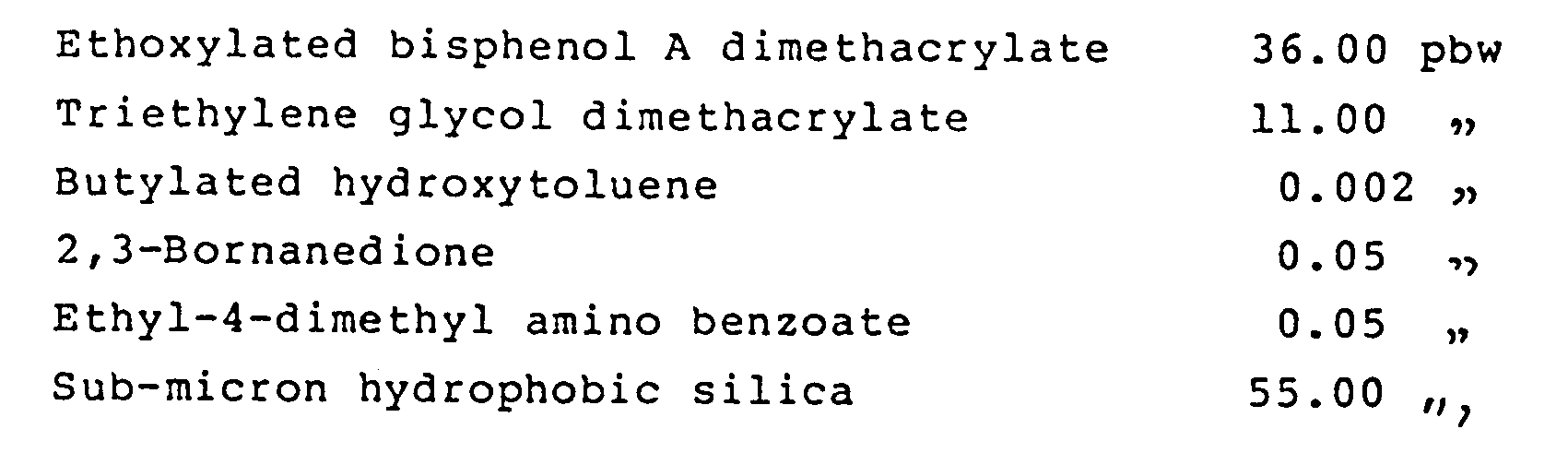
and
exposing said paste to a dental curing light for 30 seconds.
preparing a paste consisting of:
and
exposing said paste to a dental curing light for 30 seconds.
1. Ein mikro-gefüllter Dentalwerkstoff, der 15% bis 55% Füllstoff enthält, wobei der
besagte Füllstoff aus sub-mikronen hydrophoben SiO₂-Teilchen mit einem Durchmesser
von 1 bis 4 x 10⁻⁸m (0,01 bis 0,04 Mikrometer) besteht, dispergiert in ethoxyliertem
Bisphenol A-dimethacrylat Harz, das passende aliphatische Dimethacrylat-Lösungsmittel
bis zu einem Gewichtsanteil von 40%, und Härtungsstoffe, die die Härtung bewirken,
enthält.
2. Werkstoff von Anspruch 1, mit Mitteln, um ein einkomponenten-lichthärtendes Material
zu bewirken.
3. Werkstoff von Anspruch 1, der ein zweikomponenten-selbsthärtendes Material enthält.
4. Werkstoff von Anspruch 1, der ein dreikomponenten-Härtungssystem aufweist, um ein
zweikomponenten-lichthärtendes Material mit unbegrenzter Härtung zu erzielen.
5. Werkstoff von Anspruch 1 in Form einer einzelnen, lichthärtenden Paste, welche aufgetragen,
geformt und anschließend durch Bestrahlung mit einem zahntechnischen, sichtbaren Licht
gehärtet wird.
6. Ein mikro-gefüllter Dentalwerkstoff, der folgendes enthält:
| Bestandteil | Gewichtsanteil |
| ethoxyliertes Bisphenol A-dimethacrylat | 67,75 - 36,00 |
| Triethylen-glykol-dimethacrylat | 11,00 - 16,94 |
| Antioxidant (z.B. Butyl-hydroxy-toluol) | 0,002 - 0,02 |
| härtendes Reagens | 0,05 - 0,20 |
| Härtungs-Beschleuniger | 0,05 - 0,20 |
| submikrone hydrophobe SiO₂-Teilchen | 15,00 - 55,00 |
7. Werkstoff von Anspruch 6, wobei das sub-Mikrometer hydrophobe SiO₂ Teilchengrößen
zwischen 1 bis 4 x 10⁻⁸m aufweist, mit einer durchschnittlichen Teilchengröße von
ungefähr 20 x 10⁻⁷cm, und auf hydrophobem, sehr reinem Siliciumdioxid basiert, welches
als Aerosol bei der Flammenhydrolyse entsteht, wobei die Teilchen im Durchmesser zwischen
1 und 4 x 10⁻⁵m variieren und auf 100 m² Oberfläche ungefähr 0,5 Millimol Silanolgruppen
besitzen, sodaß es hydrophil ist und auf der Oberfläche eine Silanolgruppe (-Si-OH)
pro 28-33 Quadratangström besitzt, sodaß es mit 200 Quadratmeter pro Gramm spezifischer
Oberfläche ungefähr 6,2 x 10²⁰ Silanolgruppen pro Gramm gibt, d.h. ein Millimol und
daraus etwa 2.000 Silanolgruppen pro Teilchen.
8. Werkstoff von Anspruch 6, wobei das Härtungsmittel 2,3-Bornandion und Ethyl-4-dimethylamino-benzoat
ist.
9. Werkstoff von Anspruch 6, wobei die Härtungsreagentien und die Härtungsbeschleuniger
aus den folgenden Paaren von Verbindungen ausgesucht werden:
2,3-Bornandion mit Ethyl-2-dimethylamino-benzoat
Benzil mit Ethyl-4-dimethylamino-benzoat
Benzil mit Ethyl-2-dimethylamino-benzoat
2-Isopropyl-thioxanthon mit Ethyl-4-dimethylamino-benzoat
2-Isopropyl-thioxanthon mit Ethyl-2-dimethylaminobenzoat
Dibenzylketon mit Ethyl-4-dimethylamino-benzoat
Dibenzylketon mit Ethyl-4-dimethylamino-benzoat
2-Hydroxy-2-methyl-1-phenyl-propan-1-on mit Ethyl-2-dimethylamino-benzoat
2-Hydroxy-2-methyl-1-phenyl-propan-1-on mit Ethyl-4-dimethylamino-benzoat
Benzil-dimethyl-acetal mit Ethyl-4-dimethylamino-benzoat
Benzil-dimethyl-acetal mit Ethyl-2-dimethylamino-benzoat
Dimethoxy-acetophenon mit Ethyl-4-dimethylamino-benzoat
Dimethoxy-acetophenon mit Ethyl-2-dimethylamino-benzoat
Benzoin-methyl-ether mit Ethyl-4-dimethylamino-benzoat
Benzoin-methyl-ether mit Ethyl-2-dimethylamino-benzoat
2,3-Bornandion mit Ethyl-2-dimethylamino-benzoat
Benzil mit Ethyl-4-dimethylamino-benzoat
Benzil mit Ethyl-2-dimethylamino-benzoat
2-Isopropyl-thioxanthon mit Ethyl-4-dimethylamino-benzoat
2-Isopropyl-thioxanthon mit Ethyl-2-dimethylaminobenzoat
Dibenzylketon mit Ethyl-4-dimethylamino-benzoat
Dibenzylketon mit Ethyl-4-dimethylamino-benzoat
2-Hydroxy-2-methyl-1-phenyl-propan-1-on mit Ethyl-2-dimethylamino-benzoat
2-Hydroxy-2-methyl-1-phenyl-propan-1-on mit Ethyl-4-dimethylamino-benzoat
Benzil-dimethyl-acetal mit Ethyl-4-dimethylamino-benzoat
Benzil-dimethyl-acetal mit Ethyl-2-dimethylamino-benzoat
Dimethoxy-acetophenon mit Ethyl-4-dimethylamino-benzoat
Dimethoxy-acetophenon mit Ethyl-2-dimethylamino-benzoat
Benzoin-methyl-ether mit Ethyl-4-dimethylamino-benzoat
Benzoin-methyl-ether mit Ethyl-2-dimethylamino-benzoat
10. Ein Dental-Werkstoff als lichthärtende Paste mit folgender Zusammensetzung:
| Gewichtsanteil | |
| ethoxyliertes Bisphenol A-dimethacrylat | 80,00 |
| Triethylen-glykol-dimethacrylat | 20,00 |
| butyliertes Hydroxytoluol | 0,0125 |
| 2,3-Bornandion | 0,18 |
| Ethyl-4-dimethylamino-benzoat | 0,18 |
| sub-Mikrometer hydrophobes SiO₂ | 50,00 |
11. Eine Methode, um einen mikro-gefüllten Dental-Werkstoff nach folgenden Schritten herzustellen:
man bereitet eine erste Paste zu, bestehend aus:
weitere eine zweite Paste, bestehend aus:
und mischt obengenannte erste und zweite Paste zusammen und härtet die Mischung innerhalb
2 1/2 Minuten.
| Gewichtsanteil | |
| ethoxyliertes Bisphenol A-dimethacrylat | 80,00 |
| Triethylen-glykol-dimethacrylat | 20,00 |
| butyliertes Hydroxytoluol | 0,0125 |
| Benzoylperoxid | 1,50 |
| sub-Mikrometer hydrophobes SiO₂ | 50,00 |
| Gewichtsanteil | |
| ethoxyliertes Bisphenol A-dimethacrylat | 80,00 |
| Triethylen-glykol-dimethacrylat | 20,00 |
| butyliertes Hydroxytoluol | 0,0125 |
| 2-hydroxy-ethyl-p-toluidid | 4,25 |
| sub-Mikrometer hydrophobes SiO₂ | 50,00 |
12. Eine Methode, um einen mikro-gefüllten Zahnersatzstoff herzustellen: man bereitet
eine erste Paste zu, bestehend aus:
Weiters eine zweite Paste aus:
mischt obengenannte erste und zweite Paste in gleicher Menge zusammen, und aktiviert
die Mischung mit einem härtenden zahntechnischen Gerät.
| Gewichtsanteil | |
| ethoxyliertes Bisphenol A-dimethacrylat | 80,00 |
| Triethylen-glykol-dimethacrylat | 20,00 |
| butyliertes Hydroxytoluol | 0,0125 |
| Benzoylperoxid | 0,55 |
| sub-Mikrometer hydrophobes SiO₂ | 50,00 |
| Gewichtsanteil | |
| ethoxyliertes Bisphenol A-dimethacrylat | 80,00 |
| Triethylen-glykol-dimethacrylat | 20,00 |
| butyliertes Hydroxytoluol | 0,0125 |
| 2,3-Bornandion | 0,18 |
| Ethyl-4-dimethylamino-benzoat | 20,00 |
| sub-Mikrometer hydrophobes SiO₂ | 50,00 |
13. Eine Methode, um einen mikrogefüllten Dental-Werkstoff herzustellen: man bereitet
eine Paste wie folgt zu:
weiters setzt man die besagte Paste einem härtenden sichtbaren Licht 30 Sekunden
lang aus.
| Gewichtsanteil | |
| ethoxyliertes Bisphenol A-dimethacrylat | 67,75 |
| Triethylen-glykol-dimethacrylat | 16,94 |
| butyliertes Hydroxytoluol | 0,02 |
| 2,3-Bornandion | 0,20 |
| Ethyl-4-dimethylamino-benzoat | 0,20 |
| sub-Mikrometer hydrophobes SiO₂ | 15,00 |
14. Eine Methode, um einen mikro-gefüllten Dental-Werkstoff herzustellen: man bereitet
eine Paste zu bestehend aus:
und setzt die besagte Paste einem härtenden Zahnbehandlungslicht 30 Sekunden lang
aus.
| Gewichtsanteil | |
| ethoxyliertes Bisphenol A-dimethacrylat | 36,00 |
| Triethylen-glykol-dimethacrylat | 11,00 |
| butyliertes Hydroxytoluol | 0,002 |
| 2,3-Bornandion | 0,05 |
| Ethyl-4-dimethylamino-benzoat | 0,05 |
| sub-Mikrometer hydrophobes SiO₂ | 55,00 |
1. Matériau composite dentaire à charge microparticulaire, contenant de 15 à 55 % de
charge, cette charge étant constituée de particules submicroniques de silice hydrophobe,
de 1 à 4.10⁻⁸ m (0,01 à 0,04 µm) de diamètre, dispersées dans une résine de diméthacrylate
de bisphénol-A éthoxylé contenant jusqu'environ 40 % en poids de diluants convenables
de type diméthacrylate aliphatique, ainsi que des agents durcisseurs réalisant le
durcissement.
2. Matériau composite conforme à la revendication 1, contenant des moyens permettant
de réaliser un matériau photo-durci à un seul composant.
3. Matériau composite conforme à la revendication 1, contenant un matériau auto-durci
à deux composants.
4. Matériau composite conforme à la revendication 1, contenant un système durcisseur
en trois parties, destiné à produire un matériau photo-durci à deux composants et
à durcissement infini.
5. Matériau composite conforme à la revendication 1, se présentant sous la forme d'une
simple pâte à photodurcissement, qui est appliquée, façonnée et ensuite durcie par
exposition à une lumière visible de durcissement pour technique dentaire.
6. Matériau composite dentaire à charge microparticulaire, comprenant :
| Composant | Parties en poids |
| Diméthacrylate de bisphénol-A éthoxylé | 67,75 - 36,00 |
| Diméthacrylate de triéthylène-glycol | 11,00 - 16,94 |
| Antioxydant (par ex. butyl-hydroxytoluène) | 0,002 - 0,02 |
| Agent durcisseur | 0,05 - 0,20 |
| Accélérateur de durcissement | 0,05 - 0,20 |
| Particules submicroniques de silice hydrophobe | 15,00 - 55,00 |
7. Matériau composite conforme à la revendication 6, dans lequel les particules submicroniques
de silice hydrophobe ont une taille de 1 à 4.10⁻⁸ m (0,01 à 0,04 µm), la dimension
moyenne des particules valant environ 20.10⁻⁷ cm (0,02 µm), et cette silice est à
base d'un aérosol de dioxyde de silicium hydrophile très pur, obtenu par hydrolyse
à la flamme, dont les particules ont un diamètre variant entre 1 et 4.10⁻⁵ m (10 et
40 µm) et portent, sur 100 m² d'aire, environ 0,5 millimole de groupes silanol, de
sorte qu'elles sont hydrophiles et possèdent en surface un groupe silanol (-Si-OH)
par 28-33 Ų, de sorte que, pour une aire spécifique de 200 m²/g, il y a environ 6,2.10²⁰
groupes silanol, c'est-à-dire une millimole de tels groupes, par gramme, et par conséquent,
environ 2000 groupes silanol par particule.
8. Matériau composite conforme à la revendication 6, dans lequel le durcisseur est de
la 2,3-bornanedione associée à du 4-diméthylaminobenzoate d'éthyle.
9. Matériau composite conforme à la revendication 6, dans lequel les agents durcisseurs
et les accélérateurs de durcissement sont choisis parmi les paires suivantes :
2,3-bornanedione associée au 2-diméthylaminobenzoate d'éthyle
benzile associé au 4-diméthylaminobenzoate d'éthyle
benzile associé au 2-diméthylaminobenzoate d'éthyle
2-isopropyl-thioxanthone associée au 4-diméthylaminobenzoate d'éthyle
2-isopropyl-thioxanthone associée au 2-diméthylaminobenzoate d'éthyle
dibenzyl-cétone associée au 4-diméthylaminobenzoate d'éthyle
dibenzyl-cétone associée au 2-diméthylaminobenzoate d'éthyle
2-hydroxy-2-méthyl-1-phényl-propane-1-one associée au 2-diméthylaminobenzoate d'éthyle
2-hydroxy-2-méthyl-1-phényl-propane-1-one associée au 4-diméthylaminobenzoate d'éthyle
diméthylacétal de benzile associé au 4-diméthylaminobenzoate d'éthyle
diméthylacétal de benzile associé au 2-diméthylaminobenzoate d'éthyle
diméthoxyacétophénone associée au 4-diméthylaminobenzoate d'éthyle
diméthoxyacétophénone associée au 2-diméthylaminobenzoate d'éthyle
éther méthylique de benzoïne associé au 4-diméthylaminobenzoate d'éthyle
éther méthylique de benzoïne associé au 2-diméthylaminobenzoate d'éthyle
2,3-bornanedione associée au 2-diméthylaminobenzoate d'éthyle
benzile associé au 4-diméthylaminobenzoate d'éthyle
benzile associé au 2-diméthylaminobenzoate d'éthyle
2-isopropyl-thioxanthone associée au 4-diméthylaminobenzoate d'éthyle
2-isopropyl-thioxanthone associée au 2-diméthylaminobenzoate d'éthyle
dibenzyl-cétone associée au 4-diméthylaminobenzoate d'éthyle
dibenzyl-cétone associée au 2-diméthylaminobenzoate d'éthyle
2-hydroxy-2-méthyl-1-phényl-propane-1-one associée au 2-diméthylaminobenzoate d'éthyle
2-hydroxy-2-méthyl-1-phényl-propane-1-one associée au 4-diméthylaminobenzoate d'éthyle
diméthylacétal de benzile associé au 4-diméthylaminobenzoate d'éthyle
diméthylacétal de benzile associé au 2-diméthylaminobenzoate d'éthyle
diméthoxyacétophénone associée au 4-diméthylaminobenzoate d'éthyle
diméthoxyacétophénone associée au 2-diméthylaminobenzoate d'éthyle
éther méthylique de benzoïne associé au 4-diméthylaminobenzoate d'éthyle
éther méthylique de benzoïne associé au 2-diméthylaminobenzoate d'éthyle
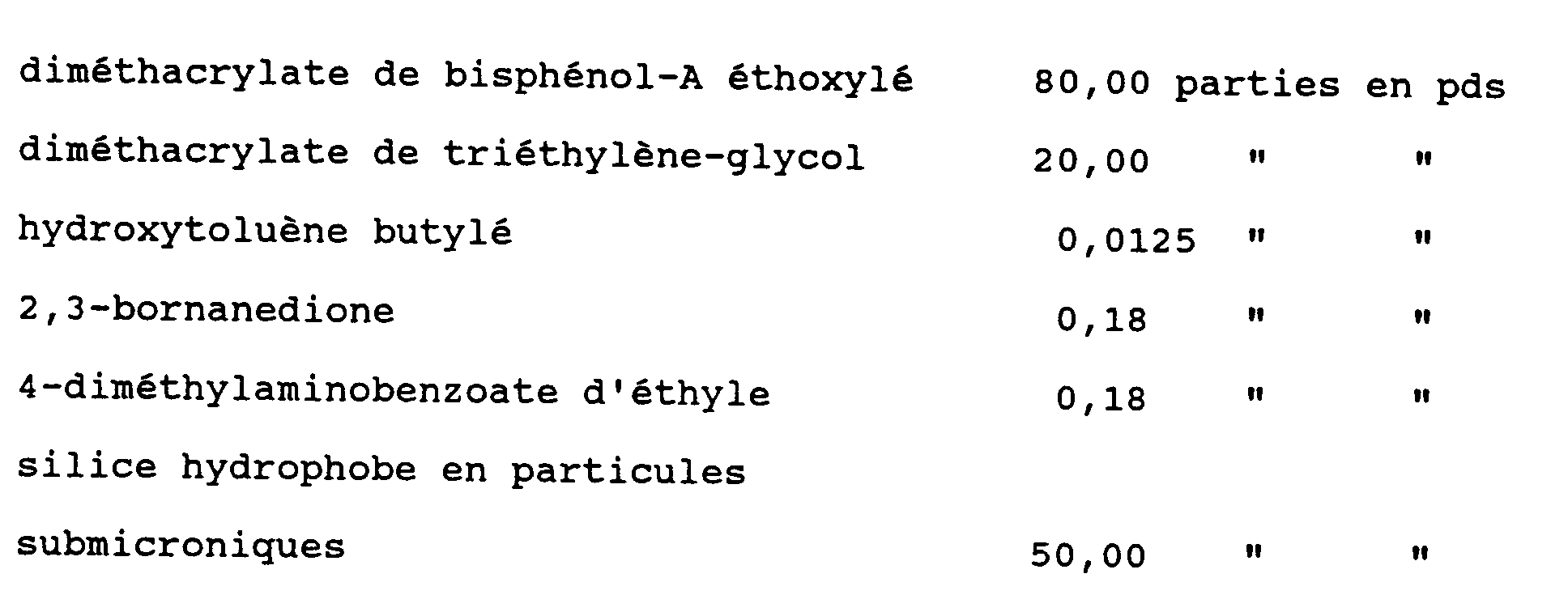
10. Matériau composite dentaire constitué d'une pâte photo-durcie de composition suivante
:
11. Procédé de fabrication d'un matériau composite dentaire à charge microparticulaire,
comprenant les étapes consistant à :
préparer une première pâte avec
préparer une seconde pâte avec
mélanger ensemble lesdites première et seconde pâtes et faire durcir le mélange
en l'espace de 2,5 minutes.
préparer une première pâte avec
| Parties en pds | |
| Diméthacrylate de bisphénol-A éthoxylé | 80,00 |
| Diméthacrylate de triéthylène-glycol | 20,00 |
| Hydroxytoluène butylé | 0,0125 |
| Peroxyde de benzoyle | 1,50 |
| Silice hydrophobe submicronique | 50,00 |
| Parties en pds | |
| Diméthacrylate de bisphénol-A éthoxylé | 80,00 |
| Diméthacrylate de triéthylène-glycol | 20,00 |
| Hydroxytoluène butylé | 0,0125 |
| 2-hydroxyéthyl-p-toluidine | 4,25 |
| Silice hydrophobe submicronique | 50,00 |
12. Procédé de fabrication d'un matériau composite dentaire à charge microparticulaire,
comprenant :
la préparation d'une première pâte avec
la préparation d'une seconde pâte avec
le mélange en parties égales desdites première et seconde pâtes, et
l'activation du mélange à l'aide d'un dispositif de durcissement pour technique dentaire.
la préparation d'une première pâte avec
| Parties en pds | |
| Diméthacrylate de bisphénol-A éthoxylé | 80,00 |
| Diméthacrylate de triéthylène-glycol | 20,00 |
| Hydroxytoluène butylé | 0,0125 |
| Peroxyde de benzoyle | 0,55 |
| Silice hydrophobe submicronique | 50,00 |
| Parties en pds | |
| Diméthacrylate de bisphénol-A éthoxylé | 80,00 |
| Diméthacrylate de triéthylène-glycol | 20,00 |
| Hydroxytoluène butylé | 0,0125 |
| 2,3-bornanedione | 0,18 |
| 4-diméthylaminobenzoate d'éthyle | 20,00 |
| Silice hydrophobe submicronique | 50,00 |
l'activation du mélange à l'aide d'un dispositif de durcissement pour technique dentaire.
13. Procédé de fabrication d'un matériau composite dentaire à charge microparticulaire,
comprenant :
la préparation de la pâte suivante
et l'exposition de cette pâte à une lumière visible de durcissement pour technique
dentaire pendant 30 secondes.
la préparation de la pâte suivante
| Parties en pds | |
| Diméthacrylate de bisphénol-A éthoxylé | 67,75 |
| Diméthacrylate de triéthylène-glycol | 16,94 |
| Hydroxytoluène butylé | 0,02 |
| 2,3-bornanedione | 0,20 |
| 4-diméthylaminobenzoate d'éthyle | 0,20 |
| Silice hydrophobe submicronique | 15,00 |
14. Procédé de fabrication d'un composite dentaire à charge microparticulaire, comprenant
:
la préparation d'une pâte constituée de :
et l'exposition de cette pâte à une lumière de durcissement pour technique dentaire
pendant 30 secondes.
la préparation d'une pâte constituée de :
| Parties en pds | |
| Diméthacrylate de bisphénol-A éthoxylé | 36,00 |
| Diméthacrylate de triéthylène-glycol | 11,00 |
| Hydroxytoluène butylé | 0,002 |
| 2,3-bornanedione | 0,05 |
| 4-diméthylaminobenzoate d'éthyle | 0,05 |
| Silice hydrophobe submicronique | 55,00 |