|
(11) | EP 0 317 587 B1 |

| (12) | EUROPEAN PATENT SPECIFICATION |
|
|
| (54) |
LIQUID CRYSTAL PHASE FLÜSSIGKRISTALLPHASE PHASE CRISTALLINE LIQUIDE |
|
|
|||||||||||||||||||||||||||
| Note: Within nine months from the publication of the mention of the grant of the European patent, any person may give notice to the European Patent Office of opposition to the European patent granted. Notice of opposition shall be filed in a written reasoned statement. It shall not be deemed to have been filed until the opposition fee has been paid. (Art. 99(1) European Patent Convention). |
Liquid crystal phase
[0001] The invention relates to liquid crystal phases (LC phases) having elastic and dielectric properties appropriate for use in supertwisted nematic cells.
[0002] Liquid crystal display cells can be made to support more than 90° of twist in the liquid crystal layer by a combination of offset alignment directions at the surfaces, and incorporation of chiral additives. If the twist angle is increased in this way, the slope of the threshold characteristic increases and eventually becomes vertical. Further increase of the twist angle will result in bistable behaviour, but at the onset of bistability the very steep switching curve allows high level multiplex drive using conventional RMS waveforms. The limit to the increase of twist angle is set by a scattering texture which becomes stabilised as the cholesteric pitch is shortened; the effect can be alleviated but not eliminated by increasing the surface tilt in the cell.
[0003] The term "supertwisted nematic cell" includes all cells with clearly more than 90° of twist, e.g. the cells using a Guest-Host mode (C.M. Waters, V. Brimmell and E.P. Raynes, Proc. 3. Int. Display Research Conference, Kobe (1983) 396; C.M. Waters, V. Brimmell and E.P. Raynes, Proc. SID 25/4 (1984) 261), a birefringence mode (T.J. Scheffer and J. Nehring, Appl. Phys. Lett. 45 (1984) 1021; T.J. Scheffer and J. Nehring, J. Appl. Phys. 58 (1985) 3022), Black & White STN-LCD's (optical mode interference) (M. Schadt and F. Leenhouts, Appl. Phys. Lett. 50 (1987) 236; K. Kawasaki, K. Yamada, R. Watanabe and K. Mizunoya, Proc. SID '87 Digest (1987) 391), HBE-LCD's (K. Kinugawa, Y. Kando, M. Kanasaki, H. Kawakami and E. Kaneko), Double Layer Black & White STN LCD's (K. Katoh, Y. Endo, M. Akatsuka, M. Ohgawara and K. Sawada).
[0004] By comparison with the standard twisted nematic display, the supertwist nematic cell has important differences in behaviour. Because light guiding through the highly twisted structure is imperfect, the cells are commonly operated in a variable birefringence mode and this, together with a strong dependence of threshold voltage on cell thickness, means that a high accuracy of cell spacing is required. In order to minimise the change in materials properties with temperature, a relatively high clearing point is desirable in the mixture. A near optimal optical performance can be obtained, e.g. by setting dΔn ≅ 0.73 for the 270° twist cell and adjusting the polariser orientation if necessary to obtain the best contrast.
[0005] Because of the large number of interacting cell and material properties which contribute to the performance of the supertwisted nematic display, it is highly difficult to select combinations of materials to suit the parameters of the cell for best performance.
[0006] There is thus still a great need for liquid crystal phases having suitable material properties for use in supertwisted nematic display cells.
[0007] The invention has for its object to prepare liquid crystal phases which have a nematic phase including room temperature and exhibit elastic and dielectric properties appropriate for use in supertwist cells.
[0008] It has now been found that the liquid crystal phases having particularly favorable combinations of material properties are obtained when they consist of at least three components A, B, and C, each of which contains one or more compounds, wherein component A has a viscosity or at most about 25 mPa.s at 20°, a clearing point of at most 130° and a dielectric anysotropy between about -2 and about +2, component B has a dielectric anisotropy above about +8, component C has a clearing point of more than 130° and a dielectric anisotropy between about -2 and about +2, characterized in that component A ccntains at least one compound of the formula III
[0009] in which R¹ is alkyl of 1 to 12 C atoms, in which in addition one or two nonadjacent CH₂ groups can be replaced by 0 atoms, -CO-, -O-CO-, -CO-O- and/or -CH=CH- groups,
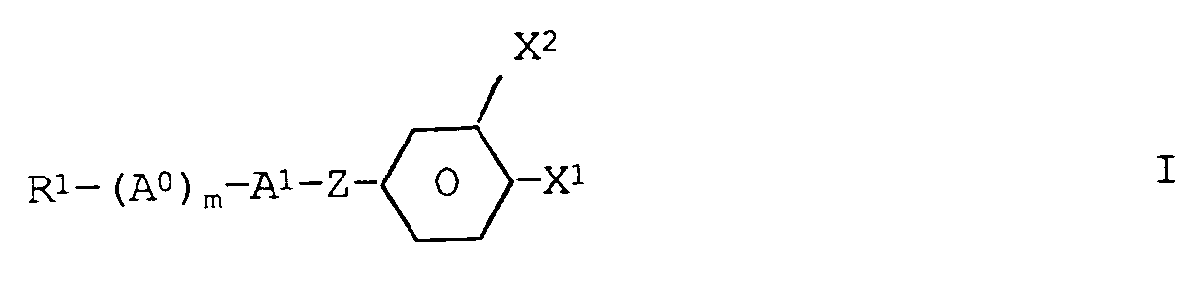
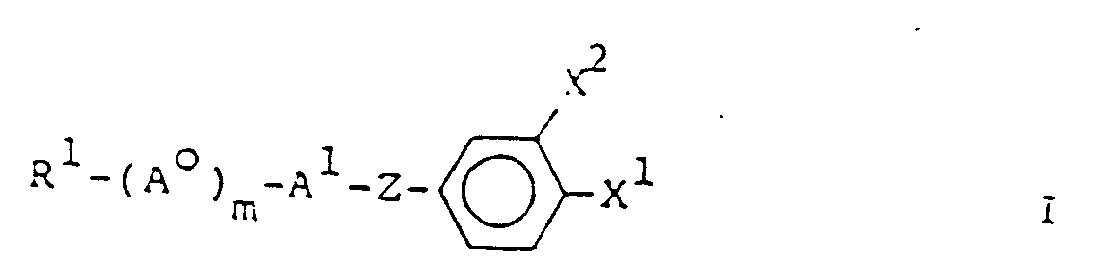
[0014] that component B contains at least one compound of the formula I
in which R¹ is alkyl of 1 to 12 C atoms, in which in addition one or two non-adjacent CH₂ groups can be replaced by 0 atoms, -CO-, -O-CO-, -CO-O- and/or -CH=CH- groups,
[0024] The liquid crystal phases according to the invention exhibit favorable elastic constants, i.e. relatively low K₁₁ and K₂₂ values, relatively high K₃₃ values and very favorable K₃₃/K₁₁ and K₃₃/K₂₂ relationship for use in spertwisted nematic cells.
[0025] Liquid crystal compounds as used in the liquid crystal phases of the present invention and nematic mixtures containing compounds of the formula III are disclosed in
WO-A 88/02018, EP-A 0117631
WO-A 86/03769, DE-A 33 39 216 and
EP-A 0 216 672.
[0026] The invention thus provides the above-described liquid crystal phases for use in supertwisted nematic cells which may also contain one or more suitable chiral additives to obtain the desired d/p relationship.
[0027] The invention further provides supertwisted nematic liquid crystal display elements, in particular supertwisted nematic display elements which contain such phases.
[0028] Such phases preferably consist of at least about 10 wt.% of component A, at least about 15 wt.% of component B and at least about 5 wt.% of component C and particularly of about 40 to 70 % wt.% (favorably about 50 wt.%) of component A, about 30 to 50 wt.% (favorably about 40 wt.%) of component B and about 5 to 30 wt.% (favorably about 10 wt.%) of component C. The amount of compounds of formula III in the total mixture conveniently amounts to at least about 10 wt.% and preferably about 20 to 60 wt.% (favorably about 50 wt.%).
[0029] Compounds having the above properties required for the components A, B and C are basically known to the person skilled in the art. The total mixture must have nematic or cholesteric properties. Component A can be nematic or of monotropic liquid crystalline behaviour or, as long as the total mixture is nematic, also smectic. However, there are preferred those mixtures in which at least one compound of component A is enantiotropic liquid crystalline and there are especially preferred those mixtures in which components A, B and C are enantiotropic liquid crystalline.
[0030] Compound and mixtures which are suitable as component A, B and C are to a large extent known and many of them are also commercially available.
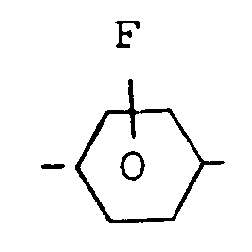
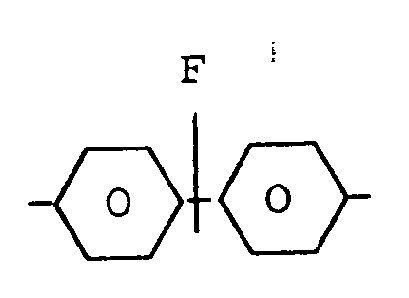
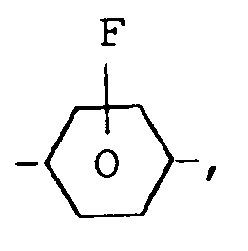
[0031] Preferred compounds of the formula III are those of the formulae IIIa to IIIg:
R¹-Cy-Cy-OOC-PheF-R² IIIa
R¹-Cy-Cy-CH₂CH₂-Phe-F-R² IIIb
R¹-Cy-Cy-COO-PheF-R² IIIc
R¹-Cy-COO-PheF-R² IIId
R¹-Cy-CH₂CH₂-PheF-R² IIIe
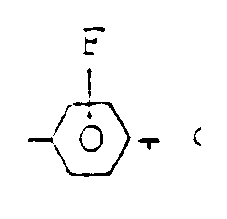
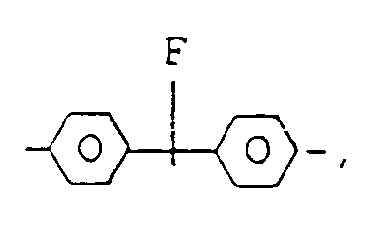
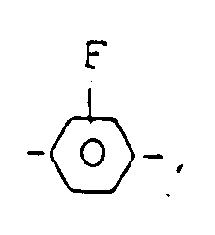
wherein PheF is
or
preferably
and
Compounds of the formulae IIIc, IIId and IIIg are particularly preferred.
[0032] Component A has favorably a viscosity of at most about 20, in particular at most 18 mPa.s at 20° and a clearing point of at most 120°.
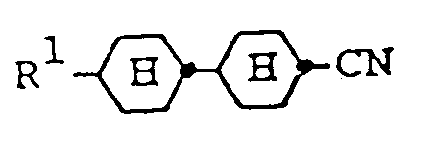
[0033] Compounds which are used for or as components B are the known compounds of formula I and
in which R¹ is alkyl of 1 to 12 C atoms, in which in addition one or two non-adjacent CH₂ groups can be replaced by 0 atoms, -CO-, -O-CO-, -CO-O- and/or -CH=CH- groups,
[0043] Additional compound which can be used for component B are those of the formula II:
R¹-A⁴-Phe-CN
in which A⁴ is Cy, Cy-CH₂CH₂, Phe, Dio, Phe-COO, Cy-COO, Phe-Phe, Phe-COO-Phe, Cy-Phe-COO-Phe, Phe-Phe-COO-Phe, Cy-Cy, Cy-Cy-CH₂CH₂, Cy-CH₂CH₂-Cy, Cy-Phe or Cy-COO-Phe
and R¹, Cy and Phe have the meanings indicated above.
[0044] Further additional compounds which are suitable for components are
and/or
in which R¹ has the meaning indicated above.
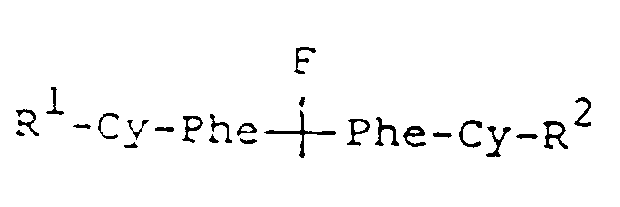
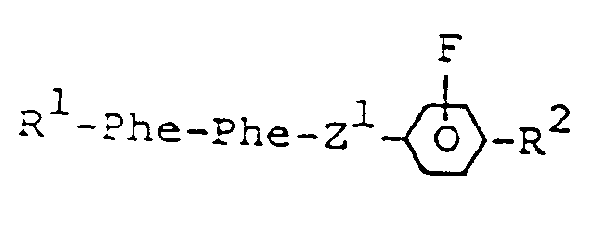
[0045] Compounds which are suitable for or as components C are, for example, the known compounds of the following formulae:
R¹-Cy-Phe-Phe-R²
R¹-Cy-Cy-Phe-R²
R¹-Cy-Cy-Cy-R²
R¹-Cy-Z¹-Phe-Z¹-Phe-R²
R¹-Cy-Z¹-Cy-Z¹-Phe-R²
R¹-Cy-Cy-Z¹-Phe-R²
R¹-Cy-Cy-Cy-Phe-R²
R¹-Cy-Cy-Z¹-Cy-R²
R¹-Cy-Z¹-Cy-Z¹-Cy-R²
R¹-Cy-Phe-Phe-Cy-R²
R¹-Cy-Z¹-Phe-Phe-Cy-R²
[0046] Component C has favorably a clearing point of at least about 140°. Preferably component C contains at least one compound with a clearing point of at least 180°, preferably of at least 200°.
[0047] Further compounds which are suitable for or as components C are those of the formula IV
R¹-A²-(Z²-A²)₂-R² IV
in which Z² independently is -CO-O- or -O-CO-, A² is Cy or Phe and R¹ and R² independently have the meanings indicated above.
[0048] The individual compounds of the formula I to IV of the liquid crystal phases according to the invention are either known or preparable by methods which are easily derivable by those skilled in the art from the prior art, since they are based on standard methods described in the literature.
[0049] Corresponding compounds of the formula I are described for example in German Patent Applications P 34 05 914 and P 35 15 633; in European Patent Specification 0,019,665; in S.M. Kelly and Hp. Schad, Helvetica Chimica Acta, 67, 1580-1587 (1984); in S.M. Kelly, ibid, 67, 1572-1579 (1984); in Japanese Offenlegungsschrift 59-191,789 and European Offenlegungsschriften 0,099,099 and 0,119,756. Compounds of the formula II are described for example in German Offenlegungsschriften 29 44 905, 31 12 185, 31 46 249, 31 50 761, 31 50 763, 32 07 114, 32 27 916, 33 02 218, 33 34 054, in European Offenlegungsschrift 0,122,389, in U.S. Patent 4,322,354 and in Japanese Offenlegungsschrift 56-164,179.
[0050] It was found, surprisingly, that the combination according to the invention of components A, B and C gives LC phases for use in supertwisted nematic cells which on the one hand have favorable elastic properties, wide mesophase ranges with low melting points and low smectic-nematic transition temperatures and on the other hand are capable of multiplexed drive by virtue of their good electro-optic steepness and viewing angle characteristic.
[0051] The LC phases according to the invention preferably contain at least two compounds, in particular at least three compounds, of the formula III and preferably at least two compounds, in particular at least three compounds, selected from the formulae I and II. Preferably at least one compound of formula I is present.
[0052] X¹ is preferably CN. X² is preferably fluorine. Z is preferably -CO-O-. R¹ is preferably alkyl, alkenyl, alkoxy or alkoxymethyl in each case with 1 to 7 C atoms, in particular alkyl or alkoxymethyl. (Ao)m-A¹ is preferably Phe, CyPhe, PhePhe or PyrPhe, in particular Phe or CyPhe.
[0055] R¹ is preferably straight-chain alkyl of 2 to 7 C atoms. Z is in the case of compounds of the formula I preferably -CO-O-, -CH₂-O- or a single bond. X² is preferably fluorine.
[0056] Of the foregoing partial formulae, those of the formulae Ia, Ib, Ic, Id, Ie, Ig, Ih, Ii, Ij, Ik, Il, Im, Io, Ip, Ir and Is are preferred. Particular preference is given to those of the partial formulae Ia-Ic, Ig, Ih, Im and Ip.
[0057] In the case of the compounds of the foregoing partial formulae, R is a straight-chain alkyl group, preferably of 1 to 7 C atoms, in which in addition a CH₂ group can also be replaced by -O- or -CH=CH-. Particularly preferred groups R are methyl, ethyl, n-propyl, n-butyl, n-pentyl and n-heptyl.
[0058] In the case of compounds of the foregoing partial formulae with two groups R, both groups R each have independently of each other one of the abovementioned meanings.
[0059] In the compounds of the formula III R¹ and R² are each independently preferably alkyl, alkoxy or alkoxymethyl with each up to 7 C atoms.
[0060] In the compounds of the formula IV R¹ and R² have the preferred meanings indicated above. Preferred compounds of the formula IV are those of the partial formulae IVa to IVf:
R¹-Phe-COO-Phe-COO-Phe-R² IVa
R¹-Cy-COO-Phe-COO-Phe-R² IVb
R¹-Phe-COO-Cy-COO-Phe-R² IVc
R¹-Phe-OOC-Cy-COO-Phe-R² IVd
R¹-Cy-COO-Cy-COO-Phe-R² IVe
R¹-Cy-COO-Phe-COO-Cy-R² IVf
[0062] When the alkyl groups in the compounds of formulae I to IV contain 3 or more carbon atoms, these can be arranged in a straight or branched chain. However, the phases according to the invention did not use any components which contain more than one branched alkyl group. Such branched alkyl groups for the purposes of the present invention contain not more than one chain branching; preferably this is a methyl or ethyl group in the 1- or 2-position of carbon skeleton, so that suitable branched alkyl groups are in particular: 2-methylpropyl, 2-methylbutyl, 1-methylpentyl, 2-methylpentyl, 1-methylhexyl. Generally the liquid crystal dielectrics according to the invention contain only one component having a branched-chain alkyl radical in order to induce, if desired, optical activity. For this purpose, normally not more than 10 percent by weight, preferably 0.5 to 3 percent by weight, of a component having a branched alkyl radical are added.
[0064] Preferred phases according to the invention contain compounds of the formula III in wich R¹ is n-alkyl and R² is n-alkyl, n-alkoxy or n-alkanoyloxy.
[0066] The preparation of the phases according to the invention is effected in the conventional manner. In general, the desired amount of the components which is used in the smaller amount is dissolved in the components which constitutes the main constituent, preferably at elevated temperature. If this temperature is chosen to be above the clear point of the main constituent, the completeness of the process of dissolving can be observed particularly easily.
[0067] However, it is also possible to mix solutions of the components in a suitable organic solvent, for example acetone, chloroform or methanol, and to remove the solvent after thorough mixing, for example by distillation under reduced pressure. It is self-evident that with this method it must be ensured that the solvent does not introduce any contaminants or undesirable dopants.
[0068] By means of suitable additives the liquid crystal phases according to the invention can be modified in such a way that they can be used in any hitherto disclosed kind of supertwisted nematic liquid crystal display element.
[0069] The production of a supertwisted nematic electro-optical cell containing a phase in accordance with the invention can also be carried out in a manner known per se; for example, by evacuating a suitable cell and introducing the mixture into the evacuated cell.
[0070] The examples below serve to illustrate the invention without limiting it. In the examples, the melting point and clear point of a liquid crystal substance are given in degrees Celsius. The percentages are by weight. The values of the threshold voltages relate to an angle of observation of 0°, 10 % contrast and 20 °C and are voltages in a 90° twist cell.
Example 1
[0071] A liquid crystal phase consisting of
3 % of 4-cyanobiphenyl-4′-yl p-(n-heptylphenyl)-benzoate
10 % of 2-fluoro-4-pentylphenyl p-(heptylphenyl)-benzoate
14 % of 4-cyano-4′-(trans-4-pentylcyclohexyl)-biphenyl
7 % of 4-cyano-3-fluorophenyl p-propylbenzoate
2 % of 4-cyano-3-fluorophenyl p-ethylbenzoate
10 % of 2-fluoro-4-pentylphenyl trans-4-(trans-4-pentyl
cyclohexyl)-cyclohexane carboxylate
14 % of 2-p-cyanophenyl-5-propyl-1,3-dioxane
8 % of 2-fluoro-4-pentylphenyl trans-4-propylcyclohexane
carboxylate
16 % of 2-fluoro-4-pentylphenyl trans-4-pentylcyclohexane carboxylate and
16 % of 2-fluoro-4-pentylphenyl trans-4-heptylcyclohexane carboxylate
has a clearing point of 85.4°, an optical anisotropy of 0.131, a viscosity of 54.3 mPa.s at 20°, a threshold voltage of 2.22 volt, a dielectric anisotropy of +11.1, and K₃₃/K₁₁ of 1.18.
Comparative Example 2
[0072] A liquid crystal phase consisting of
8.6 % of 1-(trans-4-propylcyclohexyl)-2-(4′-pentyl-2′-fluorobiphenyl-4-yl)-ethane
8.7 % of 1-(trans-4-propylcyclohexyl)-2-(4′-ethyl-2′-fluorobiphenyl-4-yl)-ethane
8.7 % of 1-(trans-4-pentylcyclohexyl)-2-(4′-ethyl-2′-fluorobiphenyl-4-yl)-ethane
6 % of 4-ethyl-4′-cyanobiphenyl
20 % of 2-p-cyanophenyl-5-propyl-1,3-dioxane
20 % of 2-p-cyanophenyl-5-pentyl-1,3-dioxane
9 % of trans-4-(trans-4-propylcyclohexane)-propoxycyclohexane
2 % of 4-cyanobiphenyl-4′-yl p-(heptylphenyl)-benzoate
4 % of 4,4′-Bis-(trans-4-propylcyclohexyl)-biphenyl
4 % of 4-(trans-4-pentylcyclohexyl)-4′-(trans-4-propylcyclohexyl)-biphenyl and
9 % of trans-4-pentylcyclohexyl trans-4-(trans-4-butylcyclohexyl)-cyclohexane carboxylate
has a clearing point of 86.9°, an optical anisotropy of 0.130, a viscosity of 32.3 mPa.s at 20°, and threshold voltage of 2.28 volt, a dielectric anisotropy of +11.2 and K₃₃/K₁₁ of 1.27.
Example 3
[0073] A liquid crystal phase consisting of
3.0 % of 4-cyanobiphenyl-4′-yl p-(heptylphenyl)-benzoate
10.0 % of 2-fluoro-4-pentylphenyl p-(heptylphenyl)-benzoate
14.0 % of 4-cyano-4′-(trans-4-pentylcyclohexyl)-biphenyl
7.0 % of 4-cyano-3-fluorophenyl p-propylbenzoate
2.0 % of 4-cyano-3-fluorophenyl p-ethylbenzoate
10.0 % of 2-fluoro-4-pentylphenyl trans-4-(trans-4-pentylcyclohexyl)-cyclohexane carboxylate
14.0 % of 2-p-cyanophenyl-5-propyl-1,3-dioxane
12.6 % of p-propylphenyl trans-4-propylcyclohexane carboxylate
15.4 % of p-pentylphenyl trans-4-propylcyclohexane carboxylate
and
12.0 % of p-heptylphenyl trans-4-propylcyclohexane carboxylate
has a clearing point of 85.2°, an optial anisotropy of 0.131, a viscosity of 45.3 mPa.s at 20°, a threshold voltage of 2.21 volt, a dielectric anisotropy of +11.2, and K₃₃/K₁₁ of 1.16.
[0074] The mixture of Example 1 is a good starting point when designing supertwisted displays. If the initial test cells containing this phase show insufficient threshold sharpness, the mixture of Example 2 may be added in order to introduce hysteresis and obtain an optimised transmission vs voltage curve in the test cell. Similarly, the mixture of Example 3 may be added if necessary in order to reduce excess hysteresis. The driving voltage should then be adjusted to provide the correct switching voltages for the tuned cell.
[0075] The mixtures of Examples 1 to 3 are undoped and suitable chiral additives and have to be used to obtain the desired d/p relationship. These additives are readily available and known to the skilled worker.
[0076] The three mixtures may also be mixed together in any proportion to obtain intermediate properties.
Example 4
[0077] A liquid crystal phase is prepared consisting of
3 % of 4-cyanobiphenyl-4′-yl p-(n-heptylphenyl)-benzoate
8 % of 2-fluoro-4-pentylphenyl p-(heptylphenyl)-benzoate
14 % of 4-cyano-4′-(trans-4-pentylcyclohexyl)-biphenyl
7 % of 4-cyano-3-fluorophenyl p-propylbenzoate
2 % of 4-cyano-3-fluorophenyl p-ethylbenzoate
10 % of 2-fluoro-4-pentylphenyl trans-4-(trans-4-pentylcyclohexyl)-cyclohexane carboxylate
14 % of 2-p-cyanophenyl-5-propyl-1,3-dioxane
2 % of p-(p-propylphenoxycarbonyl)-phenyl trans-4-cyclohexane carboxylate
8 % of 2-fluoro-4-pentylphenyl trans-4-propylcyclohexane carboxylate
16 % of 2-fluoro-4-pentylphenyl trans-4-pentylcyclohexane carboxylate and
16 % of 2-fluoro-4-pentylphenyl trans-4-heptylcyclohexane carboxylate.
Comparative Example 5
[0078] A liquid crystal phase consisting of
16.6 % of 1-(trans-4-propylcyclohexyl)-2-(4′-ethyl-2′-fluorobiphenyl-4-yl)-ethane
16.7 % of 1-(trans-4-propylcyclohexyl)-2-(4′-pentyl-2′-fluorobiphenyl-4-yl)-ethane
16.7 % of 1-(trans-4-pentylcyclohexyl)-2-(4′-ethyl-2′-fluorobiphenyl-4-yl)-ethane
10 % of 4-ethyl-4′-cyanobiphenyl
10 % of 4-propyl-4′-cyanobiphenyl
15 % of 4-pentyl-4′-cyanobiphenyl
5 % of 4,4′-bis-(trans-4-propylcyclohexyl)-2-fluorobiphenyl,
5 % of 4,4'-bis-(trans-4-pentylcyclohexyl)-2-fluorobiphenyl and
5 % of 4-(trans-4-pentylcyclohexyl)-4′-(trans-4-propylcyclohexyl)-2-fluorobiphenyl
has a clearing point of 97-5°, a transition point smectic-nematic of < -20°, a viscosity of 33.1 mPa.s at 20°, an optical anisotropy of 0.179 and shows good properties in SBE devices
Example 6
[0079] A liquid crystal phase consisting of
9,2 % of 1-(trans-4-propylcyclohexyl)-2-(4′-ethyl-2′-fluorobiphenyl-4-yl)-ethane,
9,1 % of 1-(trans-4-propylcyclohexyl)-2-(4′-pentyl-2′-fluorobiphenyl-4-yl)-ethane,
9,2 % of 1-(trans-4-pentylcyclohexyl)-2-(4′-ethyl-2′-fluorobiphenyl-4-yl)-ethane,
22,5 % of 1-(trans-4-propylcyclohexyl)-2-(p-cyanophenyl)-ethane,
15 % of trans,trans-4-propyl-4′-cyanocyclohexylcyclohexane,
5 % of 2-p-cyanophenyl-5-propyl-1,3-dioxane,
5 % of 4-cyano-3-fluorophenyl p-propylbenzoate,
5 % of 4,4′-Bis-(trans-4-propylcyclohexyl)-2-fluorobiphenyl,
5 % of 4,4′-Bis-(trans-4-pentylcyclohexyl)-2-fluorobiphenyl,
5 % of 4-(trans-4-pentylcyclohexyl)-4′-(trans-4-propylcyclohexyl)-2-fluorobiphenyl,
5 % of trans-4-pentylcyclohexyl trans-4-(trans-4-propylcyclohexyl)-cyclohexane carboxylate and
5 % of trans-4-pentylcycloiexyl trans-4-(trans-4-butylcyclohexyl)-cyclohexane carboxylate
has a clearing point of 96.8°, a transition point smecticnematic of < -20°, a viscosity of 33.5 mPa.s at 20°, an optical anisotropy of 0.122 and shows good properties in SBE devices.
[0080] The mixtures of example 6 and example 5 are suitable as a two-bottle system with variable birefringence for STN devices. This system is especially useful for STN displays with twist angles of 180 degrees-220 degrees, incorporating a variable birefringence to allow matching to precise cell twist angle and thickness. Both mixtures are miscible in all proportions, providing a range of Δn from 0.179 to 0.122, and a near constant threshold voltage of 2.03 V-2.04 V in 180 degrees twist cells (7 µm, 180 °C twist, low surface tilt cell, d/p = 0.375, d.Δn = 0.95). The high clearing points minimise undesirable variation in colour at elevated operating temperatures.
[0081] A suitable birefringence for a 7 µm STN cell is obtained by mixing 21.8 parts of the mixture of example 5 with 78.2 parts of the mixture of example 6 The resulting liquid crystal phase shows an optical anisotropy of 0.1357 which gives the optimal optical path difference for a 180° twist STN cell with 7 µm thickness (d.Δn = 0.95).
[0082] Electro-optical measurements were taken using a white light source in positive contrast mode with both polarisers parallel and the input polariser was at an angle of 45° to the input director:
- V90,0,20
- 1.92
- V10,0,20
- 2.05
- V90,45,20
- 1.86
- V50,10,20
- 1.96
- M₂₀
- 1.10
- M′₂₀
- 1.05
Example 7
[0083] A liquid crystal phase consisting of
9.1 % of 1-(trans-4-propylcyclohexyl)-2-(4′-ethyl-2′fluorobiyhenyl-4-yl)-ethane,
9.1 % of 1-(trans-4-pentylcyclohexyl)-2-(4′-ethyl-2′-fluorobiphenyl-4-yl)-ethane,
9.1 % of 1-(trans-4-propylcyclohexyl)-2-(4′-pentyl-2′-fluorobiphenyl-4-yl)-ethane,
14.9 % of trans,trans-4-propyl-4′-propolycyclohexyl-cyclohexane,
5.2 % of 2-p-cyanophenyl-5-propyl-1,3-dioxane,
5.0 % of 4-cyano-3-fluorophenyl p-propylbenzoate,
9.9 % of 2-fluoro-4-pentylphenyl trans-4-(trans-4-pentylcyclohexyl)-cyclohexane carboxylate,
22.6 % of 1-(trans-4-propylcyclohexyl)-2-(p-cyanophenyl)-ethane,
5.0 % of 4,4′-Bis-(trans-4-propylcyclohexyl)-2-fluorobiphenyl,
5.1 % of 4,4′-Bis-(trans-4-pentylcyclohexyl)-2-fluorobiphenyl and
5.0 % of 4-(trans-4-pentylcyclohexyl)-4′-(trans-4-propylcyclohexyl)-2-fluorobiphenyl
has a clearing point of 93.4°, a viscosity of 24.6 mPa.s at 20°, an optical anisotropy of 0.121 and shows good properties in supertwisted nematic devices.
1. A liquid crystal phase for use in supertwisted nematic cells consisting of at least
three components A, B and C, each of which contains one or more compounds, wherein
component A has a viscosity of at most about 25 mPa.s at 20°, a clearing point of
at most 130° and a dielectric anisotropy between about -2 and about +2, component
B has a dielectric anisotropy above about +8, component C has a clearing point of
more than 130° and a dielectric anisotropy between about -2 and about +2, characterized
in that component A contains at least one compound of the formula III
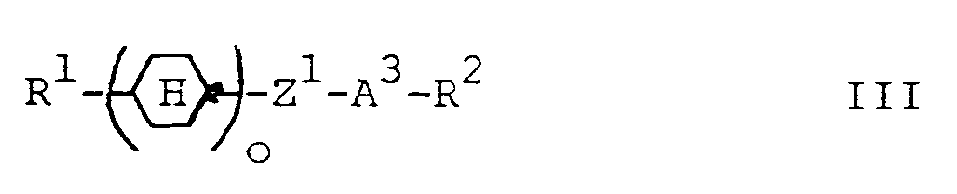
in which R¹ is alkyl of 1 to 12 C atoms, in which in addition one or two non-adjacent CH₂ groups can be replaced by 0 atoms, -CO-, -O-CO-, -CO-O- and/or -CH=CH- groups,
R² has one of the meanings of R¹,
A³ is
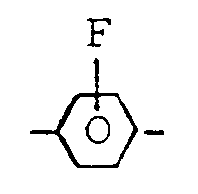
or
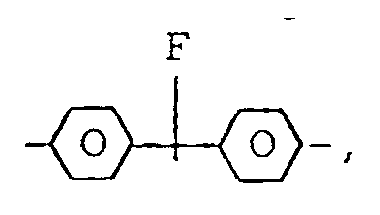
Z¹ is -CO-O-, -O-CO- or -CH₂CH₂-,
o is 1 or, if A³ isalso 2, that component B contains at least one compound of the formula I
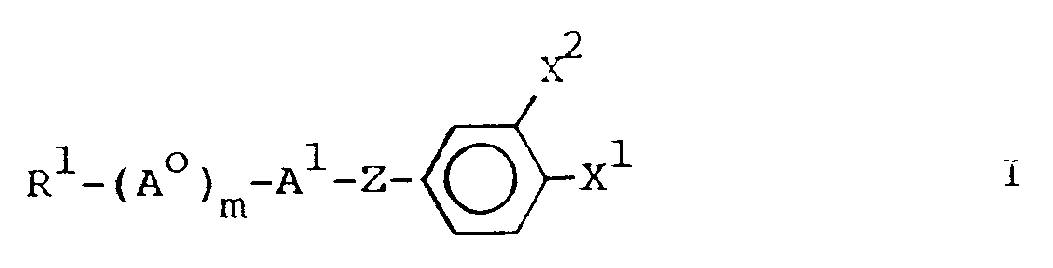
in which R¹ is alkyl of 1 to 12 C atoms, in which in addition one or two non-adjacent CH₂ groups can be replaced by 0 atoms, -CO-, -O-CO-, -CO-O- and/or -CH=CH- groups,
Ao and A¹ are each, independently of each other, Cy, Dio, Pyr or Phe,
Z is -CO-O-, -O-CO-,-CH₂-O-, -O-CH₂- or a single bond,
X¹ is F, Cl or -CN,
X² is F or Cl,
m is 0 or 1,
Cy is trans-1,4-cyclohexylene,
Pyr is pyrimidine-2,5-diyl or pyridine-2,5-diyl,
Dio is trans-1,3-dioxane-2,5-diyl and
Phe is 1,4-phenylene.
in which R¹ is alkyl of 1 to 12 C atoms, in which in addition one or two non-adjacent CH₂ groups can be replaced by 0 atoms, -CO-, -O-CO-, -CO-O- and/or -CH=CH- groups,
R² has one of the meanings of R¹,
A³ is
or
Z¹ is -CO-O-, -O-CO- or -CH₂CH₂-,
o is 1 or, if A³ isalso 2, that component B contains at least one compound of the formula I
in which R¹ is alkyl of 1 to 12 C atoms, in which in addition one or two non-adjacent CH₂ groups can be replaced by 0 atoms, -CO-, -O-CO-, -CO-O- and/or -CH=CH- groups,
Ao and A¹ are each, independently of each other, Cy, Dio, Pyr or Phe,
Z is -CO-O-, -O-CO-,-CH₂-O-, -O-CH₂- or a single bond,
X¹ is F, Cl or -CN,
X² is F or Cl,
m is 0 or 1,
Cy is trans-1,4-cyclohexylene,
Pyr is pyrimidine-2,5-diyl or pyridine-2,5-diyl,
Dio is trans-1,3-dioxane-2,5-diyl and
Phe is 1,4-phenylene.
2. Liquid crystal phase according to claim 1, characterized in that component B contains
at least one compound of the formula II
R¹-A⁴-Phe-CN II
in which A⁴ is Cy, Cy-CH₂CH₂, Phe, Dio, Phe-COO, Cy-COO, Phe-Phe, Phe-COO-Phe, Cy-Phe-COO-Phe, Phe-Phe-COO-Phe, Cy-Cy, Cy-Cy-CH₂CH₂, Cy-CH₂CH₂-Cy, Cy-Phe or Cy-COO-Phe
and R¹, Cy and Phe have the meanings indicated above.
R¹-A⁴-Phe-CN II
in which A⁴ is Cy, Cy-CH₂CH₂, Phe, Dio, Phe-COO, Cy-COO, Phe-Phe, Phe-COO-Phe, Cy-Phe-COO-Phe, Phe-Phe-COO-Phe, Cy-Cy, Cy-Cy-CH₂CH₂, Cy-CH₂CH₂-Cy, Cy-Phe or Cy-COO-Phe
and R¹, Cy and Phe have the meanings indicated above.
3. Liquid crystal phase according to at least one of claims 1 to 2, characterized
in that component B contains at least one compound of the formula
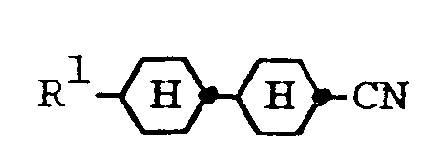
and/or of the formula
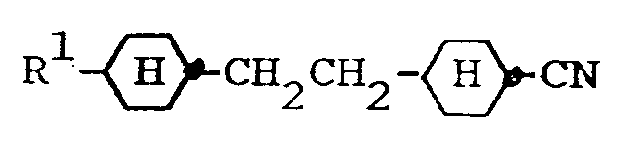
in which R¹ has the meaning indicated above.
and/or of the formula
in which R¹ has the meaning indicated above.
4. Liquid crystal phase according to at least one of claims 1 to 3, characterized
in that component C contains at least one compound of the formula IV
R¹-A²-(Z²-A²)₂-R²
in which Z² independently is -CO-O- or -O-CO- A² is Cy or Phe and R¹ and R² independently have the reanings indicated above.
R¹-A²-(Z²-A²)₂-R²
in which Z² independently is -CO-O- or -O-CO- A² is Cy or Phe and R¹ and R² independently have the reanings indicated above.
5. Liquid crystal phase according to at least one of claims 1 to 4, characterized
in that component C contains at least one compound of the formulae
R¹-Cy-Phe-Phe-R²
R¹-Cy-Cy-Phe-R²
R¹-Cy-Cy-Cy-R²
R¹-Cy-Z¹-Phe-Z¹-Phe-R²
R¹-Cy-Z¹-Cy-Z¹-Phe-R²
R¹-Cy-Cy-Z¹-Phe-R²
R¹-Cy-Cy-Cy-Phe-R²
R¹-Cy-Cy-Z¹-Cy-R²
R¹-Cy-Z¹-Cy-Z¹-R²
R¹-Cy-Phe-Phe-Cy-R²
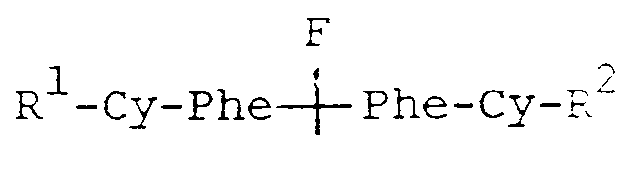
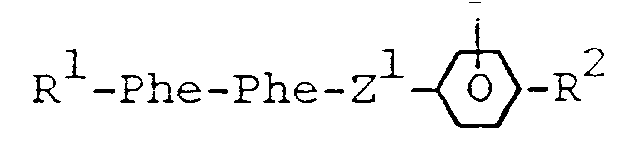
R¹-Cy-Z¹-Phe-Phe-Cy-R²
R¹-Cy-Phe-Phe-R²
R¹-Cy-Cy-Phe-R²
R¹-Cy-Cy-Cy-R²
R¹-Cy-Z¹-Phe-Z¹-Phe-R²
R¹-Cy-Z¹-Cy-Z¹-Phe-R²
R¹-Cy-Cy-Z¹-Phe-R²
R¹-Cy-Cy-Cy-Phe-R²
R¹-Cy-Cy-Z¹-Cy-R²
R¹-Cy-Z¹-Cy-Z¹-R²
R¹-Cy-Phe-Phe-Cy-R²
R¹-Cy-Z¹-Phe-Phe-Cy-R²
6. Use of liquid crystal phases according to claim 1, for supertwisted nematic electro-optical
display elements.
7. Supertwisted nematic electro-optical display element, characterized in that it
contains a phase according to claim 1.
1. Flüssigkristalline Phase zur Verwendung in höherverdrillten nematischen Zellen
bestehend aus mindestens drei Komponenten A, B und C, wobei jede dieser Komponenten
eine oder mehrere Verbindungen enthält und Komponente A eine Viskosität von nicht
mehr als ungefähr 25 mPa·s bei 20°, einem Klärpunkt von höchstens 130° und eine dielektrische
Anisotropie im Bereich von etwa -2 bis etwa +2 hat, Komponente B eine dieleketrische
Anisotropie von mehr als ungefähr +8 und Komponente C einen Klärpunkt von mehr als
130° und eine dielektrische Anisotropie im Bereich von etwa -2 bis etwa +2 hat, dadurch
gekennzeichnet, daß Komponente A mindestens Verbindung der Formel III enthält

worin R¹ Alkyl mit 1 bis 12 C-Atomen ist, worin auch eine oder zwei nicht benachbarte CH₂-Gruppen durch O-Atome, -CO-, -O-CO-, -CO-O- und/oder -CH=CH-Gruppen ersetzt sein können,
R² eine der Bedeutungen von R¹ hat,
A³
oder
ist,
Z¹ -CO-O-, -O-CO- oder -CH₂CH₂- ist,
o 1 oder, im Falle A³ =
auch 2, und Komponente B mindestens eine Verbindung der Formel I enthält
worin R¹ Alkyl mit 1 bis 12 C-Atomen ist, worin auch eine oder zwei nicht benachbarte CH₂-Gruppen durch O-Atome, -CO-, -O-CO-, -CO-O- und/oder -CH=CH-Gruppen ersetzt sein können,
A⁰ und A¹ sind jeweils unabhängig voneinander Cy, Dio, Pyr or Phe,
Z ist -CO-O-, -O-CO-, -CH₂-O-, -O-CH₂- oder eine Einfachbindung,
X¹ ist F, Cl oder -CN,
X² ist F oder Cl,
m ist 0 oder 1,
Cy ist trans-1,4-Cyclohexylen,
Pyr ist Pyrimidin-2,5-diyl oder Pyridin-2,5-diyl,
Dio ist trans-1,3-Dioxan-2,5-diyl und
Phe ist 1,4-Phenylen.
worin R¹ Alkyl mit 1 bis 12 C-Atomen ist, worin auch eine oder zwei nicht benachbarte CH₂-Gruppen durch O-Atome, -CO-, -O-CO-, -CO-O- und/oder -CH=CH-Gruppen ersetzt sein können,
R² eine der Bedeutungen von R¹ hat,
A³
oder
ist,
Z¹ -CO-O-, -O-CO- oder -CH₂CH₂- ist,
o 1 oder, im Falle A³ =
auch 2, und Komponente B mindestens eine Verbindung der Formel I enthält
worin R¹ Alkyl mit 1 bis 12 C-Atomen ist, worin auch eine oder zwei nicht benachbarte CH₂-Gruppen durch O-Atome, -CO-, -O-CO-, -CO-O- und/oder -CH=CH-Gruppen ersetzt sein können,
A⁰ und A¹ sind jeweils unabhängig voneinander Cy, Dio, Pyr or Phe,
Z ist -CO-O-, -O-CO-, -CH₂-O-, -O-CH₂- oder eine Einfachbindung,
X¹ ist F, Cl oder -CN,
X² ist F oder Cl,
m ist 0 oder 1,
Cy ist trans-1,4-Cyclohexylen,
Pyr ist Pyrimidin-2,5-diyl oder Pyridin-2,5-diyl,
Dio ist trans-1,3-Dioxan-2,5-diyl und
Phe ist 1,4-Phenylen.
2. Flüssigkristalline Phase nach Anspruch 1, dadurch gekennzeichnet, daß Komponente
B mindestens eine Verbindung der Formel II enthält
R¹-A⁴-Phe-CN II
worin A⁴ Cy, Cy-CH₂CH₂, Phe, Dio, Phe-COO, Cy-COO, Phe-Phe, Phe-COO-Phe, Cy-Phe-COO-Phe, Phe-Phe-COO-Phe, Cy-Cy, Cy-Cy-CH₂CH₂, Cy-CH₂CH₂-Cy, Cy-Phe oder Cy-COO-Phe bedeutet,
und R¹, Cy und Phe die oben angegebene Bedeutungen haben.
R¹-A⁴-Phe-CN II
worin A⁴ Cy, Cy-CH₂CH₂, Phe, Dio, Phe-COO, Cy-COO, Phe-Phe, Phe-COO-Phe, Cy-Phe-COO-Phe, Phe-Phe-COO-Phe, Cy-Cy, Cy-Cy-CH₂CH₂, Cy-CH₂CH₂-Cy, Cy-Phe oder Cy-COO-Phe bedeutet,
und R¹, Cy und Phe die oben angegebene Bedeutungen haben.
3. Flüssigkristalline Phase nach mindestens einem der Ansprüche 1 und 2, dadurch gekennzeichnet,
daß Komponente B mindestens eine Verbindung der Formel
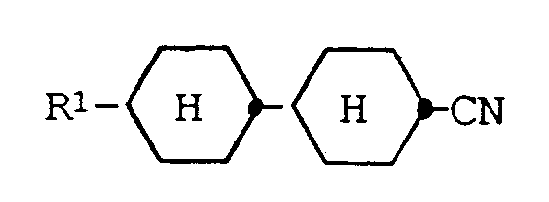
und/oder
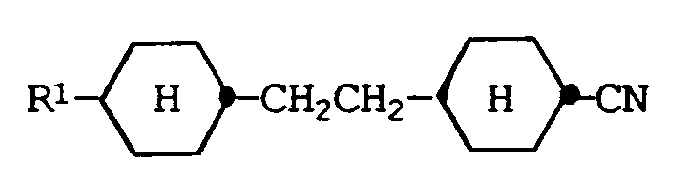
enthält, worin R¹ die oben angegebene Bedeutung hat.
und/oder
enthält, worin R¹ die oben angegebene Bedeutung hat.
4. Flüssigkristalline Phase nach mindestens einem der Ansprüche 1 bis 3, dadurch gekennzeichnet,
daß Komponente C mindestens eine Verbindung der Formel IV enthält
R¹-A²-(Z²-A²)₂-R² IV
worin Z² unabhängig voneinander jeweils -CO-O- oder -O-CO, A² Cy oder Phe bedeutet und R¹ und R² unabhängig voneinander die oben angegebene Bedeutung haben.
R¹-A²-(Z²-A²)₂-R² IV
worin Z² unabhängig voneinander jeweils -CO-O- oder -O-CO, A² Cy oder Phe bedeutet und R¹ und R² unabhängig voneinander die oben angegebene Bedeutung haben.
5. Flüssigkristalline Phase nach mindestens einem der Ansprüche 1-4, dadurch gekennzeichnet,
daß Komponente C mindestens eine Verbindung der Formeln
R¹-Cy-Phe-Phe-R²
R¹-Cy-Cy-Phe-R²
R¹-Cy-Cy-Cy-R²
R¹-Cy-Z¹-Phe-Z¹-Phe-R²
R¹-Cy-Z¹-Cy-Z¹-Phe-R²
R¹-Cy-Cy-Z¹-Phe-R²
R¹-Cy-Cy-Cy-Phe-R²
R¹-Cy-Cy-Z¹-Cy-R²
R¹-Cy-Z¹-Cy-Z¹-R²
R¹-Cy-Phe-Phe-Cy-R²
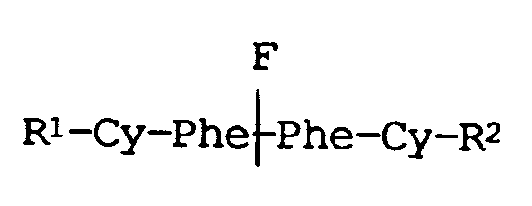
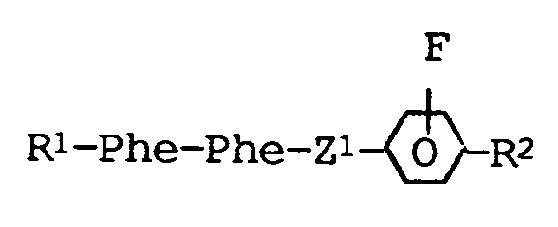
R¹-Cy-Z¹-Phe-Phe-Cy-R²
enthält.
R¹-Cy-Phe-Phe-R²
R¹-Cy-Cy-Phe-R²
R¹-Cy-Cy-Cy-R²
R¹-Cy-Z¹-Phe-Z¹-Phe-R²
R¹-Cy-Z¹-Cy-Z¹-Phe-R²
R¹-Cy-Cy-Z¹-Phe-R²
R¹-Cy-Cy-Cy-Phe-R²
R¹-Cy-Cy-Z¹-Cy-R²
R¹-Cy-Z¹-Cy-Z¹-R²
R¹-Cy-Phe-Phe-Cy-R²
R¹-Cy-Z¹-Phe-Phe-Cy-R²
enthält.
6. Verwendung von flüssigkristallinen Phasen nach Anspruch 1 für höherverdrillte nematische
elektro-optische Anzeigeelemente.
7. Höherverdrilltes nematisches elektrooptisches Anzeigeelement, dadurch gekennzeichnet,
daß es eine Phase nach Anspruch 1 enthält.
1. Phase cristalline liquide pour utilisation dans des cellules nématiques supertorsadées
consistant en au moins trois composants A, B et C, dont chacun contient un ou plusieurs
composés, où le composant A a une viscosité d'au plus environ 25 mPa.s à 20°, un point
de clarté d'au plus 130° et une anisotropie diélectrique comprise entre environ -2
et environ +2, le composant B a une anisotropie diélectrique supérieure à environ
+8, le composant C a un point de clarté supérieur à 130° et une anisotropie diélectrique
comprise entre environ -2 et environ +2, caractérisée en ce que le composant A contient
au moins un composé de formule III

où R¹ est un alcoyle en C₁ à C₁₂ , où en outre un ou deux groupes CH₂ non-adjacents peuvent être remplacés par des atomes d'oxygène, des groupes -CO-, -O-CO-, -CO-O- et/ou -CH=CH-,
R² a l'une des significations de R¹ ,
A³ représente
ou
Z¹ représente -CO-O-, -O-CO- ou CH₂CH₂-,
o vaut 1 ou, si A³ représente
également 2, et en ce que le composant B contient au moins un composé de formule I
où R¹ est un alcoyle en C₁ à C₁₂ , où en outre un ou deux groupes CH₂ non-adjacents peuvent être remplacés par des atomes d'oxygène, des groupes -CO-, -O-CO-, -CO-O- et/ou -CH=CH-,
Ao et A¹ représentent chacun, indépendamment l'un de l'autre, Cy, Dio, Pyr ou Phe,
Z représente -CO-O-, -O-CO-, -CH₂-O-, -O-CH₂- ou une liaison simple,
X¹ représente F, Cl ou -CN,
X² représente F ou Cl,
m vaut 0 ou 1,
Cy est le trans-1,4-cyclohexylène,
Pyr est le pyrimidine-2,5-diyle ou le pyridine-2,5-diyle,
Dio est le trans-1,3-dioxanne-2,5-diyle et
Phe est le 1,4-phénylène.
où R¹ est un alcoyle en C₁ à C₁₂ , où en outre un ou deux groupes CH₂ non-adjacents peuvent être remplacés par des atomes d'oxygène, des groupes -CO-, -O-CO-, -CO-O- et/ou -CH=CH-,
R² a l'une des significations de R¹ ,
A³ représente
ou
Z¹ représente -CO-O-, -O-CO- ou CH₂CH₂-,
o vaut 1 ou, si A³ représente
également 2, et en ce que le composant B contient au moins un composé de formule I
où R¹ est un alcoyle en C₁ à C₁₂ , où en outre un ou deux groupes CH₂ non-adjacents peuvent être remplacés par des atomes d'oxygène, des groupes -CO-, -O-CO-, -CO-O- et/ou -CH=CH-,
Ao et A¹ représentent chacun, indépendamment l'un de l'autre, Cy, Dio, Pyr ou Phe,
Z représente -CO-O-, -O-CO-, -CH₂-O-, -O-CH₂- ou une liaison simple,
X¹ représente F, Cl ou -CN,
X² représente F ou Cl,
m vaut 0 ou 1,
Cy est le trans-1,4-cyclohexylène,
Pyr est le pyrimidine-2,5-diyle ou le pyridine-2,5-diyle,
Dio est le trans-1,3-dioxanne-2,5-diyle et
Phe est le 1,4-phénylène.
2. Phase cristalline liquide selon la revendication 1, caractérisée en ce que le composant
B contient au moins un composé de formule II
R¹-A⁴-Phe-CN II
où A⁴ représente Cy, Cy-CH₂CH₂, Phe, Dio, Phe-COO, Cy-COO, Phe-Phe, Phe-COO-Phe, Cy-Phe-COO-Phe, Phe-Phe-COO-Phe, Cy-Cy, Cy-Cy-CH₂CH₂, Cy-CH₂CH₂-Cy, Cy-Phe ou Cy-COO-Phe
et R¹, Cy et Phe ont les significations indiquées ci-dessus.
R¹-A⁴-Phe-CN II
où A⁴ représente Cy, Cy-CH₂CH₂, Phe, Dio, Phe-COO, Cy-COO, Phe-Phe, Phe-COO-Phe, Cy-Phe-COO-Phe, Phe-Phe-COO-Phe, Cy-Cy, Cy-Cy-CH₂CH₂, Cy-CH₂CH₂-Cy, Cy-Phe ou Cy-COO-Phe
et R¹, Cy et Phe ont les significations indiquées ci-dessus.
3. Phase cristalline liquide selon au moins une des revendications 1 à 2, caractérisée
en ce que le composant B contient au moins un composé de formule
et/ou de formule
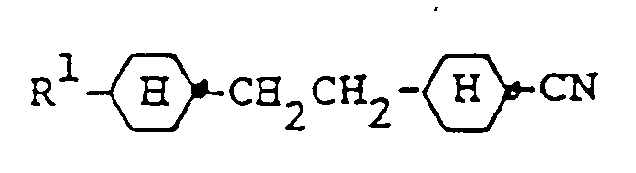
où R¹ a la signification donnée ci-dessus.
et/ou de formule
où R¹ a la signification donnée ci-dessus.
4. Phase cristalline liquide selon au moins une des revendications 1 à 3, caractérisée
en ce que le composant C contient au moins un composé de formule IV
R¹-A²-(Z²-A²)₂-R² IV
où Z² représente indépendamment -CO-O- ou -O-CO- , A² représente Cy ou Phe et R¹ et R² ont indépendamment les significations données ci-dessus.
R¹-A²-(Z²-A²)₂-R² IV
où Z² représente indépendamment -CO-O- ou -O-CO- , A² représente Cy ou Phe et R¹ et R² ont indépendamment les significations données ci-dessus.
5. Phase cristalline liquide selon au moins une des revendications 1 à 4, caractérisée
en ce que le composant C contient au moins un composé de formules
R¹-Cy-Phe-Phe-R²
R¹-Cy-Cy-Phe-R²
R¹-Cy-Cy-Cy-R²
R¹-Cy-Z¹-Phe-Z¹-Phe-R²
R¹-Cy-Z¹-Cy-Z¹-Phe-R²
R¹-Cy-Cy-Z¹-Phe-R²
R¹Cy-Cy-Cy-Phe-R²
R¹-Cy-Cy-Z¹-Cy-R²
R¹-Cy-Z¹-Cy-Z¹-R²
R¹-Cy-Phe-Phe-Cy-R²
R¹-Cy-Z¹-Phe-Phe-Cy-R²
R¹-Cy-Phe-Phe-R²
R¹-Cy-Cy-Phe-R²
R¹-Cy-Cy-Cy-R²
R¹-Cy-Z¹-Phe-Z¹-Phe-R²
R¹-Cy-Z¹-Cy-Z¹-Phe-R²
R¹-Cy-Cy-Z¹-Phe-R²
R¹Cy-Cy-Cy-Phe-R²
R¹-Cy-Cy-Z¹-Cy-R²
R¹-Cy-Z¹-Cy-Z¹-R²
R¹-Cy-Phe-Phe-Cy-R²
R¹-Cy-Z¹-Phe-Phe-Cy-R²
6. Application de phases cristallines liquides selon la revendication 1, pour des
éléments d'affichage électro-optique nématiques supertorsadés.
7. Elément d'affichage électro-optique nématique supertorsadé, caractérisé en ce qu'il
contient une phase selon la revendication 1.