|
(11) | EP 0 317 607 B1 |

| (12) | EUROPEAN PATENT SPECIFICATION |
|
|
| (54) |
A NOVEL PROCESS FOR PRODUCING ALPHA-TOCOPHEROL AND NOVEL INTERMEDIATES IN THIS PROCESS VERFAHREN ZUR HERSTELLUNG VON ALPHA-TOCOPHEROL UND ZWISCHENPRODUKTE FÜR DIESES VERFAHREN NOUVEAU PROCEDE DE PRODUCTION D'ALPHA-TOCOPHEROL ET NOUVEAUX INTERMEDIAIRES DANS CE PROCEDE |
|
|
|||||||||||||||||||||||||||||||
| Note: Within nine months from the publication of the mention of the grant of the European patent, any person may give notice to the European Patent Office of opposition to the European patent granted. Notice of opposition shall be filed in a written reasoned statement. It shall not be deemed to have been filed until the opposition fee has been paid. (Art. 99(1) European Patent Convention). |
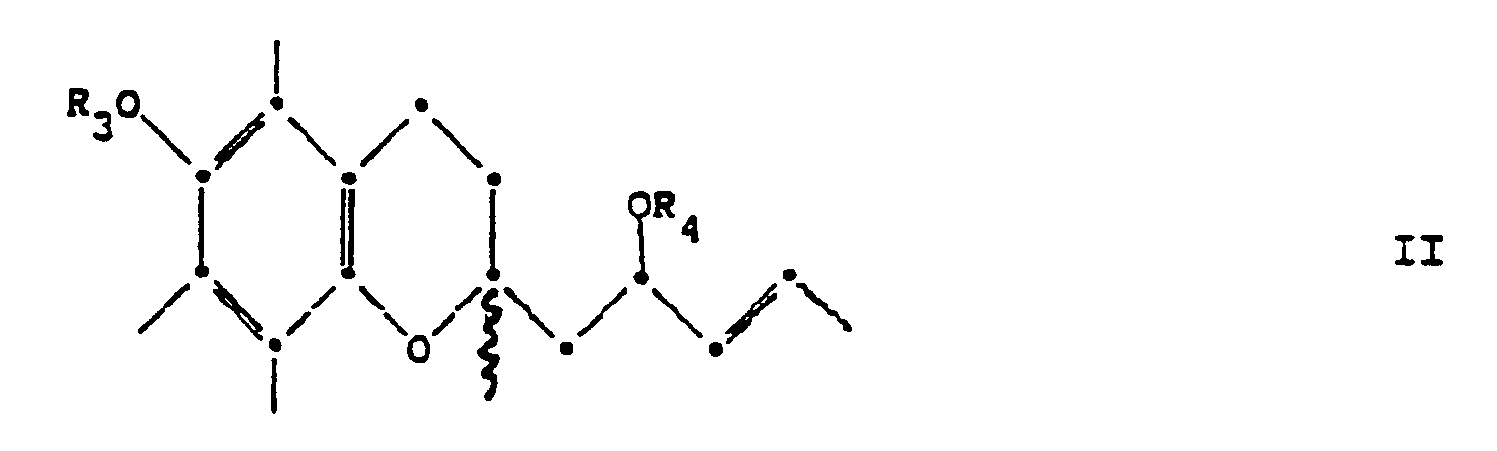
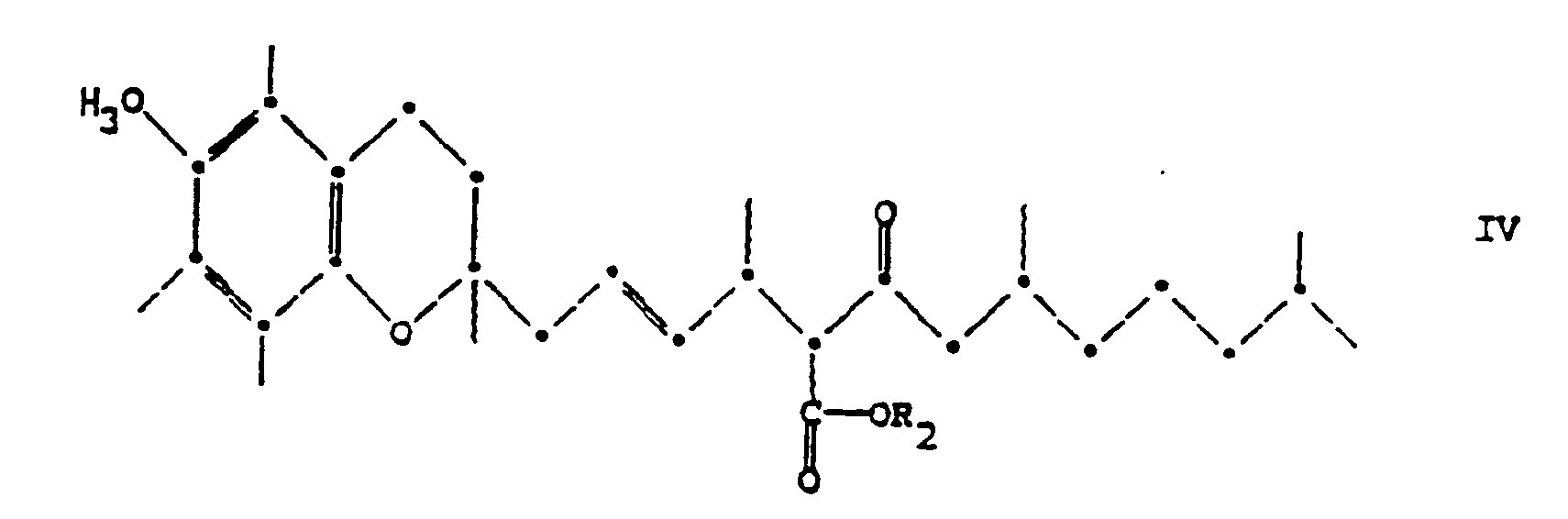
[0002] More particularly, the present invention provides benzopyran derivatives as depicted below, said benzopyran derivatives being valuable intermediates for the synthesis of vitamin E, and said intermediates being obtainable, through the reaction in the presence of a palladium containing catalyst, of a compound of the formula
[0003] wherein R₄ taken together with its attached oxgyen atom forms an ester group; and R₃ forms an ether hydroxy protecting group,
with a compound of the formula
[0005] As pointed out above, this invention provides intermediates which can be utilized to produce the compound I in any of its stereo configurations including naturally occurring optically active vitamin E which has the formula
[0006] In producing the compound of formula IA, the reactions set forth above are carried out with the optically active forms of the compound of formulas II and III as follows:
[0008] As used throughout this application, the term "lower alkyl" denominates both straight chain and branched chain alkyl groups having from 1 to 7 carbon atoms, e.g. methyl, ethyl, etc.
[0009] As used herein, the term "lower alkoxy" denominates lower alkoxy groups containing 1 to 7 carbon atoms, such as methoxy, ethoxy, i- propoxy, t-butoxy, etc. As also used herein, the term "lower alkanoic acid" denominates an alkanoic acids of from 1 to 7 carbon atoms such as formic acid, acetic acid, etc.
[0010] The term "lower alkanoyl" designates the monovalent radical formed from a lower alkanoic acid by removal of the OH group on the COOH moiety. Among the preferred lower alkanoyl groups are acetyl, pivaloyl, butyryl, propionyl, with acetyl being especially preferred. As further used herein, the term "halogen" or "halo", unless otherwise stated, comprehends all halogens such as fluorine, chlorine, bromine and iodine.
[0013] In the pictorial representation of the compounds given throughout this application, a thickened taper line (
) indicates a substituent which is in the beta-orientation (in front of the plane of the molecule), a broken line (
) indicates a substituent which is in the alpha-orientation (behind the plane of the molecule) and a wavy line (
) indicates a substituent which is in either the alpha- or beta-orientation or mixtures of these isomers. It is to be understood that the pictorial representations of the compounds given throughout the specification are set forth for convenience and are to be construed as inclusive of other forms including enantiomers and racemates and are not to be construed as limited to the particular form shown.
[0014] As also used herein, the term "aryl" signifies mononuclear aromatic hydrocarbon groups such as phenyl, which can be unsubstituted or substituted in one or more positions with a lower alkylenedioxy, nitro, halo, a lower alkyl or a lower alkoxy substituent, and polynuclear aryl groups such as naphthyl, anthryl, phenanthryl, etc., which can be unsubstituted or substituted with one or more of the aforementioned groups. The preferred aryl groups are the substituted and unsubstituted mononuclear aryl groups, particularly phenyl.
[0015] The term "ether hydroxy protecting group" designates any ether group useful for protecting a hydroxy group which, upon acid catalyzed cleavage or hydrogenolysis yields the free hydroxy group. Suitable ether protecting groups are, for example, the tetrahydropyranyl, benzyl, t-butyl or 4-methoxy-tetrahydropyranyl ethers. Others are arylmethyl ethers such as benzhydryl, or trityl ethers or alpha-lower alkoxy lower alkyl ethers, for example, methoxymethyl or tri(lower alkyl)silyl ethers such as trimethylsilyl ether diethyl-t-butylsilyl ether or dimethyl-tert-butylsilyl ether. Acid catalyzed cleavage is suitably carried out by treatment with an organic or inorganic acid. Among the preferred inorganic acids are the mineral acids such as sulfuric acid, hydrohalic acid, etc. Among the preferred organic acids are lower alkanoic acids such as acetic acid, or sulfonic acids such as para-toluenesulfonic acid, etc. The acid catalyzed cleavage can be carried out in an aqueous medium or in an organic solvent medium. Where an organic acid or alcohol is utilized, the organic acid or alcohol can be the solvent medium. In the case of tetrahydropyranyl ethers, the cleavage is generally carried out in an aqueous medium. In carrying out such cleavage, temperature and pressure are not critical and this reaction can thus be carried out, e.g. at room temperature and atmospheric pressure.
[0016] The term "ester group" denotes those esters as commonly used to protect hydroxy groups, which can be removed to liberate the hydroxy group by hydrolysis. Among the preferred esters formed by R₄ are those esters formed by reacting the hydroxy group with a lower alkanoic acid containing from 1 to 7 carbon atoms present as acetic acid, propionic acid, butyric acid, as well as aroic acids such as benzoic acid and carbonic acid chlorides of the formula
[0017] wherein R₂ is lower alkyl or aryl
as well as lower alkoxy-lower alkanoic acids where the lower alkoxy is as above and the lower alkanoic acids contain from 2 to 7 carbon atoms.
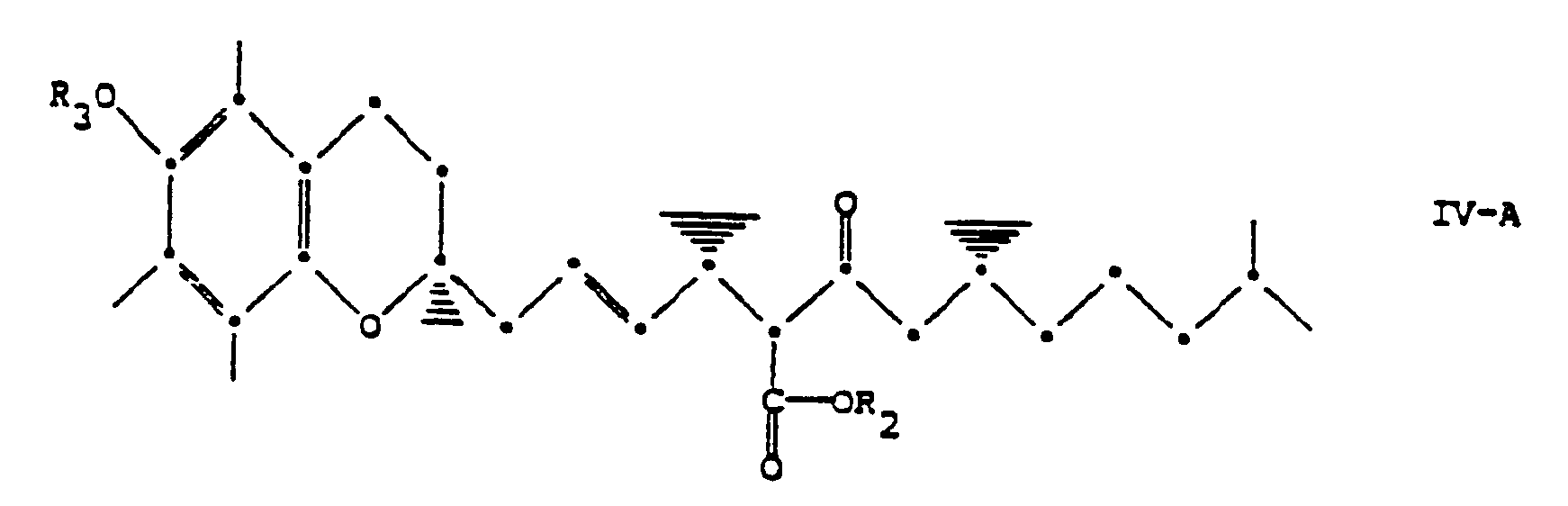
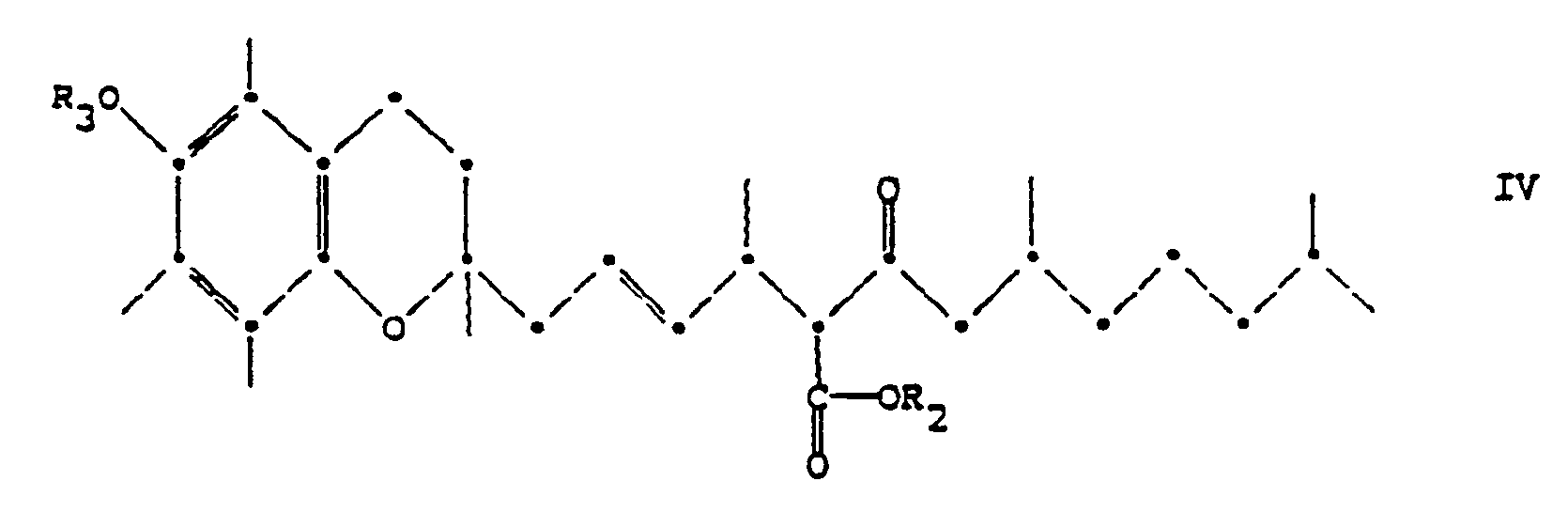
[0018] The compound of formula II is reacted, as pointed out above, with the compound of formula III to produce a compound of the formula
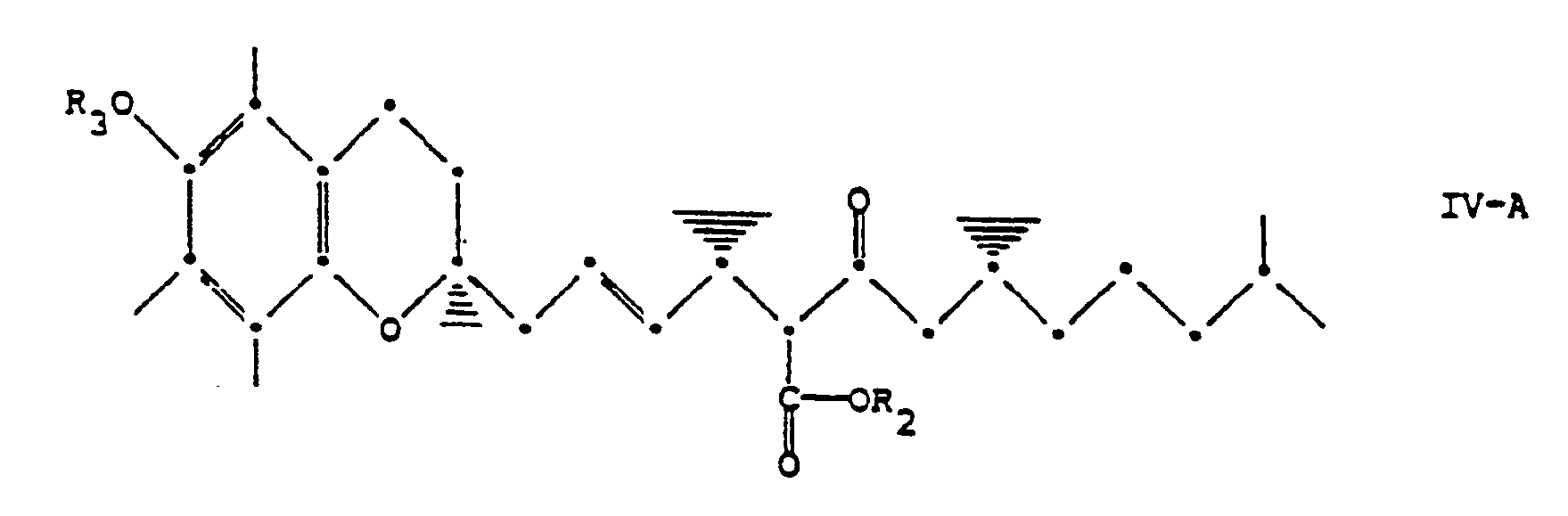
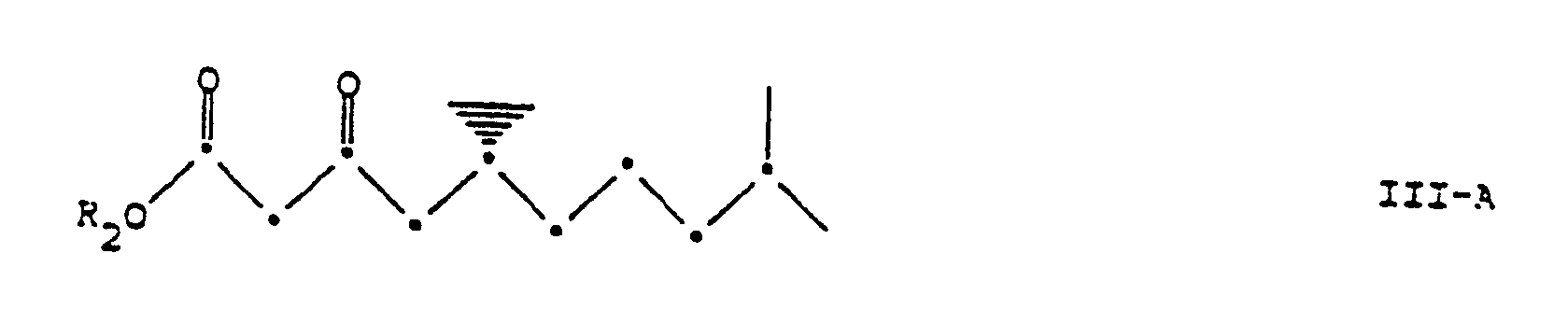
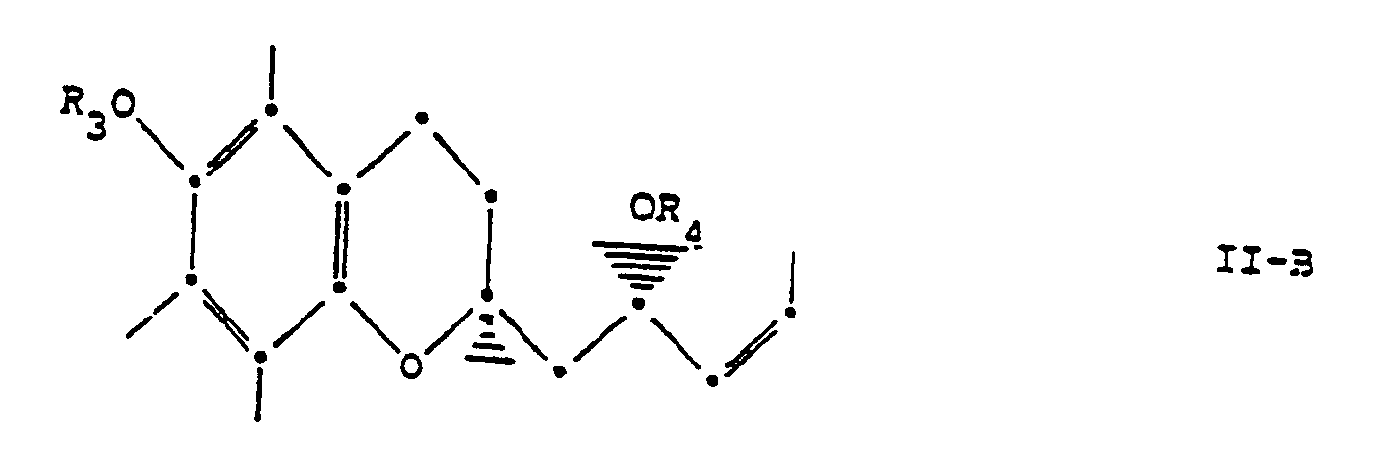
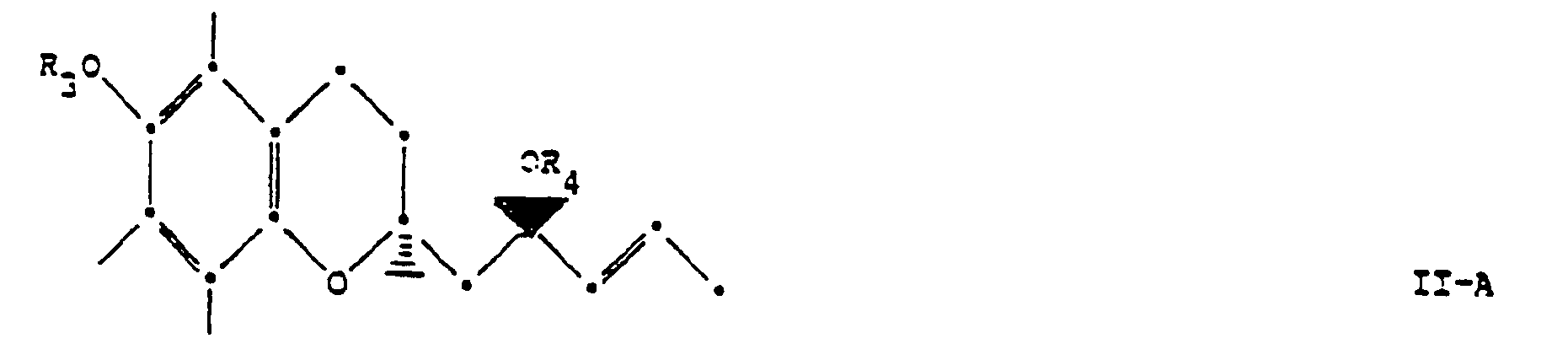
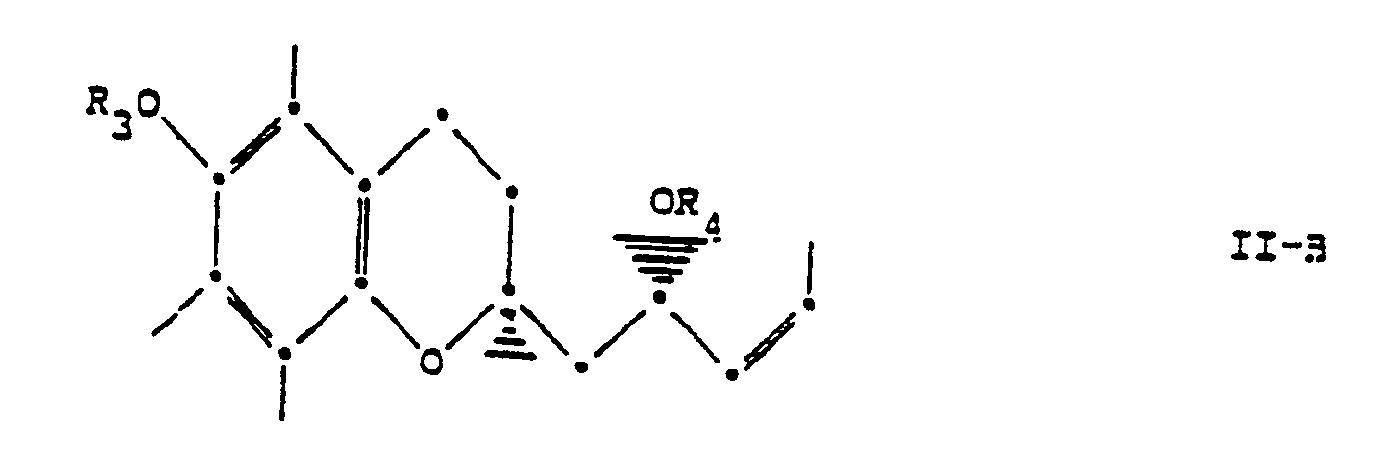
[0020] In providing the natural tocopherol of formula I-A either one the of the isomeric forms of the compound of formula II i.e. the compound of formula II-A or II-B, can be reacted with the compound of formula III-A to produce a compound of the formula
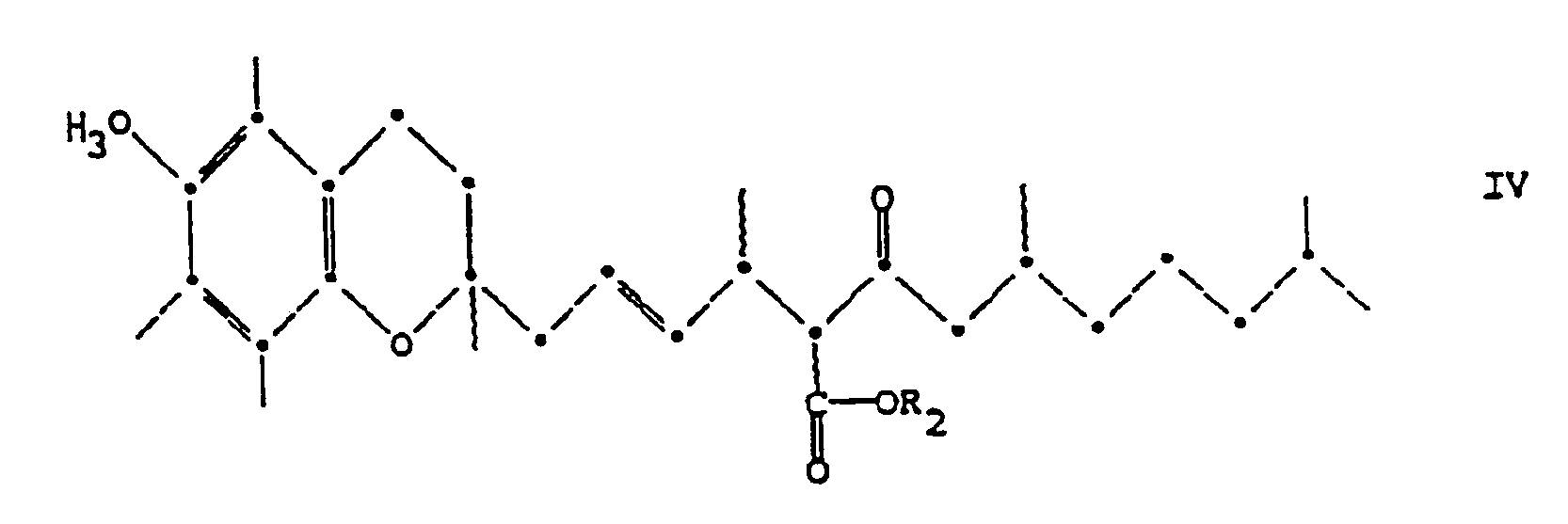
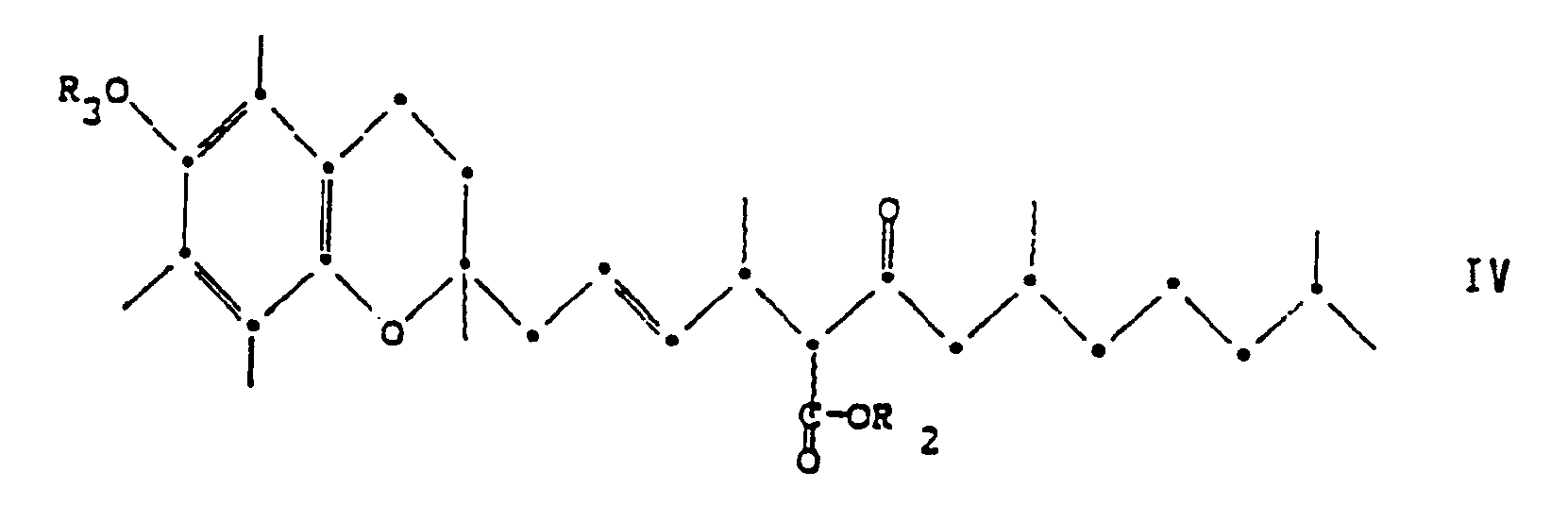
[0022] The above condensation to produce the compound of formula IV or any of the stereoisomers thereof is suitably carried out in an inert organic solvent medium in the presence of a base and a catalyst which is an organic complex of zero valent palladium. Among the preferred catalysts are those complexes of palladium with tri(alkyl or aryl) phosphines. Among the particularly preferred catalysts for use in this reaction are palladium tetrakis(triarylphosphines).
[0023] In carrying out the above condensation reaction with a palladium complex as a catalyst, an organic solvent medium is utilized and the reaction proceeds at temperatures of from -90°C to + 50°C, with temperatures of from about -78° to -20°C being preferred. Furthermore, the reaction is carried out in the presence of a strong base used to convert compound III to its salts. Any strong base can be utilized, such as the alkali metal lower alkoxides, alkali metal hydrides or lower alkyl alkali metals. In carrying out this reaction, any conventional inert organic solvent can be utilized as the reaction medium. Among the preferred solvents are organic ethers and those organic solvents which are liquid at the reaction temperature utilized.
[0024] The compound of formula IV can be converted to the compound of formula I or its various stereoisomers such as to compounds of formula I-A depending upon the stereo-configuration of the methyl groups designated by the wavy line in the compound of formula IV via the following intermediates:
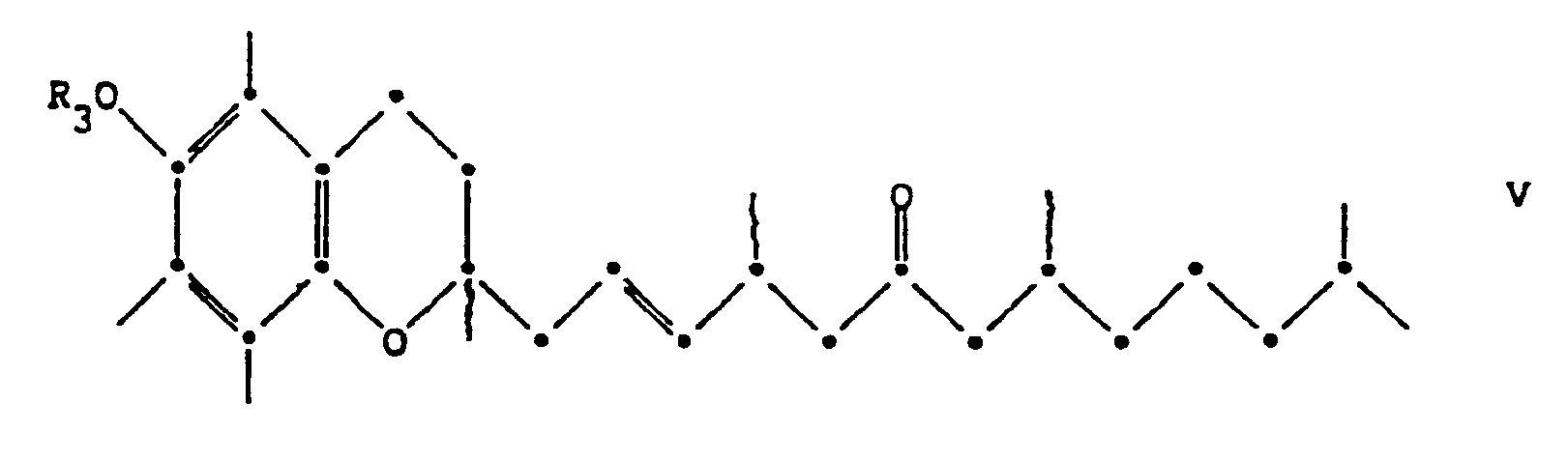
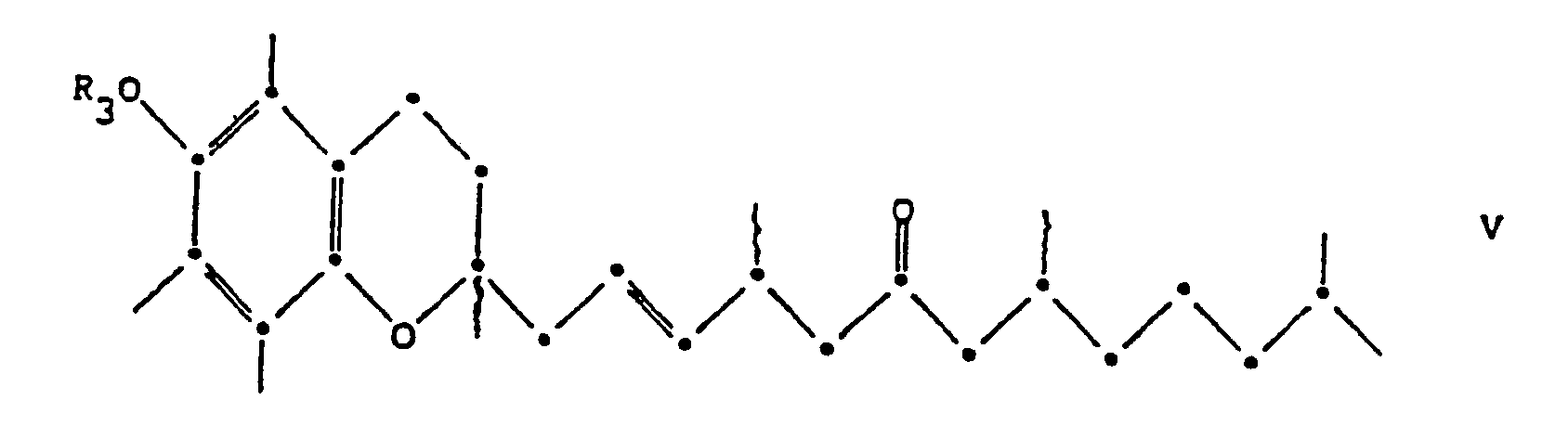
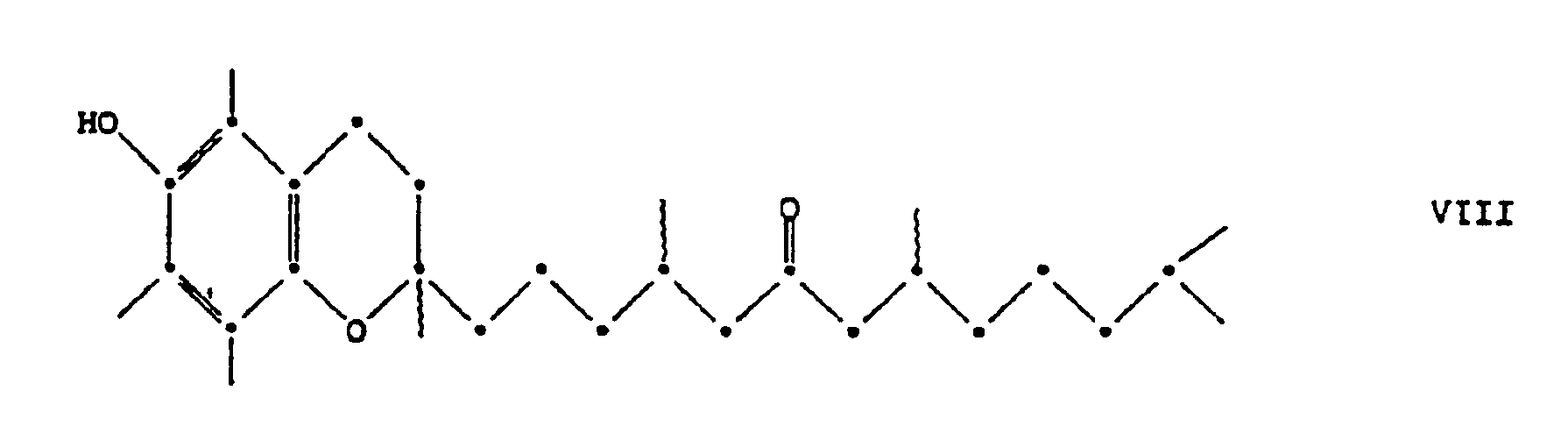
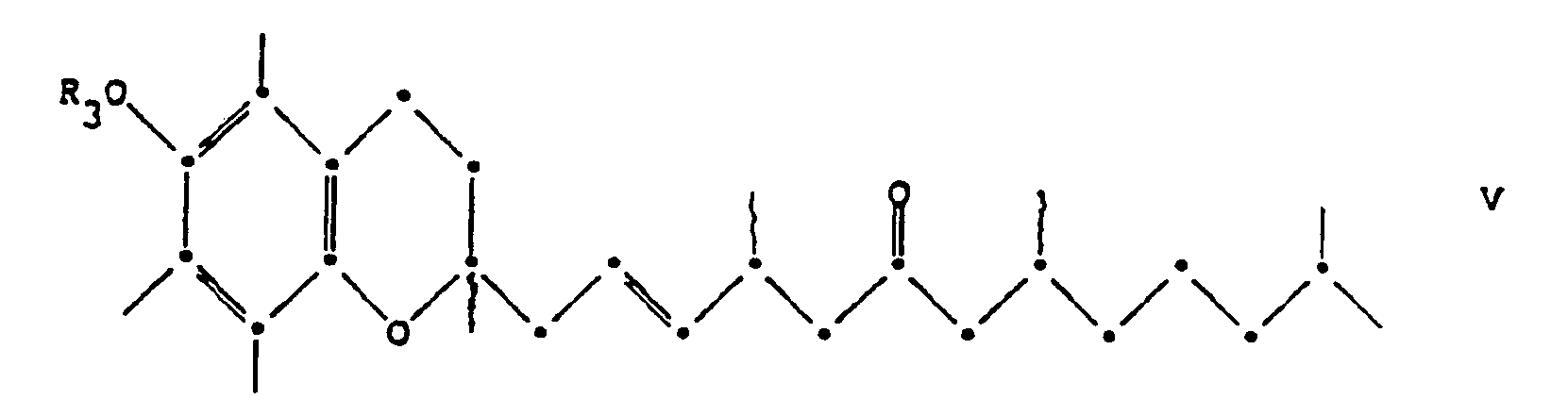
[0026] The compound of formula IV is converted to the compound of V by ester hydrolysis. This ester hydrolysis causes decarboxylation of the compound of formula IV. Any of the conditions conventional in ester hydrolysis can be utilized to carry out this conversion. The compound of formula V is converted to the compound of formula VI in accordance with the standard conditions for a Wolff-Kishner reaction by treating the compound of formula V with hydrazine and alkali metal hydroxide. The compound of formula VI is converted directly to the compound of formula I or its various stereoisomers, such as the compound of formula I-A by hydrogenation utilizing a conventional hydrogenation catalyst, such as platinum or palladium on carbon or Raney nickel. Any of the conditions conventional for such hydrogenations can be utilized in this conversion. Where R₃ is an ether removable by hydrolysis rather than hydrogenolysis, the ether group is removed by ether hydrolysis after hydrogenation.
[0027] On the other hand the compound of formula IV can be converted to the compound of formula I or its various steroisomeric forms by hydrogenation to form a compound of the formula
[0028] wherein R₂ is as above.
Hydrogenation of the compound of formula IV can be accomplished is the manner described is connection with the conversion of the compound of formula VI to the compound of formula I.
[0029] The compound of formula VII is next converted to a compound of the formula
by ester hydrolysis which causes decarboxylation of the compound of formula VII. The ester hydrolysis is carried out in the same manner as described in connection with the formation of a compound of formula V from a compound of formula IV.
[0030] The compound of formula VIII can be directly converted to the compound of formula I or any of its desired steroisomeric forms by utilizing a standard Wolff-Kishner reaction such as described in connection with the formation of a compound of formula VI.
[0031] The compound of formula III may be produced from a compound of the formula
via the following intermediates
[0033] The compound of formula IX may be converted to the compound of formula X having the same stereoconfiguration as the compound of formula X by halogenation. Any conventional method of converting an organic acid to the corresponding acid halide can be utilized in this conversion. The compound of formula X may be converted to the compound of formula XI by reacting the compound of formula X with Meldrum's acid according to conventional procedures such as disclosed by Oikawa, Sugano, et al., J. Org. Chem., 1978, 43 2087; and Davidson, and Bernhardt, J. Am. Chem. Soc., 1948, 70 3426.
[0034] The compound of formula XI can be converted to the compound of formula III, III-A or III-B, depending upon the stereo configuration of the compound of formula XI, by refluxing the compound of formula XI with a lower alkanol. The particular lower alkanol that is utilized becomes the lower alkyl substituent R₂ in the compound of formula III.
[0035] In contradistinction thereto, Vitamin E is obtained according to US-PS 4.029.678 through the steps
Example 1
[0037] A solution of 11.37g (66.1 mmoles) of (R)-(+)-3,7-dimethyloctanoic acid in 50 ml of benzene was stirred while 10 ml (114.6 mmoles) of oxalyl chloride was added. The solution was stirred and refluxed overnight then concentrated in vacuo giving 12.03g (95.6 %) of (R)-(+) -3,7-dimethyloctanoyl chloride as an oil. An 8.2g (43.0 mmoles) sample of this material in 10ml of dichloromethane was added to a stirred solution of 6.2 (43.0 mmoles) of Meldrum's Acid and 8.68 ml of pyridine in 40ml of dichloromethane, at 0°C. The resulting solution was stirred overnight then treated with cold 3N aqueous HCl. The organic phase was separated and the aqueous phase was extracted with dichloromethane. The dichloromethane extracts were combined, dried (Na₂SO₄), and concentrated in vacuo giving 12.1g of crude product. This material was dissolved in 100ml of methanol and the solution was refluxed for 4hr then cooled and concentrated in vacuo. The residue was chromatographed on silica gel giving (R)-5,9-dimethyl-3-oxodecanoic acid methyl ester as an oil, eluted with pet. ether - ether mixtures.
Example 2
[0038] A mixture of 1.45g (3.83 mmoles) of (2S, 2R*S*)-1-(3,4-dihydro-6-benzyloxy-2,5,7,8-tetramethyl-2H-benzopyran-2-yl)-3-pentyn-2-ol, 0.25 g of Lindlar catalyst, 0.1 ml of quinoline, and 100 ml of 2:1 parts by volume of an ethyl acetate - hexane mixture was stirred at room temperature, under 30 psi of hydrogen (1 psi = 0.068 atm.), until gas uptake ceased (ca. 1.5 hr). The catalyst was removed by filtration and the filtrate was concentrated in vacuo. The residue was dissolved in 20 ml of dichloromethane and 0.61g (4.97 mmoles) of 4-dimethylaminopyridine was added followed by 0.46 ml (4.59 mmoles) of acetic anhydride added dropwise, with stirring. The solution was stirred for 1.5 hr then treated with cold 1NHCl. The mixture was extracted three times with dichloromethane. The extracts were combined, dried (MgSO₄), filtered, and concentrated in vacuo. The oily residue was chromatographed on 150 g of silica gel. Elution with pet. ether - ether mixtures afforded 1.6g of acetic acid (2S,2R*S*,3Z)-1-(3,4-dihydro-6-benzyloxy-2,5,7,8-tetramethyl-2H-1-benzopyran-2-yl)-3-penten-2-yl ester as an oil.
Example 3
[0039] A 48mg (1mmol) sample of a 50% sodium hydride-mineral oil dispersion was washed free of oil with hexane and treated with 5 ml of dry tetrahydrofuran. A solution of 228mg (1mmol) of (R)-5,9-dimethyl-3-oxodecanoic acid methyl ester in 5ml of dry tetrahydrofuran was added dropwise and the mixture was stirred for 20 min then added to a solution of 115.6mg (0.1mmol) of tetrakistriphenylphosphinepalladium, and 423mg (1mmol) of acetic acid (2S,2R*S*,3Z)-1-(3,4- dihydro-6-benzyloxy-2,5,7,8-tetramethyl-2H-1-benzopyran- 2-yl)-3-penten-2-yl ester in 10ml of dry tetrahydrofuran. The mixture was stirred for 1 day at room temperature and 1 day at 50°C then treated with saturated aqueous sodium bicarbonate and extracted three times with ether. The ether extracts were combined, washed with brine, dried (MgSO₄), filtered and concentrated in vacuo. Chromatography of the residue on silica gel, eluting with heptane-ethyl acetate mixtures gave 343mg (58%) of 2RS-[5-(3,4-dihydro-6-benzyloxy-2,5,7,8-tetramethyl-2H-1-benzopyran-2S-yl)-3E- penten-2S-yl]-3-oxo-5R,9-dimethyldecanoic acid methyl ester as an oil.
Example 4
[0040] A solution of 343mg (0.58 mmol) of the product from Example 3 in 10ml of tetrahydrofuran was treated with 0.5g of sodium hydroxide. The mixture was stirred and refluxed overnight. An additional 0.5g of sodium hydroxide, 3 ml of water and 5 ml of methanol were added and refluxing was continued for 1 hr. The mixture was diluted with water and extracted with ether. The ether extracts were dried, filtered, and concentrated in vacuo giving 0.3g of (2R, 4′RS,8′R,2′E)-6-benzyloxy-3,4-dihydro-2,5,7,8-tetramethyl-2-(4′,8′,12′-trimethyl-6′-oxo-2′-tridecen-1′-yl)-2H-1-benzopyran as an oil.
Example 5
[0041] The product from Example 4 (300mg; 0.56 mmol), 31.7mg (0.56 mmol) of potassium hydroxide, and 70.8 mg (1.41 mmol) of hydrazine hydrate, in 0.6 ml of diethylene glycol was stirred at 200°C for 4 hr then cooled and treated with IN HCl. The crude product was isolated by ether extraction. Chromatography on silica gel gave (2R,4′RS,8′R,2′E)-6-benzyloxy-3,4-dihydro-2,5,7,8-tetramethyl-2-(4′,8′,12′-trimethyl-2′-tridecen-1′-yl)-2H-1-benzopyran as an oil.
Example 6
1. A process for preparing a compound of the formula
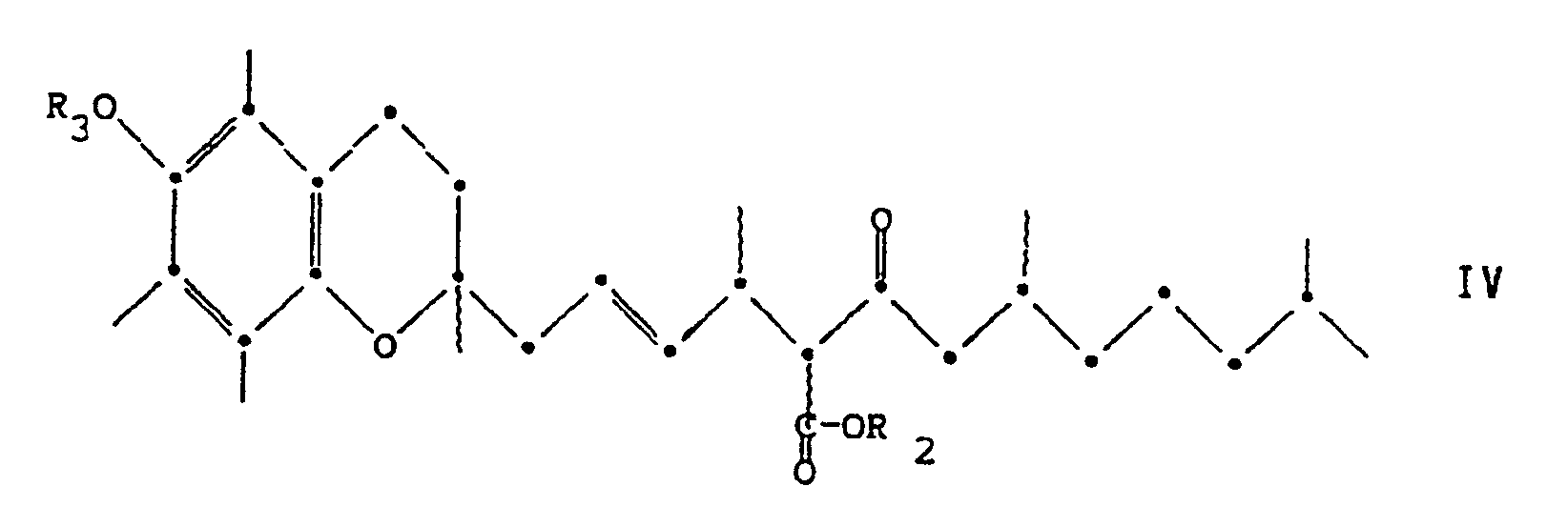
wherein R₃ forms an ether hydroxy protecting group and R₂ is C₁₋₇-alkyl,
comprising reacting a compound of the formula
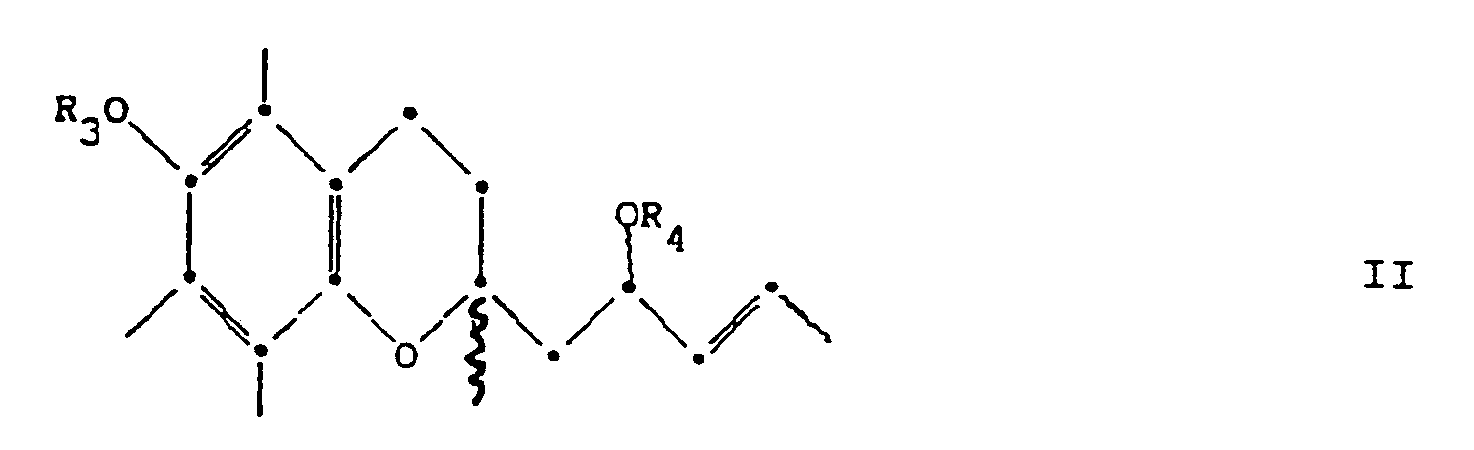
wherein R₃ as above; and R₄ forms an ester group with a compound of the formula

wherein R₂ is as above
in an organic solvent medium containing a base and a catalyst which is an organic complex of zero valent palladium, said reaction being carried out at a temperature of from -90°C to 50°C.
wherein R₃ forms an ether hydroxy protecting group and R₂ is C₁₋₇-alkyl,
comprising reacting a compound of the formula
wherein R₃ as above; and R₄ forms an ester group with a compound of the formula
wherein R₂ is as above
in an organic solvent medium containing a base and a catalyst which is an organic complex of zero valent palladium, said reaction being carried out at a temperature of from -90°C to 50°C.
2. The process of claim 1 wherein said reaction is carried out at a temperature of
from -78°C to -20°C.
3. The process of claim 2 wherein said base is an alkali metal C₁₋₇-alkoxide, an alkali
metal hydride or C₁₋₇-alkyl alkali metal.
4. The process of claim 3 wherein said catalyst is a complex of zero valent palladium.
5. The process of claim 4 wherein said catalyst is a tetrakisphosphine complex of
zero valent palladium.
6. A process for preparing a compound of the formula:
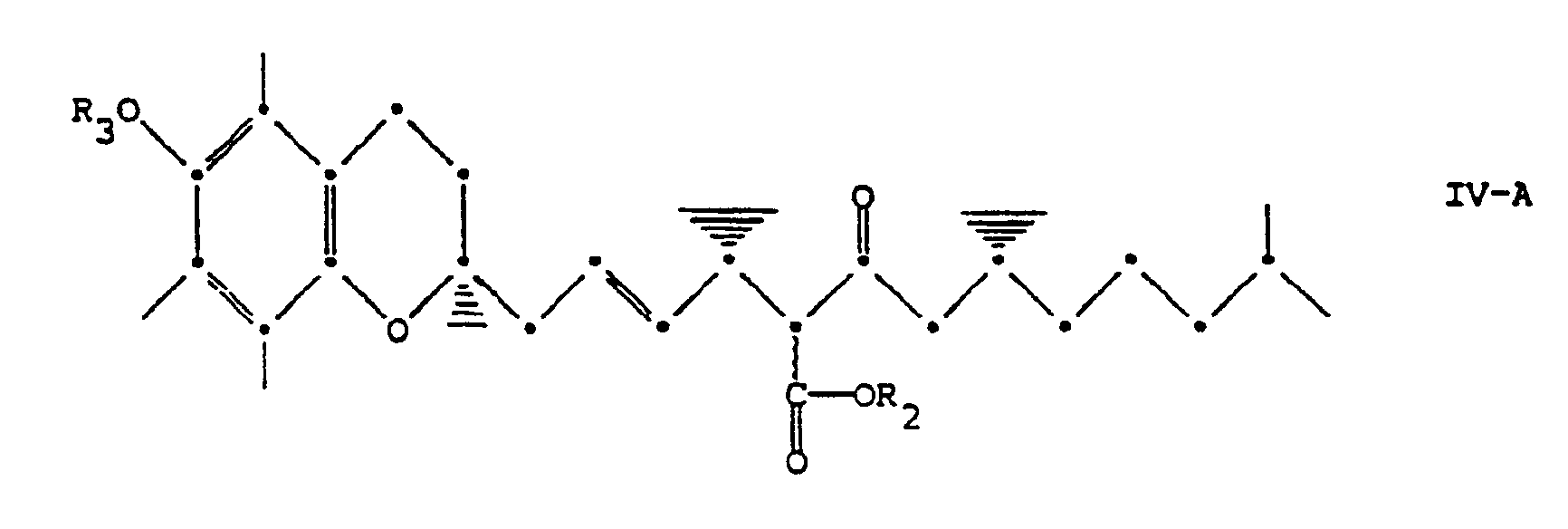
wherein R₂ is C₁₋₇-alkyl and R₃ forms an ether hydroxy protecting group
comprising reacting an ester of the formula

with a chroman, which has either the formula
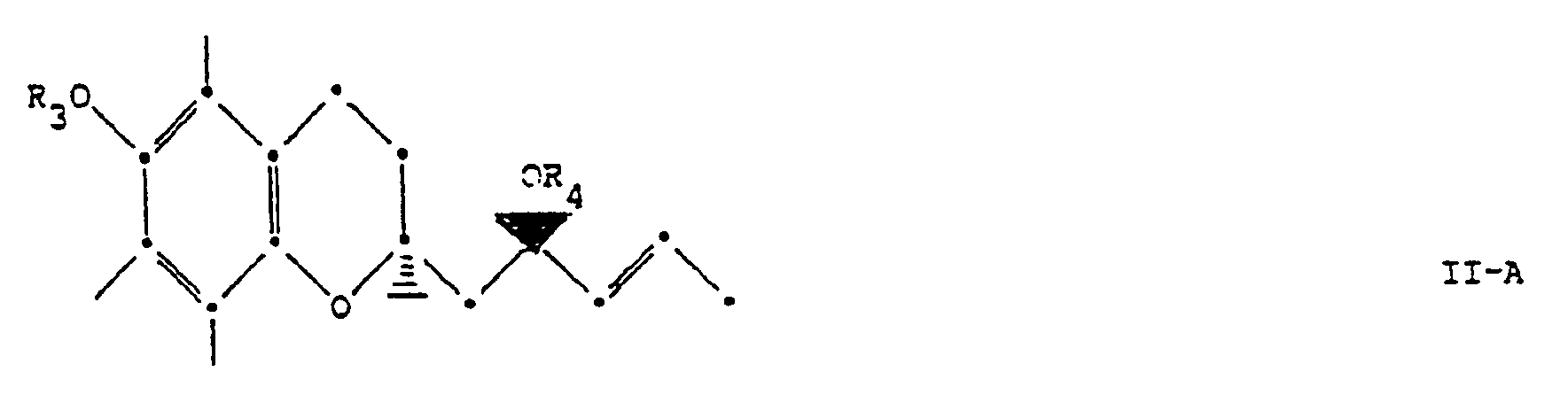
or the formula
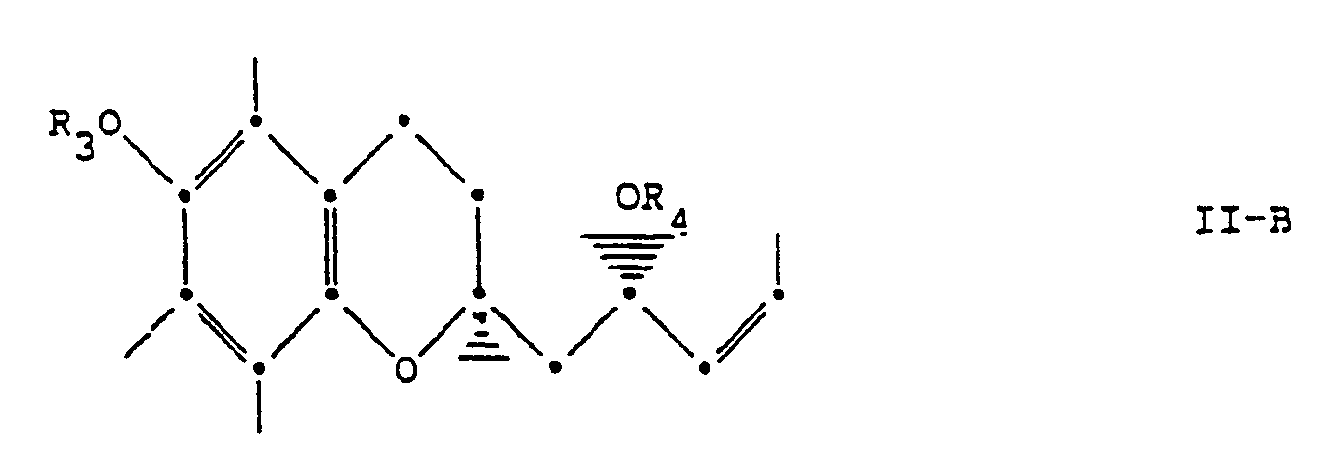
wherein R₃ is as above; and R₄ forms an ester protecting group;
said reaction being carried out in an inert organic solvent medium containing a base and catalyst which is an organic complex of palladium, said reaction being carried out at a temperature of from -90°C to 50°C.
wherein R₂ is C₁₋₇-alkyl and R₃ forms an ether hydroxy protecting group
comprising reacting an ester of the formula
with a chroman, which has either the formula
or the formula
wherein R₃ is as above; and R₄ forms an ester protecting group;
said reaction being carried out in an inert organic solvent medium containing a base and catalyst which is an organic complex of palladium, said reaction being carried out at a temperature of from -90°C to 50°C.
7. The process of claim 6 wherein said reaction is carried out at a temperature of
from -78°C to -20°C.
8. The process of claim 7 wherein said base is an alkali metal C₁₋₇-alkoxide, an alkali
metal hydride or C₁₋₇-alkyl alkali metal.
9. The process of claim 6 wherein said catalyst is a complex of zero valent palladium.
10. The process of claim 6 wherein said catalyst is a tetrakisphosphine complex of
zero valent palladium.
11. Process for the manufacture of vitamin E, comprising subjecting a compound of
formula
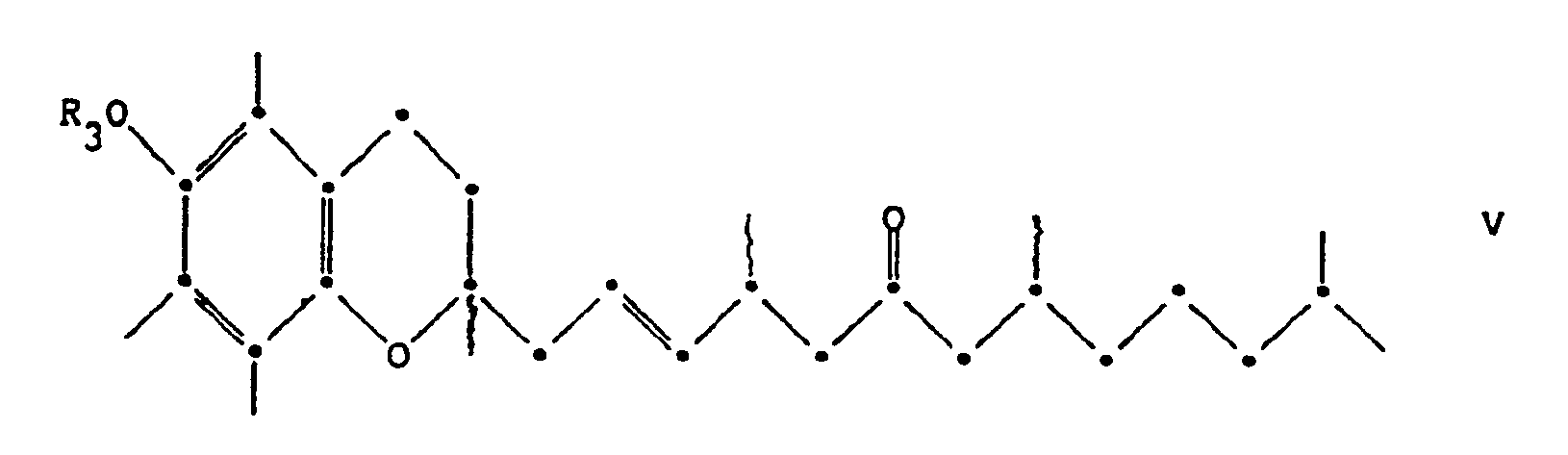
wherein R₃ from an ether hydroxy protecting group or a compound of formula
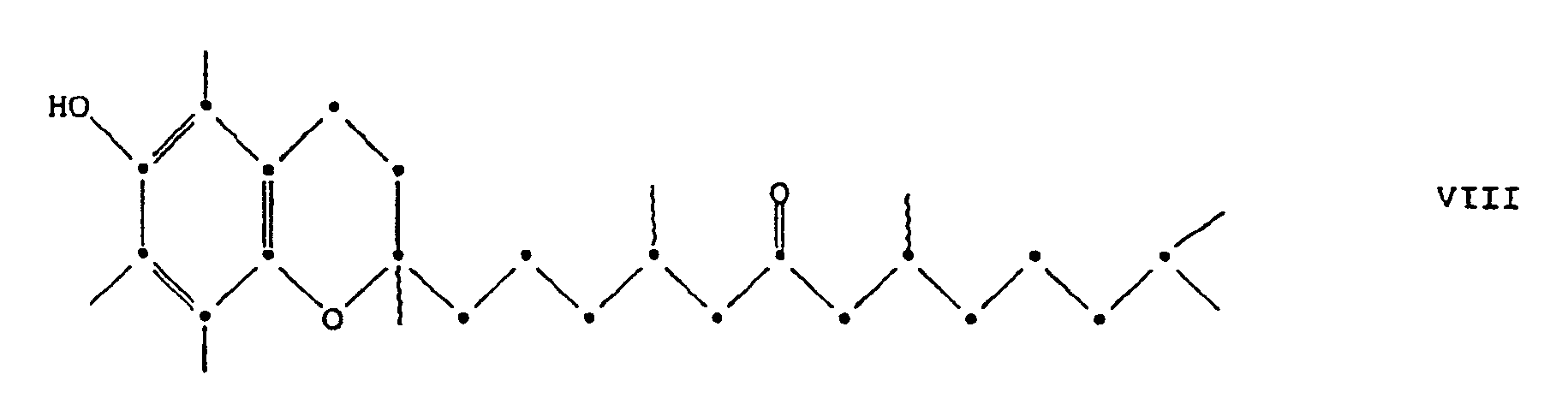
to a Wolff-Kishner reaction with hydrazine and an alkali metal hydroxide, followed, if necessary, by deprotection of the group R³.
wherein R₃ from an ether hydroxy protecting group or a compound of formula
to a Wolff-Kishner reaction with hydrazine and an alkali metal hydroxide, followed, if necessary, by deprotection of the group R³.
12. Process according to claim 11, comprising subjecting a compound of formula V and
a compound of formula VIII respectively, wherein, in these compounds, the methyl substituents
represented by the wavey line have an alpha orientation to the Wolff-Kishner reaction
and the subsequent reaction(s).
13. A compound of the formula
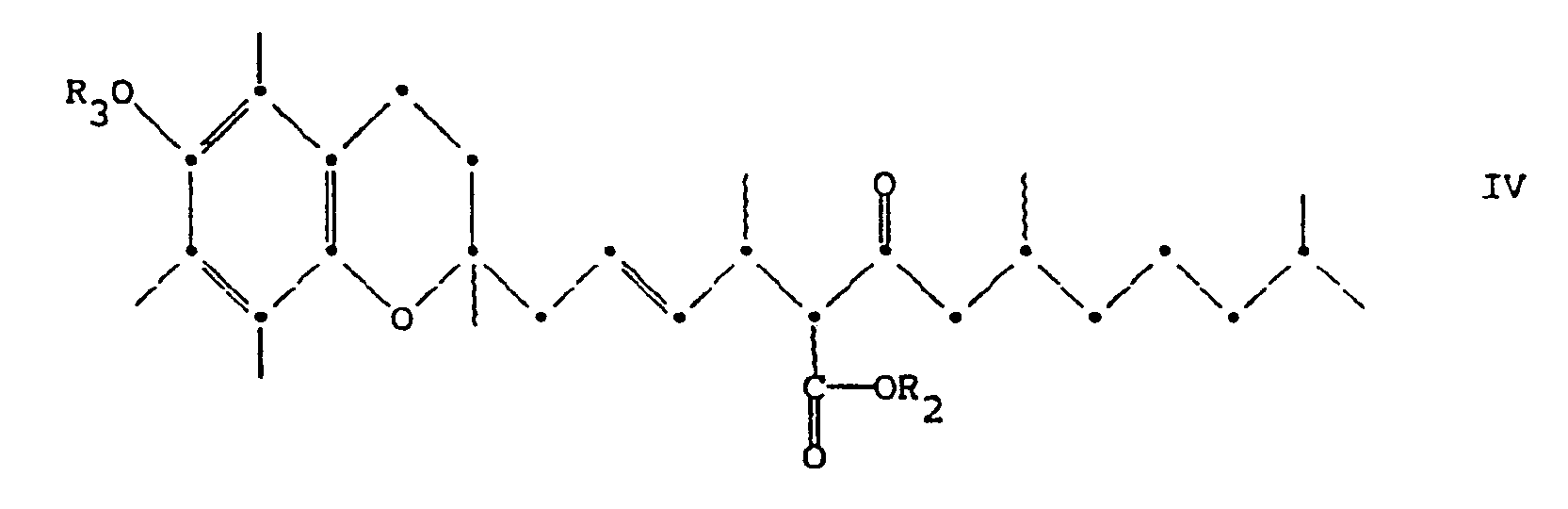
wherein R₃ forms an ether hydroxy protecting group; and R₂ is C₁₋₇-alkyl.
wherein R₃ forms an ether hydroxy protecting group; and R₂ is C₁₋₇-alkyl.
14. The compound of claim 13 wherein R₃ is benzyl.
15. The compound of claim 14 wherein R₂ is methyl.
16. The compound of claim 14 wherein R₂ is ethyl.
17. A compound of the formula

wherein R₃ forms an ether hydroxy protecting group.
wherein R₃ forms an ether hydroxy protecting group.
18. The compound of claim 17 wherein the methyl substituents represented by the wavey
line have an alpha orientation.
19. The compound of claim 17 wherein R₃ is benzyl.
20. A compound of the formula
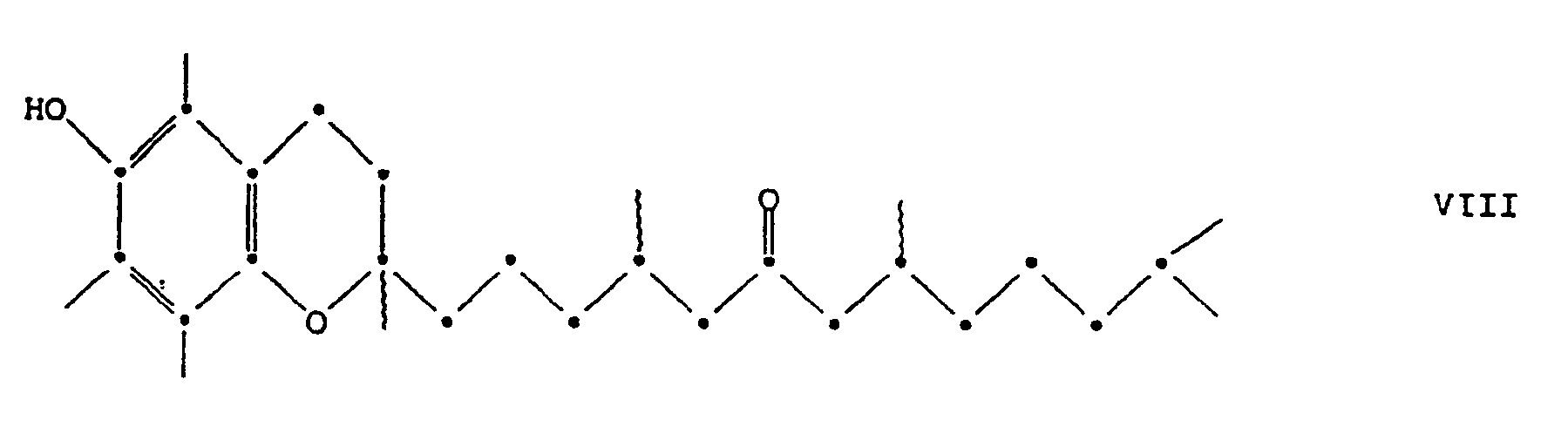
21. The compound of claim 20, wherein the methyl substituents represented by the wavey
line have an alpha orientation.
22. A compound of the formula
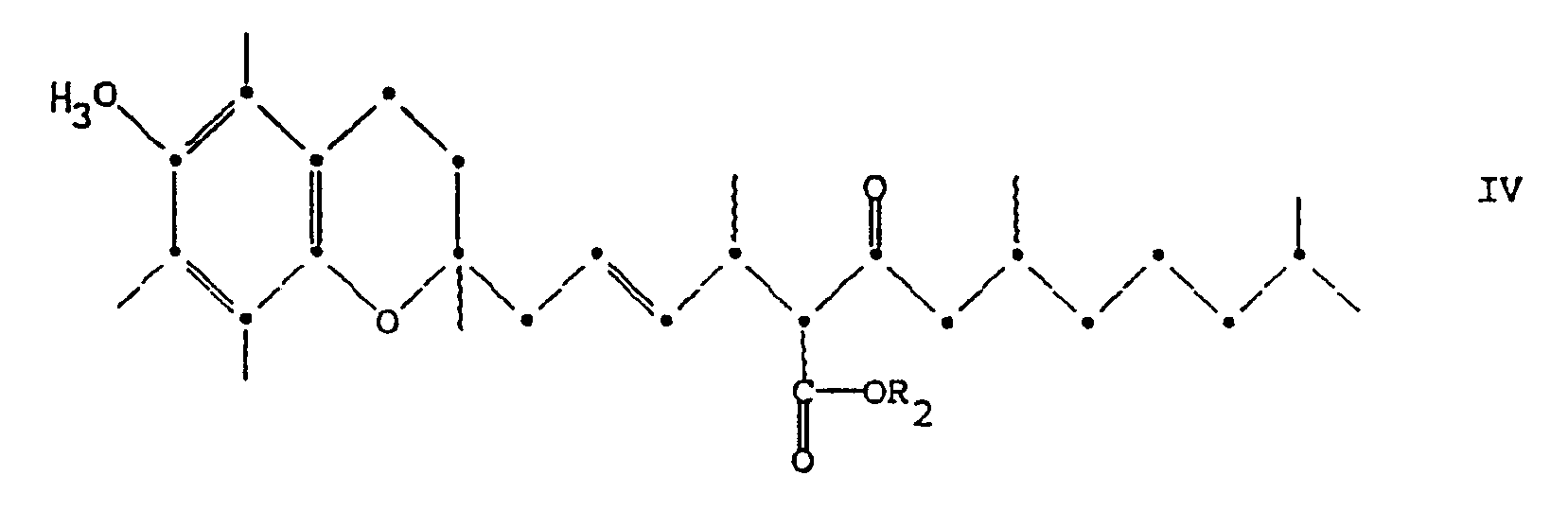
wherein R₂ is C₁₋₇-alkyl.
wherein R₂ is C₁₋₇-alkyl.
1. Ein Verfahren zur Herstellung einer Verbindung der Formel
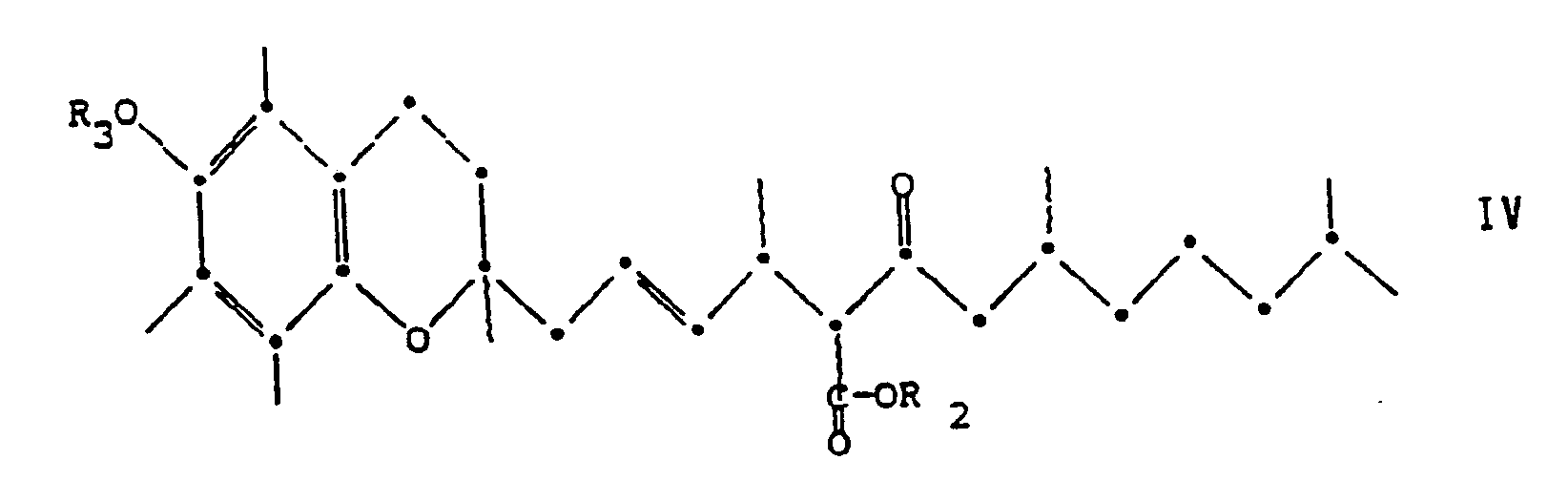
worin R₃ eine Aether-Hydroxyschutzgruppe bildet und R₂ C₁₋₇-Alkyl ist,
dadurch gekennzeichnet, dass man eine Verbindung der Formel
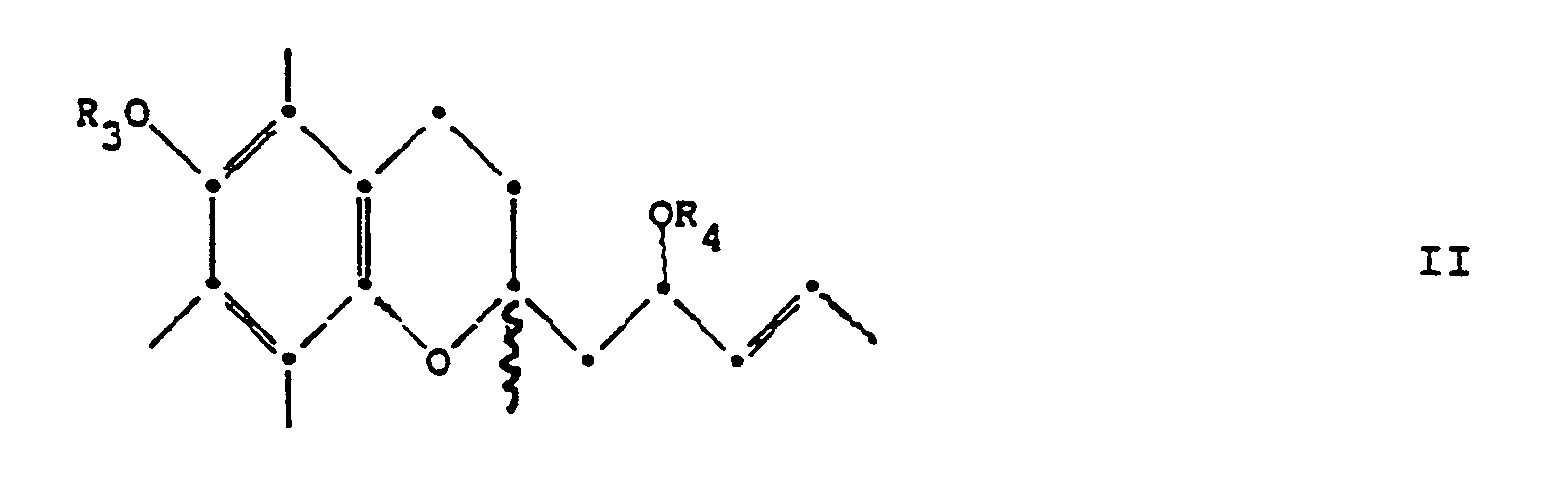
worin R₃ wie oben ist; und R₄ eine Estergruppe bildet, mit einer Verbindung der Formel

worin R₂ wie oben ist,
in einem organischen Lösungsmittelmedium umsetzt, das eine Base und einen Katalysator enthält, der ein organischer Komplex von Palladium der Valenz Null ist, wobei besagte Umsetzung bei einer Temperatur von -90°C bis 50°C durchgeführt wird.
worin R₃ eine Aether-Hydroxyschutzgruppe bildet und R₂ C₁₋₇-Alkyl ist,
dadurch gekennzeichnet, dass man eine Verbindung der Formel
worin R₃ wie oben ist; und R₄ eine Estergruppe bildet, mit einer Verbindung der Formel
worin R₂ wie oben ist,
in einem organischen Lösungsmittelmedium umsetzt, das eine Base und einen Katalysator enthält, der ein organischer Komplex von Palladium der Valenz Null ist, wobei besagte Umsetzung bei einer Temperatur von -90°C bis 50°C durchgeführt wird.
2. Das Verfahren des Anspruchs 1, worin besagte Umsetzung bei einer Temperatur von
-78°C bis -20 °C durchgeführt wird.
3. Das Verfahren des Anspruchs 2, worin besagte Base ein Alkalimetall-C₁₋₇-alkoxid,
ein Alkalimetallhydrid oder Alkalimetall-C₁₋₇-alkyl ist.
4. Das Verfahren des Anspruchs 3, worin besagter Katalysator ein Komplex von Palladium
der Valenz Null ist.
5. Das Verfahren des Anspruchs 4, worin besagter Katalysator ein Tetrakisphosphinkomplex
von Palladium der Valenz Null ist.
6. Ein Verfahren zur Herstellung einer Verbindung der Formel
worin R₂ C₁₋₇-Alkyl ist und R₃ eine Aether-Hydroxyschutzgruppe bildet,
dadurch gekennzeichnet, dass man ein Ester der Formel
mit einem Chroman umsetzt, das entweder die Formel

oder die Formel
worin R₃ wie oben ist; und R₄ eine Esterschutzgruppe bildet;
hat, wobei besagte Umsetzung in einem inerten organischen Lösungsmittelmedium durchgeführt wird, das eine Base und einen Katalysator enthält, der ein organischer Komplex von Palladium ist, und wobei besagte Umsetzung bei einer Temperatur von -90°C bis 50°C durchgeführt wird.
worin R₂ C₁₋₇-Alkyl ist und R₃ eine Aether-Hydroxyschutzgruppe bildet,
dadurch gekennzeichnet, dass man ein Ester der Formel
mit einem Chroman umsetzt, das entweder die Formel
oder die Formel
worin R₃ wie oben ist; und R₄ eine Esterschutzgruppe bildet;
hat, wobei besagte Umsetzung in einem inerten organischen Lösungsmittelmedium durchgeführt wird, das eine Base und einen Katalysator enthält, der ein organischer Komplex von Palladium ist, und wobei besagte Umsetzung bei einer Temperatur von -90°C bis 50°C durchgeführt wird.
7. Das Verfahren des Anspruchs 6, worin besagte Umsetzung bei einer Temperatur von
-78°C bis -20°C durchgeführt wird.
8. Das Verfahren des Anspruchs 7, worin besagte Base ein Alkalimetall-C₁₋₇-alkoxid,
ein Alkalimetall- hydrid oder Alkalimetall-C₁₋₇-alkyl ist.
9. Das Verfahren des Anspruchs 6, worin besagter Katalysator ein Komplex von Palladium
der Valenz Null ist.
10. Das Verfahren des Anspruchs 6, worin besagter Katalysator ein Tetrakisphosphinkomplex
von Palladium der Valenz Null ist.
11. Verfahren zur Herstellung von Vitamin E, dadurch gekennzeichnet, dass man eine
Verbindung der Formel
worin R₃ eine Aether-Hydroxyschutzgruppe bildet, oder eine Verbindung der Formel

einer Wolff-Kishner-Reaktion mit Hydrazin und einem Alkalimetallhydroxid unterwirft, gefolgt nötigenfalls von Entfernung des Schutzes der Gruppe R₃.
worin R₃ eine Aether-Hydroxyschutzgruppe bildet, oder eine Verbindung der Formel
einer Wolff-Kishner-Reaktion mit Hydrazin und einem Alkalimetallhydroxid unterwirft, gefolgt nötigenfalls von Entfernung des Schutzes der Gruppe R₃.
12. Verfahren nach Anspruch 11, dadurch gekennzeichnet, dass man eine Verbindung der
Formel V resp. eine Verbindung der Formel VIII unterwirft, wobei in diesen Verbindungen
die durch die wellige Linie dargestellten Methylsubstituenten eine alpha-Orientierung
gegenüber der Wolff-Kishner-Reaktion und der (den) nachfolgenden Reaktion(en) haben.
13. Eine Verbindung der Formel

worin R₃ eine Aether-Hydroxyschutzgruppe bildet; und R₂ C₁₋₇-Alkyl ist.
worin R₃ eine Aether-Hydroxyschutzgruppe bildet; und R₂ C₁₋₇-Alkyl ist.
14. Die Verbindung des Anspruchs 13, worin R₃ Benzyl ist.
15. Die Verbindung des Anspruchs 14, worin R₂ Methyl ist.
16. Die Verbindung des Anspruchs 14, worin R₂ Aethyl ist.
17. Eine Verbindung der Formel
worin R₃ eine Aether-Hydroxyschutzgruppe bildet.
worin R₃ eine Aether-Hydroxyschutzgruppe bildet.
18. Die Verbindung des Anspruchs 17, worin die durch die wellige Linie dargestellten
Methylsubstituenten eine alpha-Orientierung haben.
19. Die Verbindung des Anspruchs 17, worin R₃ Benzyl ist.
20. Eine Verbindung der Formel
21. Die Verbindung des Anspruchs 20, worin die durch die wellige Linie dargestellten
Methylsubstituenten eine alpha-Orientierung haben.
22. Eine Verbindung der Formel
worin R₂ C₁₋₇-Alkyl ist.
worin R₂ C₁₋₇-Alkyl ist.
1. Un procédé pour préparer un composé de la formule
dans laquelle R₃ forme un groupe protecteur hydroxy éthérifié et R₂ est un alkyle en C₁ à C₇,
dans lequel on fait réagir un composé de formule
dans laquelle R₃ est tel que défini ci-dessus ; et R₄ forme un groupe ester avec un composé de formule

dans laquelle R₂ est tel que défini ci-dessus, dans un milieu solvant organique renfermant une base et un catalyseur qui est un complexe organique de palladium zéro valent, ladite réaction étant mise en oeuvre à une température de -90°C à 50°C.
dans laquelle R₃ forme un groupe protecteur hydroxy éthérifié et R₂ est un alkyle en C₁ à C₇,
dans lequel on fait réagir un composé de formule
dans laquelle R₃ est tel que défini ci-dessus ; et R₄ forme un groupe ester avec un composé de formule
dans laquelle R₂ est tel que défini ci-dessus, dans un milieu solvant organique renfermant une base et un catalyseur qui est un complexe organique de palladium zéro valent, ladite réaction étant mise en oeuvre à une température de -90°C à 50°C.
2. Le procédé de la revendication 1, dans lequel ladite réaction est mise en oeuvre
à une température de -78°C à -20°C.
3. Le procédé de la revendication 2, dans lequel ladite base est un alcoolate de métal
alcalin, en C₁ à C₇, un hydrure de métal alcalin ou un alkyle de métal alcalin en
C₁ à C₇.
4. Le procédé de la revendication 3, dans lequel ledit catalyseur est un complexe
de palladium zéro valent.
5. Le procédé de la revendication 4, dans lequel ledit catalyseur est un complexe
de tétrakisphosphine de palladium zéro valent.
6. Un procédé pour préparer un composé de formule
dans laquelle R₂ est un alkyle en C₁ à C₇ et R₃ forme un groupe protecteur hydroxy étherifié,
dans lequel on fait réagir un ester de formule

avec un chromane, qui présente la formule
ou la formule
dans lesquelles R₃ est tel que défini ci-dessus ; et R₄ forme un groupe protecteur estérifié ;
ladite réaction étant mise en oeuvre dans un milieu solvant organique inerte renfermant une base et un catalyseur qui est un complexe organique du palladium, ladite réaction étant réalisée à une température de -90°C à 50°C.
dans laquelle R₂ est un alkyle en C₁ à C₇ et R₃ forme un groupe protecteur hydroxy étherifié,
dans lequel on fait réagir un ester de formule
avec un chromane, qui présente la formule
ou la formule
dans lesquelles R₃ est tel que défini ci-dessus ; et R₄ forme un groupe protecteur estérifié ;
ladite réaction étant mise en oeuvre dans un milieu solvant organique inerte renfermant une base et un catalyseur qui est un complexe organique du palladium, ladite réaction étant réalisée à une température de -90°C à 50°C.
7. Le procédé de la revendication 6, dans lequel ladite réaction est mise en oeuvre
à une température de -78°C à -20°C.
8. Le procédé de la revendication 7, dans lequel ladite base est un alcoolate en C₁
à C₇ de métal alcalin, un hydrure de métal alcalin ou un alkyle en C₁ à C₇ de métal
alcalin.
9. Le procédé de la revendication 6, dans lequel ledit catalyseur est un complexe
de palladium zéro valent.
10. Le procédé de la revendication 6, dans lequel ledit catalyseur est un complexe
de tétrakisphosphine de palladium zéro valent.
11. Procédé pour la fabrication de la vitamine E, dans lequel on soumet un composé
de formule
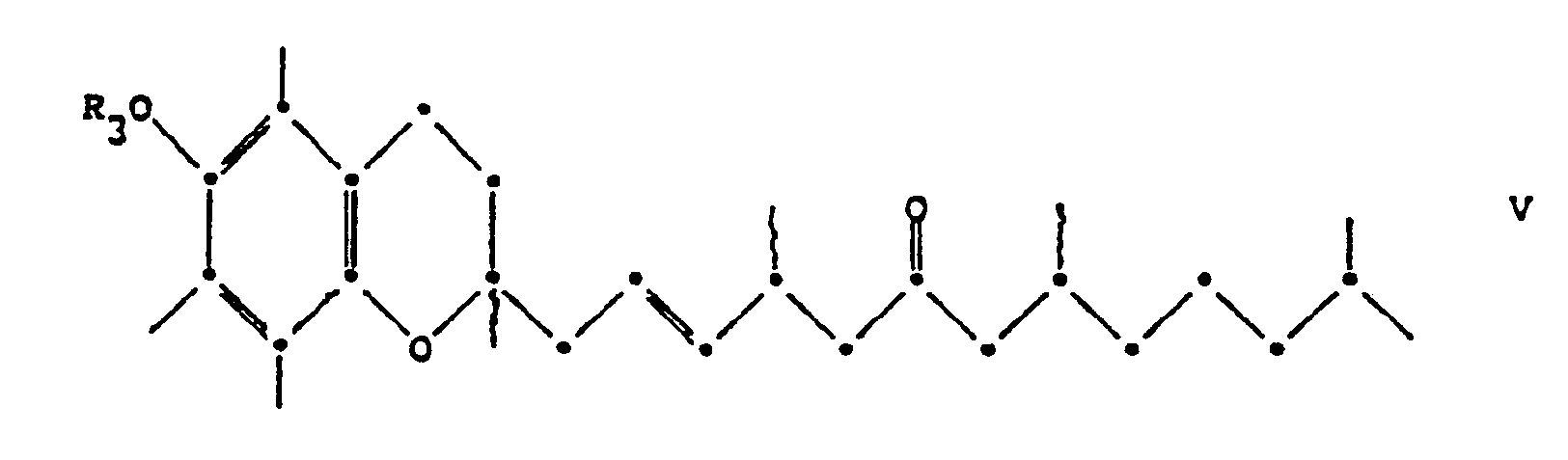
dans laquelle R₃ est un groupe protecteur hydroxy éthérifié, ou bien un composé de formule
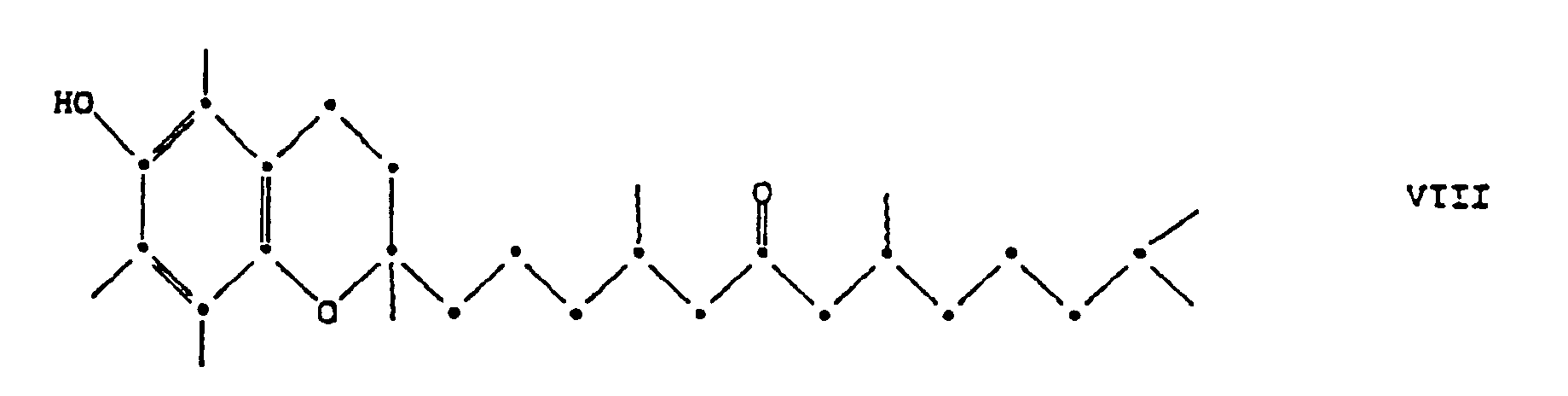
à une réaction de Wolff-Kishner avec de l'hydrazine et un hydroxyde de métal alcalin, suivie, si nécessaire, par une mise hors de protection du groupe R₃.
dans laquelle R₃ est un groupe protecteur hydroxy éthérifié, ou bien un composé de formule
à une réaction de Wolff-Kishner avec de l'hydrazine et un hydroxyde de métal alcalin, suivie, si nécessaire, par une mise hors de protection du groupe R₃.
12. Procédé selon la revendication 11, dans lequel on soumet un composé de formule
V et un composé de formule VIII, respectivement, dans lesquelles, dans ces composés,
les substituants méthyle représentés par la ligne ondulée présentent une orientation
alpha dans la réaction de Wolff-Kishner et la (les) réaction(s) subséquente(s).
13. Un composé de formule
dans laquelle R₃ forme un groupe protecteur hydroxy éthérifié ; et R₂ est un alkyle en C₁ à C₇.
dans laquelle R₃ forme un groupe protecteur hydroxy éthérifié ; et R₂ est un alkyle en C₁ à C₇.
14. Le composé de la revendication 13, dans lequel R₃ est du benzyle.
15. Le composé de la revendication 14, dans lequel R₂ est du méthyle.
16. Le composé de la revendication 14, dans lequel R₂ est de l'éthyle.
17. Un composé de la formule
dans laquelle R₃ forme un groupe protecteur hydroxy éthérifié.
dans laquelle R₃ forme un groupe protecteur hydroxy éthérifié.
18. Le composé de la revendication 17, dans lequel les substituants méthyle, représentés
par la ligne ondulée, présentent une orientation alpha.
19. Le composé de la revendication 17, dans lequel R₃ est du benzyle.
20. Un composé de la formule

21. Le composé de la revendication 20, dans lequel les substituants méthyle représentés
par la ligne ondulée présentent une orientation alpha.
22. Un composé de la formule
dans laquelle R₂ est un alkyle en C₁ à C₇.
dans laquelle R₂ est un alkyle en C₁ à C₇.