|
(11) | EP 0 321 882 B1 |

| (12) | EUROPEAN PATENT SPECIFICATION |
|
|
| (54) |
Polyfunctional ethylenically unsaturated cellulosic polymer-based photocurable compositions Photo-härtbare Zusammensetzungen auf der Basis von polyfunktionellen und äthylenisch ungesättigten Zellulosederivaten Composition photodurcissable à base de polymères cellulosiques polyfonctionnels et insaturés |
|
|
|||||||||||||||||||||||||||||||
| Note: Within nine months from the publication of the mention of the grant of the European patent, any person may give notice to the European Patent Office of opposition to the European patent granted. Notice of opposition shall be filed in a written reasoned statement. It shall not be deemed to have been filed until the opposition fee has been paid. (Art. 99(1) European Patent Convention). |
[0001] This invention relates to photocurable coating compositions comprising polyfunctional ethylenically unsaturated cellulosic polymers, a process for making them, and their use.
[0002] It is known that polyfunctional cellulosic polyesters containing alpha, beta unsaturation are useful as resinS and modifying resins in formulating photocurable compositions for use, such as, protective coatings for wood and other solid substrates. For example, U.S. Patents. 4,565,857, 4,654,233, and 4,656,202 describe photocurable coating compositions comprising cellulosic polymers and polyisocyanates, specifically including polymerizable ethylenically unsaturated cellulosic esters derived from the reaction of a cellulosic polymer having isocyanate-reactive hydroxyl functionality and a monoethylenically unsaturated compound having a hydroxyl reactive group, for instance, 2-isocyanatoethyl acrylate or methacrylate.
[0003] Such known photocurable compositions, which contain no more than two isocyanate groups, have the disadvantage that toxic or irritating reactive diluents or plasticizers are needed to crosslink with the ethylenically unsaturated cellulosic esters to achieve satisfactory solvent resistance and strength in the cured coating.
[0004] There is a need for a photocurable coating composition with improved crosslinking efficiency that significantly reduces or eliminates the need for reactive diluents, plasticizers or the like to provide maximum solvent resistance and strength in the cured products.
[0005] According to the invention, a photocurable coating composition comprising a polyfunctional ethylenically unsaturated cellulosic polymer having an average of at least 1.5 terminal alpha, beta-ethylenic unsaturations per substituted position of anhydroglucose unit of the polymer obtainable by reacting (a) a cellulosic polymer having isocyanate-reactive hydroxyl funcionality and (b) a monoethylenically unsaturated compound having a hydroxyl-reactive group, is characterized in that the reactant (a) constitutes from 48 to 69 weight percent of the composition, the reactant (b) constitutes 52 to 31 weight percent of the composition and is a hydroxyl-reactive poly (alpha,beta-ethylenically unsaturated) isocyanate obtainable by reacting (i) a hydroxyl functional (meth)acrylic ester with (ii) a polyisocyanate having an average of at least three hydroxyl reactive isocyanate groups, the molar ratio of (meth)acrylic ester to polyisocyanate being from 0.6 to 0.9.
[0006] Cellulosic polymers that may be used as reactant (a) in this invention include ester and ether derivatives of cellulose that have isocyanate-reactive hydroxyl functionality. Examples of such ester derivatives include nitrocellulose and cellulosic esters of saturated aliphatic mono-carboxylic acids having from 1 to 6 carbon atoms or aromatic monocarboxylic acids, preferably cellulose acetate, cellulose acetate propionate, cellulose acetate butyrate or cellulose acetate benzoate. Other useful carboxylated cellulose esters having isocyanate-reactive hydroxyl functionality include cellulose acetate succinate, cellulose acetate tetrahydrophthalate, cellulose propionate phthalate, cellulose butyrate phthalate, cellulose butyrate 3-nitrophthalate, cellulose butyrate phthaloyl dicarboxylic acid, cellulose butyrate succinate, and the like. Such cellullose esters are well known in the art and are described, for example, in U.S. Patent No. 4,134,809.
[0007] Examples of cellulosic ether derivatives include hydroxyethyl cellulose, hydroxypropyl cellulose or hydroxyethylhydroxypropyl cellulose. Such ether derivatives are also well known.
[0008] Generally, the molecular weight of those cellulosic polymers that are useful in this invention is not critical, however, polymers having molecular weights ranging from 2,000 to 200,000, and an average degree of substitution of 0.3 to 1.8 isocyanate-reactive hydroxyl groups per anhydroglucose unit of cellulosic polymer are preferred, with an average of 0.5 to 1.3 being most preferred.
[0009] An anhydroglucose unit of cellulosic polymer is well known in the art and can be characterized for purposes of this invention by the following structural formula:
where R represents a substituted moiety with the subscripts 2,3 and 6 denoting the substituted position on the anhydroglucose unit.
[0010] Hydroxyl-reactive poly(alpha,beta-ethylenically unsaturated) isocyanates that are reacted with the cellulosic polymers described above, in accordance with this invention, can be represented by the following general structural formula:
where Q is a multivalent organic radical and x is a saturated or unsaturated, linear, branched or cyclic divalent organic radical having from 2 to 20 carbon atoms, and where p is an average of at least 1 and r is an average of at least 1.5. Such unsaturated isocyanates can be conveniently prepared from the reaction of a hydroxyl functional (meth)acrylic ester and a polyisocyanate. Acrylic or methacrylic esters useful herein include any of the various hydroxymono-,di-, and tri(meth)acrylic esters containing terminal alpha, beta-ethylenic unsaturation, and their corresponding glycol or ester-extended analogues. Examples of such (meth)acrylic esters include 2-hydroxyethyl (meth)acrylate, 2-hydroxypropyl-(meth)acrylate, 4-hydroxybutyl (meth)acrylate 12-hydroxydodecanyl(meth)acrylate, 2-hydroxy-3-chloropropyl(meth)acrylate, trimethylol propane di(meth)acrylate, pentaerythritol diacrylate, pentaerythritol triacrylate, and the like. Other examples include caprolactone extended hydroxyethyl acrylate available as Tone M-100 from Union Carbide Corporation; polypropylene glycol monomethacrylate (PPGMM), available from Alcolac, Inc.; and Photomers 4152 hydroxydiacrylate and 4171 hydroxytriacrylate (PH 4152 and PH 4172, respectively) both available from Henkel KGaA. Similarly, related (meth)acrylamide derivatives are also useful herein, for example, N-hydroxymethylacrylamide and N-hydroxymethylmethacrylamide, as are glycidyl(meth)acrylic esters, such as described in U.S. Patent No. 4,134,809.
[0011] Any polyisocyanate having an average of at least three hydroxyl reactive isocyanate groups is useful for preparing the poly(alpha,beta-ethylenically unsaturated) isocyanates reactant (b). Examples of such polyisocyanates include diisocyanate oligomers containing biuret, isocyanurate, urethane or similar linkages between diisocyanate monomer units. It is preferred, however, that such polyisocyanates are derivatives of acyclic, saturated or unsaturated, linear or branched, polyvalent organic radicals having at least three atoms selected from carbon, oxygen, phosphorous, nitrogen and sulfur. Specific examples include isocyanate oligomers of hexamethylene diisocyanate 2,2,4-trimethyl-hexane-1,6-diisocyanate, 2,4,4-trimethylhexane-1,6-diisocyanate, cyclohexyl-1,4-diisocyanate, diphenylene methane diisocyanate, isophorone diisocyante, toluene diisocyanate, and any of those commercially available from Mobay Chemical Corporation under the trade names Mondur and Desmondur (oligomers of hexamethylene diisocyanate) that contain an average of at least 3 hydroxyl reactive isocyanate groups, preferably Desmodur N 3200 (containing an average of 3.2 isocyanate groups per molecule) and Desmodur N 100 (containing an average of 3.8 isocyanate groups per molecule).
[0012] Also useful in this invention are the various polyisocyanates obtained from the reaction of typically low molecular weight diisocyanates (e.g., toluene diisocyanate) or mixtures of two or more of such compounds with water or other known oligomerization catalysts, and/or low molecular weight polyols, e.g., glycerine, and/or polyamines, e.g., ethylenediamine. Examples of such polyisocyanates include the adduct of trimethylol propane and toluene diisocyanate, the adduct of hexamethylene diisocyanate, isophorone diisocyanate and trimethylol propane, and the adduct of pentaerythritol and hexamethylene diisocyante, such as disclosed in U.S. 4,164,459.
[0013] In a preferred embodiment of this invention, the conditions and stoichiometry of the reaction between the hydroxyl functional (meth)acrylic ester (or related compound) and the polyisocyanate is controlled such that a substantial portion, preferably an average of at least 5 mole percent and most preferably an average of 10 mole percent or more, of the resulting product is at least a monoisocyanate compound containing an average of at least 1.5 terminal alpha,beta-ethylenic unsaturations per molecule. Accordingly, the molar ratio of hydroxyl functional (meth)acrylic ester (or related compound) to polyisocyanate can range from 0.6 to 0.9, preferably from 0.7 to 0.9, depending, of course, on such factors as the specific reactants employed, i.e., the average number of isocyanate groups per molecule of polyisocyanate employed, and the degree of hydroxyl reactive isocyanate group substitution desired in the resulting product. Generally, the ratio will increase as the average number of hydroxyl reactive isocyanate groups per molecule of polyisocyanate increases, therein requiring less equivalents of polyisocyanate to react with the hydroxyl functionality of the (meth)acrylic esters or related compounds.
[0014] In general, this reaction is preferably conducted by mixing the hydroxyl functional (meth)acrylic ester with the polyisocyanate in a suitable dry, non-reactive solvent, for example, tetrahydrofuran, toluene, acetone, methylethylketone, ethylacetate, butylacetate and the like. Suitable urethane catalysts that are well known to those skilled in the art are also preferably employed. Such catalysts are described, for example, in U.S. Patent No. 4,656,202. Preferred are metallic-based catalysts such as dibutyltindilaurate, dibutyltindiacetate, stannous acetate, stannous octoate, stannous tallate or dibutyltinoxide. Preferably, such catalysts are employed in amounts from 0.001 to 1.0 weight percent, based on the total weight percent of reactants.
[0015] It is also preferred to employ a radical polymerization inhibitor in the reaction mixture to insure that the ethylenically unsaturated reactants do not polymerize prematurely. Such compounds are useful in amounts ranging from 0.001 to 0.1 weight percent based on the amount of ethylenically unsaturated reactant present. Examples of these inhibitors include hydroquinone, hydroquinone monomethyl ether, catechol, 2,6-diterbutyl-4-methyl-phenol, phenothiazine and the like. Such inhibitors are also described in U.S. Patent No. 4,656,202. Reaction temperatures can vary from 0°C to 100°C.
[0016] The following examples more fully illustrate the preparation of hydroxyl reactive poly(alpha,beta-ethylenically unsaturated) isocyanates useful in this invention.
Examples 1-8
[0017] These examples illustrate the preparation of preferred poly(alpha,beta-ethylenically unsaturated) isocyanates that are reacted with the aforementioned cellulosic polymers to form the polyfunctional cellulosic polymers useful in the photocurable coating compositions of this invention.
[0018] Example 1. In this example, 30.03 grams of Desmodur N 100 (an oligomer of hexamethylene diisocyanate containing an average of 3.8 isocyanate groups per molecule) is dissolved in 50 milliliters of a dry solvent, such as those described above, which also contains 27 milligrams of a 1:1 mixture of 2,6-diterbutyl-4-methyl phenol and hydroquinone monomethyl ether. To this mixture is added 14.97 grams of hydroxyethylmethacrylate (HEMA) and 0.10 grams (0.22 weight percent) of dibutyltindilaurate catalyst. The reaction mixture is then allowed to stir at 25°C for approximately 16 hours.
[0019] Examples 2-4. In these examples, the same procedure as set out in Example 1 is followed, except that molar ratio of HEMA to polyisocyanate is altered according to that as summarized in Table I below.
[0020] Examples 5-8. The same procedure as set out in Examples 1-4 was followed except that Desmodur N 3200 (an oligomer of hexamethylene diisocyanate containing an average of 3.2 isocyanate groups per molecule) is substituted for Desmodur N 100.
[0021] Product distribution described in terms of average mole percent of product containing at least one or more isocyanate groups per molecule available for further reaction with isocyanate-reactive hydroxyl groups present in the cellulosic polymers described above, and also containing an average of at least 1.5 terminal alpha,beta-ethylenic unsaturations per molecule is then calculated for each example using well known methods of statistical analysis described, for example, in "Monte Carlo Methods", by J. M. Hammersley and D. C. Handscomb, Methuem, London (1964). The results are summarized in Table 1 below.
TABLE 1
| Example No. | *Hema/polyisocyanate | % Average non-reacted isocyanate groups | Average mole % isocyanate groups remaining in molecule | Average ethylenic unsaturations per molecule having one or more isocyanate groups | ||
| 0(groups) | 1 | 2 | ||||
| 1 | 35/60 | 42 | 16 | 21 | 63 | 2.1 |
| 2 | 40/60 | 32 | 23 | 23 | 54 | 2.1 |
| 3 | 45/60 | 25 | 31 | 23 | 46 | 2.1 |
| 4 | 50/60 | 17 | 41 | 23 | 36 | 2.2 |
| 5 | 35/60 | 42 | 30 | 25 | 45 | 1.6 |
| 6 | 40/60 | 32 | 40 | 24 | 36 | 1.9 |
| 7 | 45/60 | 25 | 51 | 23 | 26 | 1.7 |
| 8 | 50/60 | 17 | 65 | 18 | 17 | 1.7 |
| *Describes molar ratio of equivalent isocyanate-reactive hydroxyl groups to reactive isocyanate groups. |
[0022] In accordance with this invention, at least one hydroxyl reactive poly(alpha,beta-ethylenically unsaturated) isocyanate, as described above, is then reacted with a cellulosic polymer having isocyanate-reactive hydroxyl functionality, again as described above, to produce a polyfunctional cellulosic polymer having an average of at least 1.5 terminal alpha,beta-ethylenic unsaturations per substituted position of anhydroglucose unit of the polymer, and that are useful in the photocurable coating compositions of this invention.
[0023] As previously mentioned herein an anhydroglucose unit of cellulosic polymer can be characterized for purposes of this invention by the following general formula:
where R represents a substituted moiety with the subscripts 2, 3 and 6 denoting the substituted position on the anhydroglucose unit.
[0024] This reaction is preferably conducted by simply mixing the poly(unsaturated)isocyanate, the cellulosic polymer, a catalyst for the isocyanate/hydroxyl reaction, and a radical polymerization inhibitor in a suitable dry solvent. The same solvents, catalysts and other reagents and their respective amounts described above for use in the preparation of the poly(alpha,beta-ethylenically unsaturated) isocyanates of this invention are also useful in this reaction. In a preferred embodiment the instant reaction may be carried out in a "two-step, one-pot" method, wherein a poly(alpha,beta-ethylenically unsaturated) isocyanate is prepared according to the procedure set forth in Example 1, followed by the addition thereto of a solution or suspension of the cellulosic polymer. In any event, the reaction mixture is allowed to react at temperatures ranging from 0°C to 100°C for a period of time as demonstrated by the disappearance of infrared detectable isocyanate groups. Preferably 5 to 30 percent of the available isocyanate-reactive hydroxyl groups present on the cellulosic polymer are reacted with the poly(unsaturated) isocyanate. In a preferred embodiment of this invention, any unreacted isocyanate remaining at this point can be consumed by the addition of a low molecular weight primary alcohol, preferably ethanol. The resulting polyfunctional ethylenically unsaturated cellulosic polymer can then be isolated, if desired, by precipitation into a suitable non-solvent to remove any non-reacted ethylenically unsaturated material.
[0025] Preferably, the molar ratio of isocyanate-reactive hydroxyl groups on the cellulosic polymer to hydroxyl-reactive poly(unsaturated) isocyanate will range from 20:1 to 1:1, most preferably, from 10:1 to 1:1, depending upon such factors as the average degree of substitution of isocyanate-reactive hydroxyl functionality present in the cellulosic polymer and the polymer's reactivity towards hydroxyl reactive isocyanates. In a preferred procedure in accordance with this invention, the reaction is accomplished in the presence of a molar excess of isocyanate-reactive hydroxyl functionality on the cellulosic polymer.
[0026] The following examples are provided to better illustrate the preparation of polyfunctional ethyleniclly unsaturated cellulosic polymers in accordance with the present invention.
Examples 9-20
[0027] In these examples, solutions of poly(alpha,beta-ethylenically unsaturated) isocyanates are prepared according to the procedure set forth in Examples 1-8 based on the tabulated stoichiometries summarized in Table 2 below. Where indicated in Table 2, HEMA has been substituted for other hydroxyl functional (meth)acrylic esters, for example, hydroxybutyl acrylate (HBA), caprolactone extended hydroxyethyl acrylate (Tone M-100), polypropylene glycol monomethacrylate (PPGMM), Photomer 4152 hydroxyldiacrylate (PH 4152), and Photomer 4171 hydroxytriacrylate (PH 4171). Polyfunctional ethylenical unsaturated cellulosic polymers are then conveniently prepared via a "two-step, one-pot" method by adding solutions of various cellulosic polymers in a common solvent and in their respective indicated amounts, as summarized in Table 2, to the previously prepared solutions of poly(unsaturated) isocyanates. The reaction mixtures are then stirred for approximately 16-24 hours at ambient temperature. Any unreacted isocyanate then remaining, as detected by infrared spectroscopy, is consumed by the addition of ethyl alcohol.
[0028] Photocurable coating compositions having greatly improved crosslinking efficiency, therein significantly reducing or eliminating the need for added cocurable reactive diluents, plasticizers and the like, can be conveniently prepared using the polyfunctional ethylenically unsaturated cellulosic polymers of this invention. Coating compositions prepared as such display comparable or improved solvent and abrasion resistance relative to those coating compositions that are currently available.
[0029] Preparation of the coating compositions can be conducted by simply mixing in the desired proportions the polyfunctional ethylenically unsaturated cellulosic polymer described above with a suitable ultraviolet photoinitiator in a suitable solvent or solvent mixture. Preferably, the solvent employed in the preparation of the poly(alpha, beta-ethylenically unsaturated) isocyanates and their subsequent reaction with the cellulosic polymer in accordance with this invention is employed herein.
[0030] Compounds useful as photoinitiators in the practice of this invention are well known in the art and include, for example, benzophenone, 1-chloronaphthalene, 2-chloronaphthalene, 2-chlorothioxanthone, 2,2-diethoxyacetophenone, 2,3-dichloronaphthoquinone, 4,4'-bis(2-chloroacetyl) benzene, 2,2,2-trichloroacetophenone, benzoin isopropyl ether, 4'-tertbutyl-2,2,2-trichloroacetophenone, 4,4'-bis(chloromethyl) benzophenone, 4-chloromethyl-4'-carbomethoxy benzophenone, 2-chloromethylbenzimidazole, 4,4'-dimethylbenzophenone, 3,4-bis(chloromethyl) benzophenone, benzophenone/methyl diethanolamine, 2,2-dimethoxy-2-phenyl-acetophenone, and benzoin isobutyl ether. Other photoinitiators useful herein include those described, for example, in U.S. Patent No. 4,134,809; the use of any particular photoinitiator is not critical to the practice of this invention.
[0031] These photoinitiators can be added at any point in the production of the coating compositions in amounts ranging from 0.1 to 10 weight percent, preferably from 1 to 5 weight percent, based on the total weight of the coating composition. The amount will depend, of course, on the particular photoinitiator employed.
[0032] Alternatively, the photocurable coating compositions can be prepared in the absence of photoinitiators when curing is to be carried out by electron beam radiation.
[0033] In yet another embodiment of this invention, the coating compositions can be cured without active radiation upon the addition thereto of metal oxidation catalysts such as those based on Ca, Zn, Pb, Fe and the like. Such catalysts are well known in the art.
[0034] Generally, the amount of polyfunctional, ethylenically unsaturated cellulosic polymer component of the photocurable coating composition can range from 10 to 100 weight percent, preferably from 50 to 80 weight percent based on the total curable solids present in the coating composition.
[0035] Of course, other additives that may be compounded with the photocurable coating compositions of the instant invention include, for example, binders, fillers, e.g. silica and metal oxides, pigments, dyes, flow control or thixotropic agents, reinforcing agents, plasticizers, stabilizers, inhibitors or lubricants. The addition of such materials, which are preferably transparent to radiation, will depend on the specific end uses contemplated for the coating compositions.
[0036] Additionally, other polymerizable or copolymerizable compounds that can react with the polyfunctional ethylenically unsaturated cellulosic polymer component can be optionally incorporated into the coating compositions, again depending on the particular end uses contemplated, to modify the properties thereof, e.g. hardness, flexibility, adhesion, and the like. Such compounds include, for example, ethylenically unsaturated monomers such as methyl methacrylate, ethyl acrylate, chlorohexyl acrylate, styrene, divinylbenzene, 2-chlorostyrene, acrylic acid, acrylamide, acrylonitrile, tert-butyl acrylate, methyl acrylate and the like. Such polymerizable or copolymerizable compounds useful in this invention will be readily apparent to those skilled in the art. Typically, such compounds are useful in the instant coating compositions up to 75, preferably less than 50 weight percent, based on the total polymerizable solids weight of the composition. However, the amount employed can extend well outside these ranges, depending upon the particular property of the composition to be modified and the contemplated end use of the resulting coating composition.
[0037] Furthermore, non-reactive film forming resins can be included in the coating compositions of the instant invention, for example, nitrocellulose and other non-ethylenically unsaturated derivatives of cellulosic polymers and oligomers thereof such as are useful in the instant invention for forming the polyfunctional ethylenically unsaturated cellulosic polymers. The amount of such resins employed can vary within the range mentioned above, again depending on such factors as the particular property of the coating composition to be modified, and those end uses contemplated.
[0038] The photocurable coating compositions can be coated on various substrates by any procedure known in the art, including spraying, brushing, dipping and the like. Suitable substrates which can be coated include any of the conventional materials such as wood, plastics, metal and ceramics. However, such coatings are particularly suited for use as a top coating in furniture and wood or wood veneer coating applications where minor flaws or finish imperfections can be removed, for example, by buffing, rubbing or sanding after the coating composition is applied thereto and the solvent is allowed to evaporate, thus resulting in a workable intermediate dried stage of the composition. The intermediate stage, free of minor flaws and imperfections, can thereafter be fully cured by any of the several known methods in the art, for example by exposure to ultraviolet or electron beam radiation, to provide a hard, durable, rub- and abrasion-resistant finish. During this final cure, it is believed that ethylenically unsaturated components in the coating composition undergo a cross-linking reaction to form a tough, crosslinked polymeric matrix. Any of the several base and/or sealer coating compositions, all of which are well known in the art, can be employed in one or more coats on a given substrate prior to application of the coating composition of the present invention. Such base and/or sealer coating compositions are described, for example, in U.S. Patent 4,656,202, and include alkyd resins, acrylic resins and cellulose acetate butyrate type resins. Alternatively, the coating compositions of the instant invention may be employed both as an initial base coat(s) and a final top coating. Should this method be employed, both the base coat and the top coat or finish coat can be cured as described herein subsequent to application and solvent evaporation.
[0039] The following examples are provided to further illustrate the photocurable coating compositions of the instant invention that have unexpectedly improved crosslinking efficiency therein providing for improved solvent- and abrasion-resistance compared to that displayed by coating compositions currently known in the art.
Examples 21-26
[0040] These examples illustrate the improved crosslinking efficiency of photocurable coating compositions prepared in accordance with this invention.
[0041] Polyfunctional ethylenically unsaturated cellulosic polymers prepared in Examples 9-12 above are further precipitated to remove all non-reacted ethylenically unsaturated materials that can function as reactive diluents. The precipitated polymers are dried and then dissolved in 6:1 ethyl: butyl acetate to about 25 percent weight total solids. A photoinitiator (dimethoxyphenyl acetophenone) is next added to each solution in an amount equal to 5 weight percent solids, based on the total solids content, and the solids then adjusted to 20 weight percent. To designated solutions of the unsaturated cellulosic polymer mixture summarized below in Table 3, hexanediol diacrylate is added as a reactive diluent in amounts equal to 10 weight percent based on the total weight of the composition. Films from each composition are then cast on both clean degreased glass and Bonderite 100 steel plates to provide dry films with a nominal thickness of 25.4 µm (1 mil). All dried films are then exposed under high intensity ultraviolet light (total energy equal to 3.8 J/CM²) for 20 seconds, then aged for three days. Each cured film cast on glass plates is next extracted for a period of about 24 hours with acetone in a soxhlet extractor and the percent of material insoluble in acetone, representaive of crosslinked solvent resistant material, is determined. In turn, each film cured on steel plates is tested for rub resistance to methyl ethyl ketone (MEK) by pushing an absorbant paper towel that has been saturated with the solvent back and forth across the surface of the film until the metal surface of the plate is exposed. The results are recorded in Table 3 below.
TABLE 3
| Example No. | Polymer (type) from Example No. | Coating Composition: polymer/reactive diluent | Acetone insoluble Material (%) | *MEK rub resistance |
| 21 | 9 (NC) | 100/0 | 49 | 50 |
| 22 | 10 (NC) | 90/10 | 62 | 200+ |
| 23 | 11 (CAP) | 100/0 | 60 | 200+ |
| 24 | 11 (CAP) | 90/10 | 80 | 200+ |
| 25 | 12 (CAB) | 100/0 | 45 | 200+ |
| 26 | 12 (CAB) | 90/10 | 84 | 200+ |
| *denotes the number of double rubs. |
Examples 27-32
[0042] The following examples illustrate that the improved photocurable coating compositions of the instant invention, which comprise novel modified cellulosic polymers with 1/10 the molar substitution by unsaturated polymerizable material as required by currently known coating compositions, exhibit solvent resistance that is equivalent or superior to such known compositions.
[0043] In Examples 27-29, coating compositions are prepared in accordance with the instant invention as described in Examples 21-26 above using polyfunctional ethylenically unsaturated cellulosic polymers prepared in Examples 10-12. Films of each composition are then cast on steel plates and cured for respective times of 30, 60 and 90 seconds, again as described in the examples above, then aged for three days. Each respective sample is then tested for rub resistance in the manner described above.
[0044] Comparative coating compositions in Examples 30-32 are prepared in accordance with procedures described in U.S. Patent No. 4,565,857, which comprise ethylenically unsaturated cellulosic polymers prepared from the reactants and their respective stoichiometries summarized immediately below in Table 4.
TABLE 4
| Example No. | Isocyanatoethyl methacrylate | *polymer type | Cellulosic polymer | ||
| weight (grams) | isocyanate milliquivalents | weight (grams) | hydroxyl milliquivalents | ||
| 30 | 31.00 | 200 | NC | 104.00 | 400 |
| 31 | 7.75 | 50 | CAP | 33.11 | 99 |
| 32 | 7.75 | 50 | CAB | 40.00 | 101 |
| *nitrocellulose (NC) grade RS 1/4 from Hercules Incorporated. |
[0045] Respective sample films are cast from each composition, then cured and tested for rub resistance in the manner described above. Results for all of the above examples are recorded in Table 5 below.
TABLE 5
| Example No. | Polymer (type) from Example No. | Cellulosic polymer molar substitution | MEK Rub Resistance (seconds) | ||
| 30 | 60 | 90 | |||
| 27 | 21 (NC) | 0.05 | 120 | 180 | 200+ |
| 28 | 23 (CAP) | 0.05 | 200+ | 200+ | 200+ |
| 29 | 25 (CAB) | 0.05 | 30 | 100 | 195 |
| 30 | 30 (NC) | 0.5 | 100 | 155 | 200+ |
| 31 | 31 (CAP) | 0.5 | 45 | 170 | 185 |
| 32 | 32 (CAB) | 0.5 | 90 | 115 | 195 |
Examples 33-40
[0046] These examples further illustrate the improved coating compositions of the instant invention wherein films prepared therefrom exhibit superior crosslinking efficiency in both the presence and absence of reactive diluents compared to such coating compositions known in the art.
[0047] In Examples 33-35, ethylenically unsaturated cellulosic polymers in accordance with this invention are prepared according to the procedure described in Examples 9-20, from reactants and their respective stoichiometries summarized below in Table 6.
[0048] Comparative unsaturated cellulosic polymers in Examples 36-37 are then prepared according to procedures set forth in U.S. Patent Nos. 4,565,857 and 3,749,592, respectively, using the reactants and their respective amounts as further summarized below in Table 6. In comparative Example 36, where the isocyanate employed is isocyanatoethyl methacrylate (IEM), no hydroxyl functional (meth)acrylic ester is needed since IEM contains unsaturation. In comparative Example 37, the isocyanate is toluene diisocyanate (TDI).
[0049] Coating compositions are then prepared in the manner described in Examples 21-26 from each of the unsaturated cellulosic polymers in the examples above without removing non-reacted ethylenically unsaturated materials that can further function as reactive diluents during curing of films formed from the compositions. Films are next prepared from each example composition on glass plates and exposed for 10 seconds except Example 33a, which was exposed for 90 seconds. Half of each film is then extracted with acetone for a period of about 24 hours immediately after exposure, and in turn the other half extracted after aging for three days. The percent of acetone-insoluble material, indicative of crosslinked solvent resistant material, is determined for each extraction sample and the results recorded in Table 6 below.
[0050] In Examples 38-40, unsaturated cellulosic polymers are prepared, again as above, except that prior to formulating coating compositions therefrom in the same manner as above all non-reacted ethylenically unsaturated material that could act as reactive diluents is twice precipitated out. Films are then formed, and cured as above, and the percent acetone insoluble material determined after a three day aging period. The results are also recorded below in Table 7.
TABLE 7
| Example No. | Polymer from Example No. | Acetone Insoluble Material (%) | |
| non-aged film | aged film | ||
| 33 | 33 | 48 | 54 |
| 33a | 33 | -- | 79 |
| 34 | 34 | 83 | -- |
| 35 | 35 | -- | 79 |
| 36 | 36 | 29 | 28 |
| 37 | 37 | 1 | -- |
| 38 | 33 | -- | 37 |
| 39 | 35 | -- | 78 |
| 40 | 36 | -- | 0 |
1. A photocurable coating composition comprising a polyfunctional ethylenically unsaturated
cellulosic polymer having an average of at least 1.5 terminal alpha, beta-ethylenic
unsaturations per substituted position of anhydroglucose unit of the polymer obtainable
by reacting (a) a cellulosic polymer having isocyanate-reactive hydroxyl functionality
and (b) a monoethylenically unsaturated compound having a hydroxyl-reactive group,
characterized in that the reactant (a) constitutes from 48 to 69 weight percent of
the composition, the reactant (b) constitutes 52 to 31 weight percent of the composition
and is a hydroxyl-reactive poly (alpha,beta-ethylenically unsaturated) isocyanate
obtainable by reacting (i) a hydroxyl functional (meth)acrylic ester with (ii) a polyisocyanate
having an average of at least three hydroxyl reactive isocyanate groups, the molar
ratio of (meth)acrylic ester to polyisocyanate being from 0.6 to 0.9.
2. A cellulosic composition as claimed in claim 1, further characterized in that the
cellulosic polymer reactant (a) has a molecular weight between 2,000 and 200,000,
and an average degree of substitution of 0.3 to 1.8 isocyanate-reactive hydroxyl groups
per anhydroglucose unit of the cellulosic polymer.
3. A cellulosic composition as claimed in claim 2, further characterized in that the
average degree of substitution of the cellulosic polymer reactant (a) is 0.5 to 1.3.
4. A cellulosic composition as claimed in claim 1, 2, or 3, further characterized in
that the molar ratio of isocyanate-reactive hydroxyl groups on the cellulosic polymer
to hydroxyl-reactive poly(unsaturated) isocyanate is from 20:1 to 1:1.
5. A cellulosic composition as claimed in any of the preceeding claims, further characterized
in that the hydroxyl reactive poly(alpha,beta-ethylenically unsaturated) isocyanate
reactant (b) has the general formula:
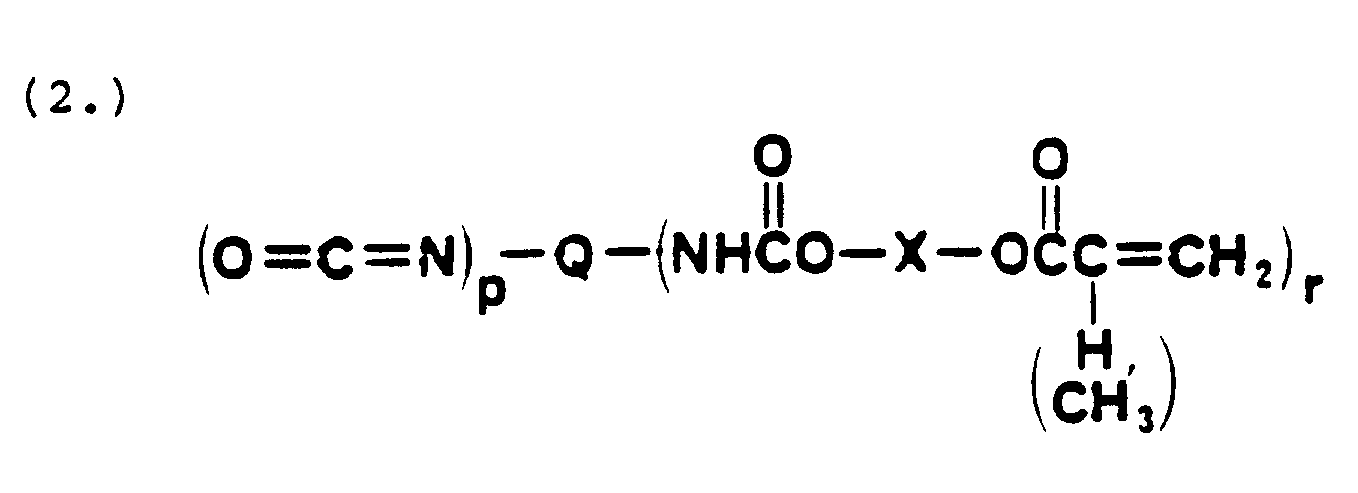
in which Q is a multivalent organic radical and x is a saturated or unsaturated, linear, branched, or cyclic divalent organic radical having from 2 to 20 carbon atoms, and in which p is an average of at least 1 and r is an average of at least 1.5.
in which Q is a multivalent organic radical and x is a saturated or unsaturated, linear, branched, or cyclic divalent organic radical having from 2 to 20 carbon atoms, and in which p is an average of at least 1 and r is an average of at least 1.5.
6. A cellulosic composition as claimed in any of the preceeding claims, further characterized
in that the cellulosic polymer reactant (a) is nitrocellulose, cellulose acetate propionate
or cellulose acetate butyrate, and the hydroxyl-functional (meth)acrylic ester reactant
(b)(i) is hydroxyethyl methacrylate.
7. A cellulosic composition as claimed in any of the preceeding claims, further characterized
in that the polyisocyanate reactant (b)(ii) is a derivative of an acyclic polyvalent
organic radical having at least three atoms selected from carbon, oxygen, phosphorus,
nitrogen and sulfur.
8. A process for making a photocurable composition as claimed in any of the preceeding
claims, in which (a) a cellulosic polymer having isocyanate-reactive hydroxyl functionality
is reacted with (b) a monoethylenically unsaturated compound having a hydroxyl-reactive
group, characterized in that 48-69 weight-% of the reactant (a) are reacted with 52-31
weight-% of the reactant (b) which is a hydroxyl-reactive poly(alpha,beta-ethylenically
unsaturated) isocyanate obtainable by reacting (i) a hydroxyl functional (meth)acrylic
ester with (ii) a polyisocyanate having an average of at least three hydroxyl reactive
isocyanate groups, the molar ratio of (meth)acrylic ester to polyisocyanate being
from about 0.6 to about 0.9.
9. Use of a photocurable composition as claimed in any of claims 1-7, for coating a substrate.
1. Photohärtbare Beschichtungsmasse, umfassend ein polyfunktionelles ethylenisch ungesättigtes
Zellulosepolymer mit im Durchschnitt mindestens 1,5 endständigen α,β-ethylenischen
Ungesättigtheiten pro substituierter Stelle einer Anhydroglucoseeinheit des Polymers,
das erhältlich ist durch Umsetzen von (a) einem Zellulosepolymer mit einer Isocyanat-reaktiven
Hydroxylfunktionalität und (b) einer monoethylenisch ungesättigten Verbindung mit
einer Hydroxyl-reaktiven Gruppe, dadurch gekennzeichnet, daß der Reaktant (a) 48 bis 69 Gew.-% der Masse ausmacht, der Reaktant (b) 52 bis
31 Gew.-% der Masse ausmacht und ein Hydroxyl-reaktives Poly(α,β-ethylenisch ungesättigtes)isocyanat
darstellt, erhältlich durch Umsetzen von (i) einem Hydroxyfunktionalität aufweisenden
(Meth)acrylsäureester mit (ii) einem Polyisocyanat, das im Durchschnitt mindestens
drei Hydroxyl-reaktive Isocyanatgruppen aufweist, wobei das Molverhältnis von (Meth)acrylsäureester
zu Polyisocyanat von 0,6 bis 0,9 beträgt.
2. Zellulosepolymermasse nach Anspruch 1, weiterhin dadurch gekennzeichnet, daß der Zellulosepolymerreaktant (a) ein Molekulargewicht zwischen 2000 und 200
000 und einen durchschnittlichen Substitutionsgrad von 0,3 bis 1,8 Isocyanat-reaktive
Hydroxylgruppen pro Anhydroglucoseeinheit des Zellulosepolymers aufweist.
3. Zellulosepolymermasse nach Anspruch 2, weiterhin dadurch gekennzeichnet, daß der durchschnittliche Substitutionsgrad des Zellulosepolymerreaktanten (a) 0,5
bis 1,3 beträgt.
4. Zellulosepolymermasse nach Anspruch 1, 2 oder 3, weiterhin dadurch gekennzeichnet, daß das Molverhältnis der Isocyanat-reaktiven Hydroxylgruppen an dem Zellulosepolymer
zu Hydroxyl-reaktivem Poly(ungesättigten)isocyanat 20:1 bis 1:1 beträgt.
5. Zellulosepolymermasse nach einem der vorangehenden Ansprüche, weiterhin dadurch gekennzeichnet, daß der Hydroxyl-reaktive Poly(α,β-ethylenisch ungesättigte)isocyanat-Reaktant (b)
die allgemeine Formel aufweist:
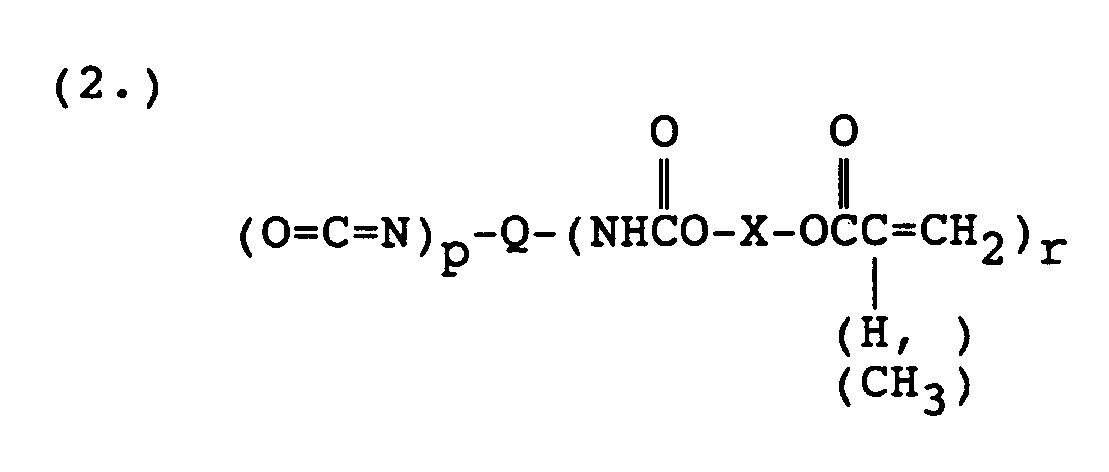
worin Q einen mehrwertigen organischen Rest bedeutet und X einen gesättigten oder ungesättigten linearen, verzweigten oder cyclischen zweiwertigen organischen Rest mit 2 bis 20 Kohlenstoffatomen bedeutet und worin p im Durchschnitt mindestens 1 ist und r im Durchschnitt mindestens 1,5 ist.
worin Q einen mehrwertigen organischen Rest bedeutet und X einen gesättigten oder ungesättigten linearen, verzweigten oder cyclischen zweiwertigen organischen Rest mit 2 bis 20 Kohlenstoffatomen bedeutet und worin p im Durchschnitt mindestens 1 ist und r im Durchschnitt mindestens 1,5 ist.
6. Zellulosepolymermasse nach einem der vorangehenden Ansprüche, weiterhin dadurch gekennzeichnet, daß der Zellulosepolymerreaktant (a) Nitrozellulose, Zelluloseacetatpropionat oder
Zelluloseacetatbutyrat ist und der Hydroxylfunktionalitäten-aufweisende (Meth)acrylester-Reaktant
(b)(i) Methacrylsäurehydroxyethylester ist.
7. Zellulosepolymermasse nach einem der vorangehenden Ansprüche, weiterhin dadurch gekennzeichnet, daß der Polyisocyanatreaktant (b)(ii) ein Derivat eines acrylischen mehrwertigen
organischen Restes mit mindestens 3 Atomen, ausgewählt aus Kohlenstoff, Sauerstoff,
Phosphor, Stickstoff und Schwefel ist.
8. Verfahren zur Herstellung einer photohärtbaren Masse nach einem der vorangehenden
Ansprüche, wobei (a) ein Zellulosepolymer mit Isocyanat-reaktiven Hydroxylfunktionalitäten
mit (b) einer monoethylenisch ungesättigten Verbindung mit einer Hydroxyl-reaktiven
Gruppe umgesetzt wird, dadurch gekennzeichnet, daß 48 bis 69 Gew.-% von Reaktant (a) mit 52 bis 31 Gew.-% von Reaktant (b), der
ein Hydroxyl-reaktives Poly(α,β-ethylenisch ungesättigtes)isocyanat darstellt, erhältlich
durch Umsetzung (i) von einem Hydroxylfunktionalität aufweisenden (Meth)acrylsäureester
mit (ii) einem Polyisocyanat, das mindestens drei Hydroxyl-reaktive Isocyanatgruppen
aufweist, wobei das Molverhältnis von (Meth)acrylsäureester zu Polyisocyanat etwa
0,6 bis etwa 0,9 beträgt, umgesetzt wird.
9. Verwendung einer photohärtbaren Masse nach einem der Ansprüche 1 bis 7 zum Beschichten
eines Substrats.
1. Composition de revêtement photodurcissable comprenant un polymère cellulosique à insaturation
éthylénique polyfonctionnel ayant une moyenne d'au moins 1,5 insaturation α,β-éthylénique
terminale par position substituée de motif anhydroglucose du polymère que l'on peut
obtenir par réaction (a) d'un polymère cellulosique ayant une fonctionnalité hydroxy
réactive aux isocyanates et (b) un composé à mono-insaturation éthylénique ayant un
groupement réactif sur les groupements hydroxy, caractérisée en ce que le réactif
(a) constitue de 48 à 69% en poids de la composition, le réactif (b) constitue de
52 à 31% en poids de la composition et est un poly(isocyanate à insaturation α,β-éthylénique)
que l'on peut obtenir en faisant réagir (i) un ester (méth)acrylique à fonction hydroxy
avec (ii) un polyisocyanate ayant une moyenne d'au moins trois groupements isocyanate
réactifs sur les groupements hydroxy, le rapport molaire de l'ester (méth)acrylique
au polyisocyanate étant de 0,6 à 0,9.
2. Composition cellulosique selon la revendication 1, caractérisée en outre en ce que
le réactif polymère cellulosique (a) a un poids moléculaire compris entre 2 000 et
200 000 et un degré moyen de substitution de 0,3 à 1,8 groupement hydroxy réactif
sur les isocyanates par motif anhydroglucose du polymère cellulosique.
3. Composition cellulosique selon la revendication 2, caractérisée en outre en ce que
le degré moyen de substitution du réactif polymère cellulosique (a) est de 0,5 à 1,3.
4. Composition cellulosique selon la revendication 1, 2 ou 3, caractérisée en outre en
ce que le rapport molaire des groupements hydroxy réactifs sur des groupements isocyanate
du polymère cellulosique au poly(isocyanate insaturé) réactif sur les groupements
hydroxy est de 20:1 à 1:1.
5. Composition cellulosique selon l'une quelconque des revendications précédentes, caractérisée
en outre en ce que le réactif poly(isocyanate à insaturation α,β-éthylénique) réactif
sur des groupements hydroxy (b) a la formule générale :
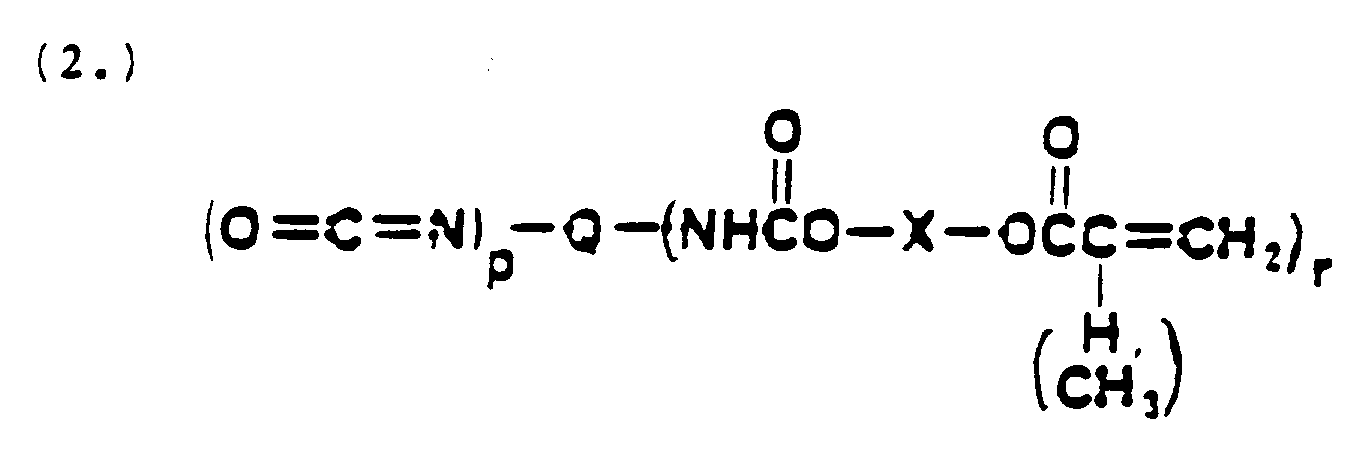
dans laquelle Q est un radical organique multivalent et X est un radical organique divalent saturé ou insaturé, linéaire, ramifié ou cyclique ayant de 2 à 20 atomes de carbone, et dans laquelle p est une valeur moyenne d'au moins 1 et r est est une valeur moyenne d'au moins 1,5.
dans laquelle Q est un radical organique multivalent et X est un radical organique divalent saturé ou insaturé, linéaire, ramifié ou cyclique ayant de 2 à 20 atomes de carbone, et dans laquelle p est une valeur moyenne d'au moins 1 et r est est une valeur moyenne d'au moins 1,5.
6. Composition cellulosique selon l'une quelconque des revendications précédentes, caractérisée
en outre en ce que le réactif polymère cellulosique (a) est la nitrocellulose, l'acétate-propionate
de cellulose ou l'acétate-butyrate de cellulose, et le réactif ester (méth)acrylique
à fonction hydroxy (b) (i) est le méthacrylate d'hydroxyéthyle.
7. Composition cellulosique selon l'une quelconque des revendications précédentes, caractérisée
en outre en ce que le réactif polyisocyanate (b) (ii) est un dérivé d'un radical organique
polyvalent acyclique ayant au moins trois atomes choisis entre le carbone, l'oxygène,
le phosphore, l'azote et le soufre.
8. Procédé de préparation d'une composition photodurcissable selon l'une quelconque des
revendications précédentes, dans lequel (a) on fait réagir un polymère cellulosique
ayant une fonctionnalité hydroxy réactive aux groupements isocyanate avec (b) un composé
à mono-insaturation éthylénique ayant un groupement réactif sur ces groupements hydroxy,
caractérisé en ce qu'on fait réagir 48 à 69% en poids du réactif (a) avec 52-31% en
poids du réactif (b) qui est un poly(isocyanate à insaturation α,β-éthylénique) réactif
sur les groupements hydroxy que l'on peut obtenir en faisant réagir (i) un ester (méth)acrylique
à fonction hydroxy avec (ii) un polyisocyanate ayant une moyenne d'au moins trois
groupements isocyanate réactifs sur les groupements hydroxy, le rapport molaire de
l'ester (méth)acrylique au polyisocyanate étant d'environ 0,6 à environ 0,9.
9. Utilisation d'une composition photodurcissable selon l'une quelconque des revendications
1 à 7, pour le revêtement d'un substrat.