|
(11) | EP 0 322 401 B1 |

| (12) | EUROPEAN PATENT SPECIFICATION |
|
|
| (54) |
Tetrahydrophthalimide derivatives, their production and use Tetrahydrophthalimidderivate, Verfahren zu ihrer Herstellung und ihre Verwendung Dérivés de tétrahydrophtalimide, leur production et utilisation |
|
|
|||||||||||||||||||||||||||||||||||
| Note: Within nine months from the publication of the mention of the grant of the European patent, any person may give notice to the European Patent Office of opposition to the European patent granted. Notice of opposition shall be filed in a written reasoned statement. It shall not be deemed to have been filed until the opposition fee has been paid. (Art. 99(1) European Patent Convention). |
[0001] This invention relates to tetrahydrophthalimide derivatives and their production and use. More particularly, it relates to tetrahydrophthalimide N-phenylamino acid esters of the formula V
wherein X is a hydrogen atom, a fluorine atom or a chlorine atom, R² is a hydrogen atom or a methyl group, R³ is a hydrogen atom or a methyl group and R⁴ is a C₁-C₄ alkyl group.
[0002] The compounds of formula V are intermediates for the preparation of compounds of formula II
wherein X is as defined above and A is a group of the formula:
in which R² is a hydrogen atom or a methyl group, R³ is a hydrogen atom or a methyl group and the nitrogen atom is bonded to the benzene ring. The compounds of formula II are used for the preparation of tetrahydrophthalimides of the formula I:
wherein R¹ is a C₁-C₅ alkyl group, a C₃-C₅ alkenyl group, a C₃-C₅ alkynyl group or a C₁-C₃ alkoxymethyl group and X and A are as defined above.
[0003] The tetrahydrophthalimides (I) show a high herbicidal activity against a wide variety of weeds. The tetrahydrophthalimides of formula (I), their production and their use is described in EP-A-0 177 032.
[0004] The N-phenylamino acid esters of the formula V of the invention are obtainable by the reaction of the N-nitrophenylphthalimide of the formula IV:
wherein X is as defined above, with an amino acid ester of the formula VIII:
wherein R², R³ and R⁴ are each as defined above in an amount of 2.5 to 4 equivalents to one equivalent of the N-nitrophenylphthalimide (IV) in a solvent (e.g. dioxane, dimethylformamide, dimethylsulfoxide) at a temperature of 50 to 200°C to give the N-phenylamino acid ester (V).
[0005] The use of the N-phenylamino acid esters of the formula V for the preparation of compounds of formula II is summarized in the following scheme:
wherein X, R², R³ and R⁴ are each as defined above.
[0006] The N-phenylamino acid ester (V) is subjected to reductive cyclization with an appropriate reducing agent, for instance, iron in an acid (e.g. acetic acid) to give the dihydroquinoxalinone (IIa). More specifically, the N-phenylamino acid ester (V) is treated with 3 to 10 equivalent amounts of powdery iron such as electrolytic iron or reduced iron in a solvent (e.g. water, alcohol, acetic acid, ethyl acetate) in the presence of an excessive amount of an acid (e.g. acetic acid, hydrochloric acid) at a temperature of 50 to 200°C.
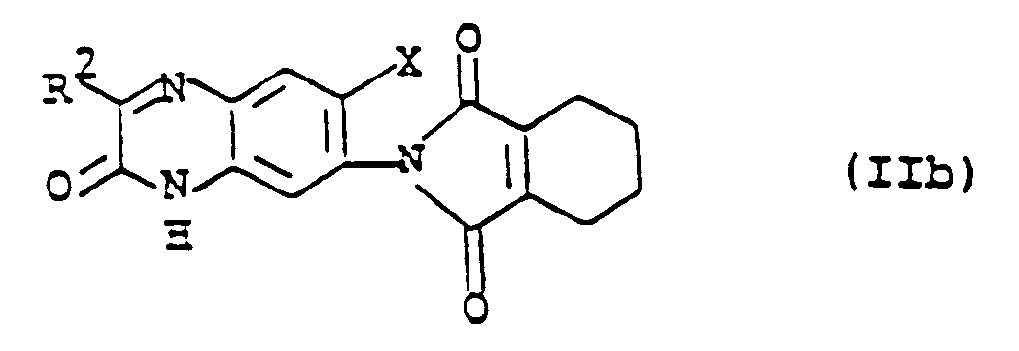
[0007] The quinoxalinone (IIb) is obtainable by oxidizing the dihydroquinoxalinone (IIa) in an excessive amount of hydrogen peroxide in the presence of sodium hydroxide.
[0008] The quinoxaline (II) as well as the N-phenylamino acid ester (V) are novel, while the N-nitrophenylphthalimide (IV) is per se known and obtainable by the method as described in EP-A-0 077 938A.
[0009] Typical examples for production of the compounds (V) and (II) are illustratively shown in the following Examples.
Example 1
[0010] 2-(4-Fluoro-3-nitrophenyl)-4,5,6,7-tetrahydro-2H-isoindole-1,3-dione (5.8 g) was added to a mixture of glycine methyl ester hydrochloride (7.5 g), triethylamine (6 g) and 1,4-dioxane (50 ml), and the resultant mixture was heated under reflux for 4 hours followed by addition of water and extraction with ethyl acetate. The extract was washed with water, dried and concentrated. The residue was crystallized from methanol to give 2-(4-methoxycarbonylmethylamino-3-nitrophenyl)-4,5,6,7-tetrahydro-2H-isoindole-1,3- dione (2.6 g). m.p. 220°C.
[0011] In the same manner as above, the N-phenylamino acid esters (V) as shown in Table 1 were obtained:
Example 2
[0012] 2-(4-Methoxycarbonylmethylamino-3-nitrophenyl)-4,5,6,7-tetrahydro-2H-isoindole-1,3-dione (2.06 g) was dissolved in a mixture of acetic acid (20 ml) and ethyl acetate (20 ml), and the resultant solution was dropwise added to a mixture of 5 % aqueous acetic acid (10 ml) and iron powder (4 g) at 70 to 80°C, followed by stirring at the same temperature for 3 hours. The reaction mixture was allowed to cool, diluted with water and extracted with ethyl acetate. The extract was washed with sodium bicarbonate solution, dried and concentrated to give 2-(3,4-dihydro-2(1H)-quinoxalinon-7-yl)-4,5,6,7-tetrahydro-2H-isoindole-1,3-dione (1.3 g). m.p. 208 - 209°C.
[0013] In the same manner as above, the dihydroquinoxalinones (IIa) as shown in Table 2 were obtained.
Example 3
[0014] 2-(3,4-Dihydro-6-fluoro-2(1H)-quinoxalinon-7-yl)-4,5,6,7-tetrahydro-2H-isoindole-1,3-dione (0.43 g) was added to a mixture of sodium hydroxide (0.16 g), water (2.1 ml) and 30 % aqueous hydrogen peroxide (0.21 ml), and the resultant mixture was stirred at room temperature for 16 hours. Ether was added thereto to separate an aqueous layer, which was adjusted to pH 4 with acetic acid. The precipitated crystals were collected by filtration and washed with water to give 2-(6-fluoro-2(1H)quinoxalinon-7-yl)-4,5,6,7-tetrahydro-2H-isoindole-1,3-dione (0.32 g). m.p. >300°C.
1. A compound of the formula V:
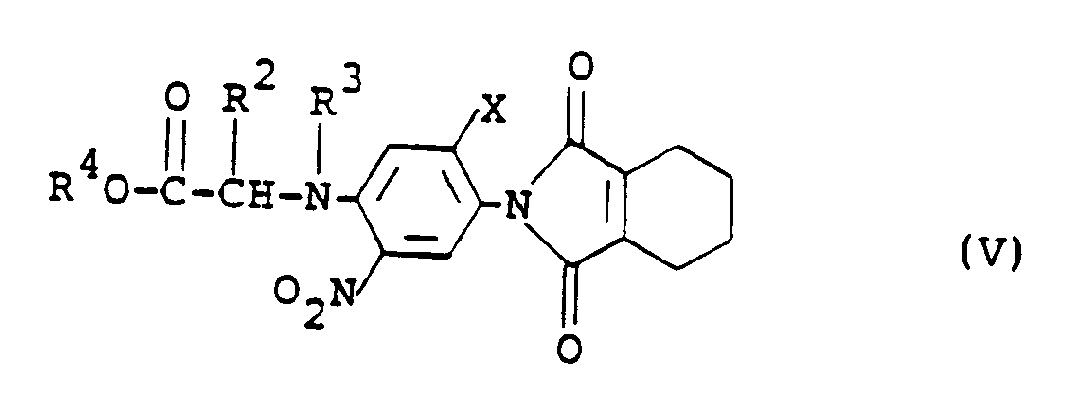
wherein X is a hydrogen atom, a fluorine atom or a chlorine atom, R² is a hydrogen atom or a methyl group, R³ is a hydrogen atom or a methyl group and R⁴ is a C₁-C₄ alkyl group.
wherein X is a hydrogen atom, a fluorine atom or a chlorine atom, R² is a hydrogen atom or a methyl group, R³ is a hydrogen atom or a methyl group and R⁴ is a C₁-C₄ alkyl group.
2. A process for preparing the compound according to claim 1 which comprises reacting
a compound of formula IV
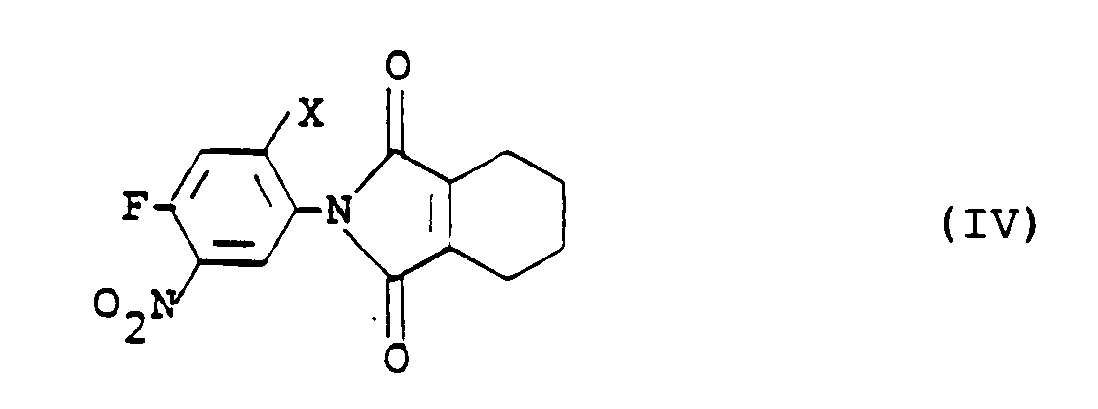
wherein X is as defined in claim 1, with a compound of formula VIII
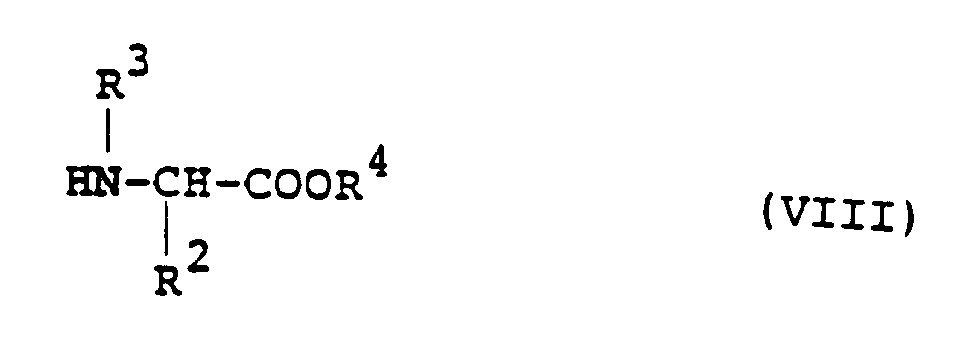
wherein R², R³ and R⁴ are as defined in claim 1.
wherein X is as defined in claim 1, with a compound of formula VIII
wherein R², R³ and R⁴ are as defined in claim 1.
3. Use of the compound according to claim 1 for the preparation of a compound of formula
II
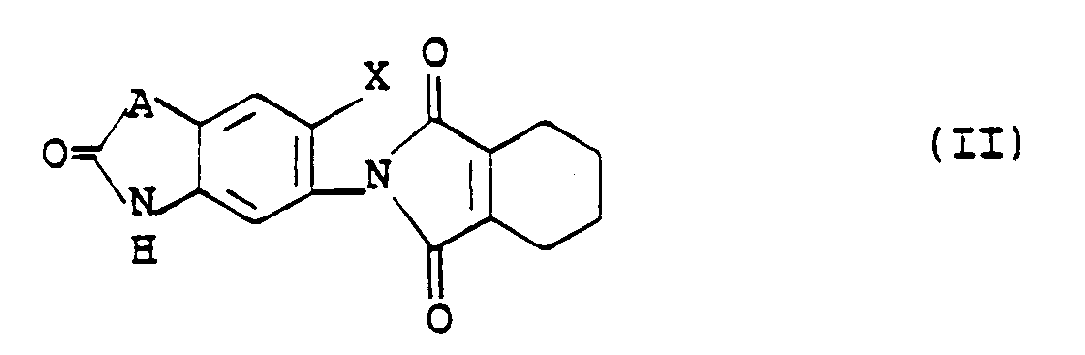
wherein X is as defined in claim 1 and A is a group of the formula:
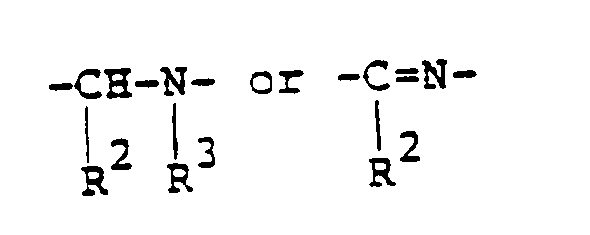
in which R² is a hydrogen atom or a methyl group, R³ is a hydrogen atom or a methyl group and the nitrogen atom is bonded to the benzene ring,
which comprises subjecting a compound according to claim 1 to reductive cyclization to give the dihydroquinoxalinone of formula IIa
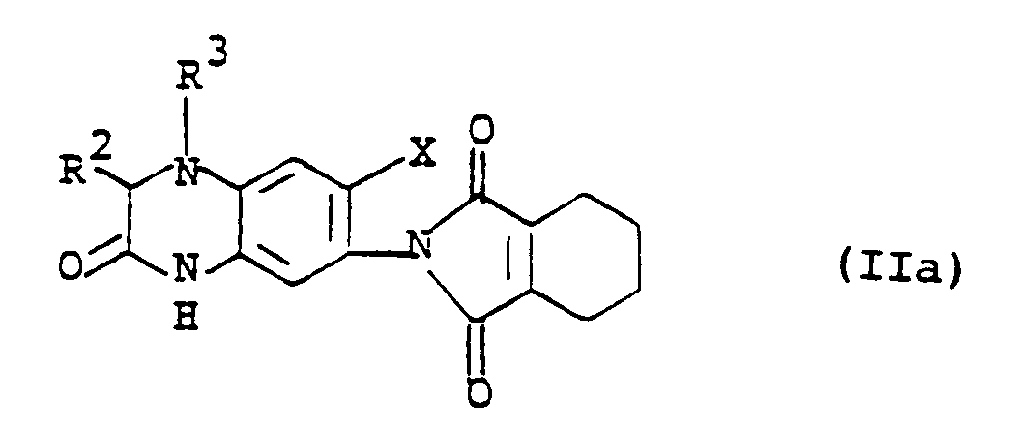
wherein X, R² and R³ are as defined above, and optionally oxidizing the compound of formula IIa to give the compound of formula IIb
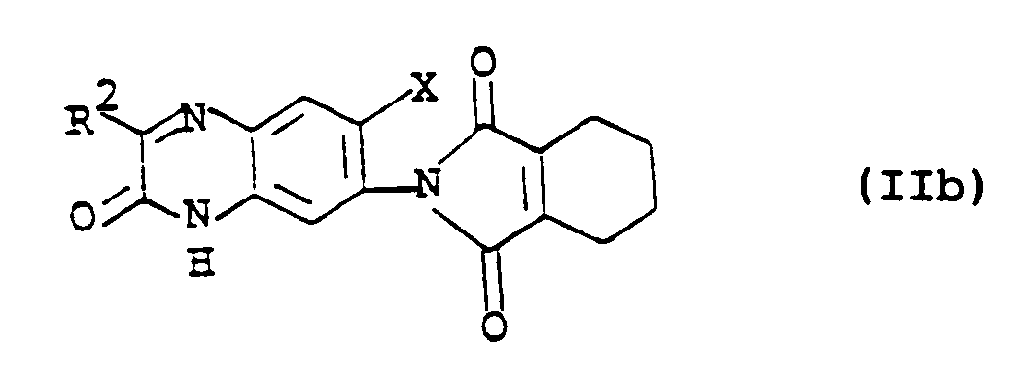
wherein X and R² are as defined above.
wherein X is as defined in claim 1 and A is a group of the formula:
in which R² is a hydrogen atom or a methyl group, R³ is a hydrogen atom or a methyl group and the nitrogen atom is bonded to the benzene ring,
which comprises subjecting a compound according to claim 1 to reductive cyclization to give the dihydroquinoxalinone of formula IIa
wherein X, R² and R³ are as defined above, and optionally oxidizing the compound of formula IIa to give the compound of formula IIb
wherein X and R² are as defined above.
1. Verbindung der Formel V:
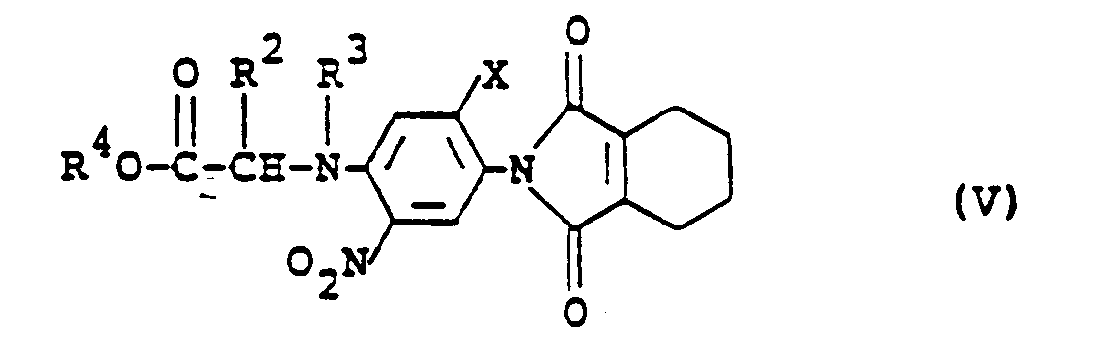
in der X ein Wasserstoffatom, ein Fluoratom oder ein Chloratom bedeutet, R² ein Wasserstoffatom oder eine Methylgruppe darstellt, R³ ein Wasserstoffatom oder eine Methylgruppe bedeutet und R⁴ ein C₁-C₄-Alkylrest ist.
in der X ein Wasserstoffatom, ein Fluoratom oder ein Chloratom bedeutet, R² ein Wasserstoffatom oder eine Methylgruppe darstellt, R³ ein Wasserstoffatom oder eine Methylgruppe bedeutet und R⁴ ein C₁-C₄-Alkylrest ist.
2. Verfahren zur Herstellung der Verbindung nach Anspruch 1, umfassend die Umsetzung
einer Verbindung der Formel IV
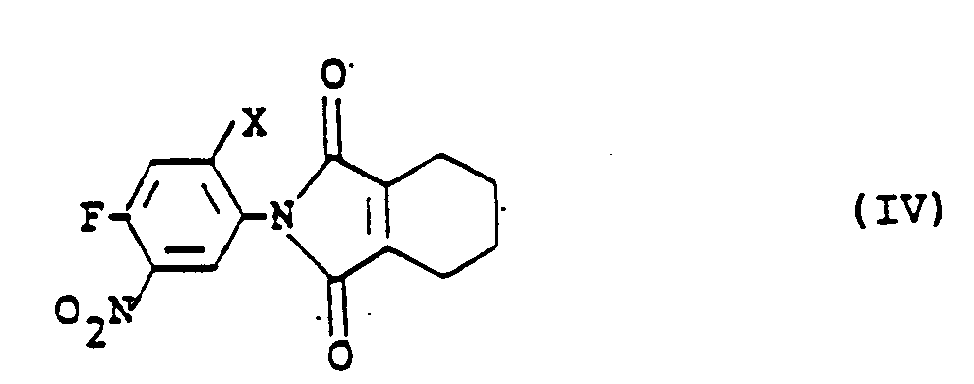
in der X wie in Anspruch 1 definiert ist, mit einer Verbindung der Formel VIII
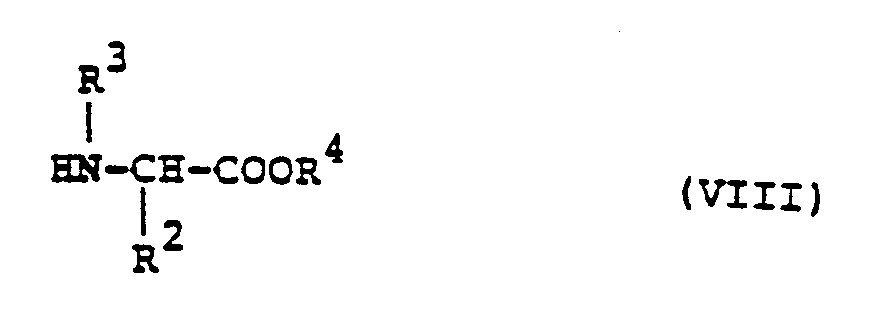
in der R², R³ und R⁴ wie in Anspruch 1 definiert sind.
in der X wie in Anspruch 1 definiert ist, mit einer Verbindung der Formel VIII
in der R², R³ und R⁴ wie in Anspruch 1 definiert sind.
3. Verwendung der Verbindung nach Anspruch 1 für die Herstellung einer Verbindung
der Formel II
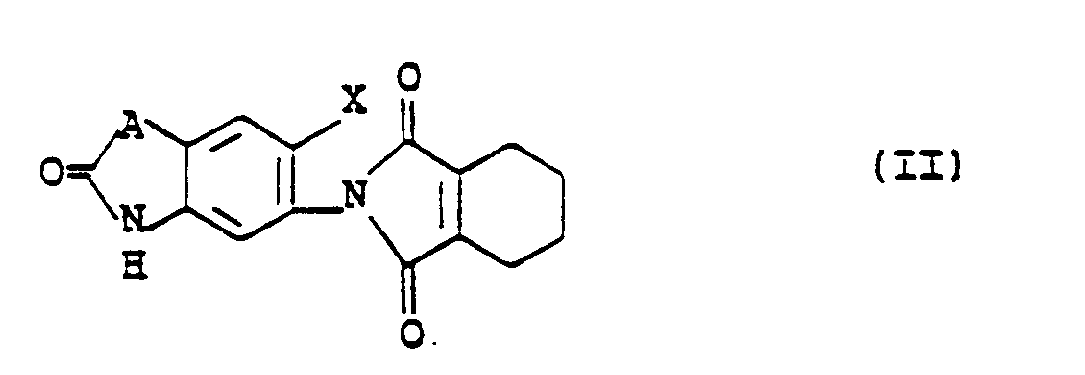
in der X wie in Anspruch 1 definiert ist und A ein Rest der Formel
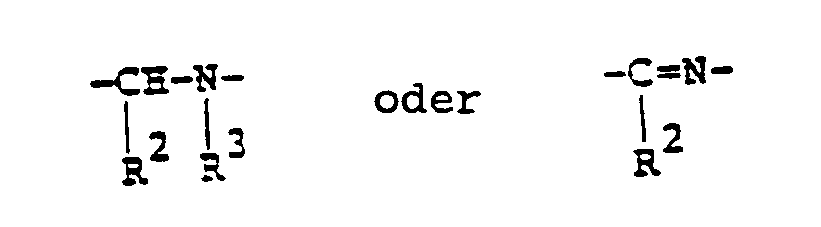
ist, in der R² ein Wasserstoffatom oder eine Methylgruppe bedeutet, R³ ein Wasserstoffatom oder eine Methylgruppe darstellt und das Stickstoffatom an den Benzolring gebunden ist,
umfassend die reduktive Cyclisierung einer Verbindung nach Anspruch 1 zu dem Dihydrochinoxalinon der Formel IIa
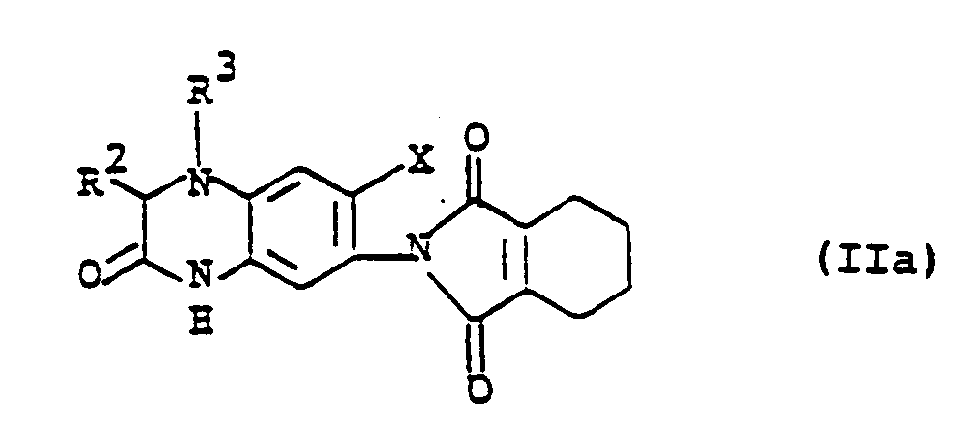
in der X, R² und R³ wie vorstehend angegeben definiert sind, und gegebenenfalls die Oxidation der Verbindung der Formel IIa zur Verbindung der Formel IIb
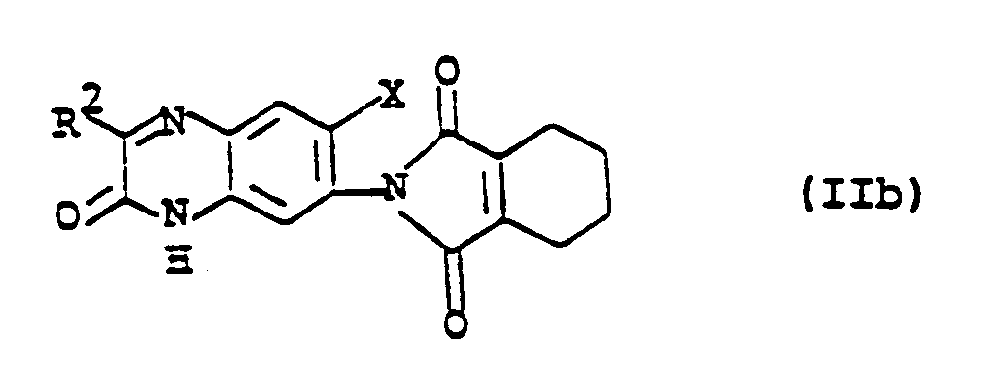
in der X und R² wie vorstehend angegeben definiert sind.
in der X wie in Anspruch 1 definiert ist und A ein Rest der Formel
ist, in der R² ein Wasserstoffatom oder eine Methylgruppe bedeutet, R³ ein Wasserstoffatom oder eine Methylgruppe darstellt und das Stickstoffatom an den Benzolring gebunden ist,
umfassend die reduktive Cyclisierung einer Verbindung nach Anspruch 1 zu dem Dihydrochinoxalinon der Formel IIa
in der X, R² und R³ wie vorstehend angegeben definiert sind, und gegebenenfalls die Oxidation der Verbindung der Formel IIa zur Verbindung der Formel IIb
in der X und R² wie vorstehend angegeben definiert sind.
1. Un composé de formule V :
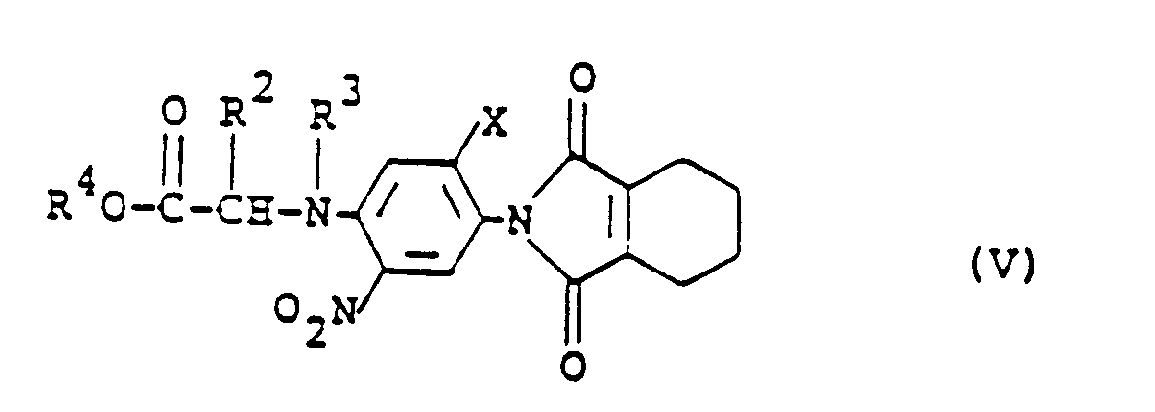
dans laquelle X est un atome d'hydrogène, un atome de fluor ou un atome de chlore, R² est un atome d'hydrogène ou un groupe méthyle, R³ est un groupe d'hydrogène ou un groupe méthyle et R⁴ est un groupe alkyle en C₁-C₄.
dans laquelle X est un atome d'hydrogène, un atome de fluor ou un atome de chlore, R² est un atome d'hydrogène ou un groupe méthyle, R³ est un groupe d'hydrogène ou un groupe méthyle et R⁴ est un groupe alkyle en C₁-C₄.
2. Un procédé pour préparer le composé selon la revendication 1 qui comprend la réaction
d'un composé de formule IV :
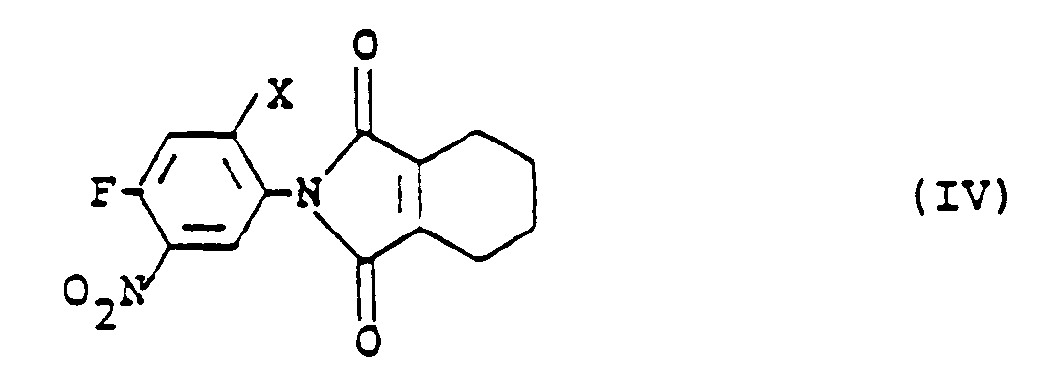
dans laquelle X est défini comme à la revendication 1 avec un composé de formule VIII :
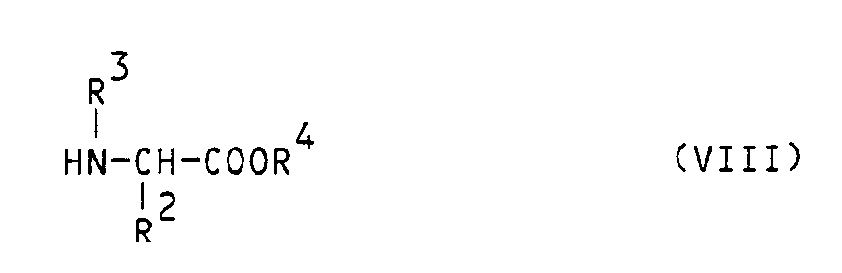
dans laquelle R², R³ et R⁴ sont définis comme à la revendication 1.
dans laquelle X est défini comme à la revendication 1 avec un composé de formule VIII :
dans laquelle R², R³ et R⁴ sont définis comme à la revendication 1.
3. Utilisation du composé selon la revendication 1 pour la préparation d'un composé
de formule II :
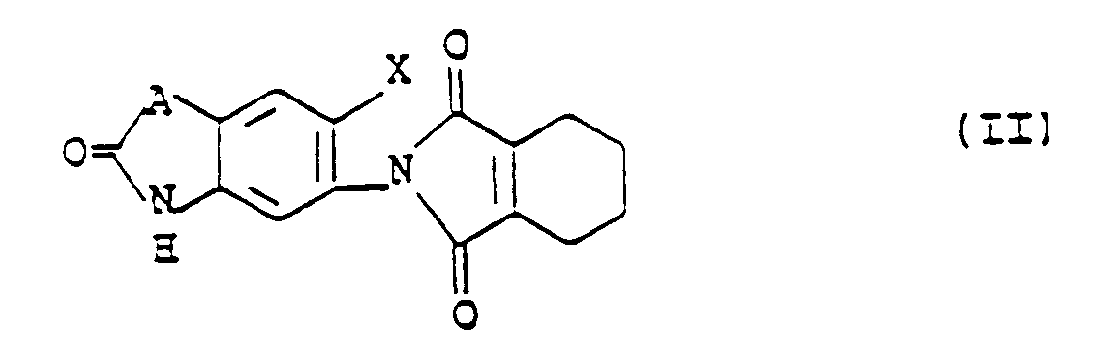
dans laquelle X est défini comme à la revendication 1 et A est un groupe de formule :
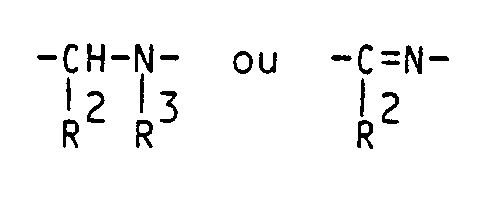
dans laquelle R² est un atome d'hydrogène ou un groupe méthyle, R³ est un atome d'hydrogène ou un groupe méthyle et l'atome d'azote est lié au noyau benzénique,
qui consiste à soumettre un composé selon la revendication 1 à une cyclisation réductive pour donner la dihydroquinoxalinone de formule IIa :
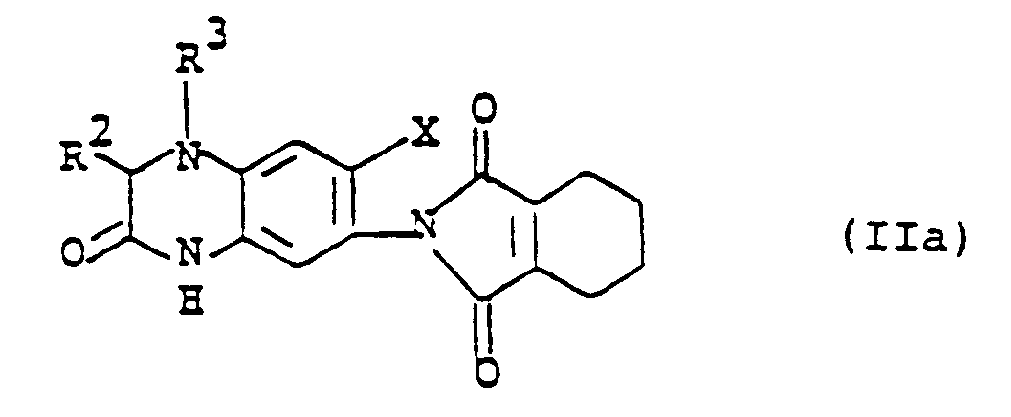
dans laquelle X, R² et R³ sont définis comme ci-dessus et facultativement à oxyder le composé de formule IIa pour donner le composé de formule IIb :
dans laquelle X et R² sont définis comme ci-dessus.
dans laquelle X est défini comme à la revendication 1 et A est un groupe de formule :
dans laquelle R² est un atome d'hydrogène ou un groupe méthyle, R³ est un atome d'hydrogène ou un groupe méthyle et l'atome d'azote est lié au noyau benzénique,
qui consiste à soumettre un composé selon la revendication 1 à une cyclisation réductive pour donner la dihydroquinoxalinone de formule IIa :
dans laquelle X, R² et R³ sont définis comme ci-dessus et facultativement à oxyder le composé de formule IIa pour donner le composé de formule IIb :
dans laquelle X et R² sont définis comme ci-dessus.