|
(11) | EP 0 322 457 B1 |

| (12) | EUROPEAN PATENT SPECIFICATION |
|
|
| (54) |
WATER-SOLUBLE REACTIVE DYE MIXTURE AND PROCESS FOR DYEING CELLULOSE FIBERS USING SAME WASSERLÖSLICHE REAKTIVFARBSTOFFMISCHUNG UND VERFAHREN ZUM FÄRBEN VON ZELLULOSEFASERN MELANGE DE COLORANTS REACTIFS SOLUBLES DANS L'EAU ET PROCEDE PERMETTANT LA TEINTURE DE FIBRES CELLULOSIQUES UTILISANT LEDIT MELANGE |
|
|
|||||||||||||||||||||||||||||||
| Note: Within nine months from the publication of the mention of the grant of the European patent, any person may give notice to the European Patent Office of opposition to the European patent granted. Notice of opposition shall be filed in a written reasoned statement. It shall not be deemed to have been filed until the opposition fee has been paid. (Art. 99(1) European Patent Convention). |
TECHNICAL FIELD
[0001] This invention ralates to mixtures of water-soluble reactive dyes and a method of dyeing cellulosic fibers using such dye mixtures. More particularly, it is concerned with mixtures of water-soluble reactive dyes which are excellent in various dyeing properties and are prepared by blending a yellow and/or blue dye having a particular chemical structure with a red dye, as the base, having a particular chemical structure; and a method of dyeing cellulosic fibers using such dye mixtures.
BACKGROUND TECHNOLOGY
[0002] The water-soluble reactive dyes (hereinafter simply called "reactive dyes") have heretofore been used widely as the dyestuff for dyeing cellulosic fibers. As the method of dyeing the fiber materials with use of such reactive dyes, there have been adopted various known techniques such as exhaustion method and printing method. Of these various dyeing methods, the exhaustion method for dyeing the cellulosic fibers requires the presence, in the dye bath, of inorganic salts such as Glauber's salt, edible salt, and others together with alkali. In particular, for obtaining dyed fabrics of high density, it is usually necessary that approximately 50 to 100 g of the inorganic salt per 1 liter of the dye bath be added. If the added quantity of the inorganic salt is too small, it is not possible to dye the cellulosic fibers to an intended color hue.
[0003] In recent years, reduction in quantity of the inorganic salts in the dye bath has been desired from the standpoint of rationalizing the operations in the dyeing factories. In other words, the reduction in the quantity of the inorganic salts not only leads to reduction in the manufacturing cost, but also to reduction in the load imposed on disposal of the waste water from the dye bath. Accordingly, for the purpose of such dyeing method, there is a demand for reactive dyes which are not only superior in their fastness to various circumstances as well as their reproducibility, but also are capable of favorably dyeing the cellulosic fibers even under a condition wherein the density of the inorganic salt is, for example, as low as 5 to 40 g per 1 liter of the dye bath. While there have so far been known a large number of reactive dyes, however, almost all of them would require a large amount of the inorganic salt at the time of dyeing.
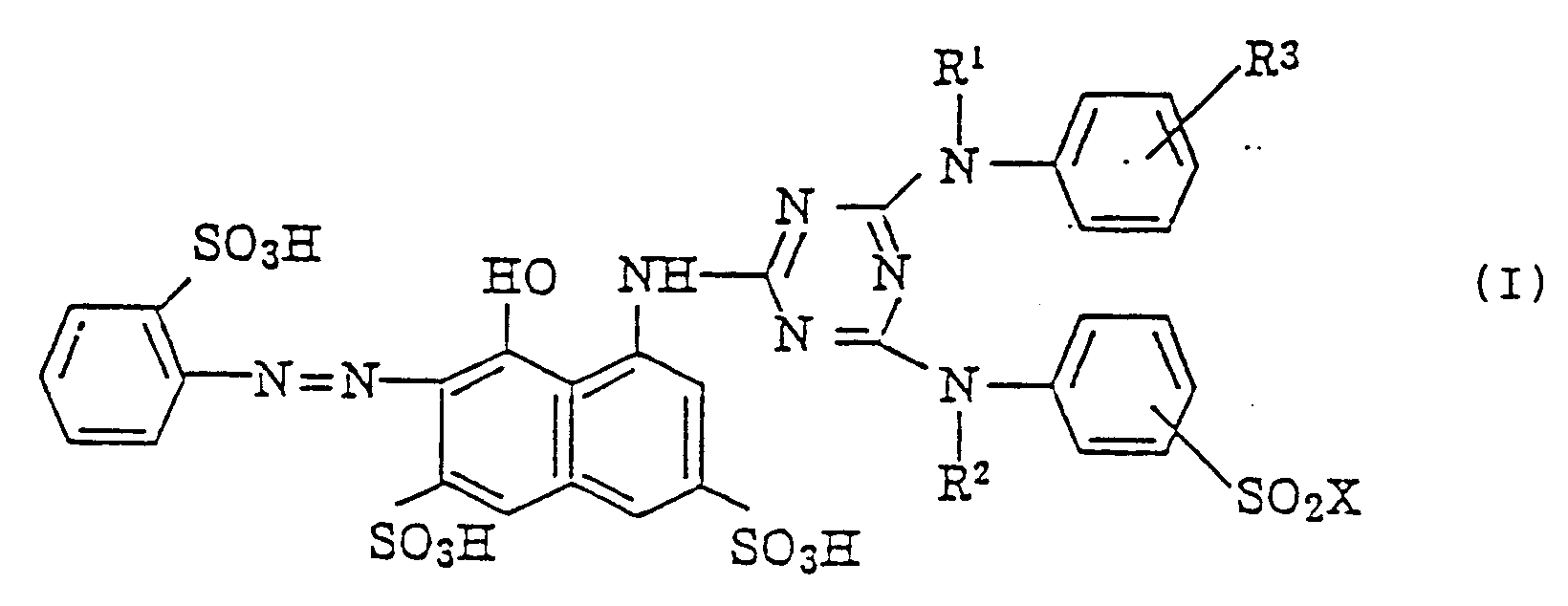
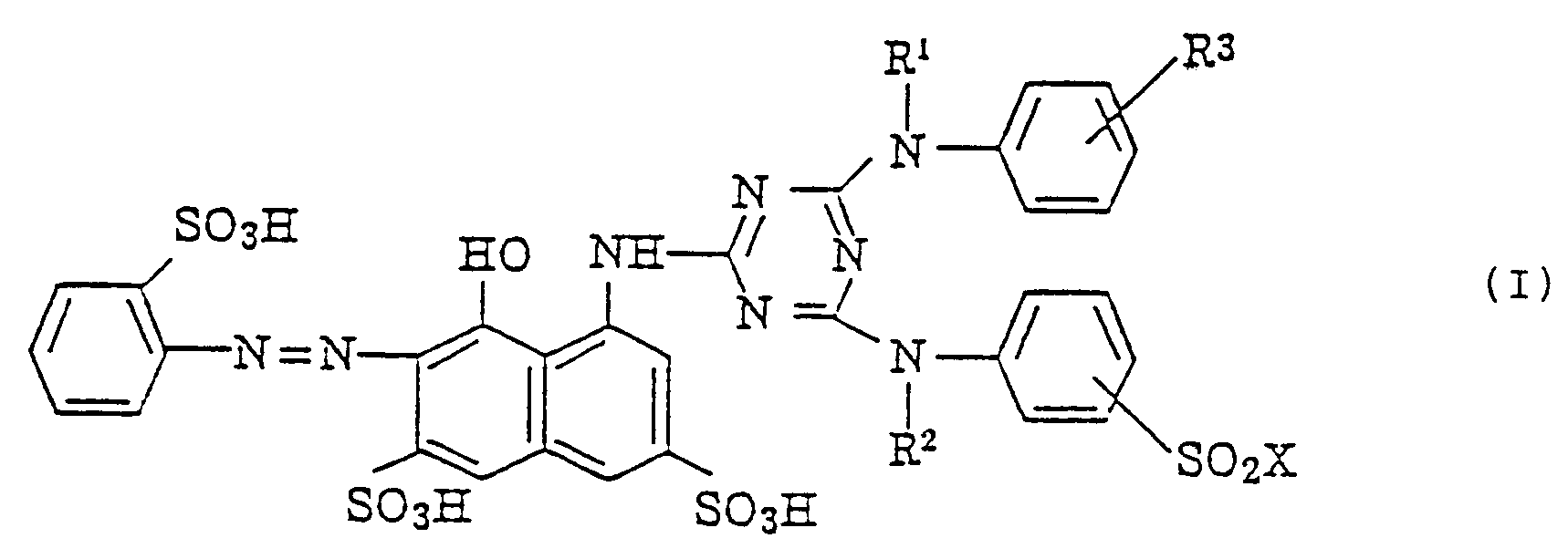
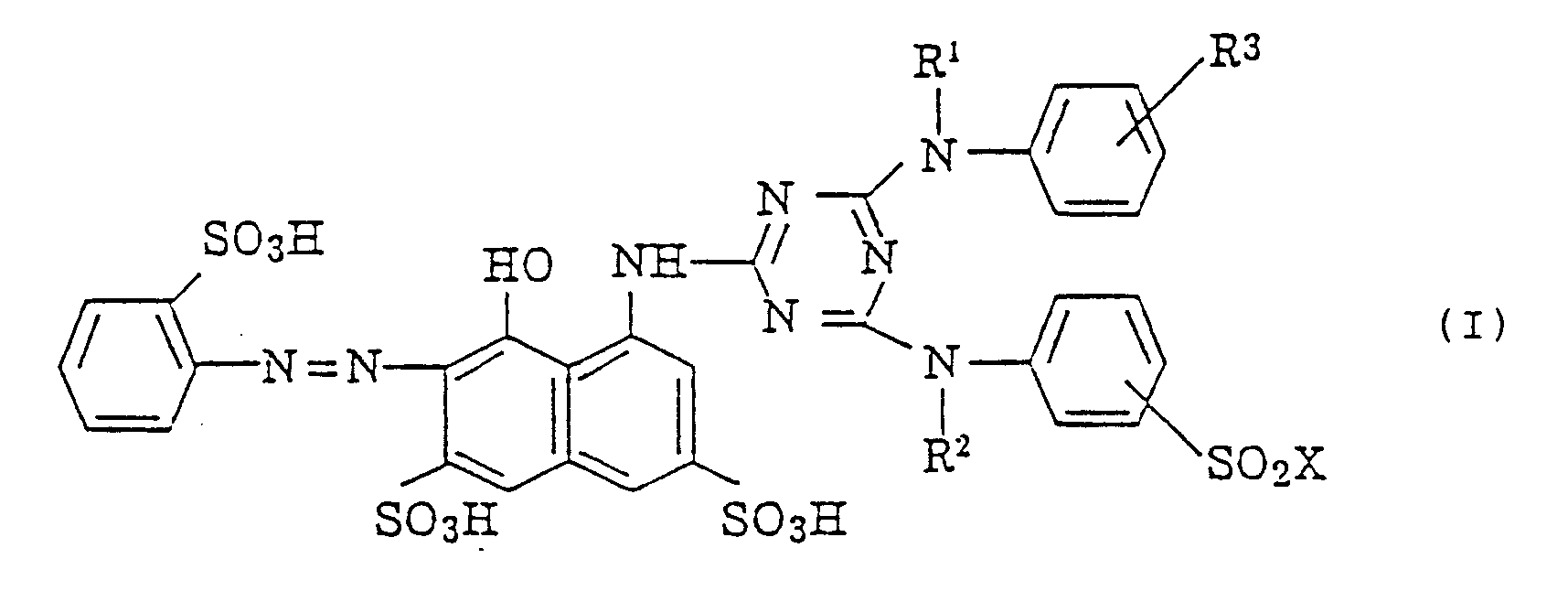
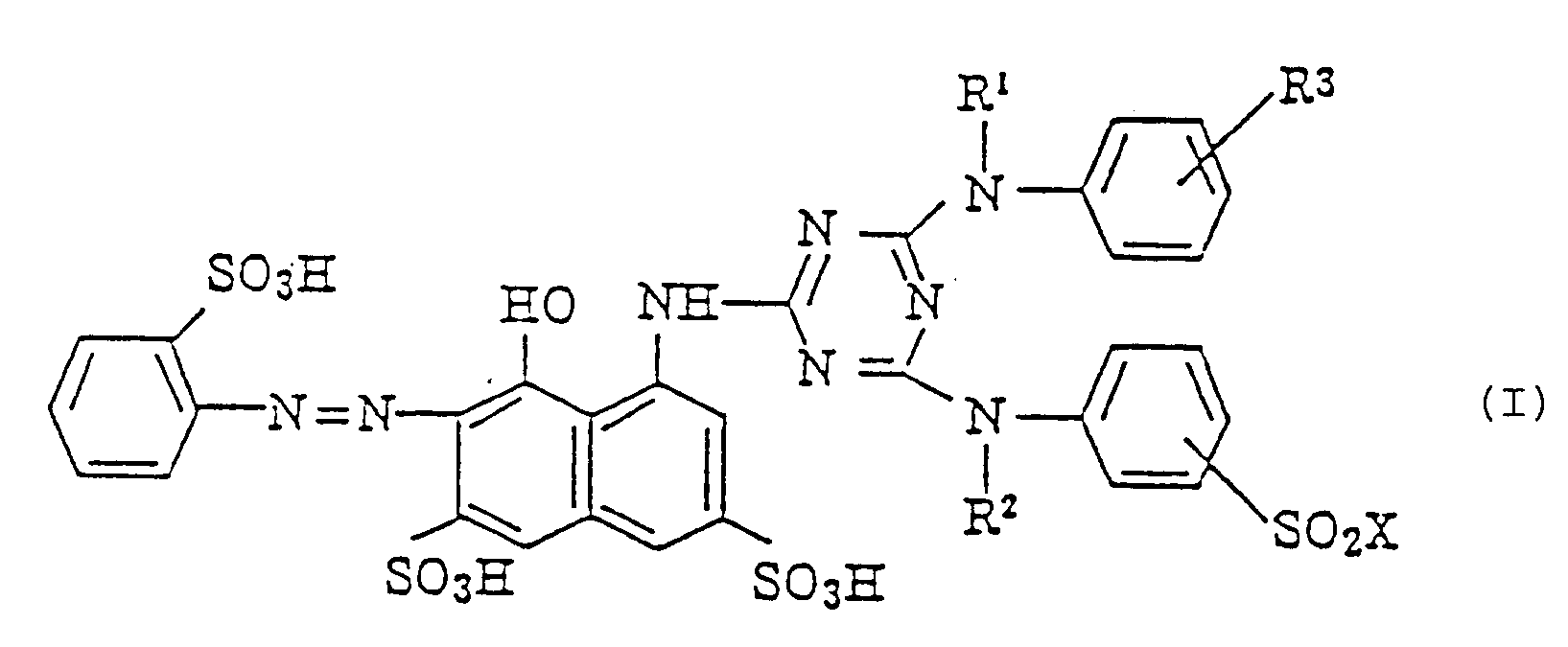
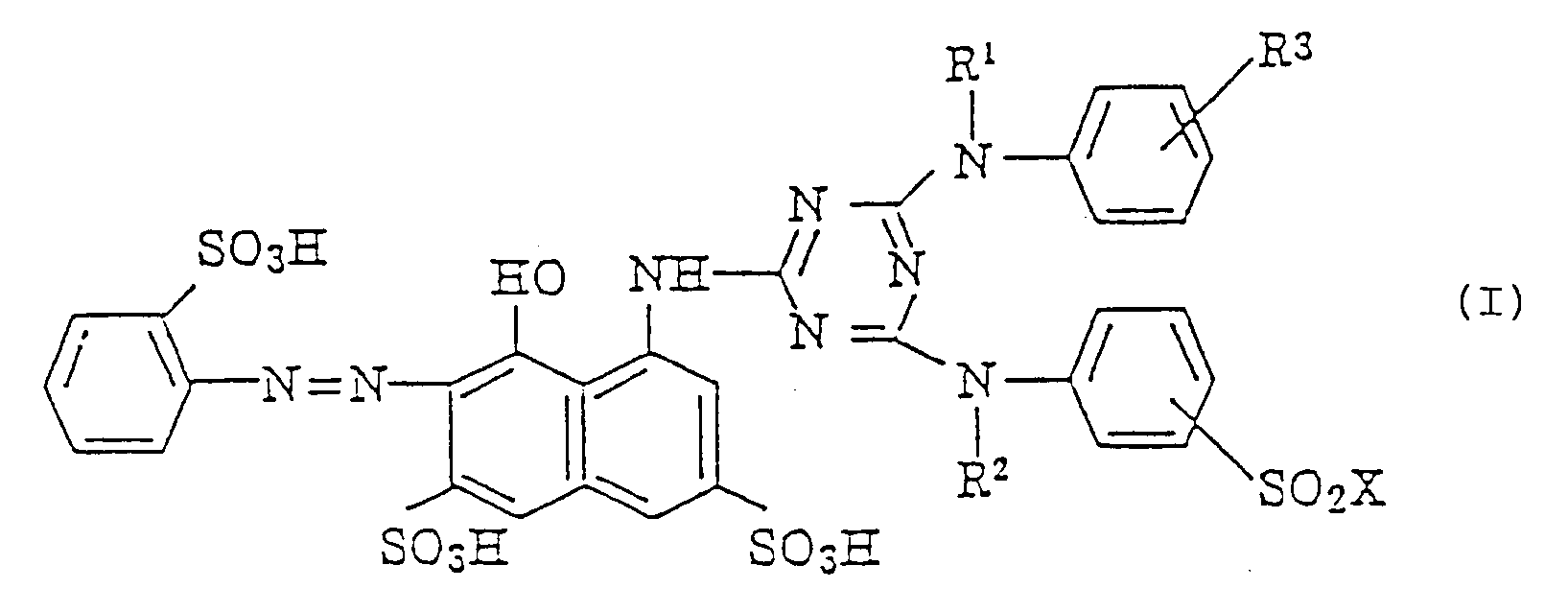
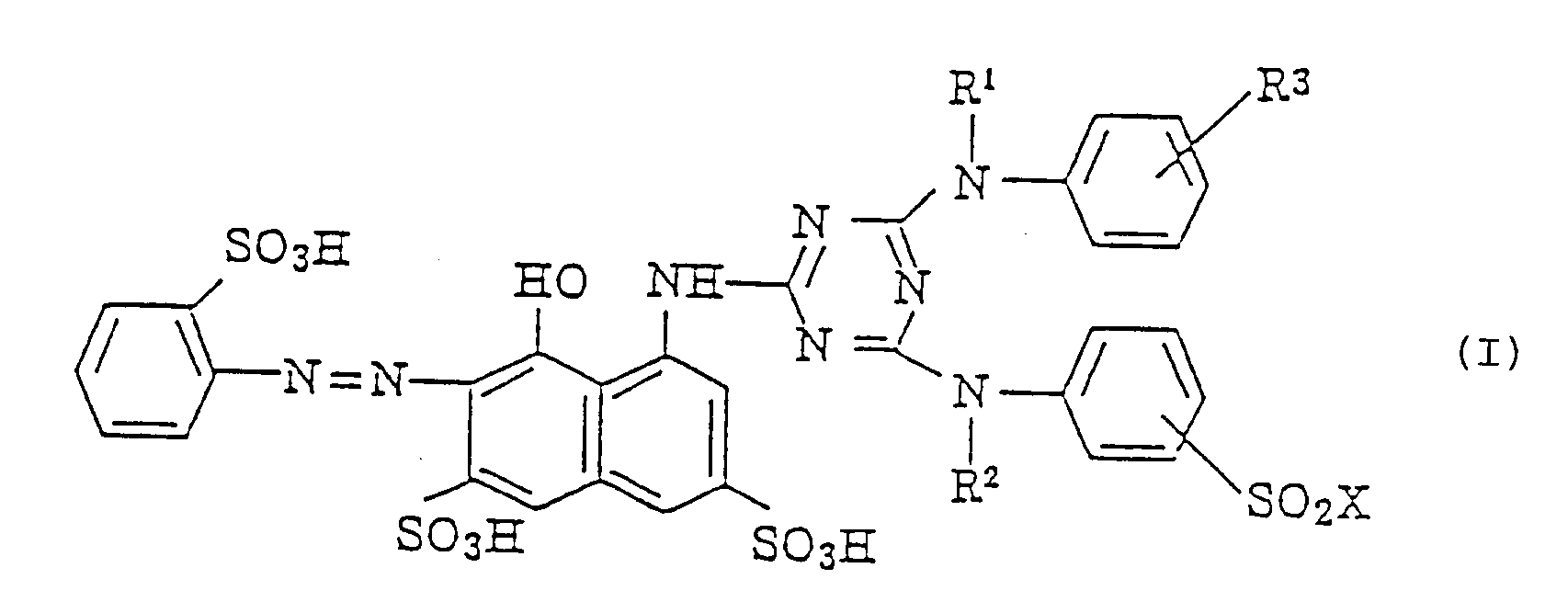
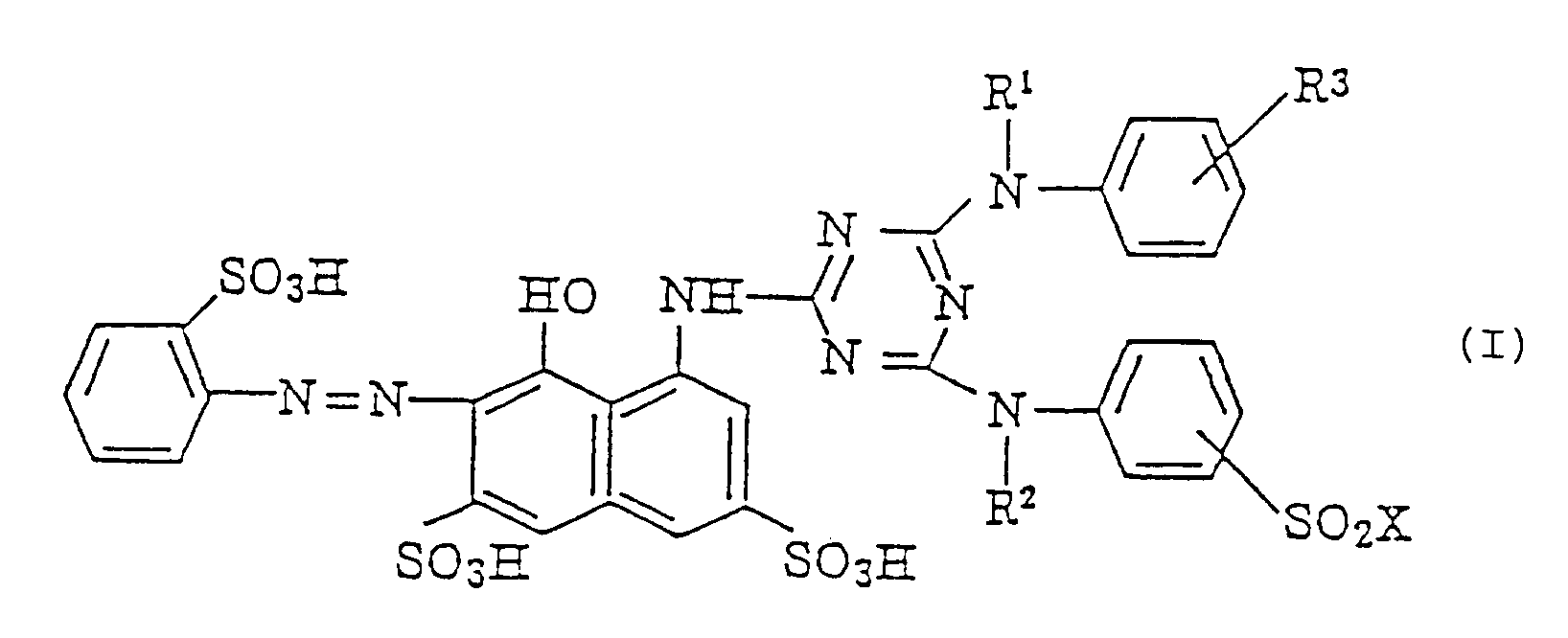
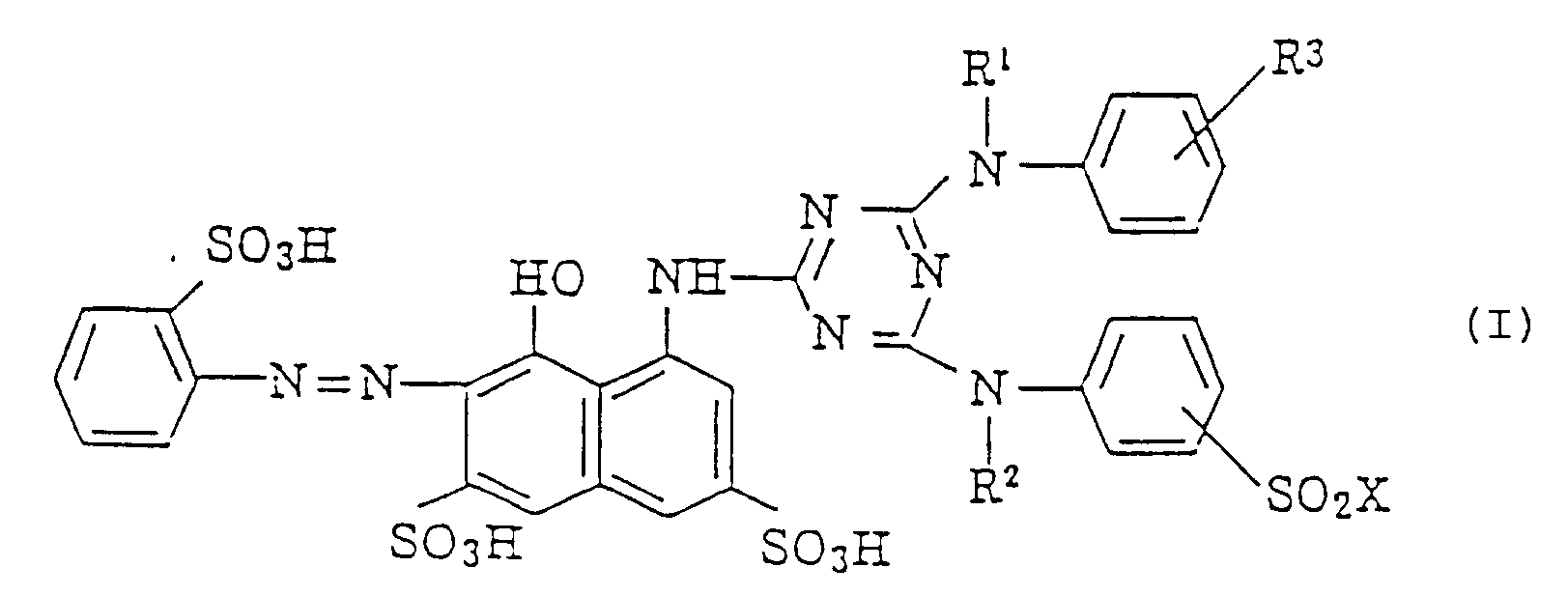
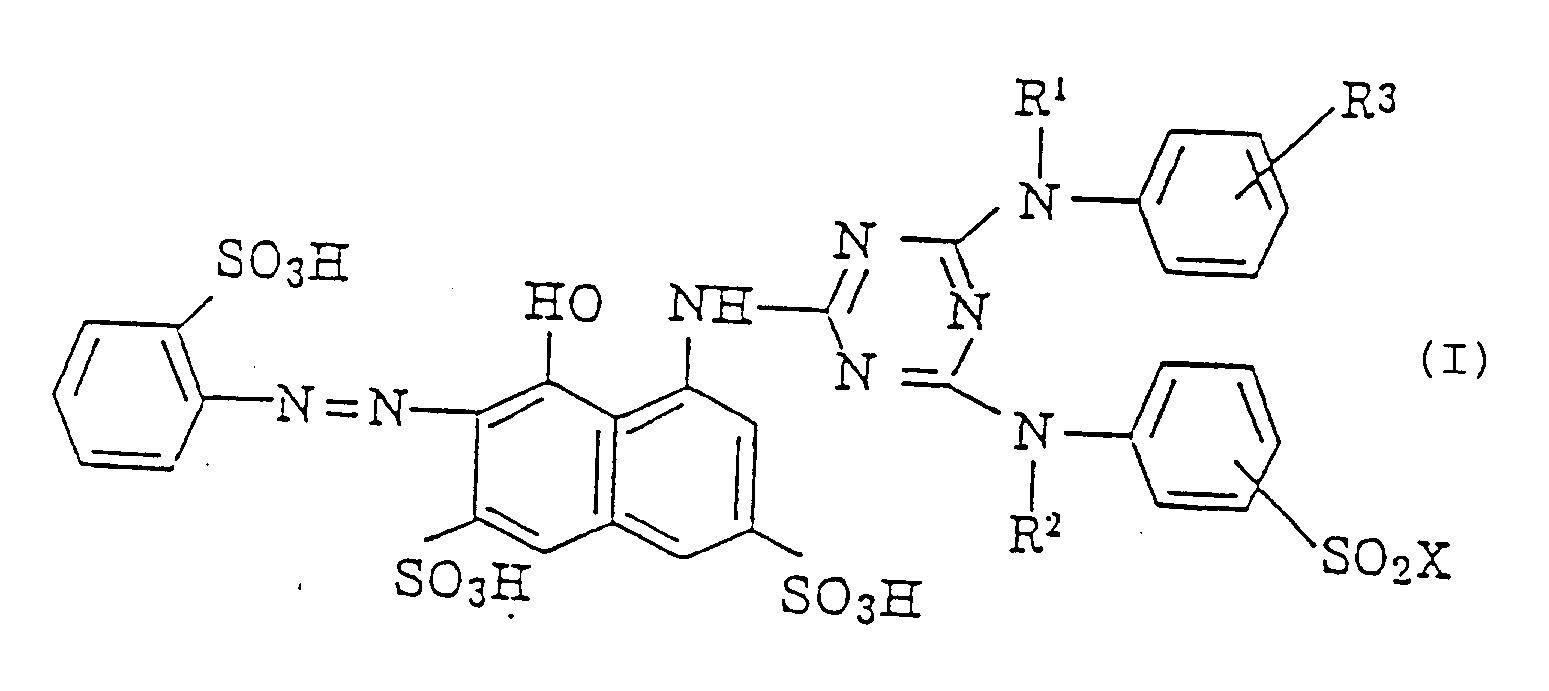
[0004] The present inventors conducted researches for presence of dyes which are suited for the above-mentioned purpose in those known reactive dyes, as the result of which they have discovered that, when use is made of a red reactive dye to be represented by the following general formula (I) in the form of free acid, there could be obtained a favorable dyed article, even when the amount of the inorganic salt in the dye bath is reduced to 1/5 to 1/10 of the amount which has been used conventionally:
(where: each of R¹ and R² denotes a hydrogen atom or a lower alkyl group which may contain therein a substituent; R³ represents a hydrogen atom, a lower alkyl group or a halogen atom; and X designates -CH=CH₂ or -C₂H₄OSO₃H).
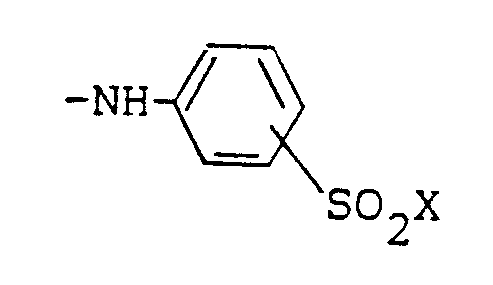
[0005] Incidentally, the structure of the reactive dye as shown in the above general formula (I) has been known in part, and reactive dyes included in the above general formula (I) are disclosed in, for example, Japanese Unexamined Patent Publications No. 212467/1987 and No. 260654/1985.
[0006] In case the reactive dye of the above-shown general formula (I) is used singly, a favorable dyeing result can be obtained even under the low concentration condition of the inorganic salt. However, when it is used in mixture with yellow dye and/or blue dye, the characteristic properties of the reactive dye as shown in the above general formula (I) cannot be exhibited to the satisfactory extent, unless the dye mixture is capable of dyeing favorably the fabrics under such low concentration condition of the inorganic salt. Accordingly, these yellow and blue dyes to be used in a mixture with the reactive dye of the above-indicated general formula (I) should be such that they are able to dye favorably the fabrics with a small amount of the inorganic salt. It is also necessary in this case that those reactive dyes to be selected possess the same level of fastness under various circumstances, dyeing speed, reproducibility, heat-stability and other physical properties as those of the reactive dye shown in the above general formula (I), and also have good compatibility with the red dyes.
[0007] That is to say, even when the reactive dye of the above formula (I) is used as the red dye, a mixed dye, in which any arbitrary dye in yellow or blue is blended, has its possible defect such that it is unable to dye the material to an intended color hue at such dyeing condition where the inorganic salt is present in low concentration, or, even if the intended color hue is attained it has high dependency on the salt-concentration or the temperature, hence it possesses insufficient reproducibility, and others.
[0008] On the other hand, a report of Hayakashi et al. "On Diamira SN Series Dyes" (Dyeing Method with Recommended Three Primary Colors with Reduced Amount of Glauber's Salt)", Senshoku Kogyo (Dyeing Industry), Vol. 34, No. 2, 1986, pp81 to 93, introduces therein, in codes, each of reactive dyes in three primary colors which are available in general commercial market and capable of dyeing materials with a small quantity of the inorganic salt (Glauber's salt), although no chemical structure whatsoever of these reactive dyes are presented in the report.
DISCLOSURE OF THE INVENTION
[0009] In view of the above-mentioned circumstances, the present inventors have made various studies with a view to providing the mixtures of dyes which are capable of dyeing materials with favorable result even under a low concentration condition of the inorganic salt, in case the red reactive dye of the above-mentioned general formula (I) is used in a mixture with yellow and/or blue dye, and which possess well-balanced dyeing properties of the component dyes in each color. As the result of such studies, they have discovered that, by blending yellow and blue dyes of certain particular structures, the resulting dye mixtures will become able to exhibit their generally excellent properties. Based on such finding, the present invention has been completed.
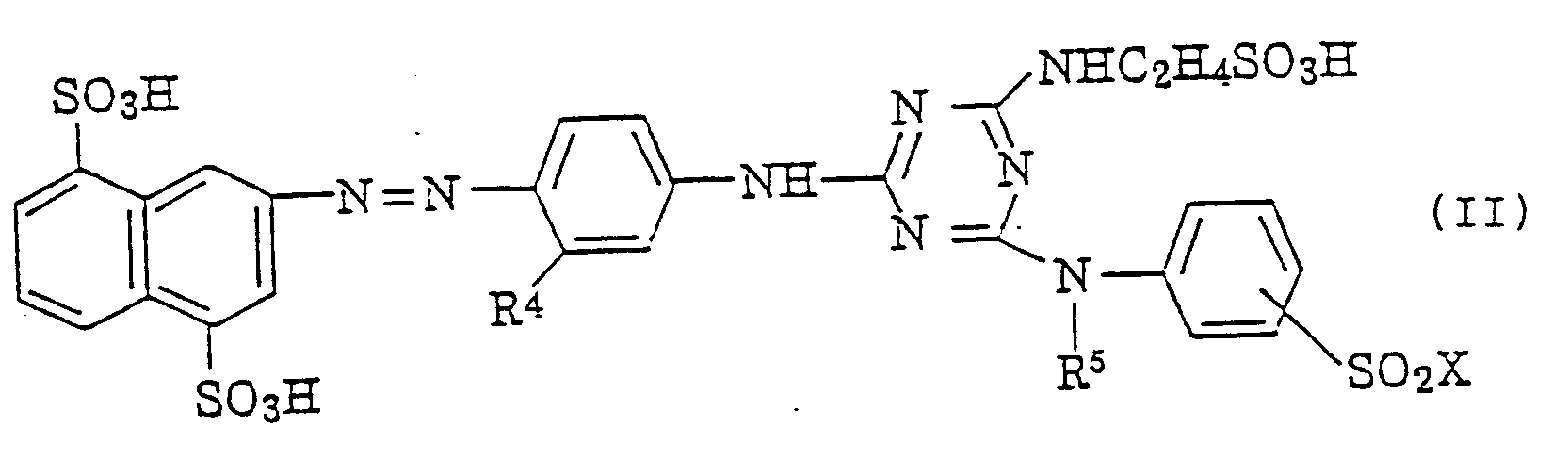
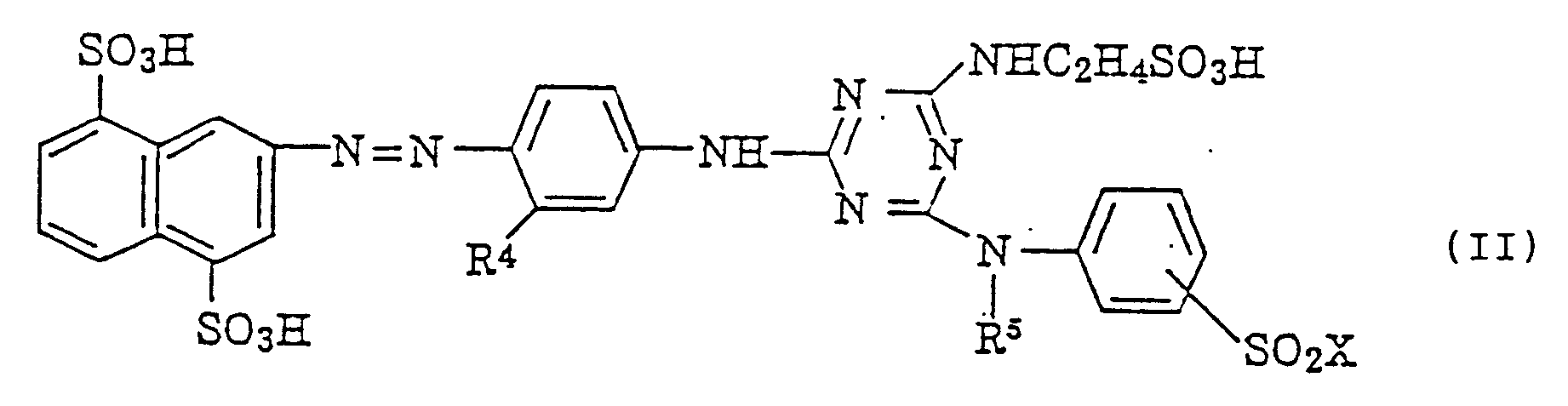
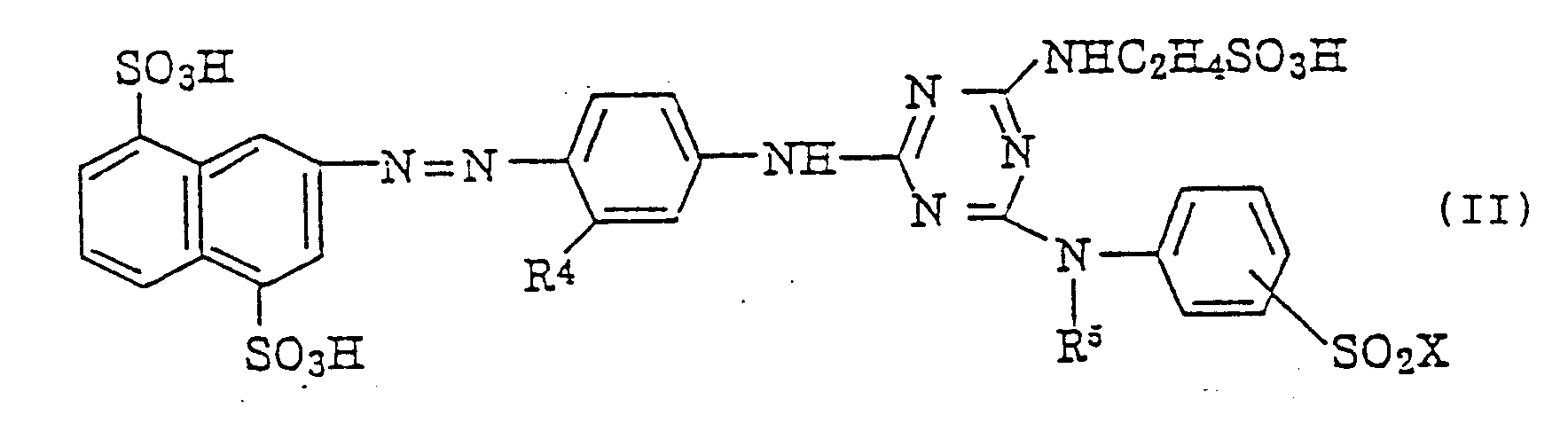
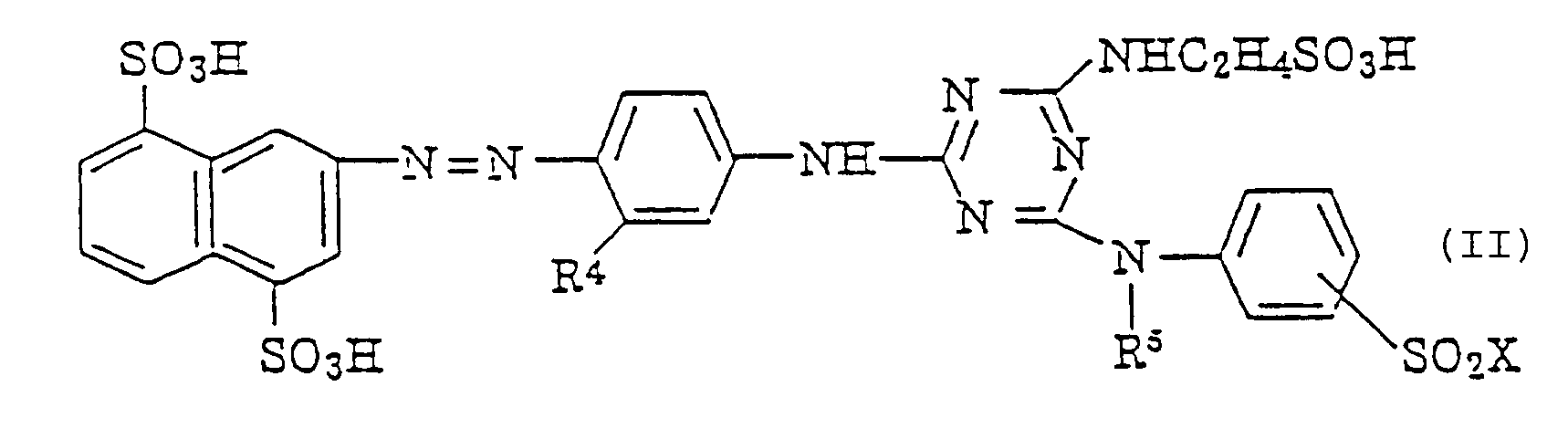
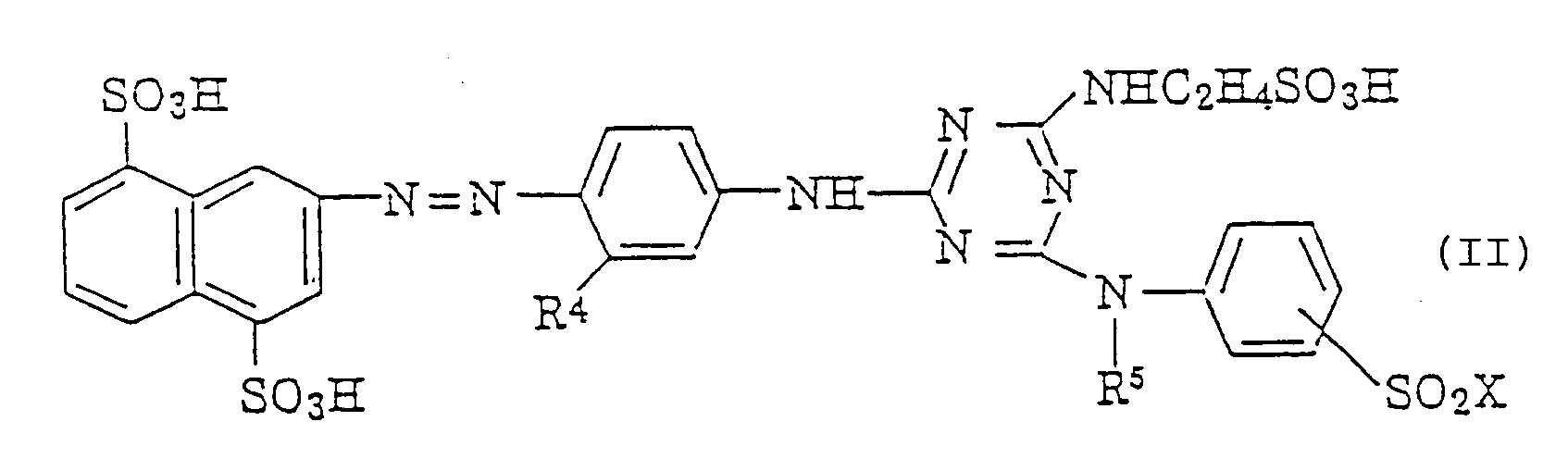
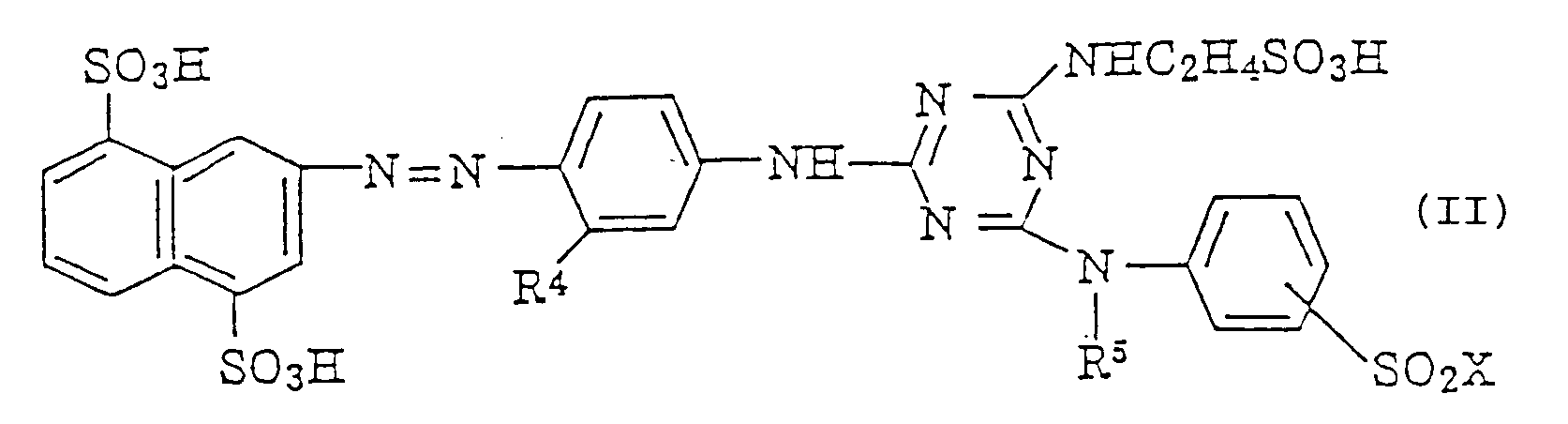
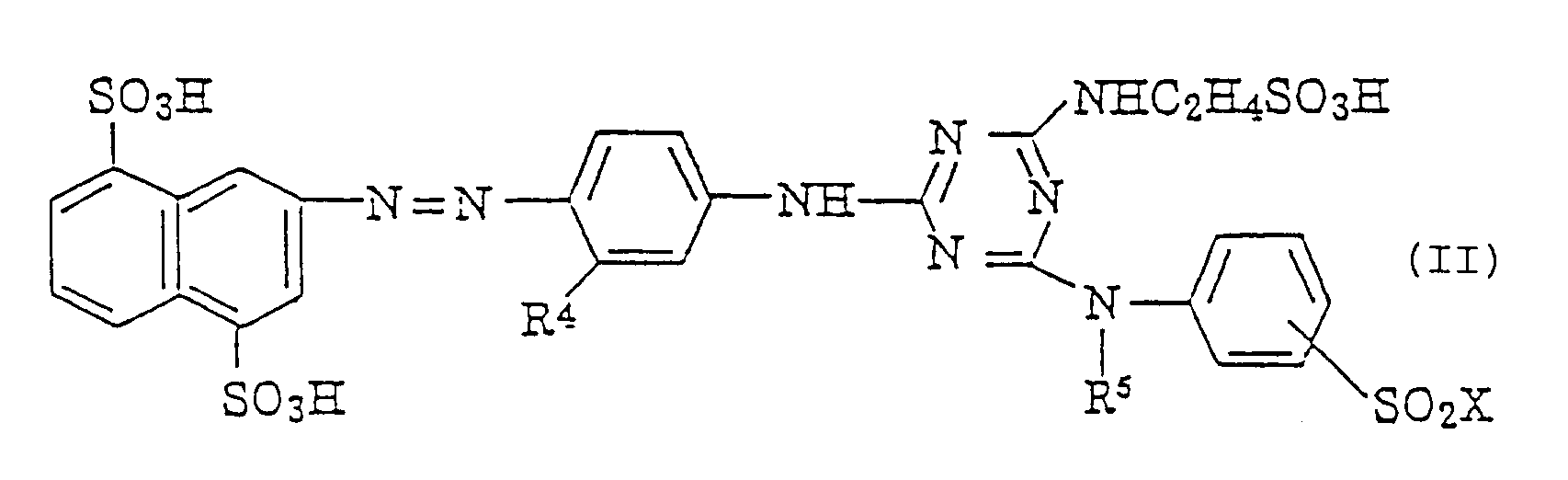
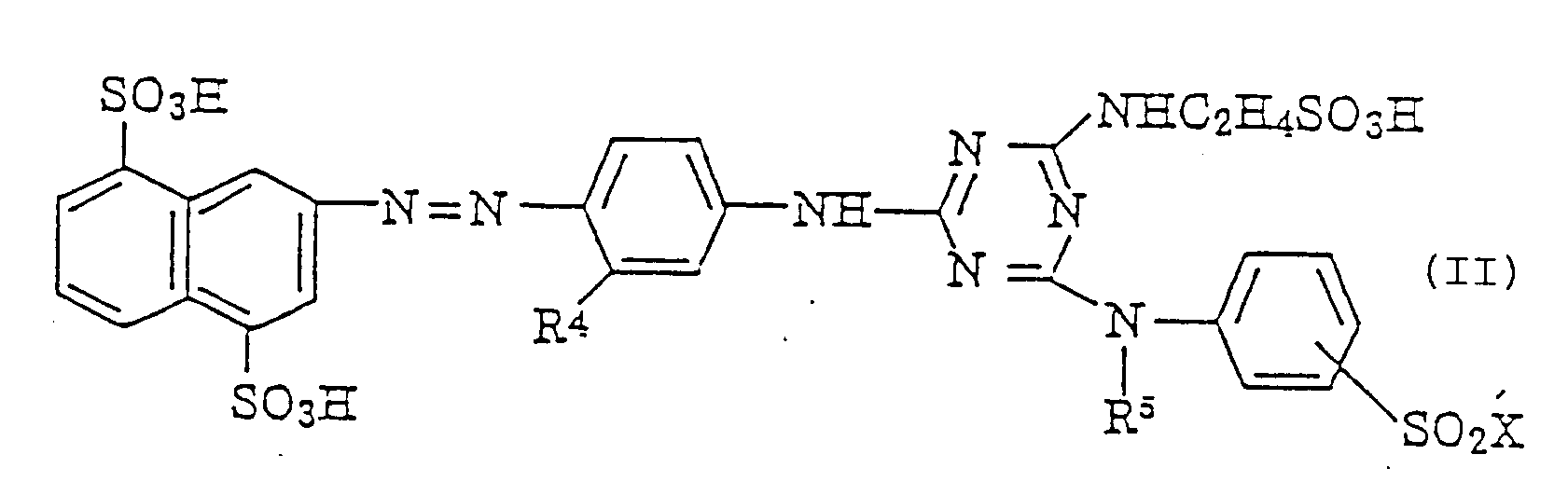
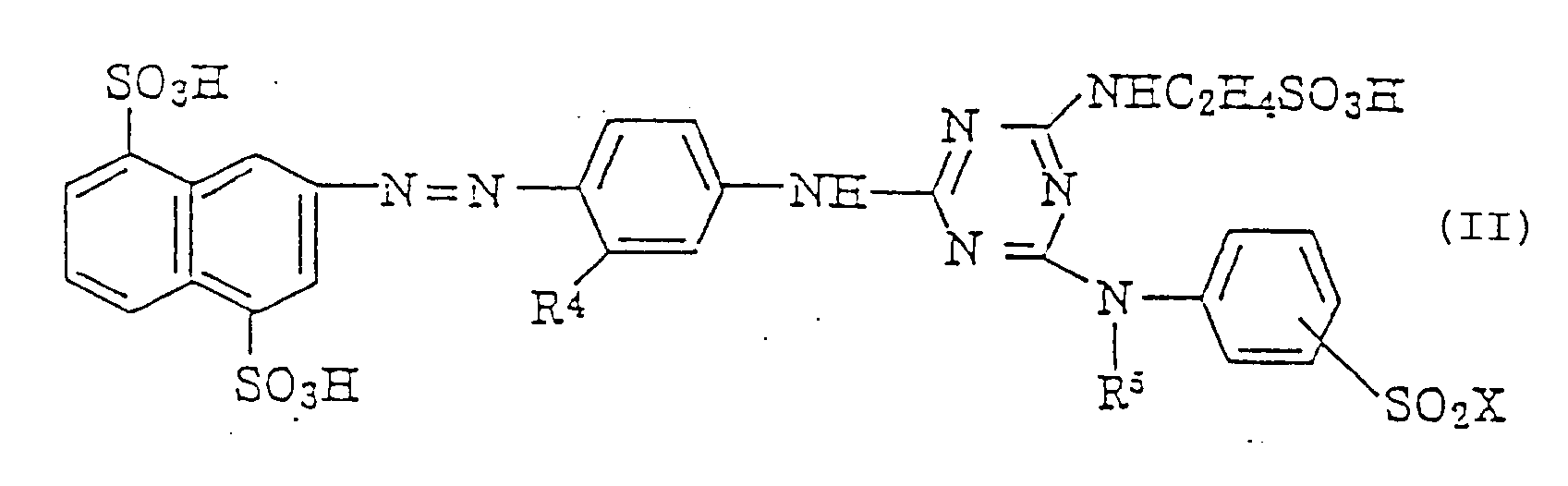
[0010] That is to say, the gist of the present invention resides in providing a water-soluble reactive dye mixture and a method for dyeing cellulosic fibers using such dye mixture, in which a yellow and/or blue water-soluble reactive dye is blended with a red water-soluble reactive dye having the above-mentioned general formula (I), the dye mixture and the method of dyeing being characterized in that the yellow dye is the water-soluble reactive dye to be represented by the following general formula (II) in the form of free acid:
(where: R⁴ denotes a -NHCOCH₃ group, a -NHCOC₂H₅ group, a -NHCONH₂ group or a -NHCOSO₂CH₃ group; R⁵ represents a hydrogen atom or a lower alkyl group which may contain therein a substituent; and X has the same definition as in the above-indicated general formula (I));
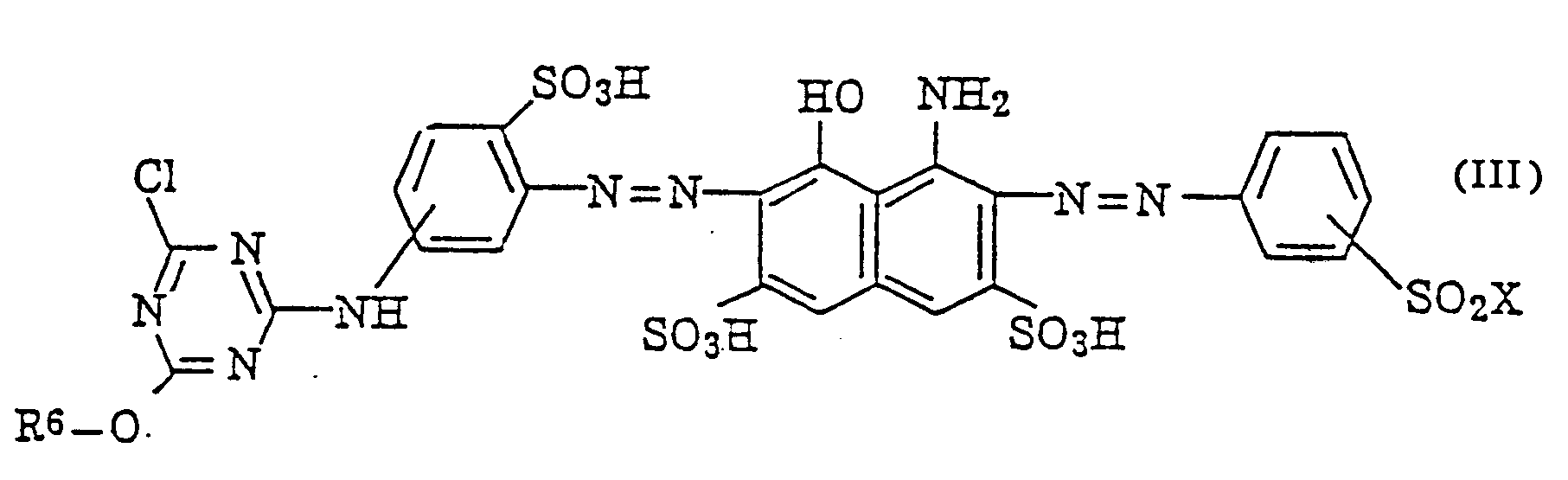
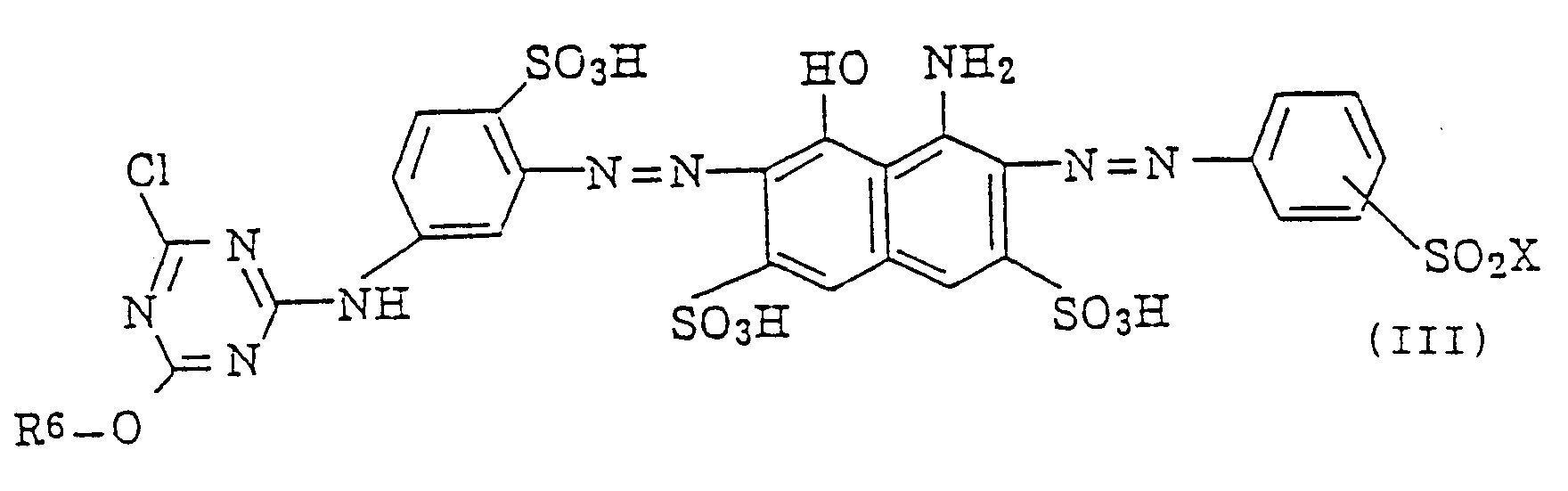
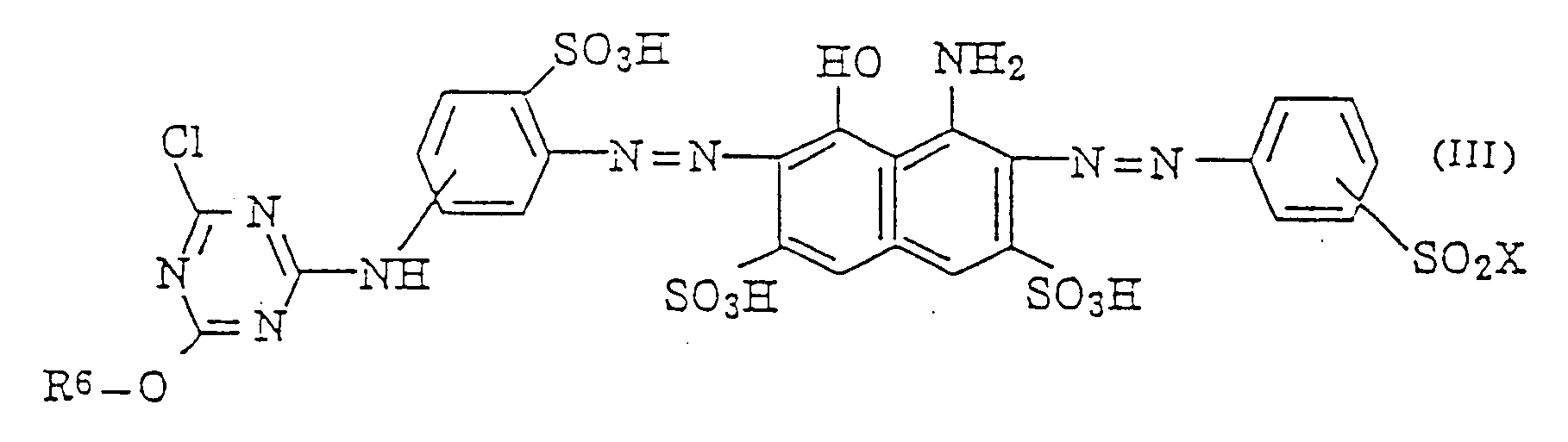
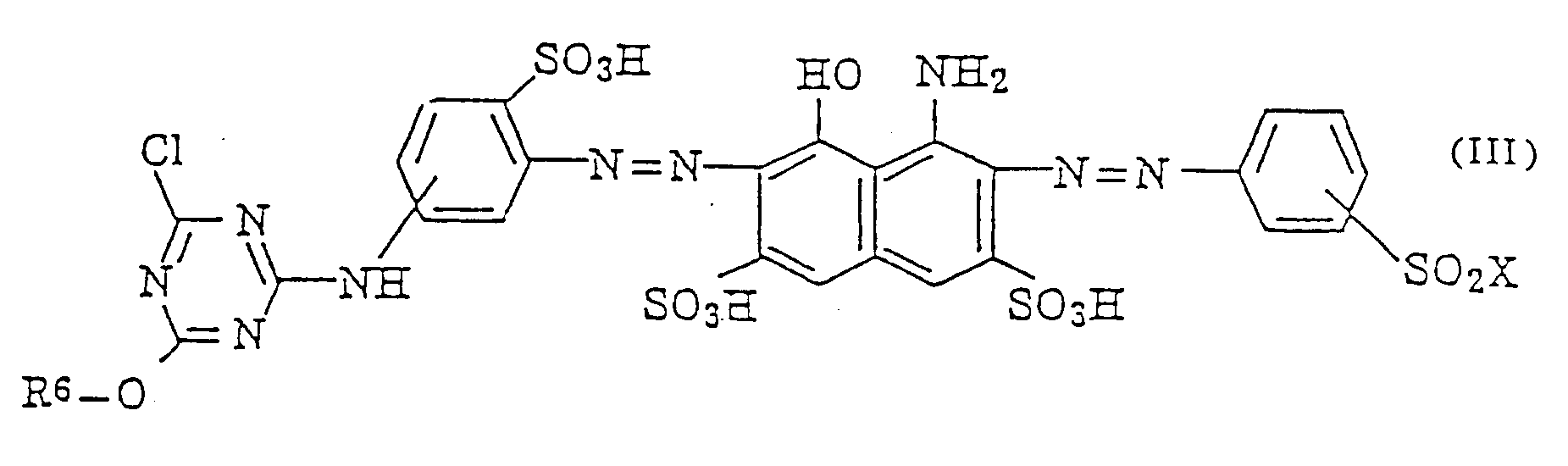
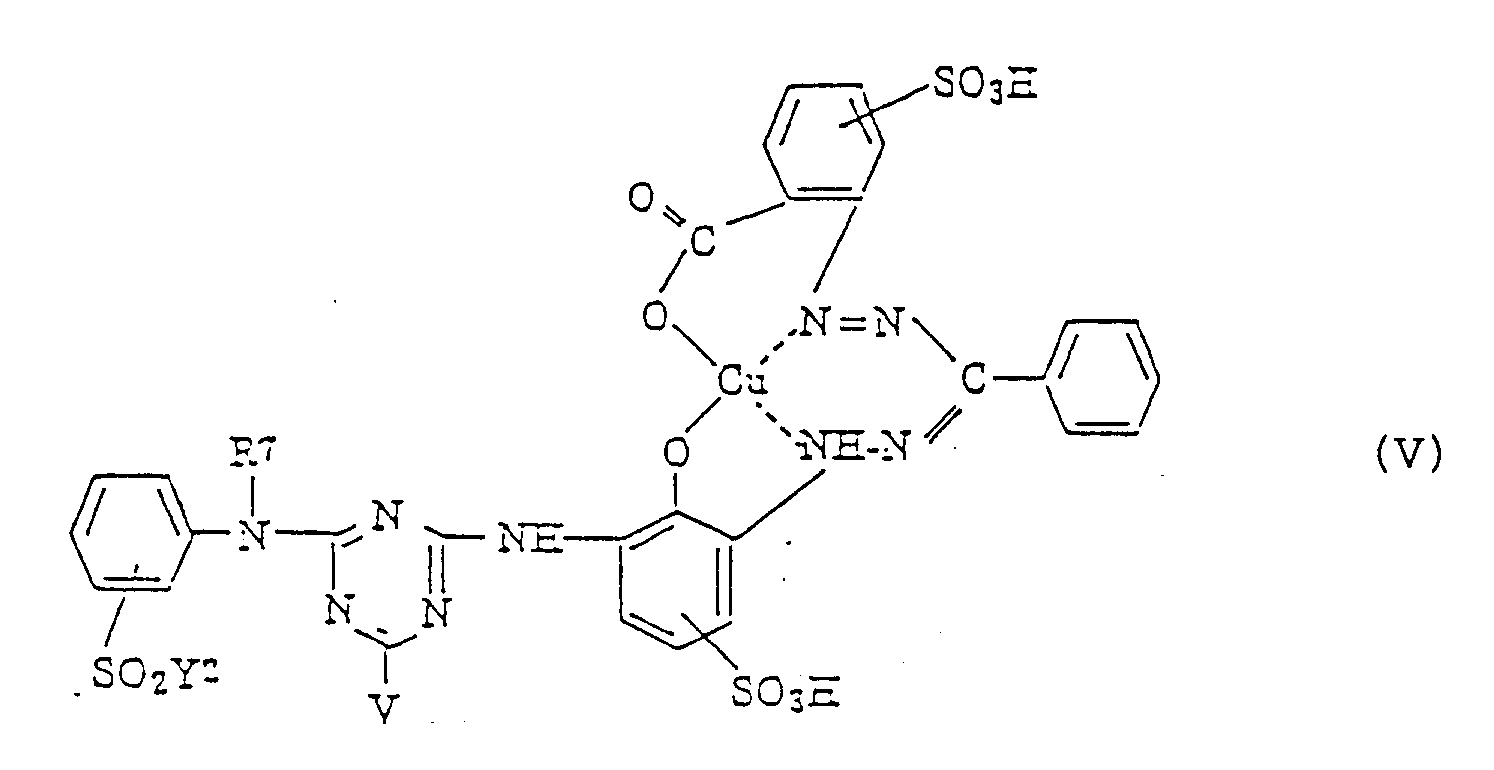
and that the blue dye is at least one kind of the water-soluble reactive dyes to be represented by the following general formulas (III) to (VI) in the form of free acid:
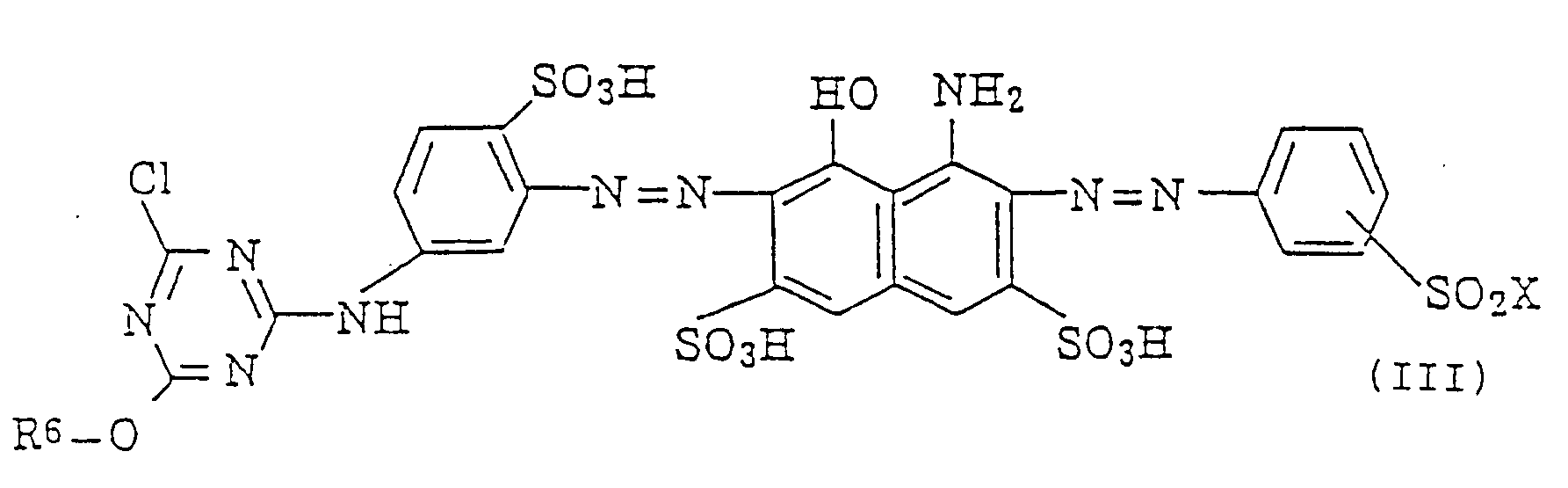
(where: R⁶ indicates a lower alkyl group; and X has the same definition as in the above-indicated general formula (I));
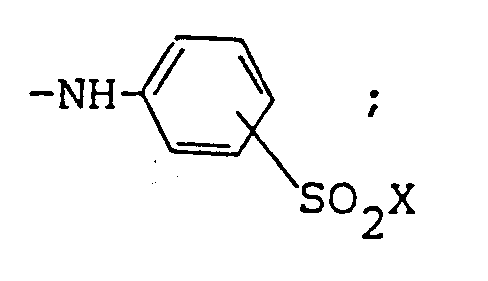
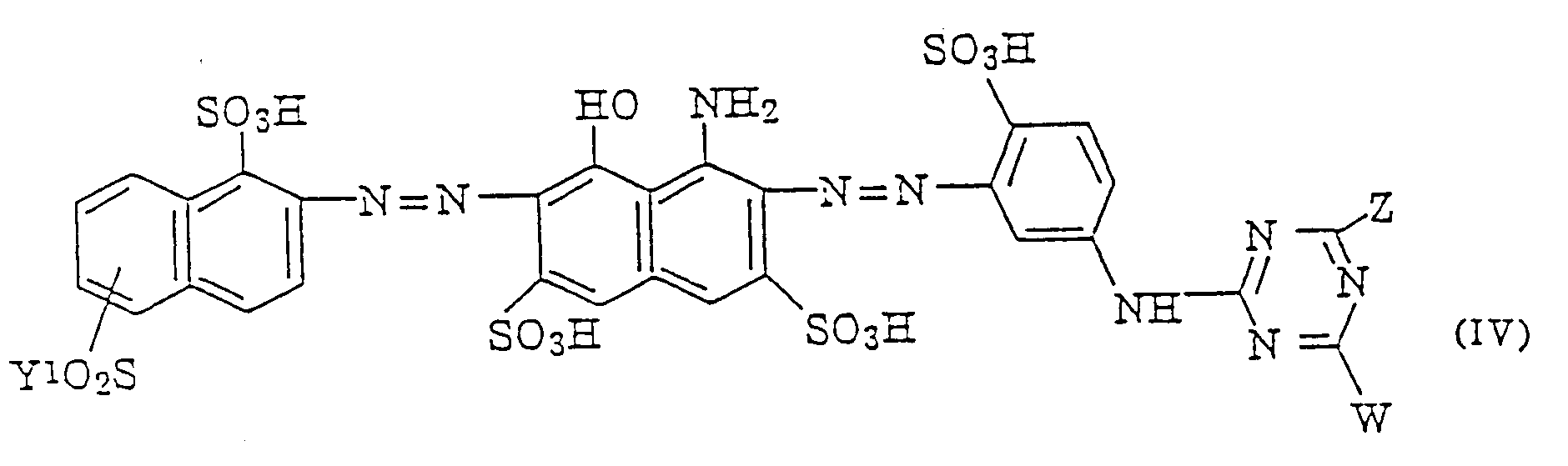
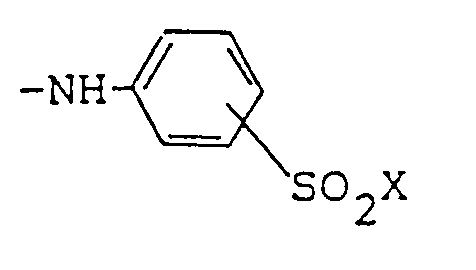
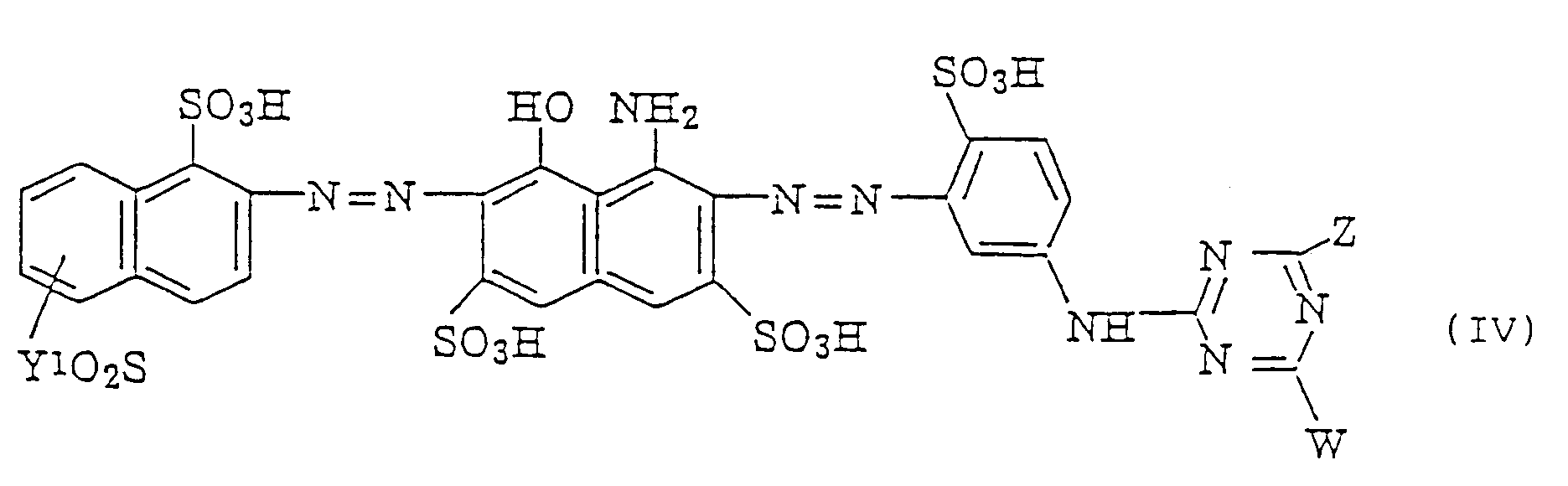
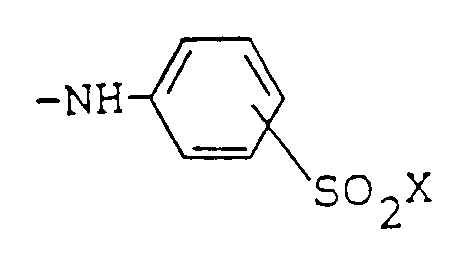
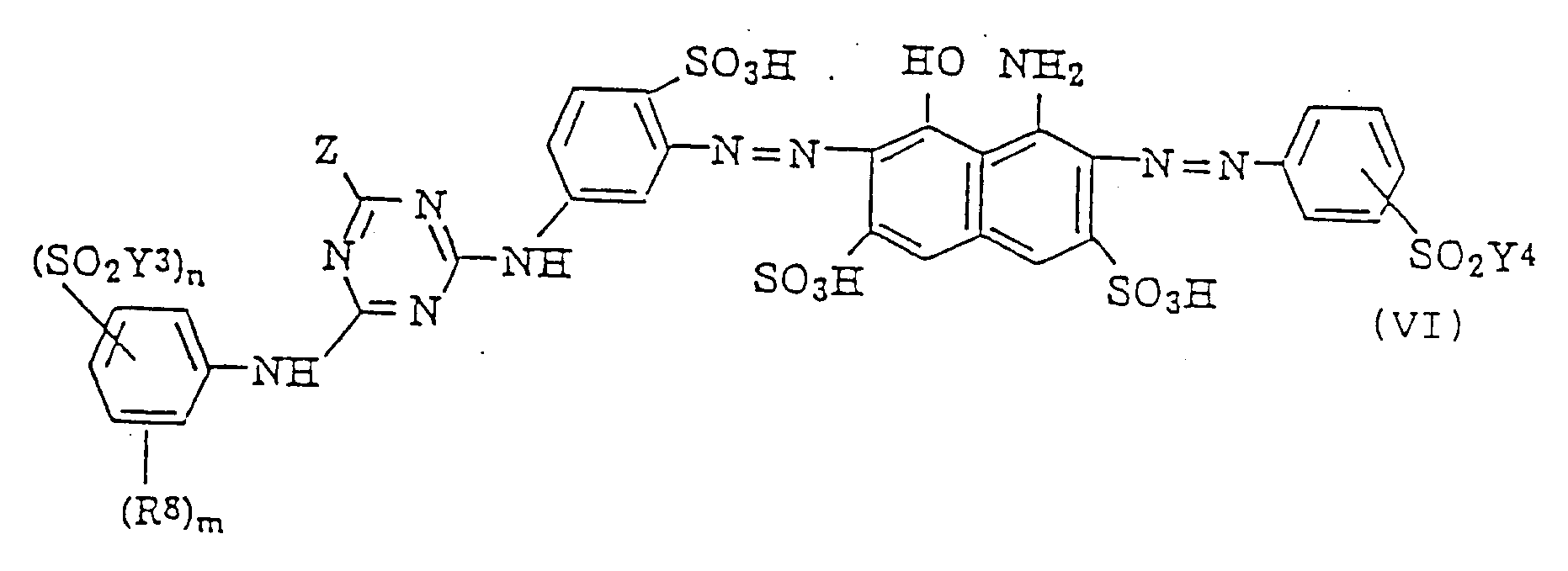
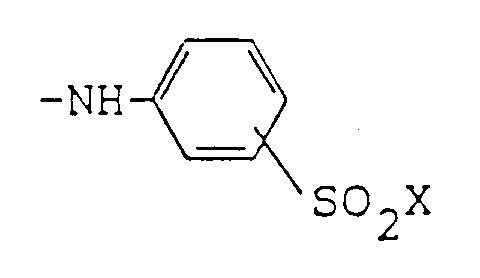
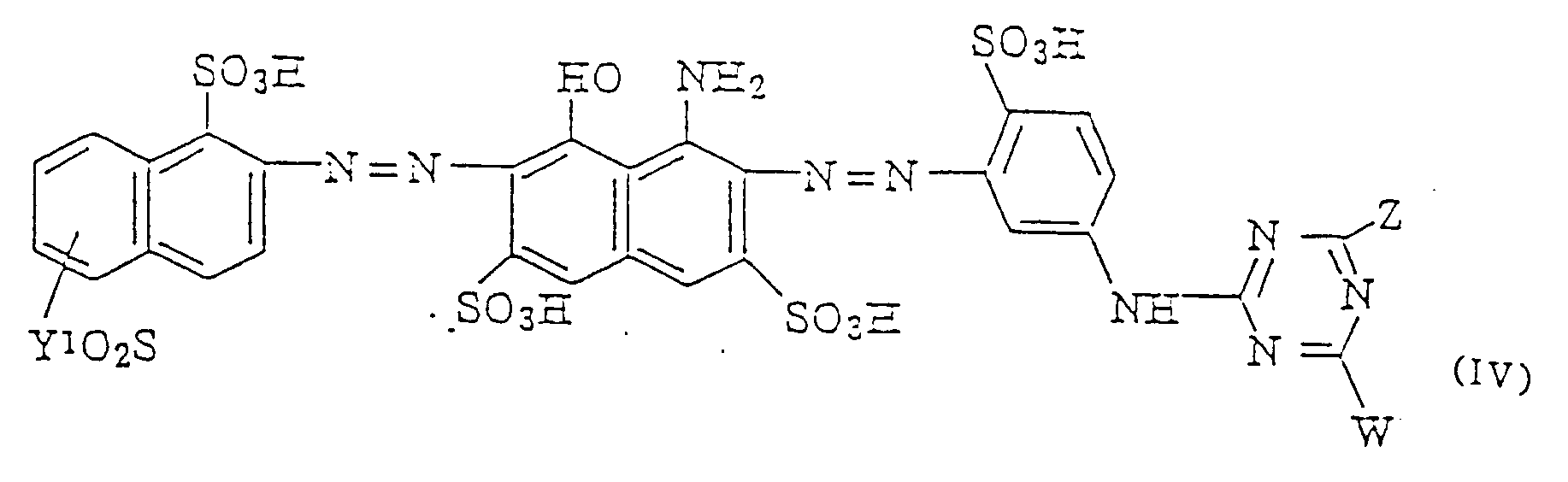
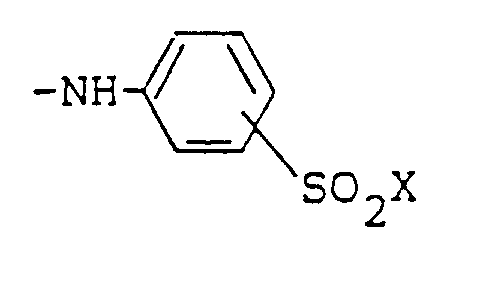
(where: Y¹ is a -CH=CH₂ group, a -C₂H₄OSO₃H group, or a -OH group; Z represents a chlorine atom or a fluorine atom; W indicates a lower alkoxy group or a
group; and X has the same definition as in the above-indicated general formula (I));
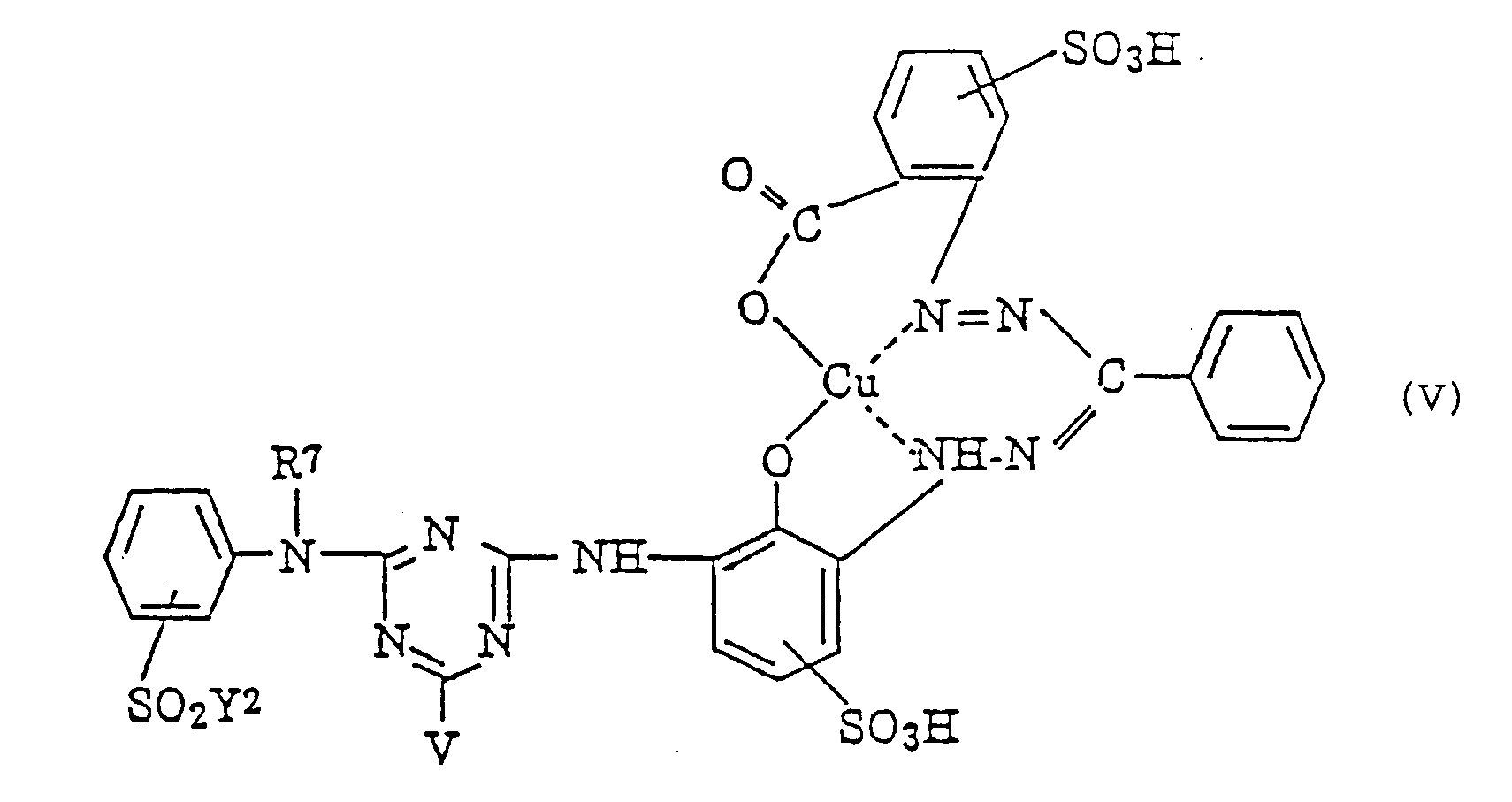
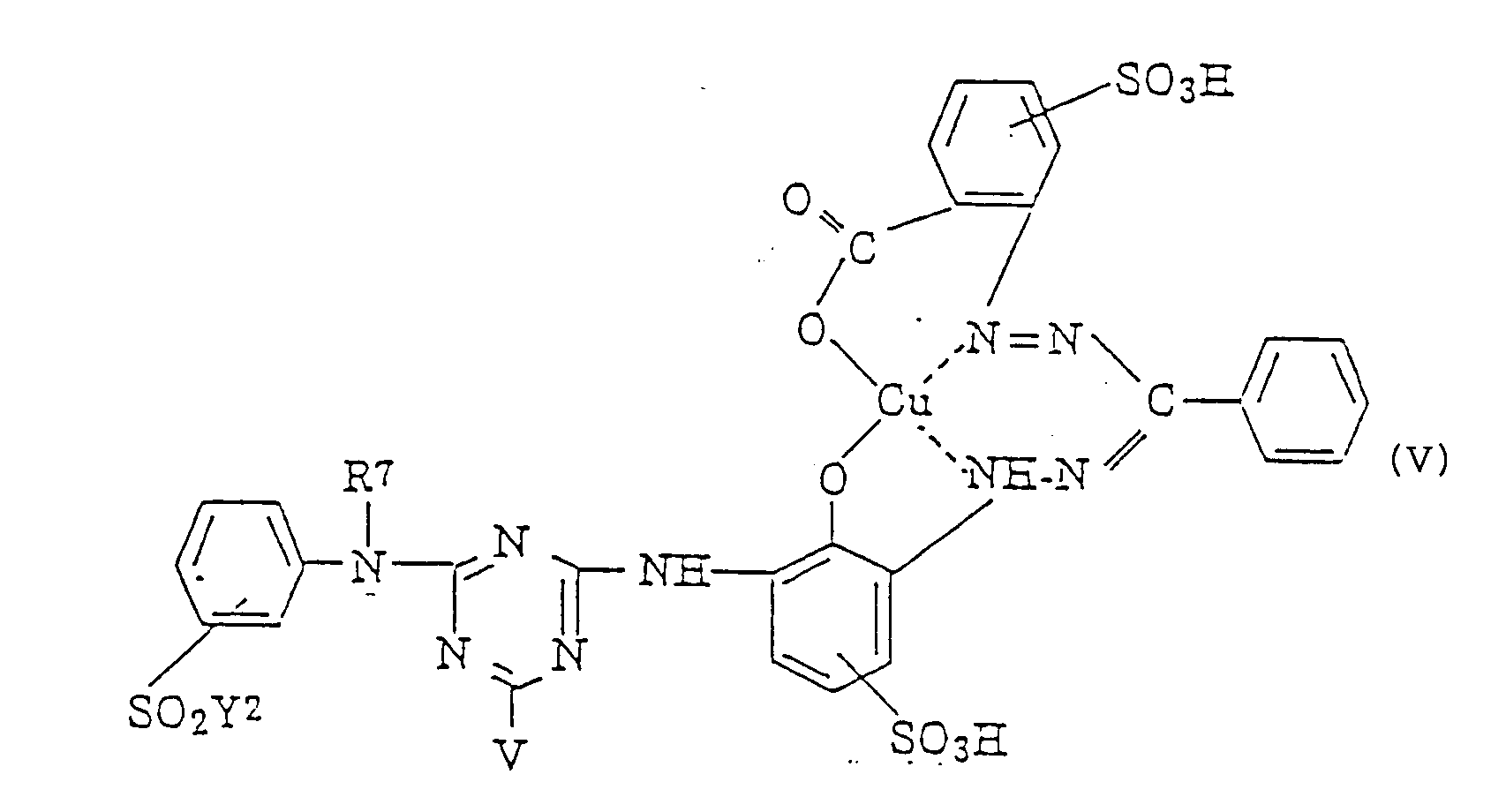
(where: V represents a chlorine atom, a fluorine atom, or a -NHC₂H₄SO₃H group; R⁷ denotes a hydrogen atom or a lower alkyl group which may contain therein a substituent; and Y² indicates a -CH=CH₂ group, a -C₂H₄OSO₃H group or a -OH group, provided however that when V denotes a -NHC₂H₄SO₃H group, Y² is a -CH=CH₂ group or a -C₂H₄OSO₃H group); and
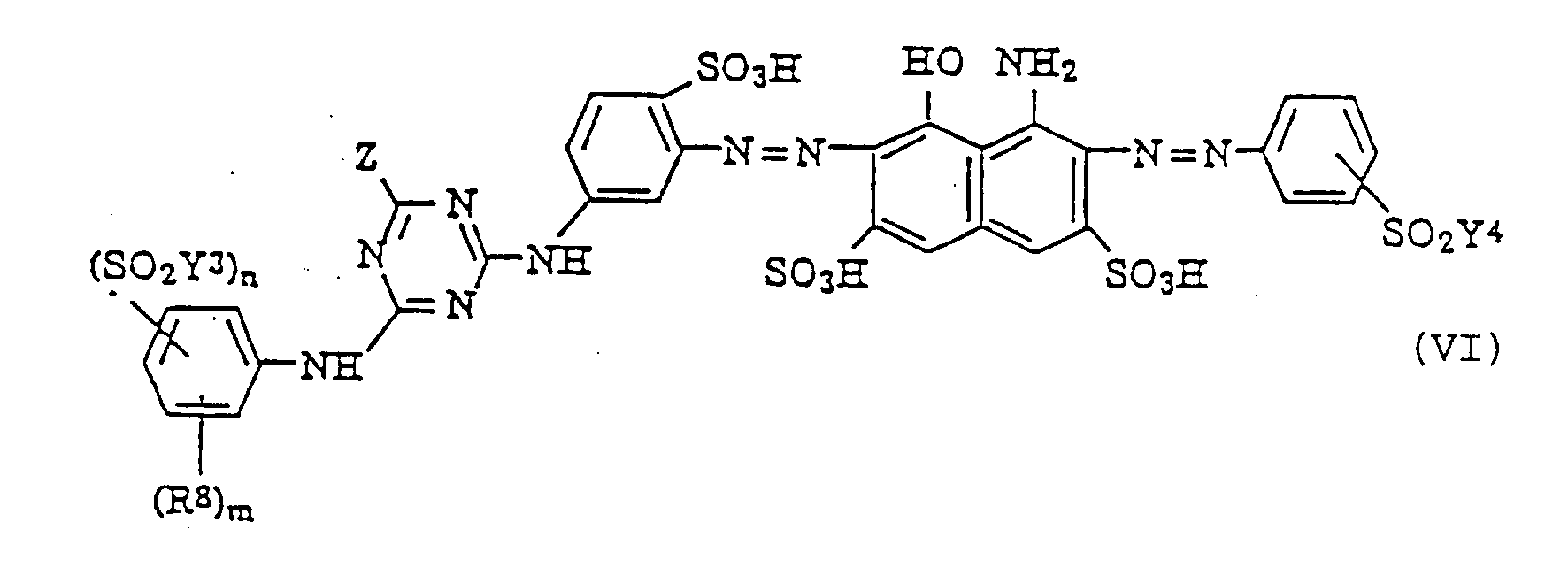
(where: R⁸ denotes a chlorine atom, a -COOH group or a -OH group; each of Y³ and Y⁴ indicates a -CH=CH₂ group, a -C₂H₄OSO₃H group or a -OH group; m and n are integers of 0 or 1, but, in no case, they will be 0 at the same time; and Z has the same definition as in the above-indicated general formula (IV)).
[0012] The present invention, as its premises, is to use, as the red dye, the reactive dye represented by the afore-indicated general formula (I).
[0013] Examples of the lower alkyl group represented by R¹ and R² in this general formula (I) and which may contain therein a substituent are: those unsubstituted alkyl groups in the form of straight chain or branched chain and containing therein 1 to 4 carbon atoms; and those lower alkyl group substituted by a those hydroxy group, a cyano group, a halogen atom or an alkoxy group such as 2-hydroxyethyl, 2-cyanoethyl, cyanomethyl, 2-chloroethyl or 3-ethoxypropyl. Preferred groups for R¹ are a methyl group and an ethyl group, and preferred groups for R² are a hydrogen atom, a methyl group and an ethyl group, of which hydrogen is particularly preferred. As the lower alkyl group represented by R³, there may be enumerated unsubstituted alkyl groups in the form of straight chain or branched chain and containing therein 1 to 4 carbon atoms. Also, as the halogen atoms represented by R³, there may be exemplified a bromine atom and a chlorine atom. Preferred groups for R³ are a hydrogen atom, a methyl group, an ethyl group, a chlorine atom and a bromine atom, of which a hydrogen atom is particularly preferred.
[0014] As the red reactive dye of the general formula (I), those containing therein a methyl group or an ethyl group as R¹ and hydrogen atoms as R² and R³ are particularly preferred. Incidentally, a part of the structure of the reactive dye represented by the general formula (I) has already been known.
[0015] The following, explanations will be given as to the reactive dye of the general formula (II) which has been selected as the yellow dye. This dye also includes the structurally known dye, and, as one example, Japanese Unexamined Patent Publication No. 96174/1984 discloses a part of the reactive dye to be embraced by the general formula (II).
[0016] Examples of the lower alkyl groups represented by R⁵ in the general formula (II) and which may contain therein a substituent are those same as in the above-mentioned R¹ and R². Preferred groups for R⁵ are a hydrogen atom, a methyl group and an ethyl group, of which a hydrogen atom is particularly preferred. Preferred groups of R⁴ are a -NHCOCH₃ group and a -NHCONH₂ group, of which a -NHCOCH₃ group is particularly preferred. Further, the position for introducing a -SO₂X group to be coupled with the benzene ring should preferably be at the metha- or para-position to the position of a nitrogen atom bound to the benzene ring, of which the metha-position is particularly preferred. As the yellow reactive dye of the general formula (II), those containing therein a -NHCOCH₃ group as R⁴ and a hydrogen atom as R⁵ are particularly preferred.
[0017] Further, explanations will be given as to the reactive dyes represented by the general formulas (III) to (VI), which are selected as the blue dyes in the present invention. These reactive dyes also include the known structures, wherein a part of the dyes embraced by the general formula (IV) are disclosed in, for example, Japanese Unexamined Patent Publication No. 128380/1981; a part of the dyes embraced by the general formula (V) are disclosed in, for example, Japanese Unexamined Patent Publication No. 15451/1984; and a part of the dyes embraced by the general formula (VI) are disclosed in, for Example, Japanese Unexamined Patent Publication No. 799/1980.
[0018] As the lower alkyl group to be represented by R⁶ in the general formula (III), there may be enumerated those alkyl groups having 1 to 4 carbon atoms such as a methyl group, an ethyl group, a propyl group and a butyl group. Of these alkyl groups, a methyl group is preferred.
[0019] As the lower alkoxy group to be represented by W in the general formula (IV), there may be exemplified those alkoxy groups having 1 to 4 carbon atoms such as a methoxy group, an ethoxy group and a propoxy group. Of these alkoxy groups, a methoxy group is preferred. Preferred example of the blue reactive dyes of the general formula (IV) are particularly those containing therein a -CH=CH₂ group or a -C₂H₄OSO₃H group as Y¹, a chlorine atom as Z, and a methoxy group as W, or those containing therein a -OH group as Y¹, a chlorine atom or a fluorine atom as Z, and a
group as W.
[0020] As the lower alkyl groups represented by R⁷ in the general formula (V) and which may contain therein a substituent, there may be exemplified those groups similar to R¹ and R² above. R⁷ is preferably a hydrogen atom, a methyl group or an ethyl group. V should preferably be a chlorine atom or a -NHC₂H₄SO₃H group, while Y² should preferably be a -CH=CH₂ group or a -C₂H₄OSO₃H group. As the blue reactive dyes of the general formula (V), those containing therein a hydrogen atom as R⁷, a -NHC₂H₄SO₃H group as V and a -CH=CH₂ group or a -C₂H₄OSO₃H group as Y² are particularly preferred.
[0021] As the blue reactive dyes of the general formula (VI), those containing therein -OH groups as Y³ and Y⁴, and a fluorine atom as Z, m being 0 and n being 1, are particularly preferred.
[0022] In the present invention, the above-mentioned reactive dyes are all present in the form of free acids or their salts. Preferred salts of such free acids are usually alkali metal salts or alkaline earth metal salts such as lithium salt, sodium salt, potassium salt and calcium salt.
[0023] By the way, these reactive dyes represented by the foregoing general formulas (I) to (VI) can be produced in accordance with known methods, hence there is no particular restriction on the method of their production.
[0024] It is the cardinal point of the present invention that the red reactive dye of the general formula (I) is made the base, with which the yellow reactive dye of the general formula (II) and/or the blue reactive dye of the general formula (III) to (VI) is blended. In short, the particularly excellent effect of the present invention can be obtained by selecting the particular yellow dye or blue dye from a large number of dyes, and blending such yellow or blue dye with the particular red dye. The effect of the present invention, cannot be obtained from combination of the above-mentioned particular red dye and numerous other yellow or blue dyes which are available at hand.
[0025] The mixing ratio of the yellow and/or blue dye with respect to the red dye according to the present invention may be determined depending on the intended color hue of the dyed material, and it is usually in a range of from 0.05 to 50 times by weight, preferably from 0.1 to 10 times by weight in total.
[0026] On the other hand, the mixing ratio of both yellow dye and blue dye to be blended with the red dye is in a range of 0 to 100/100 to 0. In this way, the dye mixture according to the present invention is a combination of the red dye and the yellow dye or the blue dye, and, in addition, a combination of the red dye and both yellow and blue dyes.
[0027] Incidentally, of these blue dyes represented by the general formulas (III) to (VI), the reactive dye of the general formula (III) or (V) is particularly preferred. A mixture of the red reactive dye represented by the general formula (I) and the yellow reactive dye represented by the general formula (II) is also preferred.
[0028] The dye mixtures according to the present invention are mainly suited as the reactive dye for exhaustion-dyeing of cellulosic fibers.
[0029] Examples of the cellulose-containing fibers to be the object of dyeing according to the present invention are usually: those cellulosic fibers such as cotton, viscose rayon, cupra ammonium rayon, hemp; and mixed fibers of these cellulosic fibers and polyester, cellulose triacetate, cellulose diacetate, polyacrylonitrile, polyamide, wool, silk and so on.
[0030] The exhaustion-dyeing of the cellulose-containing fibers by use of the reactive dyes according to the present invention is carried out in the presence of an alkali such as sodium bicarbonate, sodium carbonate, lithium carbonate, caustic soda or triethylamine, and of an inorganic salt such as Glauber's salt or edible salt, preferably Glauber's salt. The quantity of the alkali to be used in this case is usually 10 to 30 g per 1 liter of the dye bath. Usually, the dye bath has a pH value of from 10 to 13.
[0031] The quantity of the inorganic salt to be used may be as large as 50 g per 1 liter as is the case with the ordinary exhaustion-dyeing. In the case of the present invention, however, since use is made of a dye mixture prepared by blending a particular red reactive dye with a particular yellow and/or blue reactive dye, the inorganic salt may be as small as 5 to 40 g per 1 liter of the dye bath for the sufficient result of dyeing. Further, the quantity of this inorganic salt to be used may depend on the dyeing depth of the dyed fabric to be obtained. More specifically, in case the dyeing depth is of pale shade, it may range from 5 to 15 g per 1 liter of the dye bath; in the case of medium shade, it may range from 15 to 30 g per 1 liter of the dye bath; and in the case of heavy shade, it may be from 30 to 40 g per 1 liter of the dye bath.
[0032] The temperature for dyeing is usually from 40 to 80°C, or preferably from 40 to 60°C. The time for dyeing is from about 0.5 to 2 hours.
[0033] After the dyeing operation, the dyed fabric is subjected, in accordance with the known processes, to soaping and rinsing, after which it is dried and recovered as the dyed article.
BEST MODE TO PRACTICE THE INVENTION
[0034] In the following, the present invention will be described in more detail in reference to examples thereof. It should however be noted that the present invention is not limited to these examples alone.
EXAMPLE 1
[0035] Into 200 ml of water, there was dissolved 0.2 g of a dye mixture composed of 0.1 g of the reactive dye as the red dye, which is represented by the following general formula (I-1) in the form of free acid:
and 0.1 g of the reactive dye as the yellow dye, which is represented by the following general formula (II-1) in the form of free acid:
To this dye solution, there was further added 10 g of Glauber's salt to prepare a dye bath (concentration of Glauber's salt being 50 g/liter). Into this dye bath, 10 g of unmercerized cotton knitted fabric was immersed. The temperature of the dye bath was increased to 50°C in 30 minutes, and then 3 g of sodium carbonate was added to the dye bath to conduct the exhaustion dyeing for one hour at this temperature level. After the dyeing, the dyed fabric was subjected to rinsing, soaping, rinsing and drying by the ordinary method, thereby obtaining the dyed fabric in orange color.
[0036] This dyed fabric was measured for its surface reflecting rate by means of a color difference meter (a product of Nippon Denshoku Kogyo K.K., Japan).
[0037] Also, in order to examine the salt-concentration dependency and the temperature dependency, during the dyeing operation, of the dye mixture used in this Example, the same exhaustion dyeing was carried out under the same conditions as above, with the exception of the following changes: (1) the concentration of Glauber's salt in the dye bath was made 25 g/liter; or (2) the dyeing temperature was set at 80°C.
[0038] Based on the results obtained from the above dyeing operations, the salt-concentration dependency and the temperature dependency of the dye mixture were found in accordance with the following definitions:
Salt-concentration dependency is represented by a difference between the surface reflecting rate of the dyed fabric with the concentration of Glauber's salt being 50 g/liter and the surface reflecting rate of the dyed fabric with the concentration of Glauber's salt being 10 g/liter (difference in color hue (ΔE)): and
Temperature dependency is represented by a difference between the surface reflecting rate of the dyed fabric at the dyeing temperature of 50°C and the surface reflecting rate of the dyed fabric at the dyeing temperature of 80°C (difference in color hue (ΔE)).
COMPARATIVE EXAMPLES 1 and 2
[0040] The exactly same dyeing tests as in Example 1 above were conducted with the exception that the yellow dye used in Example 1 was replaced by the following known type of yellow dyes having the following structural formulas (a) for Comparative Example 1 and (b) for Comparative Example 2 (both being in the form of free acid).
The results are shown in Table 1.
Table 1
| Salt concentration dependency (25 g/liter/50 g/liter) ΔE* | Temperature dependency (80°C/50°C) ΔE* | |
| Example 1 | 1.98 | 3.84 |
| Comparative Example 1 | 4.49 | 6.93 |
| Comparative Example 2 | 4.35 | 7.52 |
| Note: *While the value of ΔE should ideally be zero, it may practically be at an excellent level, if it is 3 or below for the salt-concentration dependency, and 4 or below for the temperature dependency. |
EXAMPLE 2
[0041] The exactly same dyeing operation as in Example 1 above was conducted with the exception that, instead of using the yellow dye, 0.1 g of the reactive dye to be represented by the following general formula (V-1) in the form of free acid was used as the blue dye, thereby obtaining the dyed fabric in purple color.
This dyed fabric was measured for its surface reflecting rate in the same manner as in Example 1 above. Also, the salt-concentration dependency and the temperature dependency of the dye mixture were measured in the same manner as in Example 1. The results are shown in Table 2.
COMPARATIVE EXAMPLES 3 to 6
[0042] The exactly same dyeing tests as in Example 2 above were conducted with the exception that the blue dye used in Example 2 were replaced by the following known type of blue dyes having the structural formulas (c) for Comparative Example 3, (d) for Comparative Example 4, (e) for Comparative Example 5, and (f) for Comparative Example 6 (each being in the form of free acid).
The results are shown in Table 2.
Table 2
| Salt-concentration dependency (25 g/liter/50 g/liter) ΔE* | Temperature dependency (80°C/50°C) ΔE* | |
| Example 2 | 1.73 | 3.23 |
| Comparative Example 3 | 5.23 | 7.62 |
| Comparative Example 4 | 6.10 | 5.77 |
| Comparative Example 5 | 5.28 | 4.71 |
| Comparative Example 6 | 4.28 | 8.53 |
EXAMPLE 3
[0043] Into 200 ml of water, there was dissolved a dye mixture composed of 0.1 g of the reactive dye represented by the following structural formula (I-1) in the form of free acid, as the red dye; 0.1 g of the reactive dye represented by the following structural formula (II-1) in the form of free acid, as the yellow dye; and 0.1 g of the reactive dye represented by the following structural formula (III-1) in the form of free acid, as the blue dye.
To this dye solution, there was further dissolved 5 g of Glauber's salt to prepare the dye bath (concentration of Glauber's salt being 25 g/liter). 10 g of cotton cloth was immersed in this dye bath. The temperature of the dye bath was elevated from room temperature (25°C) to 60°C in 30 minutes, after which 4 g of anhydrous sodium carbonate was added to it, and the exhaustion dyeing was conducted for one hour at this temperature level. After the dyeing operation, the dyed fabric was subjected to rinsing, soaping, rinsing and drying, thereby obtaining the dyed fabric in brown color.
[0044] The reactive fixing property of each component dye in the dye mixture to the material to be dyed was very satisfactory. Also, in the above-mentioned dyeing operation, the quantity of Glauber's salt to be used was increased from 5 g (i.e., 25 g/liter) to 10 g (i.e., 50 g/liter) to carry out the dyeing. When depth and color hue of the dyed fabric were compared between the different quantities of Glauber's salt used, there was found no substantial difference between them.
EXAMPLES 4 to 6
[0045] The exactly same dyeing operation as in Example 3 was conducted with the exception that the mixing quantities of the reactive dyes (I-1), (II-1) and (III-1) were varied to those as shown in Table 3 below, thereby obtaining the dyed fabric in such hue shown in Table 3 below. It was found that, in all these Exmaples, the reactive fixing property of each component dye in the dye mixture to the fabric to be dyed was very satisfactory.
Table 3
| Example No. | Mixing quantity of reactive dyes | Color hue of dyed fabric | ||
| (I-1) | (II-1) | (III-1) | ||
| 4 | 0.05 g | 0.06 g | 0.16 g | grey |
| 5 | 0.2 g | 0.1 g | 0.05 g | scarlet |
| 6 | 0.09 g | 0.1 g | 0.03 g | beige |
COMPARATIVE EXMAPLE 7
[0046] The exactly same dyeing operation as in Example 3 above was conducted by use of 5 g of Glauber's salt, with the exception that the blue dye as used in Example 3 was replaced by 0.1 g of the reactive dye represented by the following structural formula (c) in the form of free acid, which is the known blue dye.
The color tone of the obtained dyed fabric was orange, not brown, which indicated that dyeability of this blue dye was considerably poor. In fact, the residual liquid in the dye bath had very strong bluish tone.
[0047] Also, the same dyeing operation as mentioned above was conducted with the exception that the quantity of Glauber's salt used was increased from 5 g (25 g/liter) to 10 g (50 g/liter), whereupon the dyed fabric as obtained had its color tone of brown.
EXAMPLES 7 to 17
[0048] The exactly same dyeing operations as in Example 3 above were conducted with the exception that the reactive dye represented by the structural formula (I-1) as the red dye was replaced with those reactive dyes of the structural formulas (in the form of free acids) shown in the following Table 4. In all these cases, the reactive fixing property of each component dye in the dye mixtures to the fibers to be dyed was satisfactory, whereby the dyed fabric in heavy brown was obtained.
EXAMPLES 18 to 27
[0049] The exactly same dyeing operations as in Example 3 above were conducted with the exception that the yellow dye used in Example 3 was replaced with those having the structural formulas (in the form of free acids) shown in the following Table 5, and the blue dye used in the same Example was replaced with those having the structural formulas (in the form of free acids) also shown in the following Table 5. As the result, it was found that, in all these Examples, the reactive fixing property of each component dye in the dye mixtures to the fiber material to be dyed was favorable, whereby the dyed fabrics in heavy brownish color tone were obtained.
EXAMPLES 28 TO 30
[0050] In the same manner as in Example 1 above, cellulosic fibers are dyed by use of dye mixtures, each having been composed of two kinds of red and blue dyes at a mixing ratio of about 1:1, wherein the red dye is reactive dye represented by the following structural formula (I-1) in the form of free acid:
and the blue dye was a reactive dye represented by the following structural formula (III-1) in the form of free acid:
or a reactive dye represented by the following structural formula (IV-1) in the form of free acid;
or a reactive dye represented by the following strucutral formula (IV-1) in the form of, free acid:
The dyed fabrics as obtained would show excellent purple color, and the dye mixtures would display their salt-concentration dependency and the temperature dependency of an excellent level, which were comparable with those attained in Example 1 above.
INDUSTRIAL APPLICABILITY
[0051] The present invention is capable of preparing dye mixtures of a desired color hue for dyeing cellulose-containing fibers by belending a particular red dye with a particular yellow dye and/or blue dye in an appropriate quantity. With these dye mixtures, favorable dyeing of the fiber material can be done even under the condition wherein the inorganic salt is in a small content. That is to say, the dyeing can be done favorably even when the quantity of the inorganic salt to be used is reduced to about 1/5 to 1/10 of the quantity thereof used in the conventional methods. Accordingly, the presenet invention makes it possible to attain the resource-saving and the reduction in the cost for the dyeing operation in an industrialized scale.
1. A water-soluble reactive dye mixture, wherein a yellow and/or blue water-soluble reactive
dye is blended with at least one kind of red water-soluble reactive dyes represented
by the following general formula (I) in the form of free acid:
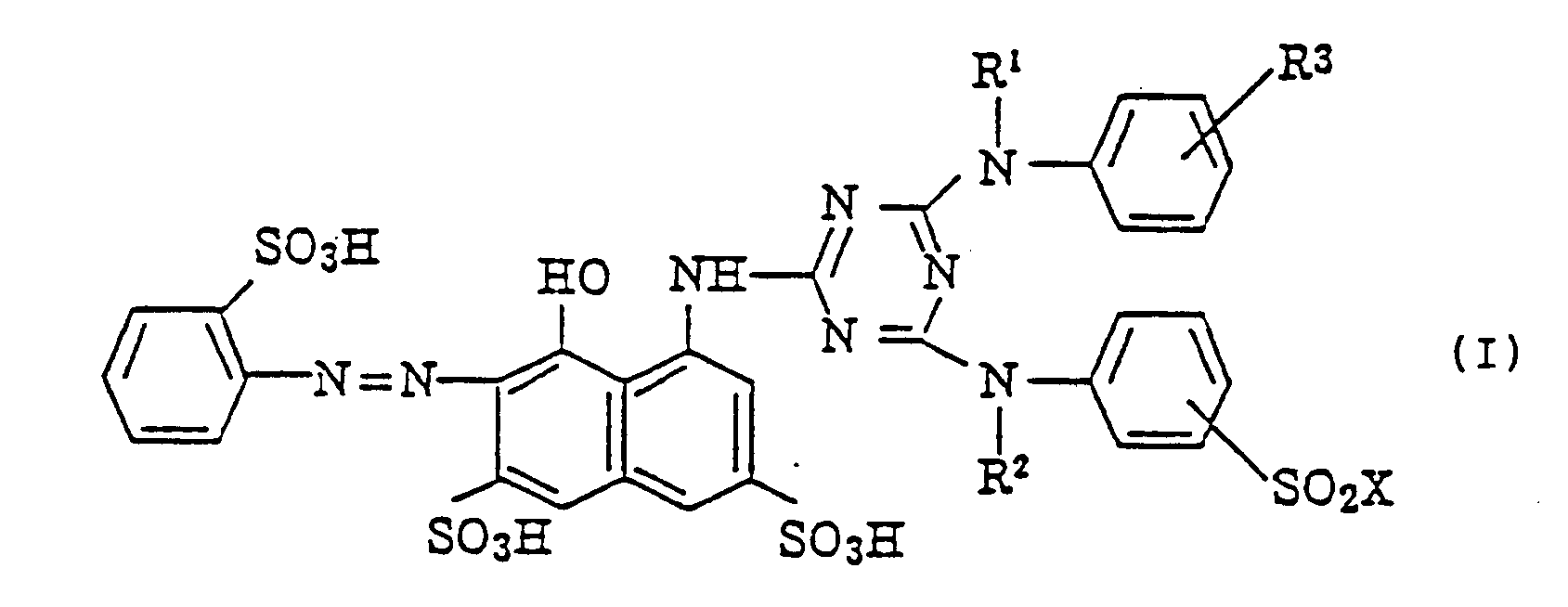
(where: each of R¹ and R² denotes a hydrogen atom or a lower alkyl group which may contain therein a substituent; R³ indicates a hydrogen atom, a lower alkyl group or a halogen atom and X representes -CH=CH₂ or -C₂H₄OSO₃H),
said water-soluble reactive dye mixture being characterized in that the yellow component is a water-soluble reactive dye represented by the following general formula (II) in the form of free acid:
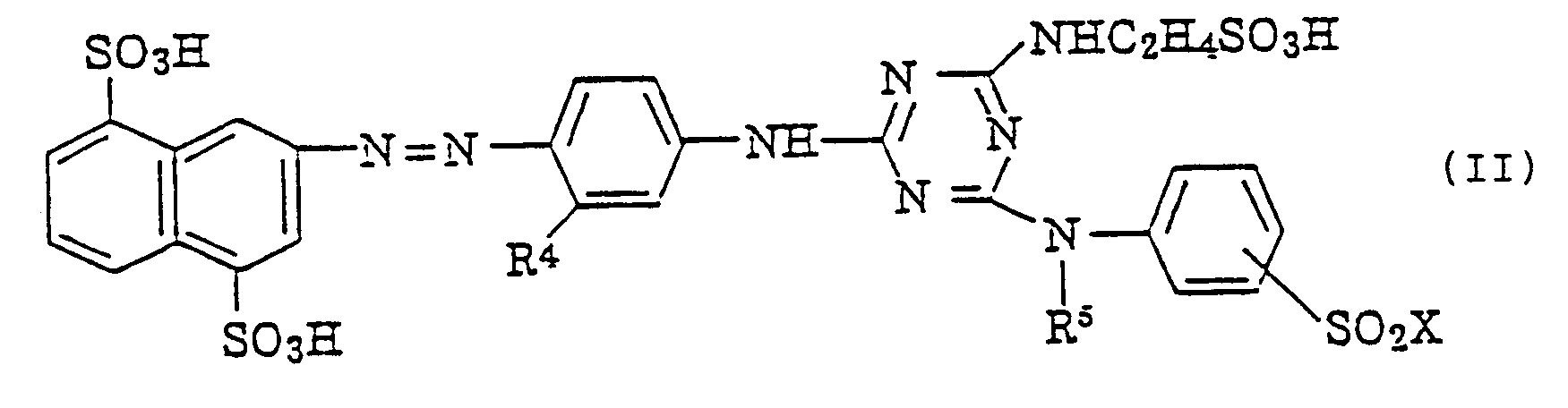
(where: R⁴ represents a -NHCOCH₃ group, a -NHCOC₂H₅ group, a -NHCONH₂ group or a -NHCOSO₂CH₃ group; R⁵ denotes a hydrogen atom or a lower alkyl group which may contain therein a substituent; and X has the same definition as in the preceding general formula (I)),
and the blue component is at least one water-soluble reactive dye represented by the following general formulas (III) to (IV) in the form of free acid:
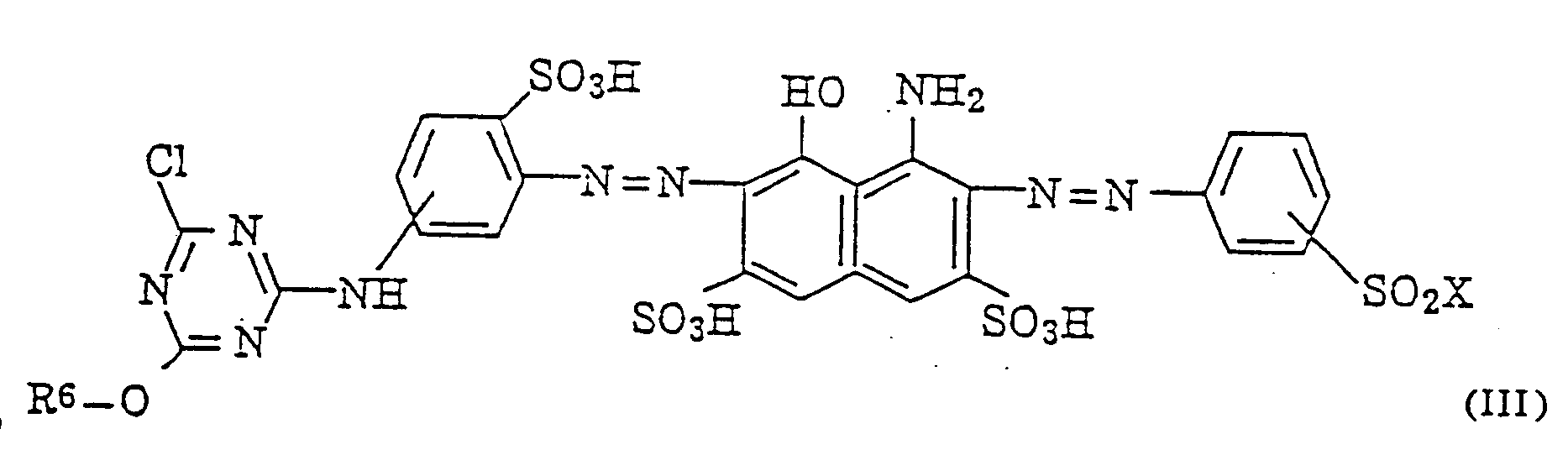
(where: R⁶ indicates a lower alkyl group; and X has the same definition in the preceding general formula (I));
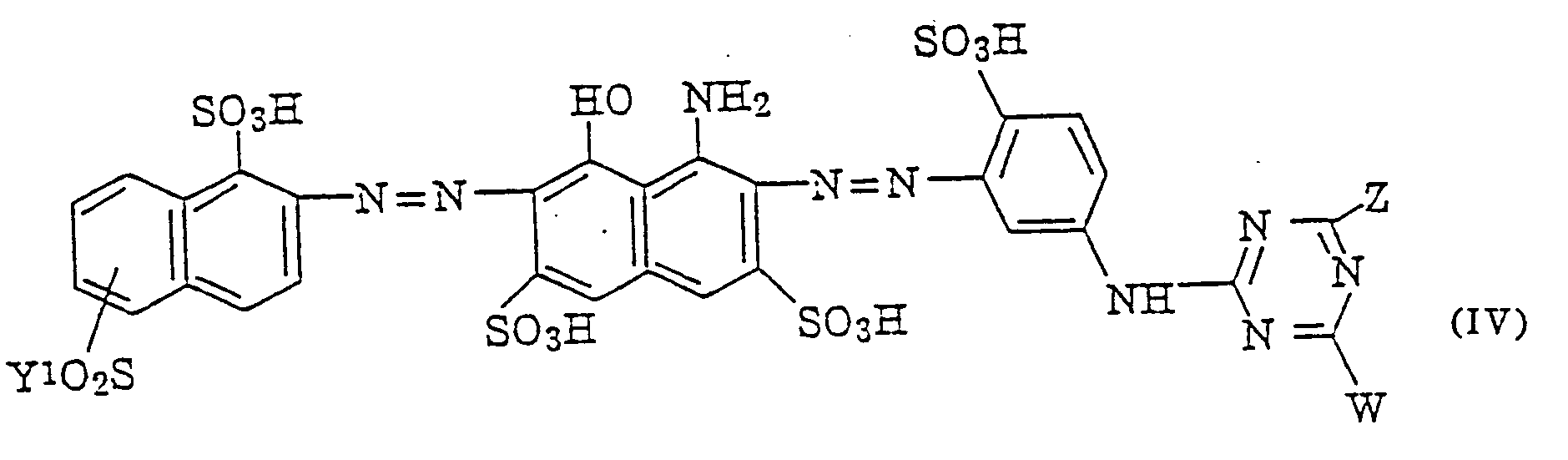
(where: Y¹ denotes a -CH=CH₂ group, a -C₂H₄OSO₃H group or a -OH group; Z represents a chlorine atom or a fluorine atom; W designates a lower alkoxy group or a
and X has the same definition as in the preceding general formula (I);
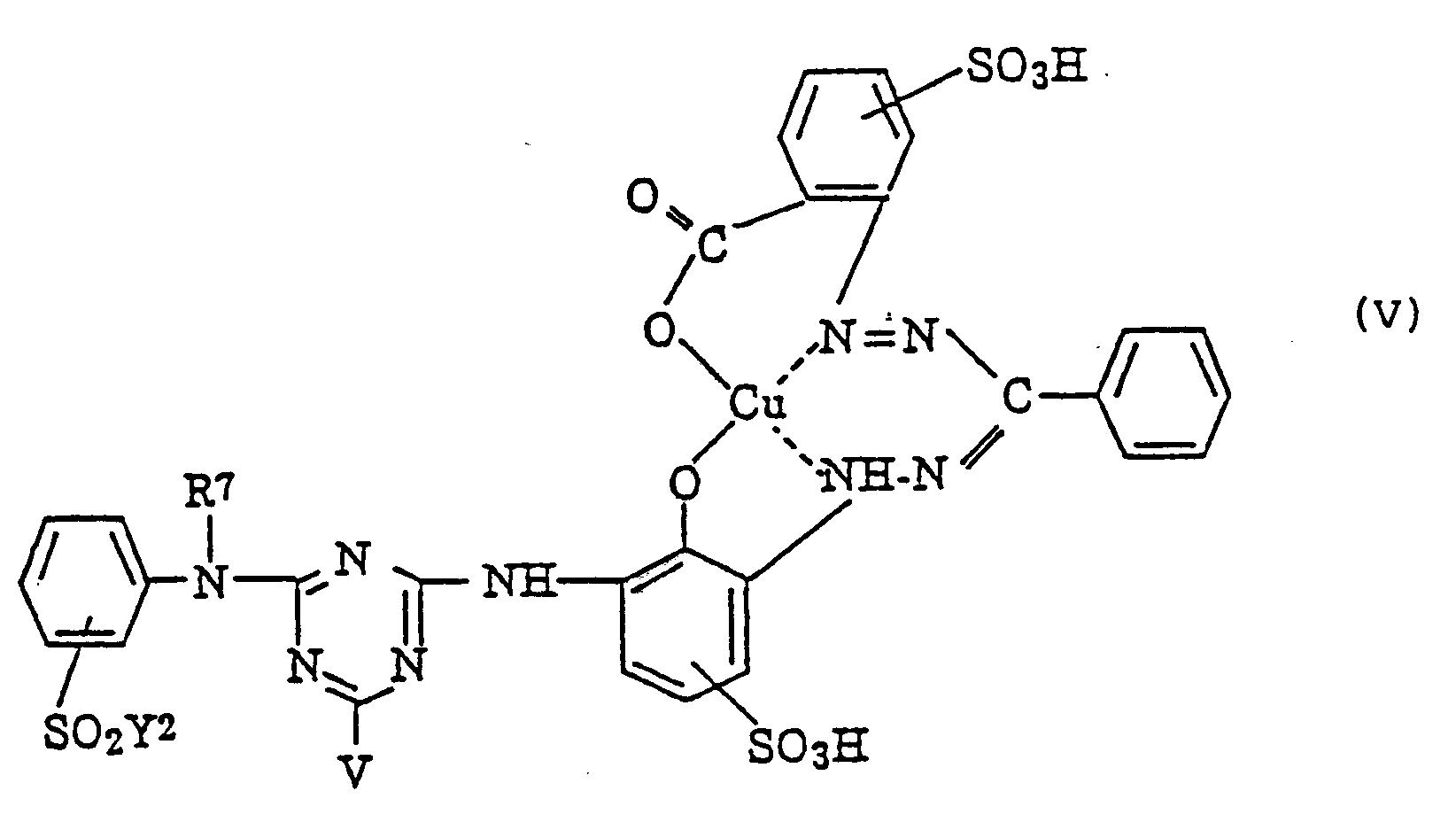
(where: V denotes a chlorine atom, a fluorine atom or a -NHC₂H₄SO₃H group; R⁷ represents a hydrogen atom or a lower alkyl group which may contain therein a substituent; and Y² indicates a -CH=CH₂ group, a -C₂H₄OSO₃H group or a -OH group, provided that when V is a -NHC₂H₄SO₃H group, Y² is either a -CH=CH₂ group or a -C₂H₄OSO₃H group; and
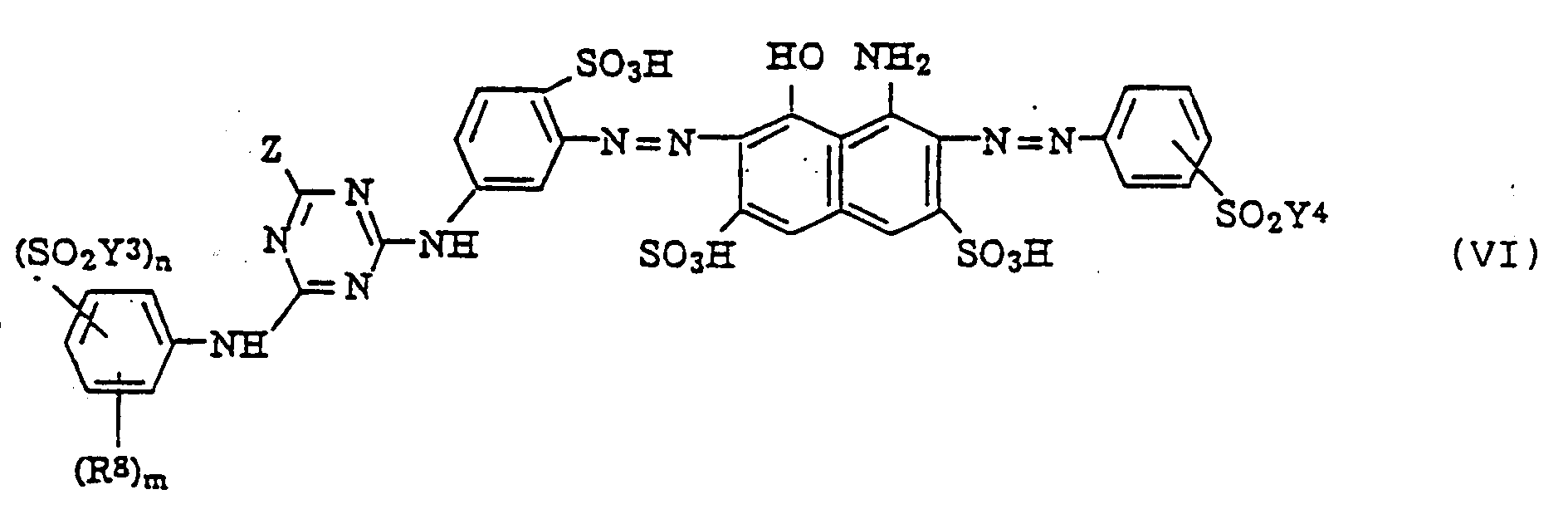
(where: R⁸ denotes a chlorine atom, a -COOH group or a -OH group; each of Y³ and Y⁴ represents a -CH=CH₂ group, a -C₂H₄OSO₃H group or a -OH group; m and n are numbers of 0 or 1, but cannot be 0 at the same time; and Z has the same definition as in the preceding general formula (IV)).
(where: each of R¹ and R² denotes a hydrogen atom or a lower alkyl group which may contain therein a substituent; R³ indicates a hydrogen atom, a lower alkyl group or a halogen atom and X representes -CH=CH₂ or -C₂H₄OSO₃H),
said water-soluble reactive dye mixture being characterized in that the yellow component is a water-soluble reactive dye represented by the following general formula (II) in the form of free acid:
(where: R⁴ represents a -NHCOCH₃ group, a -NHCOC₂H₅ group, a -NHCONH₂ group or a -NHCOSO₂CH₃ group; R⁵ denotes a hydrogen atom or a lower alkyl group which may contain therein a substituent; and X has the same definition as in the preceding general formula (I)),
and the blue component is at least one water-soluble reactive dye represented by the following general formulas (III) to (IV) in the form of free acid:
(where: R⁶ indicates a lower alkyl group; and X has the same definition in the preceding general formula (I));
(where: Y¹ denotes a -CH=CH₂ group, a -C₂H₄OSO₃H group or a -OH group; Z represents a chlorine atom or a fluorine atom; W designates a lower alkoxy group or a
and X has the same definition as in the preceding general formula (I);
(where: V denotes a chlorine atom, a fluorine atom or a -NHC₂H₄SO₃H group; R⁷ represents a hydrogen atom or a lower alkyl group which may contain therein a substituent; and Y² indicates a -CH=CH₂ group, a -C₂H₄OSO₃H group or a -OH group, provided that when V is a -NHC₂H₄SO₃H group, Y² is either a -CH=CH₂ group or a -C₂H₄OSO₃H group; and
(where: R⁸ denotes a chlorine atom, a -COOH group or a -OH group; each of Y³ and Y⁴ represents a -CH=CH₂ group, a -C₂H₄OSO₃H group or a -OH group; m and n are numbers of 0 or 1, but cannot be 0 at the same time; and Z has the same definition as in the preceding general formula (IV)).
2. A water-soluble dye mixture, wherein a yellow and/or blue water-soluble reactive dye
is blended with at least one kind of red water-soluble reactive dyes to be represented
by the following general formula (I) in the form of free acid:
(where: each of R¹ and R² denotes a hydrogen atom or a lower alkyl group which may contain therein a substituent; R³ represents a hydrogen atom, a lower alkyl group or a halogen atom; and X designates -CH=CH₂ or -C₂H₄OSO₃H),
said water-soluble reactive dye mixture being characterized in that the yellow component is a water-soluble reactive dye represented by the following general formula (II) in the form of free acid:
(where: R⁴ denotes a -NHCOCH₃ group, a -NHCOC₂H₅ group, a -NHCONH₂ group or a -NHCOSO₂CH₃ group; R₅ represents a hydrogen atom or a lower alkyl group which may contain therein a substituent; and X has the same definition as in the preceding general formula (I)),
and that the blue component is a water-soluble reactive dye represented by the following general formula (III) in the form of free acid:
(where: R⁶ denotes a lower alkyl group: and X has the same definition as in the preceding general formula (I)).
(where: each of R¹ and R² denotes a hydrogen atom or a lower alkyl group which may contain therein a substituent; R³ represents a hydrogen atom, a lower alkyl group or a halogen atom; and X designates -CH=CH₂ or -C₂H₄OSO₃H),
said water-soluble reactive dye mixture being characterized in that the yellow component is a water-soluble reactive dye represented by the following general formula (II) in the form of free acid:
(where: R⁴ denotes a -NHCOCH₃ group, a -NHCOC₂H₅ group, a -NHCONH₂ group or a -NHCOSO₂CH₃ group; R₅ represents a hydrogen atom or a lower alkyl group which may contain therein a substituent; and X has the same definition as in the preceding general formula (I)),
and that the blue component is a water-soluble reactive dye represented by the following general formula (III) in the form of free acid:
(where: R⁶ denotes a lower alkyl group: and X has the same definition as in the preceding general formula (I)).
3. A water-soluble dye mixture, wherein a yellow and/or blue water-soluble reactive dye
is blended with at least one kind of red water-soluble reactive dyes represented by
the following general formula (I) in the form of free acid:
(where: each of R¹ and R² denotes a hydrogen atom or a lower alkyl group which may contain therein a substituent; R³ represents a hydrogen atom, a lower alkyl group or a halogen atom; and X indicates -CH=CH₂ or -C₂H₄OSO₃H),
said water-soluble reactive dye mixture being characterized in that the yellow component is a water-soluble reactive dye represented by the following general formula (II) in the form of free acid:
(where: R⁴ represents a -NHCOCH₃ group, a -NHCOC₂H₅ group, a -NHCONH₂ group or a -NHCOSO₂CH₃ group; R⁵ indicates a hydrogen atom or a lower alkyl group which may contain therein a substituent; and X has the same definition as in the preceding general fromula (I),
and that the blue component is a water-soluble reactive dye represented by the following general formula (IV) in the form of free acid:
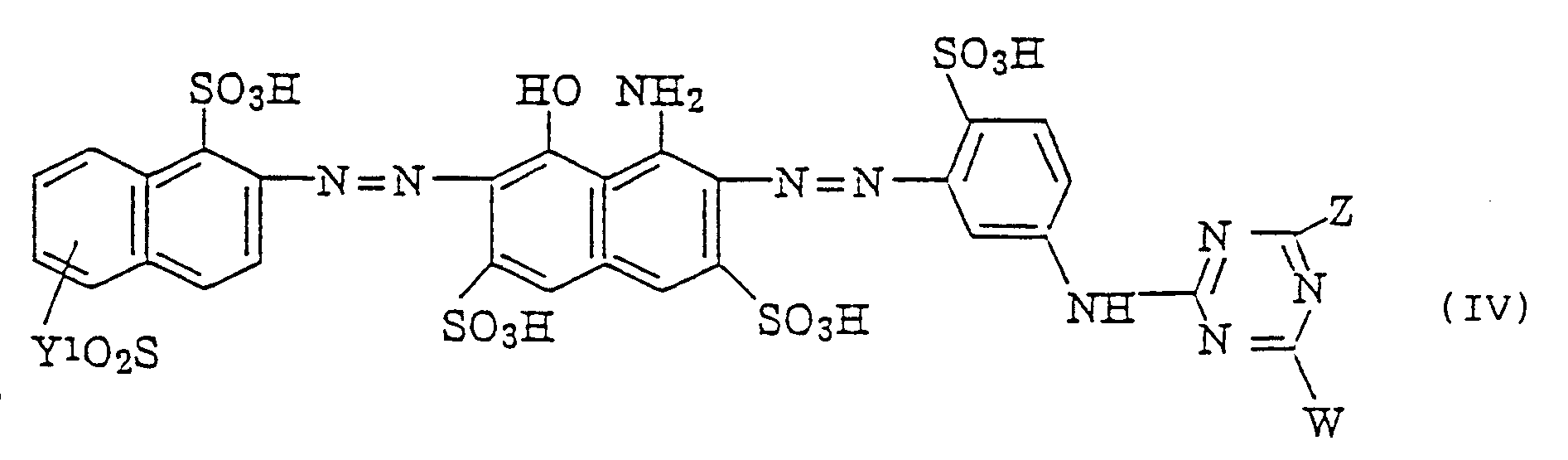
(where: Y¹ denotes a -CH=CH₂ group, a -C₂H₄OSO₃H group or a -OH group; Z designates a chlorine atom or a fluorine atom; W represents a lower alkoxy group or a
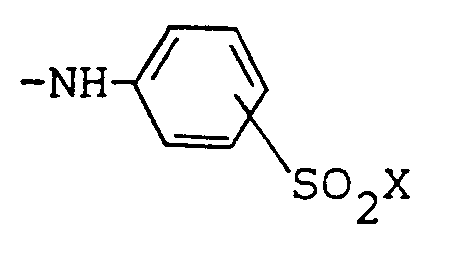
group: and X has the same definition as in the preceding general formula (I)).
(where: each of R¹ and R² denotes a hydrogen atom or a lower alkyl group which may contain therein a substituent; R³ represents a hydrogen atom, a lower alkyl group or a halogen atom; and X indicates -CH=CH₂ or -C₂H₄OSO₃H),
said water-soluble reactive dye mixture being characterized in that the yellow component is a water-soluble reactive dye represented by the following general formula (II) in the form of free acid:
(where: R⁴ represents a -NHCOCH₃ group, a -NHCOC₂H₅ group, a -NHCONH₂ group or a -NHCOSO₂CH₃ group; R⁵ indicates a hydrogen atom or a lower alkyl group which may contain therein a substituent; and X has the same definition as in the preceding general fromula (I),
and that the blue component is a water-soluble reactive dye represented by the following general formula (IV) in the form of free acid:
(where: Y¹ denotes a -CH=CH₂ group, a -C₂H₄OSO₃H group or a -OH group; Z designates a chlorine atom or a fluorine atom; W represents a lower alkoxy group or a
group: and X has the same definition as in the preceding general formula (I)).
4. A water-soluble reactive dye mixture, wherein a yellow and/or blue water-soluble reactive
dye is blended with at least one kind of red water-soluble reactive dyes represented
by the following general formula (I) in the form of free acid:
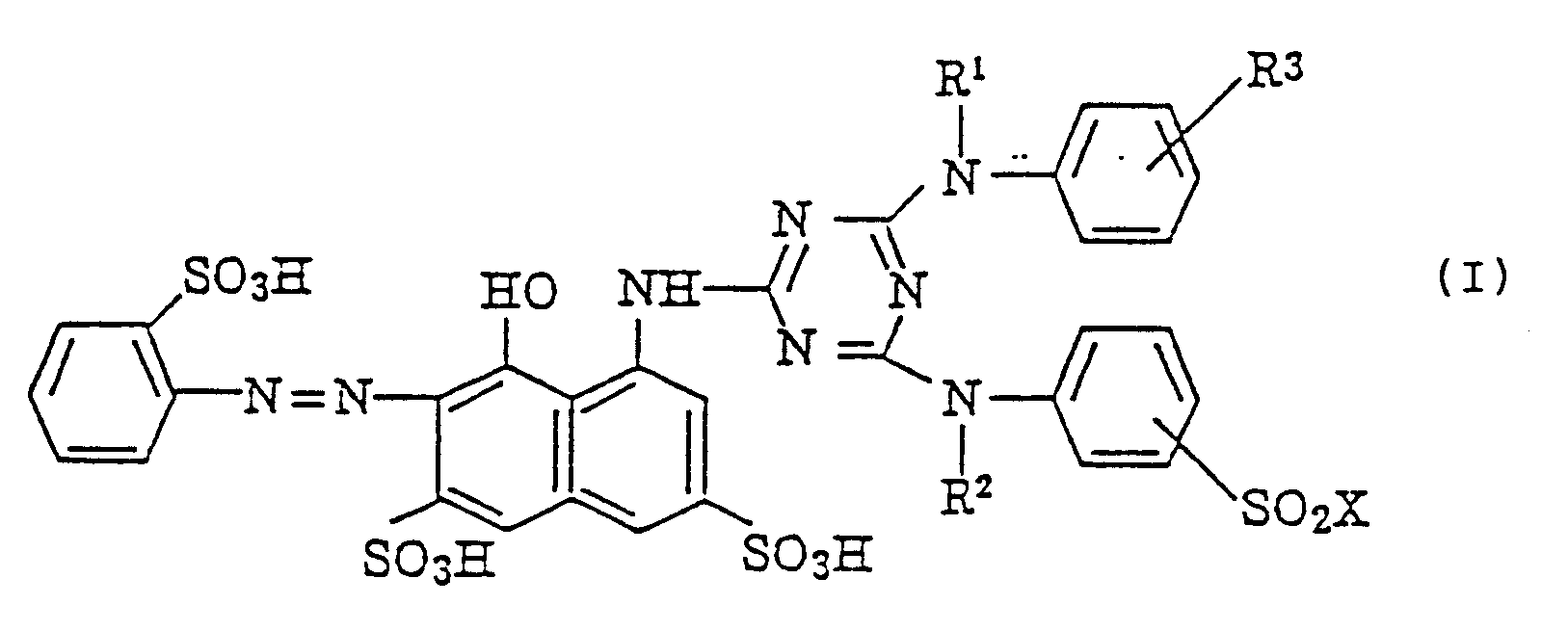
(where: each of R¹ and R² denotes a hydrogen atom or a lower alkyl group which may contain therein a substituent; R³ represents a hydrogen atom, a lower alkyl group or a halogen atom and X indicates -CH=CH₂ or -C₂H₄OSO₃H),
said water-soluble reactive dye mixture being characterized in that the yellow component is water-soluble reactive dye represented by the following general formula (II) in the form of free acid:
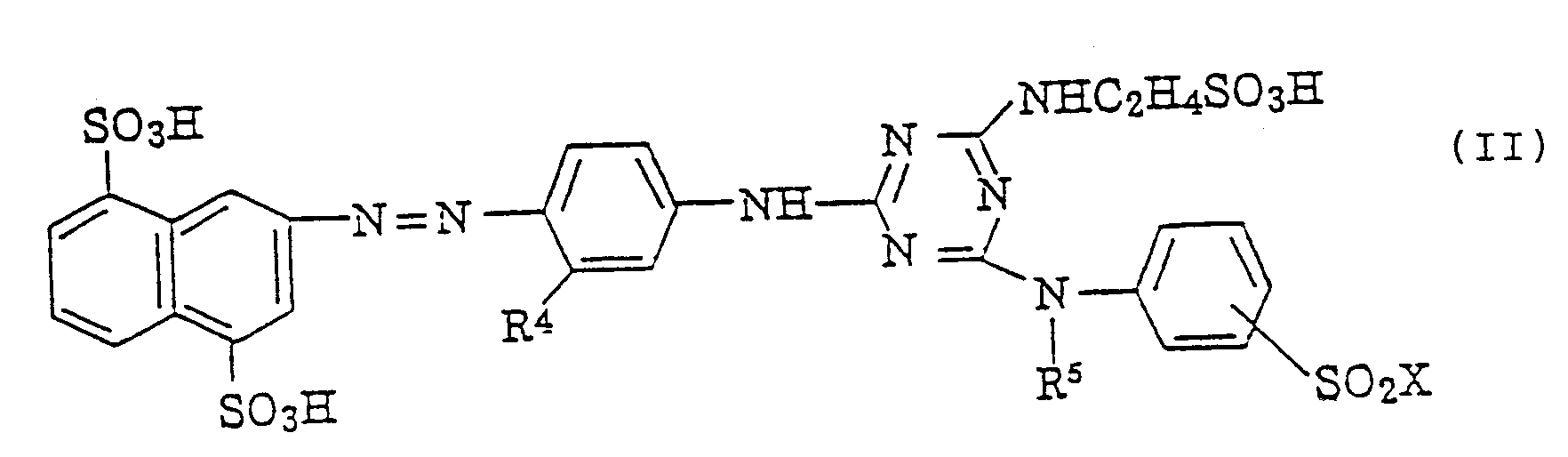
(where: R⁴ denotes a -NHCOCH₃ group, a -NHCOC₂H₅ group, a -NHCONH₂ group or a -NHCOSO₂CH₃ group; R⁵ indicates a hydrogen atom or a lower alkyl group which may contain therein a substituent; and X has the same definition as in the preceding general formula (I)),
and that the blue component is a water-soluble reactive dye represented by the following general formula (V) in the form of free acid:
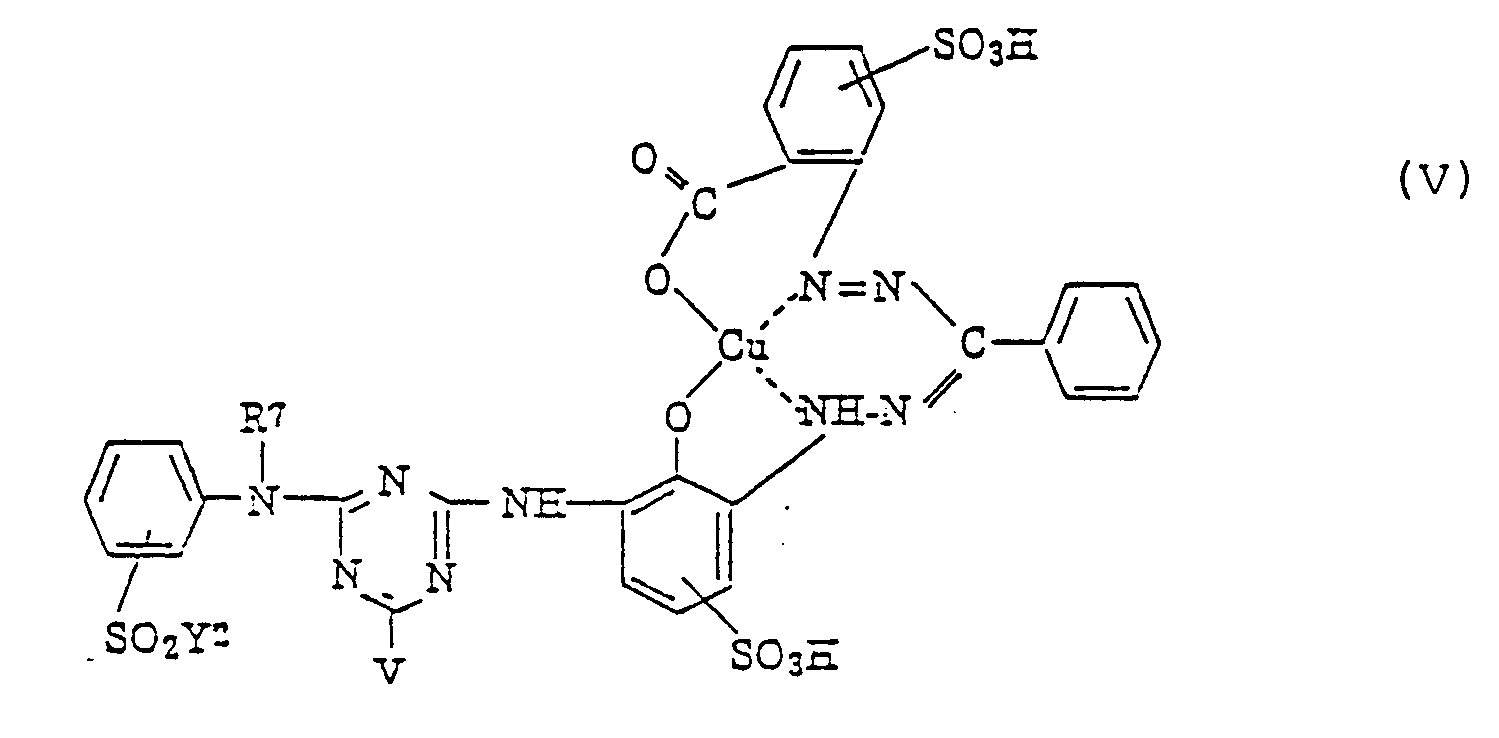
(where: V denotes a chlorine atom, a fluorine atom or a -NHC₂H₄SO₃H group; R⁷ represents a hydrogen atom or a lower alkyl group which may contain therein a substituent; and Y² designates a -CH=CH₂ group, a -C₂H₄OSO₃H group or a -OH group, provided that when V is a -NHC₂H₄SO₃H group, Y² is either a -CH=CH₂ group or a -C₂H₄OSO₃H group).
(where: each of R¹ and R² denotes a hydrogen atom or a lower alkyl group which may contain therein a substituent; R³ represents a hydrogen atom, a lower alkyl group or a halogen atom and X indicates -CH=CH₂ or -C₂H₄OSO₃H),
said water-soluble reactive dye mixture being characterized in that the yellow component is water-soluble reactive dye represented by the following general formula (II) in the form of free acid:
(where: R⁴ denotes a -NHCOCH₃ group, a -NHCOC₂H₅ group, a -NHCONH₂ group or a -NHCOSO₂CH₃ group; R⁵ indicates a hydrogen atom or a lower alkyl group which may contain therein a substituent; and X has the same definition as in the preceding general formula (I)),
and that the blue component is a water-soluble reactive dye represented by the following general formula (V) in the form of free acid:
(where: V denotes a chlorine atom, a fluorine atom or a -NHC₂H₄SO₃H group; R⁷ represents a hydrogen atom or a lower alkyl group which may contain therein a substituent; and Y² designates a -CH=CH₂ group, a -C₂H₄OSO₃H group or a -OH group, provided that when V is a -NHC₂H₄SO₃H group, Y² is either a -CH=CH₂ group or a -C₂H₄OSO₃H group).
5. A water-soluble reactive dye mixture, wherein a yellow and/or blue water-soluble reactive
dye is belnded with at least one kind of red water-soluble reactive dyes represented
by the following general formula (I) in the form of free acid:
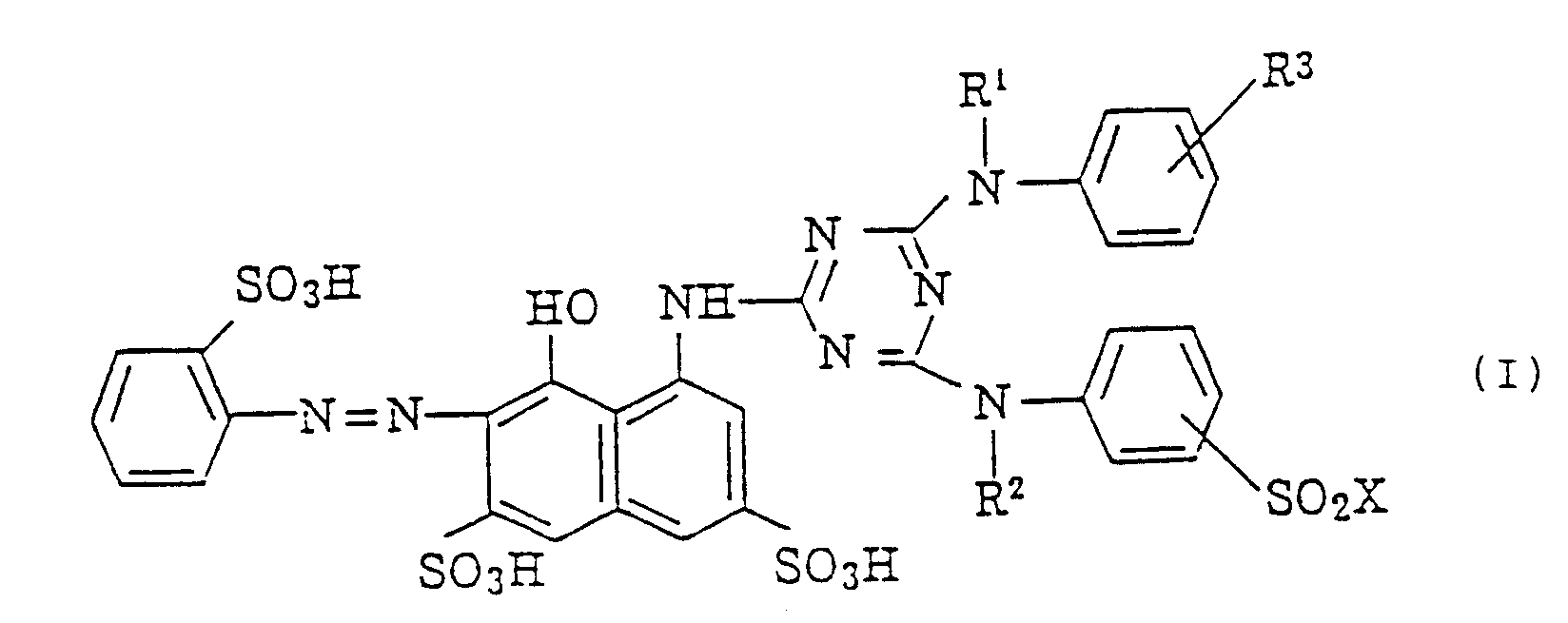
(where: each of R¹ and R² represents a hydrogen atom or a lower alkyl group which may contain therein a substituent; R³ designates a hydrogen atom, a lower alkyl group or a halogen atom and X indicates -CH=CH₂ or -C₂H₄OSO₃H),
said water-soluble reactive dye mixture being characterized in that the yellow component is a water-soluble reactive dye represented by the following general formula (II) in the form of free acid:
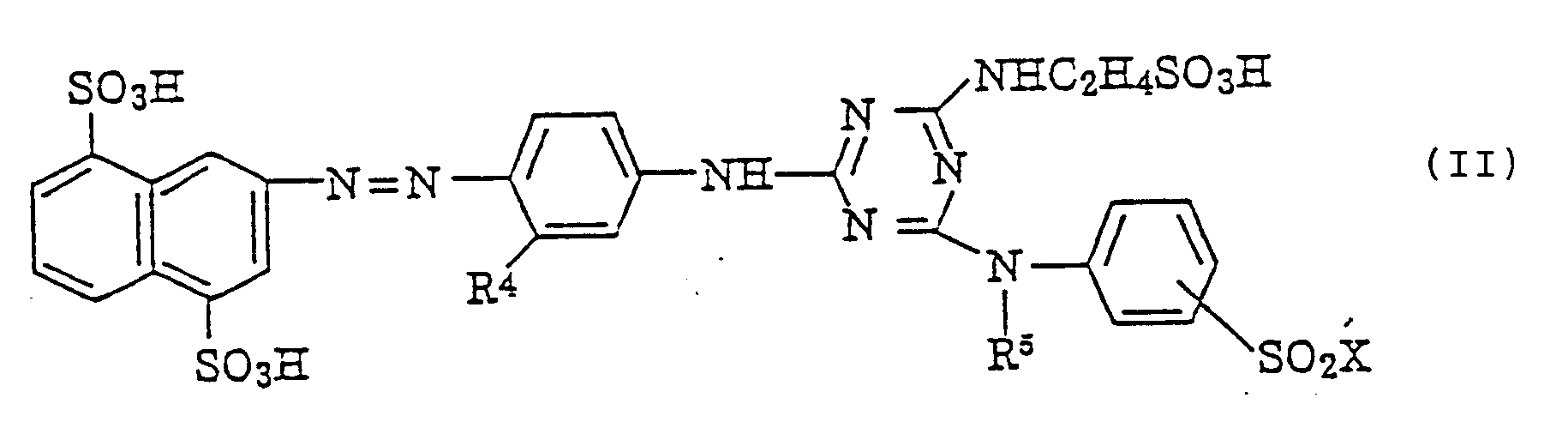
(where: R⁴ denotes a -NHCOCH₃ group, a -NHCOC₂H₅ group, a -NHCONH₂ group or a -NHCOSO₂CH₃ group; R⁵ represents a hydrogen atom or a lower alkyl group which may contain therein a substituent; and X has the same definition as in the preceding general formula (I)),
and that the blue component is water-soluble reactive dye represented by the following general formula (VI) in the form of free acid:
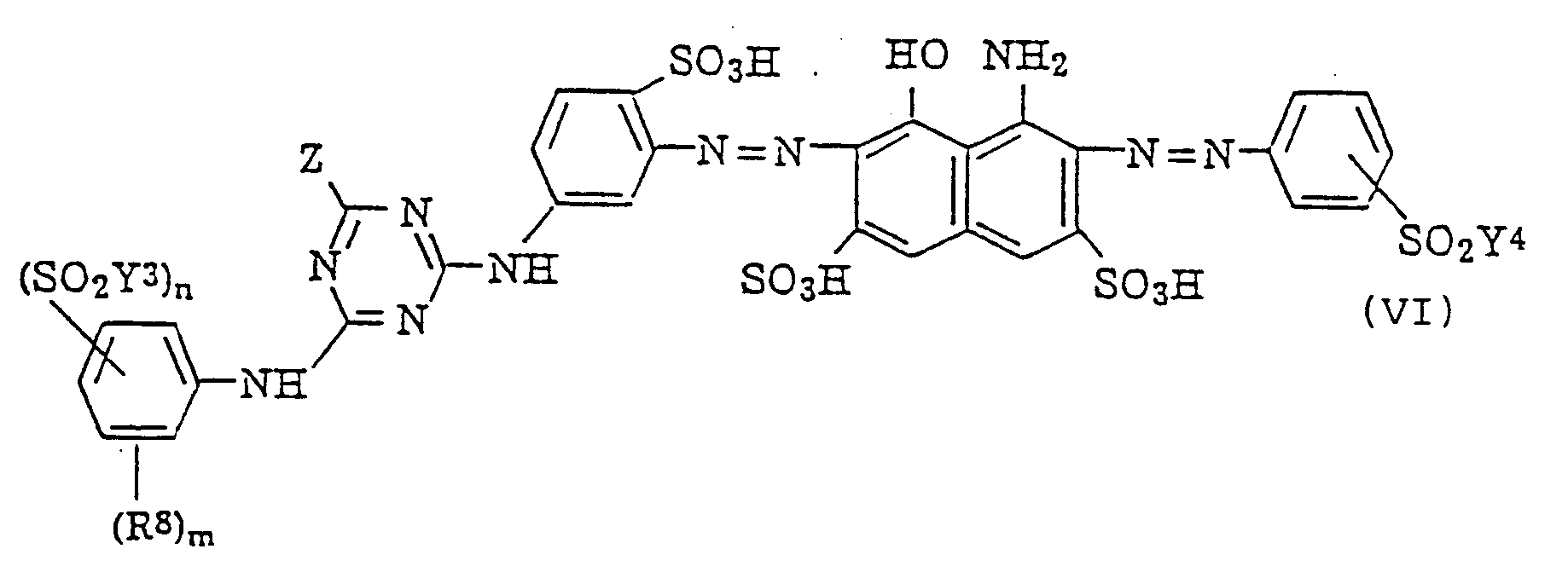
(where: R⁸ indicates a chlorine atom, a -COOH group or a -OH group; each of Y³ and Y⁴ designates a -CH=CH₂ group, a -C₂H₄OSO₃H group or a -OH group; m and n are numbers of 0 or 1, but cannot be 0 at the same time; and Z has the same definition as in the preceding general formula (IV)).
(where: each of R¹ and R² represents a hydrogen atom or a lower alkyl group which may contain therein a substituent; R³ designates a hydrogen atom, a lower alkyl group or a halogen atom and X indicates -CH=CH₂ or -C₂H₄OSO₃H),
said water-soluble reactive dye mixture being characterized in that the yellow component is a water-soluble reactive dye represented by the following general formula (II) in the form of free acid:
(where: R⁴ denotes a -NHCOCH₃ group, a -NHCOC₂H₅ group, a -NHCONH₂ group or a -NHCOSO₂CH₃ group; R⁵ represents a hydrogen atom or a lower alkyl group which may contain therein a substituent; and X has the same definition as in the preceding general formula (I)),
and that the blue component is water-soluble reactive dye represented by the following general formula (VI) in the form of free acid:
(where: R⁸ indicates a chlorine atom, a -COOH group or a -OH group; each of Y³ and Y⁴ designates a -CH=CH₂ group, a -C₂H₄OSO₃H group or a -OH group; m and n are numbers of 0 or 1, but cannot be 0 at the same time; and Z has the same definition as in the preceding general formula (IV)).
6. The water-soluble reactive dye mixture according to any one of Claims 1 to 5, characterized
in that a mixing ratio of the yellow and/or blue water-soluble reactive dye with respect
to the red water-soluble reactive dye ranges from 0.05 to 50 times by weight in total,
and that a mixing ratio between the yellow water-soluble reactive dye and the blue
water-soluble reactive dye is 0 to 100:100 to 0.
7. The water-soluble reactive dye mixture according to any one of Claims 1 to 5, characterized
in that a mixing ratio of the yellow and/or blue water-soluble reactive dye with,
respect to the red water-soluble reactive dye ranges from 0.1 to 10 times by weight
in total, and that a mixing ratio between the yellow water-soluble reactive dye and
blue water-soluble reactive dye is 0 to 100:100 to 0.
8. The water-soluble reactive dye mixture according to any one of Claims 1 to 5, characterized
in that it is used for the exhaustion-dyeing of cellulosic fibers.
9. The water-soluble reactive dye mixture according to any one of Claims 1 to 5, characterized
in that the red water-soluble reactive dye is one as represented by the general formula
(I), wherein R¹ is a methyl group or an ethyl group; and R² is a hydrogen atom, a
methyl group or an ethyl group.
10. The water-soluble reactive dye mixture according to any one of Claims 1 to 5, characterized
in that the red water-soluble reactive dye is one as represented by the general formula
(I), wherein R³ is a hydrogen atom, a methyl group, an ethyl group, a chlorine atom
or a bromine atom.
11. The water-soluble reactive dye mixture according to any one of Claims 1 to 5, characterized
in that the red water-soluble reactive dye is one as represented by the general formula
(I), wherein R² and R³ are hydrogen atoms.
12. The water-soluble reactive dye mixture according to any one of Claims 1 to 5, characterized
in that the red water-soluble reactive dye is one as represented by the general formula
(I), wherein R¹ is a methyl group or an ethyl group; and R² and R³ are hydrogen atoms.
13. The water-soluble reactive dye mixture according to any one of Claims 1 to 5, characterized
in that the yellow water-soluble reactive dye is one as represented by the general
formula (II), wherein R⁴ is a -NHCOCH₃ group or a -NHCONH₂ group.
14. The water-soluble reactive dye mixture according to any one of Claims 1 to 5, characterized
in that the yellow water-soluble reactive dye is one as represented by the general
formula (II), wherein R⁵ is a hydrogen atom, a methyl gruop or an ethyl group.
15. The water-soluble reactive dye mixture according to any one of Claims 1 to 5, characterized
in that the yellow water-soluble reactive dye is one as represented by the general
formula (II), wherein R⁴ is a -NHCOCH₃ group; and R⁵ is a hydrogen atom.
16. The water-soluble reactive dye mixture according to Claim 1 or 2, characterized in
that the blue water-soluble reactive dye is one as represented by the general formula
(III), wherein R⁶ is a methyl group.
17. The water-soluble reactive dye mixtures according to Claim 1 or 3, characterized in
that the blue water-soluble reactive dye is one as represented by the general formula
(IV), wherein Y¹ is a -CH=CH₂ group or a -C₂H₄OSO₃H group; Z is a chlorine atom; and
W is a methoxy group.
18. The water-soluble reactive dye mixture according to Claim 1 or 3 characterized in
that the blue water-soluble reactive dye is one as represented by the general formula
(IV), wherein Y¹ is a -OH group; Z is a chlorine atom or a fluorine atom; and W is
a
group.
group.
19. The water-soluble reactive dye mixture according to Claim 1 or 4, characterized in
that the blue water-soluble reactive dye is one as represented by the general formula
(V), wherein R⁷ is a hydrogen atom; V is a -NHC₂H₄SO₃H group; and Y² is a -CH=CH₂
group or a -C₂H₄OSO₃H group.
20. The water-soluble reactive dye mixture according to Claim 1 or 5, characterized in
that the blue water-soluble reactive dye is one as represented by the general formula
(VI), wherein Y³ and Y⁴ are -OH groups; Z is a fluorine atom; m is 0; and n is 1.
21. The water-soluble reactive dye mixture according to Claim 1, characterized in that
the blue component is a water-soluble reactive dye represented by the general formula
(III) or (V).
22. The water-soluble reactive dye mixture according to Claim 1, characterized in that
it is a mixture of a red water-soluble reactive dye represented by the general formula
(I) and a yellow water-soluble ractive dye represented by the general formula (II).
23. A method of dyeing cellulosic fibers by the exhaustion dyeing method in the presence
of an alkali and an inorganic salt, using a dye mixture composed of a blend of at
least one kind of red water-soluble reactive dyes represented by the following general
formula (I) in the form of free acid:
(where: each of R¹ and R² represents a hydrogen atom or a lower alkyl group which may contain therein a substituent; R³ denotes a hydrogen atom, a lower alkyl group or a halogen atom; and X indicates -CH=CH₂ or -C₂H₄OSO₃H), and a yellow and/or blue water-soluble reactive dye,
said method being characterized in that the yellow component is a water-soluble reactive dye represented by the following general formula (II) in the form of free acid:
(where: R⁴ is a -NHCOCH₃ group, a -NHCOC₂H₅ group, a -NHCONH₂ group or a -NHCOSO₂CH₃ group; R⁵ denotes a hydrogen atom or a lower alkyl group which may contain therein a substituent; and X has the same definition as in the preceding general formula (I)),
and that the blue component is at least one water-soluble reactive dye represented by the following general formulas (III) to (VI) in the form of free acid:
(where: R⁶ indicates a lower alkyl group; and X has the same definition as in the preceding general formula (I));
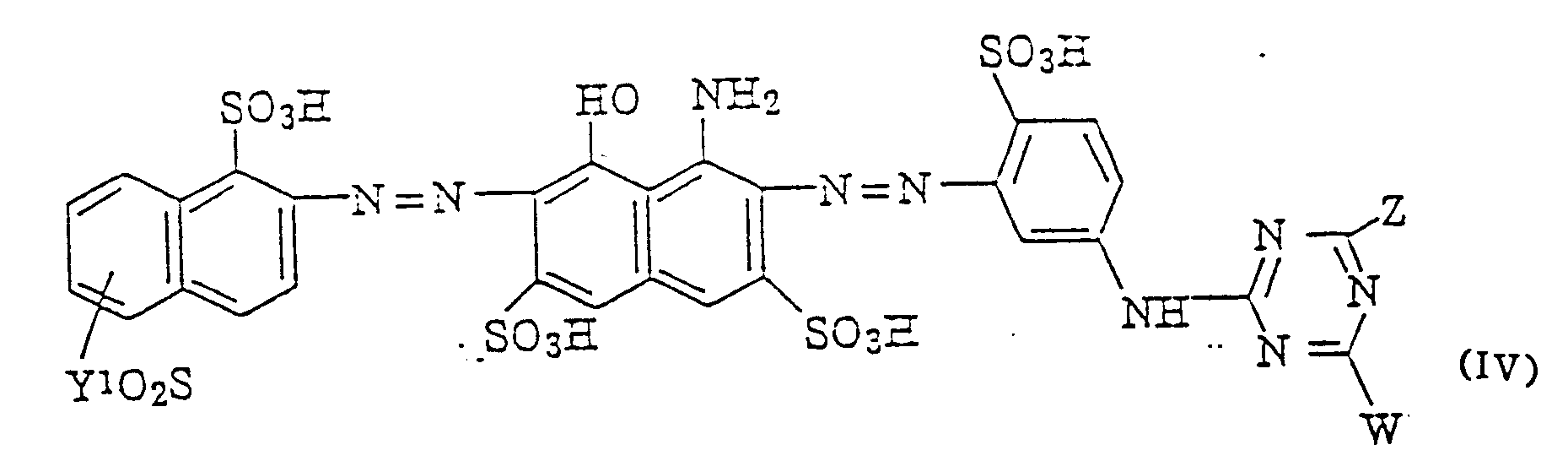
(where: Y¹ indicates a -CH=CH₂ group, a -C₂H₄OSO₃H group or a -OH group; Z denotes a chlorine atom or a fluorine atom; W designates a lower alkoxy or a
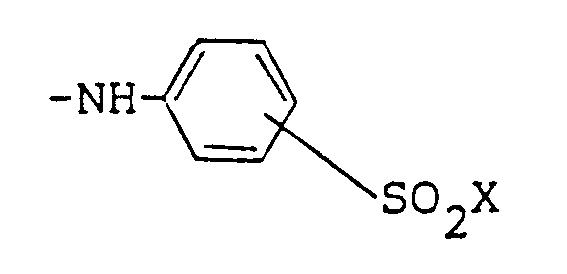
group; and X has the same definition as in the preceding general formula (I));
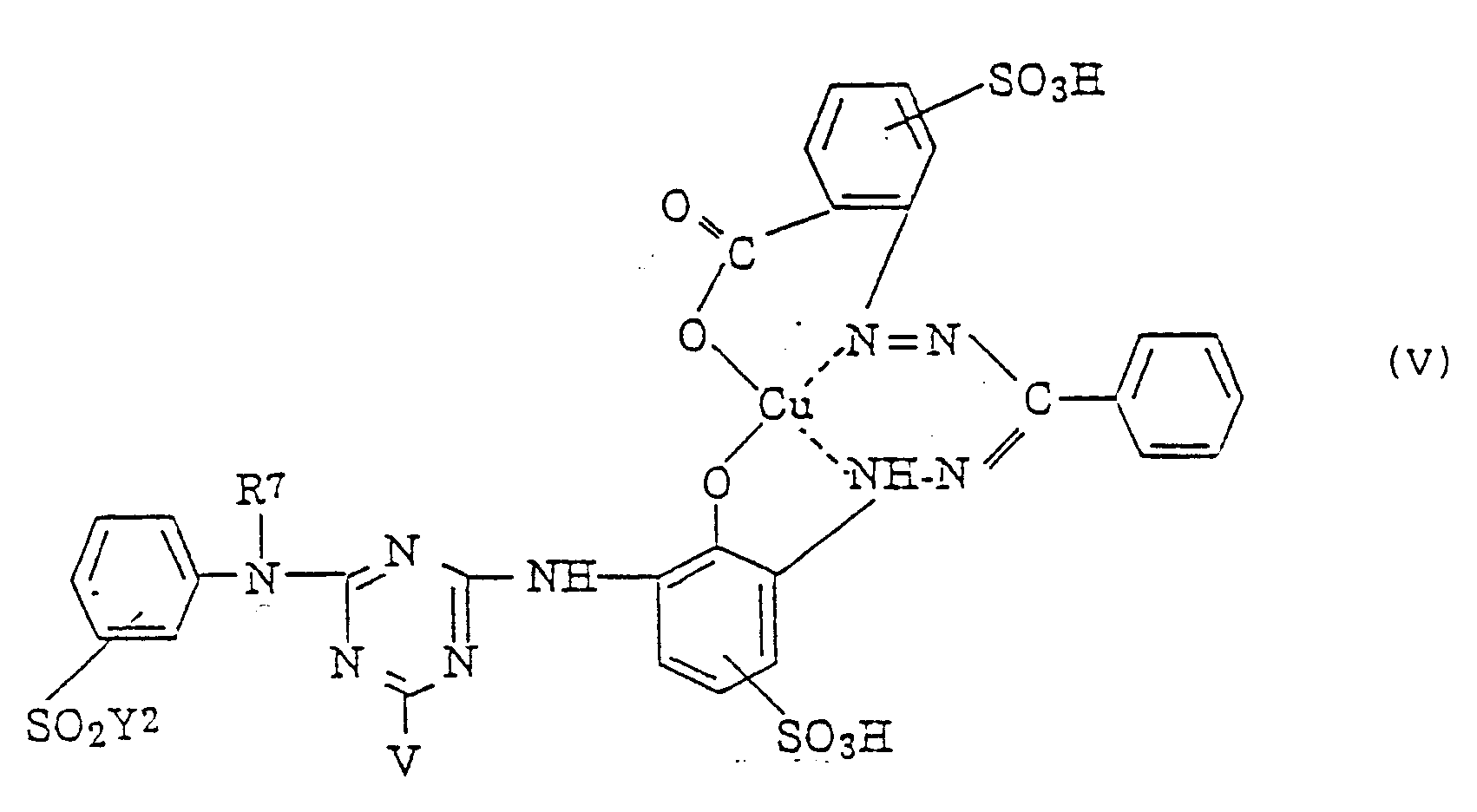
(where: V denotes a chlorine atom, a fluorine atom or a -NHC₂H₄SO₃H group; R⁷ indicates a hydrogen atom or a lower alkyl group which may contain therein a substituent; and Y² represents a -CH=CH₂ group, a -C₂H₄OSO₃H group or a -OH group, provided that when V is a -NHC₂H₄SO₃H group, Y² is either a -CH=CH₂ group or a -C₂H₄OSO₃H group);
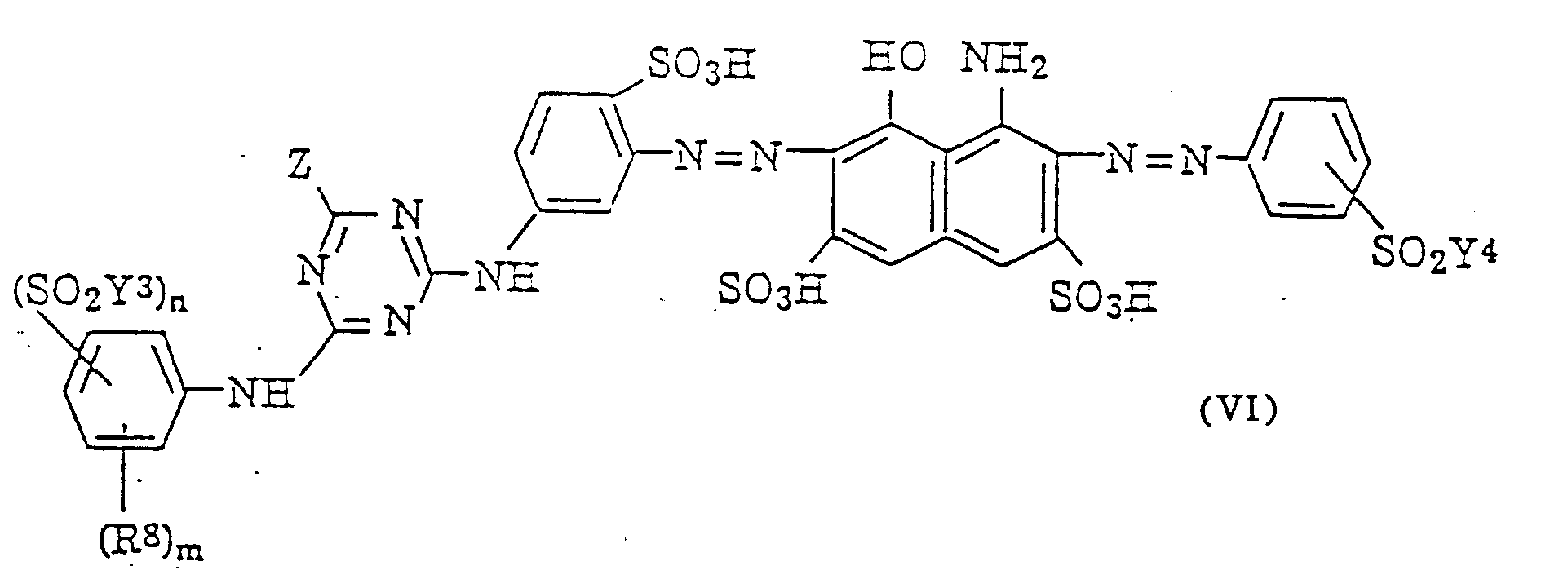
(where: R⁸ indicates a chlorine atom, a -COOH group or a -OH group; each of Y³ and Y⁴ denote a -CH=CH₂ group, a -C₂H₄OSO₃H group or a -OH group; m and n are numbers of 0 or 1, but cannot be 0 at the same time; and Z has the same definition as in the preceding general formula (IV)).
(where: each of R¹ and R² represents a hydrogen atom or a lower alkyl group which may contain therein a substituent; R³ denotes a hydrogen atom, a lower alkyl group or a halogen atom; and X indicates -CH=CH₂ or -C₂H₄OSO₃H), and a yellow and/or blue water-soluble reactive dye,
said method being characterized in that the yellow component is a water-soluble reactive dye represented by the following general formula (II) in the form of free acid:
(where: R⁴ is a -NHCOCH₃ group, a -NHCOC₂H₅ group, a -NHCONH₂ group or a -NHCOSO₂CH₃ group; R⁵ denotes a hydrogen atom or a lower alkyl group which may contain therein a substituent; and X has the same definition as in the preceding general formula (I)),
and that the blue component is at least one water-soluble reactive dye represented by the following general formulas (III) to (VI) in the form of free acid:
(where: R⁶ indicates a lower alkyl group; and X has the same definition as in the preceding general formula (I));
(where: Y¹ indicates a -CH=CH₂ group, a -C₂H₄OSO₃H group or a -OH group; Z denotes a chlorine atom or a fluorine atom; W designates a lower alkoxy or a
group; and X has the same definition as in the preceding general formula (I));
(where: V denotes a chlorine atom, a fluorine atom or a -NHC₂H₄SO₃H group; R⁷ indicates a hydrogen atom or a lower alkyl group which may contain therein a substituent; and Y² represents a -CH=CH₂ group, a -C₂H₄OSO₃H group or a -OH group, provided that when V is a -NHC₂H₄SO₃H group, Y² is either a -CH=CH₂ group or a -C₂H₄OSO₃H group);
(where: R⁸ indicates a chlorine atom, a -COOH group or a -OH group; each of Y³ and Y⁴ denote a -CH=CH₂ group, a -C₂H₄OSO₃H group or a -OH group; m and n are numbers of 0 or 1, but cannot be 0 at the same time; and Z has the same definition as in the preceding general formula (IV)).
24. The method of dyeing according to Claim 23, characterized in that the exhaustion dyeing
is conducted in a dye bath having the concentration of the inorganic salt ranging
from 5 to 40 g per 1 liter of said dye bath.
25. The method of dyeing according to Claim 23 or 24, characterized in that said inorganic
salt is Glauber's salt.
26. The method of dyeing according to Claim 23, characterized in that the exhaustion dyeing
is conducted in a dye bath having a pH of from 10 to 13.
27. The method of dyeing according to Claim 23, characterized in that the exhaustion dyeing
is conducted at a dyeing temperature of from 40 to 80°C.
28. The method of dyeing according to Claim 23, characterized in that a mixing ratio of
the yellow and/or blue water-soluble reactive dye with respect to the red water-soluble
reactive dye ranges from 0.05 to 50 times by weight in total, and a mixing ratio between
the yellow water-soluble reactive dye and the blue water-soluble reactive dye is 0
to 100:100 to 0.
29. The method of dyeing according to Claim 23, characterized in that a mixing ratio of
the yellow and/or blue water-soluble reactive dye with respect to the red water-soluble
reactive dye ranges from 0.1 to 10 times by weight in total, and a mixing ratio between
the yellow water-soluble reactive dye and the blue water-soluble reactive dye is 0
to 100:100 to 0.
30. The method of dyeing according to Claim 23, characterized in that the red water-soluble
reactive dye is one as represented by the general formula (I), wherein R¹ is a methyl
group or an ethyl group; and R² and R³ are hydrogen atoms.
31. The method of dyeing according to Claim 23, characterized in that the yellow water-soluble
reactive dye is one as represented by the general formula (II), wherein R⁴ is a -NHCOCH₃
group, and R⁵ is a hydrogen atom.
32. The method of dyeing according to Claim 23, characterized in that the blue water-soluble
reactive dye is one as represented by the general formula (III), wherein R⁶ is a methyl
group.
33. The method of dyeing according to Claim 23, characterized in that the blue water-soluble
reactive dye is one as represented by the general formula (IV), wherein Y¹ is a -CH=CH₂
group or a -C₂H₄OSO₃H group; Z is a chlorine atom; and W is a methoxy group.
34. The method of dyeing according to Claim 23, characterized in that the blue water-soluble
reactive dye is one as represented by the general formula (IV), wherein Y¹ is a -OH
group; Z is a chlorine atom or a fluorine atom; and W is a
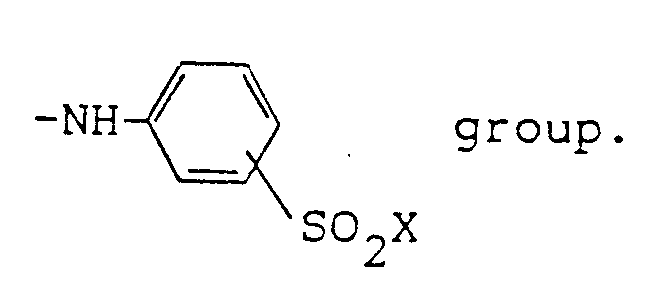
group.
group.
35. The method of dyeing according to Claim 23, characterized in that the blue water-soluble
reactive dye is one as represented by the general formula (V), wherein R⁷ is a hydrogen
atom; V is a -NHC₂H₄SO₃H group; and Y² is a -CH=CH₂ group or a -C₂H₄OSO₃H group.
36. The method of dyeing according to Claim 23, characterized in that the blue water-soluble
reactive dye is one as represented by the general formula (VI), wherein Y³ and Y⁴
are -OH groups; Z is a fluorine atom; m is 0 and n is 1.
37. The method of dyeing according to Claim 23, characterized in that the blue dye is
the water-soluble reactive dye represented by the general formula (III) or (V).
38. The method of dyeing according to Claim 23, characterized in that said water-soluble
reactive dye mixture is a mixture of the red water-soluble reactive dye represented
by the general formula (I) and the yellow water-soluble reactive dye represented by
the general formula (II).
1. Wasserlösliche Mischung von Reaktivfarbstoffen, worin ein gelber und/oder blauer wasserlöslicher
Reaktivfarbstoff mit mindestens einer Art von rotem wasserlöslichem Reaktivfarbstoff,
der durch die folgende allgemeine Formel (I) in Form freier Säure repräsentiert ist,
vermischt ist:
worin jedes von R¹ und R² ein Wasserstoffatom oder eine niedere Alkylgruppe bedeutet, die einen Substituenten enthalten kann; R³ bedeutet ein Wasserstoffatom, eine niedere Alkylgruppe oder ein Halogenatom und X repräsentiert -CH=CH₂ oder -C₂H₄OSO₃H,
wobei die wasserlösliche Mischung von Reaktivfarbstoffen dadurch gekennzeichnet ist, daß die gelbe Komponente ein wasserlöslicher Reaktivfarbstoff ist, der durch die folgende allgemeine Formel (II) in Form freier Säure repräsentiert ist:
worin R⁴ für eine -NHCOCH₃-Gruppe, eine -NHCOC₂H₅-Gruppe, eine -NHCONH₂-Gruppe oder eine -NHCOSO₂CH₃-Gruppe steht; R⁵ ein Wasserstoffatom oder eine niedere Alkylgruppe bedeutet, die einen Substituenten enthalten kann und X die gleiche Bedeutung hat wie bei der vorhergehenden allgemeinen Formel (I), und
die blaue Komponente mindestens ein wasserlöslicher Reaktivfarbstoff ist, repräsentiert durch die folgenden allgemeinen Formeln (III) bis (VI) in Form freier Säure:
worin R⁶ für eine niedere Alkylgruppe steht und X die gleiche Bedeutung wie in der vorhergehenden allgemeinen Formel (I) hat;
worin Y¹ für eine -CH=CH₂-Gruppe, eine -C₂H₄OSO₃H-Gruppe oder eine -OH-Gruppe steht; Z ein Chloratom oder ein Fluoratom repräsentiert; W eine niedere Alkoxygruppe oder ein
bedeutet und X die gleiche Bedeutung hat wie in der vorhergehenden allgemeinen Formel (I);
worin V ein Chloratom, ein Fluoratom oder eine -NHC₂H₄SO₃H-Gruppe bedeutet; R⁷ ein Wasserstoffatom oder eine niedere Alkylgruppe repräsentiert, die einen Substituenten enthalten kann und Y² eine -CH=CH₂-Gruppe, eine -C₂H₄OSO₃H-Gruppe oder eine -OH-Gruppe bezeichnet, vorausgesetzt, daß, wenn V eine -NHC₂H₄SO₃H-Gruppe ist, Y² entweder eine -CH=CH₂-Gruppe oder eine -C₂H₄OSO₃H-Gruppe ist und
worin R⁸ ein Chloratom, eine -COOH-Gruppe oder eine -OH-Gruppe bezeichnet; jedes von Y³ und Y⁴ eine -CH=CH₂-Gruppe, eine -C₂H₄OSO₃H-Gruppe oder eine -OH-Gruppe repräsentiert, m und n Zahlen von 0 oder 1 sind, aber nicht gleichzeitig 0 sein können und Z die gleiche Bedeutung hat wie in der vorhergehenden allgemeinen Formel (IV).
worin jedes von R¹ und R² ein Wasserstoffatom oder eine niedere Alkylgruppe bedeutet, die einen Substituenten enthalten kann; R³ bedeutet ein Wasserstoffatom, eine niedere Alkylgruppe oder ein Halogenatom und X repräsentiert -CH=CH₂ oder -C₂H₄OSO₃H,
wobei die wasserlösliche Mischung von Reaktivfarbstoffen dadurch gekennzeichnet ist, daß die gelbe Komponente ein wasserlöslicher Reaktivfarbstoff ist, der durch die folgende allgemeine Formel (II) in Form freier Säure repräsentiert ist:
worin R⁴ für eine -NHCOCH₃-Gruppe, eine -NHCOC₂H₅-Gruppe, eine -NHCONH₂-Gruppe oder eine -NHCOSO₂CH₃-Gruppe steht; R⁵ ein Wasserstoffatom oder eine niedere Alkylgruppe bedeutet, die einen Substituenten enthalten kann und X die gleiche Bedeutung hat wie bei der vorhergehenden allgemeinen Formel (I), und
die blaue Komponente mindestens ein wasserlöslicher Reaktivfarbstoff ist, repräsentiert durch die folgenden allgemeinen Formeln (III) bis (VI) in Form freier Säure:
worin R⁶ für eine niedere Alkylgruppe steht und X die gleiche Bedeutung wie in der vorhergehenden allgemeinen Formel (I) hat;
worin Y¹ für eine -CH=CH₂-Gruppe, eine -C₂H₄OSO₃H-Gruppe oder eine -OH-Gruppe steht; Z ein Chloratom oder ein Fluoratom repräsentiert; W eine niedere Alkoxygruppe oder ein
bedeutet und X die gleiche Bedeutung hat wie in der vorhergehenden allgemeinen Formel (I);
worin V ein Chloratom, ein Fluoratom oder eine -NHC₂H₄SO₃H-Gruppe bedeutet; R⁷ ein Wasserstoffatom oder eine niedere Alkylgruppe repräsentiert, die einen Substituenten enthalten kann und Y² eine -CH=CH₂-Gruppe, eine -C₂H₄OSO₃H-Gruppe oder eine -OH-Gruppe bezeichnet, vorausgesetzt, daß, wenn V eine -NHC₂H₄SO₃H-Gruppe ist, Y² entweder eine -CH=CH₂-Gruppe oder eine -C₂H₄OSO₃H-Gruppe ist und
worin R⁸ ein Chloratom, eine -COOH-Gruppe oder eine -OH-Gruppe bezeichnet; jedes von Y³ und Y⁴ eine -CH=CH₂-Gruppe, eine -C₂H₄OSO₃H-Gruppe oder eine -OH-Gruppe repräsentiert, m und n Zahlen von 0 oder 1 sind, aber nicht gleichzeitig 0 sein können und Z die gleiche Bedeutung hat wie in der vorhergehenden allgemeinen Formel (IV).
2. Wasserlösliche Farbstoffmischung, worin ein gelber und/oder blauer wasserlöslicher
Reaktivfarbstoff mit mindestens einer Art rotem wasserlöslichem Reaktivfarbstoff vermischt
ist, der durch die folgende allgemeine Formel (I) in Form freier Säure repräsentiert
ist:
worin jedes von R¹ und R² ein Wasserstoffatom oder eine niedere Alkylgruppe bedeutet, die einen Substituenten enthalten kann; R³ bedeutet ein Wasserstoffatom, eine niedere Alkylgruppe oder ein Halogenatom und X repräsentiert -CH=CH₂ oder -C₂H₄OSO₃H,
wobei die wasserlösliche Mischung von Reaktivfarbstoffen dadurch gekennzeichnet ist, daß die gelbe Komponente ein wasserlöslicher Reaktivfarbstoff ist, der durch die folgende allgemeine Formel (II) in Form freier Säure repräsentiert ist:
worin R⁴ für eine -NHCOCH₃-Gruppe, eine -NHCOC₂H₅-Gruppe, eine -NHCONH₂-Gruppe oder eine -NHCOSO₂CH₃-Gruppe steht; R⁵ ein Wasserstoffatom oder eine niedere Alkylgruppe bedeutet, die einen Substituenten enthalten kann und X die gleiche Bedeutung hat wie bei der vorhergehenden allgemeinen Formel (I), und
die blaue Komponente mindestens ein wasserlöslicher Reaktivfarbstoff ist, repräsentiert durch die folgenden allgemeine Formel (III) in Form freier Säure:
worin R⁶ für eine niedere Alkylgruppe steht und X die gleiche Bedeutung wie in der vorhergehenden allgemeinen Formel (I) hat.
worin jedes von R¹ und R² ein Wasserstoffatom oder eine niedere Alkylgruppe bedeutet, die einen Substituenten enthalten kann; R³ bedeutet ein Wasserstoffatom, eine niedere Alkylgruppe oder ein Halogenatom und X repräsentiert -CH=CH₂ oder -C₂H₄OSO₃H,
wobei die wasserlösliche Mischung von Reaktivfarbstoffen dadurch gekennzeichnet ist, daß die gelbe Komponente ein wasserlöslicher Reaktivfarbstoff ist, der durch die folgende allgemeine Formel (II) in Form freier Säure repräsentiert ist:
worin R⁴ für eine -NHCOCH₃-Gruppe, eine -NHCOC₂H₅-Gruppe, eine -NHCONH₂-Gruppe oder eine -NHCOSO₂CH₃-Gruppe steht; R⁵ ein Wasserstoffatom oder eine niedere Alkylgruppe bedeutet, die einen Substituenten enthalten kann und X die gleiche Bedeutung hat wie bei der vorhergehenden allgemeinen Formel (I), und
die blaue Komponente mindestens ein wasserlöslicher Reaktivfarbstoff ist, repräsentiert durch die folgenden allgemeine Formel (III) in Form freier Säure:
worin R⁶ für eine niedere Alkylgruppe steht und X die gleiche Bedeutung wie in der vorhergehenden allgemeinen Formel (I) hat.
3. Wasserlösliche Farbstoffmischung, worin ein gelber und/oder blauer wasserlöslicher
Reaktivfarbstoff mit mindestens einer Art rotem wasserlöslichem Reaktivfarbstoff vermischt
ist, der durch die folgende allgemeine Formel (I) in Form freier Säure repräsentiert
ist:
worin jedes von R¹ und R² ein Wasserstoffatom oder eine niedere Alkylgruppe bedeutet, die einen Substituenten enthalten kann; R³ bedeutet ein Wasserstoffatom, eine niedere Alkylgruppe oder ein Halogenatom und X repräsentiert -CH=CH₂ oder -C₂H₄OSO₃H,
wobei die wasserlösliche Mischung von Reaktivfarbstoffen dadurch gekennzeichnet ist, daß die gelbe Komponente ein wasserlöslicher Reaktivfarbstoff ist, der durch die folgende allgemeine Formel (II) in Form freier Säure repräsentiert ist:
worin R⁴ für eine -NHCOCH₃-Gruppe, eine -NHCOC₂H₅-Gruppe, eine -NHCONH₂-Gruppe oder eine -NHCOSO₂CH₃-Gruppe steht; R⁵ ein Wasserstoffatom oder eine niedere Alkylgruppe bedeutet, die einen Substituenten enthalten kann und X die gleiche Bedeutung hat wie bei der vorhergehenden allgemeinen Formel (I), und
daß die blaue Komponente mindestens ein wasserlöslicher Reaktivfarbstoff ist, repräsentiert durch die folgenden allgemeine Formel (IV) in Form freier Säure:
worin Y¹ für eine -CH=CH₂-Gruppe, eine -C₂H₄OSO₃H-Gruppe oder eine -OH-Gruppe steht; Z ein Chloratom oder ein Fluoratom repräsentiert; W eine niedere Alkoxygruppe oder ein
bedeutet und X die gleiche Bedeutung hat wie in der vorhergehenden allgemeinen Formel (I);
worin jedes von R¹ und R² ein Wasserstoffatom oder eine niedere Alkylgruppe bedeutet, die einen Substituenten enthalten kann; R³ bedeutet ein Wasserstoffatom, eine niedere Alkylgruppe oder ein Halogenatom und X repräsentiert -CH=CH₂ oder -C₂H₄OSO₃H,
wobei die wasserlösliche Mischung von Reaktivfarbstoffen dadurch gekennzeichnet ist, daß die gelbe Komponente ein wasserlöslicher Reaktivfarbstoff ist, der durch die folgende allgemeine Formel (II) in Form freier Säure repräsentiert ist:
worin R⁴ für eine -NHCOCH₃-Gruppe, eine -NHCOC₂H₅-Gruppe, eine -NHCONH₂-Gruppe oder eine -NHCOSO₂CH₃-Gruppe steht; R⁵ ein Wasserstoffatom oder eine niedere Alkylgruppe bedeutet, die einen Substituenten enthalten kann und X die gleiche Bedeutung hat wie bei der vorhergehenden allgemeinen Formel (I), und
daß die blaue Komponente mindestens ein wasserlöslicher Reaktivfarbstoff ist, repräsentiert durch die folgenden allgemeine Formel (IV) in Form freier Säure:
worin Y¹ für eine -CH=CH₂-Gruppe, eine -C₂H₄OSO₃H-Gruppe oder eine -OH-Gruppe steht; Z ein Chloratom oder ein Fluoratom repräsentiert; W eine niedere Alkoxygruppe oder ein
bedeutet und X die gleiche Bedeutung hat wie in der vorhergehenden allgemeinen Formel (I);
4. Wasserlösliche Farbstoffmischung, worin ein gelber und/oder blauer wasserlöslicher
Reaktivfarbstoff mit mindestens einer Art rotem wasserlöslichem Reaktivfarbstoff vermischt
ist, der durch die folgende allgemeine Formel (I) in Form freier Säure repräsentiert
ist:
worin jedes von R¹ und R² ein Wasserstoffatom oder eine niedere Alkylgruppe bedeutet, die einen Substituenten enthalten kann; R³ bedeutet ein Wasserstoffatom, eine niedere Alkylgruppe oder ein Halogenatom und X repräsentiert -CH=CH₂ oder -C₂H₄OSO₃H,
wobei die wasserlösliche Mischung von Reaktivfarbstoffen dadurch gekennzeichnet ist, daß die gelbe Komponente ein wasserlöslicher Reaktivfarbstoff ist, der durch die folgende allgemeine Formel (II) in Form freier Säure repräsentiert ist:
worin R⁴ für eine -NHCOCH₃-Gruppe, eine -NHCOC₂H₅-Gruppe, eine -NHCONH₂-Gruppe oder eine -NHCOSO₂CH₃-Gruppe steht; R⁵ ein Wasserstoffatom oder eine niedere Alkylgruppe bedeutet, die einen Substituenten enthalten kann und X die gleiche Bedeutung hat wie bei der vorhergehenden allgemeinen Formel (I), und
daß die blaue Komponente mindestens ein wasserlöslicher Reaktivfarbstoff ist, repräsentiert durch die folgende allgemeine Formel (V) in Form freier Säure:
worin V ein Chloratom, ein Fluoratom oder eine -NHC₂H₄SO₃H-Gruppe bedeutet; R⁷ ein Wasserstoffatom oder eine niedere Alkylgruppe repräsentiert, die einen Substituenten enthalten kann und Y² ein -CH=CH₂-Gruppe, eine -C₂H₄OSO₃H-Gruppe oder eine -OH-Gruppe bezeichnet, vorausgesetzt, daß wenn V eine -NHC₂H₄SO₃H-Gruppe ist, Y² entweder eine -CH=CH₂-Gruppe oder eine -C₂H₄OSO₃H-Gruppe ist.
worin jedes von R¹ und R² ein Wasserstoffatom oder eine niedere Alkylgruppe bedeutet, die einen Substituenten enthalten kann; R³ bedeutet ein Wasserstoffatom, eine niedere Alkylgruppe oder ein Halogenatom und X repräsentiert -CH=CH₂ oder -C₂H₄OSO₃H,
wobei die wasserlösliche Mischung von Reaktivfarbstoffen dadurch gekennzeichnet ist, daß die gelbe Komponente ein wasserlöslicher Reaktivfarbstoff ist, der durch die folgende allgemeine Formel (II) in Form freier Säure repräsentiert ist:
worin R⁴ für eine -NHCOCH₃-Gruppe, eine -NHCOC₂H₅-Gruppe, eine -NHCONH₂-Gruppe oder eine -NHCOSO₂CH₃-Gruppe steht; R⁵ ein Wasserstoffatom oder eine niedere Alkylgruppe bedeutet, die einen Substituenten enthalten kann und X die gleiche Bedeutung hat wie bei der vorhergehenden allgemeinen Formel (I), und
daß die blaue Komponente mindestens ein wasserlöslicher Reaktivfarbstoff ist, repräsentiert durch die folgende allgemeine Formel (V) in Form freier Säure:
worin V ein Chloratom, ein Fluoratom oder eine -NHC₂H₄SO₃H-Gruppe bedeutet; R⁷ ein Wasserstoffatom oder eine niedere Alkylgruppe repräsentiert, die einen Substituenten enthalten kann und Y² ein -CH=CH₂-Gruppe, eine -C₂H₄OSO₃H-Gruppe oder eine -OH-Gruppe bezeichnet, vorausgesetzt, daß wenn V eine -NHC₂H₄SO₃H-Gruppe ist, Y² entweder eine -CH=CH₂-Gruppe oder eine -C₂H₄OSO₃H-Gruppe ist.
5. Wasserlösliche Farbstoffmischung, worin ein gelber und/oder blauer wasserlöslicher
Reaktivfarbstoff mit mindestens einer Art rotem wasserlöslichem Reaktivfarbstoff vermischt
ist, der durch die folgende allgemeine Formel (I) in Form freier Säure repräsentiert
ist:
worin jedes von R¹ und R² ein Wasserstoffatom oder eine niedere Alkylgruppe bedeutet, die einen Substituenten enthalten kann; R³ bedeutet ein Wasserstoffatom, eine niedere Alkylgruppe oder ein Halogenatom und X repräsentiert -CH=CH₂ oder -C₂H₄OSO₃H,
wobei die wasserlösliche Mischung von Reaktivfarbstoffen dadurch gekennzeichnet ist, daß die gelbe Komponente ein wasserlöslicher Reaktivfarbstoff ist, der durch die folgende allgemeine Formel (II) in Form freier Säure repräsentiert ist:
worin R⁴ für eine -NHCOCH₃-Gruppe, eine -NHCOC₂H₅-Gruppe, eine -NHCONH₂-Gruppe oder eine -NHCOSO₂CH₃-Gruppe steht; R⁵ ein Wasserstoffatom oder eine niedere Alkylgruppe bedeutet, die einen Substituenten enthalten kann und X die gleiche Bedeutung hat wie bei der vorhergehenden allgemeinen Formel (I), und
daß die blaue Komponente mindestens ein wasserlöslicher Reaktivfarbstoff ist, repräsentiert durch die folgende allgemeine Formel (VI) in Form freier Säure:
worin R⁸ ein Chloratom, eine -COOH-Gruppe oder eine -OH-Gruppe bezeichnet; jedes von Y³ und Y⁴ eine -CH=CH₂-Gruppe, eine -C₂H₄OSO₃H-Gruppe oder eine -OH-Gruppe reprasentiert, m und n Zahlen von 0 oder 1 sind, aber nicht gleichzeitig 0 sein können und Z die gleiche Bedeutung hat wie in der vorhergehenden allgemeinen Formel (IV).
worin jedes von R¹ und R² ein Wasserstoffatom oder eine niedere Alkylgruppe bedeutet, die einen Substituenten enthalten kann; R³ bedeutet ein Wasserstoffatom, eine niedere Alkylgruppe oder ein Halogenatom und X repräsentiert -CH=CH₂ oder -C₂H₄OSO₃H,
wobei die wasserlösliche Mischung von Reaktivfarbstoffen dadurch gekennzeichnet ist, daß die gelbe Komponente ein wasserlöslicher Reaktivfarbstoff ist, der durch die folgende allgemeine Formel (II) in Form freier Säure repräsentiert ist:
worin R⁴ für eine -NHCOCH₃-Gruppe, eine -NHCOC₂H₅-Gruppe, eine -NHCONH₂-Gruppe oder eine -NHCOSO₂CH₃-Gruppe steht; R⁵ ein Wasserstoffatom oder eine niedere Alkylgruppe bedeutet, die einen Substituenten enthalten kann und X die gleiche Bedeutung hat wie bei der vorhergehenden allgemeinen Formel (I), und
daß die blaue Komponente mindestens ein wasserlöslicher Reaktivfarbstoff ist, repräsentiert durch die folgende allgemeine Formel (VI) in Form freier Säure:
worin R⁸ ein Chloratom, eine -COOH-Gruppe oder eine -OH-Gruppe bezeichnet; jedes von Y³ und Y⁴ eine -CH=CH₂-Gruppe, eine -C₂H₄OSO₃H-Gruppe oder eine -OH-Gruppe reprasentiert, m und n Zahlen von 0 oder 1 sind, aber nicht gleichzeitig 0 sein können und Z die gleiche Bedeutung hat wie in der vorhergehenden allgemeinen Formel (IV).
6. Wasserlösliche Mischung von Reaktivfarbstoffen nach einem der Ansprüche 1 bis 5, dadurch
gekennzeichnet, daß ein Mischungsverhältnis des gelben und/oder blauen wasserlöslichen
Reaktivfarbstoffes mit Bezug auf den roten wasserlöslichen Reaktivfarbstoff im Bereich
vom 0,05- bis 50-fachen, bezogen auf das Gewicht insgesamt, liegt und daß ein Mischungsverhältnis
zwischen dem gelben wasserlöslichen Reaktivfarbstoff und dem blauen wasserlöslichen
Reaktivfarbstoff von 0 bis 100:100 bis 0 beträgt.
7. Wasserlösliche Mischung von Reaktivfarbstoffen nach einem der Ansprüche 1 bis 5, dadurch
gekennzeichnet, daß ein Mischungsverhältnis des gelben und/oder blauen wasserlöslichen
Reaktivfarbstoffes mit Bezug auf den roten wasserlöslichen Reaktivfarbstoff im Bereich
vom 0,1- bis 10-fachen, bezogen auf das Gewicht insgesamt, liegt und daß ein Mischungsverhältnis
zwischen dem gelben wasserlöslichen Reaktivfarbstoff und dem blauen wasserlöslichen
Reaktivfarbstoff von 0 bis 100:100 bis 0 beträgt.
8. Wasserlösliche Mischung von Reaktivfarbstoffen nach einem der Ansprüche 1 bis 5, dadurch
gekennzeichnet, daß sie zum Erschöpfungsfärben von Cellulosefasern benutzt wird.
9. Wasserlösliche Mischung von Reaktivfarbstoffen nach einem der Ansprüche 1 bis 5, dadurch
gekennzeichnet, daß der rote wasserlösliche Reaktivfarbstoff einer ist, wie er durch
die allgemeine Formel (I) repräsentiert ist, worin R¹ eine Methylgruppe oder eine
Ethylgruppe und R² ein Wasserstoffatom, eine Methylgruppe oder eine Ethylgruppe ist.
10. Wasserlösliche Mischung von Reaktivfarbstoffen nach einem der Ansprüche 1 bis 5, dadurch
gekennzeichnet, daß der rote wasserlösliche Reaktivfarbstoff einer ist, wie er durch
die allgemeine Formel (I) repräsentiert ist, worin R³ ein Wasserstoffatom, eine Methylgruppe,
eine Ethylgruppe, ein Chloratom oder ein Bromatom ist.
11. Wasserlösliche Mischung von Reaktivfarbstoffen nach einem der Ansprüche 1 bis 5, dadurch
gekennzeichnet, daß der rote wasserlösliche Reaktivfarbstoff einer ist, wie er durch
die allgemeine Formel (I) repräsentiert ist, worin R² und R³ Wasserstoffatome sind.
12. Wasserlösliche Mischung von Reaktivfarbstoffen nach einem der Ansprüche 1 bis 5, dadurch
gekennzeichnet, daß der rote wasserlösliche Reaktivfarbstoff einer ist, wie er durch
die allgemeine Formel (I) repräsentiert ist, worin R¹ eine Methylgruppe oder eine
Ethylgruppe und R² und R³ Wasserstoffatome sind.
13. Wasserlösliche Mischung von Reaktivfarbstoffen nach einem der Ansprüche 1 bis 5, dadurch
gekennzeichnet, daß der gelbe wasserlösliche Reaktivfarbstoff einer ist, wie er durch
die allgemeine Formel (II) repräsentiert ist, worin R⁴ eine -NHCOCH₃-Gruppe oder eine
-NHCONH₂-Gruppe ist.
14. Wasserlösliche Mischung von Reaktivfarbstoffen nach einem der Ansprüche 1 bis 5, dadurch
gekennzeichnet, daß der gelbe wasserlösliche Reaktivfarbstoff einer ist, wie er durch
die allgemeine Formel (II) repräsentiert ist, worin R⁵ ein Wasserstoffatom, eine Methylgruppe
oder eine Ethylgruppe ist.
15. Wasserlösliche Mischung von Reaktivfarbstoffen nach einem der Ansprüche 1 bis 5, dadurch
gekennzeichnet, daß der gelbe wasserlösliche Reaktivfarbstoff einer ist, wie er durch
die allgemeine Formel (II) repräsentiert ist, worin R⁴ eine -NHCOCH₃-Gruppe und R⁵
ein Wasserstoffatom ist.
16. Wasserlösliche Mischung von Reaktivfarbstoffen nach Anspruch 1 oder 2, dadurch gekennzeichnet,
daß der blaue wasserlösliche Reaktivfarbstoff einer ist, wie er durch die allgemeine
Formel (III) repräsentiert ist, worin R⁶ eine Methylgruppe ist.
17. Wasserlösliche Mischung von Reaktivfarbstoffen nach Anspruch 1 oder 3, dadurch gekennzeichnet,
daß der blaue wasserlösliche Reaktivfarbstoff einer ist, wie er durch die allgemeine
Formel (IV) repräsentiert ist, worin Y¹ eine -CH=CH₂-Gruppe oder eine -C₂H₄OSO₃H-Gruppe
ist, Z ein Chloratom und W eine Methoxygruppe ist.
18. Wasserlösliche Mischung von Reaktivfarbstoffen nach Anspruch 1 oder 3, dadurch gekennzeichnet,
daß der blaue wasserlösliche Reaktivfarbstoff einer ist, wie er durch die allgemeine
Formel (IV) repräsentiert ist, worin Y¹ eine -OH-Gruppe ist; Z ein Chloratom oder
ein Fluoratom ist und W eine
-Gruppe ist.
-Gruppe ist.
19. Wasserlösliche Mischung von Reaktivfarbstoffen nach Anspruch 1 oder 4, dadurch gekennzeichnet,
daß der blaue wasserlösliche Reaktivfarbstoff einer ist, wie er durch die allgemeine
Formel (V) repräsentiert ist, worin R⁷ ein Wasserstoffatom, V eine -NHC₂H₄SO₃H-Gruppe
und Y² eine -CH=CH₂-Gruppe oder eine -C₂H₄OSO₃H-Gruppe ist.
20. Wasserlösliche Mischung von Reaktivfarbstoffen nach Anspruch 1 oder 5, dadurch gekennzeichnet,
daß der blaue wasserlösliche Reaktivfarbstoff einer ist, wie er durch die allgemeine
Formel (VI) repräsentiert ist, worin Y³ und Y⁴ -OH-Gruppen sind, Z ein Fluoratom ist,
m 0 und n 1 ist.
21. Wasserlösliche Mischung von Reaktivfarbstoffen nach Anspruch 1, dadurch gekennzeichnet,
daß die blaue Komponente ein wasserlöslicher Reaktivfarbstoff ist, repräsentiert durch
die allgemeine Formel (III) oder (V).
22. Wasserlösliche Mischung von Reaktivfarbstoffen nach Anspruch 1, dadurch gekennzeichnet,
daß es eine Mischung eines roten wasserlöslichen Reaktivfarbstoffes, repräsentiert
durch die allgemeine Formel (I) und eines gelben wasserlöslichen Reaktivfarbstoffes,
repräsentiert durch die allgemeine Formel (II), ist.
23. Verfahren zum Färben von Cellulosefasern durch das Erschöpfungsfärbeverfahren in Gegenwart
eines Alkalis und eines anorganischen Salzes unter Verwendung einer Farbstoffmischung,
zusammengesetzt aus einer Mischung mindestens einer Art von rotem wasserlöslichen
Reaktivfarbstoff, repräsentiert durch die allgemeine Formel (I) in Form der freien
Säure:
worin jedes von R¹ und R² ein Wasserstoffatom oder eine niedere Alkylgruppe bedeutet, die einen Substituenten enthalten kann; R³ bedeutet ein Wasserstoffatom, eine niedere Alkylgruppe oder ein Halogenatom und X repräsentiert -CH=CH₂ oder -C₂H₄OSO₃H, und einem gelben und/oder blauen wasserlöslichen Reaktivfarbstoff,
wobei das Verfahren dadurch gekennzeichnet ist, daß die gelbe Komponente ein wasserlöslicher Reaktivfarbstoff ist, repräsentiert durch die folgende allgemein Formel (II) in Form freier Säure:
worin R⁴ für eine -NHCOCH₃-Gruppe, eine -NHCOC₂H₅-Gruppe, eine -NHCONH₂-Gruppe oder eine -NHCOSO₂CH₃-Gruppe steht; R⁵ ein Wasserstoffatom oder eine niedere Alkylgruppe bedeutet, die einen Substituenten enthalten kann und X die gleiche Bedeutung hat wie bei der vorhergehenden allgemeinen Formel (I), und
die blaue Komponente mindestens ein wasserlöslicher Reaktivfarbstoff ist, repräsentiert durch die folgenden allgemeinen Formeln (III) bis (VI) in Form freier Säure:
worin R⁶ für eine niedere Alkylgruppe steht und X die gleiche Bedeutung wie in der vorhergehenden allgemeinen Formel (I) hat;
worin Y¹ für eine -CH=CH₂-Gruppe, eine -C₂H₄OSO₃H-Gruppe oder eine -OH-Gruppe steht; Z ein Chloratom oder ein Fluoratom repräsentiert; W eine niedere Alkoxygruppe oder ein
bedeutet und X die gleiche Bedeutung hat wie in der vorhergehenden allgemeinen Formel (I);
worin V ein Chloratom, ein Fluoratom oder eine -NHC₂H₄SO₃H-Gruppe bedeutet; R⁷ ein Wasserstoffatom oder eine niedere Alkylgruppe repräsentiert, die einen Substituenten enthalten kann und Y² eine -CH=CH₂-Gruppe, eine -C₂H₄OSO₃H-Gruppe oder eine -OH-Gruppe bezeichnet, vorausgesetzt, daß, wenn V eine -NHC₂H₄SO₃H-Gruppe ist, Y² entweder eine -CH=CH₂-Gruppe oder eine -C₂H₄OSO₃H-Gruppe ist und
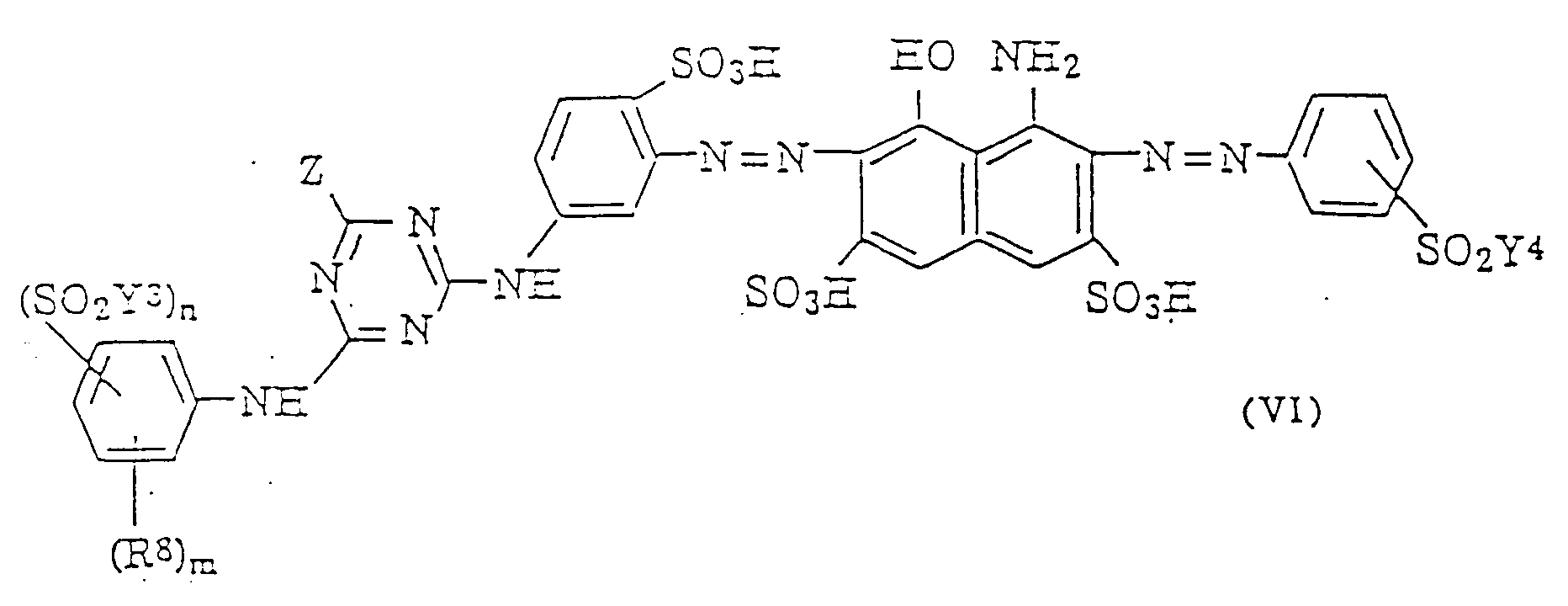
worin R⁸ ein Chloratom, eine -COOH-Gruppe oder eine -OH-Gruppe bezeichnet; jedes von Y³ und Y⁴ eine -CH=CH₂-Gruppe, eine -C₂H₄OSO₃H-Gruppe oder eine -OH-Gruppe repräsentiert, m und n Zahlen von 0 oder 1 sind, aber nicht gleichzeitig 0 sein können und Z die gleiche Bedeutung hat wie in der vorhergehenden allgemeinen Formel (IV).
worin jedes von R¹ und R² ein Wasserstoffatom oder eine niedere Alkylgruppe bedeutet, die einen Substituenten enthalten kann; R³ bedeutet ein Wasserstoffatom, eine niedere Alkylgruppe oder ein Halogenatom und X repräsentiert -CH=CH₂ oder -C₂H₄OSO₃H, und einem gelben und/oder blauen wasserlöslichen Reaktivfarbstoff,
wobei das Verfahren dadurch gekennzeichnet ist, daß die gelbe Komponente ein wasserlöslicher Reaktivfarbstoff ist, repräsentiert durch die folgende allgemein Formel (II) in Form freier Säure:
worin R⁴ für eine -NHCOCH₃-Gruppe, eine -NHCOC₂H₅-Gruppe, eine -NHCONH₂-Gruppe oder eine -NHCOSO₂CH₃-Gruppe steht; R⁵ ein Wasserstoffatom oder eine niedere Alkylgruppe bedeutet, die einen Substituenten enthalten kann und X die gleiche Bedeutung hat wie bei der vorhergehenden allgemeinen Formel (I), und
die blaue Komponente mindestens ein wasserlöslicher Reaktivfarbstoff ist, repräsentiert durch die folgenden allgemeinen Formeln (III) bis (VI) in Form freier Säure:
worin R⁶ für eine niedere Alkylgruppe steht und X die gleiche Bedeutung wie in der vorhergehenden allgemeinen Formel (I) hat;
worin Y¹ für eine -CH=CH₂-Gruppe, eine -C₂H₄OSO₃H-Gruppe oder eine -OH-Gruppe steht; Z ein Chloratom oder ein Fluoratom repräsentiert; W eine niedere Alkoxygruppe oder ein
bedeutet und X die gleiche Bedeutung hat wie in der vorhergehenden allgemeinen Formel (I);
worin V ein Chloratom, ein Fluoratom oder eine -NHC₂H₄SO₃H-Gruppe bedeutet; R⁷ ein Wasserstoffatom oder eine niedere Alkylgruppe repräsentiert, die einen Substituenten enthalten kann und Y² eine -CH=CH₂-Gruppe, eine -C₂H₄OSO₃H-Gruppe oder eine -OH-Gruppe bezeichnet, vorausgesetzt, daß, wenn V eine -NHC₂H₄SO₃H-Gruppe ist, Y² entweder eine -CH=CH₂-Gruppe oder eine -C₂H₄OSO₃H-Gruppe ist und
worin R⁸ ein Chloratom, eine -COOH-Gruppe oder eine -OH-Gruppe bezeichnet; jedes von Y³ und Y⁴ eine -CH=CH₂-Gruppe, eine -C₂H₄OSO₃H-Gruppe oder eine -OH-Gruppe repräsentiert, m und n Zahlen von 0 oder 1 sind, aber nicht gleichzeitig 0 sein können und Z die gleiche Bedeutung hat wie in der vorhergehenden allgemeinen Formel (IV).
24. Verfahren zum Färben nach Anspruch 23, dadurch gekennzeichnet, daß das Erschöpfungsfärben
in einem Farbstoffbad ausgeführt wird, dessen Konzentration an anorganischem Salz
im Bereich von 5 bis 40 g/l des Farbbades liegt.
25. Verfahren zum Färben nach Anspruch 23 oder 24, dadurch gekennzeichnet, daß das anorganische
Salz Glaubersalz ist.
26. Verfahren zum Färben nach Anspruch 23, dadurch gekennzeichnet, daß das Erschöpfungsfärben
in einem Farbbad mit einem pH von 10 bis 13 ausgeführt wird.
27. Verfahren zum Färben nach Anspruch 23, dadurch gekennzeichnet, daß das Erschöpfungsfärben
bei einer Färbetemperatur von 40 bis 80°C ausgeführt wird.
28. Verfahren zum Färben nach Anspruch 23, dadurch gekennzeichnet, daß ein Mischungsverhältnis
des gelben und/oder blauen wasserlöslichen Reaktivfarbstoffes mit Bezug auf den roten
wasserlöslichen Reaktivfarbstoff im Bereich vom 0,05- bis 50-fachen, bezogen auf das
Gewicht insgesamt, liegt und daß ein Mischungsverhältnis zwischen dem gelben wasserlöslichen
Reaktivfarbstoff und dem blauen wasserlöslichen Reaktivfarbstoff von 0 bis 100:100
bis 0 beträgt.
29. Verfahren zum Färben nach Anspruch 23, dadurch gekennzeichnet, daß ein Mischungsverhältnis
des gelben und/oder blauen wasserlöslichen Reaktivfarbstoffes mit Bezug auf den roten
wasserlöslichen Reaktivfarbstoff im Bereich vom 0,1- bis 10-fachen, bezogen auf das
Gewicht insgesamt, liegt und daß ein Mischungsverhältnis zwischen dem gelben wasserlöslichen
Reaktivfarbstoff und dem blauen wasserlöslichen Reaktivfarbstoff von 0 bis 100:100
bis 0 beträgt.
30. Verfahren zum Färben nach Anspruch 23, dadurch gekennzeichnet, daß der rote wasserlösliche
Reaktivfarbstoff einer ist, wie er durch die allgemeine Formel (I) repräsentiert ist,
worin R¹ eine Methylgruppe oder eine Ethylgruppe und R² und R³ Wasserstoffatome sind.
31. Verfahren zum Färben nach Anspruch 23, dadurch gekennzeichnet, daß der gelbe wasserlösliche
Reaktivfarbstoff einer ist, wie er durch die allgemeine Formel (II) repräsentiert
ist, worin R⁴ eine -NHCOCH₃-Gruppe und R⁵ ein Wasserstoffatom ist.
32. Verfahren zum Färben nach Anspruch 23, dadurch gekennzeichnet, daß der blaue wasserlösliche
Reaktivfarbstoff einer ist, wie er durch die allgemeine Formel (III) repräsentiert
ist, worin R⁶ eine Methylgruppe ist.
33. Verfahren zum Färben nach Anspruch 23, dadurch gekennzeichnet, daß der blaue wasserlösliche
Reaktivfarbstoff einer ist, wie er durch die allgemeine Formel (IV) repräsentiert
ist, worin Y¹ eine -CH=CH₂-Gruppe oder eine -C₂H₄OSO₃H-Gruppe ist, Z ein Chloratom
und W eine Methoxygruppe ist.
34. Verfahren zum Färben nach Anspruch 23, dadurch gekennzeichnet, daß der blaue wasserlösliche
Reaktivfarbstoff einer ist, wie er durch die allgemeine Formel (IV) repräsentiert
ist, worin Y¹ eine -OH-Gruppe ist; Z ein Chloratom oder ein Fluoratom
ist und W eine
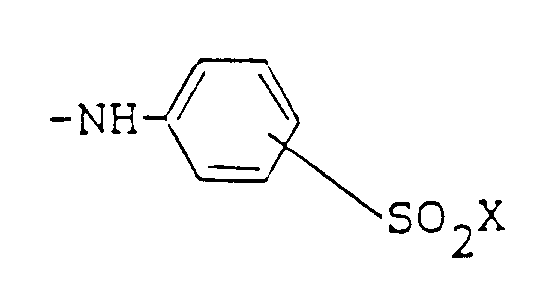
-Gruppe ist.
ist und W eine
-Gruppe ist.
35. Verfahren zum Färben nach Anspruch 23, dadurch gekennzeichnet, daß der blaue wasserlösliche
Reaktivfarbstoff einer ist, wie er durch die allgemeine Formel (V) repräsentiert ist,
worin R⁷ ein Wasserstoffatom, V eine -NHC₂H₄SO₃H-Gruppe und Y² eine -CH=CH₂-Gruppe
oder eine -C₂H₄OSO₃H-Gruppe ist.
36. Verfahren zum Färben nach Anspruch 23, dadurch gekennzeichnet, daß der blaue wasserlösliche
Reaktivfarbstoff einer ist, wie er durch die allgemeine Formel (VI) repräsentiert
ist, worin Y³ und Y⁴ -OH-Gruppen sind, Z ein Fluoratom ist, m 0 und n 1 ist.
37. Verfahren zum Färben nach Anspruch 23, dadurch gekennzeichnet, daß die blaue Komponente
ein wasserlöslicher Reaktivfarbstoff ist, repräsentiert durch die allgemeine Formel
(III) oder (V).
38. Verfahren zum Färben nach Anspruch 23, dadurch gekennzeichnet, daß die wasserlösliche
Mischung von Reaktivfarbstoffen eine Mischung des roten wasserlöslichen Reaktivfarbstoffes,
repräsentiert durch die allgemeine Formel (I), und des gelben wasserlöslichen Reaktivfarbstoffes,
repräsentiert durch die allgemeine Formel (II), ist.
1. Mélange de colorants réactifs solubles dans l'eau, dans lequel un colorant réactif
jaune soluble dans l'eau et/ou un colorant réactif bleu soluble dans l'eau est (sont)
mélangé(s) avec au moins un type de colorant réactif rouge soluble dans l'eau représenté
par la formule générale suivante (I) sous la forme d'acide libre :
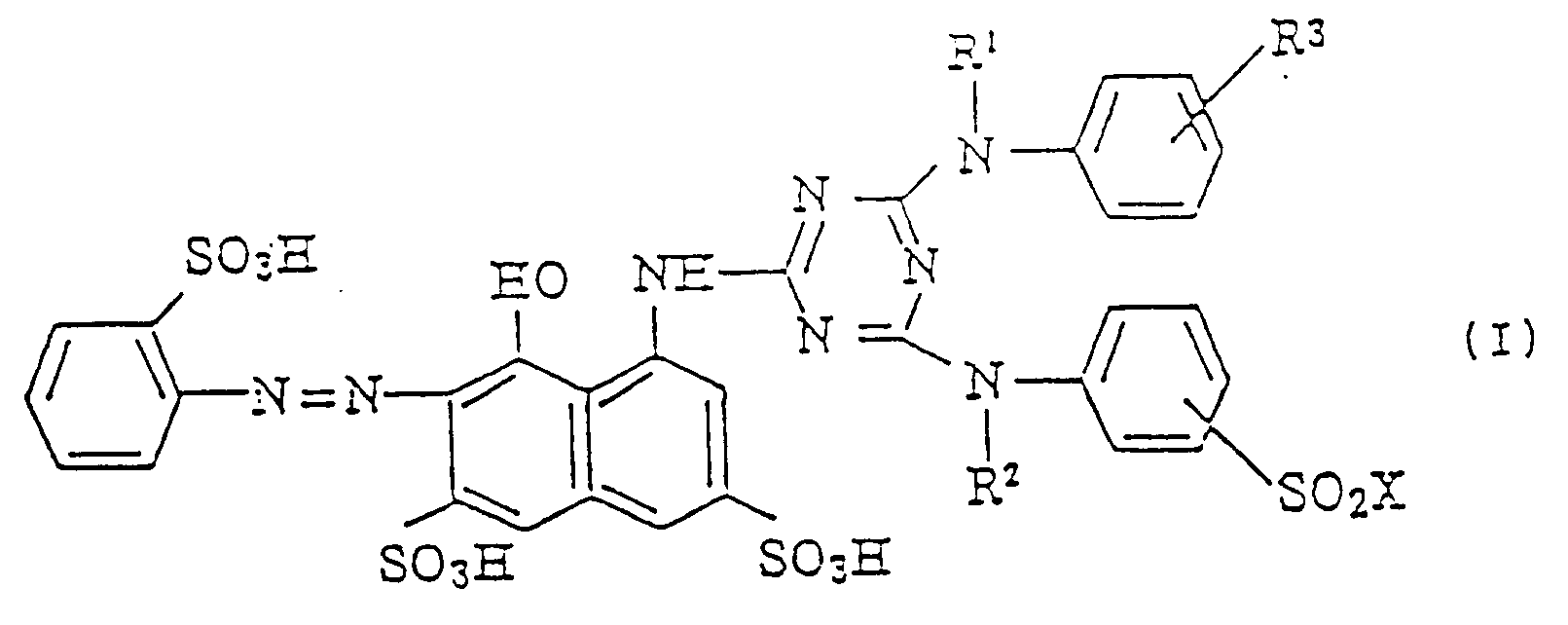
(où chacun des groupes R¹ et R² désigne un atome d'hydrogène ou un groupe alkyle inférieur qui peut contenir un substituant, R³ désigne un atome d'hydrogène, un groupe alkyle inférieur ou un atome d'halogène et X représente -CH=CH₂ ou -C₂H₄OSO₃H),
ledit mélange de colorants réactifs solubles dans l'eau étant caractérisé en ce que le composant jaune est un colorant réactif soluble dans l'eau représenté par la formule générale suivante (II) sous la forme d'acide libre :
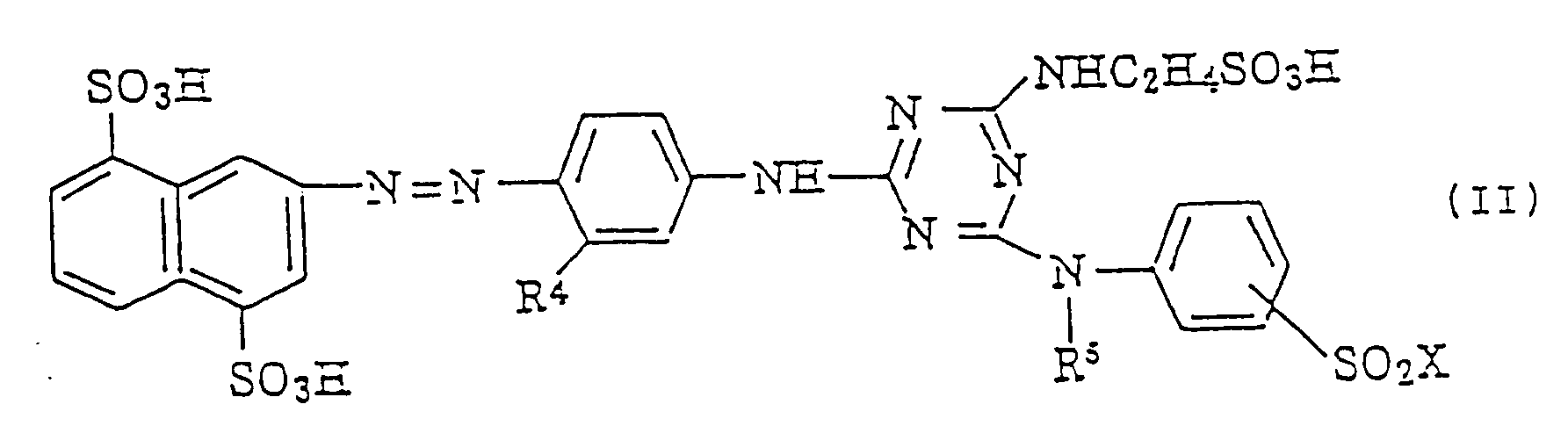
(où R⁴ représente un groupe -NHCOCH₃, un groupe -NHCOC₂H₅, un groupe -NHCONH₂ ou un groupe -NHCOSO₂CH₃, R⁵ désigne un atome d'hydrogène ou un groupe alkyle inférieur qui peut contenir un substituant et X a la même définition que dans la formule générale précédente (I)),
et le composant bleu est au moins un colorant réactif soluble dans l'eau représenté par les formules générales suivantes (III) à (IV) sous la forme d'acide libre :
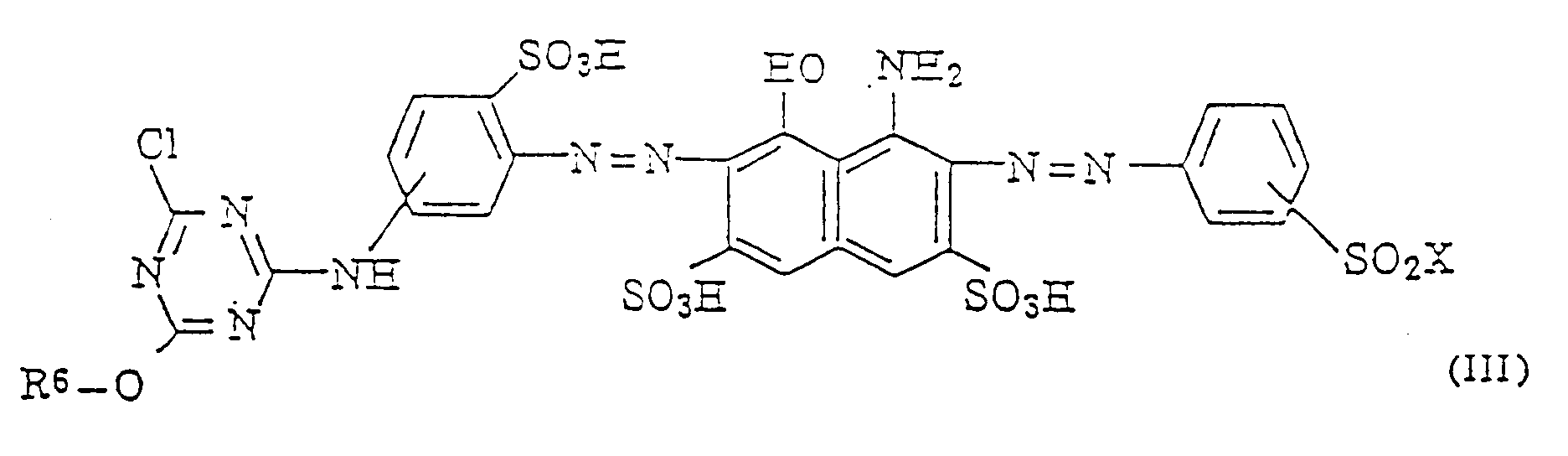
(où R⁶ désigne un groupe alkyle inférieur et X à la même signification que dans la formule générale précédente (I));
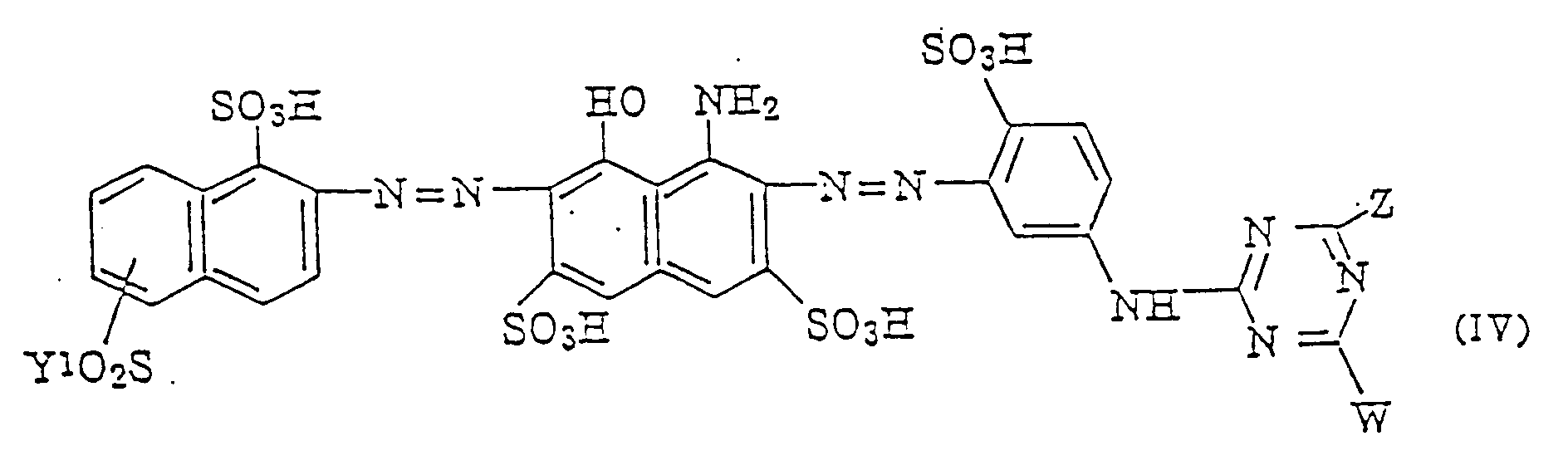
(où Y¹ désigne un groupe -CH=CH₂, un groupe -C₂H₄OSO₃H ou un groupe -OH, Z représente un atome de chlore ou un atome de fluor, W désigne un groupe alkoxy inférieur ou un groupe
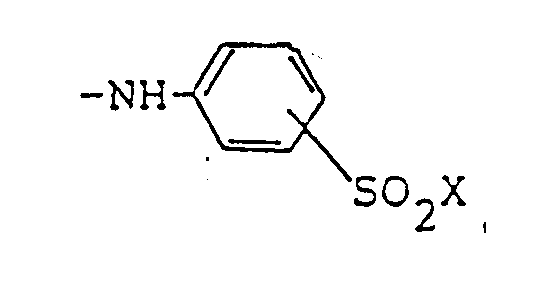
et X a la même définition que dans la formule générale précédente (I)),
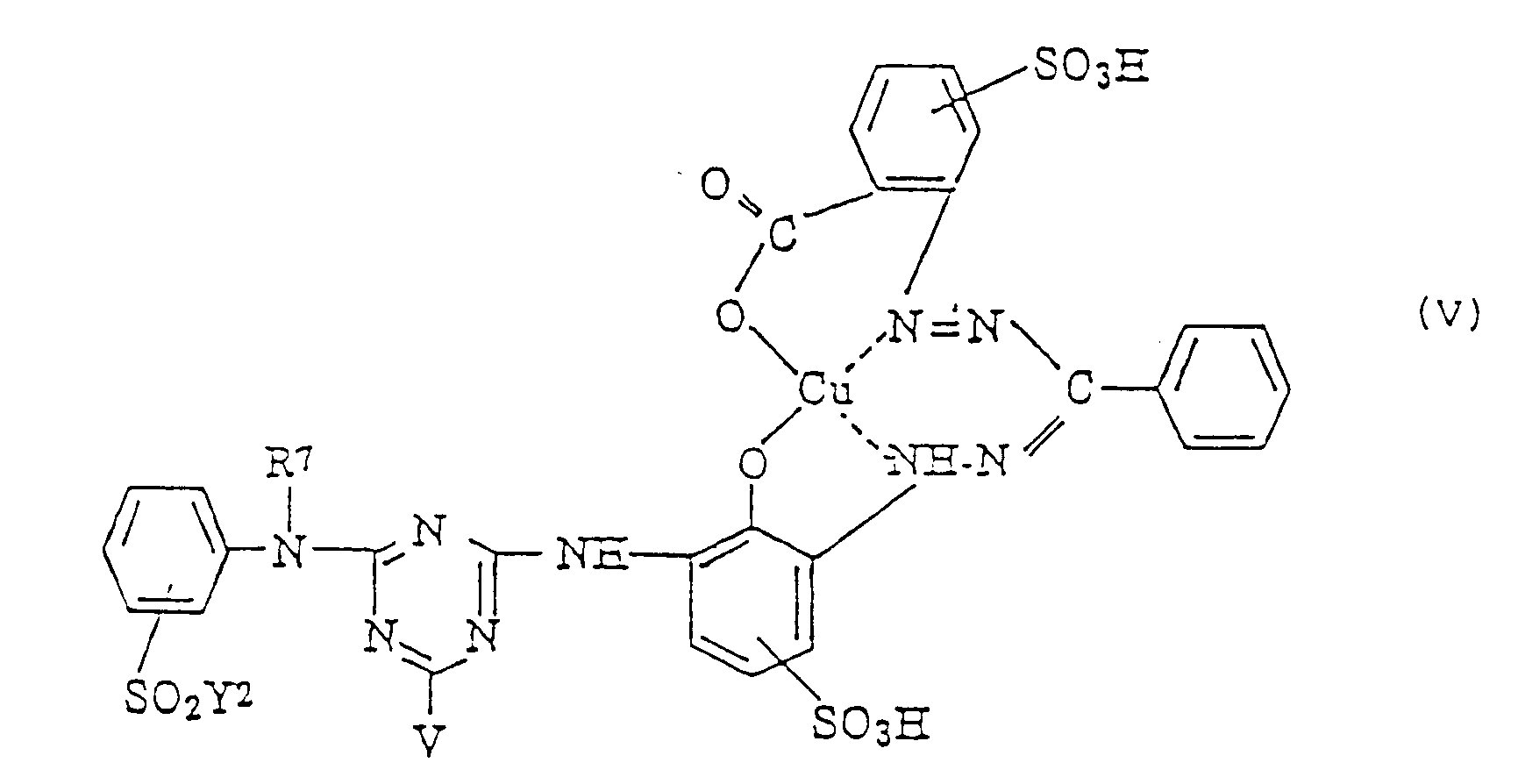
(où V désigne un atome de chlore, un atone de fluor ou un groupe -NHC₂H₄SO₃H, R⁷ représente un atome d'hydrogène ou un groupe alkyle inférieur qui peut contenir un substituant, et Y² désigne un groupe -CH=CH₂, un groupe -C₂H₄OSO₃H ou un groupe -OH, pourvu que, lorsque V est un groupe -NHC₂H₄SO₃H, Y² est soit un groupe -CH=CH₂, soit un groupe -C₂H₄OSO₃H, et
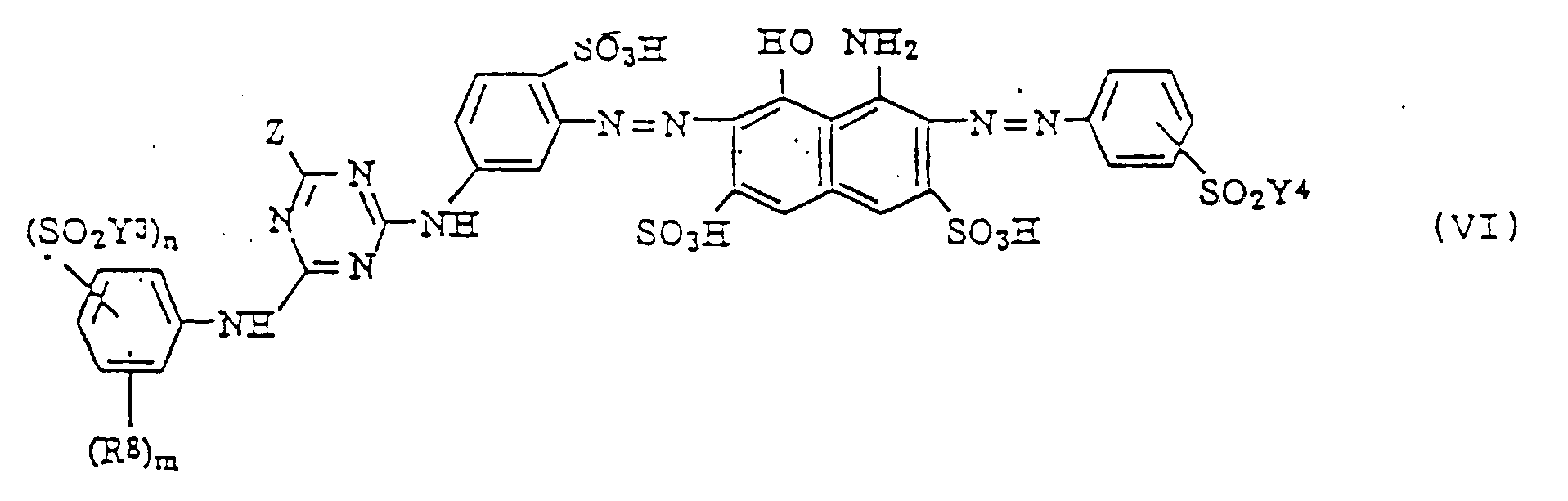
(où R⁸ désigne un atome de chlore, un groupe -COOH ou un groupe -OH, chacun des groupes Y³ et Y⁴ représente un groupe -CH=CH₂, un groupe -C₂H₄OSO₃H ou un groupe -OH, m et n sont des nombres égaux à 0 ou à 1, mais ne peuvent être égaux à 0 en même temps, et Z a la même définition que dans la formule générale précédente (IV)).
(où chacun des groupes R¹ et R² désigne un atome d'hydrogène ou un groupe alkyle inférieur qui peut contenir un substituant, R³ désigne un atome d'hydrogène, un groupe alkyle inférieur ou un atome d'halogène et X représente -CH=CH₂ ou -C₂H₄OSO₃H),
ledit mélange de colorants réactifs solubles dans l'eau étant caractérisé en ce que le composant jaune est un colorant réactif soluble dans l'eau représenté par la formule générale suivante (II) sous la forme d'acide libre :
(où R⁴ représente un groupe -NHCOCH₃, un groupe -NHCOC₂H₅, un groupe -NHCONH₂ ou un groupe -NHCOSO₂CH₃, R⁵ désigne un atome d'hydrogène ou un groupe alkyle inférieur qui peut contenir un substituant et X a la même définition que dans la formule générale précédente (I)),
et le composant bleu est au moins un colorant réactif soluble dans l'eau représenté par les formules générales suivantes (III) à (IV) sous la forme d'acide libre :
(où R⁶ désigne un groupe alkyle inférieur et X à la même signification que dans la formule générale précédente (I));
(où Y¹ désigne un groupe -CH=CH₂, un groupe -C₂H₄OSO₃H ou un groupe -OH, Z représente un atome de chlore ou un atome de fluor, W désigne un groupe alkoxy inférieur ou un groupe
et X a la même définition que dans la formule générale précédente (I)),
(où V désigne un atome de chlore, un atone de fluor ou un groupe -NHC₂H₄SO₃H, R⁷ représente un atome d'hydrogène ou un groupe alkyle inférieur qui peut contenir un substituant, et Y² désigne un groupe -CH=CH₂, un groupe -C₂H₄OSO₃H ou un groupe -OH, pourvu que, lorsque V est un groupe -NHC₂H₄SO₃H, Y² est soit un groupe -CH=CH₂, soit un groupe -C₂H₄OSO₃H, et
(où R⁸ désigne un atome de chlore, un groupe -COOH ou un groupe -OH, chacun des groupes Y³ et Y⁴ représente un groupe -CH=CH₂, un groupe -C₂H₄OSO₃H ou un groupe -OH, m et n sont des nombres égaux à 0 ou à 1, mais ne peuvent être égaux à 0 en même temps, et Z a la même définition que dans la formule générale précédente (IV)).
2. Mélange de colorants solubles dans l'eau, dans lequel un colorant réactif jaune soluble
dans l'eau et/ou un colorant réactif bleu soluble dans l'eau est (sont) mélangé(s)
avec au moins un type de colorant réactif rouge soluble dans l'eau représenté par
la formule générale suivante (I) sous la forme d'acide libre :
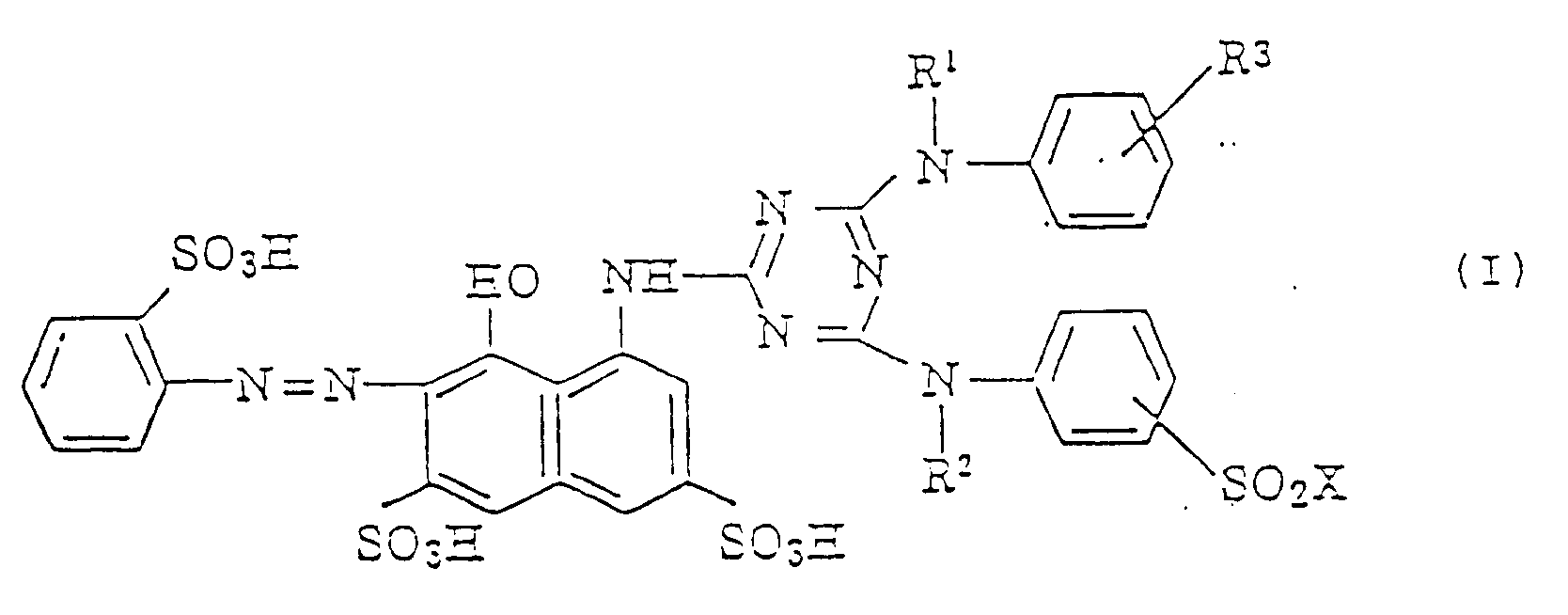
(où chacun des groupes R¹ et R² désigne un atome d'hydrogène ou un groupe alkyle inférieur qui peut contenir un substituant, R³ désigne un atome d'hydrogène, un groupe alkyle inférieur ou un atome d'halogène et X représente un groupe -CH=CH₂ ou un groupe -C₂H₄OSO₃H), ledit mélange de colorants réactifs solubles dans l'eau étant caractérisé en ce que le composant jaune est un colorant réactif soluble dans l'eau représenté par la formule générale suivante (II) sous la forme d'acide libre :
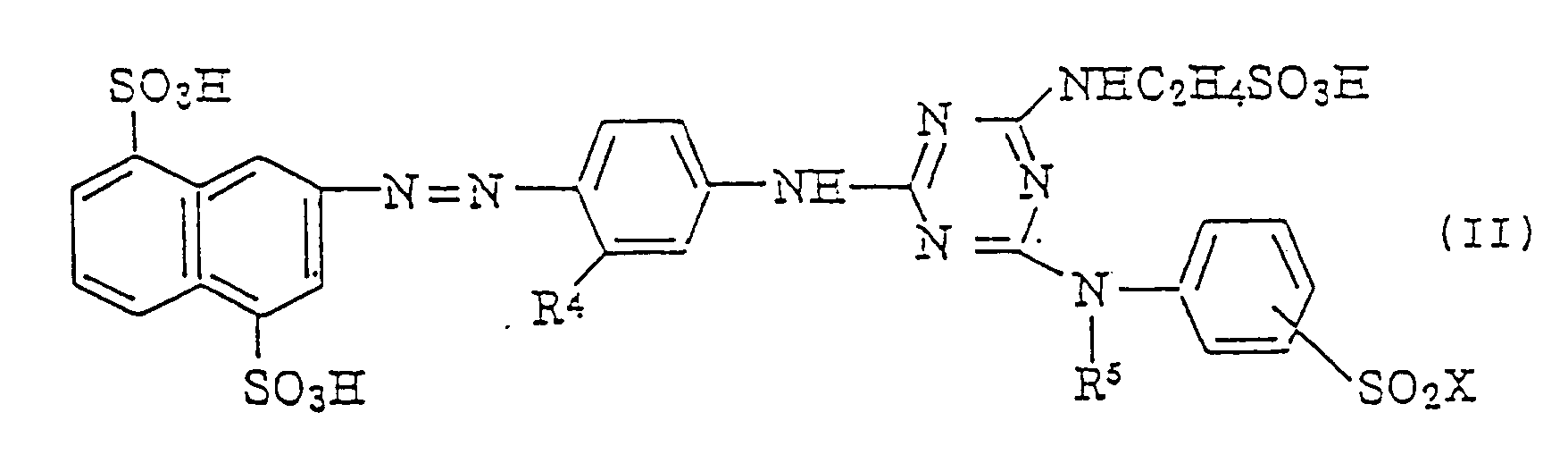
(où R⁴ représente un groupe -NHCOCH₃, un groupe -NHCOC₂H₅ un groupe -NHCONH₂ ou un groupe -NHCOSO₂CH₃, R⁵ désigne un atome d'hydrogène ou un groupe alkyle inférieur qui peut contenir un substituant et X a la même définition que dans la formule générale précédente (I)),
et le composant bleu est un colorant réactif soluble dans l'eau représenté par la formule générale suivante (III) sous la forme d'acide libre :
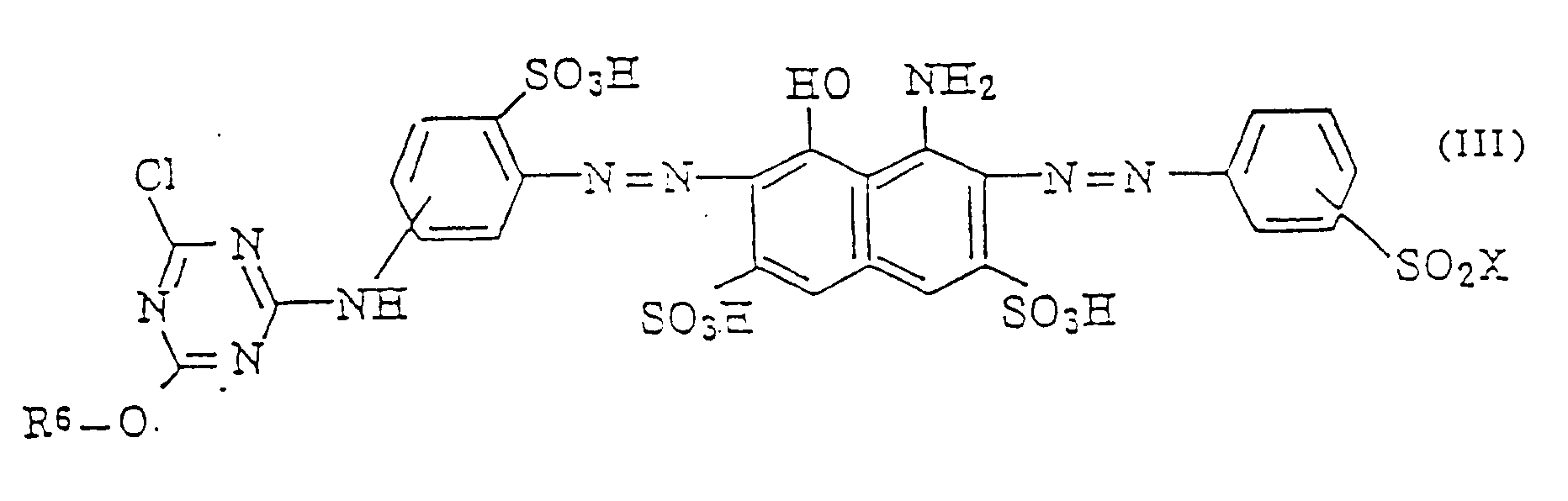
(où R⁶ désigne un groupe alkyle inférieur et X à la même signification que dans la formule générale précédente (I)).
(où chacun des groupes R¹ et R² désigne un atome d'hydrogène ou un groupe alkyle inférieur qui peut contenir un substituant, R³ désigne un atome d'hydrogène, un groupe alkyle inférieur ou un atome d'halogène et X représente un groupe -CH=CH₂ ou un groupe -C₂H₄OSO₃H), ledit mélange de colorants réactifs solubles dans l'eau étant caractérisé en ce que le composant jaune est un colorant réactif soluble dans l'eau représenté par la formule générale suivante (II) sous la forme d'acide libre :
(où R⁴ représente un groupe -NHCOCH₃, un groupe -NHCOC₂H₅ un groupe -NHCONH₂ ou un groupe -NHCOSO₂CH₃, R⁵ désigne un atome d'hydrogène ou un groupe alkyle inférieur qui peut contenir un substituant et X a la même définition que dans la formule générale précédente (I)),
et le composant bleu est un colorant réactif soluble dans l'eau représenté par la formule générale suivante (III) sous la forme d'acide libre :
(où R⁶ désigne un groupe alkyle inférieur et X à la même signification que dans la formule générale précédente (I)).
3. Mélange de colorants solubles dans l'eau, dans lequel un colorant réactif jaune soluble
dans l'eau et/ou un colorant réactif bleu soluble dans l'eau est (sont) mélangé(s)
avec au moins un type de colorant réactif rouge soluble dans l'eau représenté par
la formule générale suivante (I) sous la forme d'acide libre :
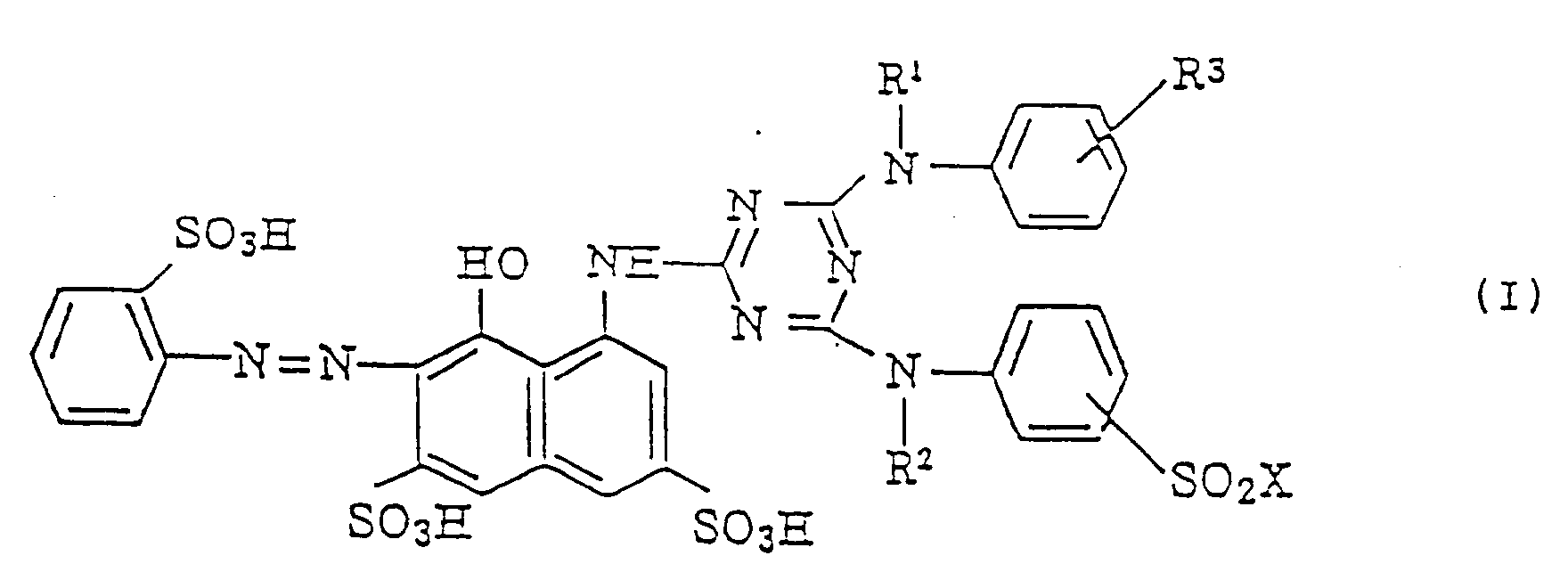
(où chacun des groupes R¹ et R² désigne un atome d'hydrogène ou un groupe alkyle inférieur qui peut contenir un substituant, R³ désigne un atome d'hydrogène, un groupe alkyle inférieur ou un atome d'halogène et X représente -CH=CH₂ ou -C₂H₄OSO₃H),
ledit mélange de colorants réactifs solubles dans l'eau étant caractérisé en ce que le composant jaune est un colorant réactif soluble dans l'eau représenté par la formule générale suivante (II) sous la forme d'acide libre :
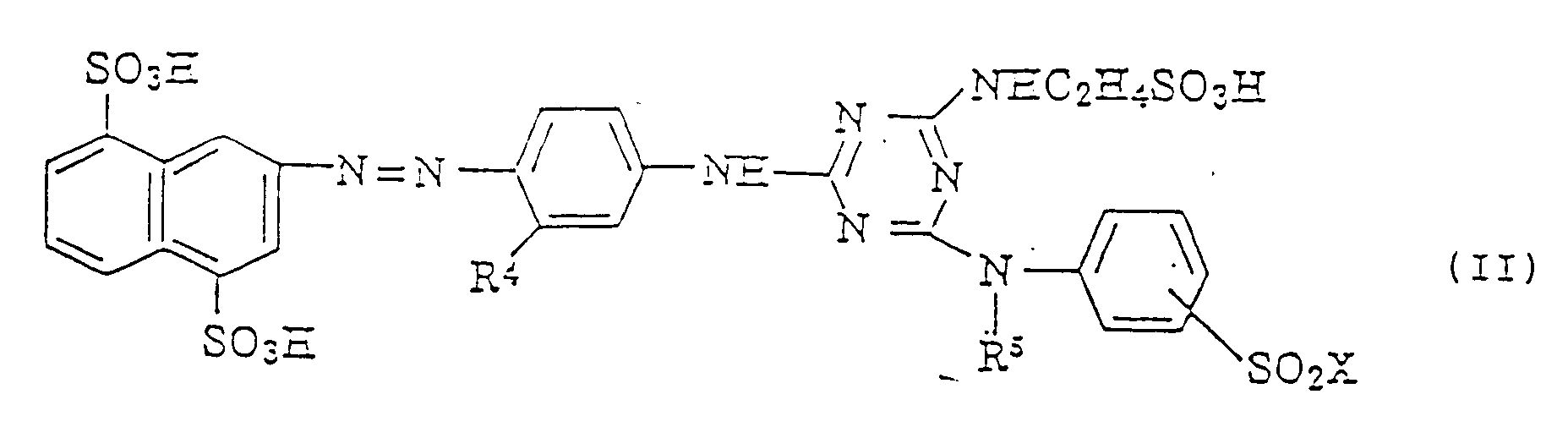
(où R⁴ représente un groupe -NHCOCH₃, un groupe -NHCOC₂H₅, un groupe -NHCONH₂ ou un groupe -NHCOSO₂CH₃, R⁵ désigne un atome d'hydrogène ou un groupe alkyle inférieur qui peut contenir un substituant et X a la même définition que dans la formule générale précédente (I)),
et le composant bleu est un colorant réactif soluble dans l'eau représenté par la formule générale suivante (IV) sous la forme d'acide libre :
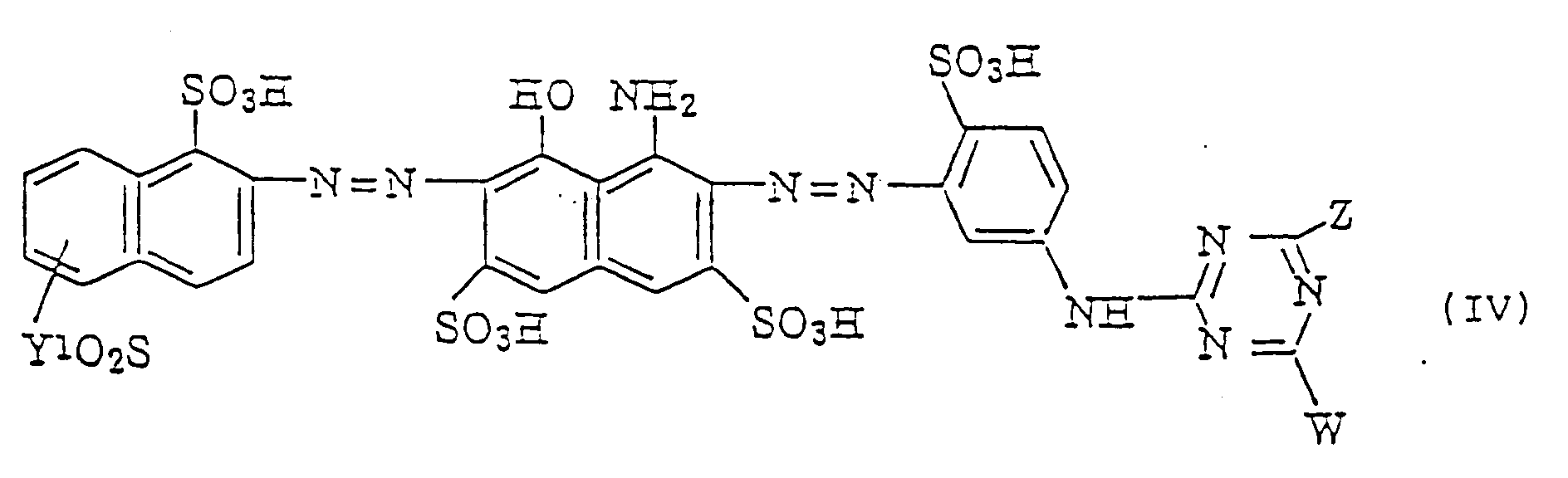
(où Y¹ désigne un groupe -CH=CH₂, un groupe -C₂H₄OSO₃H ou un groupe -OH, Z représente un atome de chlore ou un atome de fluor, W désigne un groupe alkoxy inférieur ou un groupe
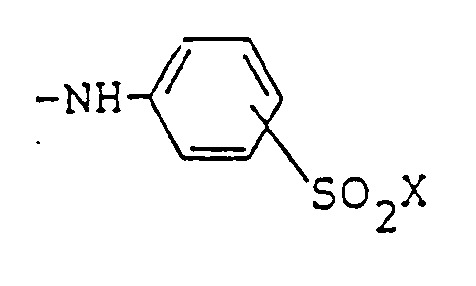
et X a la même définition que dans la formule générale précédente (I)).
(où chacun des groupes R¹ et R² désigne un atome d'hydrogène ou un groupe alkyle inférieur qui peut contenir un substituant, R³ désigne un atome d'hydrogène, un groupe alkyle inférieur ou un atome d'halogène et X représente -CH=CH₂ ou -C₂H₄OSO₃H),
ledit mélange de colorants réactifs solubles dans l'eau étant caractérisé en ce que le composant jaune est un colorant réactif soluble dans l'eau représenté par la formule générale suivante (II) sous la forme d'acide libre :
(où R⁴ représente un groupe -NHCOCH₃, un groupe -NHCOC₂H₅, un groupe -NHCONH₂ ou un groupe -NHCOSO₂CH₃, R⁵ désigne un atome d'hydrogène ou un groupe alkyle inférieur qui peut contenir un substituant et X a la même définition que dans la formule générale précédente (I)),
et le composant bleu est un colorant réactif soluble dans l'eau représenté par la formule générale suivante (IV) sous la forme d'acide libre :
(où Y¹ désigne un groupe -CH=CH₂, un groupe -C₂H₄OSO₃H ou un groupe -OH, Z représente un atome de chlore ou un atome de fluor, W désigne un groupe alkoxy inférieur ou un groupe
et X a la même définition que dans la formule générale précédente (I)).
4. Mélange de colorants réactifs solubles dans l'eau, dans lequel un colorant réactif
jaune soluble dans l'eau et/ou un colorant réactif bleu soluble dans l'eau est (sont)
mélangé(s) avec au moins un type de colorant réactif rouge soluble dans l'eau représenté
par la formule générale suivante (I) sous la forme d'acide libre :
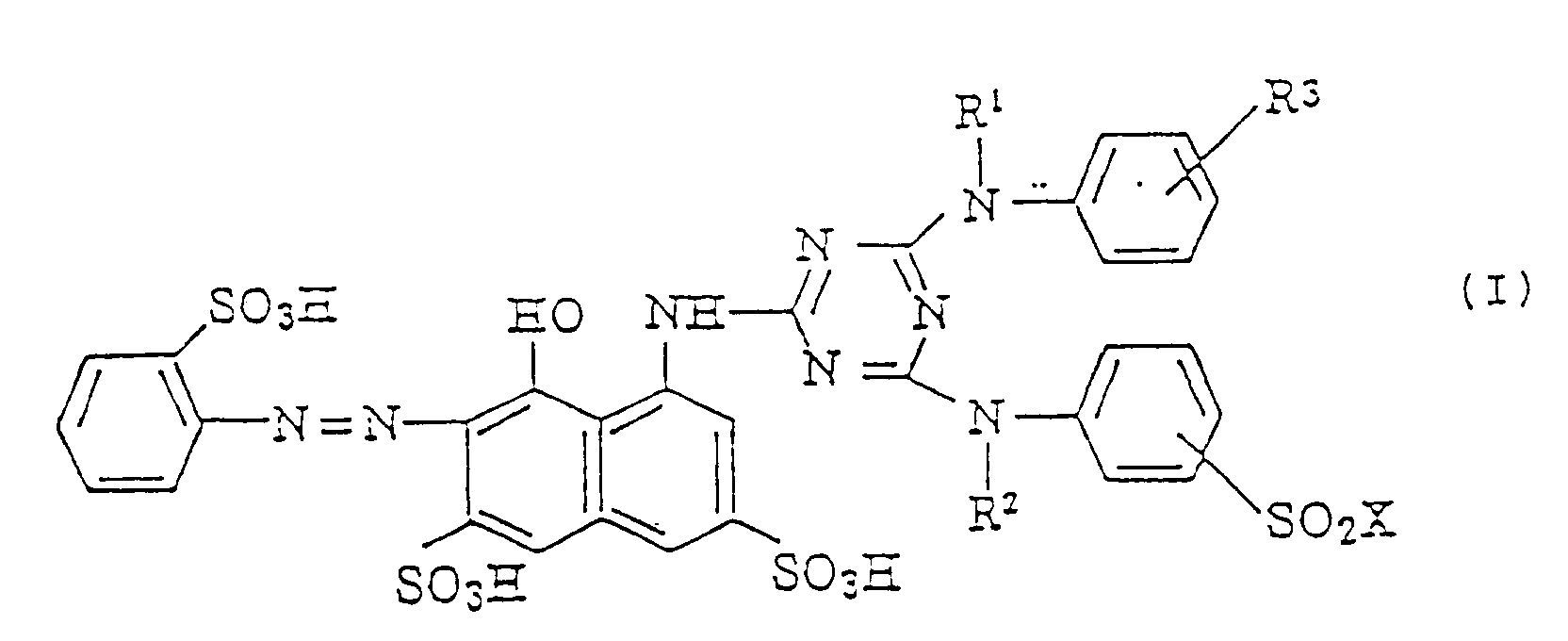
(où chacun des groupes R¹ et R² désigne un atome d'hydrogène ou un groupe alkyle inférieur qui peut contenir un substituant, R³ désigne un atome d'hydrogène, un groupe alkyle inférieur ou un atome d'halogène et X représente -CH=CH₂ ou -C₂H₄OSO₃H),
ledit mélange de colorants réactifs solubles dans l'eau étant caractérisé en ce que le composant jaune est un colorant réactif soluble dans l'eau représenté par la formule générale suivante (II) sous la forme d'acide libre :
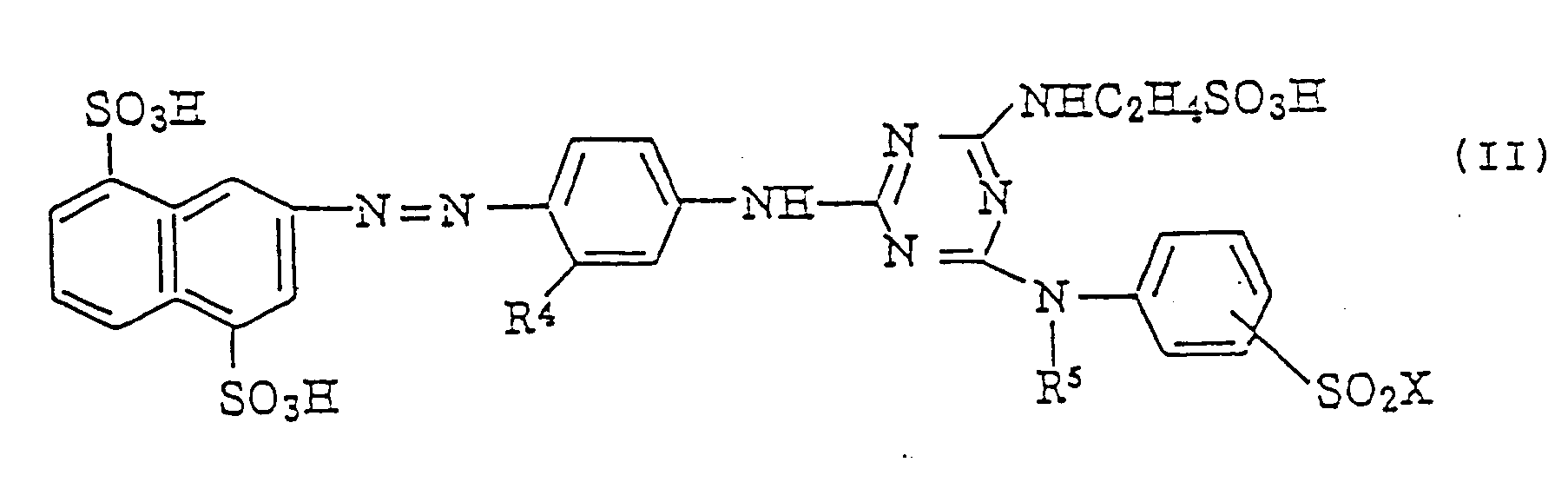
(où R⁴ représente un groupe -NHCOCH₃, un groupe -NHCOC₂H₅, un groupe -NHCONH₂ ou un groupe -NHCOSO₂CH₃, R⁵ désigne un atome d'hydrogène ou un groupe alkyle inférieur qui peut contenir un substituant et X a la même définition que dans la formule générale précédente (I)),
et le composant bleu est un colorant réactif soluble dans l'eau représenté par la formule générale suivante (V) sous la forme d'un acide libre :
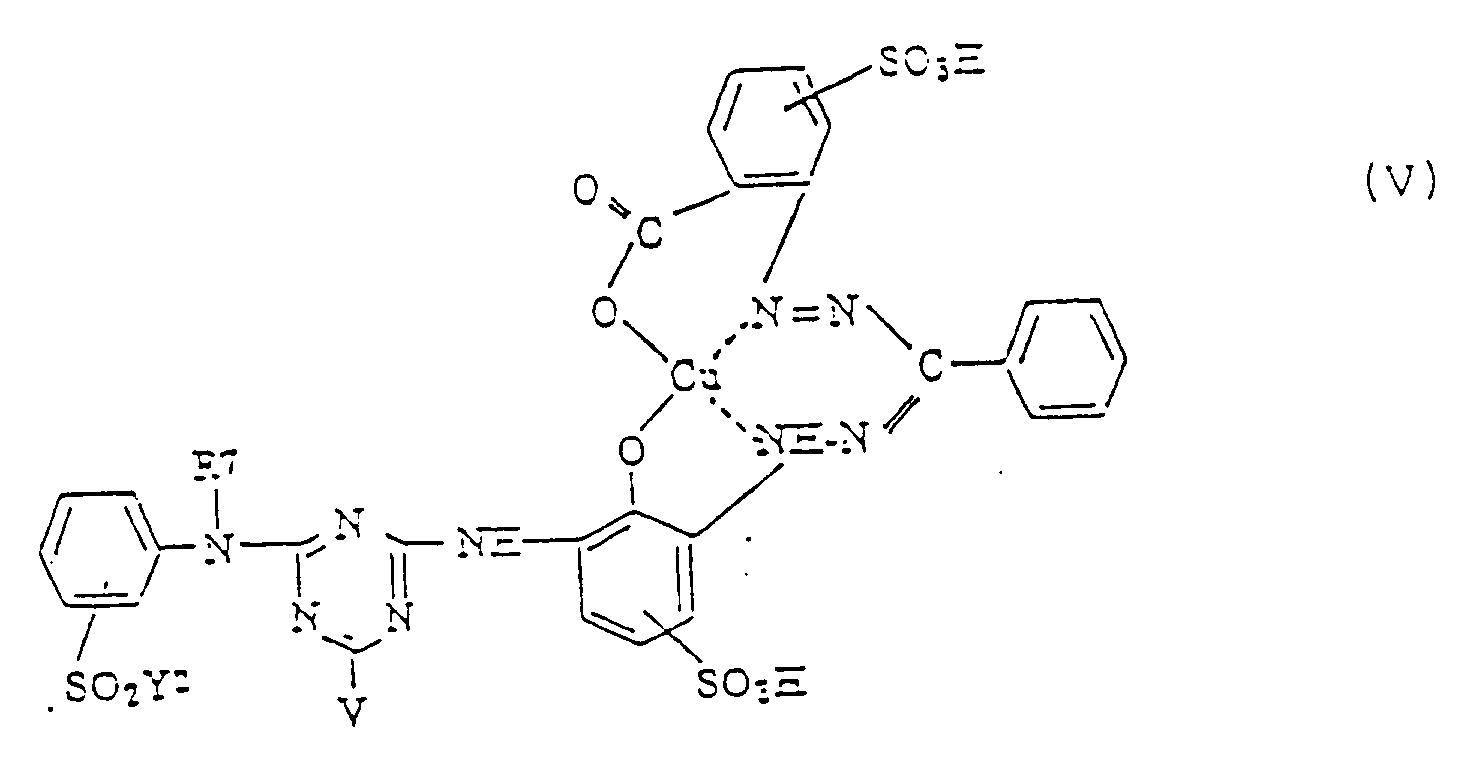
(où V désigne un atome de chlore, un atome de fluor ou un groupe -NHC₂H₄SO₃H, R⁷ représente un atome d'hydrogène ou un groupe alkyle inférieur qui peut contenir un substituant, et Y² désigne un groupe -CH=CH₂, un groupe -C₂H₄OSO₃H ou un groupe -OH, pourvu que, lorsque V est un groupe -NHC₂H₄SO₃H, Y² est soit un groupe -CH=CH₂, soit un groupe -C₂H₄OSO₃H).
(où chacun des groupes R¹ et R² désigne un atome d'hydrogène ou un groupe alkyle inférieur qui peut contenir un substituant, R³ désigne un atome d'hydrogène, un groupe alkyle inférieur ou un atome d'halogène et X représente -CH=CH₂ ou -C₂H₄OSO₃H),
ledit mélange de colorants réactifs solubles dans l'eau étant caractérisé en ce que le composant jaune est un colorant réactif soluble dans l'eau représenté par la formule générale suivante (II) sous la forme d'acide libre :
(où R⁴ représente un groupe -NHCOCH₃, un groupe -NHCOC₂H₅, un groupe -NHCONH₂ ou un groupe -NHCOSO₂CH₃, R⁵ désigne un atome d'hydrogène ou un groupe alkyle inférieur qui peut contenir un substituant et X a la même définition que dans la formule générale précédente (I)),
et le composant bleu est un colorant réactif soluble dans l'eau représenté par la formule générale suivante (V) sous la forme d'un acide libre :
(où V désigne un atome de chlore, un atome de fluor ou un groupe -NHC₂H₄SO₃H, R⁷ représente un atome d'hydrogène ou un groupe alkyle inférieur qui peut contenir un substituant, et Y² désigne un groupe -CH=CH₂, un groupe -C₂H₄OSO₃H ou un groupe -OH, pourvu que, lorsque V est un groupe -NHC₂H₄SO₃H, Y² est soit un groupe -CH=CH₂, soit un groupe -C₂H₄OSO₃H).
5. Mélange de colorants réactifs solubles dans l'eau, dans lequel un colorant réactif
jaune soluble dans l'eau et/ou un colorant réactif bleu soluble dans l'eau est (sont)
mélangé(s) avec au moins un type de colorant réactif rouge soluble dans l'eau représenté
par la formule générale suivante (I) sous la forme d'acide libre :
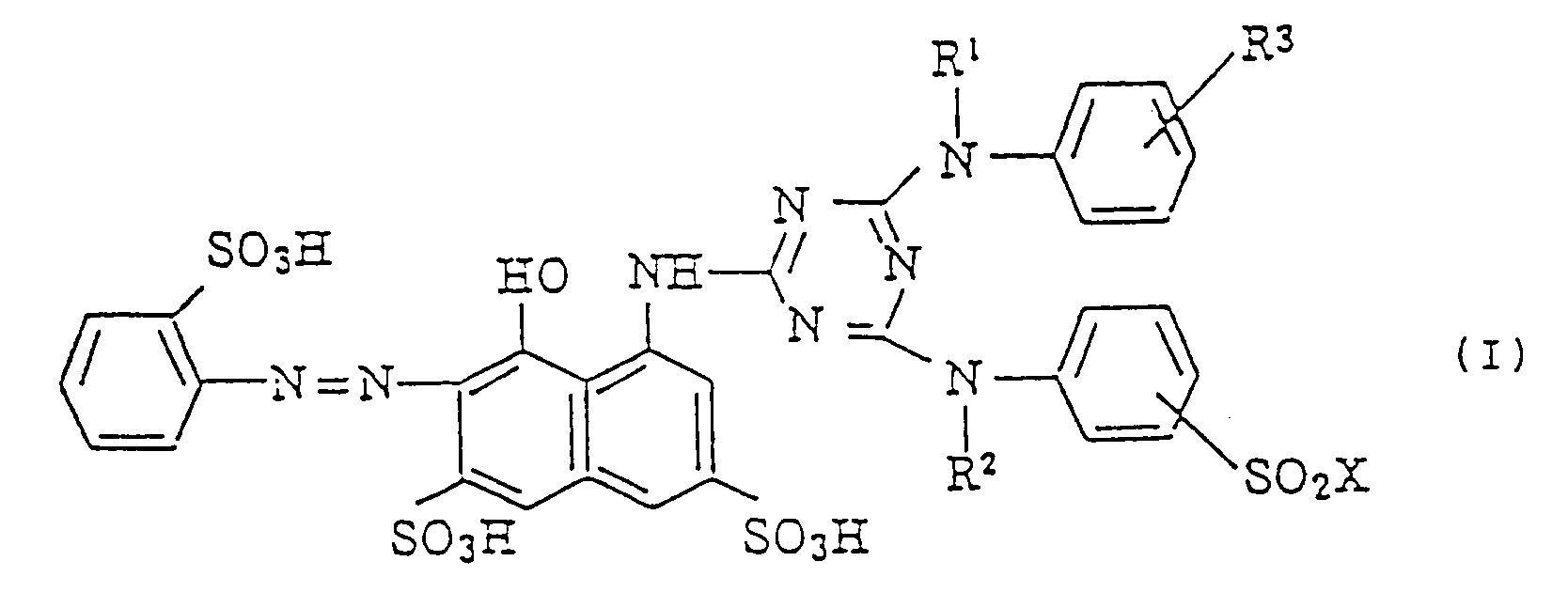
(où chacun des groupes R¹ et R² désigne un atome d'hydrogène ou un groupe alkyle inférieur qui peut contenir un substituant, R³ désigne un atome d'hydrogène, un groupe alkyle inférieur ou un atome d'halogène et X représente -CH=CH₂ ou -C₂H₄OSO₃H),
ledit mélange de colorants réactifs solubles dans l'eau étant caractérisé en ce que le composant jaune est un colorant réactif soluble dans l'eau représenté par la formule générale suivante (II) sous la forme d'acide libre :
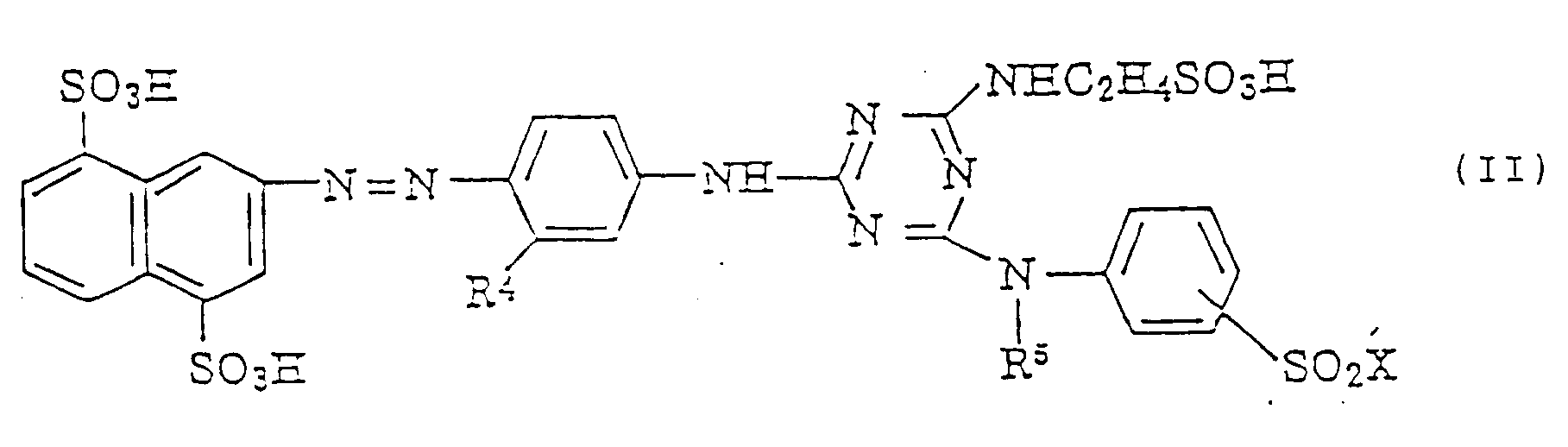
(où R⁴ représente un groupe -NHCOCH₃, un groupe -NHCOC₂H₅, un groupe -NHCONH₂ ou un groupe -NHCOSO₂CH₃, R⁵ désigne un atome d'hydrogène ou un groupe alkyle inférieur qui peut contenir un substituant et X a la même définition que dans la formule générale précédente (I)),
et le composant bleu est un colorant réactif soluble dans l'eau représenté par la formule générale suivante (VI) sous la forme d'acide libre :
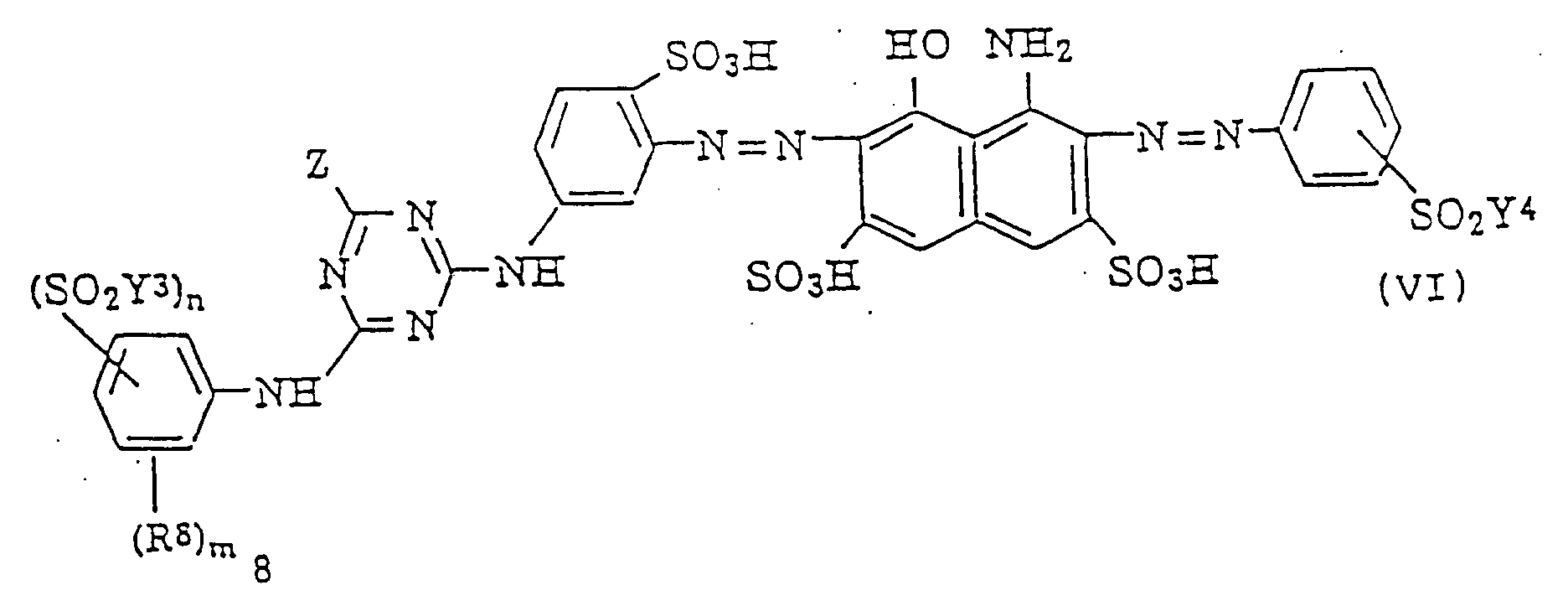
(où R⁸ désigne un atome de chlore, un groupe -COOH ou un groupe -OH, chacun des groupes Y³ et Y⁴ représente un groupe -CH=CH₂, un groupe -C₂H₄OSO₃H ou un groupe OH, m et n sont des nombres égaux à 0 ou à 1, mais ne peuvent être égaux à 0 en même temps, et Z a la même définition dans la formule générale précédente (IV)).
(où chacun des groupes R¹ et R² désigne un atome d'hydrogène ou un groupe alkyle inférieur qui peut contenir un substituant, R³ désigne un atome d'hydrogène, un groupe alkyle inférieur ou un atome d'halogène et X représente -CH=CH₂ ou -C₂H₄OSO₃H),
ledit mélange de colorants réactifs solubles dans l'eau étant caractérisé en ce que le composant jaune est un colorant réactif soluble dans l'eau représenté par la formule générale suivante (II) sous la forme d'acide libre :
(où R⁴ représente un groupe -NHCOCH₃, un groupe -NHCOC₂H₅, un groupe -NHCONH₂ ou un groupe -NHCOSO₂CH₃, R⁵ désigne un atome d'hydrogène ou un groupe alkyle inférieur qui peut contenir un substituant et X a la même définition que dans la formule générale précédente (I)),
et le composant bleu est un colorant réactif soluble dans l'eau représenté par la formule générale suivante (VI) sous la forme d'acide libre :
(où R⁸ désigne un atome de chlore, un groupe -COOH ou un groupe -OH, chacun des groupes Y³ et Y⁴ représente un groupe -CH=CH₂, un groupe -C₂H₄OSO₃H ou un groupe OH, m et n sont des nombres égaux à 0 ou à 1, mais ne peuvent être égaux à 0 en même temps, et Z a la même définition dans la formule générale précédente (IV)).
6. Mélange de colorants réactifs solubles dans l'eau selon l'une quelconque des revendications
1 à 5, caractérisé en ce que le rapport de mélange du colorant réactif jaune soluble
dans l'eau et/ou du colorant réactif bleu soluble dans l'eau par rapport au colorant
réactif rouge soluble dans l'eau est situé dans la plage de 0,05 à 50 fois en poids
au total et le rapport de mélange entre le colorant réactif jaune soluble dans l'eau
et le colorant réactif bleu soluble dans l'eau est de 0 à 100:100 à 0.
7. Mélange de colorants réactifs solubles dans l'eau selon l'une quelconque des revendications
1 à 5, caractérisé en ce que le rapport de mélange du colorant réactif jaune soluble
dans l'eau et/ou du colorant réactif bleu soluble dans l'eau par rapport au colorant
réactif rouge soluble dans l'eau est situé dans la plage de 0,1 à 10 fois en poids
au total et le rapport de mélange entre le colorant réactif jaune soluble dans l'eau
et le colorant réactif bleu soluble dans l'eau est de 0 à 100:100 à 0.
8. Mélange de colorants réactifs solubles dans l'eau selon l'une quelconque des revendications
1 à 5, caractérisé en ce qu'il est utilisé pour la teinture par fixation de fibres
cellulosiques.
9. Mélange de colorants réactifs solubles dans l'eau selon l'une quelconque des revendications
1 à 5, caractérisé en ce que le colorant réactif rouge soluble dans l'eau est celui
représenté par la formule générale (I), dans laquelle R¹ est un groupe méthyle ou
un groupe éthyle, et R² est un atome d'hydrogène, un groupe méthyle ou un groupe éthyle.
10. Mélange de colorants réactifs solubles dans l'eau selon l'une quelconque des revendications
1 à 5, caractérisé en ce que le colorant réactif rouge soluble dans l'eau est celui
représenté par la formule générale (I), dans laquelle R³ est un atome d'hydrogène,
un groupe méthyle, un groupe éthyle, un atome de chlore ou un atome de brome.
11. Mélange de colorants réactifs solubles dans l'eau selon l'une quelconque des revendications
1 à 5, caractérisé en ce que le colorant réactif rouge soluble dans l'eau est celui
représenté par la formule générale (I), dans laquelle R² et R³ sont des atomes d'hydrogène.
12. Mélange de colorants réactifs solubles dans l'eau selon l'une quelconque des revendications
1 à 5, caractérisé en ce que le colorant réactif rouge soluble dans l'eau est celui
représenté par la formule générale (I), dans laquelle R¹ est un groupe méthyle ou
un groupe éthyle et R² et R³ sont des atomes d'hydrogène.
13. Mélange de colorants réactifs solubles dans l'eau selon l'une quelconque des revendications
1 à 5, caractérisé en ce que le colorant réactif jaune soluble dans l'eau est celui
représenté par la formule générale (II), dans laquelle R⁴ est un groupe -NHCOCH₃ ou
un groupe -NHCONH₂.
14. Mélange de colorants réactifs solubles dans l'eau selon l'une quelconque des revendications
1 à 5, caractérisé en ce que le colorant réactif jaune soluble dans l'eau est celui
représenté par la formule générale (II), dans laquelle R⁵ est un atome d'hydrogène,
un groupe méthyle ou un groupe éthyle.
15. Mélange de colorants réactifs solubles dans l'eau selon l'une quelconque des revendications
1 à 5, caractérisé en ce que le colorant réactif jaune soluble dans l'eau est celui
représenté par la formule générale (II) dans laquelle R⁴ est un groupe -NHCOCH₃ et
R⁵ est un atome d'hydrogène.
16. Mélange de colorants réactifs solubles dans l'eau selon la revendication 1 ou 2, caractérisé
en ce que le colorant réactif bleu soluble dans l'eau est celui représenté par la
formule générale (III) dans laquelle R⁶ est un groupe méthyle.
17. Mélange de colorants réactifs solubles dans l'eau selon la revendication 1 ou 3, caractérisé
en ce que le colorant réactif bleu soluble dans l'eau est celui représenté par la
formule générale (IV) dans laquelle Y¹ est un groupe -CH=CH₂ ou un groupe -C₂H₄OSO₃H,
Z est un atome de chlore et W est un groupe méthoxy.
18. Mélange de colorants réactifs solubles dans l'eau selon la revendication 1 ou 3, caractérisé
en ce que le colorant réactif bleu soluble dans l'eau est celui représenté par la
formule générale (IV) dans laquelle Y¹ est un groupe -OH, Z est un atome de chlore
ou un atome de fluor, et W est un groupe
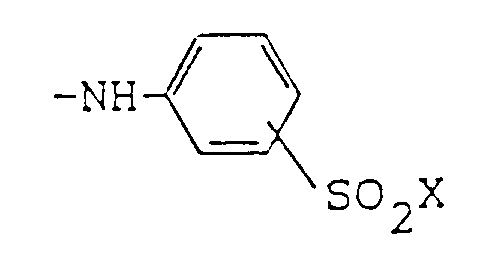
19. Mélange de colorants réactifs solubles dans l'eau selon la revendication 1 ou 4, caractérisé
en ce que le colorant réactif bleu soluble dans l'eau est celui représenté par la
formule générale (V), dans laquelle R⁷ est un atome d'hydrogène, V est un groupe -NHC₂H₄SO₃H
et Y² est un groupe -CH=CH₂ ou un groupe -C₂H₄OSO₃H.
20. Mélange de colorants réactifs solubles dans l'eau selon la revendication 1 ou 5, caractérisé
en ce que le colorant réactif bleu soluble dans l'eau est celui représenté par la
formule générale (VI), dans laquelle Y³ et Y⁴ sont des groupes -OH, Z est un atome
de fluor, m est égal à 0 et n est égal à 1.
21. Mélange de colorants réactifs solubles dans l'eau selon la revendication 1, caractérisé
en ce que le composant bleu est un colorant réactif soluble dans l'eau représenté
par la formule générale (III) ou (V).
22. Mélange de colorants réactifs solubles dans l'eau selon la revendication 1, caractérisé
en ce qu'il s'agit d'un mélange d'un colorant réactif rouge soluble dans l'eau représenté
par la formule générale (I) et d'un colorant réactif jaune soluble dans l'eau représenté
par la formule générale (II).
23. Procédé de coloration de fibres cellulosiques par le procédé de teinture par fixation
en présence d'un alcali et d'un sel minéral, en utilisant un mélange de colorants
constitué d'un mélange d'au moins un type de colorant réactif rouge soluble dans l'eau
représenté par la formule générale suivante (I) sous la forme d'un acide libre :
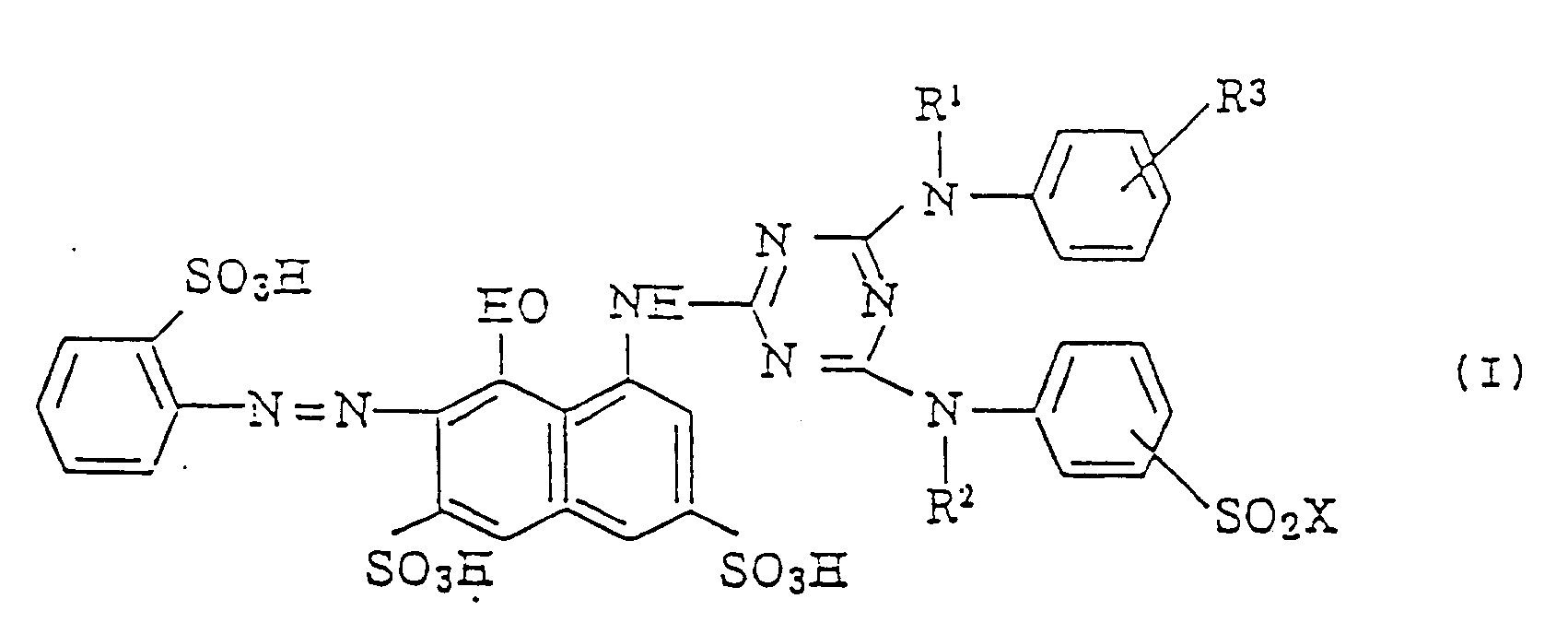
(où chacun des groupes R¹ et R² désigne un atome d'hydrogène ou un groupe alkyle inférieur qui peut contenir un substituant, R³ désigne un atome d'hydrogène, un groupe alkyle inférieur ou un atome d'halogène et X représente -CH=CH₂ ou un groupe -C₂H₄OSO₃H),
et un colorant réactif jaune et/ou un colorant réactif bleu solubles dans l'eau,
ledit procédé étant caractérisé en ce que le composant jaune est un colorant réactif soluble dans l'eau représenté par la formule générale suivante (II) sous la forme d'un acide libre :
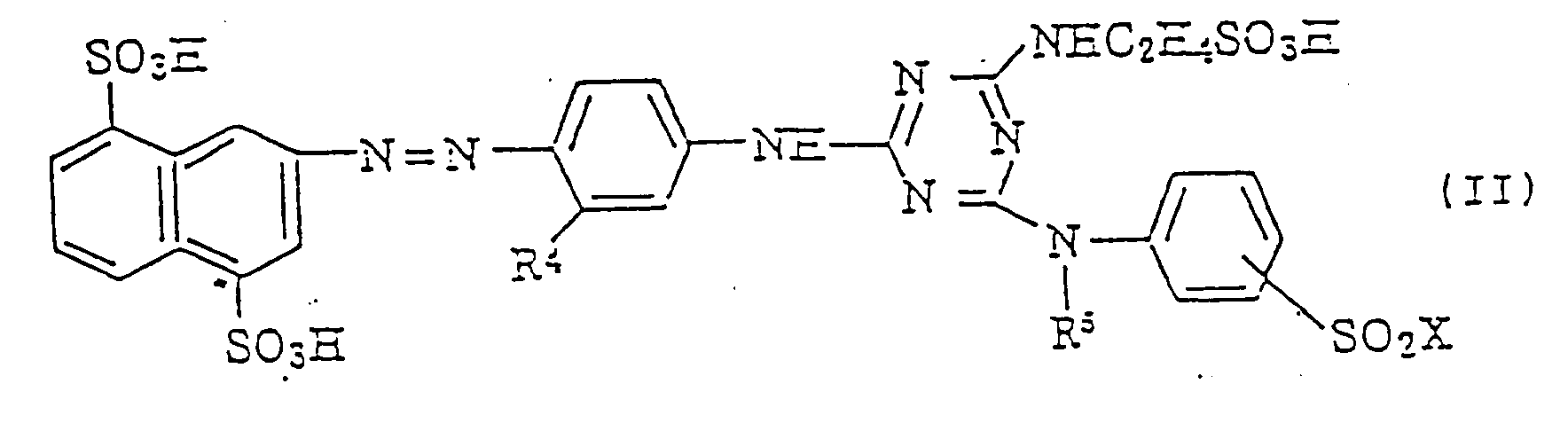
(où R⁴ représente un groupe -NHCOCH₃, un groupe -NHCOC₂H₅, un groupe -NHCONH₂ ou un groupe -NHCOSO₂CH₃, R⁵ désigne un atome d'hydrogène ou un groupe alkyle inférieur qui peut contenir un substituant et X a la même définition que dans la formule générale précédente (I)),
et le composant bleu est au moins un colorant réactif soluble dans l'eau représenté par les formules générales suivantes (III) à (VI) sous la forme d'acide libre :
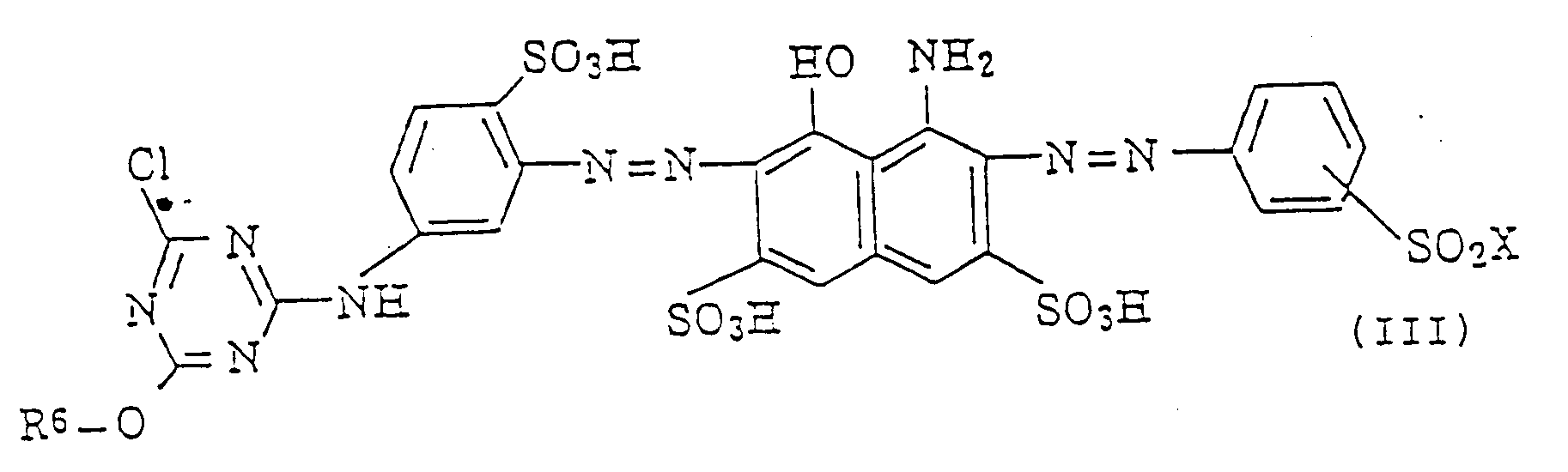
(où R⁶ désigne un groupe alkyle inférieur et X à la même signification que dans la formule générale précédente (I));
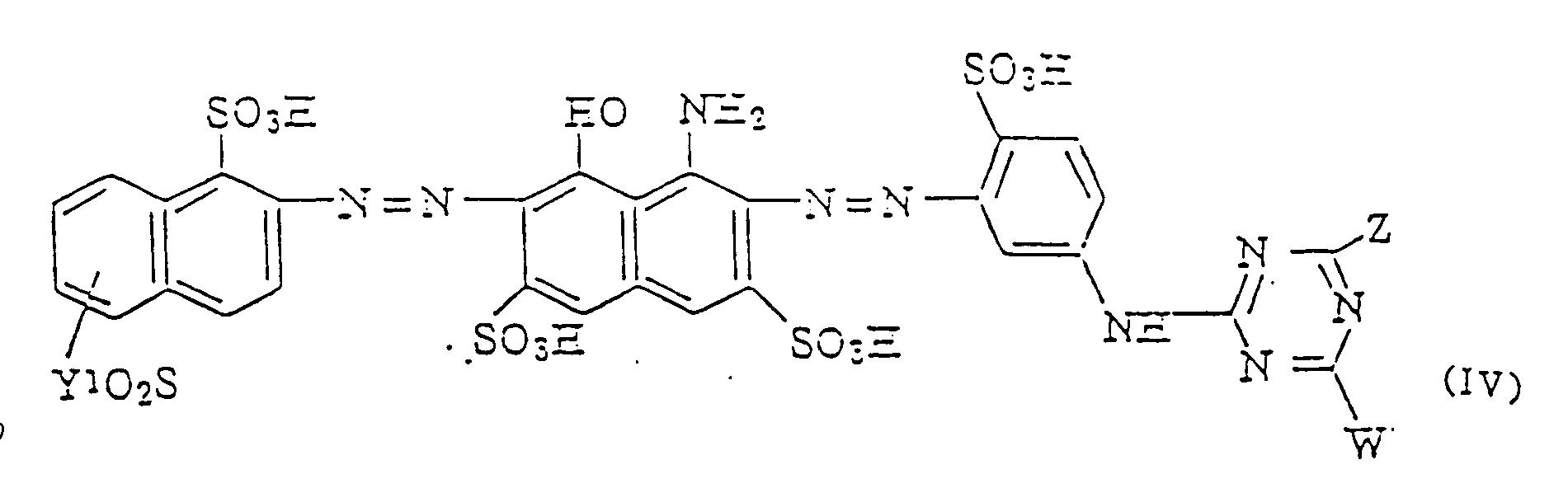
(où Y¹ désigne un groupe -CH=CH₂, un groupe -C₂H₄OSO₃H ou un groupe -OH, Z représente un atome de chlore ou un atome de fluor, W désigne un groupe alkoxy inférieur ou un groupe
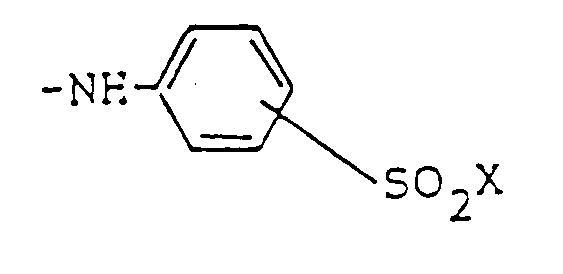
et X a la même définition dans la formule générale précédente (I),
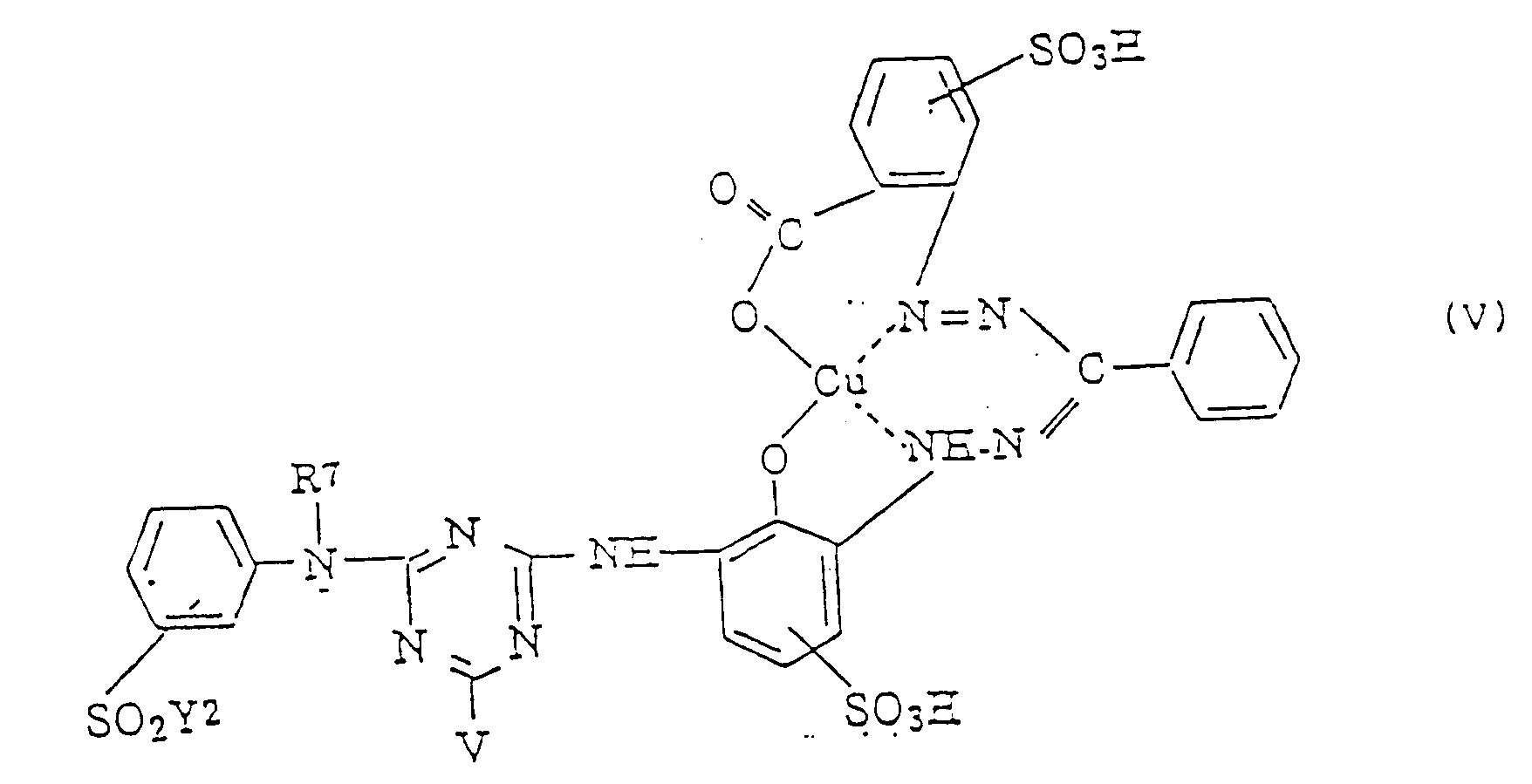
(où V désigne un atome de chlore, un atome de fluor ou un groupe -NHC₂H₄SO₃H, R⁷ représente un atome d'hydrogène ou un groupe alkyle inférieur qui peut contenir un substituant, et Y² désigne un groupe -CH=CH₂, un groupe -C₂H₄OSO₃H ou un groupe -OH, pourvu que, lorsque V est un groupe -NHC₂H₄SO₃H, Y² est soit un groupe -CH=CH₂, soit un groupe -C₂H₄OSO₃H),
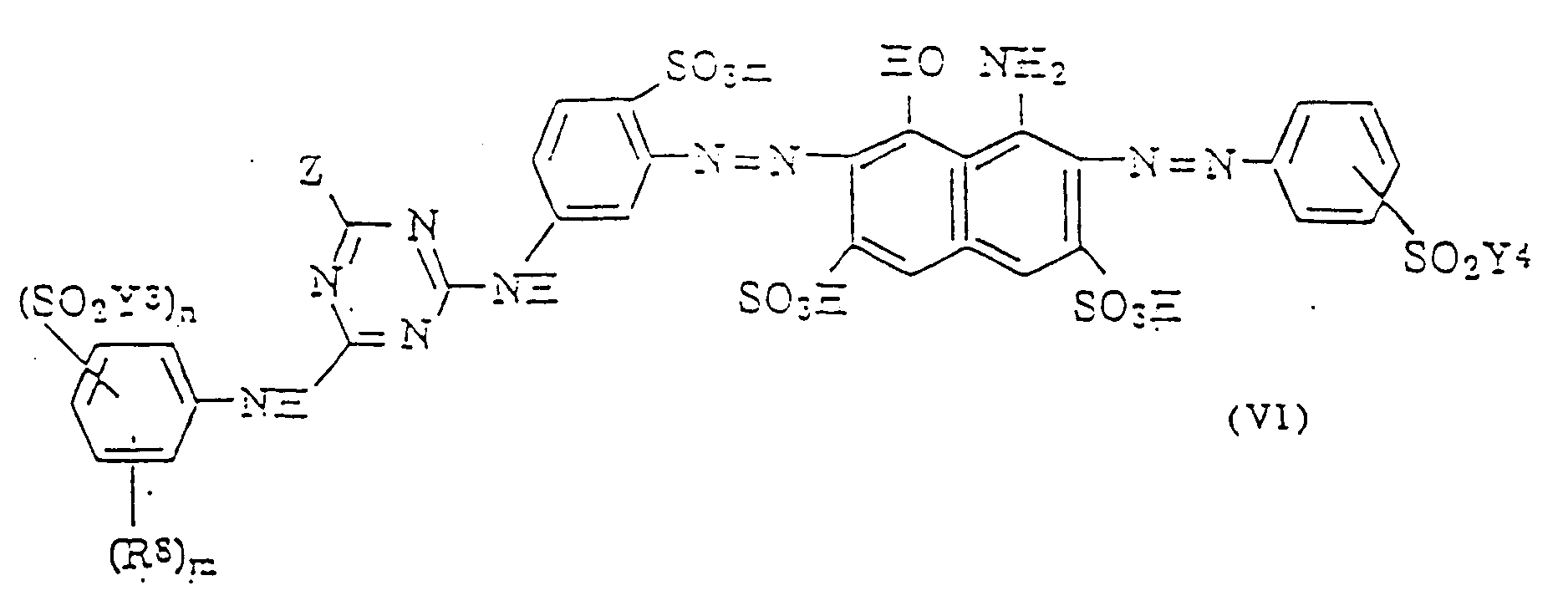
(où R⁸ désigne un atome de chlore, un groupe -COOH ou un groupe -OH, chacun des groupes Y³ et Y⁴ représente un groupe -CH=CH₂, un groupe -C₂H₄OSO₃H ou un groupe -OH, m et n sont des nombres égaux à 0 ou à 1, mais ne peuvent être égaux à 0 en même temps, et Z a la même définition que dans la formule générale précédente (IV)).
(où chacun des groupes R¹ et R² désigne un atome d'hydrogène ou un groupe alkyle inférieur qui peut contenir un substituant, R³ désigne un atome d'hydrogène, un groupe alkyle inférieur ou un atome d'halogène et X représente -CH=CH₂ ou un groupe -C₂H₄OSO₃H),
et un colorant réactif jaune et/ou un colorant réactif bleu solubles dans l'eau,
ledit procédé étant caractérisé en ce que le composant jaune est un colorant réactif soluble dans l'eau représenté par la formule générale suivante (II) sous la forme d'un acide libre :
(où R⁴ représente un groupe -NHCOCH₃, un groupe -NHCOC₂H₅, un groupe -NHCONH₂ ou un groupe -NHCOSO₂CH₃, R⁵ désigne un atome d'hydrogène ou un groupe alkyle inférieur qui peut contenir un substituant et X a la même définition que dans la formule générale précédente (I)),
et le composant bleu est au moins un colorant réactif soluble dans l'eau représenté par les formules générales suivantes (III) à (VI) sous la forme d'acide libre :
(où R⁶ désigne un groupe alkyle inférieur et X à la même signification que dans la formule générale précédente (I));
(où Y¹ désigne un groupe -CH=CH₂, un groupe -C₂H₄OSO₃H ou un groupe -OH, Z représente un atome de chlore ou un atome de fluor, W désigne un groupe alkoxy inférieur ou un groupe
et X a la même définition dans la formule générale précédente (I),
(où V désigne un atome de chlore, un atome de fluor ou un groupe -NHC₂H₄SO₃H, R⁷ représente un atome d'hydrogène ou un groupe alkyle inférieur qui peut contenir un substituant, et Y² désigne un groupe -CH=CH₂, un groupe -C₂H₄OSO₃H ou un groupe -OH, pourvu que, lorsque V est un groupe -NHC₂H₄SO₃H, Y² est soit un groupe -CH=CH₂, soit un groupe -C₂H₄OSO₃H),
(où R⁸ désigne un atome de chlore, un groupe -COOH ou un groupe -OH, chacun des groupes Y³ et Y⁴ représente un groupe -CH=CH₂, un groupe -C₂H₄OSO₃H ou un groupe -OH, m et n sont des nombres égaux à 0 ou à 1, mais ne peuvent être égaux à 0 en même temps, et Z a la même définition que dans la formule générale précédente (IV)).
24. Procédé de teinture selon la revendication 23, caractérisé en ce que la teinture par
fixation est réalisée dans un bain de colorant ayant une concentration en sel minéral
de 5 à 40 g par litre dudit bain de colorant.
25. Procédé de teinture selon la revendication 23 ou 24, caractérisé en ce que ledit sel
minéral est un sel de Glauber.
26. Procédé de teinture selon la revendication 23, caractérisé en ce que la teinture par
fixation est réalisée dans un bain de colorant ayant un pH de 10 à 13.
27. Procédé de teinture selon la revendication 23, caractérisé en ce que la teinture par
fixation est réalisée à une température de teinture de 40 à 80°C.
28. Procédé de teinture selon la revendication 23, caractérisé en ce que le rapport de
mélange du colorant réactif jaune soluble dans l'eau et/ou du colorant réactif bleu
soluble dans l'eau par rapport au colorant réactif rouge soluble dans l'eau est situé
dans la plage de 0,05 à 50 fois en poids au total et le rapport de mélange entre le
colorant réactif jaune soluble dans l'eau et le colorant réactif bleu soluble dans
l'eau est de 0 à 100:100 à 0.
29. Procédé de teinture selon la revendication 23, caractérisé en ce que le rapport de
mélange du colorant réactif jaune et/ou du colorant réactif bleu solubles dans l'eau
par rapport au colorant réactif rouge soluble dans l'eau est situé dans la plage de
0,1 à 10 fois en poids au total et un rapport de mélange entre le colorant réactif
jaune soluble dans l'eau et le colorant réactif bleu soluble dans l'eau est de 0 à
100:100 à 0.
30. Procédé de teinture selon la revendication 23, caractérisé en ce que le colorant réactif
rouge soluble dans l'eau est celui représenté par la formule générale (I), dans laquelle
R¹ est un groupe méthyle ou un groupe éthyle et R² et R³ sont des atomes d'hydrogène.
31. Procédé de teinture selon la revendication 23, caractérisé en ce que le colorant réactif
jaune soluble dans l'eau est celui représenté par la formule générale (II) dans laquelle
R⁴ est un groupe -NHCOCH₃ et R⁵ est un atome d'hydrogène.
32. Procédé de teinture selon la revendication 23, caractérisé en ce que le colorant réactif
bleu soluble dans l'eau est celui représenté par la formule générale (III) dans laquelle
R⁶ et un groupe méthyle.
33. Procédé de teinture selon la revendication 23, caractérisé en ce que le colorant réactif
bleu soluble dans l'eau est celui représenté par la formule générale (IV), dans laquelle
Y¹ est un groupe -CH=CH₂ ou un groupe -C₂H₄OSO₃H, Z représente un atome de chlore
et W désigne un groupe méthoxy.
34. Procédé de teinture selon la revendication 23, caractérisé en ce que le colorant réactif
bleu soluble dans l'eau est celui représenté par la formule générale (IV), dans laquelle
Y¹ est un groupe -OH, Z est un atome de chlore ou un atome de fluor et W est un groupe
35. Procédé de teinture selon la revendication 23, caractérisé en ce que le colorant réactif
bleu soluble dans l'eau est celui représenté par la formule générale (V), dans laquelle
R⁷ est un atome d'hydrogène, V est un groupe -NHC₂H₄SO₃H et Y² est un groupe -CH=CH₂
ou un groupe -C₂H₄OSO₃H.
36. Procédé de teinture selon la revendication 23, caractérisé en ce que le colorant réactif
bleu soluble dans l'eau est celui représenté par la formule générale (VI) dans laquelle
Y³ et Y⁴ sont des groupes -OH, Z est un atome de fluor, m est égal à 0 et n est égal
à 1.
37. Procédé de teinture selon la revendication 23, caractérisé en ce que le colorant bleu
est le colorant réactif soluble dans l'eau représenté par la formule générale (III)
ou (V).
38. Procédé de teinture selon la revendication 23, caractérisé en ce que ledit mélange
de colorants réactifs solubles dans l'eau est un mélange du colorant réactif rouge
soluble dans l'eau représenté par la formule générale (I) et du colorant réactif jaune
soluble dans l'eau représenté par la formule générale (II).