|
(11) | EP 0 328 641 B1 |

| (12) | EUROPEAN PATENT SPECIFICATION |
|
|
| (54) |
TRACTION FLUID ANTRIEBSFLÜSSIGKEIT FLUIDE DE TRACTION |
|
|
||||||||||||||||||||||||||||
|
|||||||||||||||||||||||||||||
| Note: Within nine months from the publication of the mention of the grant of the European patent, any person may give notice to the European Patent Office of opposition to the European patent granted. Notice of opposition shall be filed in a written reasoned statement. It shall not be deemed to have been filed until the opposition fee has been paid. (Art. 99(1) European Patent Convention). |
[0001] This invention relates to a traction fluid. More particularly, the present invention is concerned with a traction fluid comprising by incorporating a diester or its derivative having two cyclohexyl rings as a base oil.
[0002] Traction drive power transmissions, which transmit power to a driven part through a traction drive mechanism, have attracted attention in the field of automobiles and industrial machinery, and in recent years research and development thereon has progressed. The traction drive mechanism is a power transmitting mechanism using a rolling friction. Unlike conventional drive mechanisms it does not use any gears, which enables a reduction in vibration and noise as well as a smooth speed change in highspeed rotation. An important goal in the automobile industry is improvement in the fuel economy of automobiles. It has been suggested that if the traction drive is applied to the transmission of automobiles to convert the transmission to a continuous variable-speed transmission the fuel consumption can be reduced by 20% or more compared to conventional transmission systems since the drive can always be in the optimum speed ratio. Recent studies have resulted in the development of materials having high fatigue resistance and in the theoretical analysis of traction mechanisms. Regarding the traction fluid, the correlation of traction coefficients is gradually being understood on a level of the molecular structure of the components. The term "traction coefficient" as used herein is defined as the ratio of the tractional force which is caused by slipping at the contact points between rotators which are in contact with each other in a power transmission of the rolling friction type to the normal load.
[0003] The traction fluid is required to be a lubricating oil having a high traction coefficient. It has been confirmed that a traction fluid possessing a molecular structure having a naphthene ring exhibits a high performance. "Santotrack®" manufactured by the Monsanto Chemical Company is widely known as a commercially available traction fluid. Japanese Patent Publication No. 47-35763 discloses di(cyclohexyl)alkane and dicyclohexane as traction fluids having a naphthene ring. This patent publication describes that a fluid obtained by incorporating the above-mentioned alkane compound into a perhydrogenated (α -methyl) styrene polymer, a hydrindane compound or the like has a high traction coefficient. Further, Japanese Patent Laid Open No. 59-191797 discloses a traction fluid containing an ester compound having a naphthene ring. It teaches that an ester obtained by the hydrogenation of the aromatic nucleus of dicyclohexyl cyclohexyldicarboxylate or dicyclohexyl phthalate is preferable as the traction fluid.
[0004] As mentioned above, in recent years the automobile industry has made great efforts in the development of continuous variable-speed transmissions. The higher the traction coefficient of the traction fluid, the larger the transmission force in the device. This contributes to a reduction in the size of the device with a corresponding reduction in exhaust gas, thereby reducing environmental pollution. Therefore, there is a demand for a fluid having a traction coefficient as high as possible. However, even the use of a traction fluid which exhibits the highest performance of all the currently commercially available fluids in such a traction drive device provides unsatisfactory performance with respect to the traction coefficient and economics. The traction fluid that has been proposed in Japanese Patent Publication No. 46-35763 contains Santotrack® or its analogue as a component and. therefore, is also unsatisfactory with respect to performance and cost.
[0005] The present inventors have made extensive and intensive studies with a view to developing a traction fluid which not only exhibits a high traction coefficient but is also inexpensive. As a result, the inventors have found that the incorporation of a diester or its derivative, in which two cyclohexyl rings are connected through a linear chain hydrocarbon, can economically provide an higher-performance base oil fluid. The present invention is based on this finding.
[0006] The present invention relates to a traction fluid. characterized by incorporating a diester or its derivative, in which the diester is represented by the general formula:
wherein A' is an ester linkage of -COO- or -OOC-, n is an integer of 1 to 4, each R₁ is independently selected from a hydrogen atom and alkyl groups having 1 to 8 carbon atoms, and each R₂ is independently selected from a hydrogen atom and alkyl groups having 1 to 3 carbon atoms.
[0007] A first object of the present invention is to provide a high-performance traction fluid having a high traction coefficient. A second object of the present invention is to provide a tractian fluid which is not only economical but also readily available and easily applicable to transmissions.
[0008] The traction fluid of the present invention is a diester or its derivative having two cyclohexyl rings linked through a Straight or branched chain of hydrocarbon and is represented by the above-mentioned general formula. A' of the ester linkage is -COO- or -OOC-, and the number, n, of the carbon atoms in the hydrocarbon skelton, is 1 to 4. When n is zero the traction coefficient is low. This diester or derivative thereof can be prepared by the following methods, and has a viscosity of 5 to 50 cst (5x10⁻⁶ to 5x10⁻⁵ m²/s), preferably 7 to 30 cst (7x10⁻⁶ to 3x10⁻⁵ m²/s) at 40°C, and 1 to 10 cst (1x10⁻⁶ to 1x10⁻⁵ m²/s), preferably 2 to 6 cst (2x10⁻⁶ to 6x10⁻⁶ m²/s), at 100°C. Examples of the diester derivative include an amino compound, a halide compound, and an ether compound.
[0009] The diester can be prepared by any of the following methods. The first method comprises an esterification reaction of a dihydric alcohol with a cyclohexanecarboxylic acid compound. The dihydric alcohol has 1 to 4 carbon atoms in the main chain. Specifically, examples of the dihydric alcohol include ethylene glycol, 1,3-propanediol, 1,3-butanediol and 1,4-butanediol. Examples of the cyclohexanecarboxylic acid compound include, besides cyclohexanecarboxylic acid, those having an alkyl group with 1 to 8 carbon atoms, e.g., methylcyclohexanecarhoxylic acid, ethtlcyclohexanecarboxylic acid, etc. Cyclohexacarboxylic acid is particularly preferred. The esterification reaction is conducted with an alcohol/acid molar ratio of 1:2, or in the presence of an access amount of the acid. The former method requires the use of a catalyst and further has the problem that a monoalcohol is produced as the by-product. Therefore, it is preferred that the esterification reaction be conducted in the presence of an excess amount of the acid. Specifically, 1 mol of the dihydric alcohol is reacted with the acid in 2 to 5-fold by mol excess (particularly preferred is a 2.5 to 4-fold by mol excess). The reaction temperature is about 150 to 250°C. preferably 170 to 230°C, and the reaction time is 10 to 40 hr, preferably 15 to 25 hr. Although the esterification reaction may be conducted under either elevated or reduced pressures, it is preferred that the reaction is conducted at atmospheric pressure from the standpoint of ease of reaction operation. Under this condition, the excess acid serves as a catalyst. An alkylbenzene such as xylene or toluene can be added in a suitable amount as a solvent. The addition of the solvent enables the reaction temperature to be easily controlled. As the reaction proceeds the water formed during the reaction evaporates. The reaction is terminated when the amount of the water reaches, on a mole basis, twice that of the alcohol. The excess acid is neutralized with an aqueous alkaline solution and removed by washing with water. When an acid which is difficult to extract with an alkali washing is used, the reaction is conducted using the acid in an amount of 2 to 2.5-fold mol excess over the alcohol in the presence of a catalyst. Examples of the catalyst include phosphoric acid, p-toluenesulfonic acid and sulfuric acid. The most preferable catalyst is phosphoric acid because it enhances the reaction rate and increases the yield of the ester. The reaction product is finally distilled under reduced pressure to remove water and the solvent, thereby obtaining the diester compound of the present invention.
[0010] The second method of producing the diester comprises esterification of cyclohexanol compound with a dicarboxylic acid having 3 to 6 carbon atoms in the main chain. Examples of the cyclohexanol compound include, besides cyclohexanol, those having an alkyl group with 1 to 8 carbon atoms, e.g., methylcyclohexanol and tert-butylcyclohexanol. Cyclohexanol is particularly preferred.
[0011] Examples of the dicarboxylic acid include malonic acid, succinic acid and glutaric acid. The esterification reaction is conducted in an alcohol/acid molar ratio of 2:1 or in the presence of an excess amount of the alcohol. In the former method, there is a possibility of forming a monocarboxylic acid as the by-product. Therefore, it is preferred that the esterification reaction is conducted in the presence of an excess amount of the alcohol. Specifically, 1 mol of the dicarboxylic acid is reacted with the alcohol in 2.5 to 5-fold by mol excess. The reaction temperature is about 150 to 250°C, preferably 170 to 230°C, and the reaction time is 10 to 40 hr, preferably 15 to 25 hr. Although the esterification reaction may be conducted under either elevated or reduced pressures, it is preferred that the reaction be conducted at atmospheric pressure from the standpoint of ease of reaction operation. An alkylbenzene such as xylene or toluene can be added in a suitable amount as a solvent. The addition of the solvent enables the reaction temperature to be easily controlled. As the reaction proceeds the water formed during the reaction evaporates. The reaction is terminated when the amount of the water reaches twice by mol that of the alcohol. Phosphoric acid, p-toluenesulfonic acid or sulfuric acid can be used as a catalyst. The most preferable catalyst is phosphoric acid because it enhances the reaction rate and increases the yield of the ester. The reaction product is finally distilled under reduced pressure to remove the water, solvent and excess alcohol, thereby obtaining the diester compound of the present invention.
[0012] The diester of the present invention, e.g., a diester of succinic acid with cyclohexanol, exhibits a traction coefficient of 0.102 to 0.106. Therefore, the use of the diester alone in the traction drive device results in a high performance. A second component may be optionally incorporated into the diester. Specifically, the second component is so selected that it cooperates with the cyclohexyl rings of the diester to exhibit a synergistic effect with respect to improving traction coefficient and is so selected that it is inexpensive and exhibits excellent viscosity characteristics. A traction fluid can be more economically obtained by blending the second component with the diester. Normally 0.01 to 90% by weight, particularly 0.1 to 70% by weight, of the second component, is blended.
[0013] Various additives may also be added to the traction fluid of the present invention depending upon their applications. Specifically, when the traction device undergoes a high temperature and a large load, at least one additive selected from among an antioxidant, a wear inhibitor and a corrosion inhibitor may be added in an amount of 0.01 to 5% by weight. Similarly, when a high viscosity index is required, a known viscosity index improver is added in an amount of 1 to 10% by weight.
[0014] The term "traction fluid" as used in the present invention is intended to mean a fluid for use in devices which transmit a rotational torque through point contact or line contact, or for use in transmissions having a similar structure. The traction fluid of the present invention exhibits a traction coefficient higher than those of conventionally known fluids, i.e., exhibits a traction coefficient 1 to 15% higher than those of the conventional fluids, although the value varies depending on the viscosity. Therefore, the traction fluid of the present invention can be advantageously used for relatively low power drive transmissions including internal combustion engines of small passenger cars, spinning machines and food producing machines, as well as large power drive transmissions such as industrial machines, etc.
[0015] The traction fluid of the present invention exhibits a remarkably superior traction coefficient relative to the conventional fluids. The reason why the traction fluid of the present invention exhibits a high traction coefficient is not yet fully understood. However, basically, the reason is believed to reside in the unique molecular structure of the traction fluid of the present invention.
[0016] The traction fluid of the present invention comprises a diester having two cyclohexyl rings in its molecule. The two ester linkages bring about an interdipolar force between the molecules. It is believed that the interdipolar force serves to bring the fluid into a stable glassy state under high load conditions, thereby increasing the shearing force. Further, the traction fluid of the present invention possesses a structure having suitable flexibility because the carbon atoms in the basic skeleton are connected to the two cyclohexyl rings through an ester linkage. Therefore when the traction device is under high load conditions, the cyclohexyl rings are firmly engaged, like gears, with the linked portions of the linear-chain hydrocarbons, while when the device is released from the load, this engagement is quickly detached, thereby causing fluidization.
THE OPTIMUM EMBODIMENTS OF THE INVENTION
Examples 1-4
[0017] Dicyclohexyl diester compound A₁ of the present invention was synthesized by the following method:
First, 118g of succinic acid and 250g of cyclohexanol (i.e., 2.5 mol per mol of succinic acid) were charged into a reactor, and phosphoric acid was added in an amount of 1% by weight based on the total weight of the reactants. The reactor was heated at 180°C. The contents of the reactor were allowed to react at a temperature in the range of 180°C to 210°C under atmospheric pressure.
[0018] The reaction was stopped at a point when the water generated during the reaction amounted to twice, by mol, of the amount of the succinic acid. The reaction mixture was washed with an alkaline solution to remove unreacted compounds, i.e., cyclohexanol, and phosphoric acid, from the mixture of the reaction product, i.e., an ester of cyclohexanol with succinic acid, the unreacted compounds, and phosphoric acid, followed by vacuum distillation, thereby isolating a pure diester (A₁).
[0019] Using the same method as mentioned above, diesters (A₂ to A₄) of the present invention were synthesized using the following raw materials:
- A₂
- cyclohexanol and malonic acid
- A₃
- ethylene glycol and cyclohexanecarboxylic acid (in excess acid)
- A₄
- 1,3-butanediol and cyclohexanecarboxylic acid (in excess acid)
- measuring equipment:
- Soda-type four-roller traction testing machine
- test conditions:
- a fluid temperature of 20°C; a roller temperature of 30°C; a mean Hertzian pressure of 1.2 GPa; a rolling velocity of 3.6 m/s; and a slipping ratio of 3.0%.
[0020] The traction fluid of the present invention was found to be remarkably superior in traction performance to the conventional fluids as shown in Table 1.
Comparative Examples 1 to 4
[0021] A commercially available traction fluid B (Santotrack®, manufactured by the Monsanto Chemical Company), polybutene C (having an average molecular weight of 900), a commercially available naphthenic fluid D (having 1 to 3 cyclohexyl rings), and dicyclohexyl fumarate diester E were used as comparative samples. The traction coefficient of each comparative sample was measured in the same manner as described in the above examples.
[0022] The results are shown in Table 1. As can be seen from Table 1, all the comparative samples exhibited, traction coefficients 10 to 15% smaller than that of the diester compound of the present invention.
INDUSTRIAL AVAILABILITY
[0023] The traction fluid of the present invention comprises by incorporating a diester of which the skeleton comprises two cyclohexyl rings and linear chain hydrocarbons and not only exhibits an extremely high traction coefficient but also is inexpensive and exhibits excellent viscosity characteristics.
1. A traction fluid comprising a diester represented by the formula
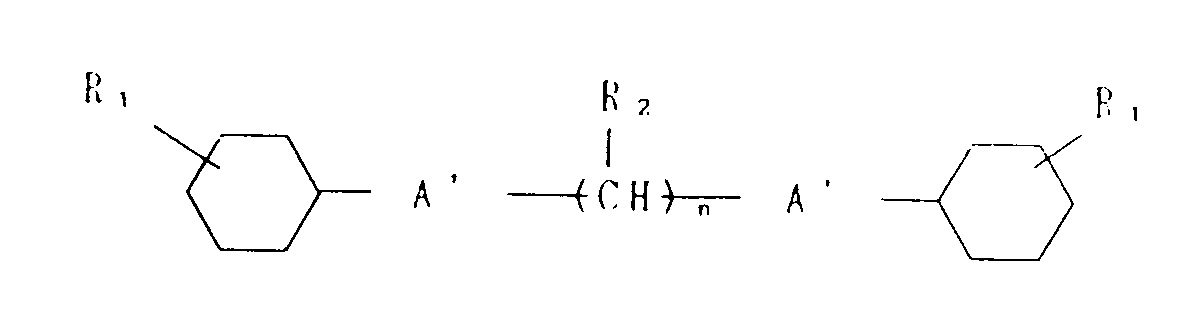
wherein each of the groups A' which may be the same or different is an ester linkage of -COO-or -OOC-; n is an integer of 1 to 4; each of the groups R₁ which may be the same or different is independently selected from hydrogen and alkyl groups having 1 to 8 carbon atoms; and each of the groups R₂ which may be the same or different is independently selected from hydrogen and alkyl groups having 1 to 3 carbon atoms; or a derivative thereof.
wherein each of the groups A' which may be the same or different is an ester linkage of -COO-or -OOC-; n is an integer of 1 to 4; each of the groups R₁ which may be the same or different is independently selected from hydrogen and alkyl groups having 1 to 8 carbon atoms; and each of the groups R₂ which may be the same or different is independently selected from hydrogen and alkyl groups having 1 to 3 carbon atoms; or a derivative thereof.
2. A traction fluid as claimed in claim 1, wherein each of the groups R₁ of the diester
is independently selected from hydrogen and alkyl groups having 1 to 4 carbon atoms.
3. A traction fluid as claimed in either of claims 1 and 2 wherein each of the groups
R₂ of the diester is selected from hydrogen or a methyl group.
4. A traction fluid as claimed in any one of claims 1 to 3 wherein said derivative is
an amino, halogen or ether compound.
5. A traction fluid as claimed in any one of claims 1 to 4 further comprising at least
one additive selected from the group consisting of an antioxidant, a wear inhibitor
and a corrosion inhibitor, in an amount of 0.01 to 5% by weight.
6. A traction fluid as claimed in any one of claims 1 to 5 further comprising a viscosity
index improver in an amount of 1 to 10% by weight.
7. Use of a diester as claimed in claim 1 as a base oil for a traction fluid.
1. Antriebsflüssigkeit, die einen Diester mit der Formel
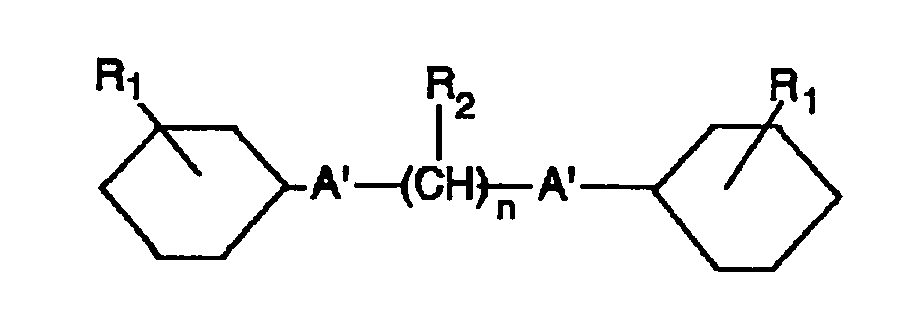
wobei jede der Gruppen A', die gleich oder verschieden sein können, eine Esterbindung von -COO- oder -OOC- ist, n eine ganze Zahl von 1 bis 4 ist, jede der Gruppen R₁, die gleich oder verschieden sein können, unabhängig ausgewählt ist aus Wasserstoff und Alkylgruppen mit 1 bis 8 Kohlenstoffatomen, und jede der Gruppen R₂, die gleich oder verschieden sein können, unabhängig ausgewählt ist aus Wasserstoff und Alkylgruppen mit 1 bis 3 Kohlenstoffatomen, oder ein Derivat hiervon umfaßt.
wobei jede der Gruppen A', die gleich oder verschieden sein können, eine Esterbindung von -COO- oder -OOC- ist, n eine ganze Zahl von 1 bis 4 ist, jede der Gruppen R₁, die gleich oder verschieden sein können, unabhängig ausgewählt ist aus Wasserstoff und Alkylgruppen mit 1 bis 8 Kohlenstoffatomen, und jede der Gruppen R₂, die gleich oder verschieden sein können, unabhängig ausgewählt ist aus Wasserstoff und Alkylgruppen mit 1 bis 3 Kohlenstoffatomen, oder ein Derivat hiervon umfaßt.
2. Antriebsflüssigkeit nach Anspruch 1, bei der jede der Gruppen R₁ des Diesters unabhängig
ausgewählt ist aus Wasserstoff und Alkylgruppen mit 1 bis 4 Kohlenstoffatomen.
3. Antriebsflüssigkeit nach einem der Ansprüche 1 oder 2, bei der jede der Gruppen R₂
des Diesters ausgewählt ist aus Wasserstoff oder einer Methylgruppe.
4. Antriebsflüssigkeit nach einem der Ansprüche 1 bis 3, bei der das Derivat eine Amino-,
Halogen- oder Etherverbindung ist.
5. Antriebsflüssigkeit nach einem der Ansprüche 1 bis 4, die außerdem mindestens ein
Additiv ausgewählt aus der Gruppe bestehend aus einem Antioxidans, einem Verschleißschutzmittel
und einem Korrosionsschutzmittel in einer Menge von 0,01 bis 5 Gew.% umfaßt.
6. Antriebsflüssigkeit nach einem der Ansprüche 1 bis 5, die außerdem einen Viskositätsindexverbesserer
in einer Menge von 1 bis 10 Gew.% umfaßt.
7. Verwendung eines Diesters gemäß Anspruch 1 als Grundöl für eine Antriebsflüssigkeit.
1. Fluide de traction comprenant un diester représenté par la formule
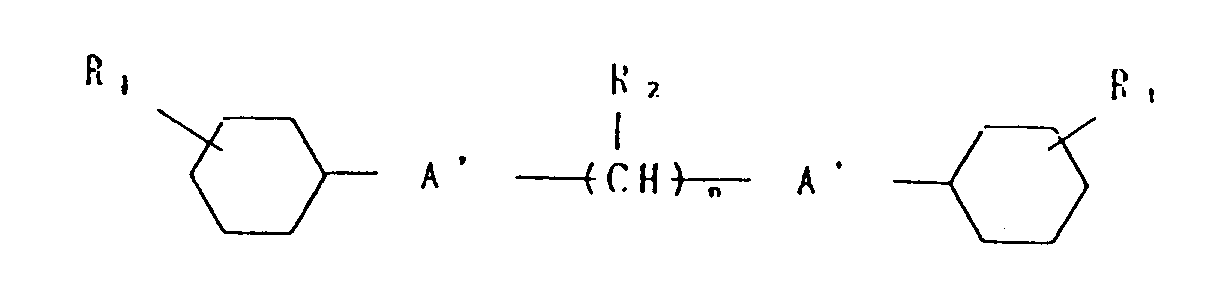
dans laquelle chacun des groupes A' qui peuvent être identiques ou différents, représente une liaison ester de formule -COO- ou -OOC- ; n est un nombre entier de 1 à 4 ; chacun des groupes R₁, qui peuvent être identiques ou différents, est choisi indépendamment entre l'hydrogène et des groupes alkyle ayant l à 8 atomes de carbone ; et chacun des groupes R₂, qui peuvent être identiques ou différents, est choisi indépendamment entre l'hydrogène et des groupes alkyle ayant 1 à 3 atomes de carbone ; ou un de ses dérivés.
dans laquelle chacun des groupes A' qui peuvent être identiques ou différents, représente une liaison ester de formule -COO- ou -OOC- ; n est un nombre entier de 1 à 4 ; chacun des groupes R₁, qui peuvent être identiques ou différents, est choisi indépendamment entre l'hydrogène et des groupes alkyle ayant l à 8 atomes de carbone ; et chacun des groupes R₂, qui peuvent être identiques ou différents, est choisi indépendamment entre l'hydrogène et des groupes alkyle ayant 1 à 3 atomes de carbone ; ou un de ses dérivés.
2. Fluide de traction suivant la revendication 1, dans lequel chacun des groupes R₁ du
diester est choisi indépendamment entre l'hydrogène et des groupes alkyle ayant 1
à 4 atomes de carbone.
3. Fluide de traction suivant l'une des revendications 1 et 2, dans lequel chacun des
groupes R₂ du diester est choisi entre l'hydrogène et un groupe méthyle.
4. Fluide de traction suivant l'une quelconque des revendications 1 à 3, dans lequel
le dérivé est un composé à fonction amino, halogéno ou éther.
5. Fluide de traction suivant l'une quelconque des revendications 1 à 4, comprenant en
outre au moins un additif choisi dans le groupe consistant en un antioxydant, un agent
anti-usure et un inhibiteur de corrosion, en une quantité de 0,01 à 5 % en poids.
6. Fluide de traction suivant l'une quelconque des revendications 1 à 5, comprenant en
outre un agent améliorant l'indice de viscosité, en une quantité de 1 à 10 % en poids.
7. Utilisation d'un diester suivant la revendication 1 comme huile de base pour un fluide
de traction.