|
(11) | EP 0 331 187 B1 |

| (12) | EUROPEAN PATENT SPECIFICATION |
|
|
| (54) |
Process for producing a ceramic preform Verfahren zur Herstellung eines keramischen Vorformlings Procédé de production d'une préforme céramique |
|
|
|||||||||||||||||||||||||||||||
| Note: Within nine months from the publication of the mention of the grant of the European patent, any person may give notice to the European Patent Office of opposition to the European patent granted. Notice of opposition shall be filed in a written reasoned statement. It shall not be deemed to have been filed until the opposition fee has been paid. (Art. 99(1) European Patent Convention). |
[0001] The present invention relates to a process for producing a ceramic preform. More particularly, it relates to a process for producing a ceramic preform which is free from fracture or cracking and which can be sintered to obtain a sintered product having a low water content.
[0002] Heretofore, for the production of ceramic shaped products, a so-called sol-gel method wherein a sol obtainable by hydrolyzing a metal alkoxide such as alkoxysilane by an addition of water, is gelled and dried to obtain a dry gel i.e. a ceramic preform, which is then sintered to obtain a sintered ceramic product. However, in this method, water is used in an amount several times the theoretical amount for the hydrolysis, or an alcohol is used as the solvent. Therefore, the gel contains substantial amounts of water and the alcohol, and it takes a long time of from 0.5 to 2 months for drying the gel. Yet, as the volume reduces, fracture or cracking is likely to take place. For the purpose of preventing such fracture or cracking, it has been proposed to incorporate fine silica powder in an amount of from 0.2 to 5 mol times to the metal alkoxide. However, even by this method, when the gel to be dried is left to stand at room temperature, the surface drying takes place rapidly, whereby it has been difficult to adequately prevent fracture or cracking. Therefore, it used to be required to put a cover having a relatively small opening on the container and gradually dry the gel. (Japanese Unexamined Patent Publication No. 131833/1975)
[0003] According to the conventional technique for producing a sintered product such as quartz glass by the sol-gel method, the reduction of the water content (the OH group content) in the quartz glass used to be about 1,000 ppm at best, and it has been difficult to reduce the water content to a level of molten natural quartz, i.e. to a water content of 300 ppm.
[0004] Derwent Abstract 87-98187 (D) discloses a method of making a ceramic product by treating silicon dioxide with an alkoxysilane having an Si-C-bonded alkyl group, and baking and finally sintering the thus obtained product.
[0005] Japanese Unexamined Patent Publication No. 168542/1986 discloses a process for producing quartz glass by a sol-gel method using an alkylsilicate and super fine silica powder as starting materials, wherein a dry gel is held within a temperature range of from 900 to 1,300°C for at least 20 hours to reduce the water content in quartz glass. However, even by this method, in order to reduce the water content in quartz glass to a level of not more than 300 ppm, it is required to continue the heating within the above temperature range for at least 80 hours. Thus, this method involves many practical problems for industrial operation.
[0006] It is an object of the present invention to provide a process for producing a ceramic preform having excellent quality, particularly a ceramic preform free from fracture or cracking and capable of being sintered to form a sintered product having a low water content.
[0007] The present inventors have accomplished this object by mixing an alkoxysilane and fine silica powder, molding the mixture, followed by heating for de-alcoholysis.
[0008] In the broadest sense, the present invention provides a process for producing a ceramic preform, which comprises mixing (A) an alkoxysilane of the formula:
wherein n is an interger of from 0 to 9 and R is an alkyl group and (B) fine silica powder, molding the mixture followed by heating for de-alcoholysis. R is preferably an alkyl group having from 1 to 4 carbon atoms, more preferably a methyl group or an ethyl group.
[0009] Specifically, the alkoxysilane includes tetramethoxysilane, tetraethoxysilane, tetrapropoxysilane and tetrabutoxysilane.
[0010] Oligomeric alkoxysilanes (such as each of the dimer to decamer) are obtainable by partial hydrolysis and poly-condensation of the above-mentioned monomeric alkoxysilanes. Such oligomeric alkoxysilanes are industrially suitable in view of the transportation and storage stability, the handling efficiency and the cost effectiveness.
[0011] In the case of an alkoxysilane which has a relatively high vapor pressure and which is likely to evaporate and disperse during the subsequent heating for de-alcoholysis, it is preferred to use its oligomeric alkoxysilane having a low vapor pressure, as the starting material.
[0012] The fine silica powder may be produced, for instance, by a method wherein a hydroxide prepared by hydrolyzing a silicon compound in a wet system, is sintered, or by a method wherein a silicon halide or an alkoxysilane is hydrolyzed in a dry system or burned. In the case of a dry system, it is possible to obtain fine silica powder having adsorbed water remarkably reduced.
[0013] As will be described hereinafter, it is beleived that in the present invention, a reaction of the fine silica powder and the alkoxysilane i.e. a reaction of the hydroxyl groups of the fine silica powder with the alkoxysilane, is utilized. Therefore, the fine silica powder is required to have hydroxyl groups on its surface. Depending upon the process for its preparation, fine silica powder may have an extremely small density of surface hydroxyl groups. However, for the purpose of the present invention, the surface hydroxyl group density obtainable by the contact with air after the production, may be sufficient. Therefore, there is no particular restriction as to the method for the prepration of fine silica powder to be used in the present invention.
[0014] The fine silica powder to be used in the present invention usually has a hydroxyl group density of from 0.1 to 8 groups/100 Ų, preferably from 0.2 to 4 groups/100 Ų.
[0015] The fine silica powder preferably has a particle size of from 5 to 1,000 nm, more preferably from 10 to 500 nm. If the particle size is too small, deaeration during the molding tends to be inadequate, whereby it tends to be difficult to obtain a highly dense preform, or cracking tends to take place during the after-mentioned step for de-alcoholysis. On the other hand, if the particle size is too large, it requires a high sintering temperature when the preform is sintered to obtain a sintered product, such being disadvantageous from the viewpoint of energy consumption. There is an additional drawback that it is thereby difficult to obtain a transparent sintered product.
[0016] The fine silica powder is used preferably in an amount of from 0.2 to 50 parts by weight, more preferably from 0.5 to 20 parts by weight, per part by weight of the alkoxysilane. If the amount is too small, the strength of the preform tends to be low, and the amount of the alcohol generated during the step for de-alcoholysis tends to be large, whereby fracture or cracking is likely to take place. On the other hand, if the amount is too large, it tends to be difficult to obtain a dense sintered product.
[0017] There is no particular restriction as to the method for mixing the alkoxysilane and the fine silica powder. They may be simply stirred and mixed, or a solvent may be used in a case where a material having a high viscosity such as an oligomeric alkoxysilane, is used. Usually, it is preferred to stir and mix them in the presence of a solvent (or a dispersing medium).
[0018] As the solvent for this purpose, not only the same alcohol as the alcohol component of the above alkoxysilane, but also a lower alcohol such as methanol, ethanol, propanol or butanol, an ether, acetone or methyl ethyl ketone, or other inert organic solvents having a low boiling point, may be mentioned. The solvent is used usually in an amount of from 0.5 to 10 parts by weight, preferably from 1 to 5 parts by weight, per part by weight of the total amount of the alkoxysilane and the fine silica powder.
[0019] The solvent used here may optionally be evaporated after the mixing. Of course the solvent can be recovered and reused.
[0020] During the mixing, a binder such as polyvinyl alcohol, carboxymethyl cellulose or starch, a surfactant, a pH controlling agent, etc. may be added, as the case requires. At that time, a small amount of fine powder of an alkoxide or an oxide of a metal in Groups III to V of the Periodic Table, such as Aℓ, B, Ti, P, Ge, Zr, Sb, Y or rare earth metals, may also be added.
[0021] The mixture of the alkoxysilane and the fine silica powder thus obtained, is molded in a dry state or in a wet state where the solvent or the like remains to some extent. In such a mixture, the fine silica powder is mostly agglomerated in such a state that the alkoxysilane is deposited on its surface or it is dispersed in a liquid comprising the alkoxysilane and the solvent. It may some times form coarse agglomerates. Therefore, prior to the molding operation, it is preferred to adjust the particle size of the mixture to a level of at most 150 µm, preferably at most 100 µm, more preferably at most 50 µm, so that no agglomerates remain, whereby it is possible to prevent the turbidity or non-uniformity of the ceramic preform, and it is possible to obtain a uniform and highly dense ceramic preform.
[0022] The particle size may be adjusted by a method such as sieving by means of a sieve, or pulverization followed by sieving. As the sieve, any filter material having a desired mesh size may be employed such as a net, cloth or a sintered product made of various materials. However, in order to avoid inclusion of impurities, it is preferred to employ a filter material made of a synthetic resin. For the same reason, the pulverizer may preferably be made of a synthetic resin.
[0023] The agglomerates in the above mixture are usually in a loosely agglomerated state and can be pulverized during the sieving by means of such a sieve. Therefore, in many cases, the object can be attained simply by sieving. However, pulverization may be conducted as the case requires.
[0024] There is no particular restriction as to the method for molding. For example, the mixture may simply be filled in a predetermined container, or may be put into a mold and pressed. Otherwise, molding may be conducted by means of an extrusion molding machine or an injection molding machine. The shape of the molded product may be in the form of the final product or in the form of a shaped material for further processing, such as pellets, strands or sheets. Among these methods, mold pressing is preferred. In this case, pressing is conducted usually under a pressure of from 50 to 3,000 kg/cm², preferably from 100 to 2,000 kg/cm². If the pressing pressure is too low, voids tend to remain in the preform, or the shape is likely to change. On the other hand, even if the pressing pressure is high, there is no adverse effect to the preform. However, the pressing under a pressure of higher than 3,000 kg/cm² is not advantageous from the view-point of installation and operation.
[0025] If a product molded by such as pressing is further subjected to finish molding such as cold isostatic pressing (CIP), distortion due to the molding can be reduced to obtain a preform having a higher density.
[0026] The preform thus obtained is then heated for the de-alcoholysis reaction of the alkoxysilane with hydroxyl groups on the surface of the fine silica powder. The de-alcoholysis is conducted usually at a temperature of from 100 to 300°C, preferably from 120 to 250°C, for at least 10 minutes, usually at least 30 minutes. If the temperature is too low or the time is too short, the de-alcoholysis reaction of the alkoxysilane with hydroxyl groups on the surface of the fine silica powder does not proceed adequately, whereby the strength of the ceramic preform will be low. On the other hand, if the temperature is too high, decomposition or evaporation of the alkoxysilane tends to increase, whereby fracture or cracking tends to take place, such being undesirable.
[0027] In this de-alcoholysis, the volume change of the preform is small, and the resulting ceramic preform will be free from fracture and cracking.
[0028] The de-alcoholysis in the process of the present invention is considered to proceed as shown by the following scheme in the case where the monomeric alkoxysilane or oligomeric alkoxysilane (dimer to decamer) and fine silica powder are used:
In the above formulas, n is an integer of from 0 to 9, R is an alkyl group, and
is SiO₂ particle.
indicates that a OH group is attached on the surface of a SiO₂ particle, and for convenience sake, it is represented by a mono functional group.
[0029] Accordingly, if the de-alcoholysis adequately proceeds, the product is considered to be as follows:
wherein n and
are as defined above.
[0030] The ceramic preform thus prepared can be converted by sintering to glass or strong ceramics, which can be used as optical glass such as a lens, a prism or a photomask, as a belljar, a crucible, as a semiconductor product such as semiconductor jig, as quartz glass for science and chemistry or as a structural material used at a high temperature. Further, the ceramic preform may be used by-itself without sintering for applications such as separation membranes, catalysts carriers, gas absorbents or heat shielding materials utilizing the porous nature.
[0031] The temperature for sintering the ceramic preform varies depending upon the content of the fine silica powder, the particle size, etc. However, it is usually at a level of from 800 to 1,900°C. For example, in a case where transparent quartz glass is to be prepared by using an alkoxysilane and fine silica powder as the starting materials, the temperature is preferably from 1,000 to 1,300°C.
[0032] For the purpose of comparison with the present invention, the assumed reaction scheme of the reaction by the above-mentioned sol-gel method will be given below wherein alkoxysilane is employed.
Hydrolysis
Dehydration condensation reaction
[0034]
XSi(OH)₄ → (SiO₂)X + 2XH₂O
The process of the present invention does not require the presence of water, whereby a ceramic preform having excellent quality is believed to be obtainable.
[0035] The presence of a large amount of water means that the preform and the sintered product thereof will contain water. Accordigly, fracture or cracking will thereby be caused, and the de-alcoholysis will thereby be hindered in the subsequence de-alcoholysis step, whereby the strength of the preform is likely to be low.
[0036] However, according to the process of the present invention, the presence of water can be reduced, and it is thereby possible to avoid the above-mentioned problems inherent to use of a large amount of water as in the sol-gel method. The present invention does not require an absolute anhydrous state. An alcohol used as the solvent, such as an alcohol for industrial purposes, usually contains water in an amount of a few hundreds ppm, and air or the starting materials have deposited water. In the present invention, the presence of water of this degree is permissible. The alkoxysilane has low compatibility with water, and water in an amount of about 1 mol per mol of the alkoxysilane, will be consumed by the conversion of the alkoxysilane to an oligomeric alkoxysilane, whereby the presence of water is reduced. Further, as mentioned above, the amount of water adsorbed on the fine silica powder varies depending upon the method for the preparation of silica powder or on the state of contact with air after the preparation, and such may affect the formation of OH groups on the surface of the fine silica powder. Accordingly, it is preferred that water adsorbed on the fine silica powder is controlled to be not more than 1 mol%, more preferably not more than 0.1 mol%, relative to the fine silica powder.
[0037] The ceramic preform obtained by the present invention can be converted by sintering to quartz glass having a low water content at a level of not higher than a few hundreds ppm and having excellent heat stability and transparency-retaining properties.
[0038] Now, the present invention will be described in further detail with reference to Examples. However, it should be understood that the present invention is by no means restricted by such specific Examples.
EXAMPLE 1
[0039] 100 g of commercially available fumed silica (Aerosil OX 50, tradename, manufactured by Degussa, Fed. Rep. of Germany) was added to 500 g of methanol (guaranteed reagent) and dispersed uniformly in the methanol by mixing with a stirrer. Further, 18.2 g of methyl silicate (methoxysilane oligomer containing SiO₂ at a concenration of 51%) was added thereto, and the mixture was thoroughly stirred and mixed. Then, the methanol solvent was evaporated from the mixture by an evaporator to obtain a non-sticky powder mixture (Mixture I).
[0040] Mixture I was passed through a nylon net having a mesh size of 50 µm to remove coarse agglomerate particles larger than the mesh size of the net. The mixture after the removal of coarse particles, was charged into a SUS 304 press container having a square cross sectional shape with each side being 55 mm and press-molded under a pressure of 150 kg/cm²G. Further, a pressure of 2,000 kg/cm²G was exerted by cold isostatic pressing to obtain a molded product of a sheet shape of 52.7 mm x 52.7 mm x 6.5 mm. This molded product was placed in a drier and subjected to de-alcoholysis at 200°C for 4 hours. As a result, the weight of the obtained ceramic preform was 23.5 g, and no dimensional change or no cracking was observed. Then, the ceramic preform was introduced into an electric furnace, heated to 1,250°C at a temperature raising rate of 50°C/hr and maintained at that temperature for 5 hours to obtain a transparent quartz glass having a size of 43.5 mm x 43.5 mm x 5.4 mm and a weight of 22.6 g (density: 2.2 g/cc) and having no turbidity. The water content (OH groups) in this quartz glass was measured by the infrared spectrum and found to be 300 ppm.
[0041] Then, the same operation as above was conducted except that as the nylon net, one having a mesh size of 70 µm or 100 µm was used. As a result, in each case, the quartz glass obtained was a trasparent quartz glass having no turbidity. The water content (OH groups) in each quartz glass was measured by the infrared spectrum and found to be 300 ppm in each case.
[0042] Further, the same operation as above was conducted except that as the nylon net, one having a mesh size of at least 300 µm was used for the removal of coarse agglomerate particles, or the operation for the removal of coarse particles was omitted. As a result, in each case, a transparent quartz glass having a size of 43.5 mm x 43.5 mm x 5.4 mm and a weight of 22.6 g (density: 2.2/cc) was obtained although three or fifteen white turbid points of a size of from 0.1 to 1 mm were observed in it. The water content (OH groups) in each quartz glass was measured by the infrared spectrum and found to be 300 ppm in each case.
EXAMPLE 2
[0043] 18.2 g of methyl silicate (methoxysilane oligomer containing SiO₂ at a concentration of 51%) and 250 g of methanol (guaranteed reagent) were mixed. To this liquid mixture, 100 g of fumed silica (Aerosil OX 50, tradename, manufactured by Degussa, Fed. Rep. of Germany) was added and dispersed uniformly by mixing with a stirrer.
[0044] The mixture was heated under reduced pressure (30-60 Torr) at 40°C by means of an evaporator to evaporate the methanol solvent. As a result, a non-sticky powder mixture was obtained.
[0045] 24.9 g of this mixture was charged into a SUS 304 press container having a square cross sectional shape with each side being 55 mm and press-molded under a pressure of 100 kg/cm²G. Further, a pressure of 1,500 kg/cm²G was exerted by cold isostatic pressing to obtain a molded product of a sheet shape of 53. 2 mm x 53.2 mm x 6.6 mm. This molded product was put in a drier and subjected to de-alcoholysis at 150°C for 6 hours. The weight of the ceramic preform thus obtained was 23.5 g, and no dimensional change or no cracking was observed.
[0046] Then, this ceramic preform was introduced into an electric furnace and heated to 1,250°C at a temperature raising rate of 50°C/hr and held at that temperature for 6 hours to obtain a transparent quartz glass having a size of 43.5 mm x 43.5 mm x 5.4 mm and a weight of 22.63 g (density: 2.2 g/cc) although 10 white turbid points of a size of from 0.1 to 1 mm were observed in the glass.
[0047] The water content (OH groups) in the quartz glass was measured by the infrared spectrum and found to be 300 ppm.
EXAMPLE 3
[0048] 36.7 g of methyl silicate (methoxysilane oligomer containing SiO₂ at a concentration of 51%) and 500 g of methanol (guaranteed reagent) were mixed. To this liquid mixture, 100 g of fumed silica (Aerosil #200, tradename, Nippon Aerosil Company Limited) was added and dispersed uniformly by mixing with a stirrer.
[0049] This mixture was heated to 60°C under stirring to evaporate the methanol solvent. As a result, a non-sticky dry powder mixture was obtained. 16.40 g of this mixture was charged into a SUS 304 press container having a square cross sectional shape with each side being 55 mm and press-molded under a pressure 130 kg/cm²G. Further, a pressure of 2,000 kg/cm²G was exerted by cold isostatic pressing to obtain a molded product of a sheet shape of 51 mm x 51 mm x 6.0 mm.
[0050] The molded product was introduced into an electric furnace and subjected to de-alcoholysis at 200°C for 2 hours. Then, it was heated from 200°C to 1,200°C at a temperature raising rate of 50°C/hr and held at that temperature for 2 hours, to obtain a transparent quartz glass having a size of 35.8 mm x 35.8 mm x 5.0 mm and a weight of 14.09 g (density: 2.2 g/cc) although 15 white turbid points of a size of from 0.1 to 1 mm were observed in the glass. The water content (OH groups) in the quartz glass was measured by the infrared spectrum and found to be 300 ppm.
EXAMPLE 4
[0051] 25.0 g of ethyl silicate (ethoxysilane oligomer containing SiO₂ at a concentration of 40%) and 250 g of ethanol (guaranteed reagent) were mixed. To this liquid mixture, 100 g of fumed silica (Aerosil OX·50, tradename, manufactured by Degussa, Fed. Rep. of Germany) was added and dispersed uniformly by mixing with a stirrer. This mixture was heated to about 75°C under stirring to evaporate the ethanol solvent. As a result, a non-sticky dry powder mixture was obtained. 30.0 g of this mixture was charged into a SUS 304 press container having a square cross sectional shape with each side being 55 mm and press-molded under pressure of 130 kg/cm²G. Then, a pressure of 2,000 kg/cm²G was exerted by cold isostatic pressing to obtain a molded product of a sheet shape of 53 mm x 53 mm x 8.0 mm. The molded product was introduced into a drier and subjected to de-alcoholysis at 200°C for 2 hours. As a result, the weight of the molded product was 27.9 g, and no dimensional change or no cracking was observed.
[0052] Then, the molded product was put in an electric furnace, heated to 1,250°C at a temperature raising rate of 50°C/hr and held at that temperature for 6 hours to obtain a transparent quartz glass having a size of 43.1 mm x 43.1 mm x 6.5 mm and a weight of 26.6 g (density: 2.2 g/cc) although 13 white turbid points of a size of from 0.1 to 1 mm were observed in the glass. The water content (OH groups) in the quartz glass was measured by the infrared spectrum and found to be 300 ppm.
[0053] As is apparent from the Examples, according to the present invention, there is no problem of fracture or cracking due to the shrinkage of the gel during the drying operation, as compared with the conventional process for the preparation of a ceramic preform by a sol-gel method, and the drying step which used to be a controlling factor for the period required for the production, can be omitted. Yet, as opposed to the production of a ceramic preform by the conventional sol-gel method, no water is used during the process. Thus, it is possible to obtain a sintered ceramic product having a very small water content and excellent heat stability and transparency-retaining properties. Thus, the process of the present invention is very advantageous from the industrial point of view.
1. A process for producing a ceramic preform, which comprises mixing (A) an alkoxysilane
of the formula:
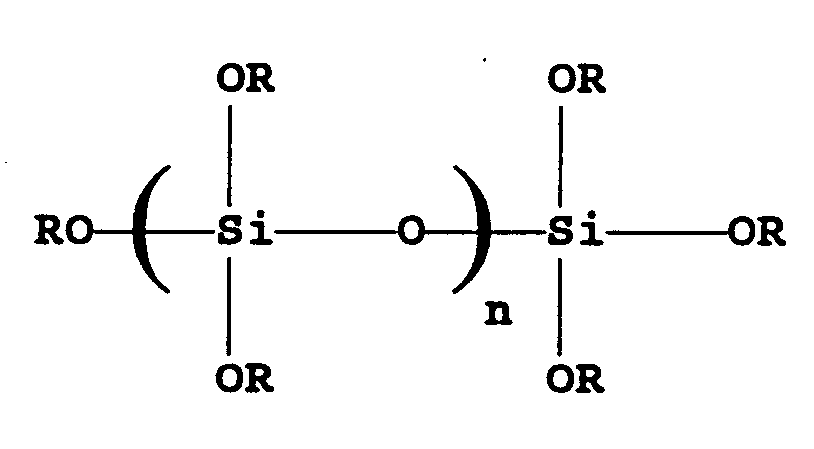
wherein n is an interger of from 0 to 9 and R is an alkyl group and (B) fine silica powder, molding the mixture followed by heating for de-alcoholysis.
wherein n is an interger of from 0 to 9 and R is an alkyl group and (B) fine silica powder, molding the mixture followed by heating for de-alcoholysis.
2. The process according to Claim 1, wherein R is an alkyl group having from 1 to 4 carbon
atoms.
3. The process according to any one of Claims 1 to 2, wherein the fine silica powder
has a surface silanol group density of from 0.1 to 8 groups/100 Ų.
4. The process according to any one of Claims 1 to 3, wherein the fine silica powder
is used in an amount of from 0.2 to 50 parts by weight per part by weight of the alkoxysilane.
5. The process according to any one of Claims 1 to 4, wherein the alkoxysilane and the
fine silica powder are mixed in the presence of a solvent.
6. The process according to any one of Claims 1 to 5, wherein the mixture is adjusted
to have a particle size of at most 150 µm prior to the molding.
7. The process according to any one of Claims 1 to 6, wherein the de-alcoholysis is conducted
by heating at a temperature of from 100 to 300 °C.
8. A process for producing a sintered ceramic product, which comprises sintering the
ceramic preform prepared by the process of any one of Claims 1 to 7.
1. Ein Verfahren zum Herstellen eines keramischen Vorformlings, umfassend das Vermischen
von (A) einem Alkoxysilan der Formel:
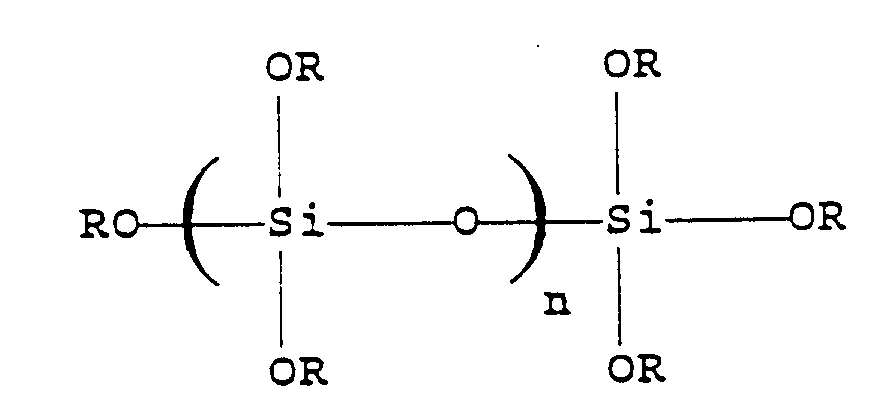
worin n eine ganze Zahl von 0 bis 9 ist und R eine Alkylgruppe ist und (B) feines Siliciumdioxidpulver, Formen der Mischung, gefolgt von einem Erhitzen zur Entalkoholierung.
worin n eine ganze Zahl von 0 bis 9 ist und R eine Alkylgruppe ist und (B) feines Siliciumdioxidpulver, Formen der Mischung, gefolgt von einem Erhitzen zur Entalkoholierung.
2. Das Verfahren nach Anspruch 1, worin R eine Alkylgruppe mit 1 bis 4 Kohlenstoffatomen
ist.
3. Das Verfahren nach einem der Ansprüche 1 bis 2, worin das feine Siliciumdioxidpulver
eine Oberflächendichte an Silanolgruppen von 0,1 bis 8 Gruppen/100 Ų (1 nm²) hat.
4. Das Verfahren nach einem der Ansprüche 1 bis 3, worin das feine Siliciumdioxidpulver
in einer Menge von 0,2 bis 50 Gewichtsteilen pro Gewichtsteil des Alkoxysilans eingesetzt
wird.
5. Das Verfahren nach einem der Ansprüche 1 bis 4, worin das Alkoxysilan und das feine
Siliciumdioxidpulver in Gegenwart eines Lösungsmittels vermischt werden.
6. Das Verfahren nach einem der Ansprüche 1 bis 5, worin die Mischung auf eine Teilchengröße
von höchstens 150 µm vor dem Formen eingestellt wird.
7. Das Verfahren nach einem der Ansprüche 1 bis 6, worin die Entalkoholierung durch Erhitzen
auf eine Temperatur von 100 bis 300°C ausgeführt wird.
8. Ein Verfahren zum Herstellen eines gesinterten Keramikproduktes, umfassend das Sintern
der Keramikvorform, die nach dem Verfahren nach einem der Ansprüche 1 bis 7 hergestellt
ist.
1. Procédé de fabrication d'une préforme céramique, qui comprend le mélange de :
(A) un alcoxysilane représenté par la formule :
dans laquelle :
- n représente un entier de 0 à 9 ; et
- R représente un groupe alkyle ; et
(B) une poudre de silice fine,
le moulage du mélange suivi par un chauffage en vue d'une désalcoolyse.2. Procédé selon la revendication 1, dans lequel R représente un groupe alkyle ayant
1 à 4 atomes de carbone.
3. Procédé selon l'une des revendications 1 et 2, dans lequel la poudre de silice fine
a une densité de groupes silanol de surface de 0,1 à 8 groupes/100 Ų.
4. Procédé selon l'une des revendications 1 à 3, dans lequel la poudre de silice fine
est utilisée dans une quantité de 0,2 à 50 parties en poids par partie en poids de
l'alcoxysilane.
5. Procédé selon l'une des revendications 1 à 4, dans lequel l'alcoxysilane et la poudre
de silice fine sont mélangés en présence d'un solvant.
6. Procédé selon l'une des revendications 1 à 5, dans lequel le mélange est ajusté pour
avoir une dimension de particule d'au plus 150 µm avant le moulage.
7. Procédé selon l'une des revendications 1 à 6, dans lequel la désalcoolyse est conduite
par chauffage à une température de 100 à 300°C.
8. Procédé de fabrication d'un produit céramique fritté, qui comprend le frittage de
la préforme céramique préparée par le procédé tel que défini à l'une des revendications
1 à 7.