| (19) |
 |
|
(11) |
EP 0 331 489 B1 |
| (12) |
EUROPEAN PATENT SPECIFICATION |
| (45) |
Mention of the grant of the patent: |
|
07.07.1993 Bulletin 1993/27 |
| (22) |
Date of filing: 02.03.1989 |
|
|
| (54) |
Acne treatment
Behandlung der Akne
Traitement de l'acné
|
| (84) |
Designated Contracting States: |
|
AT BE CH DE ES FR GB GR IT LI LU NL SE |
| (30) |
Priority: |
03.03.1988 AU 511/88
20.12.1988 AU 2046/88
|
| (43) |
Date of publication of application: |
|
06.09.1989 Bulletin 1989/36 |
| (73) |
Proprietors: |
|
- PARKE DAVIS PTY. LTD.
Caringbah
New South Wales, 2229 (AU)
- SOLTEC RESEARCH PTY. LTD.
Rowville
Victoria 3178 (AU)
|
|
| (72) |
Inventor: |
|
- Tomlinson, Roderick Peter
Glen Waverley
Victoria, 3150 (AU)
|
| (74) |
Representative: Jones, Michael Raymond et al |
|
Haseltine Lake & Co.,
Imperial House,
15-19 Kingsway
London WC2B 6UD
London WC2B 6UD (GB) |
| (56) |
References cited: :
AU-A- 463 216
GB-A- 2 181 349
|
GB-A- 2 018 589
US-A- 3 535 422
|
|
| |
|
|
|
|
| |
|
|
|
Remarks: |
|
The file contains technical information submitted after the application was filed
and not included in this specification |
|
| Note: Within nine months from the publication of the mention of the grant of the European
patent, any person may give notice to the European Patent Office of opposition to
the European patent
granted. Notice of opposition shall be filed in a written reasoned statement. It shall
not be deemed to
have been filed until the opposition fee has been paid. (Art. 99(1) European Patent
Convention).
|
[0001] The present invention resides in a new bacteriacidal composition which is particularly
applicable for use in treatment of acne.
[0002] Acne is caused by bacterial infection.
[0003] In the past, treatment of acne has normally comprised the external application of
solutions, lotions or creams containing benzoyl peroxide or such phenolics as resorcinol.
Although such treatment may be effective in some instances, the high proportion of
instances where external treatment has been largely ineffective has led to the development
of internal treatments, administration of which is liable to cause serious side-effects
and is therefore highly undesirable except in very extreme cases.
[0004] Consequently, it has long been recognised that development of new methods of treating
acne is highly desirable.
[0005] US-A-3535422 is concerned with providing storage stable compositions for the treatment
of acne which contain benzoyl peroxide. This document describes compositions containing
benzoyl peroxide, water and an organic emollient which may be a saturated aliphatic
alcohol, a glycol, a saturated fatty acid, a lower alkyl or glyceryl ester of a fatty
acid or a mixture thereof. The compositions are dermally applied in the form of creams
or ointments.
[0006] It has been found that one of the main reasons for the ineffectiveness of the known
solutions, lotions and creams is that the active constituents do not reach the appropriate
dermal site where treatment is required. Solutions tend to evaporate before penetrating
the epidermis, and lotions and creams are generally too viscous to allow penetration
of the epidermis.
[0007] The present invention ameliorates at least some of the disadvantages of the prior
art.
[0008] According to the present invention, there is provided a bactericidal composition
for use in the external treatment of acne, said composition comprising:
(a) a biocide effective in killing acne bacteria;
(b) a fatty acid;
(c) a quick breaking foaming agent comprising an aliphatic alcohol, water, a fatty
alcohol and a surface active agent; and
(d) an aerosol propellant.
[0009] Such compositions are of low viscosity and are therefore capable of rapid penetration
of the epidermis. Preferred biocides are chosen from the group consisting of parachlorometraxylenol
(PCMX), benzoyl peroxide, triclosan, sulphur and salicylic acid or mixtures thereof.
The preferred fatty acids in the composition of the present invention are linoleic
and/or linolenic acid although mixtures with other fatty acids of this type are also
suitable. Linoleic and/or linolenic acid is preferably present in an amount of 0.5
- 5%w/w, more preferably of 0.82 - 1.25%w/w composition.
[0010] The structure of the composition is improved relative to conventional compositions
as it is capable of forming a quick breaking form, thus reducing the amount of evaporation
on application but at the same time allowing rapid penetration of the epidermis. Quick
breaking foams minimise early evaporation as they are applied to the skin surface
as a thick foam which rapidly disintegrates when spread.
[0011] One preferred composition which forms a quick breaking foam comprises biocide, linoleic
and/or linolenic acid, the quick breaking foam agent and an aerosol propellant. Preferably
a corrosion inhibitor is also included if the composition is to be stored in metal
containers. However, this is not necessary if the container is of non-metal such as
glass or plastic. The biocide is preferably in the composition in an amount between
0.05 and 1% w/w composition. Most preferably the amount is approximately 0.2%w/w.
[0012] Quick breaking foaming agents for producing quick breaking foams are well known.
A general discussion may be found in Australian Patent AU-A-463216. The quick breaking
foaming agent in the composition of the present invention comprises an aliphatic alcohol,
water, a fatty alcohol and a surface active agent. Preferably, the aliphatic alcohol
is aqueous ethanol.
[0013] The quick break foaming agent comprises:
(a) An aliphatic alcohol preferably in amounts from 40-90%w/w composition, more preferably
55-70%w/w and most preferably 60%w/w;
(b) Water preferably in amounts from 10-40%w/w;
(c) A fatty alcohol, preferably in amounts from 0.5-10%w/w; and
(d) A surface active agent preferably an ethoxylated sorbitan ester (as emulsifier)
typically in amounts from 0.1-15% w/w.
[0014] Aerosol propellants for use in the compositions of the present invention should be
carefully selected for their compatability with the entire composition. The most preferred
propellants may be selected from the group comprising propane, butane, dichloro difluoro
methane, dichloro tetra fluoro ethane, and octafluoro cyclo butane. The propellant
is preferably present in amounts from 3 to 30% w/w, more preferably from 5-15%w/w
and most preferably 8 to 10% w/w.
[0015] Preferred corrosion inhibitors for use in the present invention include organic acid
salts such as sorbic acid, benzoic acid, sodium benzoate and potassium sorbate. The
preferred amount of corrosion inhibitor is 0.1 to 15%w/w, more preferably 0.1 to 3%w/w.
[0016] The invention will now be more fully described by way of the following examples.
Example 1.
[0017] The following formulation is a general formulation which may be used as a basis for
more specific formulations thus enabling variation as required for particular circumstances.
| |
%w/w |
| PROPELLANT e.g. propane, butane, dichloro difluoro methane, dichloro tetra fluoro
ethane, octafluoro cyclo butane and mixtures thereof |
3-30 |
| BIOCIDE e.g. parachlorometaxylenol, Benzoyl Peroxide, Triclosan, Sulphur, Salicylic
Acid and mixtures thereof |
0.05-10 |
| FATTY ACID e.g. linoleic and/or linolenic acid |
0.5-5 |
| FATTY ALCOHOL e.g. cetyl, stearyl, lauryl, myristyl, palmityl, and mixtures thereof |
0.5-10 |
| ALIPHATIC ALCOHOL e.g. methyl, ethyl isopropyl, butyl and mixtures thereof |
40-90 |
| WATER |
10-40 |
| POLYOL e.g. glycerol, propylene glycol, sorbitol and low molecular weight polymers
thereof |
1-10 |
| ORGANIC ACID SALT e.g. sorbic acid, benzoic acid |
0.1-15 |
| SURFACE ACTIVE AGENT e.g. ethoxylated sorbitan stearate, palmitate, oleate, nonyl
phenol ethoxylates, fatty alcohol ethoxylates. |
0.1-15 |
[0018] The following examples are particularly preferred embodiments of the present invention.
Example 2.
[0019]
| |
%w/w |
| cetostearyl alcohol B.P. |
1.60 |
| polyoxyethylene sorbitan monostearate N.F. |
0.40 |
| ethanol 95% U.S.P. |
52.50 |
| polyunsaturated fatty acid |
1.85 |
| purified water B.P. |
30.90 |
| sodium hydroxide B.P |
0.25 |
| parachlorometaxylenol |
0.20 |
| sodium benzoate B.P. |
1.20 |
| propylene glycol B.P. |
2.00 |
| fragrance |
0.10 |
| F12/114 (40:60) B.P. |
9.00 |
| |
100.00 |
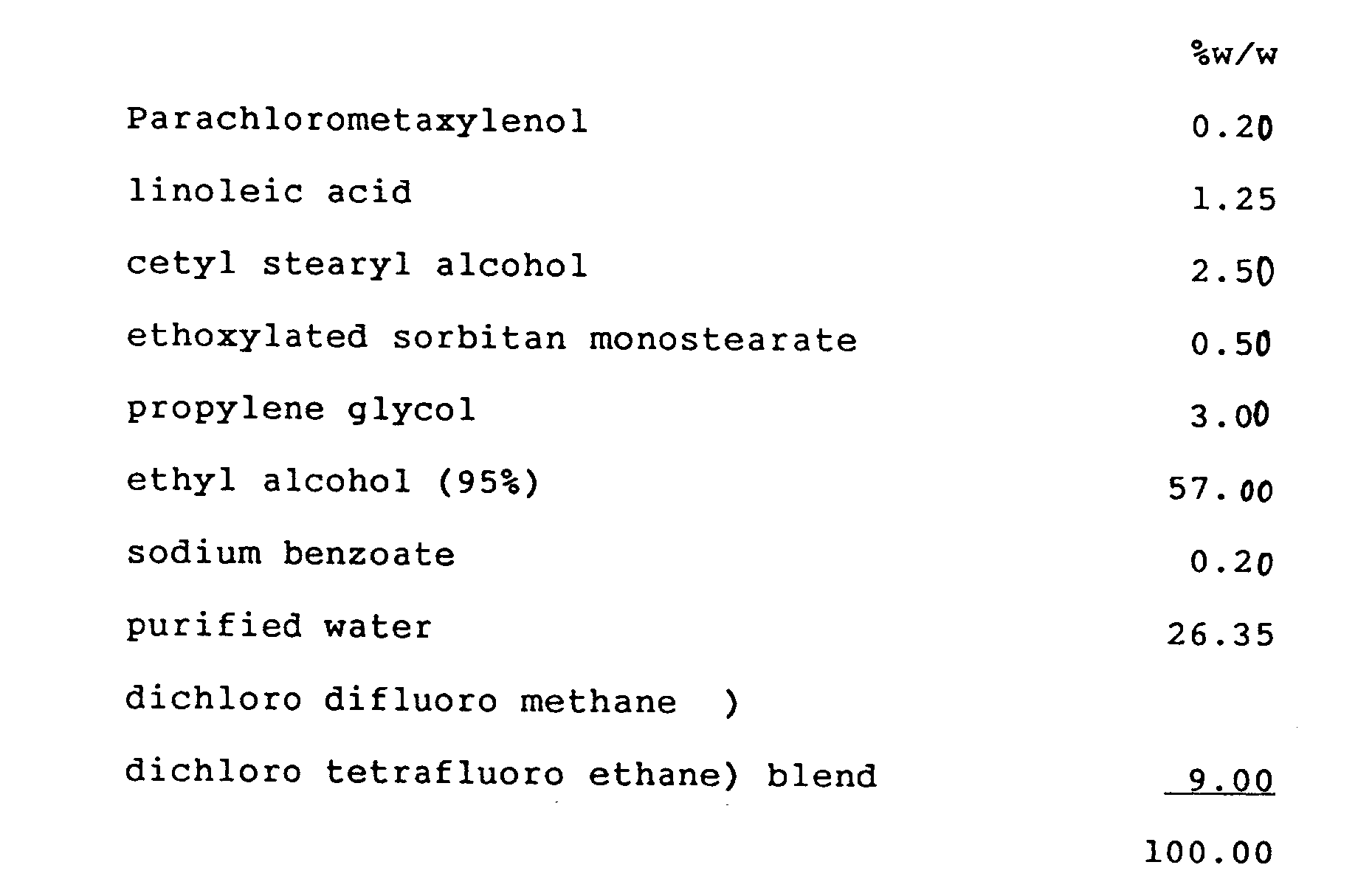
Example 3.
[0020]
Example 4.
[0021]
| |
%w/w |
| Parachlorometaxylenol |
0.18 |
| linolenic acid |
0.82 |
| myristyl alcohol |
3.00 |
| ethoxylated octylalcohol |
0.80 |
| glycerol |
2.5 |
| isopropyl alcohol |
60.0 |
| potassium sorbate |
0.3 |
| purified water |
25.4 |
| butane propane |
7.0 |
| |
100.00 |
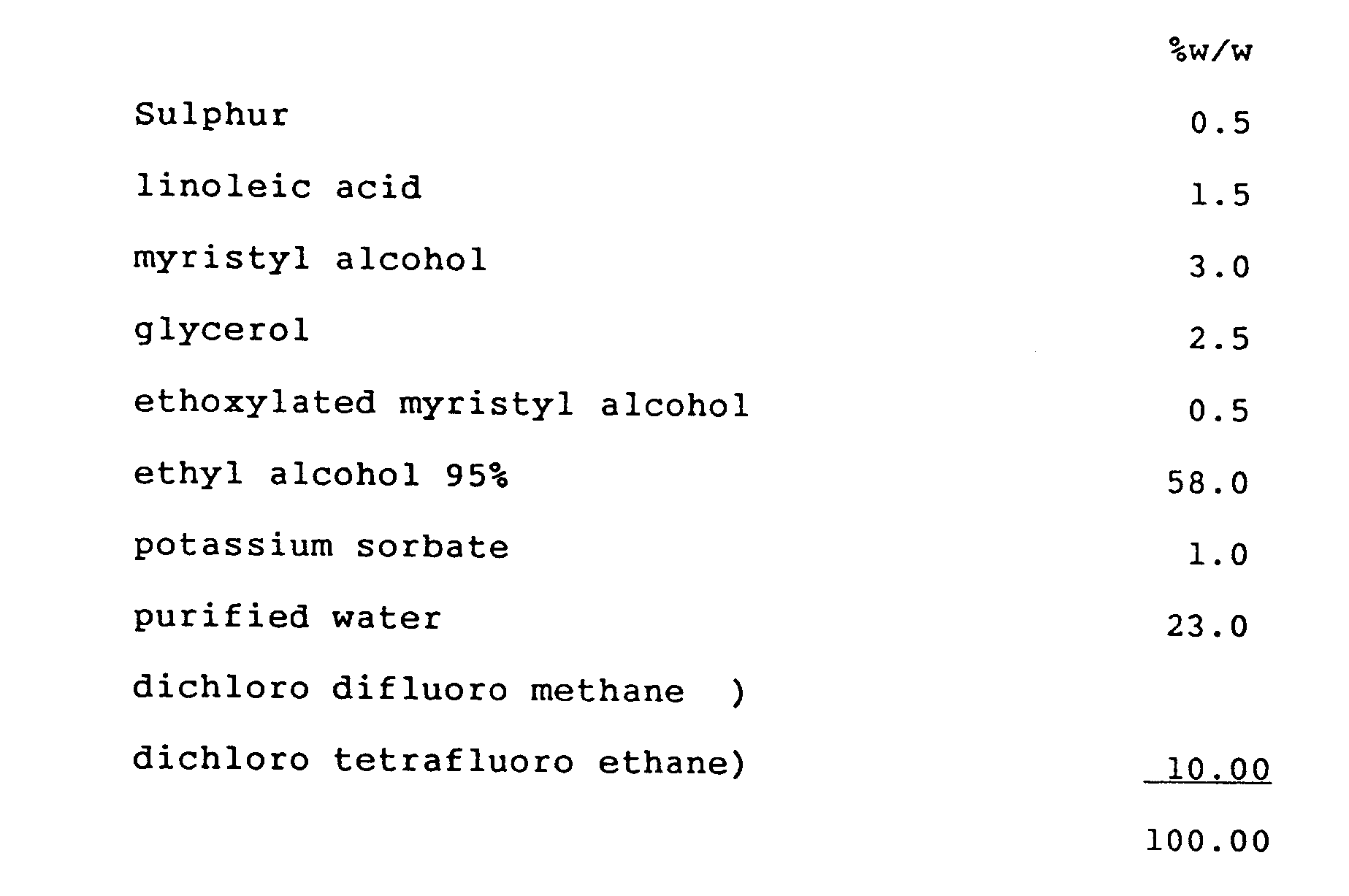
Example 5.
[0022]
Example 6.
[0023]
| |
%w/w |
| cetostearyl alcohol B.P. |
1.60 |
| polyoxyethylene sorbitan monostearate N.F. |
0.40 |
| ethanol 95% U.S.P. |
52.50 |
| polyunsaturated fatty acid |
1.85 |
| purified water B.P. |
30.90 |
| sodium hydroxide B.P |
0.25 |
| salicylic acid |
0.20 |
| sodium benzoate B.P. |
1.20 |
| propylene glycol B.P. |
2.00 |
| fragrance |
0.10 |
| F12/114 (40:60) B.P. |
9.00 |
| |
100.00 |
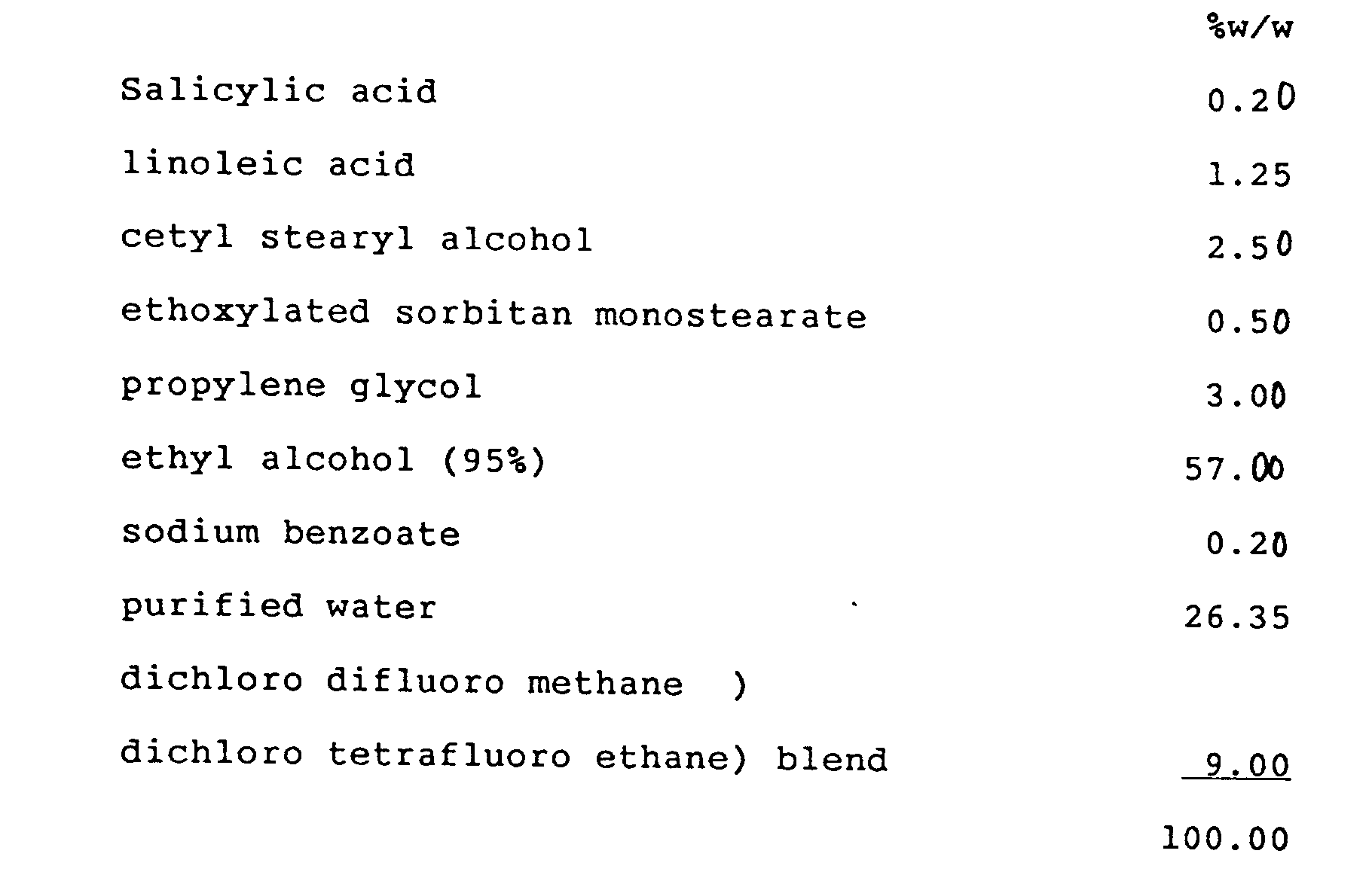
Example 7.
[0024]
Example 8.
[0025]
| |
%w/w |
| Triclosan |
0.18 |
| linolenic acid |
0.82 |
| myristyl alcohol |
3.00 |
| ethoxylated octylalcohol |
0.80 |
| glycerol |
2.50 |
| isopropyl alcohol |
60.00 |
| potassium sorbate |
0.30 |
| purified water |
25.40 |
| butane propane |
7.00 |
| |
100.00 |
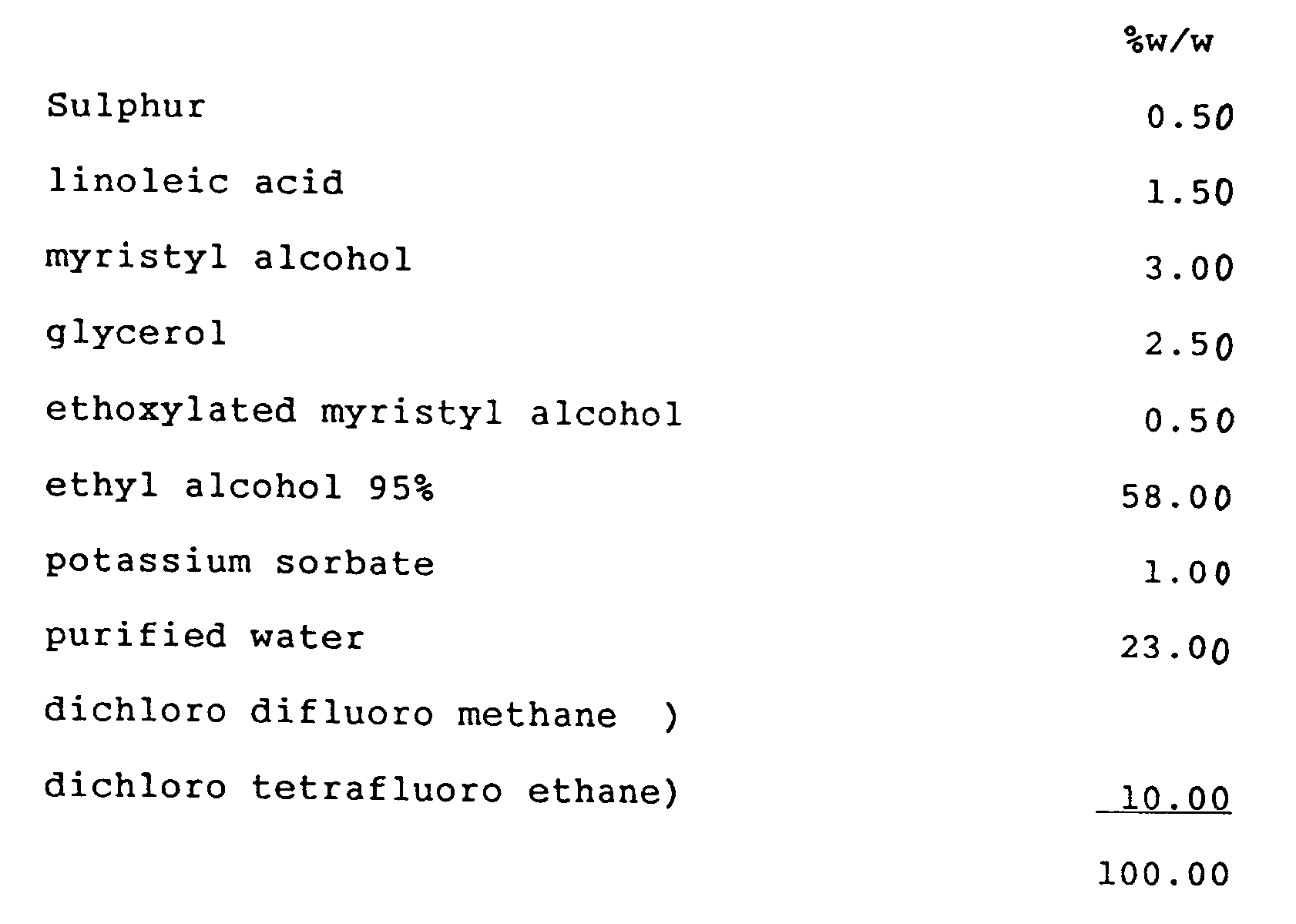
Example 9.
[0026]
Example 10.
[0027]
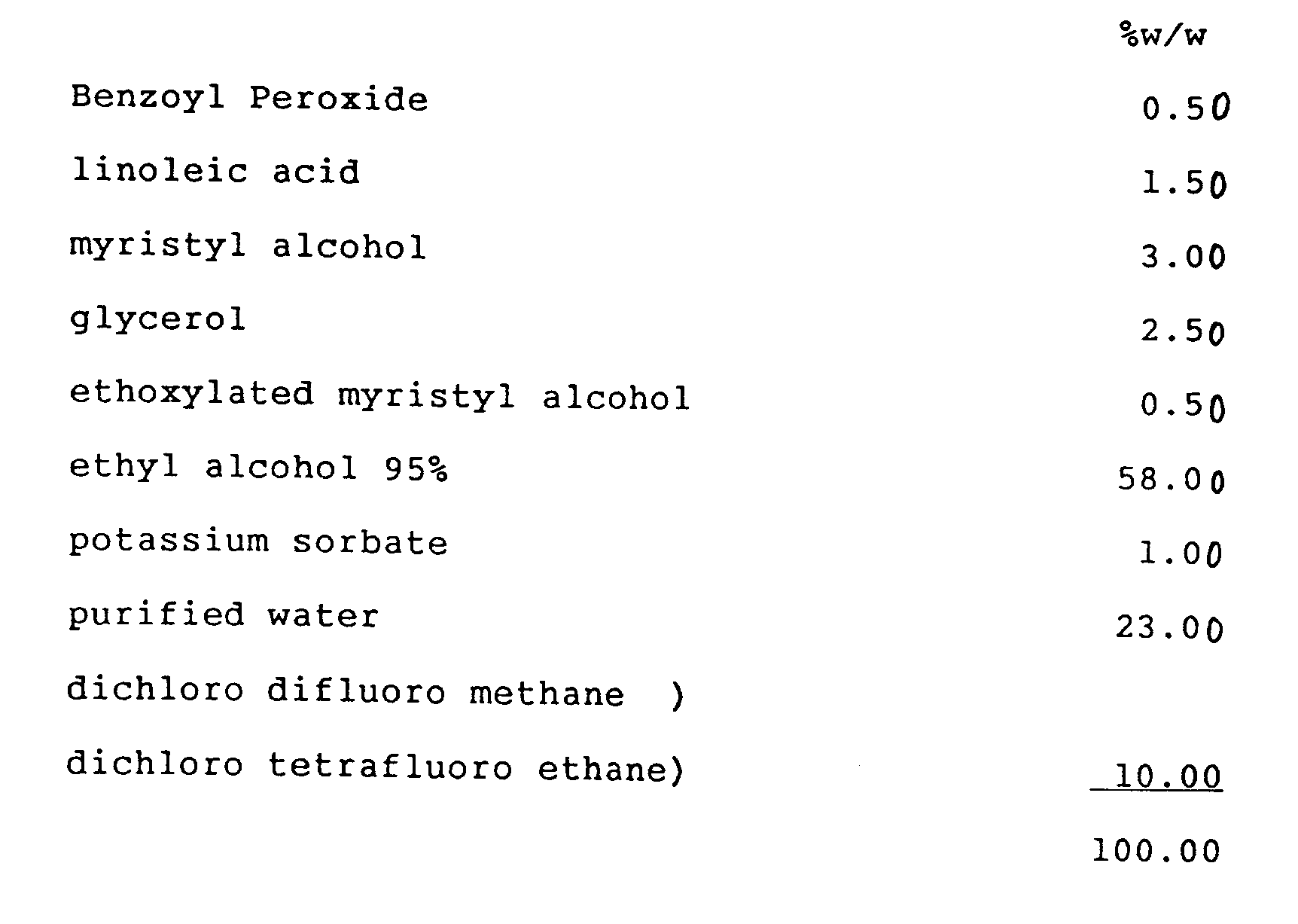
Example 11.
[0028]
| |
%w/w |
| cetostearyl alcohol B.P. |
1.60 |
| polyoxyethylene sorbitan monostearate N.F. |
0.40 |
| ethanol 95% U.S.P. |
53.75 |
| polyunsaturated fatty acid |
1.85 |
| purified water B.P. |
34.65 |
| sodium hydroxide B.P. |
0.25 |
| parachlorometaxylenol |
0.20 |
| sodium benzoate B.P. |
1.20 |
| propylene glycol B.P. |
2.00 |
| fragrance |
0.10 |
| propane/butane |
4.00 |
| |
100.00 |
Example 12.
[0029]
| |
%w/w |
| cetostearyl alcohol B.P. |
2.10 |
| polyoxyethylene sorbitan monostearate N.F. |
0.40 |
| ethanol 95% U.S.P. |
53.40 |
| polyunsaturated fatty acid |
1.85 |
| purified water B.P. |
34.50 |
| sodium hydroxide B.P. |
0.25 |
| parachlorometaxylenol |
0.20 |
| sodium benzoate B.P. |
1.20 |
| propylene glycol B.P. |
2.00 |
| fragance |
0.10 |
| propane/butane |
4.00 |
| |
100.00 |
Claims for the following Contracting State(s): AT, BE, CH, DE, FR, GB, IT, LI, LU,
NL, SE
1. A bactericidal composition for use in the external treatment of acne, said composition
comprising:
(a) a biocide effective in killing acne bacteria;
(b) a fatty acid;
(c) a quick breaking foaming agent comprising an aliphatic alcohol, water, a fatty
alcohol and a surface active agent; and
(d) an aerosol propellant.
2. A composition according to claim 1, wherein the agent comprises from 40 to 90%w/w
of the aliphatic alcohol, from 10% to 40%w/w of water, from 0.5 to 10%w/w of the fatty
alcohol and from 0.1 to 15%w/w of the surface active agent.
3. A composition according to either of the preceding claims, wherein the biocide is
selected from parachlorometaxylenol, benzoyl peroxide, triclosan, sulphur, salicylic
acid, or mixtures thereof.
4. A composition according to any one of the present claims, wherein the fatty acid is
selected from linoleic acid, linolenic acid, or a mixture thereof.
5. A composition according to any one of the present claims, wherein the aliphatic alcohol
is aqueous ethanol.
6. A composition according to any one of the preceding claims, wherein the composition
is in the form of a quick breaking foam.
7. A composition according to any one of the preceding claims, comprising from 0.05 to
10%w/w of a biocide selected from parachlorometaxylenol, benzoyl peroxide, triclosan,
sulphur, salicylic acid or mixtures thereof, from 0.5 to 5.0%w/w of linoleic and/or
linolenic acid, from 24.0 to 95.25%w/w of said quick breaking foaming agent, and from
3 to 30%w/w of an aerosol propellant.
8. A composition according to any one of the preceding claims, which further comprises
a corrosion inhibitor.
9. A composition according to any one of the preceding claims, wherein the biocide is
present in an amount of approximately 0.2%w/w.
10. A composition according to any one of claims 4 to 10, wherein the linoleic and/or
linolenic acid is present in an amount between 0.8 and 1.25%w/w.
11. A composition according to any one of the preceding claims for use in the manufacture
of a medicament for the external treatment of acne.
Claims for the following Contracting State(s): ES, GR
1. A process for the preparation of a bactericidal composition for use in the external
treatment of acne, which process comprises admixing:
(a) a biocide effective in killing acne bacteria;
(b) a fatty acid;
(c) a quick breaking foaming agent comprising an aliphatic alcohol, water, a fatty
alcohol and a surface active agent; and
(d) an aerosol propellant.
2. A process according to claim 1, wherein the quick breaking foaming agent comprises
from 40 to 90%w/w of the aliphatic alcohol, from 10 to 40%w/w of water, from 0.5 to
10%w/w of the fatty alcohol and from 0.1 to 15%w/w of the surface active agent.
3. A process according to either of the preceding claims, wherein the biocide is selected
from parachlorometaxylenol, benzoyl peroxide, triclosan, sulphur, salicylic acid,
or mixtures thereof.
4. A process according to any one of the preceding claims, wherein the fatty acid is
selected from linoleic acid, linolenic acid, or a mixture thereof.
5. A process according to any one of the preceding claims, wherein the aliphatic alcohol
is aqueous ethanol.
6. A process according to any one of the preceding claims, wherein the composition is
formed into a quick breaking foam.
7. A process according to any one of the preceding claims, in which the composition comprises
from 0.05 to 10%w/w of a biocide selected from parachlorometaxylenol, benzoyl peroxide,
triclosan, sulphur, salicylic acid or mixtures thereof, from 0.5 to 5.0%w/w of linoleic
and/or linolenic acid, from 24.0 to 95.25%w/w of said quick breaking foaming agent,
and from 3 to 30%w/w of an aerosol propellant.
8. A process according to any one of the preceding claims, which further comprises admixing
a corrosion inhibitor.
9. A process according to any one of the preceding claims, wherein the biocide is present
in an amount of approximately 0.2%w/w.
10. A process according to any one of claims 4 to 9, wherein the linoleic and/or linolenic
acid is present in an amount between 0.8 and 1.25%w/w.
Patentansprüche für folgende(n) Vertragsstaat(en): AT, BE, CH, DE, FR, GB, IT, LI,
LU, NL, SE
1. Bakterizide Zusammensetzung zur Verwendung bei der äußerlichen Behandlung von Akne,
wobei diese Zusammensetzung enthält: (a) ein zum Abtöten von Aknebakterien wirksames
Biozid; (b) eine Fettsäure; (c) ein schnellbrechendes Schaummittel, umfassend einen
aliphatischen Alkohol, Wasser, einen Fettalkohol und ein oberflächenaktives Mittel;
und (d) ein Aerosoltreibmittel.
2. Zusammensetzung nach Anspruch 1, worin das Mittel 40 bis 90 Gew.-% des aliphatischen
Alkohols, 10 bis 40 Gew.-% Wasser, 0,5 bis 10 Gew.-% des Fettalkohols und 0,1 bis
15 Gew.-% des oberflächenaktiven Mittels umfaßt.
3. Zusammensetzung nach einem der vorhergehenden Ansprüche, worin das Biozid aus Parachlormetaxylenol,
Benzoylperoxid, Triclosan, Schwefel, Salicylsäure oder deren Gemischen ausgewählt
wird.
4. Zusammensetzung nach irgendeinem der vorhergehenden Ansprüche, worin die Fettsäure
aus Linolsäure, Linolensäure oder einem Gemisch davon ausgewählt wird.
5. Zusammensetzung nach irgendeinem der vorhergehenden Ansprüche, worin der aliphatische
Alkohol wäßriges Ethanol ist.
6. Zusammensetzung nach irgendeinem der vorhergehenden Ansprüche, worin die Zusammensetzung
in Form eines schnellbrechenden Schaums vorliegt.
7. Zusammensetzung nach irgendeinem der vorhergehenden Ansprüche, umfassend 0,05 bis
10 Gew.-% eines aus Parachlormetaxylenol, Benzoylperoxid, Triclosan, Schwefel, Salicylsäure
oder deren Gemischen ausgewählten Biozids, 0,5 bis 5,0 Gew.-% Linolsäure und/oder
Linolensäure, 24,0 bis 95,25 Gew.-% des schnellbrechenden Schaummittels und 3 bis
30 Gew.-% eines Aerosoltreibmittels.
8. Zusammensetzung nach irgendeinem der vorhergehenden Ansprüche, welche weiters einen
Korrosionsinhibitor enthält.
9. Zusammensetzung nach irgendeinem der vorhergehenden Ansprüche, worin das Biozid in
einer Menge von ungefähr 0,2 Gew.-% vorliegt.
10. Zusammensetzung nach irgendeinem der Ansprüche 4 bis 9, worin die Linolsäure und/oder
Linolensäure in einer Menge zwischen 0,8 und 1,25 Gew.-% vorliegt.
11. Zusammensetzung nach irgendeinem der vorhergehenden Ansprüche zur Verwendung bei der
Herstellung eines Medikamentes zur äußerlichen Behandlung von Akne.
Patentansprüche für folgende(n) Vertragsstaat(en): ES, GR
1. Verfahren zur Herstellung einer bakteriziden Zusammensetzung zur Verwendung bei der
äußerlichen Behandlung von Akne, wobei dieses Verfahren das Vermischen von (a) einem
zum Abtöten von Aknebakterien wirksamen Biozid; (b) einer Fettsäure; (c) einem schnellbrechenden
Schaummittel, umfassend einen aliphatischen Alkohol, Wasser, einen Fettalkohol und
ein oberflächenaktives Mittel; und (d) einem Aerosoltreibmittel umfaßt.
2. Verfahren nach Anspruch 1, worin das schnellbrechende Schaummittel 40 bis 90 Gew.-%
des aliphatischen Alkohols, 10 bis 40 Gew.-% Wasser, 0,5 bis 10 Gew.-% des Fettalkohols
und 0,1 bis 15 Gew.-% des oberflächenaktiven Mittels umfaßt.
3. Verfahren nach einem der vorhergehenden Ansprüche, worin das Biozid aus Parachlormetaxylenol,
Benzoylperoxid, Triclosan, Schwefel, Salicylsäure oder deren Gemischen ausgewählt
wird.
4. Verfahren nach irgendeinem der vorhergehenden Ansprüche, worin die Fettsäure aus Linolsäure,
Linolensäure oder einem Gemisch davon ausgewählt wird.
5. Verfahren nach irgendeinem der vorhergehenden Ansprüche, worin der aliphatische Alkohol
wäßriges Ethanol ist.
6. Verfahren nach irgendeinem der vorhergehenden Ansprüche, worin die Zusammensetzung
zu einem schnellbrechenden Schaum gebildet wird.
7. Verfahren nach irgendeinem der vorhergehenden Ansprüche, worin die Zusammensetzung
0,05 bis 10 Gew.-% eines aus Parachlormetaxylenol, Benzoylperoxid, Triclosan, Schwefel,
Salicylsäure oder deren Gemischen ausgewählten Biozids, 0,5 bis 5,0 Gew.-% Linolsäure
und/oder Linolensäure, 24,0 bis 95,25 Gew.-% des schnellbrechenden Schaummittels und
3 bis 30 Gew.-% eines Aerosoltreibmittels enthält.
8. Verfahren nach irgendeinem der vorhergehenden Ansprüche, welches weiters das Zumischen
eines Korrosionsinhibitors umfaßt.
9. Verfahren nach irgendeinem der vorhergehenden Ansprüche, worin das Biozid in einer
Menge von ungefähr 0,2 Gew.-% vorliegt.
10. Verfahren nach irgendeinem der Ansprüche 4 bis 9, worin die Linolsäure und/oder Linolensäure
in einer Menge zwischen 0,8 und 1,25 Gew.-% vorliegt.
Revendications pour l'(les) Etat(s) contractant(s) suivant(s): AT, BE, CH, DE, FR,
GB, IT, LI, LU, NL, SE
1. Composition bactéricide à utiliser dans le traitement externe de l'acné, ladite composition
comprenant :
(a) un biocide efficace pour détruire les bactéries de l'acné ;
(b) un acide gras ;
(c) un agent moussant à résolution rapide comprenant un alcool aliphatique, de l'eau,
un alcool gras et un agent tensioactif ; et
(d) un pulseur d'aérosol.
2. Composition selon la revendication 1, dans laquelle l'agent comprend de 40 à 90% p/p
d'alcool aliphatique, de 10% à 40% p/p d'eau, de 0,5 à 10% p/p d'alcool gras et de
0,1 à 15% p/p d'agent tensioactif.
3. Composition selon l'une quelconque des revendications précédentes, dans laquelle le
biocide est sélectionné parmi le parachlorométhaxylénol, le peroxyde de benzoyle,
le triclosan, le soufre, l'acide salicylique ou leurs mélanges.
4. Composition selon l'une quelconque des revendications précédentes, dans laquelle l'acide
gras est sélectionné parmi l'acide linoléique, l'acide linolénique ou leur mélange.
5. Composition selon l'une quelconque des revendications précédentes, dans laquelle l'alcool
aliphatique est de l'éthanol aqueux.
6. Composition selon l'une quelconque des revendications précédentes, dans laquelle la
composition se présente sous la forme d'une mousse à résolution rapide.
7. Composition selon l'une quelconque des revendications précédentes, comprenant de 0,05
à 10% p/p d'un biocide sélectionné parmi le parachlorométaxylénol, le peroxyde de
benzoyle, le triclosan, le soufre, l'acide salicylique ou leurs mélanges, de 0,5 à
5,0% p/p d'acide linoléique et/ou d'acide linolénique, de 24,0 à 95,25% p/p dudit
agent moussant à résolution rapide et de 3 à 30% p/p d'un pulseur d'aérosol.
8. Composition selon l'une quelconque des revendications précédentes, qui comprend en
outre un inhibiteur de corrosion.
9. Composition selon l'une quelconque des revendications précédentes, dans laquelle le
biocide est présent en une quantité approximative de 0,2% p/p.
10. Composition selon l'une quelconque des revendications 4 à 10, dans laquelle l'acide
linoléique et/ou linolénique est présent en une quantité comprise entre 0,8 et 1,25%
p/p.
11. Composition selon l'une quelconque des revendications précédentes, à utiliser dans
la préparation d'un médicament destiné au traitement externe de l'acné.
Revendications pour l'(les) Etat(s) contractant(s) suivant(s): ES, GR
1. Procédé de préparation d'une composition bactéricide à utiliser dans le traitement
externe de l'acné, lequel procédé comprend le mélange de :
(a) un biocide efficace pour détruire les bactéries de l'acné ;
(b) un acide gras ;
(c) un agent moussant à résolution rapide comprenant un alcool aliphatique, de l'eau,
un alcool gras et un agent tensioactif ; et
(d) un pulseur d'aérosol.
2. Procédé selon la revendication 1, dans lequel l'agent moussant à résolution rapide
comprend de 40 à 90% p/p d'alcool aliphatique, de 10 à 40% p/p d'eau, de 0,5 à 10%
p/p d'alcool gras et de 0,1 à 15% p/p d'agent tensioactif.
3. Procédé selon l'une quelconque des revendications précédentes, dans lequel le biocide
est sélectionné parmi le parachlorométaxylénol, le peroxyde de benzoyle, le triclosan,
le soufre, l'acide salicylique ou leurs mélanges.
4. Procédé selon l'une quelconque des revendications précédentes, dans lequel l'acide
gras est sélectionné parmi l'acide linoléique, l'acide linolénique ou leur mélange.
5. Procédé selon l'une quelconque des revendications précédentes, dans lequel l'alcool
aliphatique est de l'éthanol aqueux.
6. Procédé selon l'une quelconque des revendications précédentes, dans lequel la composition
est formée en une mousse à résolution rapide.
7. Procédé selon l'une quelconque des revendications précédentes dans lequel la composition
comprend de 0,05 à 10% p/p d'un biocide sélectionné parmi le parachlorométaxylénol,
le peroxyde de benzoyle, le triclosan, le soufre, l'acide salicylique ou leurs mélanges,
de 0,5 à 5,0% p/p d'acide linoléique et/ou linolénique, de 24,0 à 95,25% p/p dudit
agent moussant à résolution rapide et de 3 à 30% p/p d'un pulseur d'aérosol.
8. Procédé selon l'une quelconque des revendications précédentes, lequel comprend en
outre l'addition d'un inhibiteur de corrosion.
9. Procédé selon l'une quelconque des revendications précédentes, dans lequel le biocide
est présent en une quantité approximative de 0,2% p/p.
10. Procédé selon l'une quelconque des revendications 4 à 9, dans lequel l'acide linoléique
et/ou linolénique est présent en une quantité comprise entre 0,8 et 1,25% p/p.