|
(11) | EP 0 332 334 B1 |

| (12) | EUROPEAN PATENT SPECIFICATION |
|
|
| (54) |
Disperse dyes Dispersionsfarbstoffe Colorants de dispersion |
|
|
|||||||||||||||||||||||||||||||
| Note: Within nine months from the publication of the mention of the grant of the European patent, any person may give notice to the European Patent Office of opposition to the European patent granted. Notice of opposition shall be filed in a written reasoned statement. It shall not be deemed to have been filed until the opposition fee has been paid. (Art. 99(1) European Patent Convention). |
[0001] This invention relates to disperse dyes and more particularly to mixtures of disperse dyes and to methods for their manufacture and use.
[0002] Several methods are known for applying disperse dyes to synthetic textile materials, for example polyethylene terephthalate textile materials which may be in the form of filaments, loose fibres, yarn or woven or knitted fabrics.
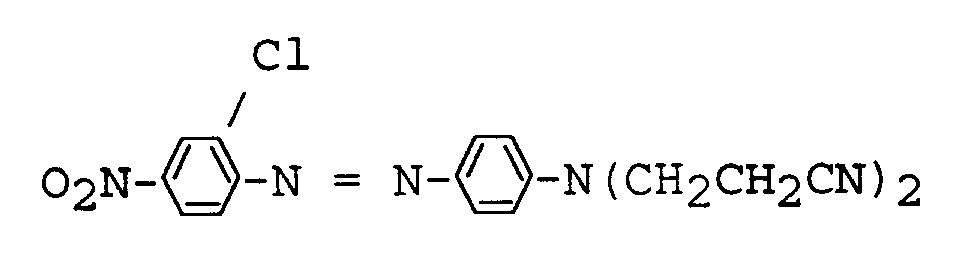
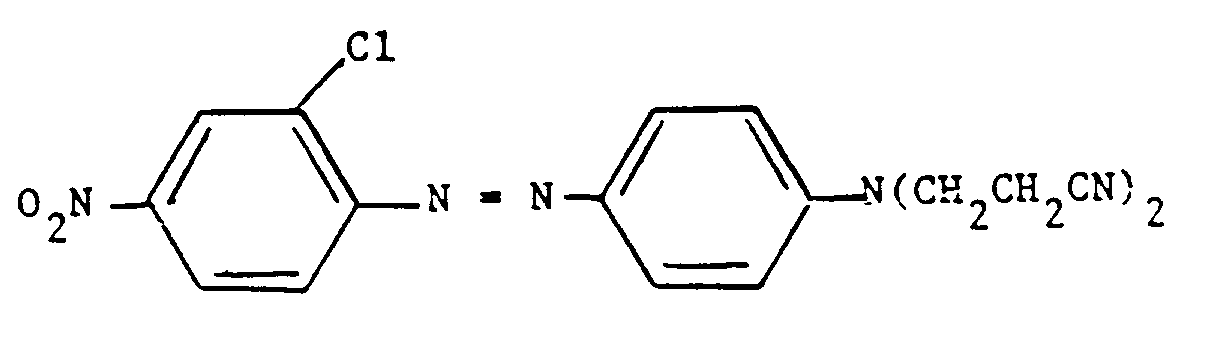
[0003] In one method, known as package dyeing, an aqueous dispersion of dye is circulated through packages of yarn, first in one direction then in the other. When some dyes are applied by this method, it is found that solid dye is deposited on the surface of the textile fibres giving uneven coloration and poor fastness to rubbing. One dye with which this problem is experienced is CI Disperse Orange 44 having the formula:
In an attempt to solve the problem, it has been proposed in United Kingdom Patent Specification No.960752 to use CI Disperse Orange 44 in admixture with a dye of the formula:
Unfortunately, the two dyes differ in shade significantly and, accordingly, when applied to textile materials, the resulting mixture of dyes does not provide the preferred shade.
[0004] It has now been found that the package dyeing performance of CI Disperse Orange 44 and related dyes can be improved with minimal shade change by using the dyes in the form of the mixtures hereinafter defined.
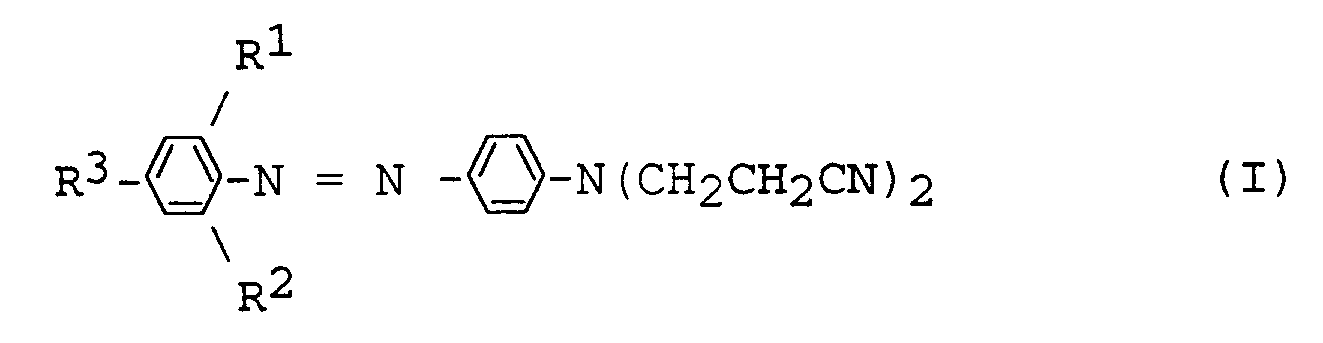
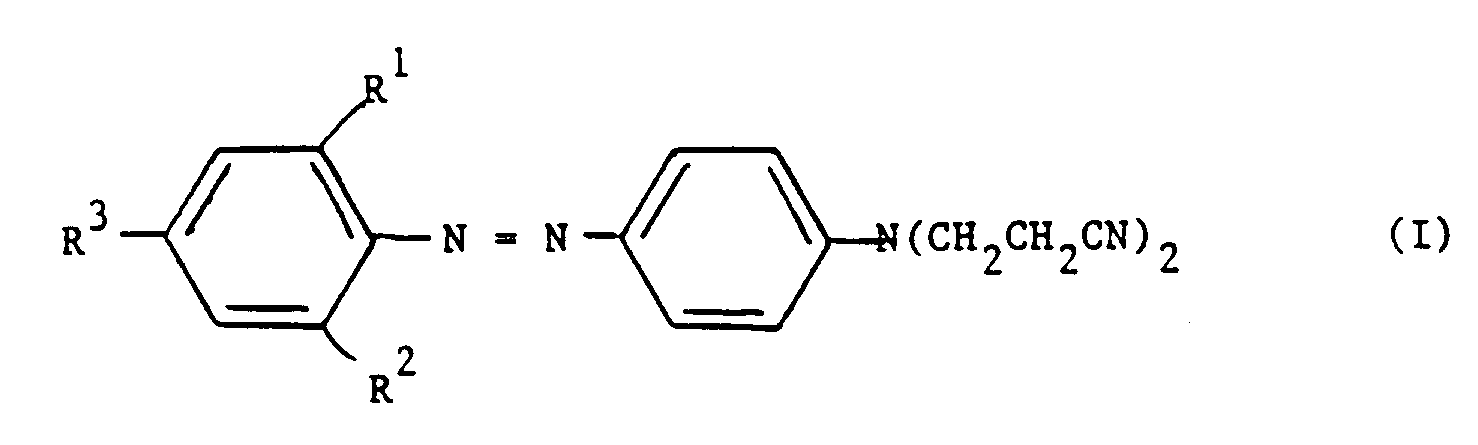
[0005] Thus, according to the invention, there is provided a disperse dye mixture comprising from 85 to95% by weight of a dye of the formula:
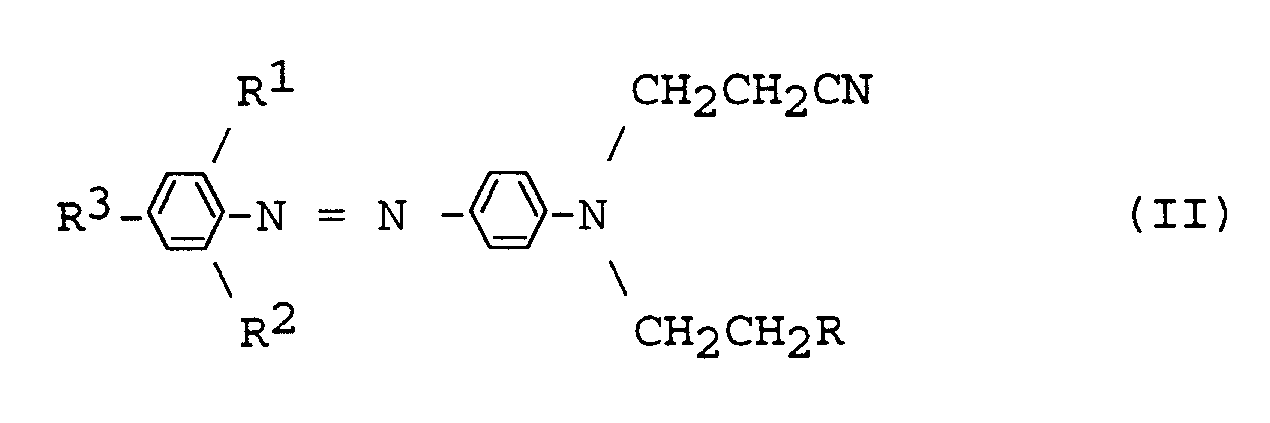
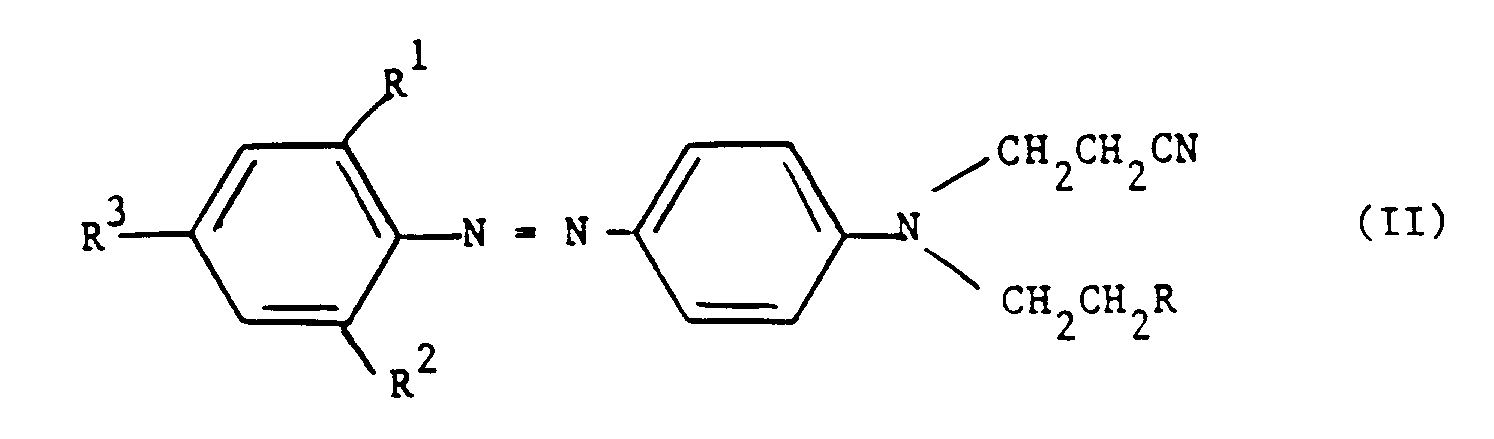
and from 15 to 5% by weight of a dye of the formula:
wherein
R represents -OH or -OCOR⁴ wherein R⁴ represents C₁₋₄-alkyl or C₁₋₄-alkoxy;
each of R¹ and R², independently, represents hydrogen, halogen, C₁₋₄-alkyl or C₁₋₄-alkoxy; and
R³ represents hydrogen, halogen or nitro.
[0006] It is preferred that R¹ is halogen and R² is hydrogen or halogen. It is also preferred that R³ is nitro. R⁴ is preferably methyl.
[0007] In the dyes of Formula I and Formula II, any halogen substituents represented by R¹, R² or R³ are preferably chlorine or bromine.
[0008] The dye mixtures may contain one or more dyes of Formula I together with one or more dyes of Formula II although, in general, the dyeing difficulties referred to above can be substantially eliminated by the use of mixtures containing a single dye of each formula.
[0009] Preferred mixtures contain from 7.5 to 12.5%, especially from 9 to 11%, by weight of the dye or dyes of Formula II, and, correspondingly, from 92.5 to 87.5, especially from 91 to 89%, by weight of a dye or dyes of Formula I.
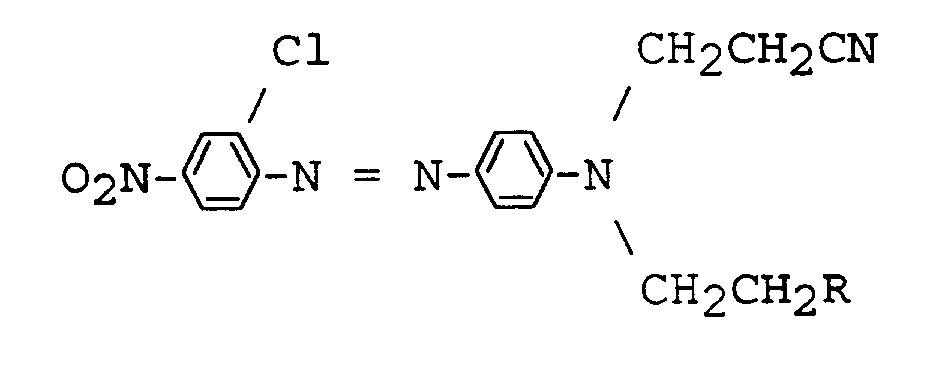
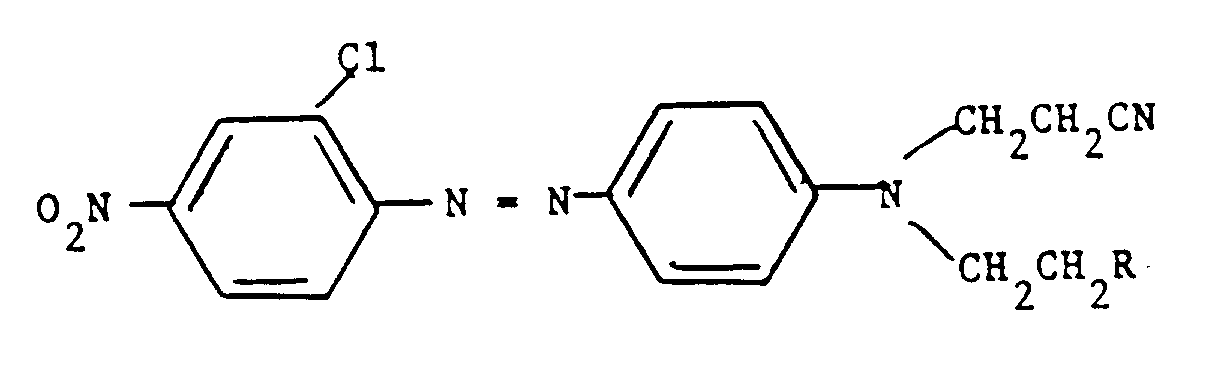
[0010] The mixtures of greatest interest contain CI Disperse Orange 44 together with a dye of the formula:
wherein R is as defined above.
[0011] The mixtures of the invention may be prepared by physically mixing a dye of Formula I and a dye of Formula II, the individual dyes being known. Thus, CI Disperse Orange 44 may be mixed with CI Disperse Red 54 or CI Disperse Red 56, the dyes of Formula III wherein R is -OCOCH₃ and -OH respectively.
[0012] Alternatively, the mixtures may be prepared by diazotising an aromatic amine of the formula:
wherein R¹, R² and R³ have the meanings given above and coupling the resulting diazo compound with a mixture of a coupling component of the formula:
and a coupling component of the formula:
wherein R has the meaning given above, the coupling components being used in such proportions as to give a dye mixture of the desired composition.
[0013] The diazotisation and coupling may be performed using methods conventionally used for these reactants and the mixtures so formed may be isolated using known techniques.
[0014] The dye mixtures may be formulated in known manner, either as liquids suitable for continuous dyeing and printing applications, with dispersing agents, stabilisers and humectants, or as fine powders suitable for high temperature (exhaust) dyeing applications with dispersing agents suitable for this application.
[0015] The mixtures of the invention are valuable for colouring synthetic textile materials, especially secondary cellulose acetate, cellulose triacetate, polyamide such as polyhexamethylene adipamide and, above all, aromatic polyester such as polyethylene terephthalate textile materials. Such materials can be in the form of filaments, loose fibres, yarn or woven or knitted fabrics. The mixtures are also useful for colouring fibre blends containing one or more synthetic fibrous material together with other types of fibre, for example polyester-cotton blends.
[0016] The mixtures are particularly well adapted for application, optionally in conjunction with other disperse dyes, by package dyeing techniques but other conventional dyeing, padding or printing processes may be used if desired, the mixtures being applied as aqueous dispersions, optionally in conjunction with other disperse dyes. The dye mixtures, especially mixtures of CI Disperse Orange 44 and a dye of Formula III provide useful black shades when employed in conjunction with blue dyes such as CI Disperse Blue 79.
Example 1
[0018] 2-chloro-4-nitroaniline (17.4g) is stirred in water (100ml) and concentrated hydrochloric acid (26ml) for 1 hour and the yellow suspension is then cooled to 0°C. A solution of 5N sodium nitrite (20ml) is then added over 5 minutes. After stirring for 1 hour, a complete solution has formed and excess nitrous acid is removed by the addition of sulphamic acid (1.0g) at 0°C. Into this diazo solution are simultaneously added solutions of N,N-bis-2-cyanoethylaniline (18.0g dissolved at 45°C in 100ml of 20% hydrochloric acid) and N-(2-cyanoethyl)-N-(2-acetoxyethyl)aniline (2.4g dissolved in 10ml of 20% hydrochloric acid). The addition is completed in 5 minutes and stirring is continued at 0-5°C for 1 hour. The pH is then raised to 4.0 by the addition of 32% sodium hydroxide solution (70ml) and the thick suspension is heated to 80°C and filtered hot. The filter cake is washed well with hot water and dried at 60°C to yield 30.89g of a dye mixture containing 90% by weight of:
2-chloro-4-nitroaniline → N,N-bis-cyanoethylaniline (CI Disperse Orange 44)
and 10% by weight of
2-chloro-4-nitroaniline → N-cyanoethyl-N-acetoxyethylaniline (CI Disperse Red 54)
Example 2
[0019] Using the procedure described in Example 1, a dye mixture containing 92.5% by weight of CI Disperse Orange 44 and 7.5% by weight of CI Disperse Red 54 is prepared.
[0020] A 300g package of texturised polyester yarn is placed in the Longclose dyeing machine and secured in place by a tightened metal lid. The reservoir of the machine is charged with 7 litres of deionised water followed by 70ml of a 10% solution of a conventional dispersing agent and the circulating pump switched on with the flow direction set for "in-to-out".
[0021] The temperature is then raised to 45°C and 5.2g of disperse dye in 150ml of water are then added to the reservoir and the liquor allowed to circulate for approximately 10 minutes. The pH of the dye liquor is checked and, if necessary, adjusted to 5.0-5.8 by small additions of 10% acetic acid.
[0022] Once the temperature reaches 60°C, the reservoir lid is closed pressurising the dyeing vessel and the temperature is then raised to 130°C. The machine is maintained at the top dyeing temperature of 130°C for 45 minutes, whereupon the pressure is released, the spent dyeing liquor drained away and the package is then rinsed with deionised water at 50°C.
[0023] On completion of the rinsing sequence, the package is removed, hydroextracted and then finally air dried. The level of deposition on the package is then assessed and from experience, it has been found that disperse dyes which give minimal (trace, little) deposit in this test can be safely recommended for package and beam dyeing on the commercial scale.
[0024] The above procedure is carried out using (1) CI Disperse Orange 44 and (2) the dye mixture prepared as described above, the dyes being formulated with a lignosulphonate dispersing agent to contain 37.5% colour.
[0025] Dyeing by the above method at a 25:1 liquor to goods ratio and approximately 2 x standard depth, it is found that CI Disperse Orange 44 gives severe deposition problems such that it can only be successfully recommended up to 1 x standard depth of shade applied, thus severely restricting its usefulness. The dye mixture on the other hand, gives a significantly improved package dyeing performance with minimal deposition (trace) and could be confidently recommended for commercial use up to 2 x standard depth.
Example 3
[0026] 2-chloro-4-nitroaniline (3.48g) is stirred in water (20ml) and concentrated hydrochloric acid (5.2ml) for 1 hour and the yellow suspension is then cooled to 0°C. A solution of 5N sodium nitrite (4ml) is then added over 5 minutes. After stirring for 1 hour, a complete solution has formed and excess nitrous acid is removed by the addition of sulphamic acid (1.0g) at 0°C. Into this diazo solution are simultaneously added solutions of N,N-bis-2-cyanoethylaniline (3.6g dissolved at 45°C in 20ml of 20% hydrochloric acid) and N-(2-cyanoethyl)-N-(2-hydroxyethyl)aniline (0.4g dissolved in 2ml of 20% hydrochloric acid). The addition is completed in 5 minutes and stirring is continued at 0-5°C for 1 hour. The pH is then raised to 4.0 by the addition of 32% sodium hydroxide solution (14ml) and the thick suspension is heated to 80°C and filtered hot. The filter cake is washed well with hot water and dried at 60°C to yield 5.9g of a dye mixture containing 90% by weight of:
2-chloro-4-nitroaniline → N,N-bis-cyanoethylaniline (CI Disperse Orange 44)
and 10% by weight of
2-chloro-4-nitroaniline → N-cyanoethyl-N-hydroxyethylaniline (CI Disperse Red 54)
When this dye mixture is applied to texturised polyester yarn by the method described in Example 2, a significant improvement in package dyeing performance, compared with the use of CI Disperse Orange 44 alone, is again observed.
Example 4
[0027] If the orange mixture prepared in Example 1 is then co-milled in the presence of conventional dispersing agents with CI Disperse Blue 79.1, then black mixtrures with excellent package dyeing performances are obtained.
[0028] For example, a useful black liquid can be prepared by milling 6.3 parts of the orange mixture (Example 1) with 17.2 parts of CI Disperse Blue 79.1 in the presence of a lignosulphonate dispersing agent such that the final product contains 23.5% colour. Dyeing with this liquid on the Longclose by the method outlined previously at 2 x standard depth of shade gives acceptable package dyeing results with minimal deposition. However if the orange component used in the black mixture described above is replaced by CI Disperse Orange 44 then severe deposition problems are encountered such that the resultant mixture cannot be recommended for package or beam dyeing.
Example 5
[0029] A second useful black liquid can be prepared by milling 7.9 parts of the orange mixture (Example 1) with 14.9 parts of CI Disperse Blue 79.1 in the presence of a lignosulphonate dispersing agent such that the final product contains 22.8% colour. Dyeing with this liquid on the Longclose by the method outlined previously at 2 x standard depth of shade gives acceptable package dyeing results with minimal deposition. However if the orange component used in the black mixture described above is replaced by CI Disperse Orange 44 then severe deposition problems are encountered such that the resultant mixture cannot be recommended for package or beam dyeing.
1. A disperse dye mixture comprising from 85 to95% by weight of a dye of the formula:
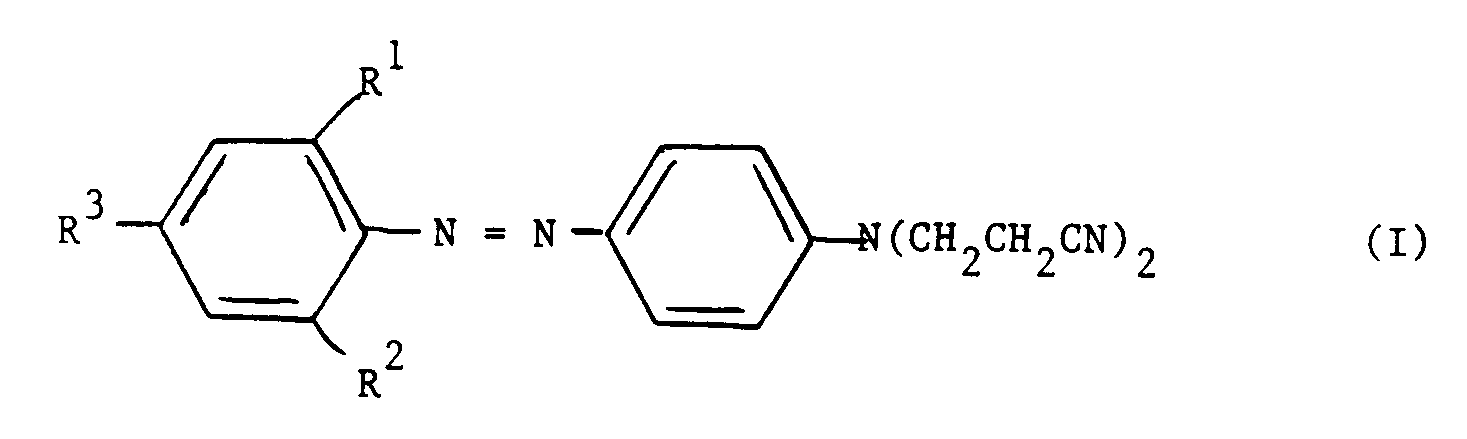
and from 15 to 5% by weight of a dye of the formula:
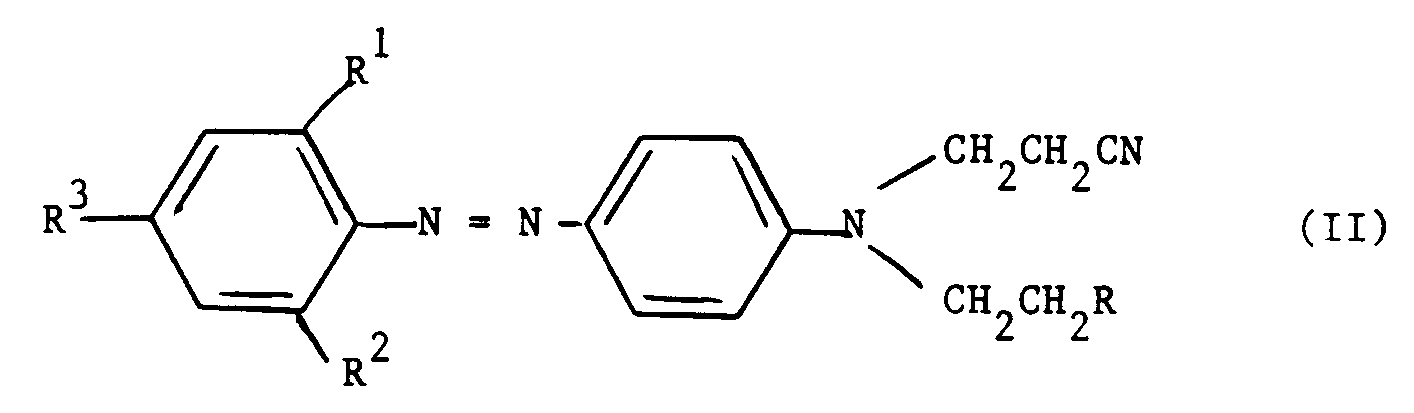
wherein
R represents -OH or -OCOR⁴ wherein R⁴ represents C₁₋₄-alkyl or C₁₋₄-alkoxy;
each of R¹ and R², independently, represents hydrogen, halogen, C₁₋₄-alkyl or C₁₋₄-alkoxy; and
R³ represents hydrogen, halogen or nitro.
and from 15 to 5% by weight of a dye of the formula:
wherein
R represents -OH or -OCOR⁴ wherein R⁴ represents C₁₋₄-alkyl or C₁₋₄-alkoxy;
each of R¹ and R², independently, represents hydrogen, halogen, C₁₋₄-alkyl or C₁₋₄-alkoxy; and
R³ represents hydrogen, halogen or nitro.
2. A disperse dye mixture according to claim1 wherein R¹ is halogen and R² is hydrogen
or halogen.
3. A disperse dye mixture according to claim 2 wherein R³ is nitro.
4. A disperse dye mixture according to any preceding claim wherein R⁴ is methyl.
5. A disperse dye mixture according to any preceding claim containing from 87.5 to 92.5%
by weight of the dye of Formula I and from 12.5 to 7.5% by weight of the dye of Formula
II.
6. A disperse dye mixture according to claim 5 containing from 89 to 91% by weight of
the dye of Formula I and from 9 to 11% by weight of the dye of Formula II.
7. A disperse dye mixture according to any preceding claim wherein the dye of Formula
I has the structure:
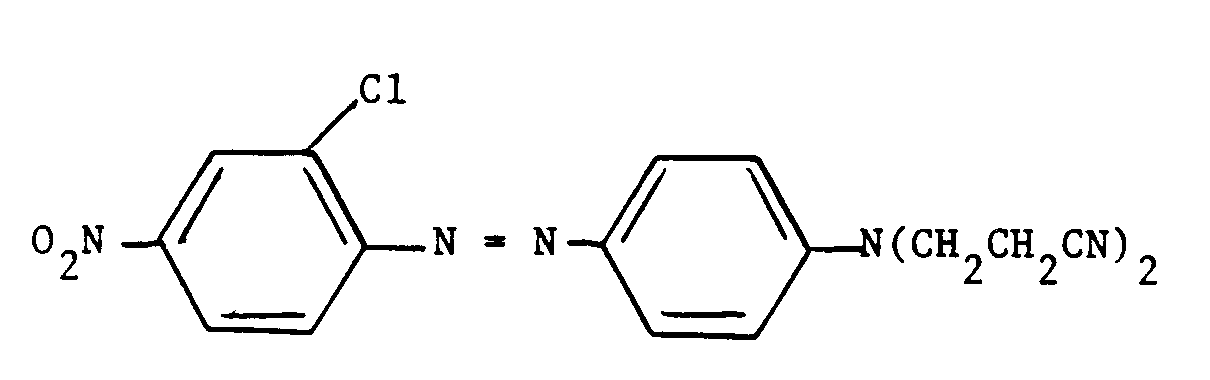
and the dye of Formiula II has the structure:
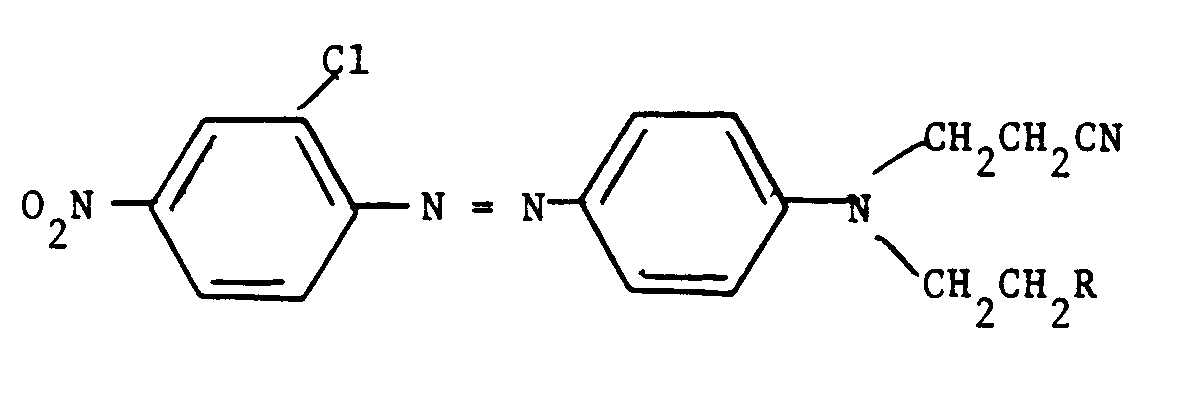
wherein R is as defined in claim 1.
and the dye of Formiula II has the structure:
wherein R is as defined in claim 1.
8. A disperse dye mixture according to claim 7 wherein R is -OCOCH₃ or -OH.
9. A disperse dye composition comprising a disperse dye mixture according to claim 7
or claim 8 and CI Disperse Blue 79.
10. A process for the coloration of synthetic textile materials which comprises applying
thereto by a dyeing, padding or printing technique an aqueous dispersion of a disperse
dye mixture according to any of claims 1 to 8.
11. A process for the coloration of synthetic textile materials which comprises applying
thereto by a dyeing, padding or printing technique an aqueous dispersion of a disperse
dye composition according to claim 9.
12. A process according to claim 10 or claim 11 wherein a package dyeing technique is
used.
13. A process according to any of claims 10 to 12 wherein the synthetic textile material
comprises an aromatic polyester textile material.
1. Dispersionsfarbstoffgemisch, das 85 bis 95 Gew.% eines Farbstoffs mit der folgenden
Formel enthält:
und 15 bis 5 Gew.% eine Farbstoffs mit der Formel:
in der
R für -OH oder -OCOR⁴ steht, wobei R⁴ für C₁₋₄-Alkyl oder C₁₋₄-Alkoxy steht;
R¹ und R² jeweils unabhängig voneinander für Wasserstoff, Halogen, C₁₋₄-Alkyl oder C₁₋₄-Alkoxy stehen; und
R³ für Wasserstoff, Halogen oder Nitro steht.
und 15 bis 5 Gew.% eine Farbstoffs mit der Formel:
in der
R für -OH oder -OCOR⁴ steht, wobei R⁴ für C₁₋₄-Alkyl oder C₁₋₄-Alkoxy steht;
R¹ und R² jeweils unabhängig voneinander für Wasserstoff, Halogen, C₁₋₄-Alkyl oder C₁₋₄-Alkoxy stehen; und
R³ für Wasserstoff, Halogen oder Nitro steht.
2. Dispersionsfarbstoffgemisch nach Anspruch 1, wobei R¹ für Halogen und R² für Wasserstoff
oder Halogen steht.
3. Dispersionsfarbstoffgemisch nach Anspruch 2, wobei R³ für Nitro steht.
4. Dispersionsfarbstoffgemisch nach einem der vorhergehenden Ansprüche, wobei R⁴ für
Methyl steht.
5. Dispersionsfarbstoffgemisch nach einem der vorhergehenden Ansprüche, das 87,5 bis
92,5 Gew.% des Farbstoffs mit der Formel I und 12,5 bis 7,5 Gew.% des Farbstoffs mit
der Formel II enthält.
6. Dispersionsfarbstoffgemisch nach Anspruch 5, das 89 bis 91 Gew.% des Farbstoffs mit
der Formel I und 9 bis 11 Gew.% des Farbstoffs mit der Formel II enthält.
7. Dispersionsfarbstoffgemisch nach einem der vorhergehenden Ansprüche, wobei der Farbstoff
mit der Formel I die folgende Struktur hat:
und der Farbstoff mit der Formel II die folgende Struktur hat:
wobei R wie in Anspruch 1 definiert ist.
und der Farbstoff mit der Formel II die folgende Struktur hat:
wobei R wie in Anspruch 1 definiert ist.
8. Dispersionsfarbstoffgemisch nach Anspruch 7, wobei R für -OCOCH₃ oder -OH steht.
9. Dispersionsfarbstoffzusammensetzung, die ein Dispersionsfarbstoffgemisch nach Anspruch
7 oder Anspruch 8 und CI-Disperse Blue 79 enthält.
10. Verfahren zur Anfärbung von synthetischen Textilmaterialien, bei dem darauf mittels
einer Färbe-, Klotz- oder Drucktechnik eine wäßrige Dispersion eines Dispersionsfarbstoffgemisches
nach einem der Ansprüche 1 bis 8 aufgebracht wird.
11. Verfahren zur Anfärbung von synthetischen Textilmaterialien, bei dem darauf mittels
einer Färbe-, Klotz- oder Drucktechnik eine wäßrige Dispersion einer Dispersionsfarbstoffzusammensetzung
nach Anspruch 9 aufgebracht wird.
12. Verfahren nach Anspruch 10 oder Anspruch 11, wobei eine Packfärbungstechnik verwendet
wird.
13. Verfahren nach einem der Ansprüche 10 bis 12, wobei das synthetische Textilmaterial
ein aromatisches Polyestertextilmaterial enthält.
1. Mélange de colorants dispersés, comprenant 85 à 95 % en poids d'un colorant de formule
et 15 à 5 % en poids d'un colorant de formule :
formules dans lesquelles
R représente un groupe -OH ou -OCOR⁴, où R⁴ est un radical alkyle en C₁ à C₄ ou alkoxy en C₁ à C₄ ;
chacun de R¹ et R² représente, indépendamment, l'hydrogène, un halogène, un groupe alkyle en C₁ à C₄ ou alkoxy en C₁ à C₄ ; et
R³ représente l'hydrogène, un halogène ou un groupe nitro.
et 15 à 5 % en poids d'un colorant de formule :
formules dans lesquelles
R représente un groupe -OH ou -OCOR⁴, où R⁴ est un radical alkyle en C₁ à C₄ ou alkoxy en C₁ à C₄ ;
chacun de R¹ et R² représente, indépendamment, l'hydrogène, un halogène, un groupe alkyle en C₁ à C₄ ou alkoxy en C₁ à C₄ ; et
R³ représente l'hydrogène, un halogène ou un groupe nitro.
2. Mélange de colorants dispersés suivant la revendication 1, dans lequel R¹ est un halogène
et R² est l'hydrogène ou un halogène.
3. Mélange de colorants dispersés suivant la revendication 2, dans lequel R³ est un groupe
nitro.
4. Mélange de colorants dispersés suivant l'une quelconque des revendications précédentes,
dans lequel R⁴ est un groupe méthyle.
5. Mélange de colorants dispersés suivant l'une quelconque des revendications précédentes,
contenant 87,5 à 92,5 % en poids du colorant de formule I et 12,5 à 7,5 % en poids
du colorant de formule II.
6. Mélange de colorants dispersés suivant la revendication 5, contenant 89 à 91 % en
poids du colorant de formule I et 9 à 11 % en poids du colorant de formule II.
7. Mélange de colorants dispersés suivant l'une quelconque des revendications précédentes,
dans lequel le colorant de formule I présente la structure :
et le colorant de formule II présente la structure :
où R est tel que défini dans la revendication 1.
et le colorant de formule II présente la structure :
où R est tel que défini dans la revendication 1.
8. Mélange de colorants dispersés suivant la revendication 7, dans lequel R est un groupe
-OCOCH₃ ou -OH.
9. Composition de colorants dispersés, comprenant un mélange de colorants dispersés suivant
la revendication 7 ou la revendication 8 et du bleu dispersé CI Disperse Blue 79.
10. Procédé de coloration de matières textiles synthétiques, qui comprend l'application
à ces matières, par une technique de teinture, de foulardage ou d'impression, d'une
dispersion aqueuse d'un mélange de colorants dispersés suivant l'une quelconque des
revendications 1 à 8.
11. Procédé de coloration de matières textiles synthétiques, qui comprend l'application
à ces matières, par une technique de teinture, de foulardage ou d'impression, d'une
dispersion aqueuse d'une composition de colorants disperses suivant la revendication
9.
12. Procédé suivant la revendication 10 ou la revendication 11, dans lequel on utilise
une technique de teinture en bobines.
13. Procédé suivant l'une quelconque des revendications 10 à 12, dans lequel la matière
textile synthétique comprend une matière textile à base d'un polyester aromatique.