|
(11) | EP 0 332 641 B1 |

| (12) | EUROPEAN PATENT SPECIFICATION |
|
|
| (54) |
CYCLONE SEPARATOR ZYKLONABSCHEIDEVORRICHTUNG SEPARATEUR A CYCLONE |
|
|
|||||||||||||||||||||||||||||||
| Note: Within nine months from the publication of the mention of the grant of the European patent, any person may give notice to the European Patent Office of opposition to the European patent granted. Notice of opposition shall be filed in a written reasoned statement. It shall not be deemed to have been filed until the opposition fee has been paid. (Art. 99(1) European Patent Convention). |
[0001] This invention relates to a cyclone separator as disclosed in WO-A-86/07548. This separator may find application in removing a lighter phase from a large volume of denser phase such as oil from water, with minimum contamination of the more voluminous phase. Most conventional cyclone separators are designed for the opposite purpose, that is removing a denser phase from a large volume of lighter phase, with minimum contamination of the less voluminous phase. In our case, a typical starting liquid-liquid dispersion would contain under 1% by volume of the lighter (less dense) phase, but it could be more.
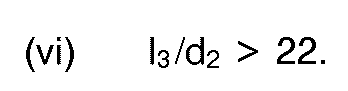
[0002] This invention is based on the observation that when the density difference is small or the droplets of the lighter phase are small (generally less than 25 µ m) more efficient separation can be achieved if there is a restriction to flow through the cyclone a longway downstream of the cyclone.
[0003] According to the present invention there is provided a cyclone separator comprising at least a primary portion having generally the form of a volume of revolution and having a first end and a second end, the diameter at said second end being less than at said first end, at least one inlet, the or each said inlet having at least a tangential component, at or adjacent said first end for introducing feed to be separated into the cyclone separator and the separator further including at least two outlets, one at each end of the primary portion in which cyclone separator the following relationships apply:-
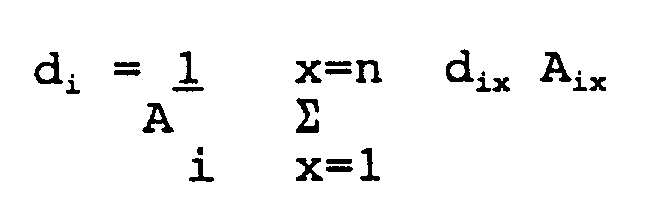
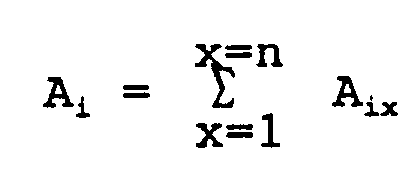
where d₁ is the diameter of the said primary portion where flow enters, preferably in an inlet portion at said first end of said primary portion, (but neglecting any feed channel) dix is twice the radius at which flow enters the cyclone through the xth inlet (i.e. twice the minimum distance of the tangential component of the inlet centre line from the axis) and
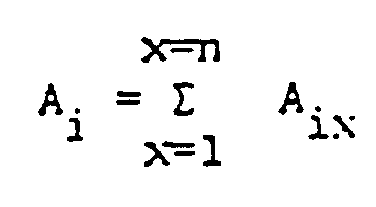
where Aix is the projection of the cross sectional area of xth inlet measured at entry to the cyclone separator in a plane parallel to the axis of the cyclone separator which is normal to the plane, also parallel to the cyclone axis which contains the tangential component of the inlet centre line, and where
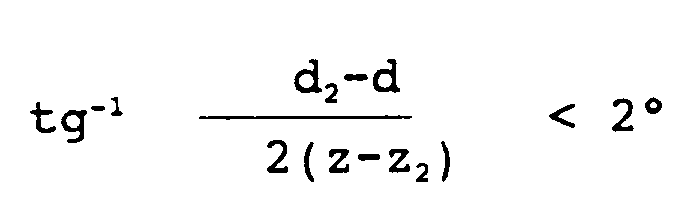
and where d₂ is the diameter of the primary portion measured at a point z₂ where the condition first applies that
for all z > z₂ where z is the distance along the cyclone separator axis downstream of the plane containing the inlet and d is the diameter of the cyclone at z, and further z = 0 being the axial position of the weighted areas of the inlets such that the injection of angular momentum into the cyclone separator is equally distributed axially about said axial position where z = 0 and being defined by
where zx is the axial position of the xth inlet.
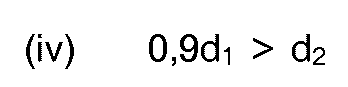
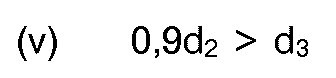
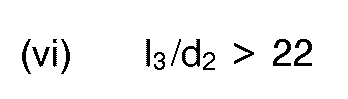
[0004] Moreover in the separator of the invention, the second end of the primary portion feeds into a second portion of constant diameter d₃ and length l₃ and the following further relationships apply:
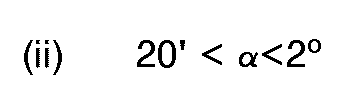
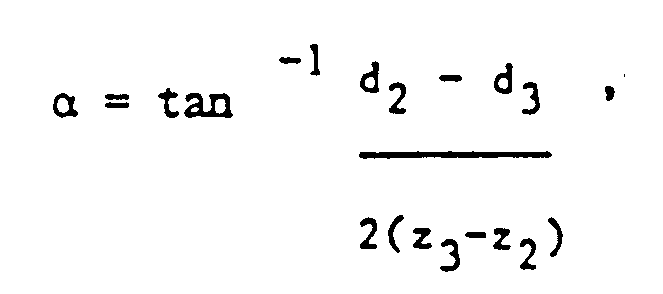
where α is the half angle of the convergence of the separation portion i.e.
where d₃ is the diameter of the second end of the primary portion, at position z₃
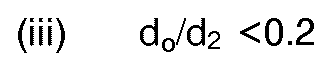
where do is the diameter of the outlet at the first end of the primary portion
The inlet or inlets may be directed tangentially into the primary portion or into an inlet portion or may have an inwardly spiralling feed channel, such as an involute entry. Preferably, where the inlet(s) are directed tangentially there are at least two equally circumferentially spaced inlets.
[0005] A plurality of inlets may be axially staggered along the primary portion or an inlet portion. Moreover the inlet or inlets need not be arranged to feed exactly radially into the separator but may have an axial component to their feed direction.
[0006] Each feed channel may be fed from a duct directed substantially tangentially into the inlet portion, the outer surface of the channel converging to the principal diameter of the inlet portion d₁, for example by substantially equal radial decrements per unit angle around the axis, preferably attaining the diameter d₁ after at least 360o around the axis.
[0007] The expression
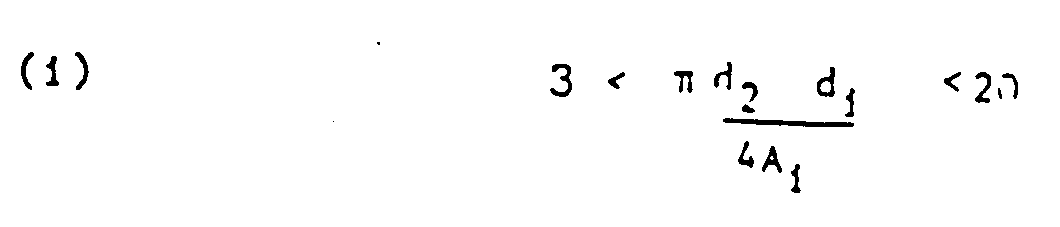
which we call the "swirl coefficient" S, is a reasonable predictor of the ratio of velocities tangentially: axially of flow which has entered the cyclone and which has reached the plane d₂.
[0008] With a dispersed lighter phase, as is of interest to us, in order to be able to create an internal flow structure favourable for separation at a low split ratio
of the order of 1%, the overflow outlet being an outlet at the first end of the primary portion, then the half-angle of convergence averaged over the whole primary portion is 20' to 2°, preferably not more than 1°, more preferably less than 52' preferably at least 30'. S is from 3 to 20, preferably from 4 to 12 and more preferably from 6 to 10.
[0009] The convergence averaged from the diameter d₁ measured in the inlet plane to the diameter d₂ may be the fastest (largest cone half-angle) in the cyclone, and may be from 5° to 45°. (The inlet plane is that plane normal to the cyclone axis including the point z= 0.)
[0010] The inlet portion should be such that the angular momentum of material entering from the inlets is substantially conserved into the primary portion.
[0011] When the separator includes an inlet portion of length l₁ then l ₁ /d₁ may be from 0.5 to 5, preferably from 1 to 4.
[0012] Preferably, d₃/d₂ is less than 0.75 (more preferably less than 0.7) and preferably exceeds 0.25 (more preferably exceeding 0.3). Where the internal length of the downstream outlet portion is l₃, l₃/d₂ is at least 22 and may be as large as desired, such as at least 50. For space reasons it may be desired to curve the second portion gently, and a radius of curvature of the order of 30 d₃ is possible. Gentle curvature of the cyclone axis is also feasible. d₁/d₂ may be from 1.5 to 3. Preferably do/d₂ is at most 0.15 and preferably at least 0.,008,for example from 0.01 to 0.1, Pressure drop in the axial overflow outlet should not be excessive, and therefore the length of the "d₀" portion of the axial overflow outlet should be kept low. The axial overflow outlet may reach its "d₀" diameter instantaneously or by any form of abrupt or smooth transition, and may widen thereafter by a taper or step. The axial distance from the inlet plane to the "do" point is preferably less than 4d₂. The actual magnitude of d₂ is a matter of choice for operating and engineering convenience and may for example be 10 to 100 mm.
[0013] According to the invention, at least part of the generator of the inlet portion or of the primary portion of both may be curved.
[0014] The generator may be, for example, (i) a monotonic curve (having no points of inflexion) steepest at the inlet-portion end and tending to a cone-angle of zero at its open end, or (ii) a curve with one or more points of inflexion but overall converging towards the downstream outlet portion, preferably never diverging towards the downstream outlet portion.
[0015] A curved generator may be for example of an exponential or cubic form in which case it perferably conforms to the formula
[0016] The invention extends to a method of removing a lighter phase from a larger volume of denser phase, comprising applying the phases to the feed of a cyclone separator as set forth above, the phases being at a higher pressure than in the axial overflow outlet and in the downstream end of the downstream outlet portion; in practice, it will generally be found that the pressure out of the downstream outlet portion will exceed that out of the axial overflow outlet.
[0017] This method is particularly envisaged for removing up to 1 part by volume of oil (light phase) from over 19 parts of water (denser phase), such as oil-field production water or sea water which may have become contaminated with oil, as a result of a spillage, shipwreck, oil-rig blow out or routine operations such as bilge-rinsing or oil-rig drilling. The ratio of flow rates: upstream outlet/downstream outlet (and hence the split ratio) has a minimum value for successful separation of the oil, which value is determined by the geometry of the cyclone (especially by the value of do/d₂ but preferably the cyclone is operated above this minimum value, e.g. by back pressure for example provided by valving or flow restriction outside the defined cyclone. Thus preferably the method comprises arranging the split ratio to exceed 1 1/2 (do/d₂)² preferably to exceed 2 (do/d₂)².
[0018] The method further comprises, as a preliminary step, reducing the amount of free gas in the feed such that in the feed to the inlet the volume of any gas is preferably not more than 20%.
[0019] The larger the ratio of do/d₂ the higher can be the content of gas in the mixture to be separated.
[0020] As liquids normally become less viscous when warm, water for example being approximately half as viscous at 50°C as at 20°C, the method is advantageously performed at as high a temperature as convenient. The invention extends to the products of the method (such as concentrated oil, or cleaned water).
[0021] The invention will now be described by way of example with reference to the accompanying drawing which shows, schematically, a cyclone separator according to the invention. The drawing is not to scale.
[0022] A generally cylindrical inlet portion 1 has two identical symmetrically circumferentially-spaced groups of feeds 8 (only one group shown) which are directed tangentially both in the same sense, into the inlet portion 1, and are slightly displaced axially from a wall 11 forming the 'left-hand' end as drawn, although subject to their forming an axisymmetric flow, their disposition and configuration are not critical. Coaxial with the inlet portion 1, and adjacent to it, is a primary portion 2, which opens at its far end into a coaxial generally cylindrical third portion 3. The third portion 3 opens into collection ducting 4. The feeds may be slightly angled towards the primary portion 2 to impart an axial component of velocity, for example by 5° from the normal to the axis.
[0024] In the present cyclone separator, the actual relationships are as follows:
d₁/d₂ = 2. This is a compromise between energy-saving and space-saving considerations, which on their own would lead to ratios of around 3 and 1.5 respectively.
Taper half-angle = 38' (T₂ on Figure).
d₃/d₂ = 0.5 Values of from 0.5 to 4 work well
l₁/d₁ = 1.0. Values of from 0.5 to 4 work well
l₂/d₂ is about 22. The primary portion 2 should not be too long.
[0025] The drawing shows part of the primary portion 2 as cylindrical, for illustration. In our actual example, it tapers over its entire length.
[0026] In accordance with this invention l₃/d₂, is at least 22 and preferably in the range 22 to 50 such as about 30, for best results.
[0027] do/d₂ = 0.04. If this ratio is too large excessive denser phase may overflow with the lighter phase through the axial overflow outlet 10, which is undesirable. If the ratio is too small, minor constituents (such as specks of grease, or bubbles of air released from solution by the reduced pressure in the vortex) can block the overflow outlet 10 and hence cause fragments of the lighter phase to pass out of the 'wrong' end, at collection ducting 4. With these exemplary dimensions, about 1% by volume (could go down to 0.4%) of the material treated in the cyclone separator overflows through the axial overflow outlet 10. (cyclones having do/d₂ of 0.02 and 0.06 have also been tested successfully).
d₂ = 38mm. This is regarded as the 'cyclone diameter' and for many purposes can be anywhere within the range 10-100 mm for example 15-60mm; with excessively large d₂, the energy consumption becomes very large while with too small d₂ unfavourable Reynolds Number effects and excessive shear stresses arise. Cyclones having d₂ = 38mm proved very serviceable.
[0029] The wall 11 is smooth as, in general, irregularities upset the desired flow, patterns within the cyclone. For best performance, all other internal surfaces of the cyclone should also be smooth. However, in the wall 11, a small upstanding circular ridge concentric with the outlet 10 may be provided to assist the flow moving radially inward near the wall, and the outer 'fringe'of the vortex, to recirculate in a generally downstream direction for resorting. The outlet 10 is a cylindrical bore as shown. Where it is replaced by an orifice plate lying flush on the wall 11 and containing a central hole of diameter d₀ leading directly to a relatively large bore, the different flow characteristics appear to have a slightly detrimental though not serious, effect on performance. The outlet 10 may advantageously be divergent in the direction of overflow, with the outlet orifice in the wall 11 having the diameter do and the outlet widening thereafter at a cone half-angle of up to 10o. In this way, a smaller pressure drop is experiencing along the outlet, which must be balanced against the tendency of the illustrated cylindrical bore (cone half-angle of zero) to encourage coalescence of droplets of the lighter phase according to the requirements of the user.
[0030] To separate oil from water (still by way of example), the oil/water mixture is introduced through the feeds at a pressure exceeding that in the ducting 4 or in the axial overflow outlet 10, and at a rate preferably of at least 100 litre/minute. The size, geometry and valving of the pipework leading to the feed 8 are so arranged as to avoid excessive break-up of the droplets (or bubbles) of the lighter phase, for best operation of the cyclone separator. For the same reason (avoidance of droplet break-up), still referring to oil and water, it is preferable for no dispersant to have been added. The feed rate (for best performance) is set at such a level that
with feed rate in m³/s and d₂ in metres. The mixture spirals within the inlet portion 1 and its angular velocity increases as it enters the portion 2. A flow-smoothing taper T₁ of angle to the axis 10o is interposed between the inlet and primary portions and 2. Alternatively worded, 10o is the conicity (half-angle) of the frustrum represented by T₁
[0031] The bulk of the oil separates within an axial vortex in the primary portion 2. The spiralling flow of the water plus remaining oil then enters the third portion 3. The remaining oil separates within a continuation of the axial vortex in the third portion 3. The cleaned water leaves through the collection ducting 4 and may be collected for return to the sea, forexample, or for further cleaning, for example in a similar or identical cyclone or a bank of cyclones in parallel.
[0032] The oil entrained in the vortex moves axially to the axial overflow outlet 10 and may be collected for dumping, storage or further separation, since it will still contain some water. In this case too, the further separation may include a second similar or identical cyclone.
[0033] Values do/d₂ at the lower end of the range are especially advantageous in the case of series operation of the cyclone separators, for example where the 'dense phase' from the first cyclone is treated in a second cyclone. The reduction in the volume of 'light phase' is treated in a third cyclone. The reduction in the volume of 'light phase' at each stage, and hence of the other phase unwantedly carried over with the 'light phase' through the axial overflow outlet 10, is an important advantage, for example in a boat being used to clear an oil spill and having only limited space on board for oil containers; although the top priority is to return impeccably de-oiled seawater to the sea, the vessel's endurance can be maximised if the oil containers are used to contain only oil and not wasted on containing adventitious sea-water.
[0034] An experimental separator constructed in accordance with this invention had the following dimensions:
d₁ 76mm
d₂ 38mm
l₁ 76mm
T₁ (the half angle or taper of the portion of the separator between the inlet and primary portions): 10o
l₂ 850mm
T₂ (the half angle or taper angle of the primary portion)
38°
d₃ 19mm
l₃ 1137mm
The overall length of the separator was 2169mm
do 1.5mm
The separator had two tangentially arranged feed inlets each of diameter such that
The separation efficiency obtained using a separator constructed in accordance with the invention was compared with the efficiency of two separators in which the length l₃ was 340mm and 740 mm respectively i.e. l₃/d₂ is approximately 9 and, 19.5 respectively,and also with a further separator in which l₃/d₂ was approximately 50. The results obtained are given in Fig.2 of the drawings which is a graph showing efficiency of separation (ε) against the ratio l₃/d₂. The tests were carried out using degassed Crude oil from the Forties Oil Field with an inlet drop size of 35µ. The oil concentration in the inlet feed lay between 100 and 710 ppm and the feed rate was 100 litres per minute. The separator was operated at split ratios between 0.2 and 1.7%. The oil concentration in the down stream outlet was reduced to below 75 ppm.
[0035] The graph shows that separation efficiency increases with increasing l₃/d₂ until a plateau region is reached when that ratio becomes about 30 after which little variation in efficiency is obtained. The amount of oil reaching the down stream outlet is reduced by as much as 22% compared with the separator in which the ratio l₃/d₂ is 19.5.
1. A cyclone separator comprising at least a primary portion having generally the form
of a volume of revolution and having a first end and a second end, the diameter at
said second end being less than at said first end, at least one inlet, the or each
said inlet having at least a tangential component at or adjacent said first end for
introducing feed to be separated into cyclone separator and the separator further
including at least two outlets, one at each end of the primary portion in which cyclone
separator the following relationships apply:-
where d₁ is the diameter of the said primary portion where flow enters, preferably in an inlet portion at said first end of said primary portion, (but neglecting any feed channel) dix is twice the radius at which flow enters the cyclone through the xth inlet (i.e. twice the minimum distance of the tangential component of the inlet centre line from the axis) and
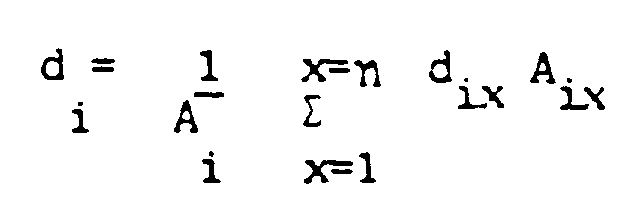
where Aix is the projection of the cross sectional area of xth inlet measured at entry to the cyclone separator in a plane parallel to the axis of the cyclone separator which is normal to the plane, also parallel to the cyclone axis which contains the tangential component of the inlet centre line, and where
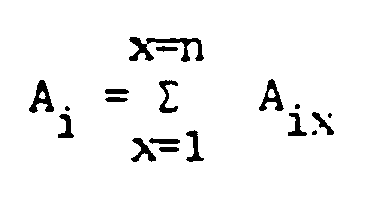
and where d₂ is the diameter of the primary portion measured at a point z₂ where the condition first applies that
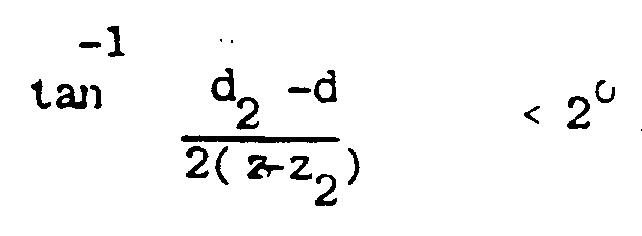
for all z > z₂ where z is the distance along the cyclone separator axis downstream of the plane containing the inlet and d is the diameter of the cyclone at z, and further z = 0 being the axial position of the weighted, areas of the inlets such that the injection of angular momentum into the cyclone separator is equally distributed axially about said axial position where z = 0 and being defined by
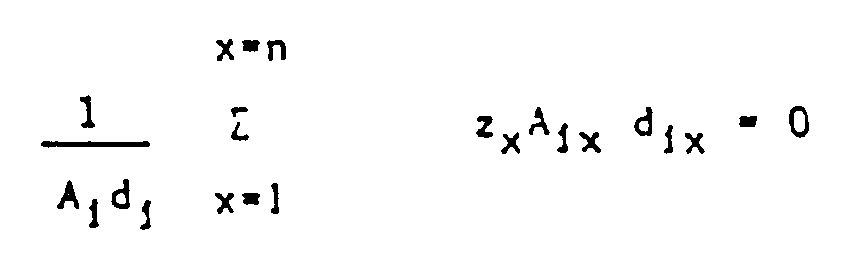
where zx is the axial position of the xth inlet and wherein the second end of the primary portion feeds into a second portion of constant diameter d₃ and length l₃ and the following further relationships apply:
where α is the half angle of the convergence of the separation portion i.e.
where d₃ is the diameter of the second end of the primary portion, at position z₃
where do is the diameter of the outlet at the first end of the primary portion
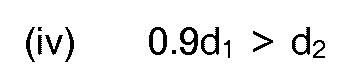
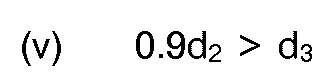
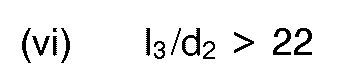
where d₁ is the diameter of the said primary portion where flow enters, preferably in an inlet portion at said first end of said primary portion, (but neglecting any feed channel) dix is twice the radius at which flow enters the cyclone through the xth inlet (i.e. twice the minimum distance of the tangential component of the inlet centre line from the axis) and
where Aix is the projection of the cross sectional area of xth inlet measured at entry to the cyclone separator in a plane parallel to the axis of the cyclone separator which is normal to the plane, also parallel to the cyclone axis which contains the tangential component of the inlet centre line, and where
and where d₂ is the diameter of the primary portion measured at a point z₂ where the condition first applies that
for all z > z₂ where z is the distance along the cyclone separator axis downstream of the plane containing the inlet and d is the diameter of the cyclone at z, and further z = 0 being the axial position of the weighted, areas of the inlets such that the injection of angular momentum into the cyclone separator is equally distributed axially about said axial position where z = 0 and being defined by
where zx is the axial position of the xth inlet and wherein the second end of the primary portion feeds into a second portion of constant diameter d₃ and length l₃ and the following further relationships apply:
where α is the half angle of the convergence of the separation portion i.e.
where d₃ is the diameter of the second end of the primary portion, at position z₃
where do is the diameter of the outlet at the first end of the primary portion
2. A cyclone separator according to claim 1 having an inlet portion at the first end
of the primary portion.
3. A cyclone separator according to claim 1 or claim 2 wherein the inlet or inlets are
directed tangentially or have an inwardly spiralling feed channel.
4. A cyclone separator according to claim 3 having its inlets directed tangentially and
having at least two equally circumferentially spaced inlets.
5. A cyclone separator according to any one of claims 1 to 4 wherein a plurality of inlets
are axially staggered along the separator.
6. A cyclone separator according to any one of claims 1 to 5 wherein the half angle of
convergence averaged over the whole length of the primary portion is between 20' and
2°.
7. A cyclone separator according to claim 6 wherein the half angle of convergence is
less than 52' and at least 30'.
8. A cyclone separator according to anyone of claims 1 to 7 wherein the swirl coefficient
S is from 4 to 12.
9. A cyclone separator according to claim 8 wherein the swirl coefficient S is from 6
to 10.
10. A cyclone separator according to any one of claims 2 to 9 wherein the separator includes
an inlet portion of length l₁ and l₁/d₁ is from 0.5 to 5.
11. A cyclone separator according to any one of claims 1 to 10 wherein d₃/d₂ is less than
0.75 and exceeds 0.25.
12. A cyclone separator according to any one of claims 1 to 11 wherein l₃/d₂ is from 30
to 50.
13. A cyclone separator according to any one of claims 1 to 12 wherein d₁ d₂ is from 1.5
to 3.
14. A cyclone separator according to any one of claims 1 to 13 wherein d₀/d₂ is at most
0.15.
15. A cyclone separator according to claim 14 wherein d₀/d₂ is from 0.01 to 0.1.
16. A cyclone separator according to any one of claims 1 to 15 wherein the axis of the
second portion is curved.
17. A cyclone separator according to anyone of claims 1 to 16 wherein at least a part
of the generator of the primary portion is curved.
18. A cyclone separator according to anyone of claims 1 to 17 wherein the axis of the
cyclone is curved.
19. A method for separating the mixture of liquids to remove a lighter phase from a larger
volume of a denser phase which comprises supplying the mixture as feed to a cyclone
separator according to any one of claims 1 to 18, the mixture being supplied at the
inlet or inlets at a higher pressure than exists in the axial overflow outlet at the
first end of the primary portion and in the underflow outlet at the end of the second
portion.
1. Zyklonabscheider, enthaltend mindestens einen Hauptabschnitt, der im allgemeinen die
Form eines Umdrehungsvolumens hat und ein erstes und zweites Ende aufweist, wobei
der Durchmesser am zweiten Ende kleiner ist als am ersten Ende, wenigstens einen Einlaß,
wobei der bzw. die Einlässe jeweils wenigstens eine Tangentialkomponente am oder benachbart
dem ersten Ende zum Eintragen von Trenngut in den Zyklonabscheider aufweisen, wobei
der Abscheider außerdem wenigstens zwei Auslässe, an jedem Ende des Hauptabschnitts
einen, enthält und für den Zyklonabscheider die folgenden Beziehungen gelten:-
wenn d₁ der Durchmesser des Hauptabschnitts dort ist, wo Strömung eintritt, vorzugsweise in einem Einlaßabschnitt am ersten Ende des Hauptabschnitts (wobei aber alle Zuleitungskanäle vernachlässigt werden), dix das Doppelte des Radius ist, mit dem Strömung in den Zyklon durch den xten Einlaß eintritt (d.h. das Doppelte des Mindestabstands der Tangentialkomponente der Einlaßmittellinie von der Achse) und
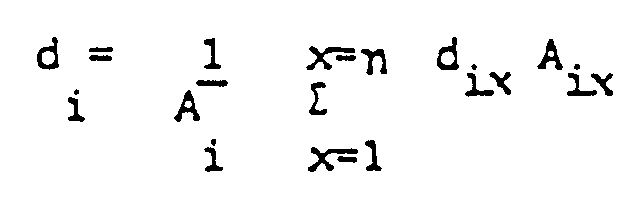
wobei Aix die Projektion der Querschnittsfläche des xten Einlasses ist, gemessen am Eintritt in den Zyklonabscheider in einer Ebene parallel zur Achse des Zyklonabscheiders, die senkrecht zu der Ebene steht, und parallel zu jener Zyklonachse verläuft, die die Tangentialkomponente der Einlaßmittellinie enthält, und wenn
und wenn d₂ der Durchmesser des Hauptabschnitts, gemessen an einem Punkt z₂, ist, wo erstmals gilt, daß
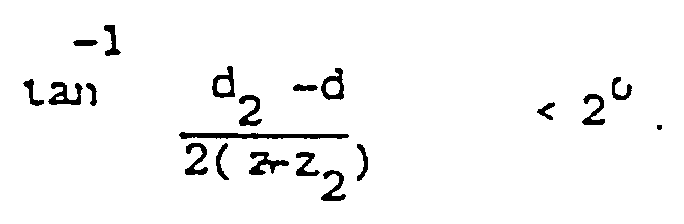
für alle Werte z größer als z₂, wobei z die Entfernung entlang der Zyklonabscheiderachse stromabwärts der den Einlaß enthaltenden Ebene und d der Durchmesser des Zyklons bei z ist und weiterhin z = 0 die axiale Position der gewichteten Flächen der Einlässe mit der Maßgabe ist, daß der Drehmomenteintrag in den Zyklonabscheider um die axiale Position, wo z = 0, gleichmäßig axial verteilt ist und durch
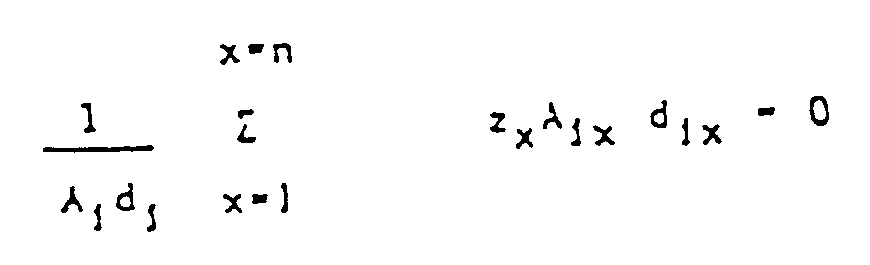
definiert ist, wobei zx die axiale Position des xten Einlasses ist, wobei das zweite Ende des Hauptabschnitts in einen zweiten Abschnitt mit konstantem Durchmesser d₃ und Länge l₃ mündet und die folgenden weiteren Beziehungen gelten:

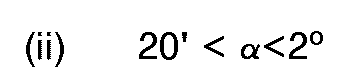
wo α der halbe Konvergenzwinkel des Trennungsabschnittes ist, d.h.
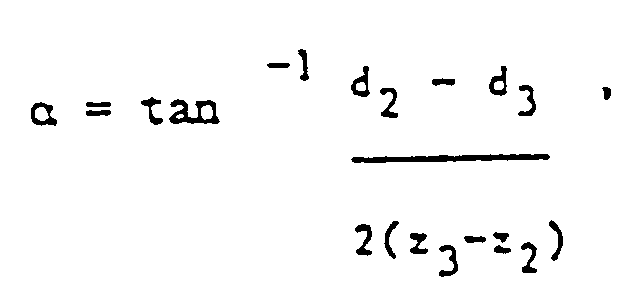
wobei d₃ der Durchmesser des zweiten Endes des Hauptabschnittes bei Position z₃ ist,
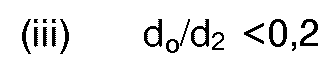
wobei d₀ der Durchmesser des Auslasses am ersten Ende des Hauptabschnitts ist,
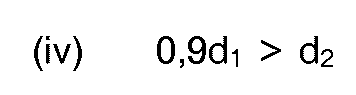
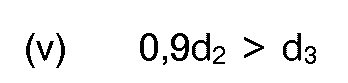
wenn d₁ der Durchmesser des Hauptabschnitts dort ist, wo Strömung eintritt, vorzugsweise in einem Einlaßabschnitt am ersten Ende des Hauptabschnitts (wobei aber alle Zuleitungskanäle vernachlässigt werden), dix das Doppelte des Radius ist, mit dem Strömung in den Zyklon durch den xten Einlaß eintritt (d.h. das Doppelte des Mindestabstands der Tangentialkomponente der Einlaßmittellinie von der Achse) und
wobei Aix die Projektion der Querschnittsfläche des xten Einlasses ist, gemessen am Eintritt in den Zyklonabscheider in einer Ebene parallel zur Achse des Zyklonabscheiders, die senkrecht zu der Ebene steht, und parallel zu jener Zyklonachse verläuft, die die Tangentialkomponente der Einlaßmittellinie enthält, und wenn
und wenn d₂ der Durchmesser des Hauptabschnitts, gemessen an einem Punkt z₂, ist, wo erstmals gilt, daß
für alle Werte z größer als z₂, wobei z die Entfernung entlang der Zyklonabscheiderachse stromabwärts der den Einlaß enthaltenden Ebene und d der Durchmesser des Zyklons bei z ist und weiterhin z = 0 die axiale Position der gewichteten Flächen der Einlässe mit der Maßgabe ist, daß der Drehmomenteintrag in den Zyklonabscheider um die axiale Position, wo z = 0, gleichmäßig axial verteilt ist und durch
definiert ist, wobei zx die axiale Position des xten Einlasses ist, wobei das zweite Ende des Hauptabschnitts in einen zweiten Abschnitt mit konstantem Durchmesser d₃ und Länge l₃ mündet und die folgenden weiteren Beziehungen gelten:
wo α der halbe Konvergenzwinkel des Trennungsabschnittes ist, d.h.
wobei d₃ der Durchmesser des zweiten Endes des Hauptabschnittes bei Position z₃ ist,
wobei d₀ der Durchmesser des Auslasses am ersten Ende des Hauptabschnitts ist,
2. Zyklonabschneider gemäß Anspruch 1 mit einem Einlaßabschnitt am ersten Ende des Hauptabschnitts.
3. Zyklonabschneider gemäß Anspruch 1 oder 2, wobei der Einlaß bzw. die Einlässe tangential
gerichtet ist bzw. sind oder einen sich einwärts schraubenden Zuleitungskanal aufweist
bzw. aufweisen.
4. Zyklonabscheider gemäß Anspruch 3, dessen Einlässe tangential gerichtet sind und der
wenigstens zwei am Umfang gleichmäßig verteilte Einlässe aufweist.
5. Zyklonabschneider gemäß einem der Ansprüche 1 bis 4, wobei mehrere Einlässe entlang
dem Abscheider axial gestaffelt sind.
6. Zyklonabscheider gemäß einem der Ansprüche 1 bis 5, wobei der halbe Konvergenzwinkel,
gemittelt über die Gesamtlänge des Hauptabschnittes, zwischen 20' und 2° liegt.
7. Zyklonabscheider gemäß Anspruch 6, wobei der halbe Konvergenzwinkel weniger als 52'
und mindestens 30' beträgt.
8. Zyklonabscheider gemäß einem der Ansprüche 1 bis 7, wobei die Verwirblungszahl S 4
bis 12 beträgt.
9. Zyklonabscheider gemäß Anspruch 8, wobei die Verwirblungszahl S 6 bis 10 beträgt.
10. Zyklonabscheider gemäß einem der Ansprüche 2 bis 9, wobei der Abscheider einen Einlaßabschnitt
der Länge l₁ enthält und l₁/d₁ 0,5 bis 5 beträgt.
11. Zyklonabscheider gemäß einem der Ansprüche 1 bis 10, wobei d₃/d₂ weniger als 0,75
und mehr als 0,25 beträgt.
12. Zyklonabscheider gemäß einem der Ansprüche 1 bis 11, wobei l₃/d₂ 30 bis 50 beträgt.
13. Zyklonabscheider gemäß einem der Ansprüche 1 bis 12, wobei d₁ d₂ 1,5 bis 3 beträgt.
14. Zyklonabscheider gemäß einem der Ansprüche 1 bis 13, wobei d₀/d₂ höchstens 0,15 beträgt.
15. Zyklonabscheider gemäß Anspruch 14, wobei d₀/d₂ 0,01 bis 0,1 beträgt.
16. Zyklonabscheider gemäß einem der Ansprüche 1 bis 15, wobei die Achse des zweiten Abschnitts
gekrümmt ist.
17. Zyklonabscheider gemäß einem der Ansprüche 1 bis 16, wobei wenigstens ein Teil der
Erzeugenden des Hauptabschnitts gekrümmt ist.
18. Zyklonabscheider gemäß einem der Ansprüche 1 bis 17, wobei die Achse des Zyklons gekrümmt
ist.
19. Verfahren zur Trennung des Flüssigkeitsgemisches zur Entfernung einer leichteren Phase
aus einem größerem Volumen einer dichteren Phase, wonach die Mischung als Einsatzstoff
einem Zyklonabscheider gemäß einem der Ansprüche 1 bis 18 zugeführt wird, wobei die
Mischung am Einlaß oder an den Einlässen unter einem Druck zugeführt wird, der höher
ist als jene Drücke, die im axialen Überlaufauslaß am ersten Ende des Hauptabschnitts
und im Unterlaufauslaß am Ende des zweiten Abschnitts herrschen.
1. Séparateur cyclone comprenant au moins une partie principale ayant d'une manière générale
la forme d'un volume de révolution et comportant une première et une seconde extrémité,
le diamètre de la seconde extrémité étant inférieur à celui de la première extrémité,
au moins une entrée, l'entrée ou chaque entrée comportant au moins une composante
tangentielle au niveau de la première extrémité ou à proximité de celle-ci pour l'introduction
d'une alimentation à séparer dans le séparateur cyclone et le séparateur comprenant,
en outre, au moins deux sorties, une à chaque extrémité de la partie principale, étant
entendu que dans le séparateur cyclone les relations suivantes sont d'application
: où d₁ est le diamètre de la partie principale où le flux pénètre, de préférence
dans une partie d'entrée située à la première extrémité de la partie principale, (mais
en négligeant tout canal d'alimentation) dix vaut le double du rayon auquel le flux pénètre dans le cyclone par la xième entrée
(c'est-à-dire deux fois la distance minimale séparant la composante tangentielle de
la ligne centrale de l'entrée par rapport à l'axe), et
où Aix est la projection de l'aire en coupe transversale de la xième entrée mesurée à l'entrée du séparateur cyclone dans un plan parallèle à l'axe du séparateur cyclone qui est perpendiculaire au plan, également parallèle à l'axe du cyclone qui contient la composante tangentielle de la ligne centrale de l'entrée, et où
et où d₂ est le diamètre de la partie principale mesurée à un point z₂ où s'applique tout d'abord la condition que:
pour tous les z > z₂ où z est la distance le long de l'axe du séparateur cyclone vers l'aval du plan passant par l'entrée et d est le diamètre du cyclone en z, et, en outre, z = 0 étant la position axiale des aires pondérées des entrées, de telle sorte que l'injection d'un moment angulaire dans le séparateur cyclone soit répartie de manière égale dans le sens axial autour de ladite position axiale où z = 0 et étant défini par :
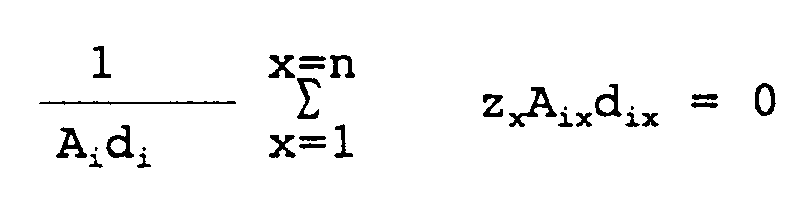
où zx est la position axiale de la xième entrée et la seconde extrémité de la partie principale débite dans une seconde partie de diamètre constant d₃ et de longueur l₃ et les autres relations suivantes sont d'application :

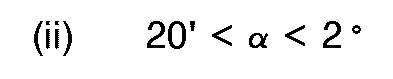
où α est le demi-angle de la convergence de la partie de séparation, c'est-à-dire :
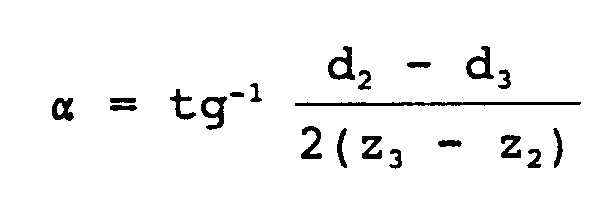
où d₃ est le diamètre de la seconde extrémité de la partie principale, à la position z₃ :
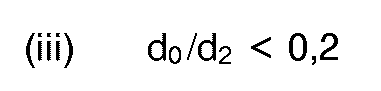
où d₀ est le diamètre de la sortie à la première extrémité de la partie principale :
où Aix est la projection de l'aire en coupe transversale de la xième entrée mesurée à l'entrée du séparateur cyclone dans un plan parallèle à l'axe du séparateur cyclone qui est perpendiculaire au plan, également parallèle à l'axe du cyclone qui contient la composante tangentielle de la ligne centrale de l'entrée, et où
et où d₂ est le diamètre de la partie principale mesurée à un point z₂ où s'applique tout d'abord la condition que:
pour tous les z > z₂ où z est la distance le long de l'axe du séparateur cyclone vers l'aval du plan passant par l'entrée et d est le diamètre du cyclone en z, et, en outre, z = 0 étant la position axiale des aires pondérées des entrées, de telle sorte que l'injection d'un moment angulaire dans le séparateur cyclone soit répartie de manière égale dans le sens axial autour de ladite position axiale où z = 0 et étant défini par :
où zx est la position axiale de la xième entrée et la seconde extrémité de la partie principale débite dans une seconde partie de diamètre constant d₃ et de longueur l₃ et les autres relations suivantes sont d'application :
où α est le demi-angle de la convergence de la partie de séparation, c'est-à-dire :
où d₃ est le diamètre de la seconde extrémité de la partie principale, à la position z₃ :
où d₀ est le diamètre de la sortie à la première extrémité de la partie principale :
2. Séparateur cyclone suivant la revendication 1, comportant une partie d'entrée à la
première extrémité de la partie principale.
3. Séparateur cyclone suivant la revendication 1 ou 2, dans lequel la ou les entrées
sont dirigées tangentiellement ou comportent un canal d'alimentation s'enroulant en
spirale vers l'intérieur.
4. Séparateur cyclone suivant la revendication 3 dont les entrées sont dirigées tangentiellement
et qui comporte au moins deux entrées également espacées dans le sens circonférentiel.
5. Séparateur cyclone suivant l'une quelconque des revendications 1 à 4, dans lequel
plusieurs entrées sont décalées en quinconce axialement le long du séparateur.
6. Séparateur cyclone suivant l'une quelconque des revendications 1 à 5, dans lequel
le demi-angle de convergence calculé en moyenne sur toute la longueur de la partie
principale est compris entre 20' et 2°.
7. Séparateur cyclone suivant la revendication 6, dans lequel le demi-angle de convergence
est inférieur à 52' et vaut au moins 30'.
8. Séparateur cyclone suivant l'une quelconque des revendications 1 à 7, dans lequel
le coefficient de tournoiement S est compris entre 4 et 12.
9. Séparateur cyclone suivant la revendication 8, dans lequel le coefficient de tourbillonnement
S est compris entre 6 et 10.
10. Séparateur cyclone suivant l'une quelconque des revendications 2 à 9, dans lequel
le séparateur comprend une partie d'entrée de longueur l₁ et l₁/d₁ est compris entre
0,5 et 5.
11. Séparateur cyclone suivant l'une quelconque des revendications 1 à 10, dans lequel
d₃/d₂ est inférieur à 0,75 et supérieur à 0,25.
12. Séparateur cyclone suivant l'une quelconque des revendications 1 à 11, dans lequel
l₃/d₂ est compris entre 30 et 50.
13. Séparateur cyclone suivant l'une quelconque des revendications 1 à 12, dans lequel
d₁/d₂ est compris entre 1,5 et 3.
14. Séparateur cyclone suivant l'une quelconque des revendications 1 à 13, dans lequel
d₀/d₂ est tout au plus de 0,15.
15. Séparateur cyclone suivant la revendication 14, dans lequel d₀/d₂ est compris entre
0,01 et 0,1.
16. Séparateur cyclone suivant l'une quelconque des revendications 1 à 15, dans lequel
l'axe de la seconde partie est courbe.
17. Séparateur cyclone suivant l'une quelconque des revendications 1 à 16, dans lequel
au moins une partie du générateur de la partie principale est courbe.
18. Séparateur cyclone suivant l'une quelconque des revendications 1 à 17, dans lequel
l'axe du cyclone est courbe.
19. Procédé pour séparer le mélange de liquides en vue d'éliminer une phase plus légère
d'un volume plus important d'une phase plus dense selon lequel on fournit le mélange
à titre d'alimentation à un séparateur cyclone suivant l'une quelconque des revendications
1 à 18, le mélange étant fourni à l'entrée ou aux entrées à une pression supérieure
à celle qui existe dans la sortie de surécoulement axiale à la première extrémité
de la partie principale et dans la sortie de sous-écoulement à l'extrémité de la seconde
partie.