| (19) |
 |
|
(11) |
EP 0 334 885 B1 |
| (12) |
EUROPEAN PATENT SPECIFICATION |
| (45) |
Mention of the grant of the patent: |
|
10.06.1992 Bulletin 1992/24 |
| (22) |
Date of filing: 02.12.1987 |
|
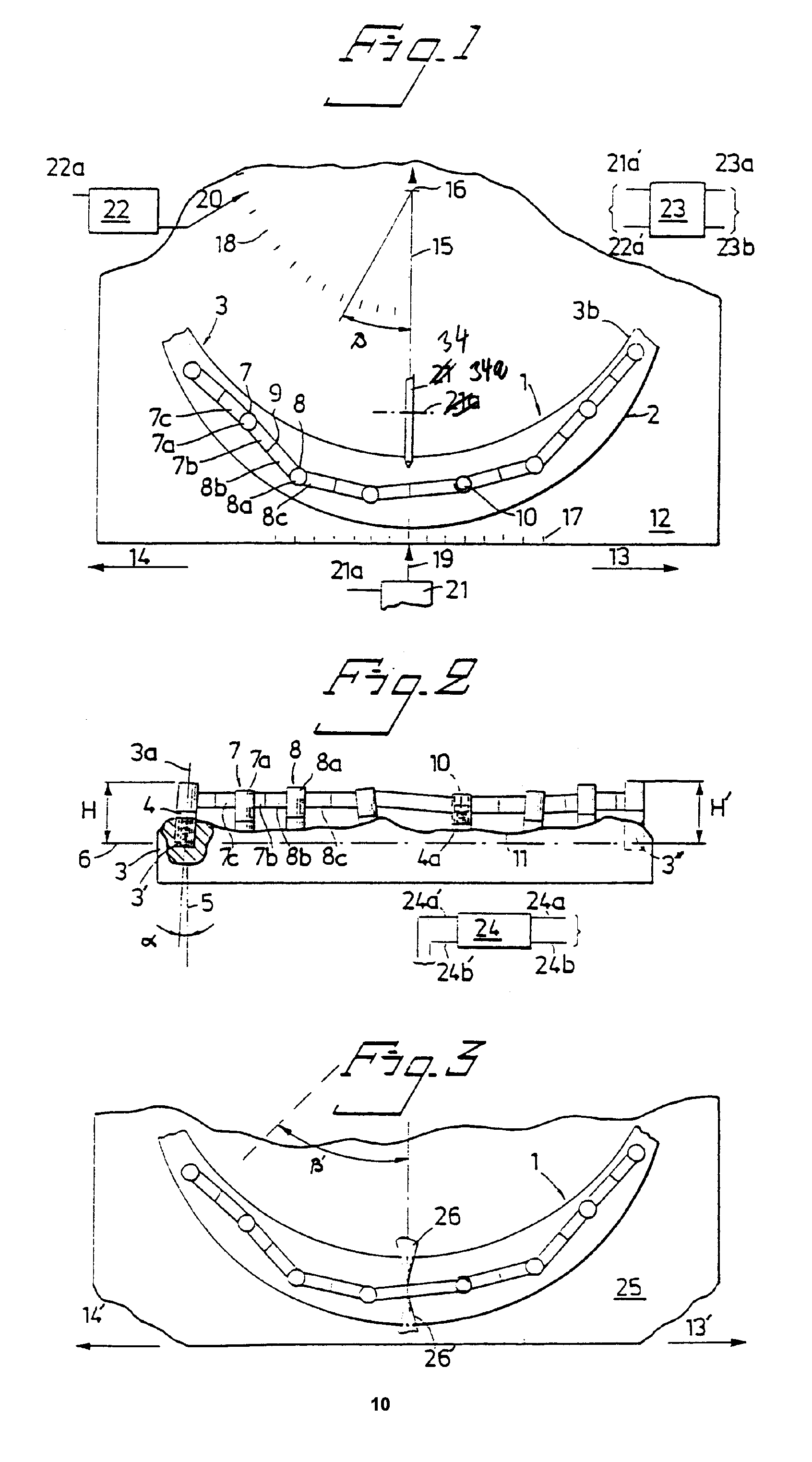
| (86) |
International application number: |
|
PCT/SE8700/574 |
| (87) |
International publication number: |
|
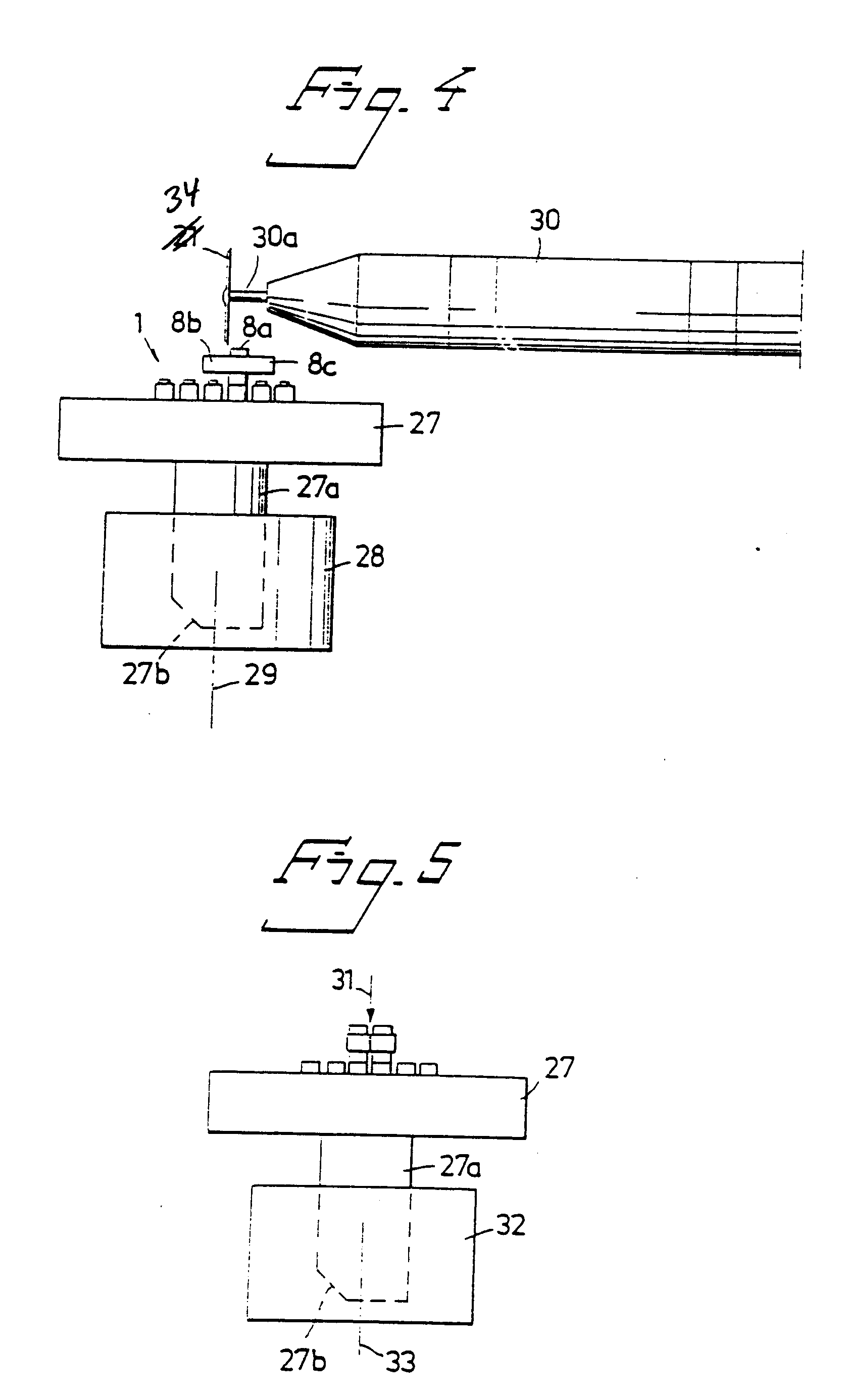
WO 8804/158 (16.06.1988 Gazette 1988/13) |
|
| (54) |
METHOD AND ARRANGEMENT FOR PRODUCING A BRIDGE FOR ANCHORAGE ELEMENTS IN DENTINE
VERFAHREN UND VORRICHTUNG ZUM HERSTELLEN EINER BRÜCKE FÜR VERANKERUNGSELEMENTE IM
DENTIN
PROCEDE ET DISPOSITIF DE FABRICATION D'UN BRIDGE PERMETTANT LA FIXATION D'UN DENTIER
DANS LA DENTINE
|
| (84) |
Designated Contracting States: |
|
AT BE CH DE FR GB IT LI LU NL SE |
| (30) |
Priority: |
09.12.1986 SE 8605272
|
| (43) |
Date of publication of application: |
|
04.10.1989 Bulletin 1989/40 |
| (73) |
Proprietor: Nobelpharma AB |
|
S-402 26 Göteborg (SE) |
|
| (72) |
Inventor: |
|
- Andersson, Knut Matts Greger
S-830 20 Faker (SE)
|
| (74) |
Representative: Olsson, Gunnar |
|
AKZO NOBEL SERVICES AB
IoD
Box 11551
100 61 Stockholm
100 61 Stockholm (SE) |
| (56) |
References cited: :
SE-B- 448 599
SE-B-44 637 1
|
SE-B- 448 600
|
|
| |
|
|
|
|
| |
|
| Note: Within nine months from the publication of the mention of the grant of the European
patent, any person may give notice to the European Patent Office of opposition to
the European patent
granted. Notice of opposition shall be filed in a written reasoned statement. It shall
not be deemed to
have been filed until the opposition fee has been paid. (Art. 99(1) European Patent
Convention).
|
[0001] The present invention relates to a method for producing by mechanical means a bridge
made of titanium for anchorage elements implanted in the dentine of a tooth. The aforementioned
bridge constitutes the framework for an artificial dental structure, and the dental
structure is capable of being attached to the anchorage elements via the bridge. The
bridge is of the kind which is built up of modular elements which are treated for
the purpose of adapting them one to the other and of being joined together. The invention
also relates to an apparatus for the execution of the aforementioned method.
[0002] The implantation of titanium pins in the jaw and the anchorage of a bridge structure
to these pins has already been disclosed. The bridge structure in this case consists
of a framework made of an appropriate material and an artificial dental structure
built up on the frame, which dental structure is secured to the pins with screws,
preferably made of titanium.
[0003] This kind of framework is associated with the need to be able to achieve rational
production without being obliged to depart from the requirement for an accurate fit
on the pins. The degree of lateral accuracy is high (e.g. 10⁻² mm). Furthermore the
requirement in respect of the strength of the bridge is high, at the same time as
which the bridge framework must be capable of being accommodated within the dimensions
of the artificial dental structure. The requirement imposed on the artificial dental
structure is that it must correspond to the natural situation which it is to replace.
[0004] The above problem is accentuated by the fact that the bridge structure exhibits a
high degree of individuality, and the implants can impart different inclinations and
heights to the attachment points for the bridge structure. In spite of this there
is a wish for an accelerated manufacturing operation and arrangements for the manufacture
of a bridge structure of this kind.
[0005] The object of the present invention is to create a method which will resolve, amongst
other things, the problem outlined above, and the method may accordingly be regarded
as being essentially characterized in that, in conjunction with the performance in
a treatment unit of one or more first treatment stages for the construction of the
bridge, identification data introduced or utilized in the one or more first treatment
stages relating to the individual different heights of the anchorage elements above
the dentine or a plane passing through same, and different relative inclinations and
the positions and directions of the modular elements in relation to one another and
to the anchorage elements are obtained and stored, and in that a processing unit which
performs a subsequent processing stage is controlled depending on the data thus obtained
and stored, so that any projecting components present in the bridge between the attachment
components of the bridge are assured a connection via contact surfaces.
[0006] In a further development of the idea of invention use is made in the manufacturing
process of a working model which constitutes an internal impression of the jaw. The
working model is secured to a component which forms part of the treatment unit and
is so arranged as to be capable of displacement and/or rotation in its own plane.
Contact surfaces between two first modular elements situated adjacent to one another
in the bridge are produced in a first displaced and/or rotated angular position of
the part, and so on. Data relating to the first and second displaced and/or rotated
angular positions of the part are recorded and utilized in a joining machine, for
example a welding machine (laser welding machine), forming the processing unit, for
the purpose of joining together modular elements at the produced contact surfaces.
[0007] The aforementioned processing device can be so arranged for this purpose that it
is controlled for the purpose of interacting with a first modular element secured
temporarily to a selected anchorage element in same, for the purpose of producing
the contact surface on the first modular element. The first modular element is removed
once its contact surface has been produced, and a second modular element, which is
to be situated adjacent to the first modular element in the bridge, is fitted to the
working model on an adjacent anchorage element. The processing device is guided for
this purpose into interaction with the second modular element for the purpose of producing
its contact surface, which is to make contact with the aforementioned contact surface
on the first modular element. This process stage is performed on the other modular
elements until all the contact surfaces have been produced, whereupon all the modular
elements are attached to the working model.
[0008] An apparatus for the execution of the method indicated in the foregoing is characterized
essentially in that it comprises, amongst other things, treatment and processing units,
whereby identification data introduced or utilized in the treatment unit relating
to the individual different heights of the anchorage elements above the dentine or
a plane passing through same, and different relative inclinations and the positions
and directions of the modular elements in relation to one another are capable of being
determined and stored. A further characteristic is that the processing unit is capable
of being controlled, by the use of the established identification data, for the purpose
of performing its processing of the modular elements in order to achieve a bridge
structure in which the projecting components of the bridge extend between the attachment
elements of the bridge.
[0009] A further development of the new apparatus involves, amongst other things, the treatment
unit exhibiting a part with a mounting surface for the attachment of a working model
which constitutes an internal impression of the jaw with the appropriate dummies representing
implanted anchorage elements. The aforementioned part is in this case capable of displacement
and/or rotation in the plane of the mounting surface and possibly in the sense of
the height of the mounting surface. The treatment unit in this case also exhibits
a processing device for producing the contact surfaces on the modular units when these
are applied one by one to the working model. The treatment device is also arranged
for the purpose of determining the displacement and/or angles of rotation at which
the different modular elements are processed.
[0010] The processing unit is so arranged in the latter case as to perform the joining operation
(e.g. laser welding) depending on the data relating to the aforementioned displacements
and/or rotations. A conventional cutting wheel can be used for the purpose of producing
the contact surfaces. The cutting wheel can be so arranged in this case as to be capable
of lateral displacement in order to compensate for the thickness of the wheel. Compensation
can be effected alternatively or in a supplementary fashion by the lateral displacement
of the part which is capable of lateral displacement.
[0011] In a further embodiment the apparatus can contain simulating devices for the simulation
of the form of the bridge and the form and positions of the contact surfaces. The
processing device in this case utilizes data from the simulation devices as the aforementioned
identification data.
[0012] Achieved through what is proposed above are a method and an arrangement which permit
the rational manufacture of individual bridge structure with the necessary accuracy
and strength. The method and apparatus are suitable for bridge structures in titanium.
[0013] The embodiments of the method and apparatus in accordance with the invention proposed
here are described below with reference to the accompanying drawing, in which:
Fig. 1 shows in horizontal view and in principle parts of a working model of an internal
impression of a jaw, in conjunction with which the working model has been applied
to a mounting surface on a treatment unit used for this purpose;
Fig. 2 shows the working model in accordance with Fig. 1 in vertical section;
Fig. 3 shows the working model applied to an attachment surface on a processing unit
illustrated in section and in principle;
Fig. 4 shows a model holder held in first chuck devices in a first processing station;
and
Fig. 5 shows the model holder held in chuck devices in a second processing station.
[0014] The designation 1 is used in the Figure in respect of a working model. The working
model is produced in a previously disclosed manner and constitutes an impression or
moulding of the dentine 2 together with surrounding parts of the person who is to
use the artificial dental structure. The working model includes dummies 3, 3b in accordance
with Fig. 2 attached to pins which are implanted in a previously disclosed manner
in the person's jaw. Attached to the dummies are distance pieces 4, the design and
application of which are also previously disclosed.
[0015] A characteristic feature of the implanted pins is that they adopt individual positions
in the dentine, which means that the distance devices project upwards above the dentine
to different heights and at different angles of inclination. This is illustrated in
Fig. 2 by the external pins 3′ and 3˝ having different heights H and H′. In addition
the pin 3′ is also inclined in relation to the vertical axis 5 in the actual section
in accordance with Fig. 2. The angle between the axis 3a of the pin and the aforementioned
vertical axis is indicated by α. The pin 3˝ exhibits the inclination 0° in the illustrative
embodiment shown here. The pin can also be inclined in the other direction, for example
perpendicularly to the plane of the paper in accordance with fig. 2.
[0016] The distances H and H′ are indicated respectively with their starting points on a
plane 6 which extends perpendicularly to the figure plane in Fig. 2 and through the
working model. The different heights H, H′ are dependent on the appearance of the
individual dentine, and any inclinations of the implanted pins are dependent on the
fact that it is not possible to predict the directions of the pins inserted by operation.
[0017] The bridge framework, which is made of titanium or some other hard material, is built
up of modular elements, two of which are indicated by 7 and 8 in Figs. 1 and 2. These
designs of the modular elements can vary within wide limits. Modular elements have
been chosen in the present case which exhibit attachment components 7a and 8a with
projecting components 7b, 7c and 8b, 8c arranged therein. In conjunction with the
construction of the bridge the modular elements are tested in respect of their fit
one with the other with regard to the production of the contact surfaces 9. The aforementioned
contact surfaces may be situated on the projecting components illustrated in the Figures.
Contact surfaces may also be provided, however, on the attachment component 7a and
8a, in which case the projecting component on an adjacent element extends all the
way to the central component concerned.
[0018] The respective distance pieces 4 are screwed securely to the respective pins 3 with
the help of a screw 4a. This anchorage is previously disclosed and is not affected
by the invention, except in the event of the bridge structure being required to be
capable of being attached/screwed securely to the distance device 4a. In order to
achieve this, the screw 4a is provided with a threaded hole for the screw 10. The
aforementioned screw 10 extends from the upper surface of the respective attachment
component, and the attachment component is provided with an internal shoulder to permit
attachment with the help of the screw 10.
[0019] In one embodiment the modular elements can contain attachment components 7a and 8a
which are capable of displacement in relation to the projecting components 7b, 7c
And 8b, 8c. A certain level equalization effect can be achieved in this way with the
help of the individual displacement of the attachment component of the modular element
in relation to the projecting parts. The modular elements can thus be given a uniform
design where the projecting parts originate at the same angle (e.g. a right-angle)
from the attachment component. It is possible, however, to cause the projecting parts
to originate from their respective attachment components at different angles, so that
individual matching in the sense of the height of the jawbone can take place. Each
of the modular elements can be provided with one or more projecting parts in relation
to the attachment component. What is important is that the projecting parts and the
attachment components in the bridge structure are given a flexible form, at the same
time as the strength requirements are satisfied. In addition the bridge components
should exhibit a clearance to the upper surface of the dentine. The requirement is
thus that the bridge elements must essentially make contact with the upper surface
11 of the dentine. The expression 'essentially' shall be interpreted with a broad
meaning in this instance, and the level equalization effect achieved by means of the
capacity of the attachment components for displacement relative to the projecting
parts shall be ignored. It is also essential for the bridge structure to be capable
of being executed with comparatively narrow dimensions, so that it is accommodated
within the artificial dental structure, which is not shown in the Figures. The requirement
imposed on the bridge structure is thus that the projecting components shall be essentially
in line with the direction of the dentine, including in the sense of the width or
depth of the dentine.
[0020] The treatment 12 is also provided with a cutting wheel illustrated symbolically by
34. The suspension of the device 12 and the cutting wheel 34 and the driving of the
latter can be executed in a previously disclosed manner. The wheel rotates about its
own axis 34a. The contact surfaces 9 between the modular elements are produced with
the help of the device 12 and the wheel 34. The operation proceeds in such a way that
a first modular element, for example the modular element 7, is clamped temporarily
in position, whereupon the device 12 is displaced and/or rotated around axis 16 through
an angle so that the predetermined cutting point on the projecting component 7b on
the modular element is brought into line with the cutting wheel 34. With the help
of the latter the projecting component 7b is cut at the predetermined point. The modular
element 7 is then loosened and rotated or removed and is applied to the modular element
8, the projecting component 8b of which is cut with the device 12 in the same position
of displacement and/or angular rotation, with compensation for the thickness of the
disc. The set position of displacement and/or angular rotation can be sensed with
sensing devices 19, 21 and 20, 22. The aforementioned sensing devices exhibit outputs
21a and 22a which are fed into the inputs 21a′ and 22a′ of a storage unit 23, which
is capable of establishing and storing the various adjustment positions for the device
12 in conjunction with the production of the different contact surfaces 9 of the modular
elements. The aforementioned data can be obtained at outputs 23a and 23b. These data
can be fed into a control unit 24 for a processing unit 25, which in this instance
consists of a laser welding machine, an adhesive bonding machine or a joining machine
of some other kind. The control unit receives the data from the sensing and storage
unit 23 via its inputs 24a and 24b. Control signals are obtained at the outputs 24a′
and 24b′ of the control unit. The joining machine 25 is controlled in a previously
disclosed manner via these control outputs into the different positions which represent
the contact surfaces on the modular elements. The working model 1 is clamped to a
part on the machine 25 which is able to move in a corresponding manner to the part
12 in the treatment machine. The part in question is thus capable of displacement
in the directions of the arrows 13, 13′ and 14, 14′, that is to say the x-coordinate,
and capable of rotation through the angle of rotation β′. In the event of the part
12 moving in some other manner, for example in the y- and z-coordinates 15 the machine
25 will possess equivalent mobility. The joining function for the processing component
is symbolized by a pair of welding electrodes 26, 26′. These welding electrodes are
given a fixed position, and the machine 25 causes the contact surfaces to rotate forwards
to the electrodes 26, 26′ depending on the control instructions given by the control
unit 24.
[0021] Figs. 4 and 5 illustrate an arrangement which is suitable in the event of the processing
stations being geographically separated, so that the working model 1 must be moved
or transported. The working model is fixed in a previously disclosed manner to a holder
27 arranged with securing devices 27a for its temporary attachment to a first chuck
device 28 of a previously disclosed kind. The chuck device is a part of rotating devices
(not shown) so arranged as to be capable of causing the chuck device to rotate about
an axis of rotation 29, 33 for the purpose of adjusting the elements 8b/8c in relation
to the cutting device 21. The latter device is arranged on a rotating device 30, via
the shaft 30a of the latter. The rotating device can be driven electrically, pneumatically
or hydraulically, etc.
[0022] The holder 27 is arranged for torsional attachment to the chuck device 28. The aforementioned
attachment is achieved by means of a searching device comprising an inclined surface
27b and a heel, etc. The holder is imparted by means of the searching device with
a predetermined angular rotational position in the chuck device 28, which in turn
is adjustable in a starting position with the help of a scale, 17, 18 heel or similar.
[0023] At the processing station in accordance with Fig. 4 cutting is executed in the manner
described above, whereupon transfer can take place to the station in accordance with
Fig. 5, where welding is performed at the contact surfaces. A welded joint is indicated
by 31. In Fig. 5 the holder is secured in a second chuck device 32 corresponding to
the first chuck device. Torsional attachment to and rotation with the second chuck
device take place in a similar manner, which means that the joining surfaces are capable
of displacement into working positions which correspond to one another in the two
instances. The devices which perform the cutting and welding functions can be caused
to work in positions which correspond to one another, past which the contact surfaces
are caused to move with the help of data transferred from the first station to the
second in respect of the rotational positions of the first and second chuck devices.
[0024] The data for the identification of the contact surfaces can be executed in a different
manner, just as other functions described in the foregoing. The bridge structure and
its joining of the modular elements can thus be simulated with the help of previously
disclosed simulation devices, for example computer equipment. Construction and joining
are calculated from the three-dimensional assumptions which relate to the construction
and attachment of the bridge structure. With the help of the data thus obtained, the
modular units are each processed individually and are combined into a combination
station.
[0025] The invention is not restricted to the embodiment referred to above as an example,
but may be subjected to modifications within the scope of the following Patent Claims.
1. Method for producing by mechanical means a bridge in titanium for anchorage elements
implanted in the dentine of a tooth, which bridge constitutes the framework for an
artificial dental structure and via which the dental structure is capable of being
attached to the anchorage elements, for which purpose the bridge is built up of modular
elements (7, 8) which are adapted one to the other and are treated for joining together,
for example by means of laser welding, characterized in that, in conjunction with the performance in a treatment unit (12) of one or more
first treatment stages for the construction of the bridge, identification data introduced
or utilized in the one or more first treatment stages relating to the individual different
heights of the anchorage elements above the dentine or a plane passing through same,
and different relative inclinations (α) and the positions and directions of the modular
elements (7, 8) in relation to one another and to the anchorage elements are obtained
and stored, and in that a processing unit (25) performing subsequent processing stages
is controlled depending on the data thus extracted and stored, such that any projecting
components (7b, 7c; 8b, 8c) present in the bridge between the attachment components
(7a, 8a) of the bridge are assured a connection via the contact surfaces (9).
2. Method according to Patent Claim 1, characterized in that a working model (2), which constitutes an internal impression of the jaw,
is secured to a component which forms part of the treatment unit (12) and is so arranged
as to be capable of displacement and/or rotation in its own plane, in that contact
surfaces (9) between two first modular elements (7, 8) situated adjacent to one another
in the bridge are produced in a first displaced and/or rotated angular position of
the part, in that the contact surface between other modular elements situated adjacent
to one another in the bridge is produced in a second displaced and/or rotated angular
position of the part, and so on, an in that data relating to the first and second
displaced and/or rotated angular positions of the part are recorded and utilized in
a joining machine, for example a welding machine, forming the processing unit, for
the purpose of joining together modular elements at the produced contact surfaces
(9).
3. Method according to Patent Claims 1 or 2, characterized in that a processing device (34) arranged of the treatment unit on the part (12)
and perpendicular to its clamping plane, is controlled for the purpose of interacting
with a first modular element applied/secured temporarily to the working model (2)
via a selected anchorage element in the model, for the purpose of producing the contact
surface on the first modular element, in that the first modular element is removed
and a second modular element, which is to be adjacent to the first modular element
in the bridge, is secured temporarily to an anchorage element adjacent to the aforementioned
anchorage element in the working model, and in that the processing device is controlled
for the purpose of interacting with the second modular element for the purpose of
producing the contact surface on the second modular element, and so on, until all
the contact surfaces have been produced, whereupon all the modular elements are attached
to the working model and this is transferred to the processing device onto a part
corresponding to the part in the treatment unit.
4. Method according to any of the preceding Patent Claims, characterized in that the form and contact surface of the bridge are simulated, and that the simulation
data are utilized as identification data in conjunction with the control of the treatment
unit.
5. Apparatus for the execution of the method indicated in Patent Claim 1 for the production
by mechanical means of a bridge in titanium for the anchorage elements implanted in
the dentine of a tooth, which bridge constitutes the framework for an artificial dental
structure and via which the dental structure is capable of being attached to the anchorage
elements, for which purpose the bridge is built up of modular elements (7, 8) which
are adapted one to the other and are treated for joining together, characterized in that it comprises treatment and processing units (12, 25) in which identification
data introduced or utilized in the treatment unit (12) relating to the individual
different heights (H, H′) of the anchorage elements above the dentine or a plane (6)
passing through same, and different relative inclinations (α) and the positions and
directions of the modular elements (7, 8) in relation to one another are capable of
being obtained and stored, and in that the processing unit (25) is capable of being
controlled by the utilization of the established identification data for the purpose
of performing its processing of the modular elements (7, 8) in order to achieve a
bridge structure in which the projecting components (7b, 7c and 8b, 8c) present in
the bridge extend between attachment components (7a, 8a) of the bridge.
6. Apparatus according to Patent Claim 5, characterized in that the treatment unit (12) exhibits a part with an attachment surface for securing
a working model (2) which constitutes an internal impression of the jaw with the appropriate
dummies representing implanted elements, in that the part is capable of being displaced
and/or rotated in the plane of the surface, and in that the treatment unit also exhibits
a processing device (34) for producing mating surfaces on modular elements (7, 8)
when these are applied one by one to the working model (2), and in that the treatment
unit is arranged for the purpose of determining displacements and/or angles of rotation
at which the different modular elements are treated.
7. Apparatus according to Patent Claim 6, characterized in that the processing unit (25) is so arranged as to perform joining depending on
the data relating to longitudinal displacements and/or angular rotations.
8. Apparatus according to Patent Claims 5, 6 or 7, characterized in that the processing device (34) contains a cutting wheel capable of interacting
with the modular elements in the various displaced and/or rotated angular positions,
said wheel preferably being arranged perpendicularly to the attachment surface of
the working model.
9. Apparatus according to any of the Patent Claims 5-8, characterized in that it contains simulating devices for the simulation of the form of the bridge
and the positions of the mating surfaces, and in that the processing device utilizes
the data from the simulation devices as the aforementioned identification data.
1. Verfahren zum mechanischen Herstellen einer Brücke aus Titan für Verankerungselemente,
die im Dentin eines Zahns implantiert sind, wobei die Brücke das Rahmenwerk für einen
künstlichen Zahnaufbau bildet und mittels der der Zahnaufbau an den Verankerungselementen
befestigt werden kann, für welchen Zweck die Brücke aus Modul-Elementen (7,8) aufgebaut
ist, die eines an das andere angepaßt und für das Miteinanderverbinden behandelt sind,
beispielsweise mittels Laserschweißen; dadurch gekennzeichnet, daß mit dem Auftreten in einer Behandlungseinheit (12) von einer oder mehreren ersten
Behandlungsstufen für die Konstruktion der Brücke Identifikationsdaten, die für die
eine oder die mehreren erste Behandlungsstufen eingeführt oder verwendet werden und
die sich auf individuelle, unterschiedliche Höhen der Verankerungselemente oberhalb
des Dentins oder einer Ebene durch diesselbe beziehen, und unterschiedliche relative
Neigungswinkel (α) und die Positionen und Richtungen der Modul-Elemente (7,8) in bezug
zueinander und zu den Verankerungselementen, erhalten und gespeichert werden und daß
eine Bearbeitungseinheit (25), die nachträgliche Bearbeitungsstufen durchführt, in
Abhängigkeit von den so extrahierten und gespeicherten Daten so gesteuert wird, daß
alle vorstehenden Komponenten (7b,7c; 8b, 8c) die in der Brücke zwischen den Befestigungskomponenten
(7a, 8a) der Brücke vorhanden sind, über die Kontaktflächen (9) eine sichere Verbindung
einnehmen.
2. Verfahren nach Patentanspruch 1, dadurch gekennzeichnet, daß ein Arbeitsmodell (2), welches den Kiefer-Innenabdruck bildet, an einer Komponente
befestigt ist, die einen Teil der Behandlungseinheit (12) bildet und so angeordnet
ist, daß es in seiner eigenen Ebene verschoben oder gedreht werden kann, daß Kontaktflächen
(9) zwischen zwei ersten Modul-Elementen (7,8) die nebeneinander in der Brücke in
einer ersten verschobenen und/oder gedrehten Winkelposition des Teils hergestellt
werden, daß die Kontaktfläche zwischen anderen Modul-Elementen, die nebeneinander
in der Brücke liegen, in einer zweiten verschobenen und/oder gedrehten Winkelposition
des Teils hergestellt wird und so weiter, und daß Daten, die sich auf die erste und
zweite verschobene und/oder gedrehte Winkelposition des Teils beziehen, aufgezeichnet
und in einer Verbindungsmaschine, beispielsweise einer Schweißmaschine, die die Bearbeitungseinheit
bildet, verwendet werden, um die Modul-Elemente an den erzeugten Kontaktflächen (9)
zu verbinden.
3. Verfahren nach Patentanspruch 1 oder 2, dadurch gekennzeichnet, daß eine Bearbeitungseinrichtung (34), die auf dem Teil der Behandlungseinheit (12)
und rechtwinkelig zu dessen Klemmebene angeordnet ist, für den Zweck des Zusammenwirkens
mit einem ersten Modul-Element, welches zeitweilig am Arbeitsmodell (2) über ein ausgewähltes
Verankerungselement im Modell angeordnet/befestigt ist, gesteuert ist, um die Kontaktfläche
am ersten Modul-Element zu erzeugen, daß das erste Modul-Element entfernt und ein
zweites Modul-Element, welches neben dem ersten Modul-Element in der Brücke liegt,
zeitweilig an einem Verankerungselement neben dem vorstehend genannten Verankerungselement
im Arbeitsmodell befestigt wird, und daß die Bearbeitungseinrichtung zum Zweck des
Zusammenwirkens mit dem zweiten Modul-Element gesteuert wird zum Zweck der Herstellung
der Kontaktfläche am zweiten Modul-Element und so weiter, bis alle Kontaktflächen
hergestellt sind, worauf alle Modul-Elemente am Arbeitsmodell befestigt und dieses
auf die Bearbeitsungseinrichtung auf einem Teil entsprechend dem Teil in der Behandlungseinheit
übertragen wird.
4. Verfahren nach jedem der vorstehenden Patentansprüche, dadurch gekennzeichnet, daß die Form- und Kontaktfläche der Brücke simuliert sind, und daß die Simulationsdaten
als Identifikationsdaten in Verbindung mit der Steuerung der Behandlungseinheit verwendet
werden.
5. Vorrichtung zur Durchführung des Verfahrens nach Patentanspruch 1, zum mechanischen
Herstellen einer Brücke aus Titan für Verankerungselemente, die im Dentin eines Zahns
implantiert sind, wobei die Brücke das Rahmenwerk für einen künstlichen Zahnaufbau
bildet und mittels des Zahnaufbaus an den Verankerungselementen befestigt werden kann,
für welchen Zweck die Brücke aus Modul-Elementen (7,8) aufgebaut ist, die eines an
das andere angepaßt und für das Miteinanderverbinden behandelt sind, dadurch gekennzeichnet, daß die Vorrichtung aufweist Behandlungs- und Bearbeitsungseinheiten (12,25) in
denen Identifikationsdaten erhalten und gespeichert werden können, welche in die Behandlungseinheit
(12) bezogen auf die individuellen Höhen (H, H′) der Verankerungselemente über den
Dentin oder eine Ebene (6), die durch dieses verläuft, und auf unterschiedlichen relativen
Neigungswinkeln (α) und die Positionen und Richtungen der Modul-Elemente (7, 8) in
Relation zueinander eingegeben oder in dieser verwendet werden, und daß die Bearbeitungseinheit
(25) durch die Verwendung der erhaltenen Identifikationsdaten zum Durchführen ihrer
Bearbeitung der Modul-Elemente (7, 8) gesteuert werden kann, um eine Brücken-Struktur
zu erzielen, in welcher die vorstehenden Komponenten (7b, 7c; 8b, 8c), die in der
Brücke vorhanden sind, sich zwischen den Befestigungskomponenten (7a, 8a) der Brücke
erstrecken.
6. Vorrichtung nach Anspruch 5, dadurch gekennzeichnet, daß die Behandlungseinheit (12) einen Teil mit einer Befestigungsfläche aufweist
zum Befestigen eines Arbeitsmodells 12, das einen Kiefer-Innenabdruck mit den entsprechenden
Attrappen, die implantierte Elemente darstellen, bildet; daß der Teil in der Ebene
der Fläche verschoben oder gedreht werden kann, und daß die Behandlungseinheit auch
eine Bearbeitungseinrichtung (34) aufweist zum Herstellen von Paßflächen an den Modul-Elementen
(7, 8), wenn diese eines nach dem anderen am Arbeitsmodell (2) angebracht werden,
und daß die Behandlungseinheit zum Bestimmen der Verschiebungen und/oder Drehwinkel,
in denen die Modul-Elemente behandelt werden, vorgesehen ist.
7. Vorrichtung nach Anspruch 6, dadurch gekennzeichnet, daß die Bearbeitungseinheit (25) so angeordnet ist, daß sie in Abhängigkeit von
den Längsverschiebungs- und/oder Drehwinkeldaten ein Anschließen durchführen kann.
8. Vorrichtung nach Anspruch 5, 6 oder 7, dadurch gekennzeichnet, daß die Bearbeitungseinrichtung (34) ein Schneidrad aufweist, das mit den Modul-Elementen
in den zahlreichen verschobenen und/oder gedrehten Positionen zusammenwirken kann,
wobei dieses Rad vorzugsweise rechtwinkelig zu der Befestigungsfläche des Arbeitsmodells
angeordnet ist.
9. Vorrichtung nach Anspruch 5 bis 8, dadurch gekennzeichnet, daß sie simulierende Einrichtungen aufweist, um die Form der Brücke und die Positionen
der Paßflächen zu simulieren, und daß die Bearbeitungseinrichtung die Daten von den
Simulationseinrichtungen als die vorstehend genannten Identifikationsdaten verwendet.
1. Procédé de fabrication par des moyens mécaniques d'un bridge en titane destiné
à servir avec des éléments d'ancrage implantés dans la dentine d'une dent, lequel
bridge constitue la monture d'une structure dentaire artificielle et permet de fixer
la structure dentaire aux éléments d'ancrage, le bridge étant constitué dans ce but
par des éléments modulaires (7, 8) qui sont adaptés les uns aux autres et qui sont
traités en vue d'être assemblés, par exemple au moyen d'une soudure par laser, procédé
caractérisé en ce qu'en conjugaison avec la réalisation dans une unité (12) de traitement,
d'une ou de plusieurs premières opérations de traitement pour la réalisation du bridge,
des données d'identification introduites ou utilisées dans une ou plusieurs premières
opérations de traitement en rapport avec les hauteurs individuelles des éléments d'ancrage
au-dessus de la dentine, ou au-dessus d'un plan passant par celle-ci et concernant
également différentes inclinaisons relatives (α), ainsi que les positions et les directions
des éléments modulaires (7, 8) les uns par rapport aux autres et aux éléments d'ancrage,
sont obtenues et mises en mémoire et en ce qu'une unité de fabrication (25), réalisant
des opérations de fabrication ultérieures, est commandée en fonction des données ainsi
prélevées et mises en mémoire de façon telle que toutes les parties en saillie (7b,
7c ; 8b, 8c) présentes dans le bridge entre les parties de fixation (7a, 8a) du bridge
sont reliées entre elles par l'intermédiaire des surfaces (9) de contact.
2. Procédé selon la revendication 1 caractérisé en ce qu'un modèle (2)de travail,
constituant une empreinte interne de la mâchoire, est fixé à un composant qui constitue
une pièce de l'unité (12) de traitement et est agencé de manière à pouvoir être déplacé
et à être mis en rotation dans son propre plan en ce que des surfaces(9) de contact
situées entre deux premiers éléments modulaires (7, 8) situés à côté l'un de l'autre
dans le bridge sont réalisées alors que la pièce a été déplacée et/ou mise en rotation
jusque dans une première position angulaire ; en ce que la surface de contact entre
d'autres éléments modulaires situés les uns à côté des autres dans le bridge est réalisée
alors que la pièce a été déplacée et/ou mise en rotation jusque dans une seconde position
angulaire et ainsi de suite et en ce que des données concernant la première et la
seconde positions angulaires de la pièce, déplacée ou mise en rotation, sont mises
en mémoire et sont utilisées dans une machine d'assemblage, par exemple une machine
de soudure, qui constitue l'unité de fabrication dans le but d'assembler les éléments
modulaires à l'emplacement des surfaces (9) de contact réalisées.
3. Procédé selon la revendication 2 caractérisé en ce qu'un dispositif de traitement
(34) de fabrication, monté sur la partie de l'unité (12) de traitement et perpendiculaire
à son plan de serrage, est commandé dans le but de coopérer avec un premier élément
modulaire appliqué/fixé de façon temporaire sur un modèle de travail (2) par l'intermédiaire
d'un élément d'ancrage choisi, présent dans le modèle, dans le but de réaliser la
surface de contact sur le premier élément modulaire ; en ce que le premier élément
modulaire est enlevé et qu'un second élément modulaire, qui doit être placé dans le
bridge à côté du premier élément modulaire, est fixé de façon temporaire à un élément
d'ancrage situé à côté de l'élément d'ancrage, mentionné plus haut, du modèle de travail,
et en ce que le dispositif de fabrication est commandé dans le but de coopérer avec
le second élément modulaire pour réaliser la surface de contact sur le second élément
modulaire, et ainsi de suite, jusqu'à ce que toutes les surfaces de contact aient
été réalisées, après quoi tous les éléments modulaires sont fixés au modèle de travail
et celui-ci est transféré au dispositif de fabrication sur une pièce qui correspond
à la pièce de l'unité de traitement.
4. Procédé selon une des revendications précédentes, caractérisé en ce qu'on simule
la forme et la surface de contact du bridge et en ce que les données de simulation
sont utilisées en tant que données d'identification en conjugaison avec la commande
de l'unité de traitement.
5. Appareil destiné à l'exécution du procédé indiqué dans la revendication 1 pour
la fabrication par des procédés mécaniques d'un bridge en titane destiné à servir
avec des éléments d'ancrage implantés dans la dentine d'une dent, lequel bridge constitue
la monture d'une structure dentaire artificielle et permet de fixer la structure dentaire
aux éléments d'ancrage, le bridge étant constitué dans ce but par des éléments modulaires
(7, 8) qui sont adaptés les uns aux autres et qui sont traités en vue d'être assemblés,
appareil caractérisé en ce qu'il comporte des unités de traitement et de fabrication
(12, 25) dans lesquelles des données d'identification sont introduites, ou utilisées
dans l'unité de traitement (12) concernant les différentes hauteurs individuelles
(H, H′) des éléments d'ancrage au-dessus de la dentine ou d'un plan (6) passant dans
celle-ci et différentes inclinaisons relatives (α) ainsi que les positions et les
directions des éléments modulaires (7, 8) les uns par rapport aux autres, peuvent
être obtenues et mises en mémoire, et en ce que l'unité (25) de traitement est apte
à être commandée en utilisant les données d'identification établies, dans le but de
réaliser la fabrication des éléments modulaires (7, 8) afin de réaliser une structure
de bridge dans laquelle les parties en saillie (7b, 7c et 8b, 8c) présentes dans le
bridge s'étendent entre des parties (7a, 8a) destinées à la fixation du bridge.
6. Appareil selon la revendication 5, caractérisé en ce que l'unité (12) de traitement
présente une pièce comportant une surface de fixation destinée à fixer un modèle de
travail (1) qui constitue une empreinte interne de la mâchoire comportant les éléments
factices appropriés représentant des éléments implantés ; en ce que la pièce est apte
à être déplacée et/ou tournée dans le plan de la surface, et en ce que l'unité de
traitement présente également un dispositif de traitement (34) de fabrication destiné
à réaliser des surfaces qui s'adaptent parfaitement sur les éléments modulaires (7,
8) lorsque ceux-ci sont appliqués un par un sur le modèle de travail (1) et en ce
que l'unité de traitement est agencée dans le but de déterminer les déplacements et/ou
les angles de rotation sous lesquels sont traités les différents éléments modulaires.
7. Appareil selon la revendication 6 caractérisé en ce que l'unité de fabrication
(25) est agencée de façon à réaliser l'assemblage en fonction des données concernant
les déplacements longitudinaux et/ou les rotations angulaires.
8. Appareil selon les revendications 5, 6 ou 7 caractérisé en ce que le dispositif
de fabrication (34) comporte un disque de coupe apte à coopérer avec les éléments
modulaires dans les différentes positions angulaires résultant de déplacements et/ou
de rotations, ledit disque étant de préférence agencé de façon à être perpendiculaire
à la surface de fixation du modèle de travail.
9. Appareil selon l'une quelconque des revendications 5 à 8 caractérisé en ce qu'il
comporte des dispositifs de simulation destinés à la simulation de la forme du bridge
et des positions des surfaces qui sont parfaitement adaptées les unes aux autres et
en ce que le dispositif de fabrication utilise les données provenant des dispositifs
de simulation en tant que les données précitées d'identification.