|
(11) | EP 0 339 516 B1 |

| (12) | EUROPEAN PATENT SPECIFICATION |
|
|
| (54) |
Catalyst and process for the preparation of polymers of tri-substituted silylalkynes Katalysator und Verfahren zur Herstellung von Polymeren trisubstituierter Silylalkine Catalyseurs et procédé de préparation de polymères de silylalkynes tri-substitués |
|
|
|||||||||||||||||||||||||||||||
| Note: Within nine months from the publication of the mention of the grant of the European patent, any person may give notice to the European Patent Office of opposition to the European patent granted. Notice of opposition shall be filed in a written reasoned statement. It shall not be deemed to have been filed until the opposition fee has been paid. (Art. 99(1) European Patent Convention). |
[0001] The present invention relates to an improvement in a process for the preparation of polymeric tri-substituted silylalkynes which may be cast into membrane from and used to separate components of a gas mixture.
BACKGROUND OF THE INVENTION
[0002] The preparation of polymeric tri-substitued silylalkynes employing an organic solvent and a suitable catalyst such as TaCl₅, MoCl₅, NbCl₅ or other Group VB or IVB metal halides is known, as is the formation of polymeric membranes and gas separation processes using the polymeric membranes.
[0003] The preparation of poly(trialkylsilylpropyne) and treated, semipermeable polymeric membranes comprising a polymer having the general structural formula:
wherein R₁ is a linear or branched C₁-C₄ alkyl group; R₂ and R₃ are independently linear or branched C₁-C₆ alkyl groups; R₄ is a linear or branched C₁-C₁₂ alkyl group or aryl group; X is a C₁-C₃ alkyl group or phenyl; m is at least 100 and n is 0 or 1, is disclosed in the Langsam U.S Patent No. 4,657,564. These polymers are prepared from tri-substituted (silylalkynes).
[0004] G.B. patent application No. 2,135,319A discloses the polymerization of one or more 1-monoalkyl (C₁-C₁₂) dimethylsilylpropynes using various silypropyne monomers in the presence of halides of transition metals of Group VB of the Periodic Table. Organo-aluminum compounds are described as co-catalysts.
[0005] The polymerization of 1-(trimethylsilyl)-1-propyne employing pentahalides of niobium and tantalum in a toluene solution at 80°C along with the effects of solvents and temperature are described in an article by T. Masuda, et al. entitled "Polymerization of 1-(trimethylsilyl)-1-propyne by Halides of Niobium (V) and Tantalum (V) and Polymer Properties," Macromolecules Vol. 18, No. 5, pp. 841-845 (1985).
[0006] Molybdenum and other methyl halides are disclosed as catalysts for the polymerization of sterically hindered acetylenes and dialkyl-acetylenes in a solvent by T. Masuda, et al. in an article entitled," "Polymerization of Methylpentynes by Transition Metal Catalysts: Monomer Structure, Reactivity, and Polymer Properties" Polymer Journal, Vol . 4, No. 5, pp 371-377 (1982).
[0007] T. Masuda in an article entitled "Synthesis of High Polymers from Substituted Acetylenes: Exploitation of Molybdenum and Tungsten-Based Catalysts," Acc. Chem. Res., Vol 17, pp. 51-56 (1984) discloses the polymerization of aromatic and aliphatic acetylenes.
[0008] The present invention is based on the discovery that the addition of tertiary amines to a solution containing Group VB or VIB metal halide catalysts or mixtures thereof forms a very active binary catalyst system which accelerates the polymerization of tri-substitued silylalkynes, particularly trimethylsilylpropyne, and increases the molecular weights of the resultant polymer beyond what would normally be expected by prior art processes.
Summary of the Invention
[0009] The present invention is based on the unexpected discovery that it is possible to increase the polymerization rate of tri-substituted silylalkynes and especially trimethylsilylpropyne by employing at polymerization temperatures a combination of a Group VB or VIB metal halide catalyst, such as TaCl5, MoCl5 and NbCl5 , and a tertiary amine (no available NH bonds), such as triethyl amine, in a solvent and at the same time increase the polymer molecular weight.
[0010] It is a primary object of this invention to provide an improved process for the preparation of polymeric tri-substituted silylalkynes useful for casting into membrane form for separating gas components as described for example in U.S. Patent No. 4,657,564.
[0011] It is another object of this invention to provide a novel highly reactive catalyst for the polymerization of trimethylsilylpropyne and other tri-substitued silylalkynes comprising a combination of a Group VB or Group VIB metal halide and a tertiary amine compound.
[0012] These and other objects and advantages of this invention will become apparent from the description of the invention which follows, and from the claims.
DETAILED DESCRIPTION OF THE INVENTION
[0013] In accordance with the present invention a tri-substituted silylalkyne polymer having the general structural formula
wherein R₁ is a linear or branched C₁-C₄ alkyl group; R₂ and R₃ are independently linear or branched C₁-C₆ alkyl groups; R₄ is a linear or branched C₁-C₁₂ alkyl group or aryl group; X is a C₁-C₃ alkyl group or phenyl; m is at least 100 and n is 0 or 1, is produced in an organic solvent solution at polymerization temperatures of preferably from about 30°C to about 100°C, more preferably from about 50°C to about 100°C and most preferably from 70°C to 90°C in the presence of a binary catalyst comprising a combination of a Group VB or VIB metal halide and a tertiary amine compound. The discovery of this very active form of catalyst system allows polymerization in the rigid pore of a microporous film and accelerates the polymerization process and increases the molecular weight of the polymer produced.
[0014] Generally, the rate of polymerization of a tri-substituted silylalkyne such as trimethyl silylpropyne is dependent on the input process parameters of polymerization temperature (Tp) and catalyst/monomer ratio (C/M). In order to increase the rate of polymerization according to prior art process systems one can either increase the polymerization temperature or increase the ratio of catalyst to monomer. Increasing the Tp and/or the C/M ratio will increase the rate of polymerization but typically results in a decrease in the molecular weight and intrinsic viscosity of the resultant polymer. Increasing both the Tp and the C/M ratio will also result in a reduction in the molecular weight of the polymer.
[0015] The change in molecular weight as a function of Tp and C/M ratios have been carried out in a number of experimental runs and the results are shown in Table I below. The data set forth illustrates the Brookfield viscosity or intrinsic viscosity as a function of Tp and C/M ratio in addition to the permeability of various gases through formed membranes of equal thickness. Table 1 clearly demonstrates that in all of the experimental runs high molecular weight polymer can be achieved only at a combination of low Tp and/or C/M.
[0016] The tertiary amine compounds employed along with the Group VB or VIB metal halides to form the binary catalyst system of the present invention are used in amounts of between 5 and 100, preferably between 5 and 25 mole percent, based on the Group VB or VIB metal halide. The tertiary amines may be aliphatic, cycloaliphatic, alkylatedaryl or aromatic amine compounds. Representative tertiary amines for use in the process of the invention includes, for example, the trialkylamines such as the trimethyl, triethyl, tripropyl, tributyl, trihexyl, trioctyl and tridecyl amines, tri-phenylamine, n-dodecyldimethlamine, n-tetra-decyldimethylamine, n-hexyldecyldimethylamine, N,N,N¹, N¹- tetramethylethylenediamine, 1,4-diazabicycle [2.2.2] octane, 4(N,N-dimethylamino)pyridine, pyridine, 1,5-diazabicycle [3.4.0] non-5-ene, 1,8-diazabicycle [5.4.0]-undec-T-ene, methyldiethylamine, butyldimethylamine, benzyldimethylamine and N,N-di-methylaniline.
[0017] The organic solvents employed in the present invention may be any aromatic or substituted aromatic hydrocarbon solvents which are stable and chemically inert to the polymerization system and include, for example, benzene, toluene, xylene, chlorobenzenes, nitrobenzenes, nitrotoluenes and bromobenzenes . Toluene is the preferred solvent for the polymerization system.
[0018] A number of experiments were carried out using various amines along with TaCl₅ and other variables to demonstrate the novel effect tertiary amines have on the molecular weight of poly(trimethylsilylpropyne). These examples are provided to illustrate the invention in accordance with principles of the invention and include particular features of the invention. However, the examples are not to be construed as limiting the invention in any way.
EXAMPLE 1
[0019] Several runs were carried out in which trimethyl silylpropyne (TMSP) was polymerized for a period of 6 hours. The TaCl₅ and tertiary amines were mixed with toluene as solvent and stirred for 30 minutes to dissolve the TaCl₅ after which the trimethylsilylpropyne was added with heating and stirring. After the polymerization period, the reaction mixture was quenched in methanol, washed with additional methanol and then dried, leaving a trimethylsilylpropyne polymer (PTMSP) for analysis. Run 1 is comparative and was carried out in the absence of a tertiary amine. The results of these runs are reported in Table 2 below.
[0020] The results reported in Table 2 above clearly show that employing a tertiary amine along with the metal halide catalyst significantly increases the molecular weight (as evidenced by an increase in viscosity) of the resultant polymer. Additionally, when the reaction temperature was reduced to 83°C (run 5), the yield and molecular weight remained high.
[0021] Although the process of the present invention will be directed primarily to the polymerization of trimethylsilylpropyne in the presence of TaCl₅ with tertiary amines, it is not intended that the process be limited to the particular silylalkyne or metal halide and those skilled in the art will recognize that the present invention is broadly applicable to the polymerization of other tri-substituted silylalkynes, within the formula as hereinabove set forth, as well as other Group VB and VIB metal halides, to produce other polymeric silylalkynes such as polymeric triethylsilylpropyne, tributylsilylpropyne and trimethylsilylbutyne.
1. A process for the polymerization of a trisubstituted silylalkyne in an organic solvent
in the presence of a Group VB or VIB metal halide catalyst, to produce a polymer having
the general structural formula:
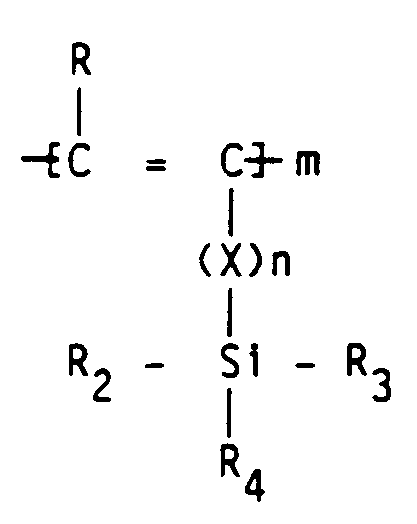
wherein R₁ is a linear or branched C₁-C₄ alkyl group; R₂ and R₃ are independently linear or branched C₁-C₆ alkyl groups; R₄ is a linear or branched C₁-C₁₂ alkyl group or aryl group; X is a C₁-C₃ alkyl group or phenyl; m is at least 100 and n is 0 or 1, characterised in that the rate of polymerization of the trisubstituted silylalkynes and the molecular weight of the resulting polymer are increased by carrying out said polymerization in the presence of a tertiary amine compound, employed in an amount of between 5 and 100 mole percent based on the metal halide.
wherein R₁ is a linear or branched C₁-C₄ alkyl group; R₂ and R₃ are independently linear or branched C₁-C₆ alkyl groups; R₄ is a linear or branched C₁-C₁₂ alkyl group or aryl group; X is a C₁-C₃ alkyl group or phenyl; m is at least 100 and n is 0 or 1, characterised in that the rate of polymerization of the trisubstituted silylalkynes and the molecular weight of the resulting polymer are increased by carrying out said polymerization in the presence of a tertiary amine compound, employed in an amount of between 5 and 100 mole percent based on the metal halide.
2. A process according to Claim 1 wherein the tri-substituted silylalkyne is trimethylsilylpropyne.
3. A process according to Claim 1 wherein the metal halide catalyst is TaCl₅.
4. A process according to Claim 1 wherein the tertiary amine is employed in an amount
of from between 5 and 25 mole percent based on the metal halide.
5. A process according to Claim 1 wherein the tertiary amine is pyridine.
6. A process according to Claim 1 wherein the tertiary amine is triethylamine.
7. A process according to Claim 1 wherein the tertiary amine is N,N-dimethylaniline.
8. A process according to Claim 1 wherein the polymerization is carried out at a temperature
is between about 30°C and 100°C.
9. A process according to Claim 1 wherein the organic solvent is toluene.
10. A polymerisation catalyst for the process of claim 1 which comprises a Group VB or
VIB metal halide and a tertiary amine compound.
11. The catalyst according to Claim 10 wherein the tri-substituted silylalkyne being polymerized
is trimethylsilylpropyne.
12. A catalyst according to Claim 10 wherein the metal halide is TaCl₅.
13. A catalyst according to Claim 10 wherein the tertiary amine is pyridine.
14. A catalyst according to Claim 10 wherein the tertiary amine is triethylamine.
15. A catalyst according to Claim 10 wherein the tertiary amine is N,N-dimethylaniline.
16. A catalyst according to Claim 10 wherein the tertiary amine is present in up to equal
molar amounts based on the metal halide.
1. Verfahren zur Polymerisation von trisubstituiertem Silylalkin in einem organischen
Lösungsmittel in Gegenwart eines Metallhalogenid-Katalysators der Gruppe VB oder VIB,
um ein Polymer mit der allgemeinen Strukturformel zu erzeugen:
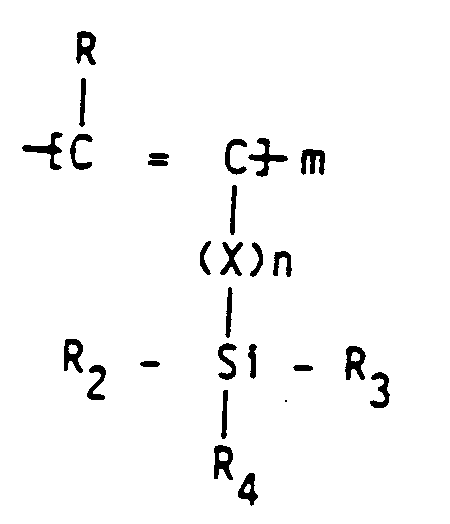
worin R₁ eine lineare oder verzweigte C₁-C₄-Alkylgruppe ist; R₂ und R₃ unabhängig voneinander lineare oder verzweigte C₁-C₆-Alkylgruppen sind; R₄ eine lineare oder verzweigte C₁-C₁₂-Alkylgruppe oder Arylgruppe ist; X eine C₁-C₃-Alkylgruppe oder Vinyl ist; m mindestens 100 und n 0 oder 1 ist; dadurch gekennzeichnet,
daß die Polymerisationsgeschwindigkeit der trisubstituierten Silylalkine und das Molekulargewicht des resultierenden Polymers erhöht werden, indem diese Polymerisation in Gegenwart einer tertiären Aminverbindung durchgeführt wird, die auf der Basis des Metallhalogenids in einer Menge von 5 bis 100 Mol-% angewendet wird.
worin R₁ eine lineare oder verzweigte C₁-C₄-Alkylgruppe ist; R₂ und R₃ unabhängig voneinander lineare oder verzweigte C₁-C₆-Alkylgruppen sind; R₄ eine lineare oder verzweigte C₁-C₁₂-Alkylgruppe oder Arylgruppe ist; X eine C₁-C₃-Alkylgruppe oder Vinyl ist; m mindestens 100 und n 0 oder 1 ist; dadurch gekennzeichnet,
daß die Polymerisationsgeschwindigkeit der trisubstituierten Silylalkine und das Molekulargewicht des resultierenden Polymers erhöht werden, indem diese Polymerisation in Gegenwart einer tertiären Aminverbindung durchgeführt wird, die auf der Basis des Metallhalogenids in einer Menge von 5 bis 100 Mol-% angewendet wird.
2. Verfahren nach Anspruch 1, worin das trisubstituierte Silylalkin Trimethylsilylpropin
ist.
3. Verfahren nach Anspruch 1, worin der Metallhalogenidkatalysator TaCl₅ ist.
4. Verfahren nach Anspruch 1, worin das tertiäre Amin auf der Basis des Metallhalogenids
in einer Menge von 5 bis 25 Mol-% angewendet wird.
5. Verfahren nach Anspruch 1, worin das tertiäre Amin Pyridin ist.
6. Verfahren nach Anspruch 1, worin das tertiäre Amin Triethylamin ist.
7. Verfahren nach Anspruch 1, worin das tertiäre Amin N,N-Dimethylanilin ist.
8. Verfahren nach Anspruch 1, worin die Polymerisation bei einer Temperatur zwischen
etwa 30 und 100°C durchgeführt wird.
9. Verfahren nach Anspruch 1, worin das organische Lösungsmittel Toluol ist.
10. Polymerisationskatalysator für das Verfahren nach Anspruch 1, der ein Metallhalogenid
der Gruppe VB oder VIB und eine tertiäre Aminverbindung umfaßt.
11. Katalysator nach Anspruch 10, worin das trisubstituierte Silylalkin, das polymerisiert
wird, Trimethylsilylpropin ist.
12. Katalysator nach Anspruch 10, worin das Metallhalogenid TaCl₅ ist.
13. Katalysator nach Anspruch 10, worin das tertiäre Amin Pyridin ist.
14. Katalysator nach Anspruch 10, worin das tertiäre Amin Triethylamin ist.
15. Katalysator nach Anspruch 10, worin das tertiäre Amin N,N-Dimethylanilin ist.
16. Katalysator nach Anspruch 10, worin das tertiäre Amin auf der Basis des Metallhalogenids
in bis zu gleichen molaren Mengen vorhanden ist.
1. Un procédé pour la polymérisation d'un silylalcyne trisubstitué, dans un solvant organique
en présence d'un catalyseur constitué d'un halogénure de métal du groupe VB ou VIB,
pour produire un polymère répondant à la formule développée générale :
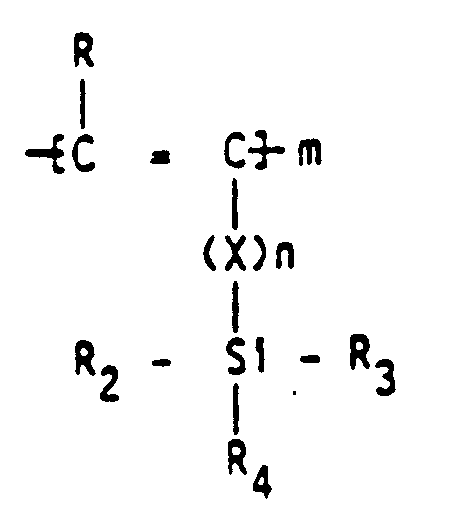
dans laquelle R₁ est un groupe alkyle en C₁-C₄ linéaire ou ramifié ; R₂ et R₃ sont indépendamment des groupes alkyles en C₁-C₆ linéaires ou ramifiés ; R₄ est un groupe alkyle en C₁-C₁₂ linéaire ou ramifié ou un groupe aryle ; X est un groupe alkyle en C₁-C₃ ou un groupe phényle ; m est au moins 100 et n est 0 ou 1, caractérisé en ce que la vitesse de polymérisation des silylalcynes trisubstitués et le poids moléculaire du polymère obtenu sont accrus par réalisation de ladite polymérisation en présence d'une amine tertiaire utilisée en une proportion entre 5 et 100 % molaires relativement à l'halogénure métallique.
dans laquelle R₁ est un groupe alkyle en C₁-C₄ linéaire ou ramifié ; R₂ et R₃ sont indépendamment des groupes alkyles en C₁-C₆ linéaires ou ramifiés ; R₄ est un groupe alkyle en C₁-C₁₂ linéaire ou ramifié ou un groupe aryle ; X est un groupe alkyle en C₁-C₃ ou un groupe phényle ; m est au moins 100 et n est 0 ou 1, caractérisé en ce que la vitesse de polymérisation des silylalcynes trisubstitués et le poids moléculaire du polymère obtenu sont accrus par réalisation de ladite polymérisation en présence d'une amine tertiaire utilisée en une proportion entre 5 et 100 % molaires relativement à l'halogénure métallique.
2. Un procédé selon la revendication 1, dans lequel le silylalcyne trisubstitué est le
triméthylsilylpropyne.
3. Un procédé selon la revendication 1, dans lequel le catalyseur constitué d'un halogénure
métallique est TaCl₅.
4. Un procédé selon la revendication 1, dans lequel l'amine tertiaire est utilisée en
une proportion entre 5 et 25 % molaires relativement à l'halogénure métallique.
5. Un procédé selon la revendication 1, dans lequel l'amine tertiaire est la pyridine.
6. Un procédé selon la revendication 1, dans lequel l'amine tertiaire est la triéthylamine.
7. Un procédé selon la revendication 1, dans lequel l'amine tertiaire est la N,N-diméthylaniline.
8. Un procédé selon la revendication 1, dans lequel la polymérisation est effectuée à
une température entre environ 30°C et 100°C.
9. Un procédé selon la revendication 1, dans lequel le solvant organique est le toluène.
10. Un catalyseur de polymérisation pour le procédé de la revendication 1, qui comprend
un halogénure de métal du groupe VB ou VIB et une amine tertiaire.
11. Le catalyseur selon la revendication 10, dans lequel le silylalcyne trisubstitué à
polymériser est le triméthylsilylpropyne.
12. Un catalyseur selon la revendication 10, dans lequel l'halogénure métallique est TaCl₅.
13. Un catalyseur selon la revendication 10, dans lequel l'amine tertiaire est la pyridine.
14. Un catalyseur selon la revendication 10, dans lequel l'amine tertiaire est la triéthylamine.
15. Un catalyseur selon la revendication 10, dans lequel l'amine tertiaire est la N,N-diméthylaniline.
16. Un catalyseur selon la revendication 10, dans lequel l'amine tertiaire est présente
en une quantité pouvant atteindre l'équimolarité relativement à l'halogénure métallique.