| (19) |
 |
|
(11) |
EP 0 341 809 B1 |
| (12) |
EUROPEAN PATENT SPECIFICATION |
| (45) |
Mention of the grant of the patent: |
|
19.08.1992 Bulletin 1992/34 |
| (22) |
Date of filing: 28.02.1989 |
|
| (51) |
International Patent Classification (IPC)5: A62C 2/06 |
|
| (54) |
Device for the automatic actuation particularly of ventilation flaps
Vorrichtung zur Zwangsbetätigung, insbesondere für Lüftungsklappen
Dispositif de déclenchement automatique, en particulier pour un système de volets
de ventilation
|
| (84) |
Designated Contracting States: |
|
AT BE CH DE FR GB IT LI LU NL SE |
| (30) |
Priority: |
10.05.1988 DE 8806181 U
|
| (43) |
Date of publication of application: |
|
15.11.1989 Bulletin 1989/46 |
| (73) |
Proprietors: |
|
- COLT INTERNATIONAL HOLDINGS A.G.
CH-6312 Steinhausen (CH)
Designated Contracting States:
BE CH DE FR IT LI LU NL SE AT
- COLT INTERNATIONAL LIMITED
Havant
Hampshire PO9 2LY (GB)
Designated Contracting States:
GB
|
|
| (72) |
Inventor: |
|
- Hüsges, Hans Dieter
D-4190 Kleve 1 (DE)
|
| (74) |
Representative: Slight, Geoffrey Charles et al |
|
Graham Watt & Co.
Riverhead
Sevenoaks
Kent TN13 2BN
Sevenoaks
Kent TN13 2BN (GB) |
| (56) |
References cited: :
DE-A- 3 429 178
GB-A- 2 040 401
|
DE-A- 3 606 560
|
|
| |
|
|
|
|
| |
|
| Note: Within nine months from the publication of the mention of the grant of the European
patent, any person may give notice to the European Patent Office of opposition to
the European patent
granted. Notice of opposition shall be filed in a written reasoned statement. It shall
not be deemed to
have been filed until the opposition fee has been paid. (Art. 99(1) European Patent
Convention).
|
[0001] The invention relates to a device for the preferably pneumatic automatic actuation
particularly of ventilation flaps, ventilation louvres and the like in smoke and heat
offtake installations, in a construction in accordance with the preamble to claim
1.
[0002] A device of this kind is known from DE-A-36 06 560. In this device, a glass fuse
element is disposed inside a housing receiving a locking rod member, which housing
is open at the bottom and top in the region of the glass element and so has inflow
and outflow openings but bounds the glass bulb element laterally, which may lead to
a delayed response behaviour of the fuse particularly if it is disposed in the roof
region of a building.
[0003] It is the object of the present invention to provide, with structurally simple means,
a device of the kind mentioned at the beginning having optimized response behaviour
of the fuse element. For the solution to this problem, reference should be made to
the features given in the characterising part of claim 1. With regard to further developments,
reference should be made to claims 2 to 5 and also to claims 6 and 7. As a result
of the supporting of the other end of the fuse by a U-shaped or L-shaped clamp having
a longitudinal central plane inclined to the vertical and preferably formed by narrow
square sections, the fuse can be blown against almost unhindered from all sides even
in devices installed in the roof region of buildings so that transverse streams of
air occurring particularly in the roof region are in a position to contribute to heating
of the fuse element and to ensure the response necessary for fire protection.
[0004] In order to optimize the response behaviour further, particularly also for the case
where a fuse element does not respond, for example as a result of the destruction
of the capillary tube of a glass bulb, a predetermined bending point may be formed
in the L-clamp, which predetermined bending point offers the device additional operational
reliability.
[0005] On rising temperature in the event of fire and rising pressure in a conventional
CO₂ compressed-air cartridge as an energy-carrying unit, the rupture disc usually
provided in this cartridge breaks at a pressure which can be preset. This pressure
acts, via the locking rod member and the fuse element, on the clamp so that, when
a loading which can be predetermined is exceeded, the clamp bends or shears off at
the predetermined bending point so that the piercing piston can be activated.
[0006] Some ways of carrying out the present invention will now be described in detail by
way of example with reference to drawings showing specific embodiments of the present
invention. In the drawings:
Figure 1 is a side view device according to the invention having an L-shaped clamp;
Figure 2 is a front view of the device of Figure 1;
Figure 3 is a plan view of the device of Figure 1;
Figure 4 is a side view to a larger size of the L-shaped clamp of the device of Figure
1;
Figure 5 is an enlarged view of the region of the clamp shown in Figure 4 which is
provided with the predetermined bending point;
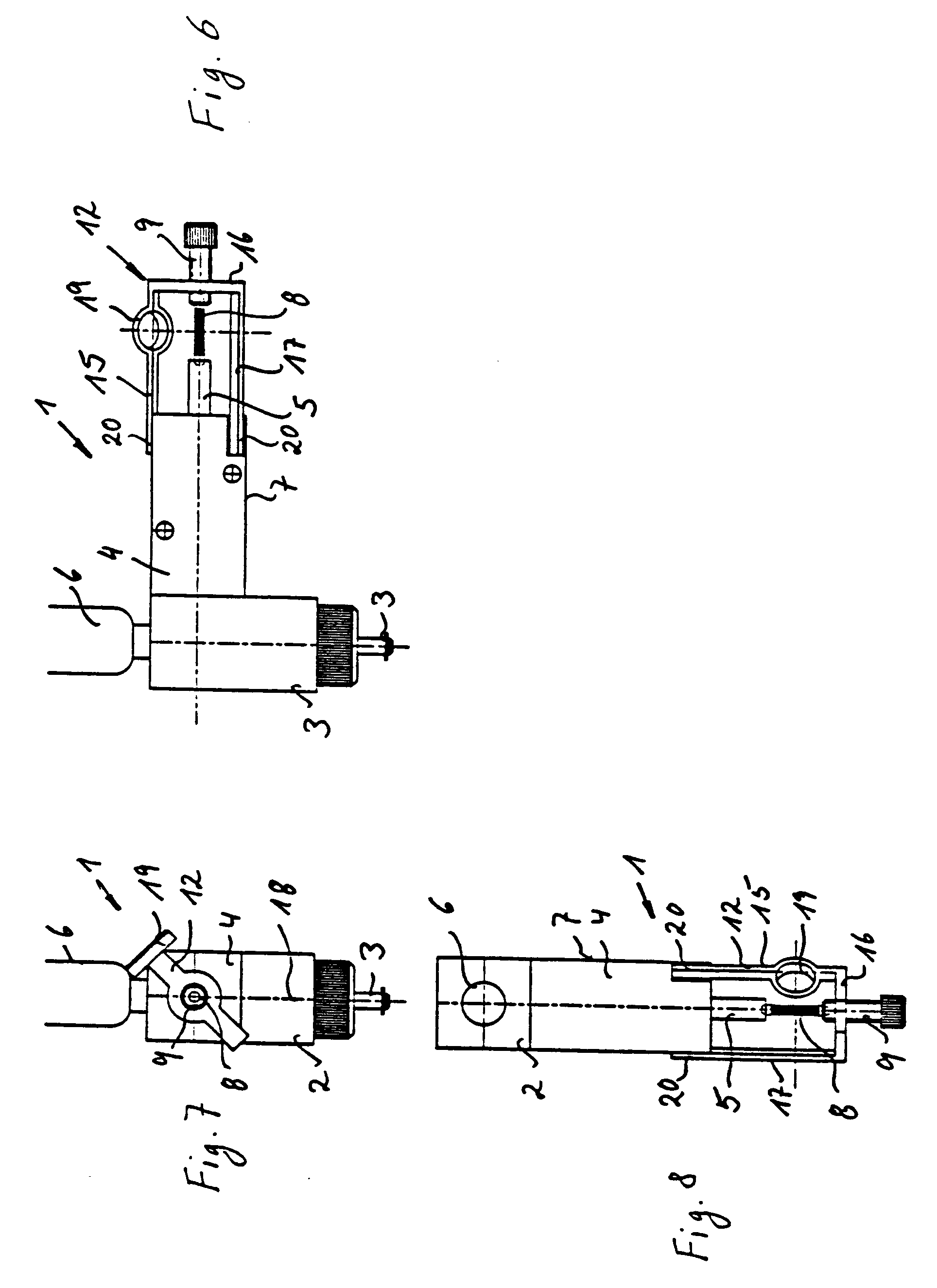
Figure 6 is a side view similar to Figure 1, showing an alternative device according
to the invention having a U-shaped clamp;
Figure 7 is a front view of the device of Figure 6, and
Figure 8 is a plan view of the device of Figure 6.
[0007] With reference now to the drawings, the device 1, for the automatic actuation of
ventilation flaps for example, has a piercing piston unit 2 with a piercing piston
3 which has to be kept in a safety position through a locking unit 4 and has a locking
rod member 5. In the event of fire, a compressed air cartridge 6 has to be pierced
by the piercing piston 3 and caused to discharge. Supported on the end of the locking
rod member 5 projecting out of the housing 7 of the locking unit is one end of a thermal
glass-bulb element 8. The other end of this thermal glass-bulb element 8 is supported,
via a screw element 9, against an L-shaped clamp 11 in Figure 1 and against a U-shaped
clamp 12 in Figures 6 to 8. The arms 13 and 14 of the L-shaped clamp 11 or 15, 16,
17 of the U-shaped clamp 12 are formed by relatively narrow square sections. The clamps
11 and 12 have a longitudinal central plane which is arranged inclined at about 45°
to the vertically extending longitudinal axis 18 so that the glass-bulb fuse element
can be blown against laterally from below and obliquely from above and hence freely
altogether. In the longitudinal region of the arm 13 or 15 engaging over the thermal
glass-bulb fuse element 8, the arm is made circular with a flow space 19 so that the
inflowing air can emerge unhindered through the flow space 19.
[0008] As can be seen in particular in the illustrations shown in Figures 4 and 5, the L-shaped
clamp 11 has a predetermined bending point 21 in the region of its connection 20 to
the housing, which predetermined bending point ensures that the device is in a position
to work in an operationally reliable manner in the way already outlined, for example
in the case where the capillary tube 22 of the thermal glass-bulb element has been
damaged, for example during insertion, and the liquid 23 with which the thermal glass-bulb
element is filled has emerged.
1. A device for the preferably pneumatic automatic actuation particularly of ventilation
flaps, ventilation louvres and the like in smoke and heat offtake installations, having
a locking unit (4) which holds one or more piercing pistons (3) of an energy-carrying
unit (6) in their locked position, which comprises a fuse responding depending on
temperature, particularly a thermal fuse element (8) which bursts when a critical
temperature is exceeded, which fuse can be supported at one end on a longitudinally
movable locking rod member (5) which is in operational communication with the piercing
piston (3), or pistons, characterised in that a U-shaped or L-shaped clamp (11, 12),
which engages over the fuse and has a central longitudinal plane inclined to the vertically
extending longitudinal axis (18) of the locking unit (4), is provided to support the
other end of the fuse (8).
2. A device according to claim 1, characterised in that the longitudinal central plane
of the clamp (11, 12) is inclined at about 45° to the vertical (18).
3. A device according to claim 1 or 2, characterised in that the clamp (11, 12) is
held on one or two lateral outer edge region(s) of a housing member (7) receiving
the locking rod member (5).
4. A device according to any one of the claims 1 to 3, characterised in that the arms
(13, 14, 15, 16, 17) of the clamp are substantially formed by narrow square sections.
5. A device according to any one of the claims 1 to 4, characterised in that the arm
(13) of the clamp (11) engaging over the fuse (7) is made substantially circular with
a flow space (19), in its longitudinal region bounding the fuse (8).
6. A device according to any one of the claims 1 to 5, with an L-shaped clamp (11)
characterised in that one arm (13) of the L-shaped clamp (11) engaging over the fuse
(8) is provided with a predetermined bending point (21).
7. A device according to claim 6, characterised in that the predetermined bending
point (21) in the arm (13) engaging over the fuse (8) is provided in a region close
to its connection (20) to the housing.
1. Vorrichtung zur vorzugsweise pneumatischen Zwangsbetätigung von insbesondere Lüftungsklappen,
Lüftungslamellen und dgl. in Rauch- und Wärmeabzugseinrichtungen einer einen oder
mehrere Anstechkolben (3) einer Energieträgereinheit (6) in ihrer Sperrstellung haltenden
Sperreinheit (4), die eine temperaturabhängig ansprechende, an einem Ende an einem
längsbeweglichen, mit dem Anstechkolben (3), oder den Kolben, in Wirkverbindung stehenden
Sperrstangenteil (5) abstützbare Sicherung, insbesondere ein bei Überschreiten einer
kritischen Temperatur zerberstendes Thermosicherungselement (8), umfaßt, dadurch gekennzeichnet,
daß zur Abstützung des anderen Endes der Sicherung (8) ein die Sicherung übergreifender
U- oder L-förmiger Spannbügel (11,12) mit zur vertikal verlaufenden Längsachse (18)
der Sperreinheit (4) geneigter Längsmittelebene vorgesehen ist.
2. Vorrichtung nach Anspruch 1, dadurch gekennzeichnet, daß die Längsmittelebene des
Spannbügels (11, 12) um in etwa 45° zur Vertikalen (18) geneigt ist.
3. Vorrichtung nach Anspruch 1 oder 2, dadurch gekennzeichnet, daß der Spannbügel
(11, 12) an einem bzw. zwei Seitenaußenkantenbereich(en) eines das Sperrstangenteil
(5) aufnehmenden Gehäuseteils (7) gehaltert ist.
4. Vorrichtung nach einem der Ansprüche 1 bis 3, dadurch gekennzeichnet, daß die Spannhügelschenkel
(13, 14, 15, 16, 17) im wesentlichen durch Vierkantschmalprofile gebildet sind.
5. Vorrichtung nach einem der Ansprüche 1 bis 4, dadurch gekennzeichnet, daß der die
Sicherung (7) übergreifende Schenkel (13) des Spannbügels (11) in seinem die Sicherung
(8) hegrenzenden Längsbereich im wesentlichen kreisförmig mit einem Durchströmraum
(19) ausgebildet ist.
6. Vorrichtung nach einem der Ansprüche 1 bis 5, mit einem L-förmigen Spannbügel,
dadurch gekennzeichnet, daß ein Schenkel (13) des die Sicherung (8) übergreifenden
L-förmigen Spannbügels (11) mit einer Sollknickstelle (21) versehen ist.
7. Vorrichtung nach Anspruch 6, dadurch gekennzeichnet, daß die Sollknickstelle (21)
in dem die Sicherung (8) übergreifenden Schenkel (13) in einem Bereich nahe seines
Gehäusebefestigungsanschlusses (20) vorgesehen ist.
1. Dispositif d'actionnement automatique, de préférence pneumatique, en particulier
pour des volets de ventilation, des jalousies de ventilation et des dispositifs similaires,
dans des installations d'évacuation de fumée et de chaleur, comportant une unité de
verrouillage (4) qui maintient, dans leur position verrouillée, un ou plusieurs pistons
de perçage (3) d'une unité (6) de transport d'énergie, ce dispositif comprenant un
fusible sensible à la température, en particulier un élément thermofusible (8) qui
explose lorsqu'une température critique est dépassée, ce fusible pouvant être supporté,
à une extrémité, sur une tige de verrouillage (5) mobile longitudinalement, laquelle
est en communication opérationnelle avec le ou les pistons de perçage (3), caractérisé
en ce qu'une pince (11, 12) en forme de U ou de L, qui s'étend par-dessus le fusible
et qui a un plan longitudinal central incliné par rapport à l'axe longitudinal (18),
s'étendant verticalement, de l'unité de verrouillage (4), est prévue pour supporter
l'autre extrémité du fusible (8).
2. Dispositif suivant la revendication 1 caractérisé en ce que le plan longitudinal
central de la pince (11, 12) est incliné d'environ 45° par rapport à la verticale
(18).
3. Dispositif suivant l'une quelconque des revendications 1 ou 2 caractérisé en ce
que la pince (11, 12) est maintenue sur une ou deux zones latérales du bord externe
d'un boîtier (7) recevant la tige de verrouillage (5).
4. Dispositif suivant l'une quelconque des revendications 1 à 3 caractérisé en ce
que les bras (13, 14, 15, 16, 17) de la pince sont sensiblement formés par des sections
carrées étroites.
5. Dispositif suivant l'une quelconque des revendications 1 à 4 caractérisé en ce
que le bras (13) de la pince (11) s'étendant au-dessus du fusible (7) est rendu sensiblement
circulaire avec un espace d'écoulement (19), dans sa région longitudinale bordant
le fusible (8).
6. Dispositif suivant l'une quelconque des revendications 1 à 5, comportant une pince
(11) en forme de L, caractérisé en ce qu'un bras (13) de la pince (11) en forme de
L, s'étendant par-dessus le fusible (8), est prévu avec un point de flexion prédéterminé
(21).
7. Dispositif suivant la revendication 6 caractérisé en ce que le point de flexion
prédéterminé (21) dans le bras (13) s'étendant par-dessus le fusible (8) est prévu
dans une région proche de son point de liaison (20) avec le boîtier.