|
(11) | EP 0 342 843 B1 |

| (12) | EUROPEAN PATENT SPECIFICATION |
|
|
| (54) |
Process for preparing racemic dihalovinylcyclopropane carboxylic acid halides Verfahren zur Herstellung von racemischen Cyclopropancarbonsäurehalogeniden Procédé pour la préparation d'halogénures d'acides cyclopropanecarboxyliques racémiques |
|
|
|||||||||||||||||||||||||||||||
| Note: Within nine months from the publication of the mention of the grant of the European patent, any person may give notice to the European Patent Office of opposition to the European patent granted. Notice of opposition shall be filed in a written reasoned statement. It shall not be deemed to have been filed until the opposition fee has been paid. (Art. 99(1) European Patent Convention). |
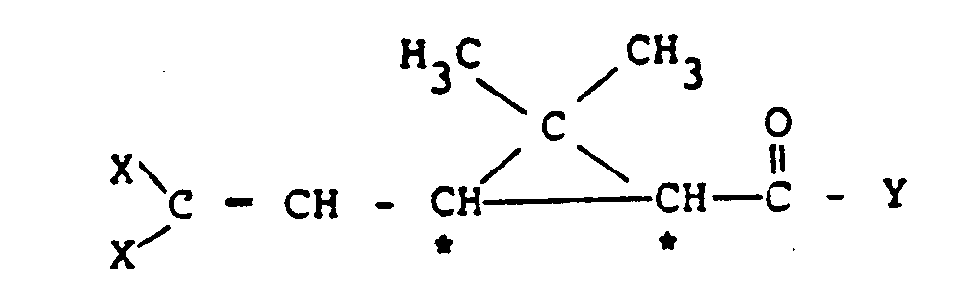
[0001] The present invention relates to a process for preparing racemic dihalovinylcyclopropane carboxylic acid halides having the formula
where both X and Y stand for halogen atoms and the mark * shows an asymmetric carbon atom.
[0002] Dihalovinylcyclopropane carboxylic acids, e.g., 2,2-dimethyl-3-(2,2-dihalovinyl)-cyclopropane carboxylic acid (hereinafter referred to as dihalo acid) corresponding to the compound belonging to the formula (I) where Y is a hydroxyl group is an acid moiety of permethrin, cypermethrin, insecticides which are familiar as household ones and are strongly active against agricultural or forest pests. Dihalo acid halides are useful as intermediates of these insecticides.
[0003] Dihalo acid halides having the formula (I) have four isomers, i.e., two geometrical isomers, cis and trans, each of which has two optical isomers, (+) and (-). It has been known that, in generel,the pyrethroidal esters derived from (+) isomers have greater insecticidal activity than those derived from (-) isomers and that esters in the trans form are far less toxic against mammals than those in the cis form (Nature 244, 456, 1973). Dihalo acids industrially available are usually in the racemic mixture, i,e., as (±) form, each of which is in a mixture of cis- and trans isomers. Optical resolution of the acids by mean of optically active organic base is effected to obtain (+)-isomers which are used for preparing highly active insecticidal compounds. Alternatively, asymmetric hydrolysis with enzymes is also effected to obtain the effective isomers, when the acids above are in the form of esters. Wherein, the remaining (-)-isomer after the resolution is least useful, since the esters composed thereof is almost inactive. Accordingly, it is a problem to be solved in the production of the (+)-form acid,-particularly in a commercial scale, that the (+)-form acid be racemized with a high efficiency, so as to be utilized again at the material for the optical resolution method above. However, a great difficulty is encountered in the racemization, since the cyclopropane carboxylic acids of the formula (I) above have two asymmetric carbon atoms at C₁ and C₃.
[0004] A method for racemization of dihalo acids is reported in which the reaction underwent by irradiating the dihalo acids with ultraviolet rays in the presence of photosensitizers (Japanese Patent Kokai 50-160242). However, the process is not necessarily economical, since an expensive apparatus for the photochemical reaction and expensive apparatus for the photochemical reaction and a large amount of electric energy are needed.
[0005] US-A-4182906 discloses a method for racemisation of optically active 2,2-dimethyl-3-(1′-alkenyl)-cyclopropane-1-carboxylic acids by contacting the corresponding acid halides with boron halide.
[0006] EP-A-261824 discloses a method for racemising optically active chrysanthemic acid using hydrogen bromide or phosphorus bromide.
[0007] After an extensive study, the present inventors succeeded in finding the fact that phosphorus iodides, silicon iodides or boron iodides facilitate racemization of optically active dihalo acid halides, and established the present invention after more additional research are made.
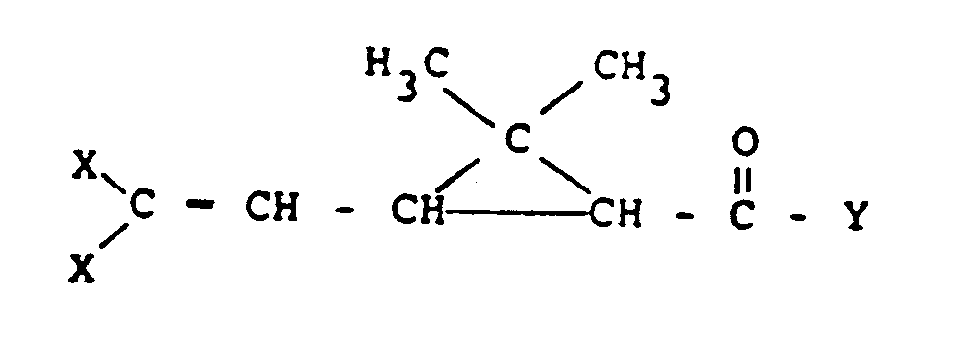
[0008] According to the present invention, a process for preparing racemic dihalovinylcyclopropane carboxylic acid halides by allowing iodides selected from phosphorus iodides, silicon iodides and boron iodides to react with optically active dihalovinylcyclopropane carboxylic acid halides of the formula
wherein both X and Y are halogen atoms and the mark * shows asymmetric carbon atoms.
[0009] Optically active dihalo acid halides (I) include, for example, optically active dichloro acid chloride, difluoro acid chloride, chlorofluoro acid chloride, dibromo acid chloride, dichloro acid bromide or dibromo acid bromide, usually dihalo acid chlorides are preferable from the point of easiness in handling and cost.
[0010] There are four isomers as stated above in the dihalo acid halides. Any of the four isomers can be used as starting material, either alone or in mixtures. The racemization can be attained irrespective of the optical purity of the starting material. The racemization method always gives the trans-rich reaction product regardless of the isomeric composition of the starting material.
[0011] Iodides of phosphorus, silicon or boron are, for example, phosphorus triiodide, silicon tetraiodide or boron triiodide. They are used usually in an amount of 1/200 - 1, preferably 1/100 - 1/10 time as much as dihalo acid halides, in mole.
[0012] The use of iodine halides together with phosphorus iodides or the use of iodine together with silicon iodides facilitates the racemization reaction. An amount of the iodine halides or iodine is usually 1/200 - 1, preferably 1/100 - 1/10 time as much as dihalo acid halides, in mole. Iodine halides are, for example, iodine, iodine bromide or iodine chloride.
[0013] The racemization is usually conducted in the presence of inert organic solvents. They are, for example, aromatic hydrocarbons such as benzene, toluene, xylene, cumene, trimethylbenzene or nitrobenzene; halogenated hydrocarbons such as chloroform, carbon tetrachloride, chlorobenzene, o-dichlorobenzene or bromobenzene; saturated hydrocarbons such as hexane, heptane, cyclohexane or cycloheptane; ethers such as tetrahydropyran, 1,4-dioxane, 1,3-dioxane, tetrahydrofuran, 2-methyltetrahydrofuran, isopropyl ether, dibutyl ether or butyl methyl ether; or nitriles such as acetonitrile, propionitrile or butyronitrile, preferably halogenated hydrocarbons.
[0014] The racemization is usually conducted in such a manner that phosphorus iodides, silicon iodides or boron iodides and then, if desired, iodine halides are added to a solution of dihalo acid halides in solvents.
[0015] Reaction temperature is usually 40 - 150 °C, preferably 80 - 120 °C, although it varies depending on amounts and kinds of phosphorus iodides, silicon iodides or boron iodides employed.
[0016] Reaction time is usually from 30 min. to 20 hours, although it varies depending on amounts and kinds of phosphorus iodides, silicon iodides, boron iodides and iodine halides.
[0017] Progress of the reaction may be checked by analysing a portion of reaction mixture with gas chromatography or NMR or IR spectroscopy.
[0018] To the reaction mass or the reaction product which has been isolated from the reaction mixture are added 2-phenoxybenzyl alcohol, 5-benzyl-3-furylmethyl alcohol, 4-methyl-3-heptene-6-in-5-ol or 4-fluoro-3-heptene-6-in-5-ol to prepare low mammalian toxic insecticides. The isolation of the product compound is effected in such a manner that the reaction mass from which a catalyst has been removed is subjected to distillation or the like. Alternatively, ethanol or the like is added to the reaction mass to effect direct esterification and then the product may be subjected to biochemically optical resolution. Another approach is addition of aqueous alkaline solution to the reaction mass until free acids are obtained by hydrolysis.
[0019] According to the present process, racemic dihalo acids are produced with high efficiency without specific apparatuses. The racemic dihalo acids obtained are rich in trans-isomers which are low-toxic against mammals.
[0020] The present process can also be used for conversion of racemic cis-isomer or racemic mixture of cis-and trans-isomers of dihalo acid halides into the corresponding racemic trans-rich isomer.
Example 1
[0022] To a solution of levo-rotatory dichloro acid chloride (1.03 g; composition: (+)-cis 18.6 %, (-)-cis 78.0 %, (+)-trans 1.6 %, and (-)-trans 1.8 %) in chlorobenzene (22 g) were added phosphorus triiodide (300 mg) and iodine (50 mg) under a nitrogen atmosphere. The mixture was stirred at 100 °C for 10 hours.
[0023] Then, a part of the reaction solution was taken as a sample and converted to ester with (+)-2-octanol. Gas chromatographic analysis gave the following optical isomer ratio: (+)-cis 10 %, (-)-cis 14.6 %, (+)-trans 39.4 % and (-)-trans 36.0 %.
[0024] The reaction solution was cooled to room temperature, and thereto were added ethanol (230 mg) and pyridine (390 mg). The mixture was stirred at room temperature for 1 hour, washed with water and subjected to distillation to remove the solvent. Solution thus obtained was distilled off to obtain a fraction (960 mg, a boiling point: 88 -90 °C/1 mmHg). This product was identified as dichloro acid ethyl ester by IR spectrum.
Example 2
[0025] To a solution of levo-rotatory dichloro acid chloride (1.95 g; composition: (+)-trans 7.1 % and (-)-trans 92.9 %) in chlorobenzene (24 g) were added phosphorus triiodide (150 mg) and iodine (92 mg) under a nitrogen atmosphere. The mixture was stirred at 100 °C for 13 hours.
[0026] Then, the similar procedure to that in Example 1 was applied to until dichloro acid ethyl ester (1.91 g) was obtained. The optical isomer ratio: (+)-cis 9.9 %, (-)-cis 8.5 %, (+)-trans 34.4 % and (-)-trans 47.2 %.
Example 3
[0027] To a solution of the same dichloro acid chloride (3.24 g) as used in Example 1 in chlorobenzene (47 g) were added phosphorus triiodide (750 mg) and iodine-monochloride (150 mg) under a nitrogen atmosphere. The mixture was stirred at 100 °C for 6 hours.
[0028] Then, the mixture was cooled to room temperature, hydrolyzed with 15 % aqueous sodium hydroxide solution, acidified with 70 % sulfuric acid and extracted with toluene. The toluene was removed by distillation to obtain a white solid (2.67 g). The solid was identified as dichloro acid by IR spectrum.
[0029] A part of the solid was taken as a sample and converted to (+)-2-octyl ester by a usual manner. Gas chromatographic analysis gave the following optical isomer ratio: (+)-cis 7.9 %, (-)-cis 11.5 %, (+)-trans 41.6 % and (-)-trans 39.0 %.
Example 4
[0030] To a solution of the same dichloro acid chloride (1.05 g) as used in Example 1 in chlorobenzene (16 g) were added phosphorus triiodide (260 mg) and iodine monobromide (140 mg) under a nitrogen atmosphere. The mixture was stirred at 100 °C for 4 hours.
[0031] Then, the similar procedure to that in Example 1 was applied to until dichloro acid ethyl ester (1.03 g) was obtained.
[0032] The optical isomer ratio: (+)-cis 8.6 %, (-)-cis 11.6 %, (+)-trans 41.8 % and (-)-trans 38.0 %.
Example 5
[0033] To a solution of the same dichloro acid chloride (930 mg) as used in Example 1 in 1,4-dioxane (20 g) were added phosphorus triiodide (310 mg) and iodine (190 mg) under a nitrogen atmosphere. The mixture was stirred at 100 °C for 4 hours.
[0034] Then, the similar procedure to that in Example 1 was applied to until dichloro acid ethyl ester (856 mg) was obtained.
[0035] The optical isomer ratio: (+)-cis 7.3 %, (-)-cis 10.8 %, (+)-trans 45.7 % and (-)-trans 36.2 %.
Example 6
[0036] To a solution of the same dichloro acid chloride (980 mg) as used in Example 2 in 1,2-dichloroethane (23 g) were added phosphorus triiodide (550 mg) and iodine (170 mg) under a nitrogen atmosphere. The mixture was stirred at 80 °C for 14 hours.
[0037] The optical isomer ratio: (+)-cis 7.9 %, (-)-cis 8.0 %, (+)-trans 38.7 % and (-)-trans 45.4 %.
Example 7
[0038] To a solution of levo-rotatory dichloro acid chloride (2.5 g; composition: (+)-cis 4.1 %, (-)-cis 2.9 %, (+)-trans 13.8 % and (-)-trans 79.2 %) in chlorobenzene (18 g) were added silicon tetraiodide (590 mg) and iodine (140 mg) under a nitrogen atmosphere. The mixture was stirred at 100 °C for 4 hours.
[0039] A part of the reaction solution was converted to ester with (+)-2-octanol. Gas chromatographic analysis gave the following optical isomer ratio: (+)-cis 9.4 %, (-)-cis 7.8 %, (+)-trans 34.7 % and (-)-trans 48.1 %.
[0040] The reaction solution was cooled to room temperature and thereto were added ethanol (660 mg) and pyridine (1.13 g). The mixture was stirred at room temperature for 1 hour and washed with water. After the solvent was evaporated, the residue was distilled to give a fraction (2.37 g, a boiling point: 88-90 °C/1 mmHg). The fraction was identified as dichloro acid ethyl ester by IR spectrum.
Example 8
[0041] To a solution of the same dichloro acid chloride (2.5 g) as used in Example 7 in chlorobenzene (11 g) were added silicon tetraiodide (625 mg) and iodine (100 mg) under a nitrogen atmosphere. The mixture was stirred at 110 °C for 6 hours.
[0042] Then, the reaction mixture was worked up according to the treatment in Example 7 to give dichloro acid ethyl ester (2.18 g).
[0043] The optical isomer ratio: (+)-cis 9.3 %, (-)cis 8.2 %, (+)-trans 36.3 % and (-)-trans 46.2 %.
Example 9
[0044] To a solution of the same dichloro acid chloride (2.5 g) as used in Example 7 in toluene (14 g) were added silicon tetraiodide (1.08 g) and iodine (274 mg) under a nitrogen atmosphere. The mixture was stirred at 100 °C for 8 hours.
[0045] The optical isomer ratio: (+)-cis 8.1 %, (-)-cis 7.3 %, (+)-trans 37.7 % and (-)-trans 46.9 %.
Example 10
[0046] To a solution of the same dichloro acid chloride (1.01 g) as used in Example 2 in chlorobenzene (23 g) was added phosphorus triiodide (630 mg) under a nitrogen atmosphere. The mixture was stirred at 100 °C for 9 hours. The reaction mixture was worked up according to the treatment in Example 1 to give dichloro acid ethyl ester.
[0047] The optical isomer ratio: (+)-cis 8.9 %, (-)-cis 8.6 %, (+)-trans 37.5 % and (-)-trans 45.0 %.
Example 11
[0048] To a solution of the same dichloro acid chloride (2.5 g) as used in Example 7 in chlorobenzene (14 g) was added silicon tetraiodide (567 mg) under a nitrogen atmosphere. The mixture was stirred at 100 °C for 4 hours.
[0049] The reaction mixture was worked up according to the treatment in Example 7 to give dichloro acid ethyl ester (2.17 g).
[0050] The optical isomer ratio: (+)-cis 11.3 %, (-)-cis 5.7 %, (+)-trans 25.3 % and (-)-trans 57.7 %.
Example 12
[0051] To a solution of the same dichloro acid chloride (2.5 g) as used in Example 7 in acetonitrile (31 g) was added silicon tetraiodide (1.17 g) under a nitrogen atmosphere. The mixture was stirred at 80 °C for 8 hours.
[0052] The reaction mixture was worked up according to the treatment in Example 7 to give dichloro acid ethyl ester.
[0053] The optical isomer ratio: (+)-cis 8.6 %, (-)-cis 4.8 %, (+)-trans 27.9 % and (-)-trans 58.7 %.
Example 13
[0054] To a solution of levo-rotatory dichloro acid chloride (1.21 g; composition: (+)-cis 3.0 %, (-)-cis 2.9 %, (+)-trans 14.1 % and (-)-trans 80.0 %) in chlorobenzene (22 g) was added boron triiodide (290 mg) under a nitrogen atmosphere. The mixture was stirred at 100 °C for 8 hours.
[0055] A part of the reaction solution was converted to ester with (+)-2-octanol. Gas chromatographic analysis gave the optical isomer ratio: (+)-cis 11.4 %, (-)-cis 7.2 %, (+)-trans 28.6 % and (-)-trans 52.8 %.
[0056] The reaction mixture was cooled to room temperature, and ethanol (270 mg) and pyridine (460 mg) were added thereto. The mixture was stirred at room temperature for 1 hour and washed with water. After the solvent was evaporated under reduced pressure, the residue was distilled to give a fraction (1.13 g, a boiling point: 88 - 90 °C/1 mmHg). The fraction was identified as dichloro acid ethyl ester by IR spectrum.
Example 14
[0057] Example 13 was repeated except that boron triiodide (540 mg) and chlorobenzene (6 g) were used to obtain dichloro acid ethyl ester (1.07 g).
[0058] The optical isomer ratio: (+)-cis 9.9 %, (-)-cis 7.6 %, (+)-trans 38.2 % and (-)-trans 44.3 %.
Example 15
[0059] To a solution of the same levo-rotatory dichloro acid chloride (1.21 g) as used in Example 1 in 1,2-dichloroethane (25 g) was added boron triiodide (320 mg) under a nitrogen atmosphere. The mixture was stirred at 80 °C for 8 hours.
[0060] Then, the reaction mixture was cooled to room temperature. The reaction mixture was hydrolyzed with 15 % aqueous sodium hydroxide solution, acidified with 70 % sulfuric acid and extracted with toluene. The toluene was removed by distillation to obtain a white solid (1 g). The solid was identified as dichloro acid by IR spectrum.
[0061] A portion of the solid was converted to (+)-2-octyl ester by a usual manner. Gas chromatographic analysis gave the following optical isomer ratio: (+)-cis 6.4 %, (-)-cis 12.2 %, (+)-trans 54.1 % and (-)-trans 27.3 %.
Example 16
[0062] To a solution of the same dichloro acid chloride (1.19 g) as based in Example 1 in toluene (17.4 g) was added boron triiodide (320 mg) under a nitrogen atmosphere. The mixture was stirred at 100 °C for 8 hours.
[0063] Then, the reaction mixture was worked up according to the treatment in Example 13 to give dichloro acid ethyl ester (1.09 g). The optical isomer ratio: (+)-cis 7.6 %, (-)-cis 21.1 %, (+)-trans 50.9 % and (-)-trans 20.4 %.
Example 17
[0064] To a solution of the same dichloro acid chloride (1.35 g) as used in Example 1 in acetonitrile (15.7 g) was added boron triiodide (390 mg) under a nitrogen atmosphere. The mixture was stirred at 80 °C for 10 hours.
[0065] Then, the reaction mixture was worked up according to the treatment in Example 13 to give dichloro acid ethyl ester (1.16 g). The optical isomer ratio: (+)-cis 5.2 %, (-)-cis 9.6 %, (+)-trans 57.4 % and (-)-trans 27.8 %.
Comparative Example 1
[0066] Example 13 was repeated except that boron tribromide (190 mg) was used in place of boron triiodide.
[0067] The optical isomer ratio: (+)-cis 3.9 %, (-)-cis 3.7 %, (+)-trans 15.7 % and (-)-trans 76.7 %.
Comparative Example 2
[0068] Example 13 was repeated except that boron trichloride (190 mg) was used in place of boron triiodide.
[0069] The optical isomer ratio: (+)-cis 3.0 %, (-)-cis 3.0 %, (+)-trans 14.0 % and (-)-trans 80.0 %.
Example 18
[0070] To a solution of dichloro acid chloride (1.95 g; composition: cis 96.3 % and trans 3.7 %) in chlorobenzene (20 g) were added phosphorus triiodide (260 mg) and iodine (160 mg) under a nitrogen atmosphere. The mixture was stirred at 80 °C for 6 hours.
[0071] Then, the reaction mixture was cooled to room temperature. Ethanol (430 mg) and pyridine (750 mg) were added to the solution. The mixture was stirred at room temperature for one hour and washed with water. After the solvent was removed by distillation, the remaining solution was subjected to distillation to obtain a fraction (1.89 g, a boiling point: 88 - 90 °C/1 mmHg). The fraction was identified as dichloro acid ethyl ester by IR spectrum. Gas chromatographic analysis gave the following result: cis 21.1 % and trans 78.9 %.
Example 19
[0072] To a solution of dichloro acid chloride (3.24 g; composition: cis 96.6 % and trans 3.4 %) in chlorobenzene (47 g) were added phosphorus triiodide (750 mg) and iodine-monochloride (150 mg) under a nitrogen atmosphere. The mixture was stirred at 100 °C for 6 hours.
[0073] Then, the reaction mixture was cooled to room temperature, hydrolyzed with 15 % aqueous sodium hydroxide solution, acidified with 70 % sulfuric acid and extracted with toluene. The toluene was removed by distillation to obtain a white solid (2.67 g). The solid was identified as dichloro acid by IR spectrum.
[0074] A portion of the solid was converted to ethyl ester by a usual manner. Gas chromatographic analysis gave the following result: cis 19.4 % and trans 80.6 %.
Example 20
[0075] To a solution of the same dichloro acid chloride (1.05 g) as used in Example 19 in chlorobenzene (16 g) were added phosphorus triiodide (260 mg) and iodine monobromide (140 mg) under a nitrogen atmosphere. The mixture was stirred at 100 °C for 4 hours.
[0076] Then, the reaction mixture was worked up according to the treatment in Example 18 to give dichloro acid ethyl ester (1.03 g).
Example 21
[0078] To a solution of the same dichloro acid chloride (2.34 g) as used in Example 18 in chlorobenzene (24 g) were added phosphorus triiodide (330 mg) and iodine (200 mg) under a nitrogen atmosphere. The mixture was stirred at 65 °C for 10 hours.
[0079] Then, the reaction mixture was worked up according to the treatment in Example 18. Gas chromatographic analysis gave the following isomer ratio: cis 39 % and trans 61 %.
Example 22
[0080] To a solution of the same dichloro acid chloride (1.37 g) as used in Example 18 in 1,2-dichloroethane (26 g) were added phosphorus triiodide (170 mg) and iodine (100 mg) under a nitrogen atmosphere. The mixture was stirred at 80 °C for 6 hours.
[0081] Then, the reaction mixture was worked up according to the treatment in Example 18 to give dichloro acid ethyl ester (1.30 g). Gas chromatographic analysis gave the following isomer ratio: cis 25.7 % and trans 74.3 %.
Example 23
[0082] To a solution of the same dichloro acid chloride (930 mg) as used in Example 19 in 1,4-dioxane (20 g) were added phosphorus triiodide (310 mg) and iodine (190 mg) under a nitrogen atmosphere. The mixture was stirred at 100 °C for 4 hours.
[0083] Then, the reaction mixture was worked up according to the treatment in Example 18 to give dichloro acid ethyl ester (856 mg). Gas chromatographic analysis gave the following isomer ratio: cis 18.1 % and trans 81.9 %.
Example 24
[0084] To a solution of the same dichloro acid chloride (2 g) as used in Example 18 in chlorobenzene (7.5 g) were added silicon tetraiodide (207 mg) and iodine (105 mg) under a nitrogen atmosphere. The mixture was stirred at 80 °C for 4 hours.
[0085] Then, the reaction solution was cooled to room temperature. Ethanol (526 mg) and pyridine (903 mg) were added to the solution. The mixture was stirred at room temperature for 1 hour and washed with water. After the solvent was removed by distillation, the residue was subjected to distillation to obtain a fraction (1.96 g, a boiling point: 88 - 90 °C/1 mmHg). The fraction was identified as dichloro acid ethyl ester by IR spectrum.
Example 25
[0087] To a solution of the same dichloro acid chloride (2 g) as used in Example 18 in chlorobenzene (18 g) were added silicon tetraiodide (217 mg) and iodine monochloride (61 mg) under a nitrogen atmosphere. The mixture was stirred at 80 °C for 4 hours.
[0088] Then, the reaction mixture was worked up according to the treatment in Example 24 to give dichloro acid ethyl ester (1.95 g).
Example 26
[0090] To a solution of the same dichloro acid chloride (2 g) as used in Example 18 in chlorobenzene (18 g) were added silicon tetraiodide (212 mg) and iodine-monobromide (122 mg) under a nitrogen atmosphere. The mixture was stirred at 80 °C for 4 hours.
[0091] Then, the reaction mixture was worked up according to the treatment in Example 24 to give dichloro acid ethyl ester (1.86 g).
Example 27
[0093] To a solution of the same dichloro acid chloride (2 g) as used in Example 18 in acetonitrile (18 g) were added silicon tetraiodide (448 mg) and iodine (212 mg) under a nitrogen atmosphere. The mixture was stirred at 80 °C for 4 hours.
Example 28
[0095] To a solution of the same dichloro acid chloride (2 g) as used in Example 18 in dichloroethane (18 g) were added silicon tetraiodide (212 mg) and iodine(100 mg) under a nitrogen atmosphere. The mixture was stirred at 80 °C for 4 hours.
[0096] Then, the reaction mixture was worked up according to the treatment in Example 24 to give dichloro acid ethyl ester (1.95 g).
Example 29
[0098] To a solution of the same dichloro acid chloride (1.47 g) as used in Example 18 in chlorobenzene (23 g) was added phosphorus triiodide (140 mg) under a nitrogen atmosphere. The mixture was stirred at 100 °C for 8 hours.
[0099] Then, the reaction mixture was worked up according to the treatment in Example 18 to give dichloro acid ethyl ester (1.44 g).
Example 30
[0101] To a solution of the same dichloro acid chloride (2 g) as used in Example 18 in chlorobenzene (8.1 g) was added silicon tetraiodide (198 mg) under a nitrogen atmosphere. The mixture was stirred at 80 °C for 4 hours.
[0102] Then, the reaction mixture was worked up according to the treatment in Example 18 to give dichloro acid ethyl ester (2.01 g).
Example 31
[0104] To a solution of the same dichloro acid chloride (2.0 g) as used in Example 18 in chlorobenzene (18 g) was added boron triiodide (110 mg) under a nitrogen atmosphere. The mixture was stirred at 100 °C for 3 hours.
[0105] Then, the reaction solution was cooled to room temperature. Ethanol (440 mg) and pyridine (770 mg) were added to the solution. The mixture was stirred at room temperature for 1 hour and washed with water. After the solvent was distilled, the residue solution was subjected to distillation to obtain a fraction (2.0 g, a boiling point: 88 - 90 °C/1 mmHg).
[0106] The fraction was identified as dichloro acid ethyl ester by IR spectrum. Gas chromatographic analysis gave the following result: cis 21.1 % and trans 78.9 %.
Example 32
[0107] To a solution of dichloro acid chloride (3.08 g; composition: cis 45.0 % and trans 55.0 %) in chlorobenzene (24 g) was added boron triiodide (440 mg) under a nitrogen atmosphere. The mixture was stirred at 80 °C for 6 hours.
[0108] Then, the reaction solution was cooled to room temperature, hydrolyzed with 15 % aqueous sodium hydroxide solution, acidified with 70 % sulfuric acid and extracted with toluene. The toluene was removed by distillation to obtain a white solid (2.64 g). The solid was identified as dichloro acid by IR spectrum.
[0109] A portion of the solid was converted to ethyl ester by a usual manner. Gas chromatographic analysis gave the following isomer ratio: cis 20.7 % and trans 79.3 %.
Example 33
[0110] To a solution of the same dichloro acid chloride (1.19 g) as used in Example 19 in toluene (17.4 g) was added boron triiodide (320 mg) under a nitrogen atmosphere. The mixture was stirred at 100 °C for 8 hours.
[0111] Then, the reaction mixture was worked up according to the treatment in Example 31 to give dichloro acid ethyl ester (1.93 g).
Example 34
[0113] To a solution of the same dichloro acid chloride (1.21 g) as used in Example 19 in 1,2-dichloroethane (25 g) was added boron triiodide (320 mg) under a nitrogen atmosphere. The mixture was stirred at 80 °C for 4 hours.
[0114] Then, the reaction mixture was worked up according to the treatment in Example 31 to give dichloro acid ethyl ester (1.13 g).
Example 35
[0116] To a solution of the same dichloro acid chloride (2.21 g) as used in Example 18 in acetonitrile (26 g) was added boron triiodide (220 mg) under a nitrogen atmosphere. The mixture was stirred at 50 °C for 9 hours.
[0117] Then, the reaction mixture was worked up according to the treatment in Example 31. Isomer ratio was as follows: cis 48 % and trans 52 %.
Comparative Example 3
[0118] A solution of the same dichloro acid chloride (1 .05 g) as used in Example 18 in chlorobenzene (16 g) was stirred under a nitrogen atmosphere at 100 °C for 8 hours.
Comparative Example 4
[0120] Example 31 was repeated except that boron tribromide (70 mg) was used in place of boron triiodide.
Comparative Example 5
1. A process for preparing racemic 2,2-dimethyl-3-2,2-dihalovinyl)-cyclopropane carboxylic
acid halides which comprises allowing iodides selected from phosphorus iodides, silicon
iodides and boron iodides to react with optically active 2,2-dimethyl-3-(2,2-dihalovinyl)cyclopropane
carboxylic acid halides of the formula:
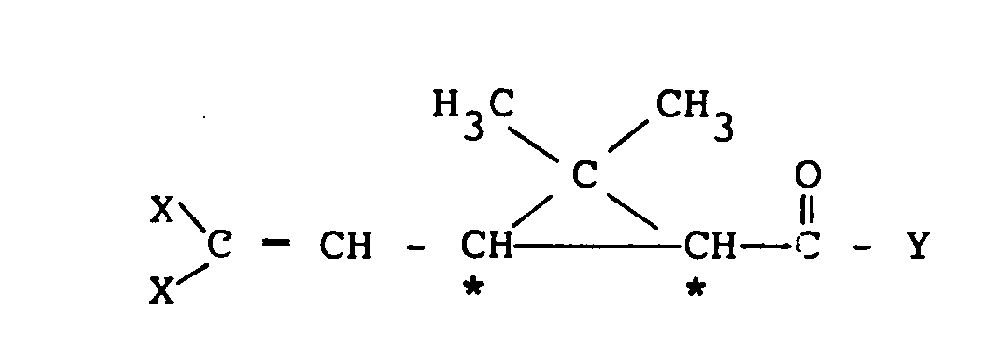
wherein both X and Y stand for halogen atoms and the mark * shows an asymmetric carbon atom.
wherein both X and Y stand for halogen atoms and the mark * shows an asymmetric carbon atom.
2. A process for preparing trans-2,2-dimethyl-3-(2,2-dihalovinyl)-cyclopropane carboxylic
acid halides which comprises allowing iodides selected from phosphorus iodides, silicon
iodides and boron iodides to react with cis- or cis/trans-mixed 2,2-dimethyl-3-(2,2-dihalovinyl)-cyclopropane
carboxylic acid halides of the formula:wherein
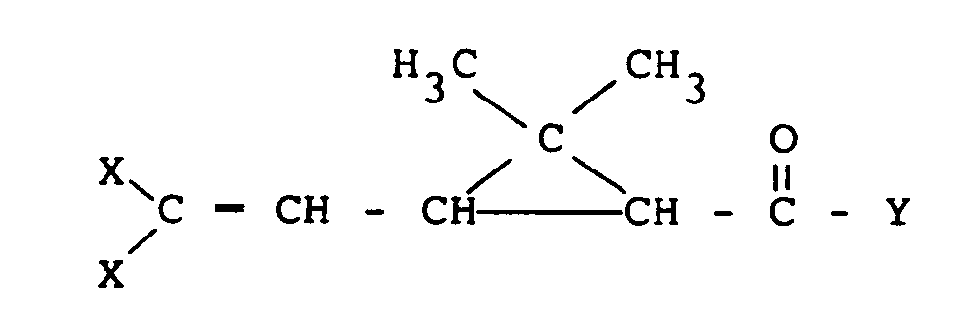
both X and Y stand for halogen atoms.
both X and Y stand for halogen atoms.
3. A process according to any one of Claims 1 to 2 wherein an amount of the iodides is
1/200 - 1 time as much as the dihalo acid halides to be treated, in mole.
4. A process according to any one of Claims 1 to 3 wherein the iodides are phosphorus
iodides.
5. A process according to any one of Claims 1 to 4 wherein the phosphorus iodides are
phosphorus triiodide.
6. A process according to any one of Claims 4 to 5 wherein the reaction is conducted
in the presence of iodine halides.
7. A process according to Claim 6 wherein the iodine halides are iodine, iodine-bromide
or iodine-chloride.
8. A process according to any one of Claims 6 to 7 wherein the amount of the iodine halides
is 1/200 - 1 time as much as the dihalo acid halides to be treated, in mole.
9. A process according to any one of Claims 1 to 3 wherein the iodides are silicon iodides.
10. A process according to any one of Claims 1 to 3 and 9 wherein the silicon iodides
are silicon tetraiodide.
11. A process according to any one of Claims 9 to 10 wherein the reaction is conducted
in the presence of iodine.
12. A process according to Claim 11 wherein an amount of the iodine is 1/200 - 1 time
as much as the dihalo acid halides to be treated, in mole.
13. A process according to any one of Claims 1 to 3 wherein the iodides are boron iodide.
14. A process according to any one of Claims 1 to 3 and 13 wherein the boron iodide is
boron triiodide.
15. A process according to any one of Claims 1 to 14 wherein the reaction is carried out
in such solvents as aromatic hydrocarbons, halogenated hydrocarbons, saturated hydrocarbons,
ethers, nitriles or mixture of them.
16. A process according to any one of Claims 1 to 15 wherein the reaction is conducted
at a temperature of 40 to 150 °C.
1. Verfahren zur Herstellung von razemischen 2,2-Dimethyl-3-(2,2-dihalovinyl)-cyclopropancarbonsäure-Halogeniden,
dadurch gekennzeichnet, daß man Iodide, ausgewählt aus Phosphoriodiden, Siliciumiodiden und Boriodiden mit
optisch aktiven 2,2-Dimethyl-3-(2,2-dihalovinyl)-cyclopropancarbonsäure-Halogeniden
der Formel
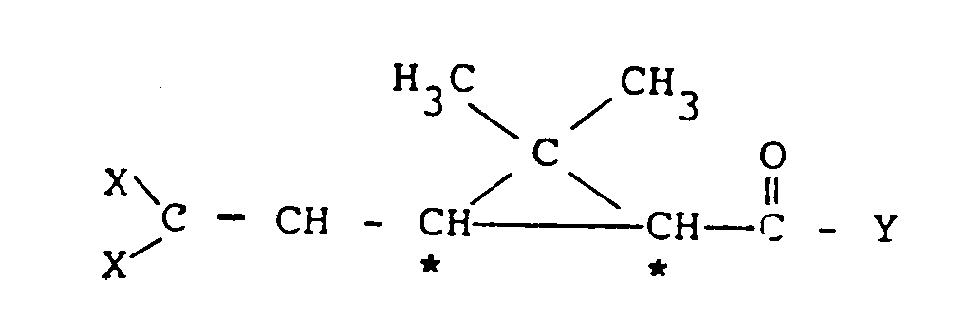
worin sowohl X als auch Y für Halogenatome stehen und die Markierung * ein asymmetrisches Kohlenstoffatom bezeichnet, umsetzt.
worin sowohl X als auch Y für Halogenatome stehen und die Markierung * ein asymmetrisches Kohlenstoffatom bezeichnet, umsetzt.
2. Verfahren zur Herstellung von trans-2,2-Dimethyl-3-(2,2-dihalovinyl)-cyclopropancarbonsäure-Halogeniden,
dadurch gekennzeichnet, daß man Iodide, ausgewählt aus Phosphoriodiden, Siliciumiodiden und Boriodiden mit
cis- oder cis/trans-gemischten 2,2-Dimethyl-3-(2,2-dihalovinyl)-cyclopropancarbonsäure-Halogeniden
der Formel
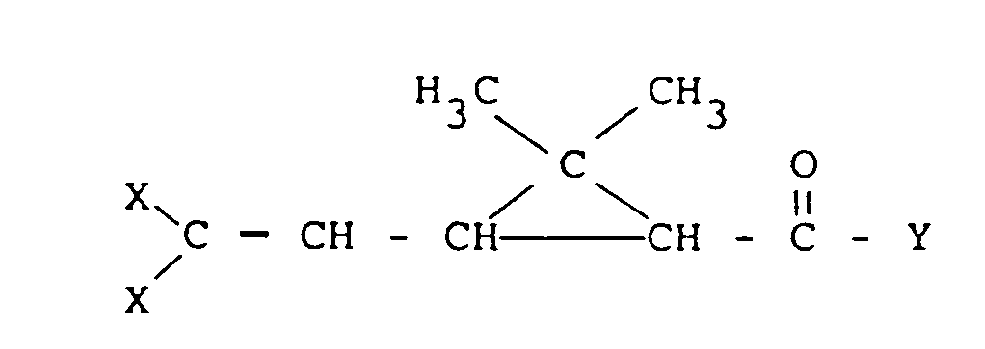
worin sowohl X als auch Y für Halogenatome stehen, umsetzt.
worin sowohl X als auch Y für Halogenatome stehen, umsetzt.
3. Verfahren nach einem der Ansprüche 1 bis 2, dadurch gekennzeichnet, daß die Menge der Iodide die 1/200 - 1fache Menge, ausgedrückt in Mol, der zu behandelnden
Dihalogensäure-Halogeniden ist.
4. Verfahren nach einem der Ansprüche 1 bis 3, dadurch gekennzeichnet, daß die Iodide Phosphoriodide sind.
5. Verfahren nach einem der Ansprüche 1 bis 4, dadurch gekennzeichnet, daß das Phosphoriodid Phosphortriiodid ist.
6. Verfahren nach einem der Ansprüche 4 bis 5, dadurch gekennzeichnet, daß man die Reaktion in Gegenwart von Iodhalogeniden durchführt.
7. Verfahren nach Anspruch 6, dadurch gekennzeichnet, daß die Iodhalogenide Iod, Iodbromid oder Iodchlorid sind.
8. Verfahren nach einem der Ansprüche 6 bis 7, dadurch gekennzeichnet, daß die Menge der Iodhalogenide die 1/200 - 1fache Menge, ausgedrückt in Mol, der
zu behandelnden Dihalogensäure-Halogeniden ist.
9. Verfahren nach einem der Ansprüche 1 bis 3, dadurch gekennzeichnet, daß die Iodide Siliciumiodide sind.
10. Verfahren nach einem der Ansprüche 1 bis 3 und 9, dadurch gekennzeichnet, daß das Siliciumiodid Siliciumtetraiodid ist.
11. Verfahren nach einem der Ansprüche 9 bis 10, dadurch gekennzeichnet, daß man die Reaktion in Gegenwart von Iod durchführt.
12. Verfahren nach Anspruch 11, dadurch gekennzeichnet, daß die Menge des Iods die 1/200 - 1fache Menge, ausgedrückt in Mol, der zu behandelnden
Dihalogensäure-Halogeniden ist.
13. Verfahren nach einem der Ansprüche 1 bis 3, dadurch gekennzeichnet, daß das Iod Boriodid ist.
14. Verfahren nach einem der Ansprüche 1 bis 3 und 13, dadurch gekennzeichnet, daß das Boriodid Bortriiodid ist.
15. Verfahren nach einem der Ansprüche 1 bis 14, dadurch gekennzeichnet, daß man die Reaktion in solchen Lösungsmitteln, wie aromatischen Kohlenwasserstoffen,
halogenierten Kohlenwasserstoffen, gesättigten Kohlenwasserstoffen, Ethern, Nitrilen
oder einem Gemisch davon, durchführt.
16. Verfahren nach einem der Ansprüche 1 bis 15, dadurch gekennzeichnet, daß die Reaktion bei einer Temperatur von 40 bis 150°C durchgeführt wird.
1. Procédé de préparation d'halogénures d'acide 2, 2-diméthyl-3-(2,2-dihalovinyl)-cyclopropane
carboxylique racémiques, qui consiste à mettre des iodures choisis parmi les iodures
de phosphore, les iodures de silicium et les iodures de bore à réagir sur des halogénures
d'acide 2,2-diméthyl-3-(2,2-dihalovinyl)-cyclopropane carboxylique optiquement actifs
de formule :
dans laquelle à la fois X et Y sont des atomes d'halogène et le repère * représente un atome de carbone asymétrique.
dans laquelle à la fois X et Y sont des atomes d'halogène et le repère * représente un atome de carbone asymétrique.
2. Procédé de préparation d'halogénures d'acide 2,2-diméthyl-3-(2,2-dihalovinyl)-cyclopropane
carboxylique trans, qui consiste à mettre des iodures choisis parmi les iodures de
phosphore, les iodures de silicium et les iodures de bore à réagir sur des halogénures
d'acide 2,2-diméthyl-3-(2,2-dihalovinyl)-cyclopropanecarboxylique cis ou mixtes cis
et trans, de formule :
dans laquelle à la fois X et Y représentent des atomes d'halogène.
dans laquelle à la fois X et Y représentent des atomes d'halogène.
3. Procédé suivant l'une quelconque des revendications 1 à 2, dans lequel la quantité
des iodures représente en mole de /200 à 1 fois la quantité des halogénures d'acide
dihalogéné à traiter.
4. Procédé suivant l'une quelconque des revendications 1 à 3, dans lequel les iodures
sont des iodures de phosphore.
5. Procédé suivant l'une quelconque des revendications 1 à 4, dans lequel les iodures
de phosphore sont le triiodure de phosphore.
6. Procédé suivant l'une quelconque des revendications 4 à 5, qui consiste à effectuer
la réaction en la présence d'halogénures d'iode.
7. Procédé suivant la revendication 6, dans lequel les halogénures d'iode sont l'iode,
le bromure d'iode ou le chlorure d'iode.
8. Procédé suivant l'une quelconque des revendications 6 à 7, dans lequel la quantité
en mole des halogénures d'iode représente de 1/200 à 1 fois celle des halogénures
de d'acide dihalogéné.
9. Procédé suivant l'une quelconque des revendications 1 à 3, dans lequel les iodures
sont des iodures de silicium.
10. Procédé suivant l'une quelconque des revendications 1 à 3 et 9, dans lequel les iodures
de silicium sont le tétraiodure de silicium.
11. Procédé suivant l'une quelconque des revendications 9 à 10, qui consiste à effectuer
la réaction en la présence d'iode.
12. Procédé suivant la revendication 11, dans lequel la quantité d'iode en mole représente
de 1/200 à 1 fois celle des halogénures d'acide dihalogéné.
13. Procédé suivant l'une quelconque des revendications 1 à 3, dans lequel les iodures
sont de l'iodure de bore.
14. Procédé suivant l'une quelconque des revendications 1 à 3 et 13, dans lequel l'iodure
de bore est le triiodure de bore.
15. Procédé suivant l'une quelconque des revendications 1 à 14, qui consiste à effectuer
la réaction dans des solvants tels que des hydrocarbures aromatiques, des hydrocarbures
halogénés, des hydrocarbures saturés, des étheroxydes, des nitriles ou leurs mélanges.
16. Procédé suivant l'une quelconque des revendications 1 à 15, qui consiste à effectuer
la réaction à une température de 40 à 150°C.