|
(11) | EP 0 343 894 B1 |

| (12) | EUROPEAN PATENT SPECIFICATION |
|
|
| (54) |
Benzamide protease inhibitors Benzamide Protease-Inhibitoren Inhibiteurs benzamidiques de protéase |
|
|
|||||||||||||||||||||||||||||||
| Note: Within nine months from the publication of the mention of the grant of the European patent, any person may give notice to the European Patent Office of opposition to the European patent granted. Notice of opposition shall be filed in a written reasoned statement. It shall not be deemed to have been filed until the opposition fee has been paid. (Art. 99(1) European Patent Convention). |
[0001] This invention relates to novel benzamide compounds and, in particular, to a series of N-heterocyclic-4-guanylalkylbenzamide useful as protease inhibitors. These compounds have application as protease inhibitors, in particular as antiplasmin agents.
[0002] U.S. Patent 4,563,527 claims a series of amidinonaphthyl esters of furoic, benzofuroic and thiophene carboxylic acids as protease inhibitors. U.S. Patent 4,732,916 claims a series of 4-guanylmethylbenzamide derivatives as antiulcer agents.
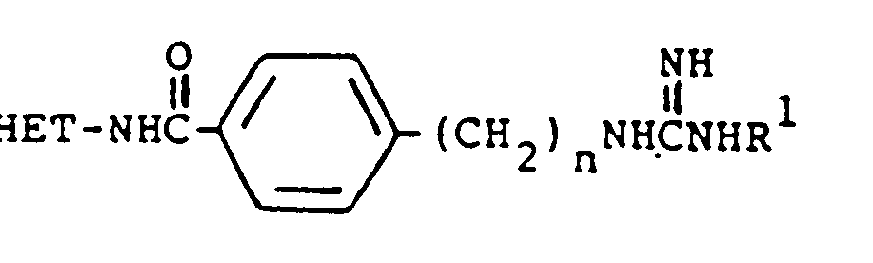
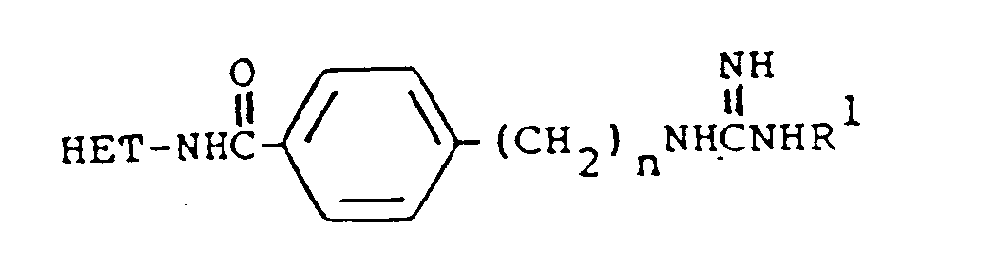
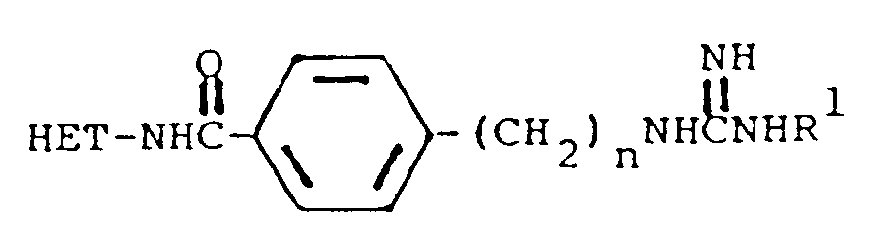
[0003] It has now been discovered that novel compounds of the formula
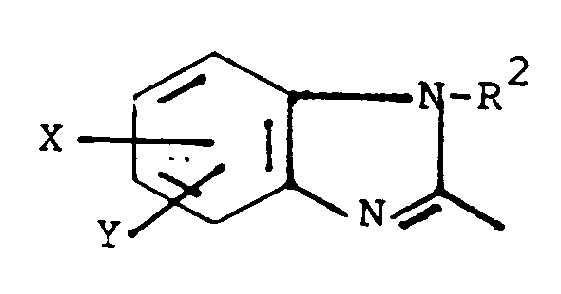
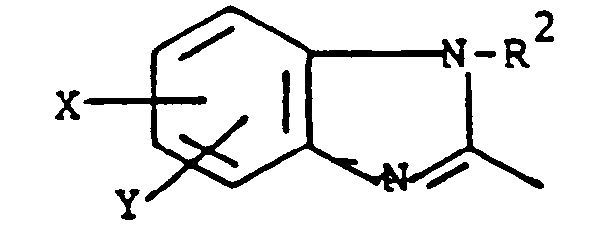
or a pharmaceutically acceptable salt thereof wherein HET is pyrimid-2-yl, dimethylpyrimid-4-yl, thiazol-2-yl, 4-phenylthiazol-2-yl, 4-phenyl-5-carbethoxythiazol-2-yl, 4-biphenylylthiazol-2-yl, pyrazin-2-yl, 6-chloropyrazin-2-yl, quinol-8-yl, 6-methoxyquinol-8-yl, quinol-3-yl, 1,3,4-thiadiazol-2-yl, 3-phenyl-1,2,4-thiadiazol-5-yl, 5-trifluoromethyl-1,3,4-thiadiazol-2-yl, 5-methylisoxazol-3-yl, 5-chloropyrid-2-yl, 4,5-dicyanoimidazol-2-yl, 5-chlorobenzoxazol-2-yl, indazol-5-yl-2-carbethoxyindol-5-yl or a benzimidazol-2-yl of the formula
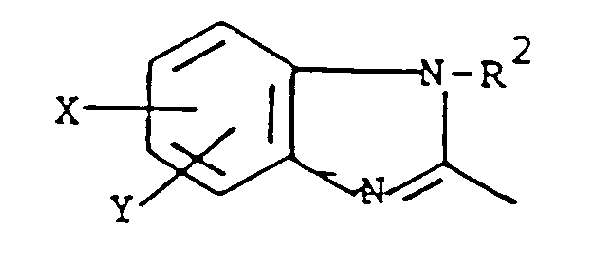
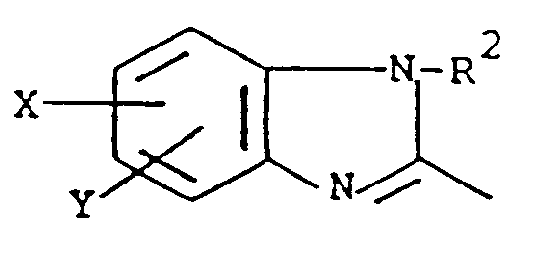
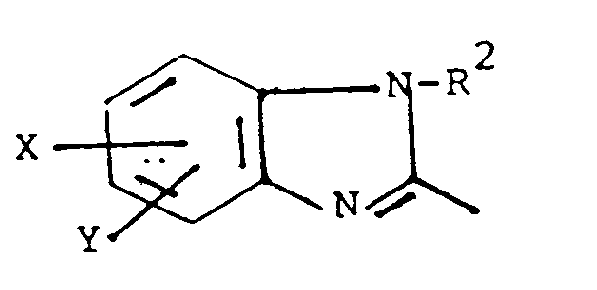
where X is hydrogen or methyl, Y is hydrogen, methyl, benzoyl, nitro, chloro, fluoro, bromo or methoxy and R² is hydrogen, (C₁-C₃)alkyl, phenethyl, phenacyl, N-(C₁-C₃)alkylcarbamylmethyl, N,N-di(C₁-C₃)alkylcarbamylmethyl, N-(C₁-C₃)alkylcarbamyl, (C₁-C₃)alkoxycarbonylmethyl or N-(p-chlorobenzyl)carbamylmethyl; n is an integer of 0 to 2; and R¹ is hydrogen or (C₁-C₃)alkyl are protease inhibitors, having particular application as inhibitors of serine protease and useful as anti-plasmin and anti-thrombin agents.
[0004] A preferred group of compounds are those wherein R¹ is hydrogen and n is 0. Especially preferred within this group are the compound where HET is pyrazin-2-yl, pyrimid-2-yl, 1,3,4-thiadiazol-2-yl, quinol-8-yl, thiazol-2-yl or indazol-5-yl.
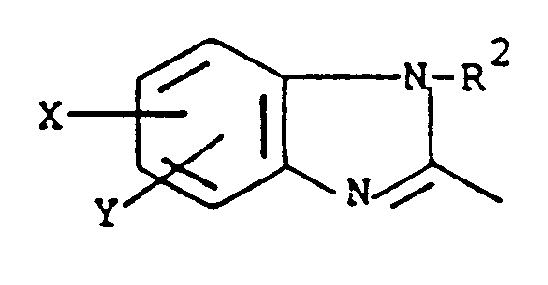
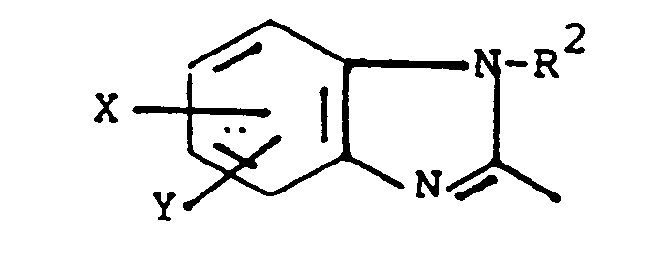
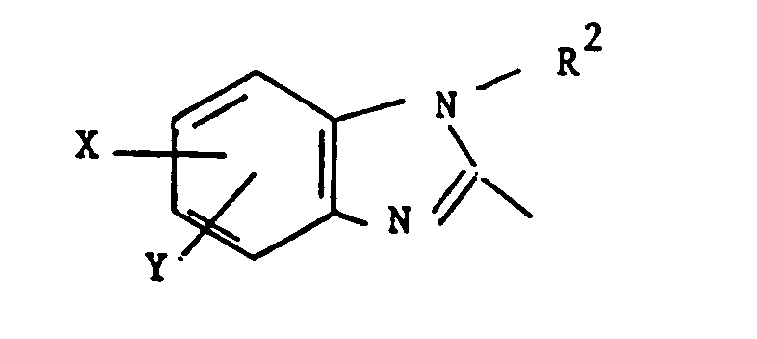
[0005] A second group of preferred compounds are those where HET is a benzimidazol-2-yl of the formula
where X is hydrogen. Especially preferred within this group are the compounds where Y and R² are each hydrogen, where Y is 5-nitro and R² is hydrogen, where Y is 5-chloro and R² is hydrogen; or where Y is hydrogen and R² is N,N-diethylcarbamylmethyl.
[0006] As used herein, the term (C₁-C₃)alkyl defines alkyl having one to three carbon atoms; similar terms can be used to define alkoxy, etc.
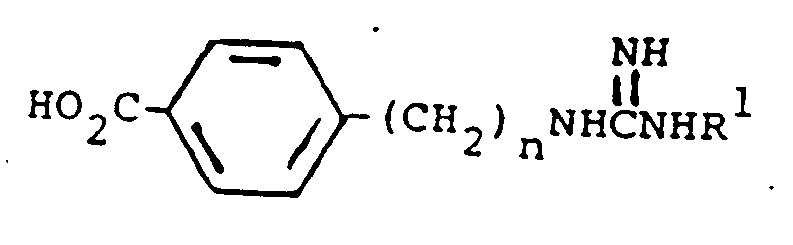
[0007] The compounds of the present invention are prepared by the acylation of the appropriate aminohetercyclic with a carboxy activated benzoic acid derivative.
[0008] The activated acid can consist of an acid halide or an activated ester or mixed anhydride. The preferred acylating agent is either the N-hydroxysuccinimide ester or the acid chloride.
[0009] The coupling reaction can be achieved by contacting one mole of the appropriate benzoic carboxylic acid N-hydroxysuccinimide ester with from 1 to 2 moles of the requisite aminoheterocyclic and about .01 mole of hydroquinone in a reaction-inert solvent such as dimethylformamide, dimethylsulfoxide, or N-methyl-2-pyrrolidone. The reaction is heated in the dark for about 1 to 36 hours at a reaction temperature of 20-180°C.
[0010] On completion of the reaction, the reaction mixture is diluted with methanol, filtered, if necessary, and the filtrate applied to the protonated form of an ionexchange resin (pH 5-6) such as GC 50 (Aldrich Chemical Co., Inc.). The resin-product complex is then loaded on a column and washed sufficiently with methanol, water, dimethylsulfoxide, dimethylformamide or acetonitrile or mixtures thereof, to remove all the remaining, unreacted aminoheterocyclic.
[0011] The product is freed from the resin complex by eluting the column with a 0.1-0.01 molar solution of an acid such as hydrochloric acid, hydrobromic acid, methane sulfonic acid, lactic acid or acetic acid in such solvents as water, methanol or acetonitrile. The wash liquids are combined and concentrated. The product, isolated as the salt of the acid wash, precipitates as the solution is concentrated, and is collected by filtration. Further purification can be carried out by recrystallization from such solvents as dimethylformamide, tetrahydrofuran, ethyl acetate, chloroform, dimethylsulfoxide, N-methyl-2-pyrrolidone, diethyl ether or methanol or mixtures thereof.
[0012] A modification of this procedure comprises contacting one mole of the 4-guanidinobenzoic acid derivative as an acid addition salt with the silating agent bis-trimethylsilylacetamide, followed by formation of the acid chloride using thionyl chloride. The acid chloride is then treated in tetrahydrofuran with as much as a two-fold excess of the appropriate aminohetercyclic, or a one fold excess plus an excess of an acid scavenger, such as triethylamine.
[0013] After a reaction time of about 30 minutes, at ambient temperatures, the reaction is diluted with sufficient water to precipitate the product, which is recrystallized as previously described.
[0014] Compounds of the present invention wherein HET is
are converted to compounds where HET is
where R² is as defined, but other than hydrogen.
[0015] Acylation of the benzimidazole nitrogen with isocyanates is carried out in a reaction-inert solvent such as dimethylformamide, dimethylsulfoxide, N-methyl-2-pyrrolidone. The reaction can be conducted at from about room temperature to 100°C. Reaction time is about 24 hours and ambient temperatures and 30 minutes to a few hours at elevated temperatures.
[0016] When reacting the isocyanate with the compounds identified, it is necessary to use the acid addition salt of the guanidinobenzamide reactant to prevent interaction of the guanyl portion with the isocyanate. Further, it is preferred to use an excess of isocyanate to aid in the completion of the reaction, a ratio of one mole of benzimidazole derivative per five moles of isocyanate provides the desired product.
[0017] The reaction mixture, at the end of the reaction period, is diluted with diethyl ether and the precipitated product filtered and purified.
[0018] Alkylation of the benzimidazole nitrogen is carried out between one mole of compound containing the benzimidazole moiety and about 5-6 moles of alkylating agent. In addition, the alkylation makes use of from 1 to 4 equivalents of base per mole of starting reagent. Such bases include alkali metal alkoxides and carbonates. The solvent, reaction times and temperature are about the same for the alkylation reaction as for the corresponding acylation reaction.
[0019] As previously indicated, the present invention embraces pharmaceutically acceptable salts of the biologically active compounds. Such salts are those which are non-toxic at the dosages administered. Pharmaceutically acceptable acid addition salts include e.g., the hydrochloride, hydrobromide, hydroiodide, sulfate, bisulfate, phosphate, acid phosphate, acetate, lactate, maleate, mesylate, fumarate, citrate, acid citrate, tartrate, bitartrate, succinate, gluconate and saccharate salts. Conventional methods of forming acid addition salts may be employed.
[0020] Plasmin, a serine protease enzyme existinginf the blood, is the result of the action of plasminogen activator on the proenzyme plasminogen. Plasmin plays an important role in capillary blood flow and in the dissolution of fibrin. However, when this enzyme is present in abnormal amounts it causes hemorrhagic diseases. In such cases, the use of an anti-plasmin agent is extremely important. The compounds of the present possess this anti-plasmin activity, which can be readily demonstrated by the assay of H. Zimmerman, et al., Proc. Natl. Acad. Sci., 75, 750 (1978).
[0021] The compounds of the present invention can be administered as anti-plasmin agents by either the oral or parental routes of administration, with the former being preferred for reasons of patient convenience and comfort. In general, these anti-plasmin compounds are normally administered orally in dosages ranging from about 6 mg to about 400 mg per kg of body weight per day and 1 mg to about 200 mg per kg of body weight per day when given parenterally; variations will necessarily occur depending upon the condition of the subject being treated and the particular compound being administered. It is to be noted that these compounds may be administered in combination with pharmaceutically acceptable carriers by either of the routes previously indicated, and that such administration can be carried out in both single and multiple dosages.
[0022] The novel compounds of the invention can be orally administered in a wide variety of different dosage forms, i.e., they may be formulated with various pharmaceutically acceptable inert carriers in the form of tablets, capsules, lozenges, troches, hard candies, powders, sprays, aqueous suspensions, elixirs, syrups, and the like. Such carriers include solid diluents or fillers, sterile aqueous media and various non-toxic organic solvents, etc. Moreover, such oral pharmaceutical formulations can be suitably sweetened and/or flavored by means of various agents of the type commonly employed for such purposes. In general, the compounds of this invention are present in such oral dosage forms at concentration levels ranging from about 0.5% to about 90% by weight of the total composition, in amounts which are sufficient to provide the desired unit dosages.
[0023] For purposes of oral administration, tablets containing various excipients such as sodium citrate, calcium carbonate and calcium phosphate may be employed along with various disintegrants such as starch and preferably potato and tapioca starch, alginic acid and certain complex silicates, together with binding agents such as polyvinylpyrrolidone, sucrose, gelatin and acacia. Additionally, lubricating agents such as magnesium stearate, sodium lauryl sulfate and talc are often very useful for tabletting purposes. Solid compositions of a similar type may also be employed as fillers in soft and hard-filled gelatin capsules; preferred materials in this connection would also include lactose or milk sugar as well as high molecular weight polyethylene glycols. When aqueous suspensions and/or elixirs are desired of oral administration, the essential active ingredient therein may be combined with various sweetening or flavoring agents, coloring matter or dyes and, if so desired, emulsifying and/or suspending agents as well, together with such diluents as water, ethanol, propylene glycol, glycerin and various like combinations thereof.
EXAMPLE 1
4-Guanidino-N-(pyrazin-2-yl)benzamide hydrochloride n = 0; R¹ = H; and HET = 2-pyrazinyl)
[0025] A solution of 1.84 g. (19.2 m. mol) of 2-aminopyrazine, 3.0 g. (9.6 m. mol) of 4-guanidinobenzoic acid N-hydroxysuccinimide ester and 300 mg. of hydroquinone in 25 ml. of N-methyl-2-pyrrolidone was heated in the dark under an inert atmosphere at 170°C for 7 hours. The cooled reaction mixture was diluted with 300 ml. of methanol and 3 ml. of pyridine and treated with 50 g. of CG50 ion exchange resin (H+ form). The solution was decanted and treated with an additional 25 g. of resin. The solution was again decanted and treated with 25 g. of resin. The resin fractions were loaded on a column such that the last resin fraction was loaded first, the first, last. The column was eluted with 2 l. of methanol and then with .02 N hydrochloric acid in methanol. The fractions containing the product were combined and concentrated in vacuo to a solid. The residue was dissolved in methanol and precipitated with diethyl ether. The product was filtered, washed with i-propanol and dried, 232 mg., m.p. 278-280°C.
EXAMPLE 2
[0026] Using the procedure of Example 1, except where noted, and starting with the appropriate reagents, the following compounds were prepared as the hydrochloride salt:
EXAMPLE 3
4-Guanidino-N-(quinol-8-yl)benzamide (HET = 8-quinolyl; n = 0; and R¹ = H)
[0027] A mixture of 200 mg. (.92 m. mol) 4-guanidino-benzoic acid hydrochloride and 190 mg. (.93 m. mol) of bis-trimethylsilylacetamide in 20 ml. of dry tetrahydrofuran was heated at reflux until a solution was achieved, and then cooled to room temperature. Thionyl chloride (380 mg., 1.86 m. mol) was added and the reaction mixture allowed to stir for 5 min. 8-Amino-quinoline (670 mg., 4.64 m. mol) was added in 5 ml. of tetrahydrofuran and the mixture allowed to stir for 30 min. Water (.2 ml) was added to the reaction mixture and the solids filtered and dissolved in 60 ml. of methanol and 120 ml. of chloroform. Addition of diethyl ether precipitated the desired product, 153 mg., m.p. 271-273°C.
EXAMPLE 4
[0028] Employing the procedure of Example 3, except where noted, and starting with the requisite reagents, the following poducts were prepared:
EXAMPLE 5
4-Guanidino-N-(5-chloro imidazol-2-yl)-benzamide (HET = 5-chloro imidazol-2-yl; n = 0; and R¹ = H)
[0029] A mixture of 970 mg. (4.48 m. mol) of 4-guanidinobenzoic acid and 910 mg. (4.48 m. mol) of bis-trimethylsilylacetamide in dry tetrahydrofuran was heated to reflux for five minutes. After cooling the resulting solution of thionylchloride, 1.07 g. (8.95 m. mol) was added, followed after 20 minutes by the addition of 1.5 g. (8.95 m. mol) of 2-amino-5-chloroimidazole and 1.81 g. (17.9 m. mol) of triethyl amine in 10 ml. of tetrahydrofuran. After 16 hours at room temperature .40 ml. of water was added and the solids filtered, washed with chloroform and recrystallized from methanol-chloroform-diethyl ether, 435 mg., m.p. 263-265°C.
EXAMPLE 6
[0030] Employing the procedure of Example 5, and starting with the appropriate reagents, the following compounds were prenared:
EXAMPLE 7
4-Guanidino-N-(1-N-methylcarbamylbenzimidazol-2-yl)benzamide (n = 0; R¹ = H; and HET = 1-(N-methylcarbamyl)benzimidazol-2-yl)
[0031] The product of Example 1 (600 ma., 1.81 m. mol) of 520 mg. (9.07 m. mol) of methylisocyanate were added to 10 ml. of dry N-methyl-2-pyrrolidone and allowed to stir at room temperature for 24 hours. The mixture was poured into 200 ml. of diethyl ether and the resulting precipitate filtered and chromatographed on silica gel using chloroform-methanol-acetic acid (18:5:1;V:V:V) as the eluent. The fractions containing the product were combined, concentrated in vacuo to dryness and the residue triturated with methanol, 76 mg., m.p. 188-190°C.
EXAMPLE 8
Claims for the following Contracting State(s): AT, BE, CH, DE, FR, GB, IT, LI, LU,
NL, SE
1. A compound of the formula
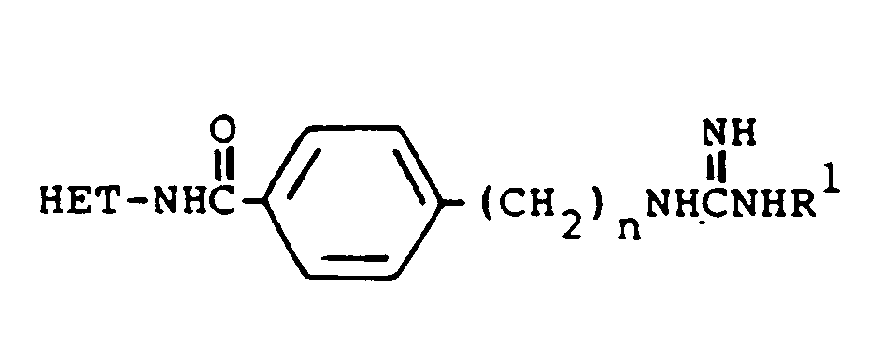
or a pharmaceutically acceptable salt thereof, wherein HET is pyrimid-2-yl, dimethylpyrimid-4-yl, thiazol-2-yl, 4-phenylthiazol-2-yl, 4-phenyl-5-carbethoxythiazol-2-yl, 4-biphenylylthiazol-2-yl, pyrazin-2-yl, 6-chloropyrazin-2-yl, quinol-8-yl, 6-methoxyquinol-8-yl, quinol-3-yl, 1,3,4-thiadiazol-2-yl, 3-phenyl-1,2,4-thiadiazol-5-yl, 5-trifluoromethyl-1,3,4-thiadiazol-2-yl, 5-methylisoxazol-3-yl, 5-chloropyrid-2-yl, 4,5-dicyanoimidazol-2-yl, 5-chlorobenzoxazol-2-yl, indazol-5-yl-2-carbethoxyindol-5-yl or a benzimidazol-2-yl of the formula
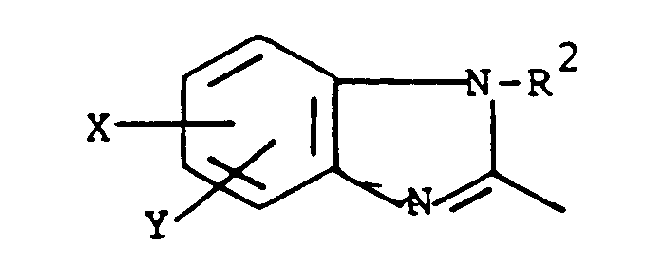
where X is hydrogen or methyl, Y is hydrogen, methyl, benzoyl, nitro, chloro, fluoro, bromo or methoxy and R² is hydrogen, (C₁-C₃)alkyl, phenethyl, phenacyl, N-(C₁-C₃)alkylcarbamylmethyl, N,N-di(C₁-C₃)alkylcarbamylmethyl, N-(C₁-C₃)alkylcarbamyl, (C₁-C₃)alkoxycarbonylmethyl or N-(p-chlorobenzyl)carbamylmethyl; n is an integer of 0 to 2; and R¹ is hydrogen or (C₁-C₃)alkyl.
or a pharmaceutically acceptable salt thereof, wherein HET is pyrimid-2-yl, dimethylpyrimid-4-yl, thiazol-2-yl, 4-phenylthiazol-2-yl, 4-phenyl-5-carbethoxythiazol-2-yl, 4-biphenylylthiazol-2-yl, pyrazin-2-yl, 6-chloropyrazin-2-yl, quinol-8-yl, 6-methoxyquinol-8-yl, quinol-3-yl, 1,3,4-thiadiazol-2-yl, 3-phenyl-1,2,4-thiadiazol-5-yl, 5-trifluoromethyl-1,3,4-thiadiazol-2-yl, 5-methylisoxazol-3-yl, 5-chloropyrid-2-yl, 4,5-dicyanoimidazol-2-yl, 5-chlorobenzoxazol-2-yl, indazol-5-yl-2-carbethoxyindol-5-yl or a benzimidazol-2-yl of the formula
where X is hydrogen or methyl, Y is hydrogen, methyl, benzoyl, nitro, chloro, fluoro, bromo or methoxy and R² is hydrogen, (C₁-C₃)alkyl, phenethyl, phenacyl, N-(C₁-C₃)alkylcarbamylmethyl, N,N-di(C₁-C₃)alkylcarbamylmethyl, N-(C₁-C₃)alkylcarbamyl, (C₁-C₃)alkoxycarbonylmethyl or N-(p-chlorobenzyl)carbamylmethyl; n is an integer of 0 to 2; and R¹ is hydrogen or (C₁-C₃)alkyl.
2. A compound of claim 1, wherein R¹ is hydrogen and n is 0.
3. The compound of claim 2, wherein HET is pyrazin-2-yl, pyrimid-2-yl, 1,3,4-thiadiazol-2-yl,
quinl-8-yl, thiazol-2-yl or indazol-5-yl.
4. A compound of claim 2, wherein HET is a benzimidazol-2-yl of the formula
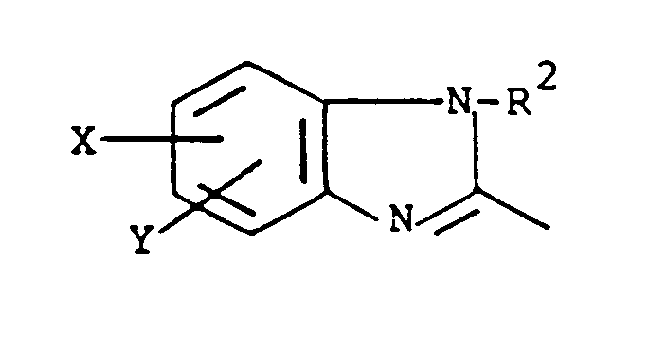
wherein, X is hydrogen.
wherein, X is hydrogen.
5. A compound of claim 4, wherein Y and R² are each hydrogen.
6. The compound of claim 4, wherein Y is 5-nitro and R² is hydrogen.
7. The compound of claim 4, wherein Y is 5-chloro and R² is hydrogen.
8. The compound of claim 4, wherein Y is hydrogen and R² is N,N-diethylcarbamylmethyl.
9. A compound according to any one of the preceeding claims for use as a medicine.
10. Use of a compound according to any one of claims 1 to 8 for making a medicament
for use as a protease inhibitor.
Claims for the following Contracting State(s): ES, GR
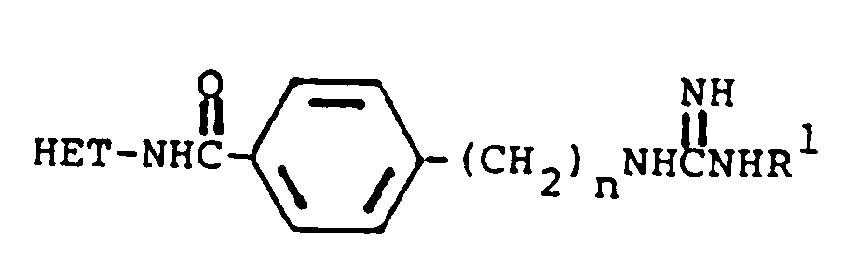
1. A process for preparing a compound of the formula
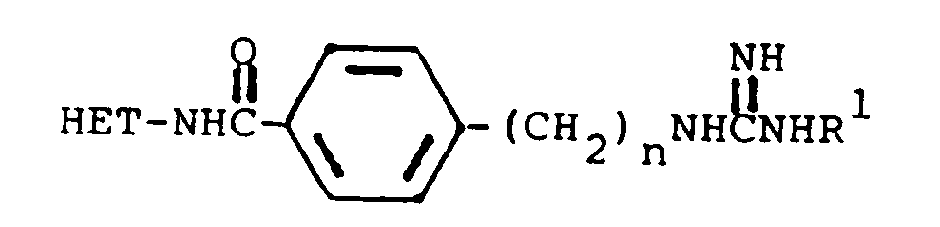
wherein HET is pyrimid-2-yl, dimethylpyrimid-4-yl, thiazol-2-yl, 4-phenylthiazol-2-yl, 4-phenyl-5-carbethoxythiazol-2-yl, 4-biphenylylthiazol-2-yl, pyrazin-2-yl, 6-chloropyrazin-2-yl, quinol-8-yl, 6-methoxyquinol-8-yl, quinol-3-yl, 1,3,4-thiadiazol-2-yl, 3-phenyl-1,2,4-thiadiazol-5-yl, 5-trifluoromethyl-1,3,4-thiadiazol-2-yl, 5-methylisoxazol-3-yl, 5-chloropyrid-2-yl, 4,5-dicyanoimidazol-2-yl, 5-chlorobenzoxazol-2-yl, indazol-5-yl-2-carbethoxyindol-5-yl or a benzimidazol-2-yl of the formula
where X is hydrogen or methyl, Y is hydrogen, methyl, benzoyl, nitro, chloro, fluoro, bromo or methoxy and R² is hydrogen, (C₁-C₃)alkyl, phenethyl, phenacyl, N-(C₁-C₃)alkylcarbamylmethyl, N,N-di(C₁-C₃)alkylcarbamylmethyl, N-(C₁-C₃)alkylcarbamyl, (C₁-C₃)alkoxycarbonylmethyl or N-(p-chlorobenzyl)carbamylmethyl; n is an integer of 0 to 2; and R¹ is hydrogen or (C₁-C₃)alkyl, which comprises acylating a compound of the formula
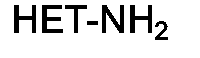
with a benzoic acid of the formula
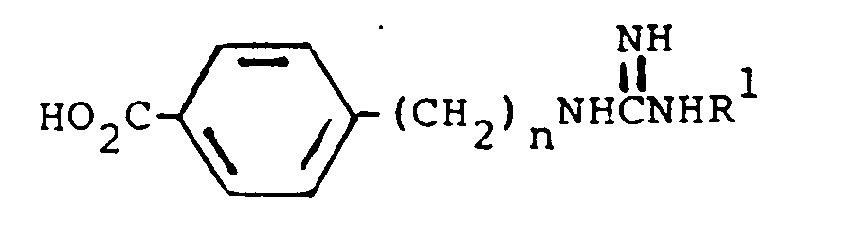
wherein the carboxyl group is activated as an acid chloride, mixed anhydride or active ester, in a reaction-inert solvent in the presence of a catalytic amount of hydroquinone at a reaction temperature of 20-180°C. and, optionally, preparing a pharmaceutically acceptable salt of the product.
wherein HET is pyrimid-2-yl, dimethylpyrimid-4-yl, thiazol-2-yl, 4-phenylthiazol-2-yl, 4-phenyl-5-carbethoxythiazol-2-yl, 4-biphenylylthiazol-2-yl, pyrazin-2-yl, 6-chloropyrazin-2-yl, quinol-8-yl, 6-methoxyquinol-8-yl, quinol-3-yl, 1,3,4-thiadiazol-2-yl, 3-phenyl-1,2,4-thiadiazol-5-yl, 5-trifluoromethyl-1,3,4-thiadiazol-2-yl, 5-methylisoxazol-3-yl, 5-chloropyrid-2-yl, 4,5-dicyanoimidazol-2-yl, 5-chlorobenzoxazol-2-yl, indazol-5-yl-2-carbethoxyindol-5-yl or a benzimidazol-2-yl of the formula
where X is hydrogen or methyl, Y is hydrogen, methyl, benzoyl, nitro, chloro, fluoro, bromo or methoxy and R² is hydrogen, (C₁-C₃)alkyl, phenethyl, phenacyl, N-(C₁-C₃)alkylcarbamylmethyl, N,N-di(C₁-C₃)alkylcarbamylmethyl, N-(C₁-C₃)alkylcarbamyl, (C₁-C₃)alkoxycarbonylmethyl or N-(p-chlorobenzyl)carbamylmethyl; n is an integer of 0 to 2; and R¹ is hydrogen or (C₁-C₃)alkyl, which comprises acylating a compound of the formula
with a benzoic acid of the formula
wherein the carboxyl group is activated as an acid chloride, mixed anhydride or active ester, in a reaction-inert solvent in the presence of a catalytic amount of hydroquinone at a reaction temperature of 20-180°C. and, optionally, preparing a pharmaceutically acceptable salt of the product.
2. A process according to claim 1, wherein R¹ is hydrogen and n is 0.
3. A process according to claim 2, wherein HET is pyrazin-2-yl, pyrimid-2-yl, 1,3,4-thiadiazol-2-yl,
quinol-8-yl, thiazol-2-yl or indazol-5-yl.
4. A process according to claim 2, wherein HET is a benzimidazol-2-yl of the formula
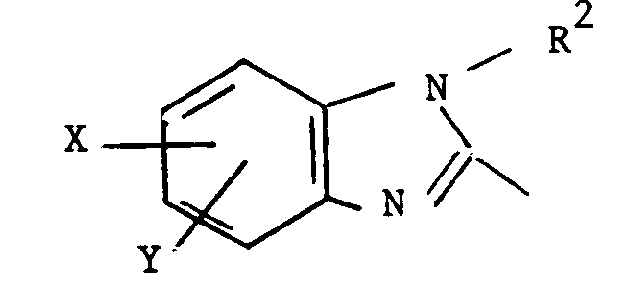
wherein X is hydrogen.
wherein X is hydrogen.
5. A process according to claim 4, wherein Y and R² are each hydrogen.
6. A process according to claim 4, wherein Y is 5-nitro and R² is hydrogen.
7. A process according to claim 4, wherein Y is 5-chloro and R² is hydrogen.
8. A process according to claim 4, wherein Y is hydrogen and R² is N, N-diethylcarbamylmethyl.
Patentansprüche für folgende(n) Vertragsstaat(en): AT, BE, CH, DE, FR, GB, IT, LI,
LU, NL, SE
1. Verbindung der Formel
oder ein gharmazeutisch annehmbares Salz davon, worin HET Pyrimid-2-yl, Dimethylpyrimid-4-yl, Thiazol-2-yl, 4-Phenylthiazol-2-yl, 4-Phenyl-5-carbethoxythiazol-2-yl, 4-Biphenylthiazol-2-yl, Pyrazid-2-yl, 6-Chlorpyrazin-2-yl, Chinol-8-yl, 6-Methoxychinol-8-yl, Chinol-3-yl, 1,3,4-Thiadiazol-2-yl, 3-Phenyl-1,2,4-thiadiazol-5-yl, 5-Trifluormethyl-1,3,4-thiadiazol-2-yl, 5-Methylisoxazol-3-yl, 5-Chlorpyrid-2-yl, 4,5-Dicyanoimidazol-2-yl, 5-Chlorbenzoxazol-2-yl, Indazol-5-yl-2-carbethoxyindol-5-yl oder ein Benzimidazol-2-yl der Formel
ist, worin X Wasserstoff oder ein Methylrest ist, Y Wasserstoff, ein Methyl-, Benzoyl-, Nitro-, Chlor-, Fluor-, Brom- oder Methoxyrest ist und R² Wasserstoff, ein (C₁-C₃)Alkyl-, Phenethyl-, Phenacyl-, N-(C₁-C₃)alkylcarbamylmethyl-, N,N-Di(C₁-C₃)alkylcarbamylmethyl-, N-(C₁-C₃)Alkylcarbamyl-, (C₁-C₃)Alkoxycarbonylmethyl- oder N-(p-Chlorbenzyl)carbamylmethylrest ist; n eine ganze Zahl von 0 bis 2 ist und R¹ Wasserstoff oder ein (C₁-C₃)Alkylrest ist.
oder ein gharmazeutisch annehmbares Salz davon, worin HET Pyrimid-2-yl, Dimethylpyrimid-4-yl, Thiazol-2-yl, 4-Phenylthiazol-2-yl, 4-Phenyl-5-carbethoxythiazol-2-yl, 4-Biphenylthiazol-2-yl, Pyrazid-2-yl, 6-Chlorpyrazin-2-yl, Chinol-8-yl, 6-Methoxychinol-8-yl, Chinol-3-yl, 1,3,4-Thiadiazol-2-yl, 3-Phenyl-1,2,4-thiadiazol-5-yl, 5-Trifluormethyl-1,3,4-thiadiazol-2-yl, 5-Methylisoxazol-3-yl, 5-Chlorpyrid-2-yl, 4,5-Dicyanoimidazol-2-yl, 5-Chlorbenzoxazol-2-yl, Indazol-5-yl-2-carbethoxyindol-5-yl oder ein Benzimidazol-2-yl der Formel
ist, worin X Wasserstoff oder ein Methylrest ist, Y Wasserstoff, ein Methyl-, Benzoyl-, Nitro-, Chlor-, Fluor-, Brom- oder Methoxyrest ist und R² Wasserstoff, ein (C₁-C₃)Alkyl-, Phenethyl-, Phenacyl-, N-(C₁-C₃)alkylcarbamylmethyl-, N,N-Di(C₁-C₃)alkylcarbamylmethyl-, N-(C₁-C₃)Alkylcarbamyl-, (C₁-C₃)Alkoxycarbonylmethyl- oder N-(p-Chlorbenzyl)carbamylmethylrest ist; n eine ganze Zahl von 0 bis 2 ist und R¹ Wasserstoff oder ein (C₁-C₃)Alkylrest ist.
2. Verbindung nach Anspruch 1, worin R¹ Wasserstoff ist und n 0 ist.
3. Verbindung nach Anspruch 2, worin HET Pyrazin-2-yl, Pyrimid-2-yl, 1,3,4-Thiadiazol-2-yl,
Chinol-8-yl, Thiazol-2-yl oder Indazol-5-yl ist.
4. Verbindung nach Anspruch 2, worin HET ein Benzimidazol-2-yl der Formel
ist, worin X Wasserstoff ist.
ist, worin X Wasserstoff ist.
5. Verbindung nach Anspruch 4, worin Y und R² jeweils Wasserstoff sind.
6. Verbindung nach Anspruch 4, worin Y ein 5-Nitrorest und R² Wasserstoff ist.
7. Verbindung nach Anspruch 4, worin Y ein 5-Chlorrest und R² Wasserstoff ist.
8. Verbindung nach Anspruch 4, worin Y Wasserstoff und R² ein N,N-Diethylcarbamylmethylrest
ist.
9. Verbindung nach einem der vorhergehenden Ansprüche zur Verwendung als Arzneimittel.
10. Verwendung einer Verbindung nach einem der Ansprüche 1 bis 8 zur Herstellung eines
Arzneimittels zur Verwendung als Protease-Inhibitor.
Patentansprüche für folgende(n) Vertragsstaat(en): ES, GR
1. Verfahren zur Herstellung einer Verbindung der Formel
worin HET Pyrimid-2-yl, Dimethylgyrimid-4-yl, Thiazol-2-yl, 4-Phenylthiazol-2-yl, 4-Phenyl-5-carbethoxythiazol-2-yl, 4-Biphenylthiazol-2-yl, Pyrazid-2-yl, 6-Chlorgyrazin-2-yl, Chinol-8-yl, 6-Methoxychinol-8-yl, Chinol-3-yl, 1,3,4-Thiadiazol-2-yl, 3-Phenyl-1,2,4-thiadiazol-5-yl, 5-Trifluormethyl-1,3,4-thiadiazol-2-yl, 5-Methylisoxazol-3-yl, 5-Chlorpyrid-2-yl, 4,5-Dicyanoimidazol-2-yl, 5-Chlorbenzoxazol-2-yl, Indazol-5-yl-2-carbethoxyindol-5-yl oder ein Benzimidazol-2-yl der Formel
ist, worin X Wasserstoff oder ein Methylrest ist, Y Wasserstoff, ein Methyl-, Benzoyl-, Nitro-, Chlor-, Fluor-, Brom- oder Methoxyrest ist und R² Wasserstoff, ein (C₁-C₃)Alkyl-, Phenethyl-, Phenacyl-, N-(C₁-C₃)alkylcarbamylmethyl-, N,N-Di(C₁-C₃)alkylcarbamylmethyl-, N-(C₁-C₃)Alkylcarbamyl-, (C₁-C₃)Alkoxycarbonylmethyl- oder N-(p-Chlorbenzyl)carbamylmethylrest ist; n eine ganze Zahl von 0 bis 2 ist und R¹ Wasserstoff oder ein (C₁-C₃)Alkylrest ist, umfassend, daß man eine Verbindung der Formel
HET-NH₂
mit einer Benzoesäure der Formel
worin die Carboxylgruppe als Säurechlorid, gemischtes Anhydrid oder Aktivester aktiviert ist, in einem reaktionsinerten Lösungsmittel in Gegenwart einer katalytischen Menge Hydrochinon bei einer Reaktionstemperatur von 20 bis 180°C acyliert und gegebenenfalls ein pharmazeutisch annehmbares Salz des Produktes herstellt.
worin HET Pyrimid-2-yl, Dimethylgyrimid-4-yl, Thiazol-2-yl, 4-Phenylthiazol-2-yl, 4-Phenyl-5-carbethoxythiazol-2-yl, 4-Biphenylthiazol-2-yl, Pyrazid-2-yl, 6-Chlorgyrazin-2-yl, Chinol-8-yl, 6-Methoxychinol-8-yl, Chinol-3-yl, 1,3,4-Thiadiazol-2-yl, 3-Phenyl-1,2,4-thiadiazol-5-yl, 5-Trifluormethyl-1,3,4-thiadiazol-2-yl, 5-Methylisoxazol-3-yl, 5-Chlorpyrid-2-yl, 4,5-Dicyanoimidazol-2-yl, 5-Chlorbenzoxazol-2-yl, Indazol-5-yl-2-carbethoxyindol-5-yl oder ein Benzimidazol-2-yl der Formel
ist, worin X Wasserstoff oder ein Methylrest ist, Y Wasserstoff, ein Methyl-, Benzoyl-, Nitro-, Chlor-, Fluor-, Brom- oder Methoxyrest ist und R² Wasserstoff, ein (C₁-C₃)Alkyl-, Phenethyl-, Phenacyl-, N-(C₁-C₃)alkylcarbamylmethyl-, N,N-Di(C₁-C₃)alkylcarbamylmethyl-, N-(C₁-C₃)Alkylcarbamyl-, (C₁-C₃)Alkoxycarbonylmethyl- oder N-(p-Chlorbenzyl)carbamylmethylrest ist; n eine ganze Zahl von 0 bis 2 ist und R¹ Wasserstoff oder ein (C₁-C₃)Alkylrest ist, umfassend, daß man eine Verbindung der Formel
HET-NH₂
mit einer Benzoesäure der Formel
worin die Carboxylgruppe als Säurechlorid, gemischtes Anhydrid oder Aktivester aktiviert ist, in einem reaktionsinerten Lösungsmittel in Gegenwart einer katalytischen Menge Hydrochinon bei einer Reaktionstemperatur von 20 bis 180°C acyliert und gegebenenfalls ein pharmazeutisch annehmbares Salz des Produktes herstellt.
2. Verfahren nach Anspruch 1, worin R¹ Wasserstoff ist und n 0 ist.
3. Verfahren nach Anspruch 2, worin HET Pyrazin-2-yl, Pyrimid-2-yl, 1,3,4-Thiadiazol-2-yl,
Chinol-8-yl, Thiazol-2-yl oder Indazol-5-yl ist.
4. Verfahren nach Anspruch 2, worin HET ein Benzimidazol-2-yl der Formel
ist, worin X Wasserstoff ist.
ist, worin X Wasserstoff ist.
5. Verfahren nach Anspruch 4, worin Y und R² jeweils Wasserstoff sind.
6. Verfahren nach Anspruch 4, worin Y ein 5-Nitrorest ist und R² Wasserstoff ist.
7. Verfahren nach Anspruch 4, worin Y ein 5-Chlorrest ist und R² Wasserstoff ist.
8. Verfahren nach Anspruch 4, worin Y Wasserstoff ist und R² ein N,N-Diethylcarbamylmethylrest
ist.
Revendications pour l'(les) Etat(s) contractant(s) suivant(s): AT, BE, CH, DE, FR,
GB, IT, LI, LU, NL, SE
1. Composé de formule
ou un de ses sels pharmaceutiquement acceptables, formule dans laquelle le terme HET représente un groupe pyrimid-2-yle, diméthylpyrimid-4-yle, thiazole-2-yle, 4-phénylthiazole-2-yle, 4-phényl-5-carbéthoxythiazole-2-yle, 4-biphénylylthiazole-2-yle, pyrazine-2-yle, 6-chloropyrazine2-yle, quinol-8-yle, 6-méthoxyquinol-8-yle, quinol-3-yle, 1,3,4-thiadiazole-2-yle, 3-phényl-1,2,4-thiadiazole-5-yle, 5-trifluorométhyl-1,3,4-thiadiazole-2-yle, 5-méthylisoxazole-3-yle, 5-chloropyrid-2-yle, 4,5-dicyanoimidazole-2-yle, 5-chlorobenzoxazole-2-yle, indazole-5-yl-2-carbéthoxyindole-5-yle ou un groupe benzimidazole-2-yle de formule
dans laquelle X représente l'hydrogène ou un groupe méthyle, Y représente l'hydrogène, un groupe méthyle, benzoyle, nitro, chloro, fluoro, bromo ou méthoxy et R² représente l'hydrogène, un groupe alkyle en C₁ à C₃, phénéthyle, phénacyle, N-(alkyle en C₁ à C₃)carbamylméthyle, N,N-di-(alkyle en C₁ à C₃)carbamylméthyle, N-(alkyle en C₁ à C₃)carbamyle, (alkoxy en C₁ à C₃)carbonylméthyle ou N-(p-chlorobenzyl)carbamylméthyle ; n représente un nombre entier de 0 à 2 ; et R¹ représente l'hydrogène ou un groupe alkyle en C₁ à C₃.
ou un de ses sels pharmaceutiquement acceptables, formule dans laquelle le terme HET représente un groupe pyrimid-2-yle, diméthylpyrimid-4-yle, thiazole-2-yle, 4-phénylthiazole-2-yle, 4-phényl-5-carbéthoxythiazole-2-yle, 4-biphénylylthiazole-2-yle, pyrazine-2-yle, 6-chloropyrazine2-yle, quinol-8-yle, 6-méthoxyquinol-8-yle, quinol-3-yle, 1,3,4-thiadiazole-2-yle, 3-phényl-1,2,4-thiadiazole-5-yle, 5-trifluorométhyl-1,3,4-thiadiazole-2-yle, 5-méthylisoxazole-3-yle, 5-chloropyrid-2-yle, 4,5-dicyanoimidazole-2-yle, 5-chlorobenzoxazole-2-yle, indazole-5-yl-2-carbéthoxyindole-5-yle ou un groupe benzimidazole-2-yle de formule
dans laquelle X représente l'hydrogène ou un groupe méthyle, Y représente l'hydrogène, un groupe méthyle, benzoyle, nitro, chloro, fluoro, bromo ou méthoxy et R² représente l'hydrogène, un groupe alkyle en C₁ à C₃, phénéthyle, phénacyle, N-(alkyle en C₁ à C₃)carbamylméthyle, N,N-di-(alkyle en C₁ à C₃)carbamylméthyle, N-(alkyle en C₁ à C₃)carbamyle, (alkoxy en C₁ à C₃)carbonylméthyle ou N-(p-chlorobenzyl)carbamylméthyle ; n représente un nombre entier de 0 à 2 ; et R¹ représente l'hydrogène ou un groupe alkyle en C₁ à C₃.
2. Composé suivant la revendication 1, dans lequel R¹ représente l'hydrogène et n est égal à 0.
3. Composé suivant la revendication 2, dans lequel le terme HET désigne un groupe
pyrazine-2-yle, pyrimid-2-yle, 1,3,4-thiadiazole-2-yle, quinol-8-yle, thiazole-2-yle
ou indazole-5-yle.
4. Composé suivant la revendication 2, dans lequel le terme HET représente un groupe
benzimidazole-2-yle de formule
dans laquelle X représente l'hydrogène.
dans laquelle X représente l'hydrogène.
5. Composé suivant la revendication 4, dans lequel Y et R² représentent chacun l'hydrogène.
6. Composé suivant la revendication 4, dans lequel Y représente un groupe 5-nitro
et R² représente l'hydrogène.
7. Composé suivant la revendication 4, dans lequel Y représente un groupe 5-chloro
et R² représente l'hydrogène.
8. Composé suivant la revendication 4, dans lequel Y représente l'hydrogène et R²
représente un groupe N,N-diéthylcarbamylméthyle.
9. Composé suivant l'une quelconque des revendications précédentes, destiné à être
utilisé comme médicament.
10. Utilisation d'un composé suivant l'une quelconque des revendications 1 à 8 pour
la production d'un médicament destiné à être utilisé comme inhibiteur de protéase.
Revendications pour l'(les) Etat(s) contractant(s) suivant(s): ES, GR
1. Procédé de préparation d'un composé de formule
dans laquelle le terme HET représente un groupe pyrimid-2-yle, diméthylpyrimid-4-yle, thiazole-2-yle, 4-phénylthiazole-2-yle, 4-phényl-5-carbéthoxythiazole-2-yle, 4-biphénylylthiaiole-2-yle, pyrazine-2-yle, 6-chloropyrazine-2-yle, quinol-8-yle, 6-méthoxyquinol-8-yle, quinol-3-yle, 1,3,4-thiadiazole-2-yle, 3-phényl-1,2,4-thiadiazole-5-yle, 5-trifluorométhyl-1,3,4-thiadiazole-2-yle, 5-méthylisoxazole-3-yle, 5-chloropyrid-2-yle, 4,5-dicyano-imidazole-2-yle, 5-chlorobenzoxazole-2-yle, indazole-5-yl-2-carbéthoxyindole-5-yle ou un groupe benzimidazole-2-yle de formule
dans laquelle X représente l'hydrogène ou un groupe méthyle, Y représente l'hydrogène, un groupe méthyle, benzoyle, nitro, chloro, fluoro, bromo ou méthoxy et R² représente l'hydrogène, un groupe alkyle en C₁ à C₃, phénéthyle, phénacyle, N-(alkyle en C₁ à C₃)carbamylméthyle, N,N-di-(alkyle en C₁ à C₃)carbamylméthyle, N-(alkyle en C₁ à C₃)carbamyle, (alkoxy en C₁ à C₃)carbonylméthyle ou N-(p-chlorobenzyl)carbamylméthyle ; n représente un nombre entier de 0 à 2 ; et R¹ représente l'hydrogène ou un groupe alkyle en C₁ à C₃, qui consiste à acyler un composé de formule
HET-NH₂
avec un acide benzoïque de formule
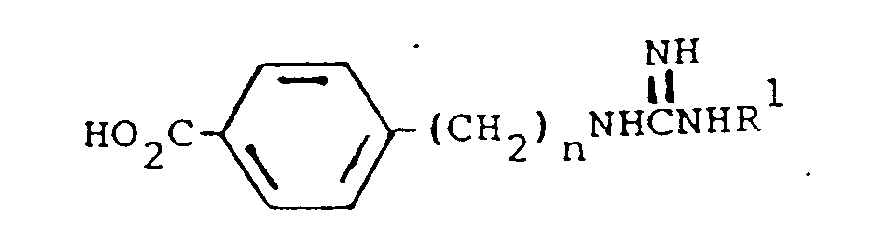
dans laquelle le groupe carboxyle est activé sous forme d'un chlorure d'acide, anhydride mixte ou ester actif, dans un solvant inerte vis-à-vis de la réaction, en présence d'une quantité catalytique d'hydroquinone à une température réactionnelle de 20 à 180°C et, facultativement, à préparer un sel pharmaceutiquement acceptable du produit.
dans laquelle le terme HET représente un groupe pyrimid-2-yle, diméthylpyrimid-4-yle, thiazole-2-yle, 4-phénylthiazole-2-yle, 4-phényl-5-carbéthoxythiazole-2-yle, 4-biphénylylthiaiole-2-yle, pyrazine-2-yle, 6-chloropyrazine-2-yle, quinol-8-yle, 6-méthoxyquinol-8-yle, quinol-3-yle, 1,3,4-thiadiazole-2-yle, 3-phényl-1,2,4-thiadiazole-5-yle, 5-trifluorométhyl-1,3,4-thiadiazole-2-yle, 5-méthylisoxazole-3-yle, 5-chloropyrid-2-yle, 4,5-dicyano-imidazole-2-yle, 5-chlorobenzoxazole-2-yle, indazole-5-yl-2-carbéthoxyindole-5-yle ou un groupe benzimidazole-2-yle de formule
dans laquelle X représente l'hydrogène ou un groupe méthyle, Y représente l'hydrogène, un groupe méthyle, benzoyle, nitro, chloro, fluoro, bromo ou méthoxy et R² représente l'hydrogène, un groupe alkyle en C₁ à C₃, phénéthyle, phénacyle, N-(alkyle en C₁ à C₃)carbamylméthyle, N,N-di-(alkyle en C₁ à C₃)carbamylméthyle, N-(alkyle en C₁ à C₃)carbamyle, (alkoxy en C₁ à C₃)carbonylméthyle ou N-(p-chlorobenzyl)carbamylméthyle ; n représente un nombre entier de 0 à 2 ; et R¹ représente l'hydrogène ou un groupe alkyle en C₁ à C₃, qui consiste à acyler un composé de formule
HET-NH₂
avec un acide benzoïque de formule
dans laquelle le groupe carboxyle est activé sous forme d'un chlorure d'acide, anhydride mixte ou ester actif, dans un solvant inerte vis-à-vis de la réaction, en présence d'une quantité catalytique d'hydroquinone à une température réactionnelle de 20 à 180°C et, facultativement, à préparer un sel pharmaceutiquement acceptable du produit.
2. Procédé suivant la revendication 1, dans lequel R¹ représente l'hydrogène et n est égal à 0.
3. Procédé suivant la revendication 2, dans lequel le terme HET représente un groupe
pyrazine-2-yle, pyrimid-2-yle, 1,3,4-thiadiazole-2-yle, quinol-8-yle, thiazole-2-yle
ou indazole-5-yle.
4. Procédé suivant la revendication 2, dans lequel le terme HET représente un groupe
benzimidazole-2-yle de formule
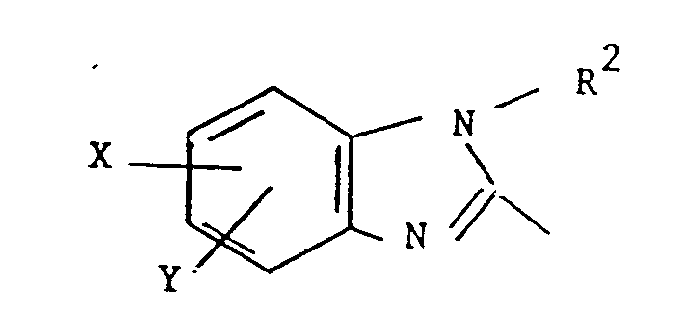
dans laquelle X représente l'hydrogène.
dans laquelle X représente l'hydrogène.
5. Procédé suivant la revendication 4, dans lequel Y et R² représentent chacun l'hydrogène.
6. Procédé suivant la revendication 4, dans lequel Y représente un groupe 5-nitro
et R² représente l'hydrogène.
7. Procédé suivant la revendication 4, dans lequel Y représente un groupe 5-chloro
et R² représente l'hydrogène.
8. Procédé suivant la revendication 4, dans lequel Y représente l'hydrogène et R²
représente un groupe N,N-diéthylcarbamylméthyle.