| (19) |
 |
|
(11) |
EP 0 344 136 B1 |
| (12) |
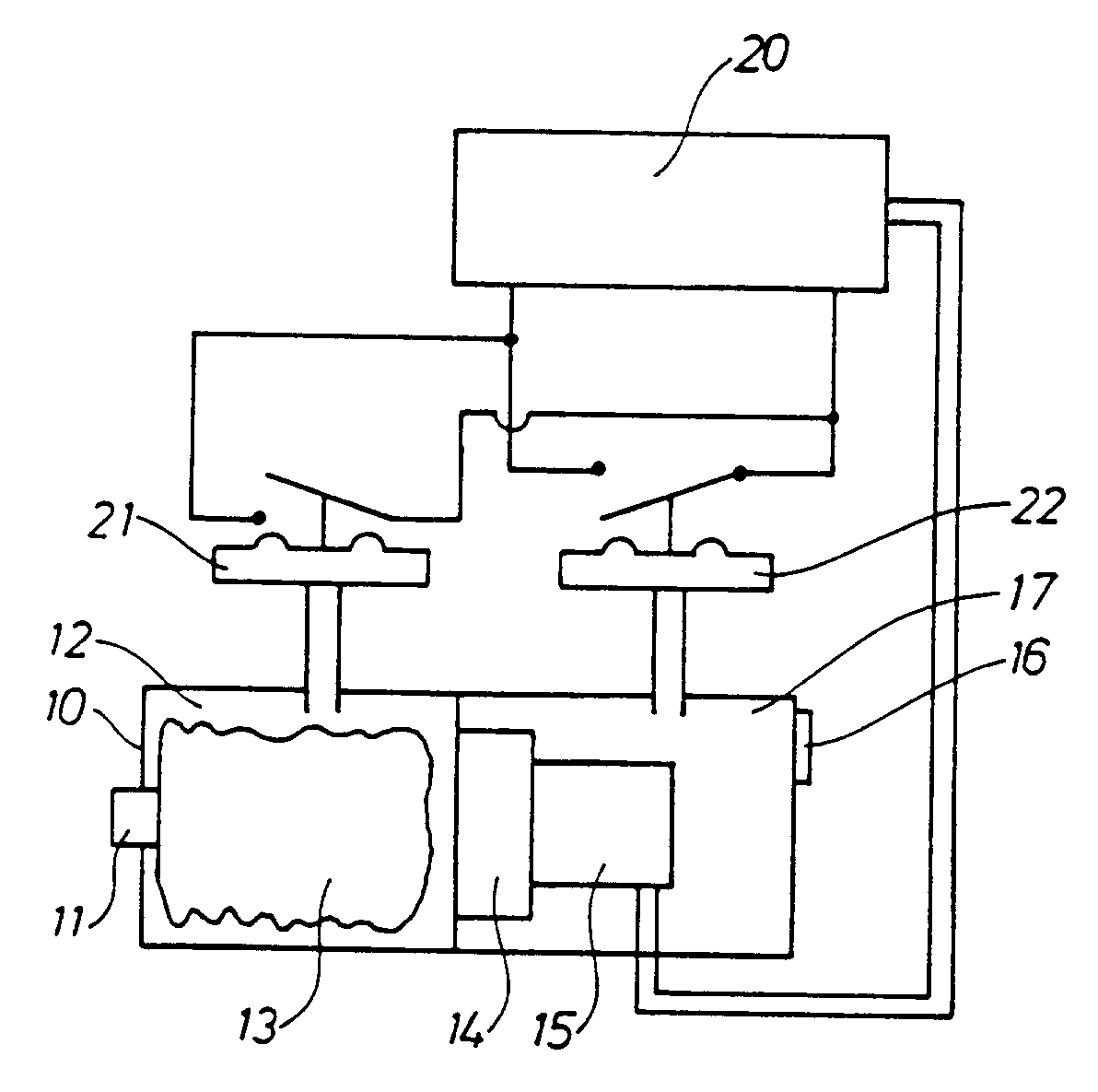
EUROPEAN PATENT SPECIFICATION |
| (45) |
Mention of the grant of the patent: |
|
13.04.1994 Bulletin 1994/15 |
| (22) |
Date of filing: 10.05.1989 |
|
| (51) |
International Patent Classification (IPC)5: A47L 9/28 |
|
| (54) |
Suction cleaner
Staubsauger
Aspirateur de poussières
|
| (84) |
Designated Contracting States: |
|
DE FR GB IT NL |
| (30) |
Priority: |
25.05.1988 SE 8801939
|
| (43) |
Date of publication of application: |
|
29.11.1989 Bulletin 1989/48 |
| (73) |
Proprietor: AKTIEBOLAGET ELECTROLUX |
|
105 45 Stockholm (SE) |
|
| (72) |
Inventors: |
|
- Kilström, Lars Gunnar
S-183 30 Täby (SE)
- Larsson, Anders Einar Clemens
S-112 28 Stockholm (SE)
- Svanberg, Joakim Axel
S-121 64 Johanneshov (SE)
- Tuvin, Lars Gunnar
S-741 00 Knivsta (SE)
|
| (74) |
Representative: Erixon, Bo et al |
|
c/o AB ELECTROLUX Corporate Patents & Trademarks
105 45 Stockholm
105 45 Stockholm (SE) |
| (56) |
References cited: :
DE-A- 3 712 233
US-A- 2 580 643
US-A- 4 514 874
|
GB-A- 2 012 158
US-A- 4 021 879
|
|
| |
|
|
|
|
| |
|
| Note: Within nine months from the publication of the mention of the grant of the European
patent, any person may give notice to the European Patent Office of opposition to
the European patent
granted. Notice of opposition shall be filed in a written reasoned statement. It shall
not be deemed to
have been filed until the opposition fee has been paid. (Art. 99(1) European Patent
Convention).
|
[0001] The present invention relates to a suction cleaner having a housing including an
inlet for dust-laden air, a filter chamber with a filter bag, a suction fan, a motor,
and an outlet passage through which filtered air flows from said suction fan to an
outlet, said motor having a control circuit including a first pressure switch communicating
with the filter chamber and actuated by the underpressure therein to control the motor
speed below a predetermined level.
[0002] A device for controlling the suction power of a suction cleaner in the manner described
above is disclosed in US 4514874.
[0003] By means of the control circuit the underpressure (i. e. partial vacuum) is restricted
to a predetermined value in that the power of the motor is automatically reduced when
this value is exceeded. The suction cleaning nozzle is thereby prevented from adhering
by suction to the surface to be cleaned, for example during cleaning of soft carpets.
It is a disadvantage of this arrangement, however, that the air flow increases when
the nozzle is raised from the surface, since the sensed underpressure is reduced.
The disadvantage of the increased air flow is that it produces a disturbing noise.
[0004] US 4021879 discloses control means in a vacuum cleaner for automatically maintaining
a substantially constant air flow under varying conditions of resistance to flow occurring
during operation of the cleaner. An increasing air flow and noise is thereby prevented
when the nozzle is raised from the surface to be cleaned. However, the problem of
the nozzle adhering to a soft carpet by too heavy suction force still remains.
[0005] The object of the present invention is to provide a suction cleaner in which both
the above-mentioned problems have been eliminated. This has been obtained by means
of a suction cleaner of the type mentioned in the introduction which according to
the invention is characterized by a second pressure switch communicating with the
outlet passage, said second pressure switch being actuatable by the pressure in the
outlet passage and being connected to the control circuit to limit fan speed when
said pressure in the outlet passage exceeds a predetermined level, both of said pressure
switches being interconnected in parallel.
[0006] The invention will be described in more detail in the following with referince to
the accompanying drawing which illustrates a diagrammatical longitudinal section of
a suction cleaner provided with the control equipment according to the invention which
is also shown diagrammatically.
[0007] The suction cleaner shown in the drawing comprises a housing 10 having an inlet 11,
a filter chamber 12 with a filter bag 13, a suction fan 14, a motor 15, and an outlet
16.
[0008] A control circuit 20 of a known type is connected to the motor 15, said control circuit
being adapted, when activated, to reduce the motor power to a predetermined level.
The control circuit is connected to a first pressure switch 21 which is actuated by
the pressure in the filter chamber 12 and activates the control circuit when this
pressure falls below a predetermined value. An excessive increase of the underpressure
causing the nozzle to adhere by suction to the surface to be cleaned is thereby prevented.
[0009] A second pressure switch 22 is connected to the control circuit 20 in parallel with
the first pressure switch 21. The second switch is actuated by the pressure in the
outlet passage 17 between the fan 14 and the outlet 16 and activates the control circuit
when this pressure exceeds a predetermined level. The flow of air through the suction
cleaner and consequently also the sound level are thereby reduced in response to a
decreasing suction resistance, such as when the nozzle is raised from the surface
to be cleaned.
[0010] In accordance to the invention, a suction cleaner has thus been provided in which
the underpressure as well as the air flow have been restricted to suitable, predetermined
levels.
1. Suction cleaner having a housing (10) including an inlet (11) for dust-laden air,
a filter chamber (12) with a filter bag (13), a suction fan (14), a motor (15), and
an outlet passage (17) through which filtered air flows from said suction fan to an
outlet (16), said motor (15) having a control circuit (20) including a first pressure
switch (21) communicating with the filter chamber and actuated by the underpressure
therein to control the motor speed below a predetermined level, characterized by a
second pressure switch (22) communicating with the outlet passage, said second pressure
switch being actuatable by the pressure in the outlet passage (17) and being connected
to the control circuit (20) to limit fan speed when said pressure in the outlet passage
exceeds a predetermined level, both of said pressure switches (21, 22) being interconnected
in parallel.
1. Staubsauger mit einem Gehäuse (10) einschließlich eines Einlasses (11) für staubbeladene
Luft, einer Filterkammer (12) mit einem Filterbeutel (13), einem Sauggebläse (14),
einem Motor (15) und einem Auslaßdurchgang (17), durch welchen die gefilterte Luft
von dem Sauggebläse zu einem Auslaß (16) strömt, wobei dar Motor (15) einen Steuerschaltkreis
(20) einschließlich eines ersten Druckschalters (21) umfaßt, der mit der Filterkammer
verbunden ist und durch den Unterdruck darin betätigt wird, um die Motorgeschwindigkeit
unter einen vorbestimmten Pegel zu regeln, dadurch gekennzeichnet, daß ein zweiter Druckschalter (22) vorgesehen ist, welcher mit dem Auslaßdurchgang
verbunden ist, wobei der zweite Druckschalter durch den Druck in dem Auslaßdurchgang
(17) betätigt wird und mit dem Steuerschaltkreis (20) verbunden ist, um die Gebläsegeschwindigkeit
zu begrenzen, wenn der Druck in dem Auslaßdurchgang einen vorbestimmten Pegel überschreitet,
wobei beide Druckschalter (21,22) parallel geschaltet sind.
1. Aspirateur comportant un boîtier (10) muni d'une entrée (11) pour de l'air chargé
de poussière, une chambre pour filtre (12) munie d'un sac (13) formant filtre, un
ventilateur d'aspiration (14), un moteur (15), et un passage de sortie (17) à travers
lequel l'air filtré s'écoule depuis ledit ventilateur d'aspiration vers une sortie
(16), ledit moteur (15) comportant un circuit de commande (20) comprenant un premier
commutateur de pression (21) communiquant avec la chambre pour filtre et actionné
par la dépression existant à l'intérieur de celle-ci pour commander la vitesse du
moteur en dessous d'un niveau prédéterminé, caractérisé en ce qu'il comporte un second
commutateur de pression (22) communiquant avec le passage de sortie, ledit second
commutateur de pression pouvant être actionné par la pression existant dans le passage
de sortie (17) et étant relié au circuit de commande (20) pour limiter la vitesse
du ventilateur lorsque ladite pression existant dans le passage de sortie dépasse
un niveau prédéterminé, les deux dits commutateurs de pression (21, 22) étant reliés
en parallèle.