|
(11) | EP 0 344 223 B1 |

| (12) | EUROPEAN PATENT SPECIFICATION |
|
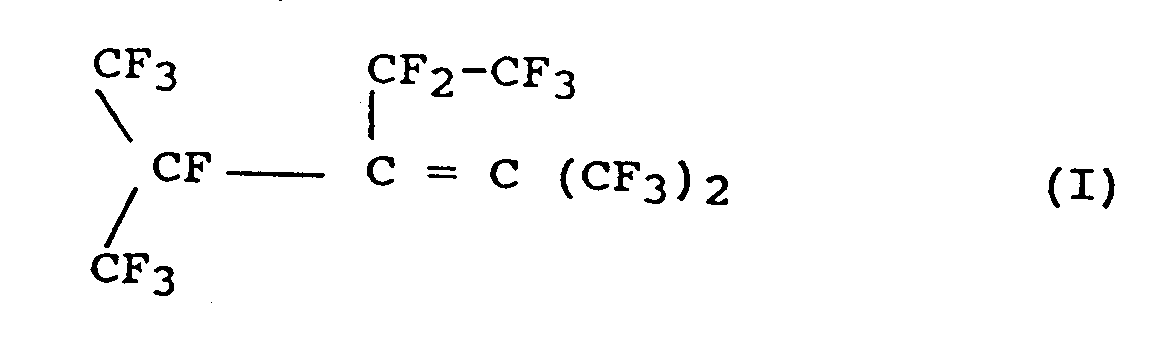
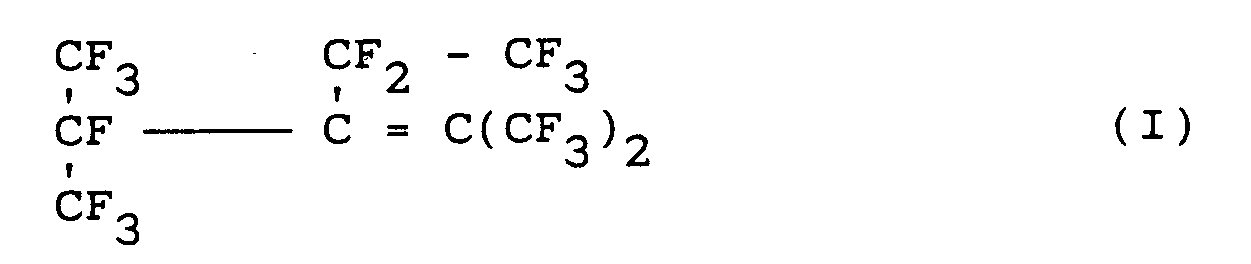
|
| (54) |
NEW PERFLUOROALKANES AND FLUORINATION PRODUCTS THEREOF PERFLUORALKENE UND FLUORIERUNGSPRODUKTE DAVON NOUVEAUX ALKOYLENES PERFLUORIQUES ET LEURS PRODUITS DE FLUORATION |
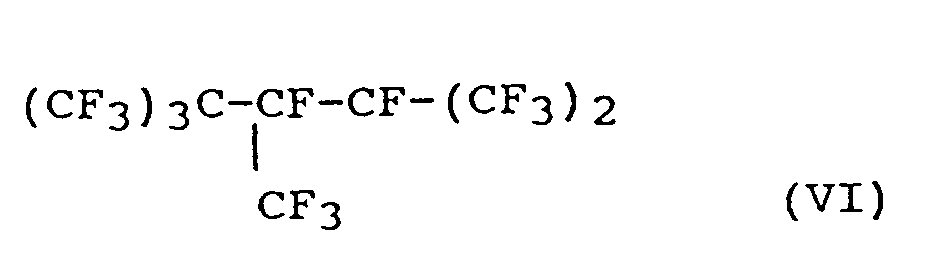
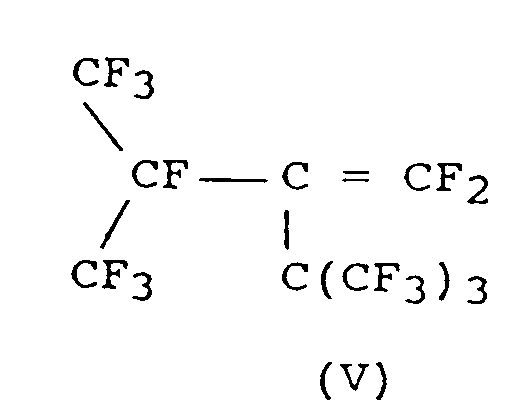
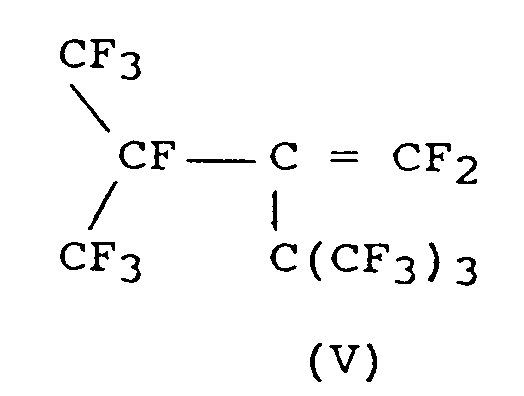
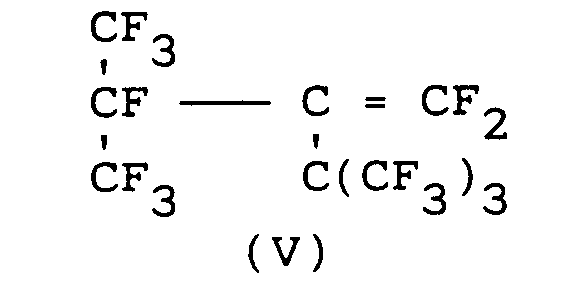
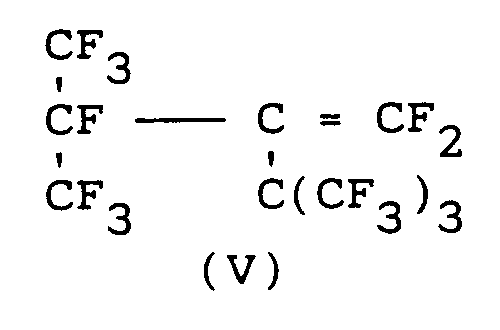
|
|
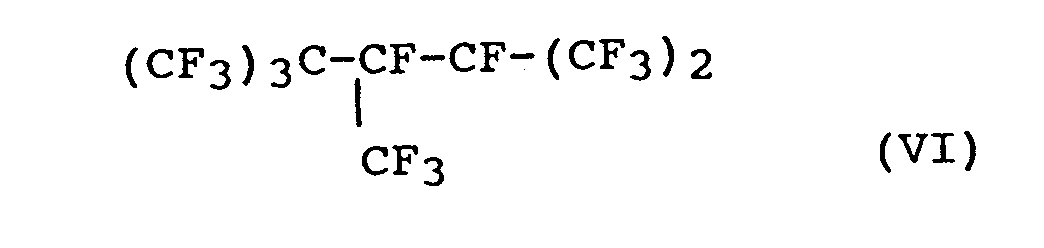
|||||||||||||||||||||||||||||||
|
||||||||||||||||||||||||||||||||
| Note: Within nine months from the publication of the mention of the grant of the European patent, any person may give notice to the European Patent Office of opposition to the European patent granted. Notice of opposition shall be filed in a written reasoned statement. It shall not be deemed to have been filed until the opposition fee has been paid. (Art. 99(1) European Patent Convention). |
[0001] The present invention relates to a branched perfluoroalkane, capable of providing perfluoroalkyl radicals, which is utilizable as an initiator for the polymerization of ethylenically unsaturated monomers and in particular of fluorinated olefins. More particularly, the present invention relates to a perfluorinated compound capable of releasing radicals which are highly reactive under the polymerization conditions. Actually, the perfluoroalkyl radicals are very interesting as they do not exhibit the drawbacks caused by inorganic peroxides, such as for example the persulphates, which introduce reactive end groups into the polymer, what requires subsequent expensive treatment in order to re-convert the polymer end groups to non-reactive groups (D.I. Mc Cane Encyclopedia of Polymer Science and Technology, vol. 12, pages 623-670).
[0002] However, at present, the generators of perfluoroalkyl radicals are often too stable, such as e.g. CF₃I, which requires too high utilization temperatures and which could interfere with the polymerization process, thereby causing undesirable drawbacks, or they are too expensive, such as the perfluoroacyl peroxides.
[0003] In EP-A-121 898, by partial fluorination of the C₃F₆ trimers, stable perfluoroalkyl radicals are obtained. However, these products are obtained in not very high yields and in admixture with the reaction raw products. Therefore, these radicals are less useful because the olefins can interfere with the monomers during the polymerization step.
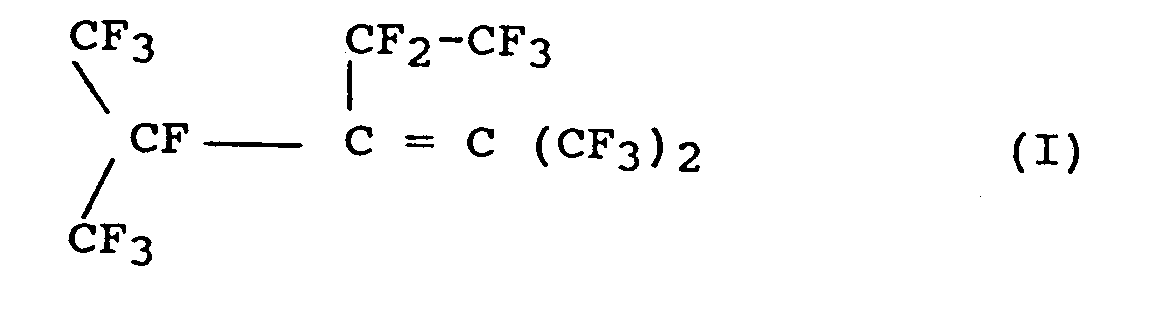
[0004] In WO 8007/88 in the name of the Applicant hereof, the hexafluoropropene trimer of formula (I) :
prepared according to the process described in US-A-3917724 was subjected to fluorination in the presence of U.V. radiation, thus obtaining the compounds of formulae (II) and (III) :
[0005] These perfluoroalkanes, when subjected to temperatures higher than 100° C, decompose, thereby generating perfluoroalkyl radicals, which are utilized in radical polymerization.
[0006] Other perfluoroalkanes capable of providing perfluoroalkyl radicals to be utilized as initiators for radical polymerization have now surprisingly been found.
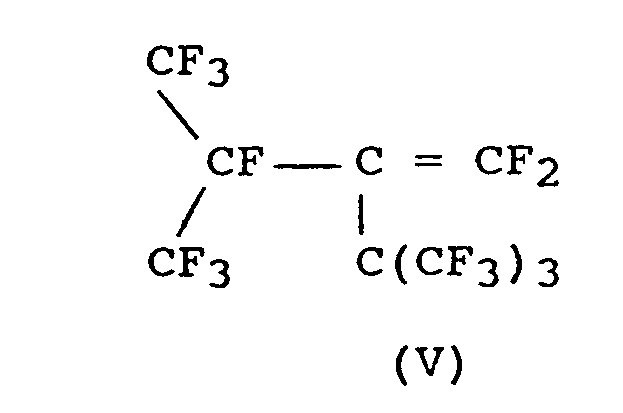
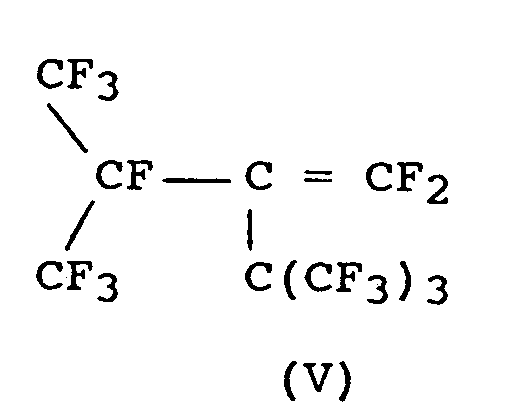
[0007] In fact, when the olefin of formula (I) is subjected to U.V. radiation, it isomerizes and provides the terminal olefins of formulas (IV) and (V):
which, when subjected to fluorination, give rise to the perfluoroalkanes of formulas (VI) and (IX) :
which, since they are highly ramified, are capable of generating perfluoroalkyl radicals at temperatures higher than 100°C.
[0008] The isomerization reaction is generally conducted at room temperature by irradiating the perfluoroolefin of formula (I) with U.V. radiation (the source of which is a high pressure Hg-vapor lamp type Hanau TQ 150 W). The raw reaction product is then purified by rectification.
[0009] The further fluorination reaction to obtain the compound of formula (VI) from the perfluoroolefin (V) is generally conducted at room temperature by introducing at the beginning fluorine diluted with an inert gas and by gradually raising the fluorine flow as the reaction proceeds. The product of formula (VI) is isolated by rectification.
[0010] By the process according to the invention, besides the mentioned perfluoroalkanes, other perfluoroalkanes are obtained, in particular the product (VIII), which, however, is not utilizable as a generator of radicals.
[0011] Furthermore, the perfluorooolefin of formula (V) according to the present invention, besides being useful as intermediate for the preparation of the perfluoroalkane (VI) utilizable as a source of perfluoroalkyl radicals, proves to be an advantageous starting product for the preparation of fine chemicals.
Example 1
[0013] Into a quartz photochemical immersion reactor, having an optical path of 1 cm, there were introduced 350 g of the olefin of formula (I), containing, 2% of its isomer of formula (VII):
[(CF₃)₂CF]₂C=CFCF₃ (VII)
[0014] The starting compound was subjected to ultraviolet radiation by means of a high pressure Hg-vapor lamp (Hanau TQ 150W).
[0015] In the course of the reaction it was possible to observe, by means of a gas-chromatographic analysis, a progressive decrease of the product of formula (I) and a simultaneous appearing of 2 new peaks in a ratio to each other of 3 to 2. After approximately a 200-hour irradiation, although the perfluorononene of formula (VII) initially contained in the starting product was still present, the conversion of the olefin of formula (I) resulted to be complete. The final mixture was subjected to gas-chromatographic analysis and revealed the following composition :
| perfluoroolefin of formula (IV) | 56% |
| perfluoroolefin of formula (V) | 38% |
| perfluoroolefin of formula (VII) | 6% |
[0016] The raw reaction product was purified by rectification on a column equipped with 90 plates. Isolated were the products of formula (IV) and (V), which boiled at 116°C and 118°C respectively.
[0017] The structure of the products was confirmed by NMR (¹⁹F,δ CFCl₃), the results being as follows :
Example 2
[0018] Into a tubular reactor having a diameter of 3.5 cm there were charged 370 g of a mixture consisting of 60% of the olefin of formula (IV) and 40% of the olefin of formula (V) in order to have in the reactor a liquid height of about 20 cm. After having put the whole under a nitrogen atmosphere, a 1:1 mixture of N₂/F₂ (total flow of 2 l/h), and then pure F₂ (flow of 1 l/h) were bubbled thereinto, at an inner temperature of 30 C. Exothermicity of the reaction was observed and the trend thereof was followed by means of gas-chromatographic analysis; a progressive decrease of the peaks relating to the starting products was observed.
[0019] After 20 hours, while maintaining constant the F₂ flow equal to 1 l/h, the reaction was complete and the mixture resulted to be composed by the following three products:
| perfluoroalkane of formula (VIII) | 24% |
| perfluoroalkane of formula (IX) | 26% |
| perfluoroalkane of formula (VI) | 50%. |
[0020] Products (VIII), (IX) and (VI) were isolated by rectification on a 90 plates column and were subjected to NMR analysis (¹⁹F,δ CFCl₃), which enabled to determine the structure. The results were as follows:
Example 3
[0021] 30 g of the product of formula (V) were subjected to an analogous fluorination: obtained were high yields of the perfluoroalkane of formula (VI) and little amounts of products having a lower number of carbon atoms deriving from the rupture of the carbon-carbon single bonds.
Example 4
[0022] The perfluoroalkane having formula (VI) was heated in sealed glass phials at different temperatures and times. The decomposition was followed by gaschromatographic analysis and the results are showed hereinbelow:
| Time (h) | Temperatures (°C) | % of product decomposed |
| 11 | 200 | 52 |
| 3,30 | 210 | 72 |
| 5 | 210 | 85 |
| 8 | 180 | 3 |
Example 5
[0023] 560 mg (1.2 m moles) of the perfluoroalkane of formula (VI) were loaded into a reactor having a volume of 30 ml and an inner diameter of 1 cm and after degasification 1,4 g of tetrafluoroethylene were charged and heated at 100° C for 1 hour and 20 minutes. The polytetrafluoroethylene obtained has a molecular weight of 145,000 . 370 mg of the polymeric initiator are recovered.
1. A ramified perfluoroalkane of formula (VI)
said perfluoroalkane being capable of generating perfluoroalkyl radicals at temperatures higher than 100°C.
said perfluoroalkane being capable of generating perfluoroalkyl radicals at temperatures higher than 100°C.
2. A process for preparing the perfluoroalkane of claim 1 which comprises fluorinating
a perfluoro olefin of formula (V)
3. A perfluoro olefin of formula (V)
4. A process for preparing the perfluoro olefin of claim 3 which comprises isomerizing,
in the presence of UV radiation, an olefin of formula (I)
5. A process for the polymerization of ethylenically unsaturated monomers which comprises
using, as a polymerization initiator, the ramified perfluoroalkane of claim 1.
1. Verzweigtes Perfluoralkan der Formel (VI)
welches Perfluoralkan befähigt ist, PerfluoralkylRadikale bei Temperaturen über 100°C zu erzeugen.
welches Perfluoralkan befähigt ist, PerfluoralkylRadikale bei Temperaturen über 100°C zu erzeugen.
2. Verfahren zur Herstellung des Perfluoralkans nach Anspruch 1, welches umfaßt die Fluorierung
eines Perfluorolefins der Formel (V)
3. Perfluorolefin der Formel (V)
4. Verfahren zur Herstellung des Perfluorolefins nach Anspruch 3, welches umfaßt die
Isomerisierung, in Gegenwart von UV-Strahlung, eines Olefins der Formel (I)
5. Verfahren zur Polymerisation von ethylenisch ungesättigten Monomeren, welches umfaßt
die Verwendung des verzweigten Perfluoralkans von Anspruch 1 als Polymerisationsinitiator.
1. Un perfluoroalkane ramifié de formule (VI):

ledit perfluoroalkane étant capable de générer des radicaux perfluoroalkyles à des températures supérieures à 100°C.
ledit perfluoroalkane étant capable de générer des radicaux perfluoroalkyles à des températures supérieures à 100°C.
2. Un procédé de préparation du perfluoroalkane selon la revendication 1, qui comprend
la fluoration d'une perfluorooléfine de formule (V):
3. Une perfluorooléfine de formule (V):
4. Un procédé de préparation d'une perfluorooléfine selon la revendication 3, qui compernd
l'isomérisation en présence de rayonnement ultraviolet d'une oléfine de formule (I):
5. Un procédé de polymérisation de monomères à insaturation éthylénique, qui comprend
l'utilisation, en tant qu'initiateur de polymérisation, du perfluoroalkane ramifié
de la revendication 1.