|
(11) | EP 0 345 091 B1 |

| (12) | EUROPEAN PATENT SPECIFICATION |
|
|
| (54) |
Ferroelectric liquid crystal compositions Ferroelektrische Flüssigkristallzusammensetzungen Compositions liquides cristallines ferro-électriques |
|
|
|||||||||||||||||||||||||||||||
|
||||||||||||||||||||||||||||||||
| Note: Within nine months from the publication of the mention of the grant of the European patent, any person may give notice to the European Patent Office of opposition to the European patent granted. Notice of opposition shall be filed in a written reasoned statement. It shall not be deemed to have been filed until the opposition fee has been paid. (Art. 99(1) European Patent Convention). |
[0001] This invention relates to a ferroelectric liquid crystal composition. More particularly it relates to a ferroelectric liquid crystal composition comprising a chiral or achiral compound having a negative dielectric anisotropy and a light switching element using the above-mentioned ferroelectric liquid crystal composition.
[0002] In recent years, liquid crystal display has come to be broadly utilized as display elements, making use of specific features of thin type, light weight, small power consumption, etc. However, most of these display elements utilize TN display mode wherein liquid crystal materials having nematic phase are used so that the response thereof is still yet slow in the application fields needing a high multiplexing; hence necessity of improvement therein has been urged.
[0003] A display mode which has recently been noted in such a present status is a display mode utilizing a light switching phenomenon proposed by N.A. Clark and S.T. Lagerwall (Applied Physics Letters, vol. 36, p. 899 (1980)). The presence of ferroelectric liquid crystals has been reported by R.B. Meyer et al in the year of 1975 for the first time (J. de Phys., vol. 36, p. 69 (1975), and in the aspect of liquid crystal classification, the liquid crystals belong to chiral smectic C phase, chiral smectic I phase, chiral smectic F phase, chiral smectic G phase, chiral smectic H phase, chiral smectic J phase and chiral smectic K phase (hereinafter abbreviated to SC* phase, SI* phase, SF* phase, SG* phase, SH* phase, SJ* phase and SK* phase, respectively).
[0004] When the light switching effect of ferroelectric liquid crystals is utilized for display elements, there are two superior specific features as compared with TN display mode. The first specific feature consists in that the display elements reply at a very high rate and the response time is ¹/₁₀₀ or less that of elements of TN display mode. The second specific feature consists in the memory effect thereof and a multiplex drive is easy as coupled with the above-mentioned high-rate response properties.
[0005] In order that display elements using ferroelectric liquid crystals are provided with memory properties, two methods are considered. The one is a method proposed by N.A. Clark et al wherein the helix is untwisted by reducing the cell thickness (d) down to a thickness less than the helical pitch (p) (d<p), to thereby cause the memory properties to appear (see Appl. Phys. Lett., vol. 36, p. 899 (1980)). The other is a method found by Le Piesant wherein the memory properties are caused to appear utilizing an AC-stabilizing effect (Paris Liquid Crystal Conference, p. 297, 1984).
[0006] Most of current ferroelectric liquid crystal materials have a short helical pitch; hence in order to cause the memory properties to appear by the thinning proposed by N.A. Clark et al, it is necessary to keep the cell thickness at about 1 to 3 µm, but taking into account the current cell preparation technique, a problem is raised that this is difficult in the aspects of cost and yield. On the other hand, the method found by Le Piesant wherein the memory properties are caused to appear utilizing AC-stabilizing effect is effective only in the case of ferroelectric liquid crystal materials having negative dielectric anisotropy (Δε), but it is possible to cause the memory properties to appear even in a thick cell of 5 to 7 µm; hence it is possible to utilize current cell preparation technique so that the method is very practical.
[0007] The AC-stabilizing effect is directed to a mode utilizing a phenomenon that in the case of a ferroelectric liquid crystal in a low frequency, the spontaneous polarization (Ps) replies to impressed electric field, while in the case of that in a high frequency, the spontaneous polarization cannot follow, and as a result, paraelectric anisotropy contributes, and if the dielectric anisotropy value is negative (Δε<0), the liquid crystal molecule is compelled to be in a parallel state relative to the substrate; thus the memory properties appear even in a thick cell. The first report presenting a matrix display practically utilizing this AC-stabilizing effect is Jeary's report in 1985 (SID '85, Digest, p. 128 (1985)), but since then there has been almost no report. The main reason is that ferroelectric liquid crystal materials having a negative dielectric anisotropy are few. Further, according to the Jeary's report, in order to cause the AC-stabilizing effect to appear, a voltage of about 40 V is necessary, but taking into account the driving voltage range of conventional IC, the AC-stabilizing effect is preferred to appear at far lower voltage (25 V or less). The AC-stabilizing effect appears at a lower voltage when the dielectric anisotropy has a larger negative value; hence a ferroelectric liquid crystal material having a large negative dielectric anisotropy value has been earnestly desired. Further, the response time of the ferroelectric liquid crystal material reported by Jeary et al is several msecs, that is, it is still slow in the practical aspect; hence appearance of a ferroelectric liquid crystal having a negative dielectric anisotropy value and also high-speed response properties has been desired.
SUMMARY OF THE INVENTION
[0008] A first object of the present invention is to provide a ferroelectric liquid crystal composition having a large negative dielectric anisotropy value, an AC-stabilizing effect at a low voltage and also high-speed response properties.
[0009] A second object of the present invention is to provide a light switching element using the above-mentioned liquid crystal composition.
[0010] In order to solve the above-mentioned problem, the present inventors have made extensive research on ferroelectric liquid crystal compositions, and as a result have found that when the following liquid crystal compounds are combined, a ferroelectric liquid crystal composition having a large negative dielectric anisotropy value and also high-speed response properties is obtained.
[0011] The present invention resides in a ferroelectric liquid crystal composition comprising at least the following three components A, B and C, each present in an amount of from 5 to 50% by weight based on the weight of the composition, the composition exhibiting a negative dielectric anisotropy value; and
component A being a compound of the formula:
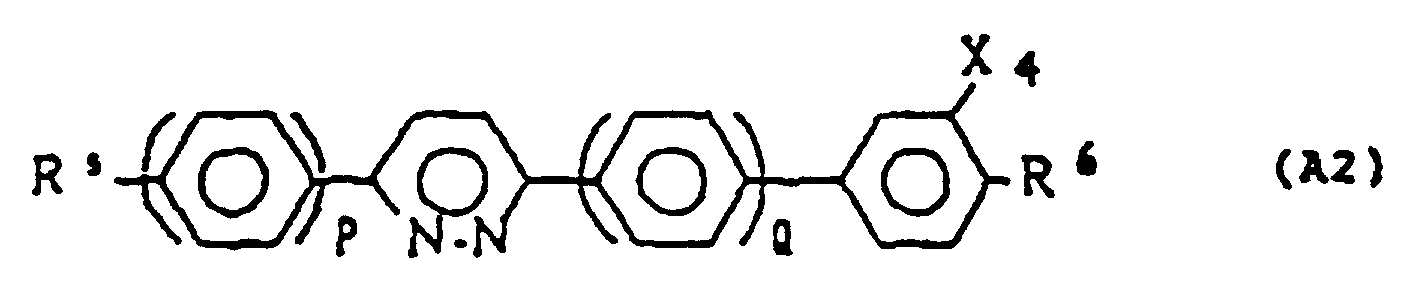
(in which R⁵ and R⁶ are each a linear or branched alkyl or an alkoxy group, each of 1 to 18 carbon atoms; X₄ is a hydrogen or halogen atom; P and Q are each 0 or 1 and the sum of P and Q is 0 or 1);
component B is a compound of the formula:
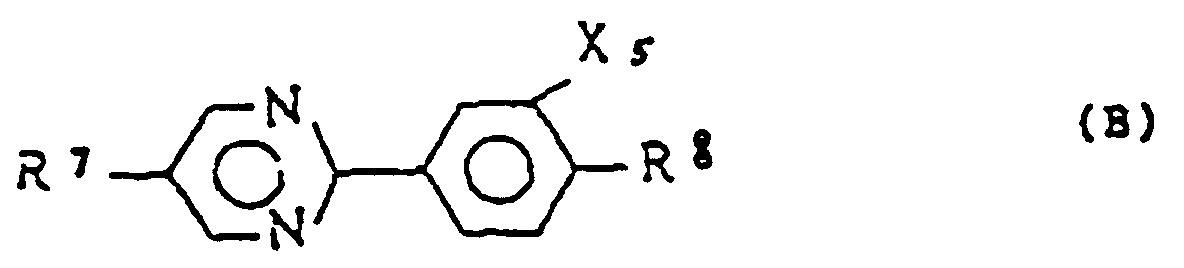
(in which R⁷ and R⁸ are each a linear or branched alkyl group or alkoxy group, each of 1 to 18 carbon atoms; and X₅ is a hydrogen or halogen atom); and
component C is a compound selected from compounds of the formulae:
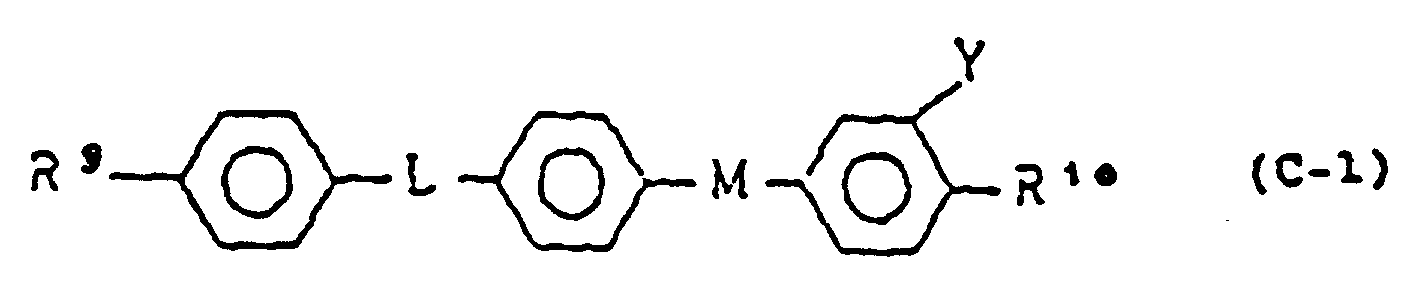
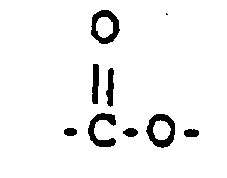
(in which R⁹ and R¹⁰ are each a linear or branched alkyl or alkoxy group, each of 1 to 18 carbon atoms, and at least one of R⁹ and R¹⁰ exhibits optical activity; one of L or M represents a single bond and the other is a group
or
and Y is a hydrogen or halogen atom or a cyano group),
[in which R¹¹ is a linear or branched alkyl or alkoxy group of 1 to 18 carbon atoms; R¹² represents a linear or branched alkyl group of 1 to 18 carbon atoms or a group
(in which R is a C₁ -C₁₀ alkyl group and * indicates an asymmetric carbon atom); or
(in which R¹³ is a linear or branched alkyl or alkoxy group each of 1 to 18 carbon atoms; R¹⁴ is a linear or branched C₂-C₁₈ alkyl group; E and F are each a group -OCH₂- or -CH₂O-, either one of E or F represents a single bond and * indicates an asymmetric carbon atom).
[0012] The invention also provides a light switching element using the above-mentioned liquid crystal composition.
BRIEF DESCRIPTION OF THE DRAWINGS
[0013] Fig. 1 shows a chart illustrating an impressed voltage wave in the ferroelectric liquid crystal composition of the present invention.
[0014] Fig. 2 shows a chart illustrating an optical response in the case where the voltage wave shown in Fig. 1 is overlapped with an AC wave of 25 KHz.
[0015] The compound expressed by the formula (A2) in the above ferroelectric liquid crystal composition is preferred to be a compound expressed by the formula
wherein R¹⁵ and R¹⁶ each represent a linear or branched alkyl group or alkoxy group each of 1 to 18 carbon atoms and X₆ represents hydrogen atom or halogen atom, or
a compound expressed by the formula
wherein R¹⁷ and R¹⁸ each represent a linear or branched alkyl group or alkoxy group each of 1 to 18 carbon atoms and X₇ represents hydrogen atom or halogen atom.
[0016] The compound of the formula (A2) used in the present invention has a pyridazine ring and also has a large dipole moment in the direction of the minor axis of the molecule; hence the compound has a specific feature of a large negative dielectric anisotropy value. The dielectric anisotropy values of main compounds belonging thereto were measured to give those in the range of about -8 to -2.
[0017] The compounds expressed by the formula (A2) are disclosed in the following literatures:
Zashke H., Hyna C., Schubert H., Z. Chem. 17, 333 (1977); Schubert H., Koch R., Weinbrecher CH., Z. Chem. 6, 467 (1966); Weygand C., Lanzendorf W., J. prakt. Chem., 151, 221 (1938); Japanese patent application laid-open Nos. Sho 60-226861/1985, Sho 63-68571/1988, and Sho 63-72680/1988, each filed by the present applicant:
Representative compounds expressed by the formula (A2) are illustrated below in Tables 1-5. In addition, in the present invention, even compounds having no smectic C phase are usable as far as the compounds are used in a quantity to such an extent that it has no notable influence upon the phase transition points of the composition.
[0019] Main compounds of the formula (C-1) will be illustrated below in the following Tables 9 - 12.
[0022] As described above, the present invention consists in that a compound of the formula(A-2) having a negative dielectric anisotropy is contained in a ferroelectric liquid crystal compound or a ferroelectric liquid crystal composition, and when a compound of the formula (A-2)as the component A, that of the formula (B) as the component B and a compound of the formula (C-1), (C-2) or (C-3) as the component C are combined together, a ferroelectric liquid crystal composition having a negative dielectric anisotropy and high-speed response properties are obtained.
[0023] As described above, the compound as the component A has a negative dielectric anisotropy value as large as about -8 to -2, causes a negative dielectric anisotropy value to appear in the resulting ferroelectric liquid crystal composition aimed in the present invention, causes the AC-stabilizing effect to occur even at low voltages, and as a result, plays an important role of generating good memory properties. The component A has a high melting point so that when it is used in a too high concentration, the melting point of the resulting ferroelectric liquid crystal composition becomes high; hence the temperature range of smectic C* phase becomes narrow. Thus, in order to present smectic C* phase in a broad temperature range including room temperature, the concentration of the component A used in the present invention is preferred to be 50% by weight or less based on the weight of the composition. The pyrimidine ring-containing compound of the formula (B) as the component B is a compound having a very low viscosity so that it plays an important role for improving the response properties, but most of the compounds of the formula (B) have a dielectric anisotropy value of about 0 to 5 and hence when they are used in a high concentration, the dielectric anisotropy value is liable to become positive, that is, this is undesirable. Thus, taking into account the use object of the component B, the concentration of the component B used in the present invention is preferred to be 50% by weight or less based on the weight of the composition.
[0024] The compound of the formula (C-1) as the component C is disclosed in Japanese patent application laid-open Nos. Sho 61-43/1986, Sho 61-210056/1986 and Sho 63-48254/1988, Japanese patent application Nos. Sho 62-053778/1987 and Sho 62-067097/1987, etc. each filed by the present applicant; further the compound of the formula (C-2) is disclosed in Japanese patent application Nos. Sho 61-133269/1986 and Sho 62-49796/1987, each filed by the present applicant; and further the compound of the formula (C-3) is disclosed in Japanese patent application No. Sho 60-149548/1985 filed by the present applicant. These compounds are ferroelectric liquid crystal compounds having superior high-speed response properties.
[0025] The respective proportions of the components A, B and C for obtaining liquid crystal compositions having the objective superior specific features making use of the specific features of these components have been researched. As a result, it has been found as described above that the proportions of the component A, the component B and the component C are preferred to be 5 to 50% by weight, 5 to 50% by weight and 5 to 50% by weight, each based on the weight of the composition, respectively.
[0026] The present invention will be described in more detail by way of Experimental examples and Examples, but it should not be construed to be limited thereto. In these examples, the spontaneous polarization value (Ps) was determined according to Sawyer-Tower method, the helical pitch (P) was determined by using a cell of about 200 µm thick subjected to homogeneous alignment and directly measuring the dechiralization line corresponding to the helical pitch under a polarizing microscope. The tilt angle (ϑ) was determined by impressing an electric field sufficiently higher than the critical one to the cell subjected to homogeneous alignment to make the helical structure extinct, further inverting the polarity and measuring the moved angle (corresponding to 2ϑ) at the extinction site under crossed nicols.
[0027] The response time was determined by filling the respective compositions in a cell subjected to aligning treatment and having a distance between the electrodes of 2 µm, imparting a square wave of ±5V/µm, 100 Hz and measuring change in the intensity of transmitted light at that time.
[0028] The dielectric anisotropy value was determined by using a cell subjected to parallel aligning treatment and vertical aligning treatment, measuring the dielectric constant from the volume of the empty cell and the volume of the cell having a liquid crystal filled therein at 1 KHz and calculating the dielectric anisotropy value.
Example 1
[0029] A ferroelectric liquid crystal composition (Mix. 1) consisting of the above-mentioned three components A, B and C and shown below was prepared:
This ferroelectric liquid crystal composition (Mix. 1) exhibited SC* phase within a range of room temperature to 59.0°C, a response time at 25°C of 250 µsec, a tilt angle of 22.2°, a Ps of 14.2 nC cm⁻² and a dielectric anisotropy value of -2.7.
[0030] This composition (Mix. 1) was filled between two substrates each having a transparent electrode subjected to rubbing treatment on its surface, placing an electro-optical element composed so as to give a cell thickness of 5 µm, between two polarizers crossed to each other, impressing a pulse wave (pulse width: 1 msec, ±25 V) as shown in Fig. 1, overlapping an AC wave of 20 KHz, ±25 V with the pulse wave and observing change in the level of transmitted light. As a result, good memory properties as shown in Fig. 2 were obtained.
[0031] As described above, when a compound having a negative dielectric anisotropy as the component of the present invention is added, the resulting ferroelectric liquid crystal composition has a large negative dielectric anisotropy value so that AC-stabilizing effect is notably exhibited, good memory properties are obtained and also the response time is very quick (about ¹/₄) as compared with that disclosed in Jeary's report and further, a low AC voltage (about ¹/₂); hence it has been found that the ferroelectric liquid crystal composition of the present invention is very suitable to practical use.
Examples 2 - 7
[0032] Table 15 shows the proportions of ferroelectric liquid crystal compositions (Mix. 2 to Mix. 7) and Table 16 shows the specific features thereof.
[0033] In Tables 15, the phase transition order of the composition (Mix. 5) is as follows:
C → SC* → SA → N* → I,
while the phase transition orders of other compositions are as follows:
C → SC* → SA → I
In addition, in the compositions Mixs. 5, 6 and 7 of Tables 15, besides components A, B and C, there are compositions containing another achiral compound or chiral liquid crystal compound for broadening the temperature region of SC* phase, elongating the helical pitch of SC* phase and for similar objects, but it does not damage the specific features of the ferroelectric liquid crystal composition of the present invention to contain these compounds; hence this does not raise any problem.
[0034] The ferroelectric liquid crystal composition of Mix. 6 was filled in a cell of a cell gap of 5 µm provided with transparent electrodes each obtained by coating PVA as an aligning treatment agent, rubbing the resulting surface and subjecting it to a parallel aligning treatment, followed by placing the resulting liquid crystal cell between two polarizers arranged in a crossed nicols state, and overlapping a pulse wave of a pulse width of 1 msec, ±25V with an AC wave of 25 KHz, ±20 V. As a result, as shown in Figs. 1 and 2, a good AC-stabilizing effect was observed, memory properties were also good and contrast ratio was as good as 1:20; thus a liquid crystal display element suitable to practical uses was obtained.
[0035] According to the present invention, a ferroelectric liquid crystal composition having a negative dielectric anisotropy, a good AC-stabilizing effect and still high-speed response properties, and a light switching element using the above composition are obtained. As the use applications of the ferroelectric liquid crystal composition of the present invention, high-speed liquid crystal shutter, high-multiplexing display, etc. are exemplified.
1. A ferrolelectric liquid crystal composition comprising at least the following three
components A, B and C, each present in an amount of from 5 to 50% by weight based
on the weight of the composition, the composition exhibiting a negative dielectric
anisotropy value; and
component A being a compound of the formula:
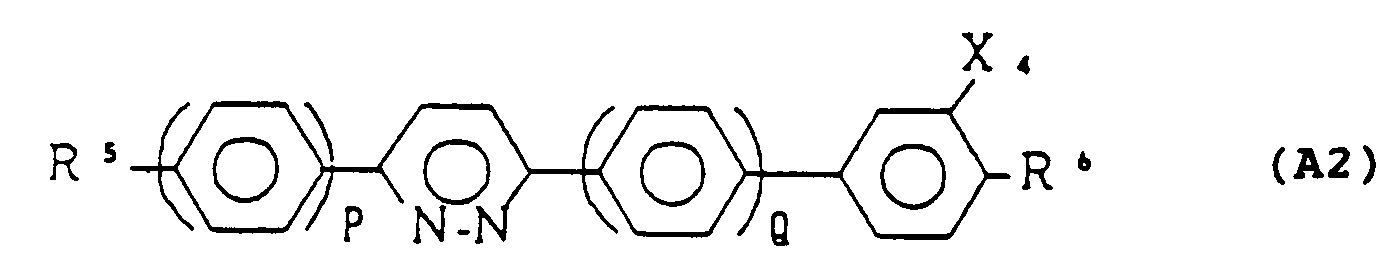
(in which R⁵ and R⁶ are each a linear or branched alkyl or an alkoxy group, each of 1 to 18 carbon atoms; X₄ is a hydrogen or halogen atom; P and Q are each 0 or 1 and the sum of P and Q is 0 or 1);
component B is a compound of the formula:
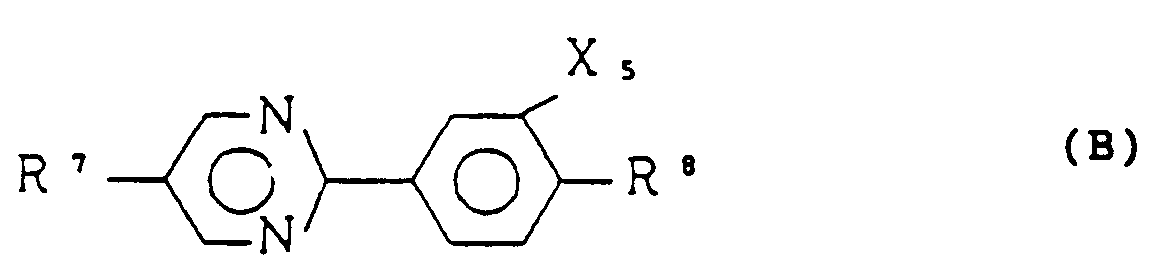
(in which R⁷ and R⁸ are each a linear or branched alkyl group or alkoxy group, each of 1 to 18 carbon atoms; and X₅ is a hydrogen or halogen atom); and
component C is a compound selected from compounds of the formulae:

(in which R⁹ and R¹⁰ are each a linear or branched alkyl or alkoxy group, each of 1 to 18 carbon atoms, and at least one of R⁹ and R¹⁰ exhibits optical activity; one of L or M represents a single bond and the other is a group
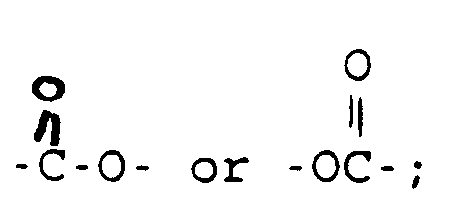
and Y is a hydrogen or halogen atom or a cyano group),

[in which R¹¹ is a linear or branched alkyl or alkoxy group of 1 to 18 carbon atoms; R¹² represents a linear or branched alkyl group of 1 to 18 carbon atoms or a group
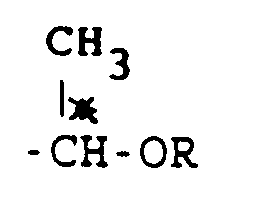
(in which R is a C₁-C₁₀ alkyl group and * indicates an asymmetric carbon atom); or

(in which R¹³ is a linear or branched alkyl or alkoxy group each of 1 to 18 carbon atoms; R¹⁴ is a linear or branched C₂-C₁₈ alkyl group; E and F are each a group -OCH₂- or -CH₂O-, either one of E or F represents a single bond and * indicates an asymmetric carbon atom).
component A being a compound of the formula:
(in which R⁵ and R⁶ are each a linear or branched alkyl or an alkoxy group, each of 1 to 18 carbon atoms; X₄ is a hydrogen or halogen atom; P and Q are each 0 or 1 and the sum of P and Q is 0 or 1);
component B is a compound of the formula:
(in which R⁷ and R⁸ are each a linear or branched alkyl group or alkoxy group, each of 1 to 18 carbon atoms; and X₅ is a hydrogen or halogen atom); and
component C is a compound selected from compounds of the formulae:
(in which R⁹ and R¹⁰ are each a linear or branched alkyl or alkoxy group, each of 1 to 18 carbon atoms, and at least one of R⁹ and R¹⁰ exhibits optical activity; one of L or M represents a single bond and the other is a group
and Y is a hydrogen or halogen atom or a cyano group),
[in which R¹¹ is a linear or branched alkyl or alkoxy group of 1 to 18 carbon atoms; R¹² represents a linear or branched alkyl group of 1 to 18 carbon atoms or a group
(in which R is a C₁-C₁₀ alkyl group and * indicates an asymmetric carbon atom); or
(in which R¹³ is a linear or branched alkyl or alkoxy group each of 1 to 18 carbon atoms; R¹⁴ is a linear or branched C₂-C₁₈ alkyl group; E and F are each a group -OCH₂- or -CH₂O-, either one of E or F represents a single bond and * indicates an asymmetric carbon atom).
2. A liquid crystal composition according to claim 2 in which the compound of formula
(A2) is a compound of the formulae:
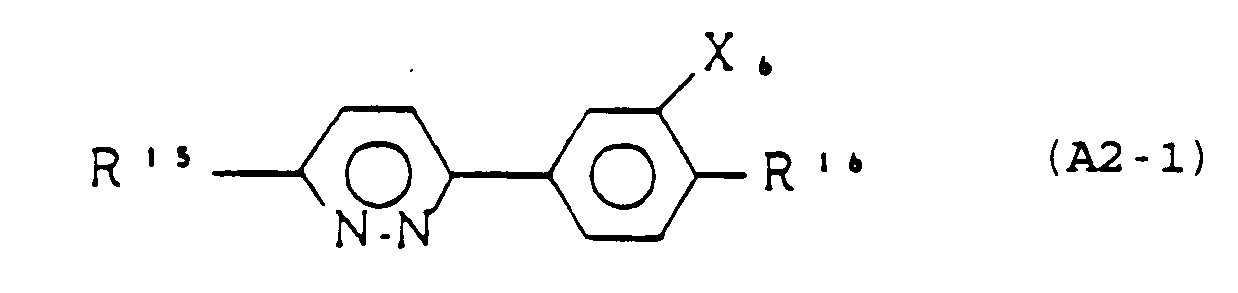
(in which R¹⁵ and R¹⁶ are each a linear or branched alkyl group or alkoxy group, each of 1 to 18 carbon atoms; and X₆ is a hydrogen or halogen atom); or
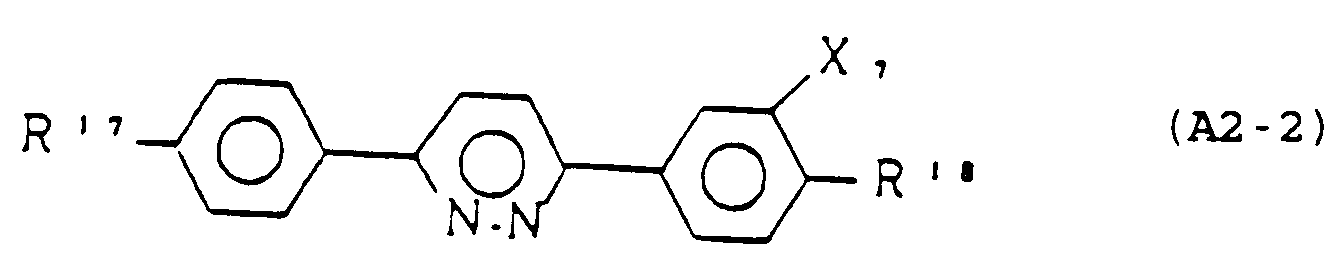
(in which R¹⁷ and R¹⁸ are each a linear or branched alkyl group or alkoxy group, each of 1 to 18 carbon atoms; and X₇ is hydrogen or halogen atom).
(in which R¹⁵ and R¹⁶ are each a linear or branched alkyl group or alkoxy group, each of 1 to 18 carbon atoms; and X₆ is a hydrogen or halogen atom); or
(in which R¹⁷ and R¹⁸ are each a linear or branched alkyl group or alkoxy group, each of 1 to 18 carbon atoms; and X₇ is hydrogen or halogen atom).
3. A light switching element comprising a liquid crystal composition as set forth in
any on of claim 1 or claim 2.
1. Ferroelektrische Flüssigkristallzusammensetzung, mit wenigstens die drei folgenden
Komponenten A, B und C, die jeweils in einer Menge zwischen 5 und 50 Gew.-% auf der
Grundlage des Gewichts der Zusammensetzung vorhanden sind, wobei die Zusammensetzung
einen negativen Wert der dielektrischen Anisotropie aufweist und
Komponente A eine Verbindung ist mit der Formel:
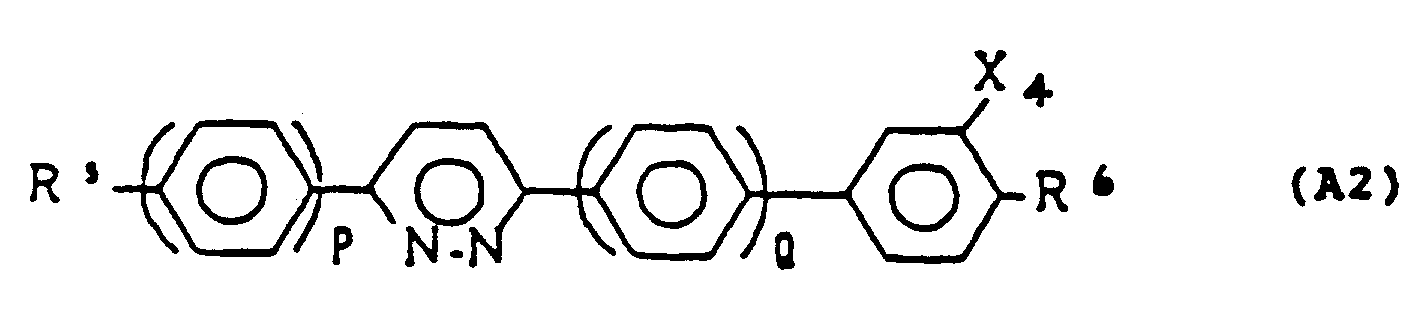
(in welcher R⁵ und R⁶ jeweils ein lineares oder verzweigtes Alkyl oder eine Alkoxygruppe, jeweils mit 1 bis 18 Kohlenstoffatomen, sind, X₄ ein Wasserstoff- oder Halogenatom ist, P und Q jeweils 0 oder 1 sind und die Summe von P und Q gleich 0 oder 1 ist);
Komponente B eine Verbindung ist mit der Formel:
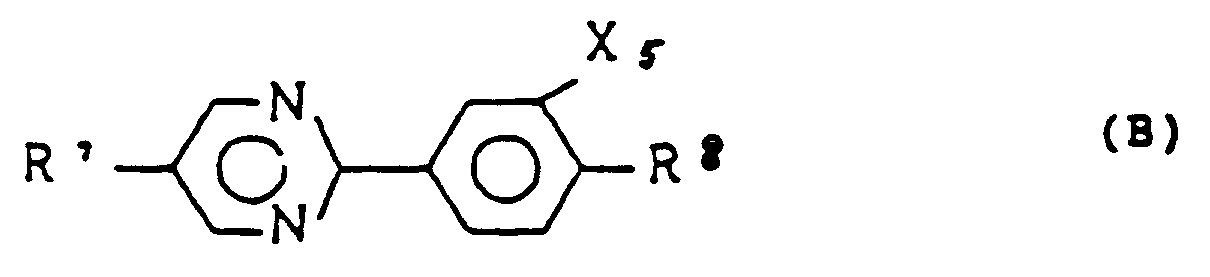
(in welcher R⁷ und R⁸ jeweils eine lineare oder verzweigte Alkylgruppe oder Alkoxygruppe, jeweils mit 1 bis 18 Kohlenstoffatomen, sind, und X₅ ein Wasserstoff- oder Halogenatom ist) und
Komponente C eine Verbindung ist, die ausgewählt wird aus den Verbindungen mit den Formeln

(in welcher R⁹ und R¹⁰ jeweils eine lineare oder verzweigte Alkyl- oder Alkoxygruppe, jeweils mit 1 bis 18 Kohlenstoffatomen, sind und wenigstens eine der Verbindungen R⁹ und R¹⁰ optische Aktivität aufweist, eines der Symbole L oder M eine Einfachbindung darstellt und die andere eine Gruppe
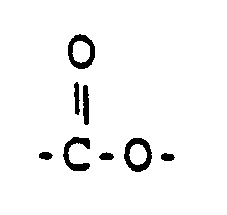
oder
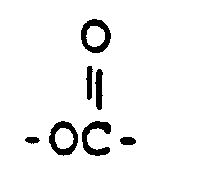
ist, und Y ein Wasserstoff- oder Halogenatom oder eine Cyangruppe ist),

[in welcher R¹¹ ein lineares oder verzweigtes Alkyl oder eine Alkoxygruppe mit 1 bis 18 Kohlenstoffatomen ist, R¹² eine lineare oder verzweigte Alkylgruppe mit 1 bis 18 Kohlenstoffatomen oder eine Gruppe
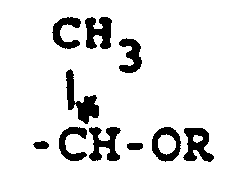
(worin R eine C₁-C₁₀-Alkylgruppe ist und * ein asymmetrisches Kohlenstoffatom kennzeichnet) darstellt], oder

(in welcher R¹³ ein lineares oder verzweigtes Alkyl oder eine Alkoxygruppe mit jeweils 1 bis 18 Kohlenstoffatomen ist; R¹⁴ eine lineare oder verzweigte C₂-C₁₈-Alkylgruppe ist; E und F jeweils eine Gruppe -OCH₂- oder -CH₂O- sind, jedes der Symbole E und F eine Einfachbindung darstellt und * ein asymmetrisches Kohlenstoffatom kennzeichnet).
Komponente A eine Verbindung ist mit der Formel:
(in welcher R⁵ und R⁶ jeweils ein lineares oder verzweigtes Alkyl oder eine Alkoxygruppe, jeweils mit 1 bis 18 Kohlenstoffatomen, sind, X₄ ein Wasserstoff- oder Halogenatom ist, P und Q jeweils 0 oder 1 sind und die Summe von P und Q gleich 0 oder 1 ist);
Komponente B eine Verbindung ist mit der Formel:
(in welcher R⁷ und R⁸ jeweils eine lineare oder verzweigte Alkylgruppe oder Alkoxygruppe, jeweils mit 1 bis 18 Kohlenstoffatomen, sind, und X₅ ein Wasserstoff- oder Halogenatom ist) und
Komponente C eine Verbindung ist, die ausgewählt wird aus den Verbindungen mit den Formeln
(in welcher R⁹ und R¹⁰ jeweils eine lineare oder verzweigte Alkyl- oder Alkoxygruppe, jeweils mit 1 bis 18 Kohlenstoffatomen, sind und wenigstens eine der Verbindungen R⁹ und R¹⁰ optische Aktivität aufweist, eines der Symbole L oder M eine Einfachbindung darstellt und die andere eine Gruppe
oder
ist, und Y ein Wasserstoff- oder Halogenatom oder eine Cyangruppe ist),
[in welcher R¹¹ ein lineares oder verzweigtes Alkyl oder eine Alkoxygruppe mit 1 bis 18 Kohlenstoffatomen ist, R¹² eine lineare oder verzweigte Alkylgruppe mit 1 bis 18 Kohlenstoffatomen oder eine Gruppe
(worin R eine C₁-C₁₀-Alkylgruppe ist und * ein asymmetrisches Kohlenstoffatom kennzeichnet) darstellt], oder
(in welcher R¹³ ein lineares oder verzweigtes Alkyl oder eine Alkoxygruppe mit jeweils 1 bis 18 Kohlenstoffatomen ist; R¹⁴ eine lineare oder verzweigte C₂-C₁₈-Alkylgruppe ist; E und F jeweils eine Gruppe -OCH₂- oder -CH₂O- sind, jedes der Symbole E und F eine Einfachbindung darstellt und * ein asymmetrisches Kohlenstoffatom kennzeichnet).
2. Flüssigkristallzusammensetzung nach Anspruch 1, gekennzeichnet dadurch, daß die Verbindung
der Formel (A2) eine Verbindung ist mit den Formeln:
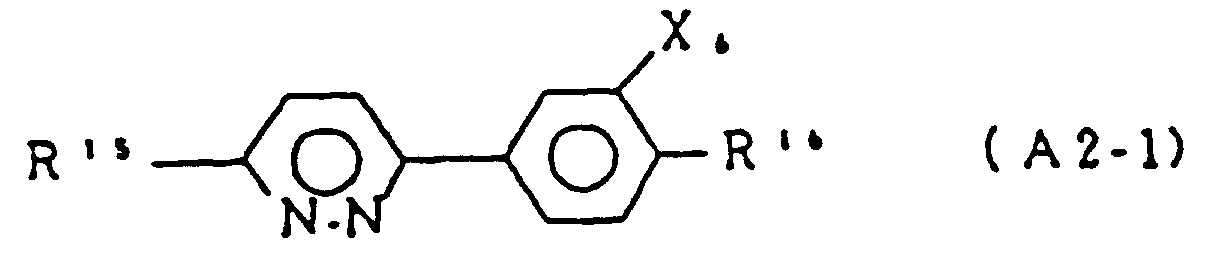
(in welcher R¹⁵ und R¹⁶ jeweils eine lineare oder verzweigte Alkylgruppe oder Alkoxygruppe, jeweils mit 1 bis 18 Kohlenstoffatomen, sind und X₆ ein Wasserstoff- oder Halogenatom ist) oder

(in welcher R¹⁷ und R¹⁸ jeweils eine lineare oder verzweigte Alkylgruppe oder Alkoxygruppe, jeweils mit 1 bis 18 Kohlenstoffatomen, sind und X₇ ein Wasserstoff- oder Halogenatom ist).
(in welcher R¹⁵ und R¹⁶ jeweils eine lineare oder verzweigte Alkylgruppe oder Alkoxygruppe, jeweils mit 1 bis 18 Kohlenstoffatomen, sind und X₆ ein Wasserstoff- oder Halogenatom ist) oder
(in welcher R¹⁷ und R¹⁸ jeweils eine lineare oder verzweigte Alkylgruppe oder Alkoxygruppe, jeweils mit 1 bis 18 Kohlenstoffatomen, sind und X₇ ein Wasserstoff- oder Halogenatom ist).
3. Lichtschaltelement mit einer Flüssigkristallzusammensetzung nach einem der Ansprüche
1 oder 2.
1. Composition liquide cristalline comprenant au moins les trois composants A, B et C
suivants, présents chacun en une quantité de 5 à 50 % en poids sur la base du poids
de la composition, la composition présentant une valeur de l'anisotropie diélectrique
négative et
le composant A étant un composé de la formule:
(dans laquelle R⁵ et R⁶ sont chacun un groupement alkyle ou alcoxy linéaire ou ramifié, chacun de 1 à 18 atomes de carbone; X₄ est un atome d'hydrogène ou d'halogène; P et Q sont chacun 0 ou 1 et la somme de P et Q est 0 ou 1);
le composant B est un composé de la formule:
(dans laquelle R⁷ et R⁸ sont chacun un groupement alkyle ou alcoxy linéaire ou ramifié, chacun de 1 à 18 atomes de carbone et X₅ est un atome d'hydrogène ou d'halogène) et
le composant C est un composé choisi parmi les composés des formules
(dans laquelle R⁹ et R¹⁰ sont chacun un groupement alkyle ou alcoxy linéaire ou ramifié, chacun de 1 à 18 atomes de carbone et au moins un des R₉ et R₁₀ présente une activité optique; un des L et M représente une liaison simple et l'autre est un groupement
ou
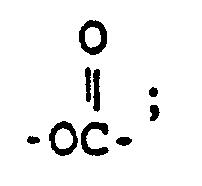
et Y est un atome d'hydrogène ou d'halogène ou un groupement nitrile),

[dans laquelle R¹¹ est un groupement alkyle ou alcoxy linéaire ou ramifié de 1 à 18 atomes de carbone; R¹² représente un groupement alkyle linéaire ou ramifié de 1 à 18 atomes de carbone ou un groupement
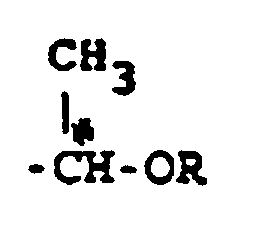
(dans lequel R est un groupement alkyle en C₁-C₁₀ et * indique un atome de carbone asymétrique)] ou

(dans lequel R¹³ est un groupement alkyle ou alcoxy linéaire ou ramifié chacun de 1 à 18 atomes de carbone; R¹⁴ est un groupement alkyle linéaire ou ramifié en C₂-C₁₈; E et F sont chacun un groupement -OCH₂- ou -CH₂O-, l'un ou l'autre des E et F représente une liaison simple et * indique un atome de carbone asymétrique).
le composant A étant un composé de la formule:
(dans laquelle R⁵ et R⁶ sont chacun un groupement alkyle ou alcoxy linéaire ou ramifié, chacun de 1 à 18 atomes de carbone; X₄ est un atome d'hydrogène ou d'halogène; P et Q sont chacun 0 ou 1 et la somme de P et Q est 0 ou 1);
le composant B est un composé de la formule:
(dans laquelle R⁷ et R⁸ sont chacun un groupement alkyle ou alcoxy linéaire ou ramifié, chacun de 1 à 18 atomes de carbone et X₅ est un atome d'hydrogène ou d'halogène) et
le composant C est un composé choisi parmi les composés des formules
(dans laquelle R⁹ et R¹⁰ sont chacun un groupement alkyle ou alcoxy linéaire ou ramifié, chacun de 1 à 18 atomes de carbone et au moins un des R₉ et R₁₀ présente une activité optique; un des L et M représente une liaison simple et l'autre est un groupement
ou
et Y est un atome d'hydrogène ou d'halogène ou un groupement nitrile),
[dans laquelle R¹¹ est un groupement alkyle ou alcoxy linéaire ou ramifié de 1 à 18 atomes de carbone; R¹² représente un groupement alkyle linéaire ou ramifié de 1 à 18 atomes de carbone ou un groupement
(dans lequel R est un groupement alkyle en C₁-C₁₀ et * indique un atome de carbone asymétrique)] ou
(dans lequel R¹³ est un groupement alkyle ou alcoxy linéaire ou ramifié chacun de 1 à 18 atomes de carbone; R¹⁴ est un groupement alkyle linéaire ou ramifié en C₂-C₁₈; E et F sont chacun un groupement -OCH₂- ou -CH₂O-, l'un ou l'autre des E et F représente une liaison simple et * indique un atome de carbone asymétrique).
2. Composition liquide cristalline selon la revendication 1, dans laquelle le composé
de la formule (A2) est un composé des formules:
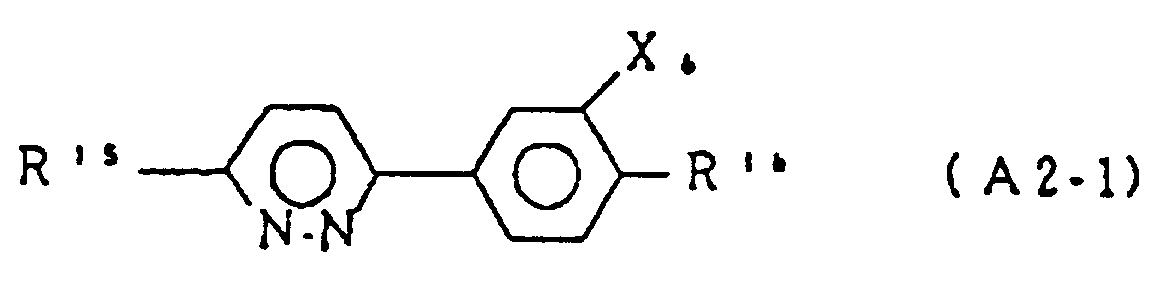
(dans laquelle R¹⁵ et R¹⁶ sont chacun un groupement alkyle ou alcoxy linéaire ou ramifié, chacun de 1 à 18 atomes de carbone et X₆ est un atome d'hydrogène ou d'halogène) ou
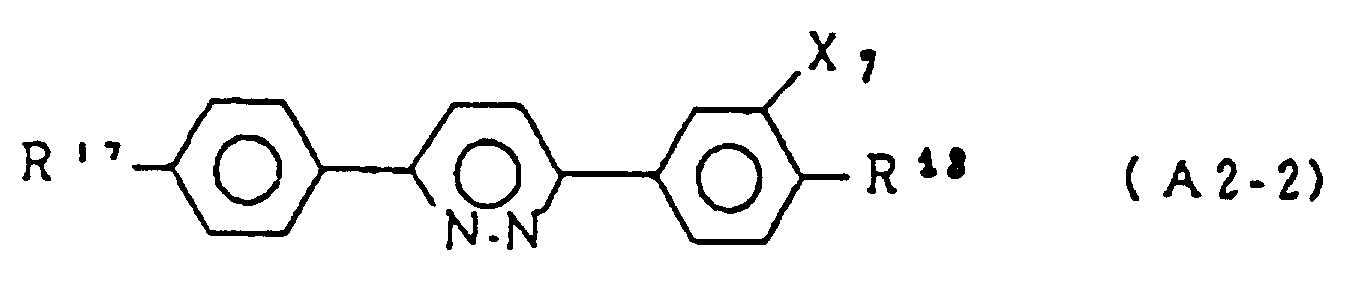
(dans laquelle R¹⁷ et R¹⁸ sont chacun un groupement alkyle ou alcoxy linéaire ou ramifié, chacun de 1 à 18 atomes de carbone et X₇ est un atome d'hydrogène ou d'halogène).
(dans laquelle R¹⁵ et R¹⁶ sont chacun un groupement alkyle ou alcoxy linéaire ou ramifié, chacun de 1 à 18 atomes de carbone et X₆ est un atome d'hydrogène ou d'halogène) ou
(dans laquelle R¹⁷ et R¹⁸ sont chacun un groupement alkyle ou alcoxy linéaire ou ramifié, chacun de 1 à 18 atomes de carbone et X₇ est un atome d'hydrogène ou d'halogène).
3. Élément de commutation de la lumière comprenant une composition liquide cristalline
telle que décrite dans l'une quelconque des revendications 1 et 2.