| (19) |
 |
|
(11) |
EP 0 345 787 B1 |
| (12) |
EUROPEAN PATENT SPECIFICATION |
| (45) |
Mention of the grant of the patent: |
|
11.11.1992 Bulletin 1992/46 |
| (22) |
Date of filing: 08.06.1989 |
|
|
| (54) |
Drug in combination with flavor masking agent and method for making same
Arzneistoff in Kombination mit einem geschmacksüberdeckenden Stoff und Verfahren zu
dessen Herstellung
Médicament en association avec un agent masquant le goût et son procédé de fabrication
|
| (84) |
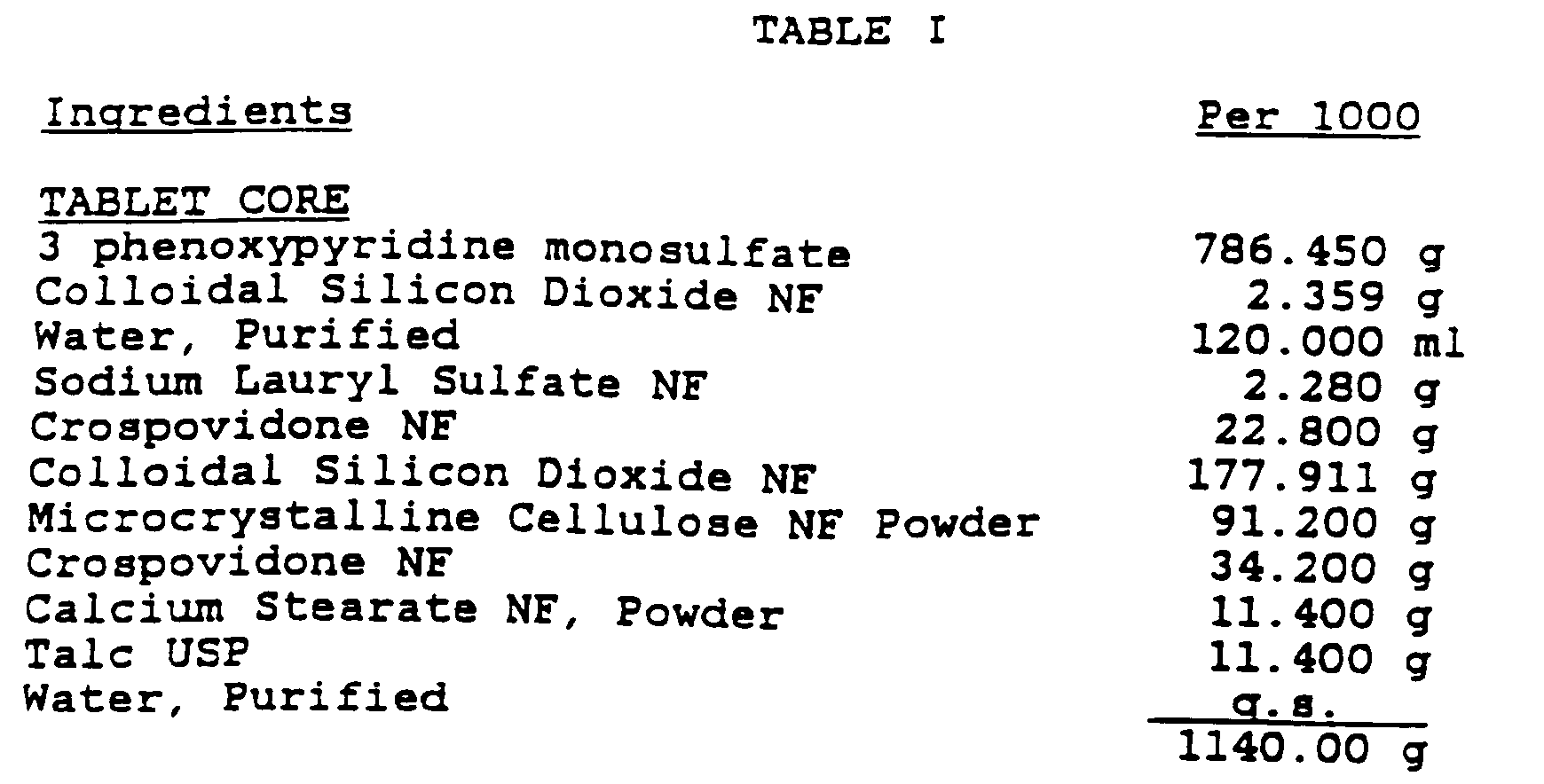
Designated Contracting States: |
|
AT BE CH DE ES FR GB GR IT LI LU NL SE |
| (30) |
Priority: |
09.06.1988 US 204437
|
| (43) |
Date of publication of application: |
|
13.12.1989 Bulletin 1989/50 |
| (73) |
Proprietor: WARNER-LAMBERT COMPANY |
|
Morris Plains
New Jersey 07950 (US) |
|
| (72) |
Inventors: |
|
- Botzolakis, John E.
Randolph
New Jersey 07869 (US)
- Harris, Michael R.
Hackettsown
New Jersey 07840 (US)
- Nesbitt, Russell U.
Somerville
New Jersey 08876 (US)
|
| (74) |
Representative: Mansmann, Ivo |
|
Gödecke AG
Patentwesen
Mooswaldallee 1-9
79090 Freiburg
79090 Freiburg (DE) |
| (56) |
References cited: :
EP-A- 0 219 458
US-A- 4 338 311
|
US-A- 3 592 921
US-A- 4 486 435
|
|
| |
|
|
|
|
| |
|
| Note: Within nine months from the publication of the mention of the grant of the European
patent, any person may give notice to the European Patent Office of opposition to
the European patent
granted. Notice of opposition shall be filed in a written reasoned statement. It shall
not be deemed to
have been filed until the opposition fee has been paid. (Art. 99(1) European Patent
Convention).
|
[0001] Drugs are most commonly administered orally and as such must be placed in a suitable
form for oral ingestion. Not only must the drug be adapted to be delivered at desirable
dosage levels but, at times, depending upon the nature of the drug, must be protected
from rapid moisture absorption.
[0002] Certain hygroscopic drugs have distinctly unpleasant tastes and odors. In addition
hygroscopic and waxy drugs present processing problems during tabletting and encapsulation.
Examples of drugs which possess one or more of these properties are oxtriphylline,
procainamide HCl, gemfibrozil, disopyramide phosphate, fenoprofen calcium, atenolol,
piracetam, carbamazepine, tetracycline HCl, oxytetracycline HCl, rifamprin, lincomycin
HCl, clindamycin HCl, cefaclor, cefadroxil, cephrabine, thiamine HCl, ascorbic acid,
acetylsalicylic acid, methocarbamol, methyldopa, sulindac, desipramine HCl, ranitine
HCl, ethionamide, divalproex sodium, meprobamate, captopril, and aminophylline. These
drugs as well as other hygroscopic unpleasant tasting drugs are known for purposes
of this specification as malflavored drugs and, because of their off flavors and difficult
handling, provide problems both for the drug manufacturer as well as in the area of
patient compliance in taking proper amounts.
[0003] Silicon dioxide is an ingredient commonly used in the tablet art as an aid to tablet
processing. Low levels of silicon dioxide usually below 2% are generally employed.
European Patent Application 108,218 by James Michael Dunn et al describes the formation
of constant release rate tablets of water soluble drugs employing from 0.5 to 3 rate
percent of fumed silicon dioxide as a lubricant.
[0004] U.S. Patent 4,536,511 issued to Wolfgang Fisher et al, discloses a drug specific
combination including levels of silica and cellulose below 1% evidently to aid binding
and flow characteristics in a wet granulation system for the drug muzolimine.
[0005] U.S. Patent 4,526,777 issued to Cheryl D. Blume et al discloses the combination of
two dry granulations including microcrystalline cellulose as a binding and disintergrant
with syloid as a flow enhancer again in precedingly low levels.
[0006] Patents issued to James M. Dunn, namely U.S. 4,461,759; 4,522,804; 4,521,402; and
4,521,401 disclose 0.4 to 3.09 % silicon dioxide in combination with hydrogenated
vegetable oil and an acrylic acid polymer.
[0007] U.S. Patent 4,609,675 issued to Robert M. Franz discloses using silicon dioxide at
a 1% level for dry granulation of ibuprofen.
[0008] U. S. Patent 4, 478, 819 issued to Hercelin, teaches silicon dioxide used in forming
extruded granules. U.S. Patent 4,442,086 issued to James M. Quinlan discloses the
use of silica as a glidant at levels not greater than 0.05%.
[0009] U.S. Patent 4,415,547 teaches the use of silica dioxide as a dusting powder for pellets
which are subsequently compressed into tablets.
[0010] U.S. Patent 3,592,927 issued to Maximillan Koffier discloses a calcium pantothenate
composition which is produced in dry free flowing form by the inclusion of silicon
dioxide during its manufacturer at a level below 5%.
[0011] U.S. Patent 4 338 311 to Ralph A. Heasley discloses a stable solid formulation of
choline salicylate and hydrophilic silicon dioxide in rather high amounts (more than
25% by weight), wherein the SiO₂ is used as a tabletting aid.
[0012] In addition, European Patent Application 167,191 discloses the inclusion of silicon
dioxide as an aid to direct compression of tablets. European Patent Application 136,100
discloses the combination of sucralfate with microcrystalline cellulose and colloidal
silicon dioxide as a suspending agent at extremely low levels.
Summary of the Invention
[0013] According to this invention various unpleasant flavored drugs can be processed by
a unique wet granulation process wherein a slurry of the drug in water is dried in
combination with colloidal silicon dioxide and, in a particularly preferred embodiment
microcrystalline cellulose is used with the colloidal silicon dioxide adsorbing onto
the drug particles.
[0014] By unpleasant flavored drugs, for purposes of this invention, the term is defined
as drugs which are unpleasant tasting and/or smelling and/or are hygroscopic and/or
tacky.
[0015] The result is a protective coating of silicon dioxide which masks unpleasant taste
and odor, decreases moisture absorption, and also reduces the adhesiveness of the
granulation onto the punch faces used in the manufacture of the granules. By adsorbing
silicon dioxide on the particulate surface of the malflavored hygroscopic drug, the
drug becomes not only easier to handle but the unpleasant tastes and/or odors are
masked making the final product more susceptible to proper patient compliance.
Detailed Description of the Invention
[0016] Levels of silicon dioxide generally from 5 % by weight and up to 20 % by weight of
the combination of the drug and the other solid components are necessary to provide
a noticeable masked effect.
[0017] The drug used in the combination is usually present at a level of 30 to 70% by weight
with other commonly used granulating and tabletting aids being added as necessary
or desired as within the skill of the art to provide a total dry weight combination
of 100%.
[0018] Particularly preferred is the addition of a drying adjunct with microcrystalline
cellulose being especially preferred at levels up to about 45 % preferably 5 to 45
% by weight of the combination. Microcrystalline cellulose also serves as a filler/binder
which helps form particularly suitable granules and aids in the compression of the
granules during tabletting.
[0019] As mentioned above, this invention involves a unique wet granulation process wherein
colloidal silicon dioxide and preferably other excipients, especially microcrystalline
cellulose are adsorbed onto particles of a particular hygroscopic malflavored drug.
Once the granulation process is completed the mixture is dried in an oven, milled
and tabletted to an appropriate sized tablet. Lubricants and disintegrants may be
added to the formulation prior to tabletting as well as suitable coloring agents as
is well known in the art. Tablets with excellent compressibility and over 20 kg hardness
may be achieved at relatively low tabletting forces. The same process is useful for
preparing granules to be placed in hard gelatin capsules.
[0020] In addition, film coating can be used to provide an additional moisture barrier.
[0021] Drugs which particularly benefit from the process of this invention are 3-phenoxypyridine
monosulfate pramiracetam, and gemfibrozil. When these drugs are used in combination
with silicon dioxide the difficulties inherent in their manufacture are substantially
diminished and the malflavor of these drugs is also minimized. (Pramiracetam is (N-[2-]Bis(1-methylethyl)amino]ethyl]-2-oxo-1-pyrolidine
acetamide, sulfate (1:1)).
[0022] Examples of the process of this invention follow with two specific drugs used. It
is to be understood that the examples are merely illustrative of malflavor drugs.
The ingredients used in the first example are set forth in the table below.
EXAMPLE 1
[0023]
[0024] A sample was prepared as indicated by first milling the drug with colloidal silicon
dioxide through a 1B screen utilizing a hammer mill. Separately, sodium lauryl sulfate
is added to water in a planetary mixer and then the aqueous mixture is mixed with
the combination of silicon dioxide and 3 phenoxypyridine monosulfate. Crospovidone
is then added to aid in disintegration.
[0025] Colloidal silicon dioxide is then added and mixed for about 5 minutes followed by
the addition of microcrystalline cellulose. The granulation is then dried in an oven
at 50°C to a moisture content of less than 0.5% and further processed by milling through
a 1B screen and then combined with calcium stearate, crospovidone and talc. Tablets
are formed by compressing 1140 mg of the mixture to a hardness generally between 18
and 20 Kgm using an ellipital punch.
[0026] The tablet is then film coated with a mixture of about 4% coat containing hydroxypropylmethylcellulose.
Claims for the following Contracting State(s): AT, BE, CH, DE, FR, GB, IT, LI, LU,
NE, SE
1. In combination, a particulate drug and colloidal SiO₂ adsorbed on said drug particles
in an amount of 5 to 20 % by weight of the combination as a protective coating.
2. The combination of claim 1 wherein the drug is present at at a level of 30 to 70 %
by weight of the combination.
3. The combination of claims 1 to 2 wherein an adjunct is added to further dry the formulation.
4. The combination of claim 3 wherein the adjunct is microcrystalline cellulose.
5. A tablet formed from the combination of claim 1 to 4 comprising at least one member
selected from the group consisting of excipients, disintegrants and glidants.
6. A process for the production of a solid drug dosage form according to claims 1 to
5 comprising:
a) forming a slurry of the drug in water
b) adsorbing the colloidal SiO₂ on the surface of the drug to form a protective coating;
and
c) drying the combination.
7. The process of claim 6 wherein microcrystalline cellulose is added with the SiO₂.
8. The process of claim 6 wherein examples are milled and tabletted.
9. 3-phenoxypyridine monosulfate in combination with SiO₂ according to claim 1 to 5.
10. Pramiracetam in combination with SiO₂ according to claims 1 to 5.
11. Gemfibrozil in combination with SiO₂ according to claims 1 to 5.
12. The combination of claim 9 to 11 wherein microcrystalline cellulose is present at
a level of up to 45 % by weight of the combination.
13. Use of a combination according to claims 1 to 4 and 9 to 12 to minimize the unpleasant
flavor effects of a drug.
14. Use of a combination according to claims 1 to 4 and 9 to 12 to minimize moisture absorption
and adhesiveness of a drug.
Claims for the following Contracting State(s): ES, GR
1. A process for the production of a solid drug dosage form comprising:
a) forming a slurry of the drug in water
b) adsorbing 5 to 20 weight% of colloidal SiO₂ on the surface of the drug to form
a protective coating; and
c) drying the combination.
2. A process according to claim 1 wherein the drug is present at a level of 30 to 70
% by weight of the combination.
3. A process of claims 1 to 2 wherein an adjunct is added to further dry the formulation.
4. A process of claim 3 wherein the adjunct is microcrystalline cellulose.
5. A process according to claims 1 to 4 wherein at least one member selected from the
group consisting of excipients, distintegrants and glidants is added.
6. The process of claim 4 wherein microcrystalline cellulose is added with the SiO₂.
7. The process of claims 1 to 6 wherein examples are milled and tabletted.
8. The process of claims 1 to 7 wherein 3-phenoxypyridine monosulfate is added in combination
with SiO₂.
9. The process of claims 1 to 7 wherein pramiracetam is added in combination with SiO₂.
10. The process of claims 1 to 7 wherein gemfibrozil is added in combination with SiO₂.
11. The process of claims 8 to 10 wherein microcrystalline cellulose is added at a level
of up to 45 % by weight of the combination.
Patentansprüche für folgende(n) Vertragsstaat(en): AT, BE, CH, DE, FR, GB, IT, LI,
LU, NL, SE
1. Arzneimittelzubereitung, enthaltend eine Kombination aus einem teilchenförmigen Arzneimittel
und kolloidalem Siliciumdioyxd, wobei das kolloidale Siliciumdioxyd in einer Menge
von 5 bis 20 Gew.-%, Bezogen auf das Gewicht de! Kombination, vorliegt und an dem
teilchenförmigen Arzneimittel unter Bildung eines Schutzüberzuges adsorbiert ist.
2. Arzneimittelzubereitung nach Anspruch 1, dadurch gekennzeichnet, dass der Anteil des
Arzneimittels in der Kombination 30 bis 70 Gew.-%, Bezogen auf das Gewicht der Kombination,
beträgt.
3. Arzneimittelzubereitung nach den Ansprüchen 1 und 2, dadurch gekennzeichnet, dass
sie ein als Trocknungmittel wirkendes Adjuvans beigemischt enthält.
4. Arzneimittelzubereitung nach Anspruch 3, dadurch gekennzeichnet, dass das Adjuvans
mikrokristalline Cellulose ist.
5. Aus der Arzneimittelzubereitung nach den Anprüchen 1 bis 4 gebildete Tablette, enthaltend
wenigstens ein Mitglied der aus Trägerstoffen, Spreng- und Gleitmitteln bestehenden
Gruppe.
6. Verfahren zur Herstellung einer in fester Form vorliegenden Dosierungsform aus der
Arzneimittelzubereitung nach den Ansprüchen 1 bis 5, gekennzeichnet durch die folgenden
Verfahrensschritte:
a) Bildung einer Aufschlämmung des Arzneimittels in Wasser;
b) Adsorption des kolloidalen Siliciumdioxyds an der Oberfläche des Arzneimittels,
um einen Schutzüberzug zu bilden; und
c) Trocknen der Arzneimittelzubereitung.
7. Verfahren nach Anspruch 6, dadurch gekennzeichnet, dass mikrokristalline Cellulose
zusammen mit dem Siliciumdioxyd zugegesetzt wird.
8. Verfahren nach Anspruch 6, dadurch gekennzeichnet, dass Proben vermahlen und tablettiert
werden.
9. 3-Phenoxypyridinmonosulfat in Kombination mit Siliciumdioxyd als Arzneimittelzubereitung
nach den Ansprüchen 1 bis 5.
10. Pramiracetam in Kombination mit Siliciumdioxyd als Arzneimittelzubereitung nach den
Ansprüchen 1 bis 5.
11. Gemfibrozil in Kombination mit Siliciumdioxyd als Arzneimittelzubereitung nach den
Ansprüchen 1 bis 5.
12. Arzneimittelzubereitung nach den Ansprüchen 9 bis 11, enthaltend mikrokristalline
Cellulose in einer Menge von bis zu 45 Gew.-%, Bezogen auf das Gewicht der Kombination
aus Arzneimittel und Siliciumdioxyd.
13. Verwendung einer Arzneimittelzubereitung nach den Ansprüchen 1 bis 4 und 9 bis 12
zur Minimierung unerwüschter Geschmackseffekte eines Arzneimittels.
14. Verwendung einer Arzneimittelzubereitung nach den Ansprüchen 1 bis 4 und 9 bis 12
zur Minimierung der Feuchtigkeitsabsorption und der Klebrigkeit eines Arzneimittels.
Patentansprüche für folgende(n) Vertragsstaat(en): ES, GR
1. Verfahren Herstellung einer in fester Form vorliegenden Dosierungsform aus der Arzneimittelzubereitung
nach den Ansprüchen 1 bis 5, gekennzeichnet durch die folgenden Verfahrensschritte:
a) Bildung einer Aufschlämmung des Arzneimittels in Wasser;
b) Adsorption des kolloidalen Siliciumdioxyds an der Oberfläche des Arzneimittels,
um einen Schutzüberzug zu bilden; und
c) Trocknen der in den vorangehenden Verfahrensschritten erhaltenen Kombination.
2. Verfahren nach Anspruch 1, dadurch gekennzeichnet, dass der Anteil des Arzneimittels
in der Rombination auf 30 bis 70 Gew.-%, Bezogen auf das Gewicht der Kombination,
eingestellt wird.
3. Verfahren nach den Ansprüchen 1 und 2, dadurch gekennzeichnet, dass der Kombination
aus Arzneimittel und Siliciumdioxyd ein als Trocknungmittel wirkendes Adjuvans beigemischt
wird.
4. Verfahren nach Anspruch 3, dadurch gekennzeichnet, dass als Adjuvans mikrokristalline
Cellulose verwendet wird.
5. Verfahren nach Anpruch 4, dadurch gekennzeichnet, dass wenigstens ein Mitglied der
aus Trägerstoffen, Spreng- und Gleitmitteln bestehenden Gruppe zugesetzt wird.
6. Verfahren nach Anspruch 4, dadurch gekennzeichnet, dass die mikrokristalline Cellulose
zusammen mit dem Siliciumdioxyd zugegesetzt wird.
7. Verfahren nach den Ansprüchen 1 bis 6, dadurch gekennzeichnet, dass Proben vermahlen
und tablettiert werden.
8. Verfahren nach den Ansprüchen 1 bis 7, dadurch gekennzeichnet, dass 3-Phenoxypyridinmonosulfat
in Kombination mit Siliciumdioxid eingesetzt wird.
9. Verfahren nach den Ansprüchen 1 bis 7, dadurch gekennzeichnet, dass Pramiracetam in
Kombination mit Siliciumdioxyd eingesetzt wird.
10. Verfahren nach den Ansprüchen 1 bis 7, dadurch gekennzeichnet, dass Gemfibrozil in
Kombination mit Siliciumdioxyd eingesetzt wird.
11. Verfahren nach den Ansprüchen 8 bis 10, dadurch gekennzeichnet, dass mikrokristalline
Cellulose in einer Menge von bis zu 45 Gew.-%, bezogen auf das Gewicht der Kombination
aus Arzneimittel und Siliciumdioxyd, zugesetzt wird.
Revendications pour l'(les) Etat(s) contractant(s) suivant(s): AT, BE, CH, DE, FR,
GB, IT, LI, LU, NE SE
1. En combinaison, un médicament particulaire et du SiO₂ colloïdal adsorbé sur lesdites
particules de médicament, en une quantité de 5 à 20% en poids de la combinaison, utilisé
en tant que revêtement protecteur.
2. La combinaison selon la revendication 1, dans laquelle le médicament est présent à
un taux de 30 à 70% en poids de la combinaison.
3. La combinaison selon les revendications 1 à 2, dans lesquelles un adjuvant est ajouté
afin de promouvoir l'assèchement de la formulation.
4. La combinaison selon la revendication 3, dans laquelle l'adjuvant est une cellulose
microcristalline.
5. Un comprimé formé de la combinaison selon les revendications 1 à 4, comprenant au
moins un membre choisi dans le groupe consistant en excipients, désintégrants et agents
glissants.
6. Un procédé de production d'une forme de dosage de médicament solide selon les revendications
1 à 5, comprenant:
a) la formation d'une pâte épaisse constituée du médicament dans l'eau;
b) l'adsorption de SiO₂ colloïdal sur la surface du médicament afin de former une
couche protectrice; et
c) le séchage de la combinaison.
7. Le procédé selon la revendication 6, dans lequel une cellulose microcristalline est
ajoutée avec le SiO₂.
8. Le procédé selon la revendication 6, dans lequel la combinaison est de plus broyée
et mise sous forme de comprimés.
9. 3-phénoxypyrridine monosulfate en combinaison avec SiO₂, selon les revendications
1 à 5.
10. Pramiracétam en combinaison avec SiO₂, selon les revendications 1 à 5.
11. Gemfibrozil en combinaison avec SiO₂, selon les revendications 1 à 5.
12. La combinaison selon les revendications 9 à 11, dans laquelle une cellulose microcristalline
est présente à des taux allant jusqu'à 45% en poids de la combinaison.
13. Utilisation d'une combinaison selon les revendications 1 à 4 et 9 à 12, afin de minimiser
les effets de l'arôme déplaisant d'un médicament.
14. Utilisation d'une combinaison selon les revendications 1 à 4 et 9 à 12, afin de minimiser
l'absorption d'humidité et l'adhésivité d'un médicament.
Revendications pour l'(les) Etat(s) contractant(s) suivant(s): ES, GR
1. Un procédé de production d'une forme de dosage de médicament solide selon les revendications
comprenant:
a) la formation d'une pâte épaisse constituée du médicament dans l'eau;
b) l' adsorption de 5 à 20% en poids de SiO₂ colloïdal sur la surface du médicament
afin de former une couche protectrice; et
c) le séchage de la combinaison.
2. Un procédé selon la revendication 1, dans lequel le médicament est présent à des taux
de 30 à 70% en poids de la combinaison.
3. Un procédé selon les revendications 1 à 2, dans lequel un adjuvant est ajouté afin
de promouvoir l'assèchement de la formulation.
4. Un procédé selon la revendication 3, dans lequel l'adjuvant est une cellulose microcristalline.
5. Un procédé selon les revendications 1 à 4, dans lequel au moins un membre choisi dans
le groupe consistant en excipients, désintégrants et agents glissants est ajouté.
6. Le procédé selon la revendication 4, dans lequel une cellulose microcristalline est
ajoutée avec le SiO₂.
7. Le procédé selon les revendications 1 à 6, dans lequel la combinaison est de plus
broyée et mise sous forme de comprimés.
8. Le procédé selon les revendications 1 à 7, dans lequel le 3-phénoxypyrridine monosulfate
est ajouté en combinaison avec SiO₂.
9. Le procédé selon les revendications 1 à 7, dans lequel le pramiracétam est ajoutée
en combinaison avec SiO₂.
10. Le procédé selon les revendications 1 à 7, dans lequel le gemfibrozsil est ajouté
en combinaison avec SiO₂.
11. Le procédé selon les revendications 8 à 10, dans lequel une cellulose microcristalline
est ajoutée à des taux allant jusqu'à 45% en poids de la combinaison.