|
(11) | EP 0 347 614 B1 |

| (12) | EUROPEAN PATENT SPECIFICATION |
|
|
| (54) |
Ruthenium bearing iron base high temperature structural alloys Ruthenium enthaltende Legierungen auf Eisenbasis für hochtemperaturbeanspruchte Bauteile Alliages ferreux contenant du ruthénium, pour applications aux températures élevées |
|
|
|||||||||||||||||||||||||||||||
| Note: Within nine months from the publication of the mention of the grant of the European patent, any person may give notice to the European Patent Office of opposition to the European patent granted. Notice of opposition shall be filed in a written reasoned statement. It shall not be deemed to have been filed until the opposition fee has been paid. (Art. 99(1) European Patent Convention). |
[0001] The present invention relates generally to alloys formed for structural use at high temperatures. More particularly, it relates to an iron-base structural alloy having a novel ruthenium content and adapted to use at high temperatures. It is known that jet engines operate more efficiently at higher temperatures than at lower temperatures. Increase in the operating temperature of an engine can give the engine itself higher performance characteristics. One of the great difficulties in achieving higher operating temperatures in jet engines and in other gas turbines is the lack of materials for the building of engines which can tolerate such high temperatures.
[0002] Engines are presently built with nickel-base alloys and more particular nickel-based superalloys which display high strength at high temperatures. However, for more advanced engines the temperature of the materials themselves would be above the temperature at which the conventional nickel-base superalloys will be molten.
[0003] Again, one of the basic problems of increasing the operating temperature of engines is that of finding materials which have suitable combination of properties for use at the higher temperatures. The temperatures of structural components in the hottest sections of such engines are envisioned to range from 1250°C (2300°F) to temperatures which are reached when stoichiometric ratios of gas and air are burned. As noted above, such temperatures are above the melting point of presently used nickel-base superalloys. Because of the distinct advantages in the operating at such elevated temperatures, efforts have been made to find alloys from which structural components for use at such temperatures can be formed. If such engines can be built, there is a reward of a greater thrust to weight ratio possible as an improvement over present designs.
[0004] Numerous metallic systems have been investigated to determine the hottest temperature at which components of higher temperature jet engines can be employed as structural members. It is known that efforts have been expended to develop ceramic systems for use in the hottest components of such engines. The ceramic systems have the advantage of low density thus increasing the thrust to weight ratio, but they suffer from a lack of, or a lower order of, ductility. The metallic systems which have been studied for such applications include metal matrix composites as well as low density intermediate phases and intermetallic compounds. However, none of these compositions have been found to provide the combination of properties which are needed for structural use in the very high temperature engines.
[0005] It is accordingly one object of the present invention to provide compositions which have a desirable set of properties for use as structural elements in high temperature environments.
[0006] Another object is to provide a metal component which has the capability of operating in the temperature range of 1250°C (2300°F)or higher.
[0007] Another object is to provide a metal capable of providing structural elements within a jet engine for operation at very elevated temperatures.
[0008] Another object is to provide components of a jet engine capable of operating at very high temperatures.
[0009] Another object is to provide a composition capable of structural support in an operating environment at or above the melting point of the commonly used nickel-base superalloys.
[0010] Other objects will be in part apparent and in part pointed out in the description which follows.
[0011] The objects of the invention can be achieved by providing an alloy and a structural element formed of such an alloy containing the following ingredients in approximate weight percent:
[0012] A preferred composition of one of the other aspects of the invention has the following ranges of ingredients:
[0013] As used herein the term balance iron indicates that the other ingredient of the composition is predominantly iron. However it will be understood that impurities normally encountered in metal processing may be present as well.
[0014] It is believed that an optimum composition of the present invention is within the following compositional range:
[0015] The invention which is here described will be better understood by a reading of the following specification taken together with the accompanying drawings in which:
[0016] Figure 1 is a graph in which the yield strength in MPa (ksi) is plotted against temperature in degrees centigrade and Fahrenheit for a number of compositions which contain various concentrations of ruthenium.
[0017] Figure 2 is a graph in which yield strength in MPa (ksi) is plotted against temperature for a number of compositions prepared by different methods and showing a contrast between the alloys which do not contain ruthenium and those that do.
[0018] Figure 3 is a photomicrograph in which samples of alloys as provided pursuant to the present invention are shown at high magnification.
[0019] The present invention concerns structural alloys which have solidification temperatures (1565.5° (2850°F) and which have use temperatures of 1250°C of (2300°F) and above. One aspect of the invention rests on the discovery that the properties of a known high temperature material FeCrAlY can be strikingly improved by additions of RuAl as ingredients.
Examples 1-4
[0020] Four alloy compositions were prepared to have ingredients and concentrations in atomic percent as illustrated in Table I below.
[0021] The alloys of Examples 1, 2, 3, and 4 were prepared by induction melting of four separate melts which were then each cast into ingots.
[0022] It was observed that the castings formed were coarse grained and radially columnar. The radial columnar structure and coarse grain structure of the castings resulted in their having a low ductility even though FeCrAlY alloy of Example 1 is known normally be a ductile composition.
[0023] The alloy of Example 2 was machined in order to prepare test specimens of the sample but difficulties in machining the alloy of Example 2 resulted in the sample with 5 atomic percent ruthenium being eliminated from the testing accorded the alloys 1, 3 and 4. The other three alloys could be machined and were machined to provide tensile test specimens. The alloys of Examples 3 and 4 were tensile tested at temperatures from 860°C to 1160°C (1580°F to 2120°F). The results which were obtained from the tests are plotted in Figure 1. In this Figure, three different samples of alloy were tested at the temperatures indicated in the abscissa of the graph. The FeCrAlY sample of Example 1 was tested and found to have the lowest yield strength in ksi at the temperatures tested as illustrated in Figure 1. The sample containing 10 atomic percent ruthenium had a very distinct improvement in tensile strength and, as can be seen from the Figure, was more than twice as strong in this tensile property than the FeCrAlY alloy which contained no ruthenium.
[0024] The sample which contained 15 atomic percent ruthenium may also be seen from the graph as having the highest tensile properties over the full temperature range of up to 11766°C (2150°F). It is clear from these data that the samples containing the 10 and 15 percent of ruthenium provide very distinct improvement in yield strength over the sample which had no ruthenium present. For comparison, a sample of alloy MA956 is included in Figure 1.
[0025] The alloy MA956 is an oxide dispersion strengthened FeCrAlY alloy which has been mechanically alloyed through powdered metallurgy techniques and is supplied commercially by the International Nickel Company.
[0026] As may be seen from Figure 1, the addition of the RuAl to the FeCrAlY base cast ingots resulted in substantial strengthening. The yield strength was approximately tripled by the 10 Ru10Al addition and was increased five fold by the 15 Ru15Al addition. The results of the tensile testing of the novel ruthenium-containing alloy were results obtained by conventional testing. The results are tabulated in Table II.
[0027] From the tabulated data, it is evident that the compositions containing the 10 and 15 atomic percent ruthenium are very strong and accordingly very valuable alloys.
[0028] The microstructures of the alloys containing the 10 and 15 atomic percent ruthenium were obtained in a conventional fashion. The photomicrographs of this microstructure are provided in Figure 3. The upper figure, Figure 3A, has a magnification of 260X and displays the composition with the 10 atomic percent ruthenium. The lower portion of the figure, Figure 3B, is at the same magnification and displays the microstructure of the sample containing 15 atomic percent ruthenium.
[0029] A large second phase is evident in the Figures and it was determined by analysis to be B-2 (body centered) structure (Ru,Fe)Al, normally identified as β. The size and morphology of the second phase suggests that it is possible to achieve greater strength and ductility by refining the second phase grain size.
[0030] The FeCrAlYRu material may be directionally solidified, or potentially may be oxide dispersion strengthened (ODS treated) in a manner similar to the ODS MA956.
[0031] Solidification temperatures for these materials are approximately 1570°C (2860°F) as compared to less than 1350°C (2460°F) for typical nickel-base superalloys.
[0032] The strength of the novel FeCrRuAlY alloy of this invention is shown in relation to materials prepared by casting and rapid solidification deposition in Figure 2. It is evident from this figure that incorporation of the ruthenium aluminum in the FeCrAlY alloy results in a very significant increase in the tensile strength of the alloy. In general cast alloy tends to be coarse grained and rapidly solidified plasma deposited (RSPD) alloy tends to be fine grained. This difference in grain structure accounts for a small part of the differences in properties of materials prepared by the two different methods.
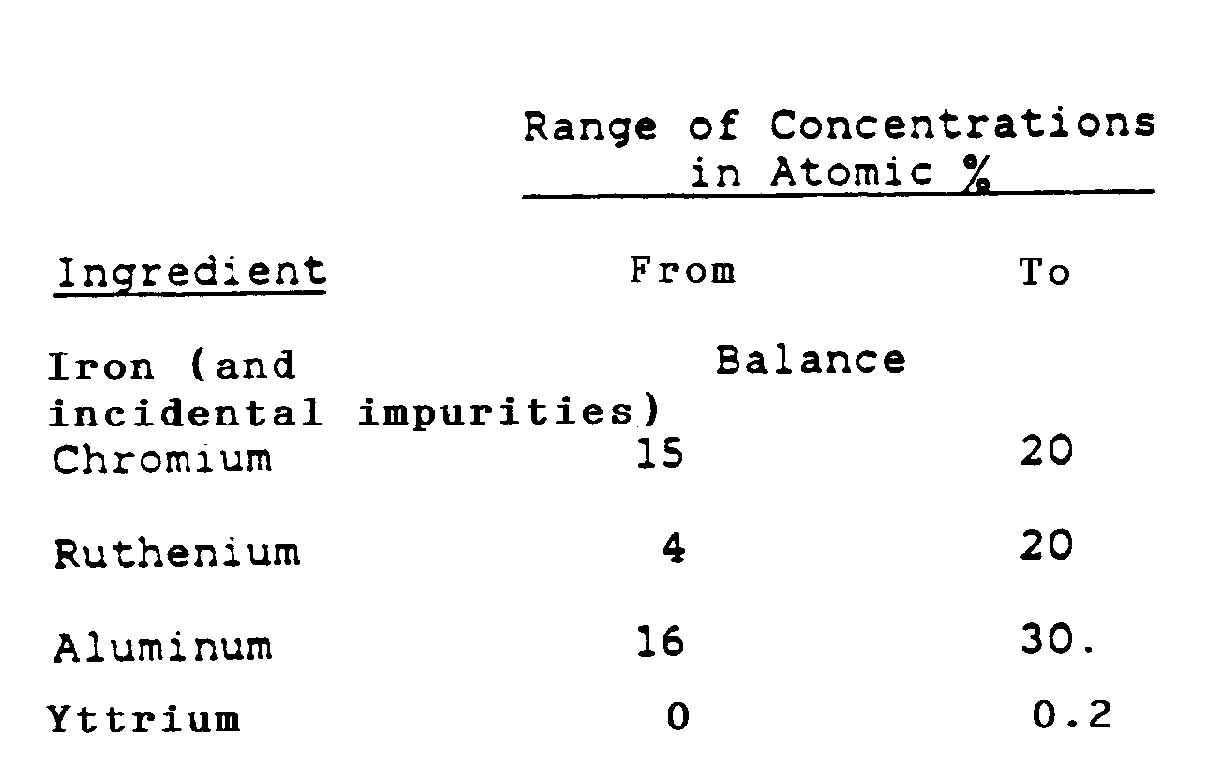
1. An alloy containing the following ranges of concentration of ingredients :
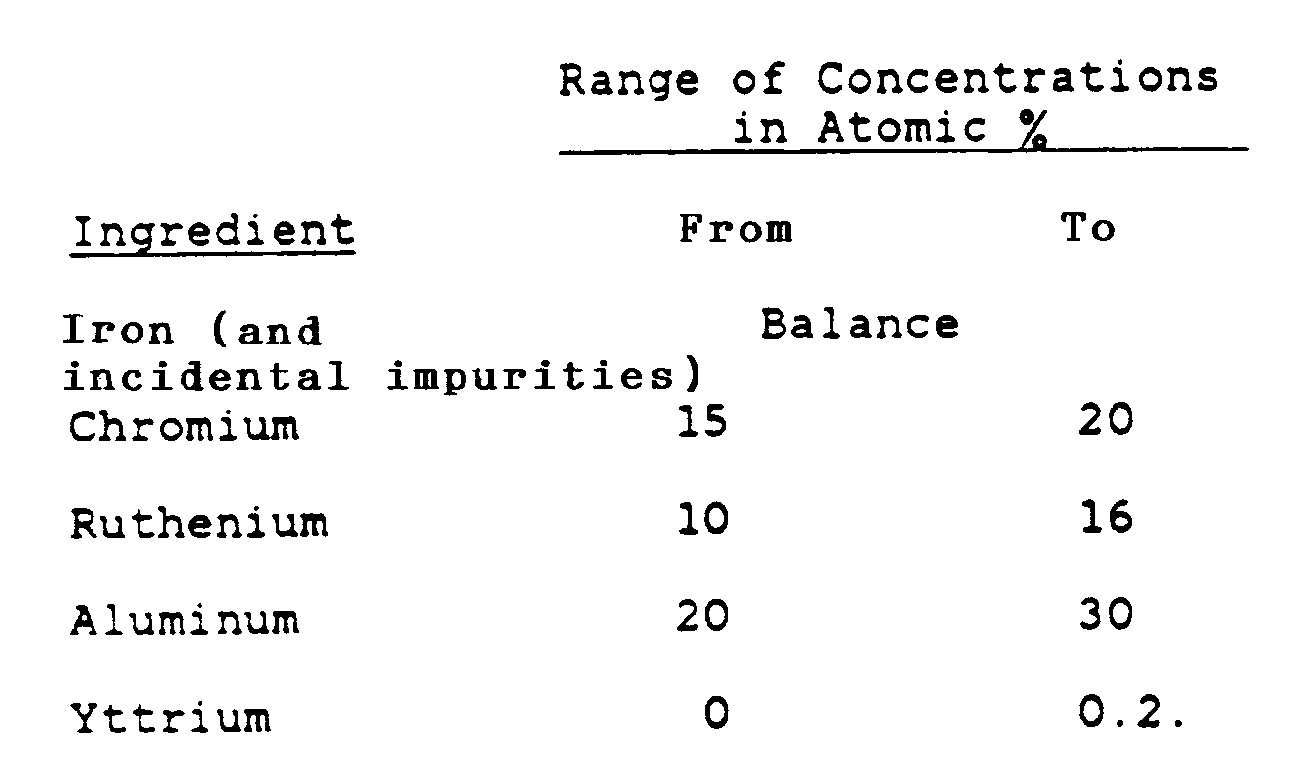
2. The composition of claim 1 in which the ingredient ranges as follows:
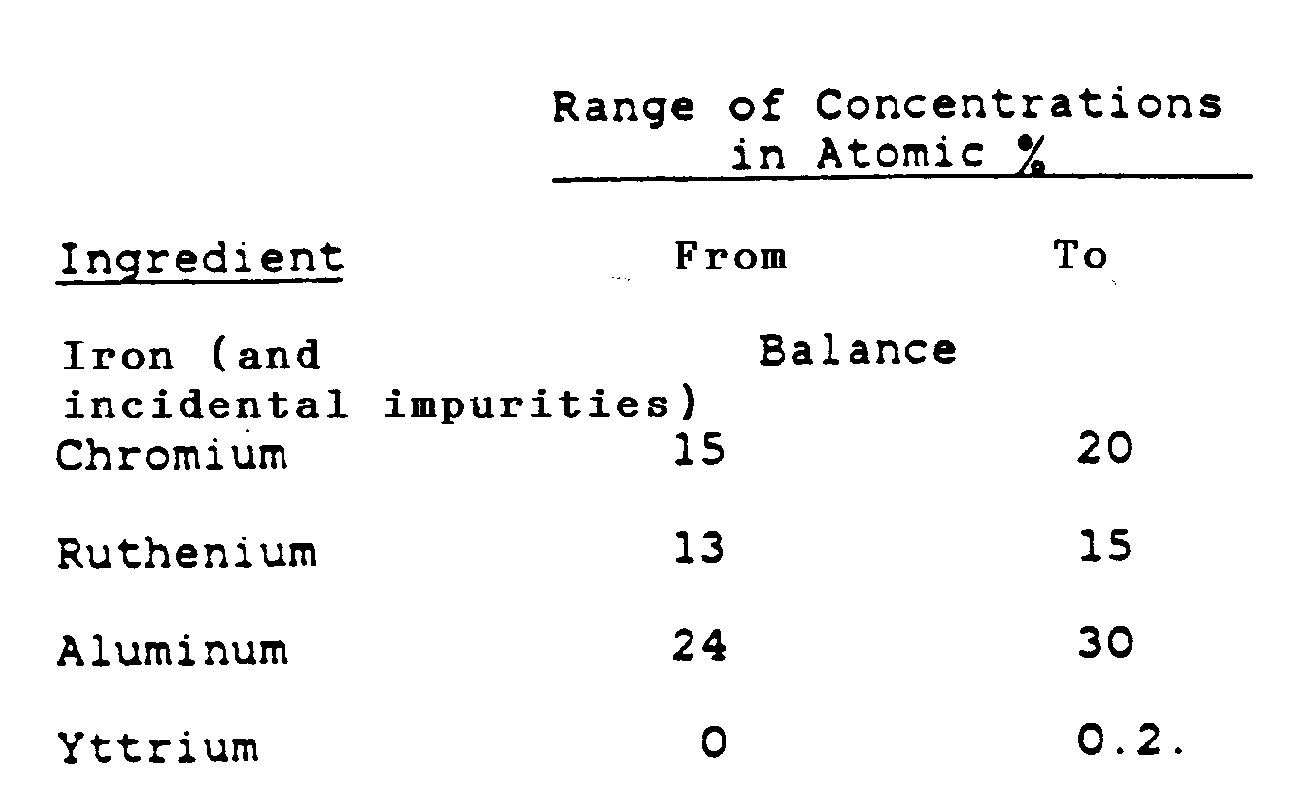
3. The composition of claim 1 in which the ingredient ranges as follows:
4. A structural element for use in high temperature jet engines operating at very elevated
temperatures, said element being formed from a composition as set forth in anyone
of claims 1 to 3.
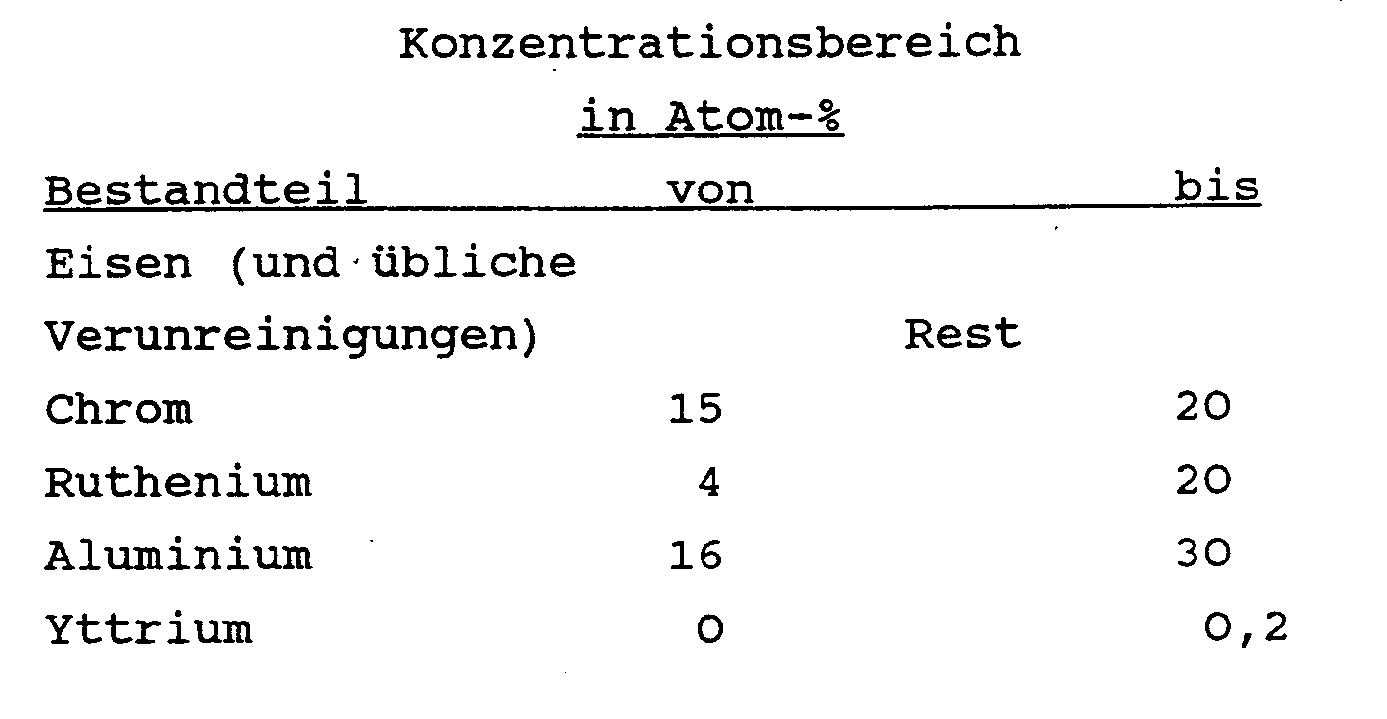
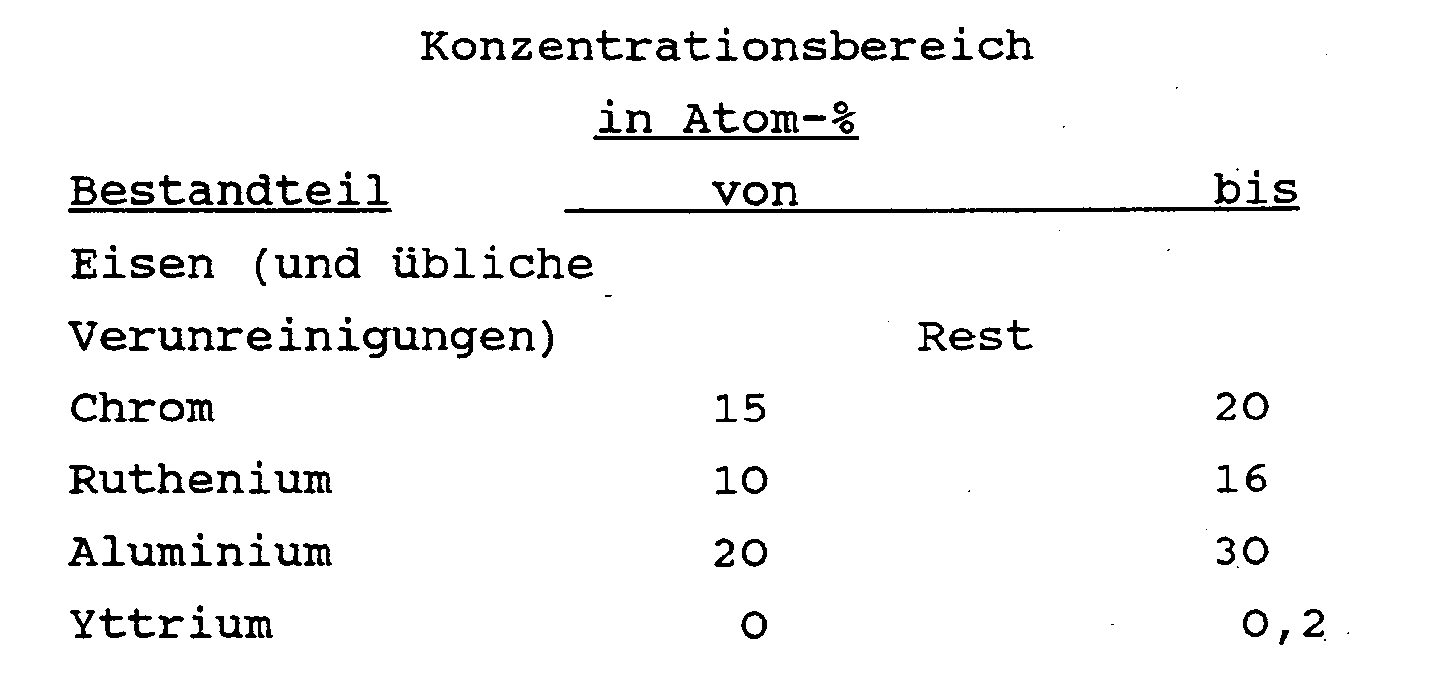
1. Legierung enthaltend die folgenden Konzentrationsbereiche von Bestandteilen:
2. Zusammensetzung nach Anspruch 1 mit den folgenden Bereichen der Bestandteile
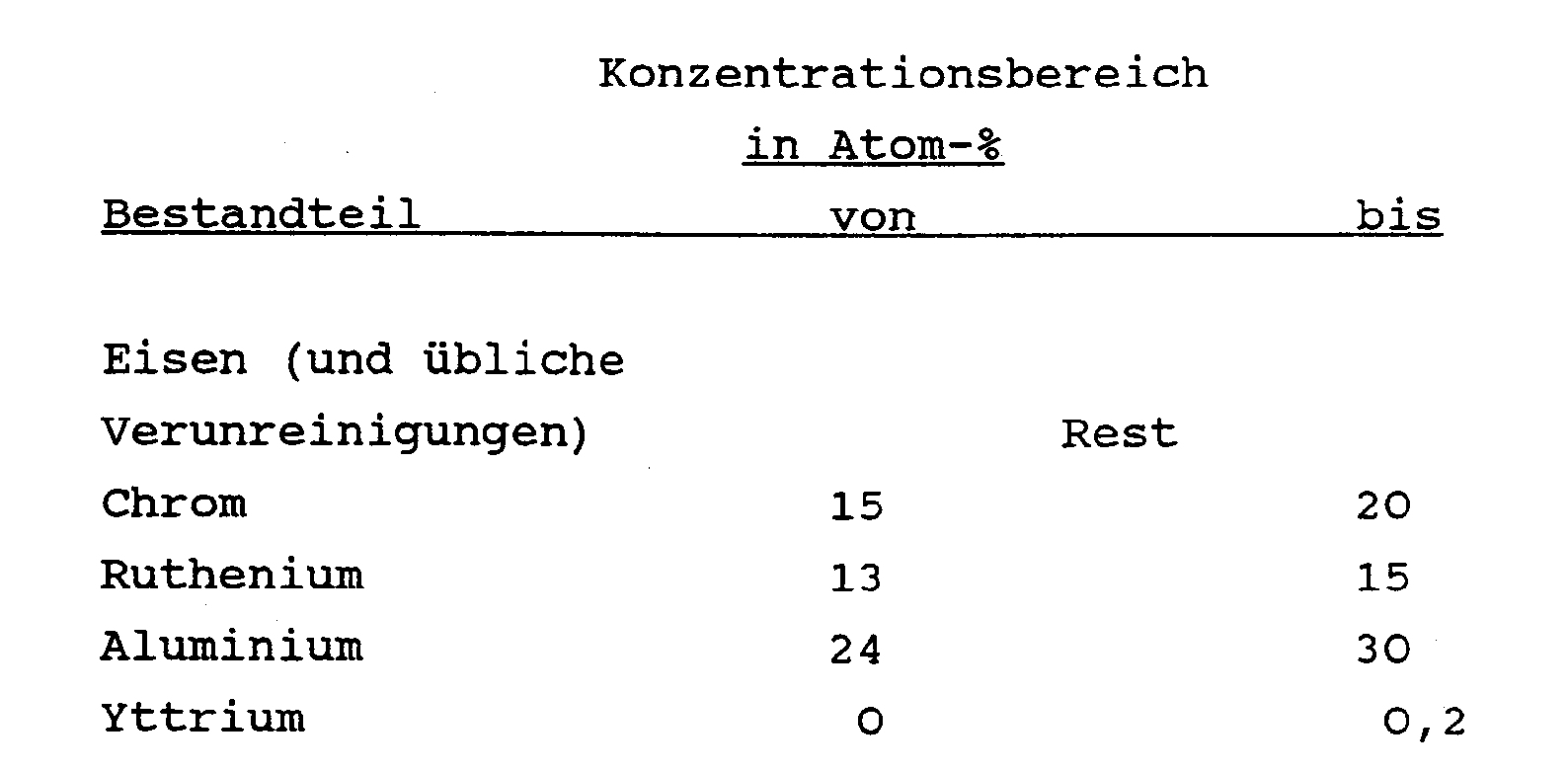
3. Zusammensetzung nach Anspruch 1 mit den folgenden Bereichen der Bestandteile
4. Bauteil zum Einsatz in Hochtemperatur-Strahltriebwerken, die bei sehr hohen Temperaturen
arbeiten, wobei das Bauteil aus einer Zusammensetzung nach irgendeinem der Ansprüche
1 bis 3 gebildet ist.
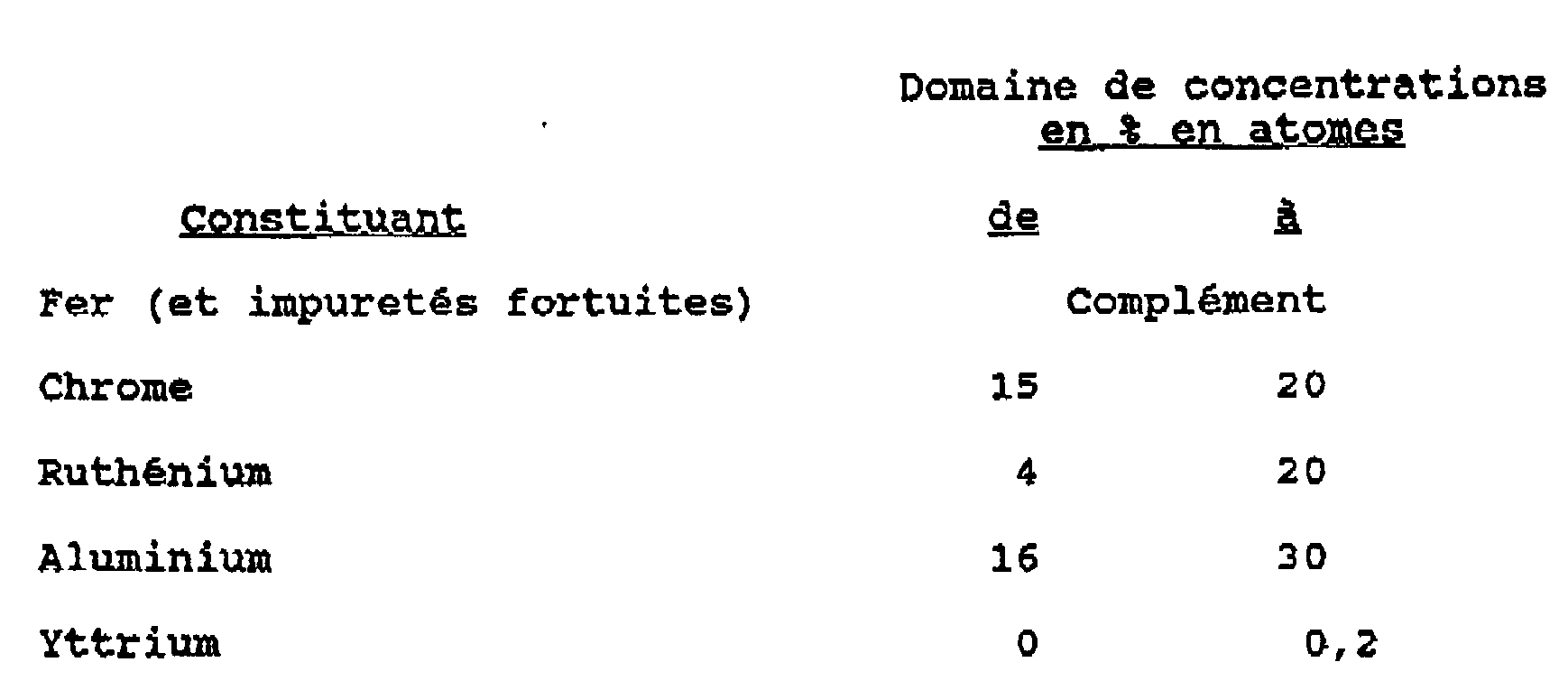
1. Alliage contenant les constituants suivants, aux concentrations indiquées :
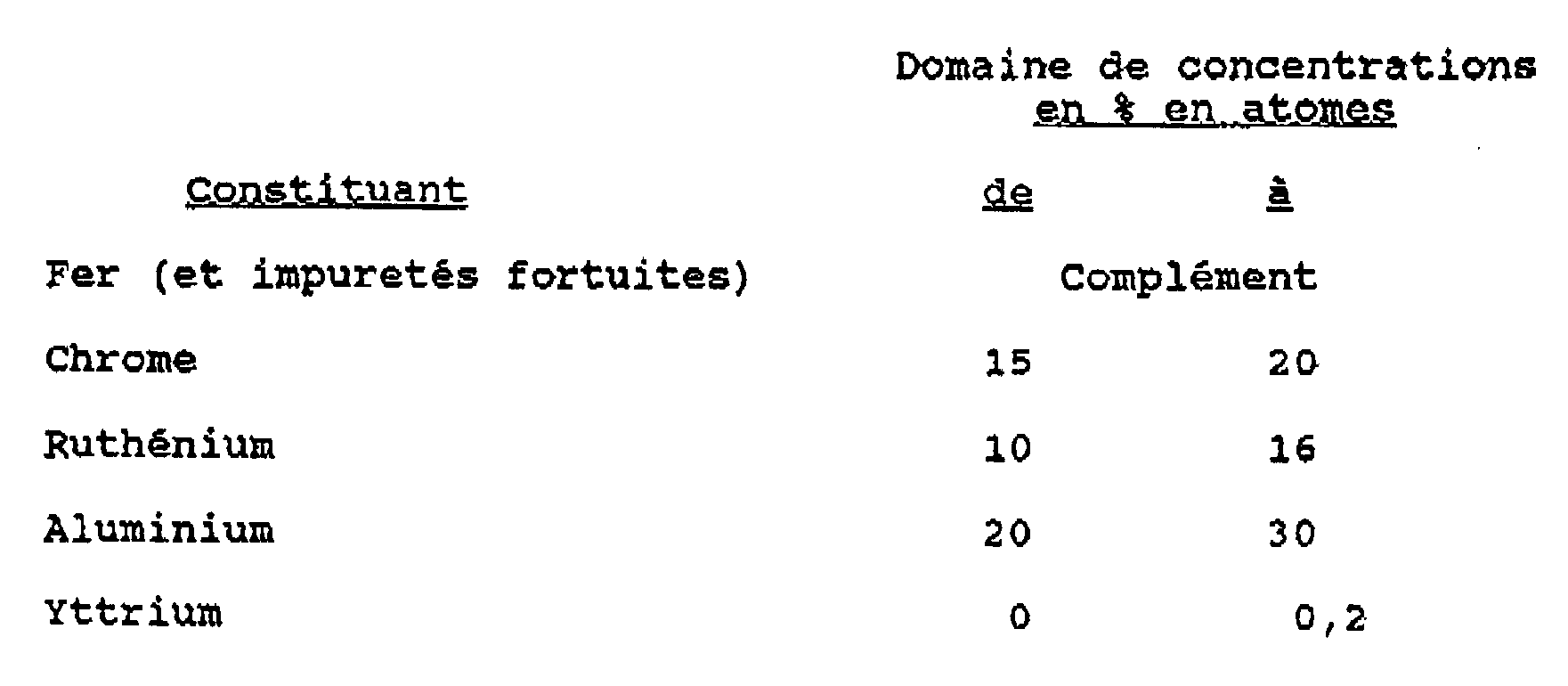
2. Composition selon la revendication 1, dans laquelle les concentrations des constituants
sont les suivantes :
3. Composition selon la revendication 1, dans laquelle les concentrations des constituants
sont les suivantes :
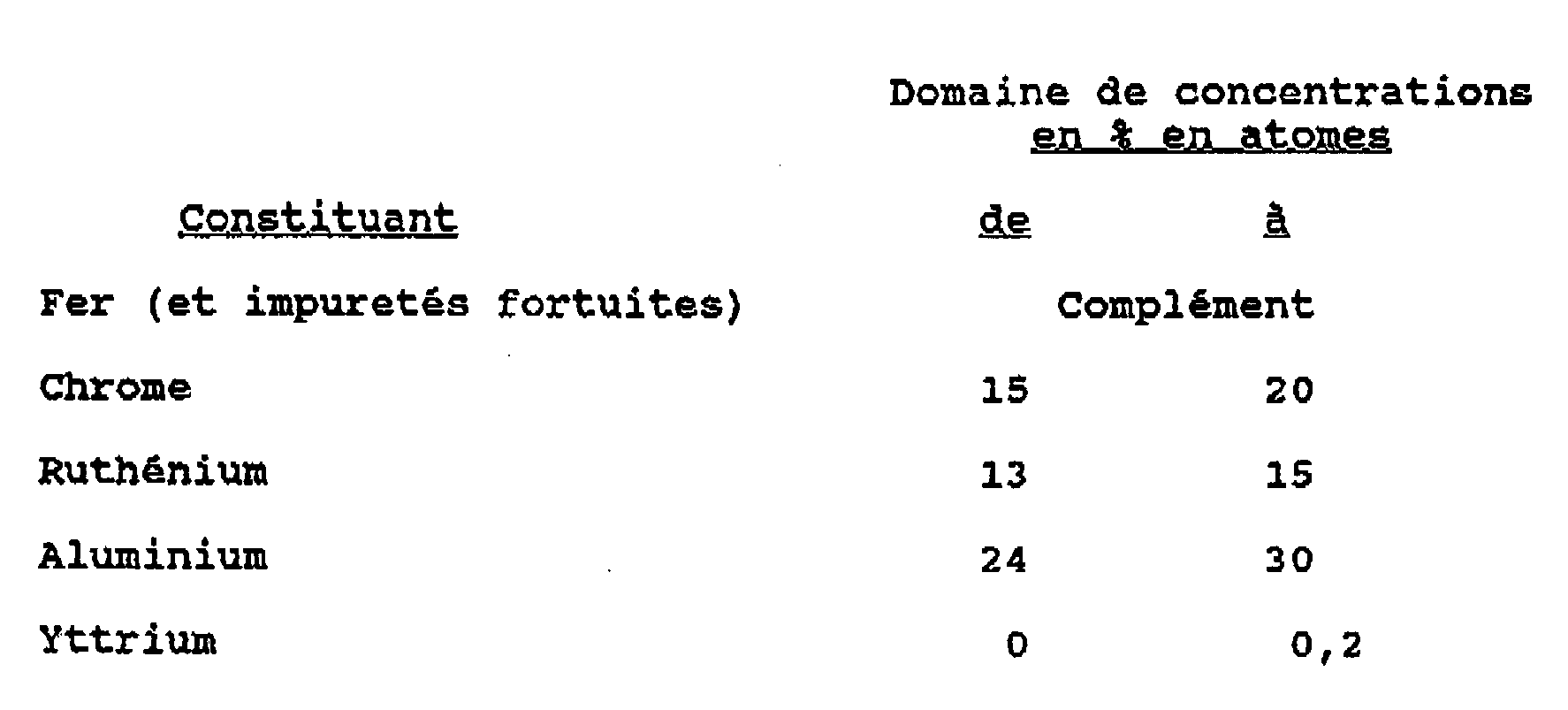
4. Elément de construction destiné à être utilisé dans des moteurs à réaction à haute
température, fonctionnant à des températures très élevées, ledit élément étant constitué
d'une composition telle qu'indiquée dans l'une quelconque des revendications 1 à 3.