| (19) |
 |
|
(11) |
EP 0 348 029 B1 |
| (12) |
EUROPEAN PATENT SPECIFICATION |
| (45) |
Mention of the grant of the patent: |
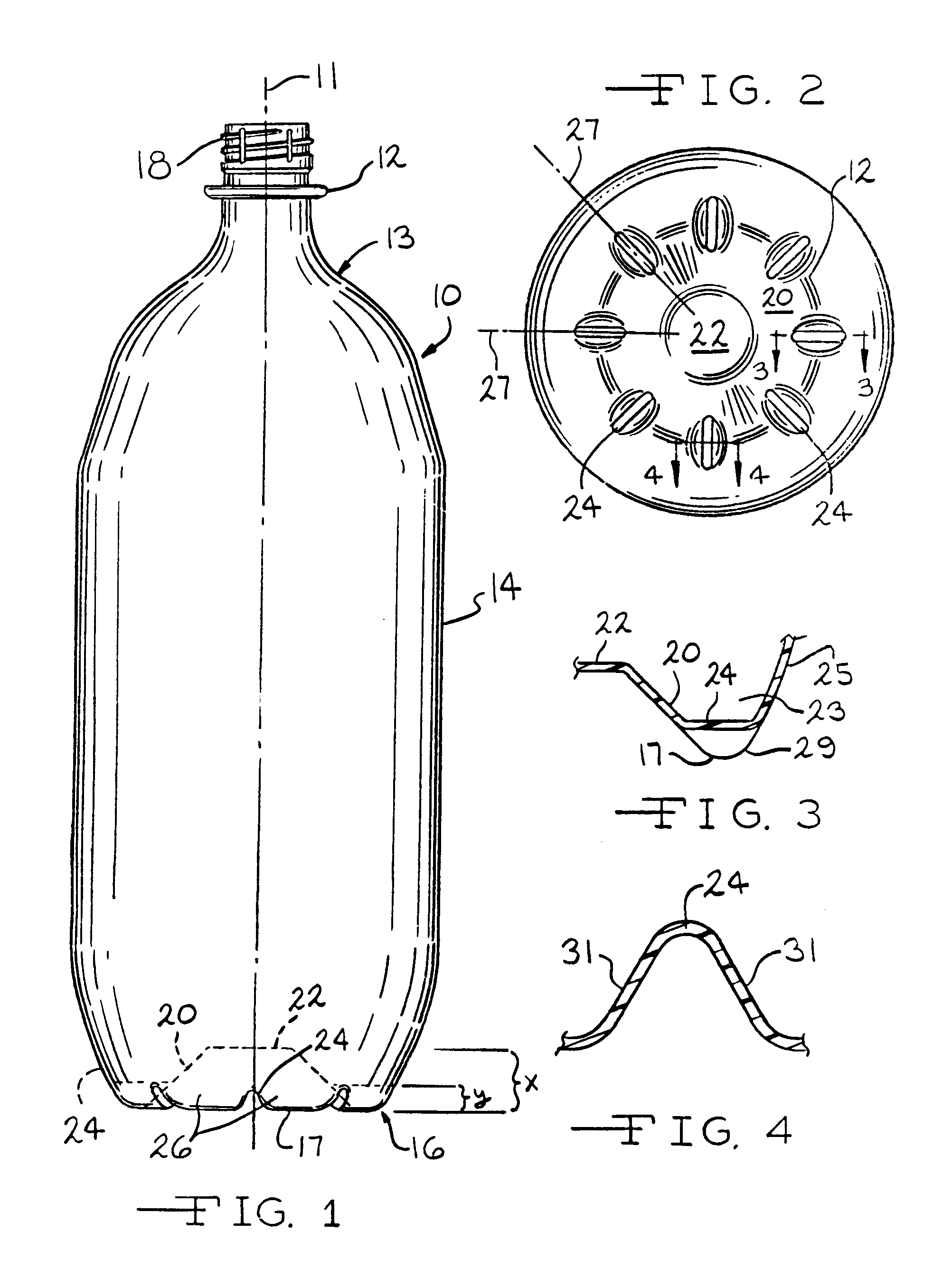
|
07.10.1992 Bulletin 1992/41 |
| (22) |
Date of filing: 03.05.1989 |
|
| (51) |
International Patent Classification (IPC)5: B65D 1/02 |
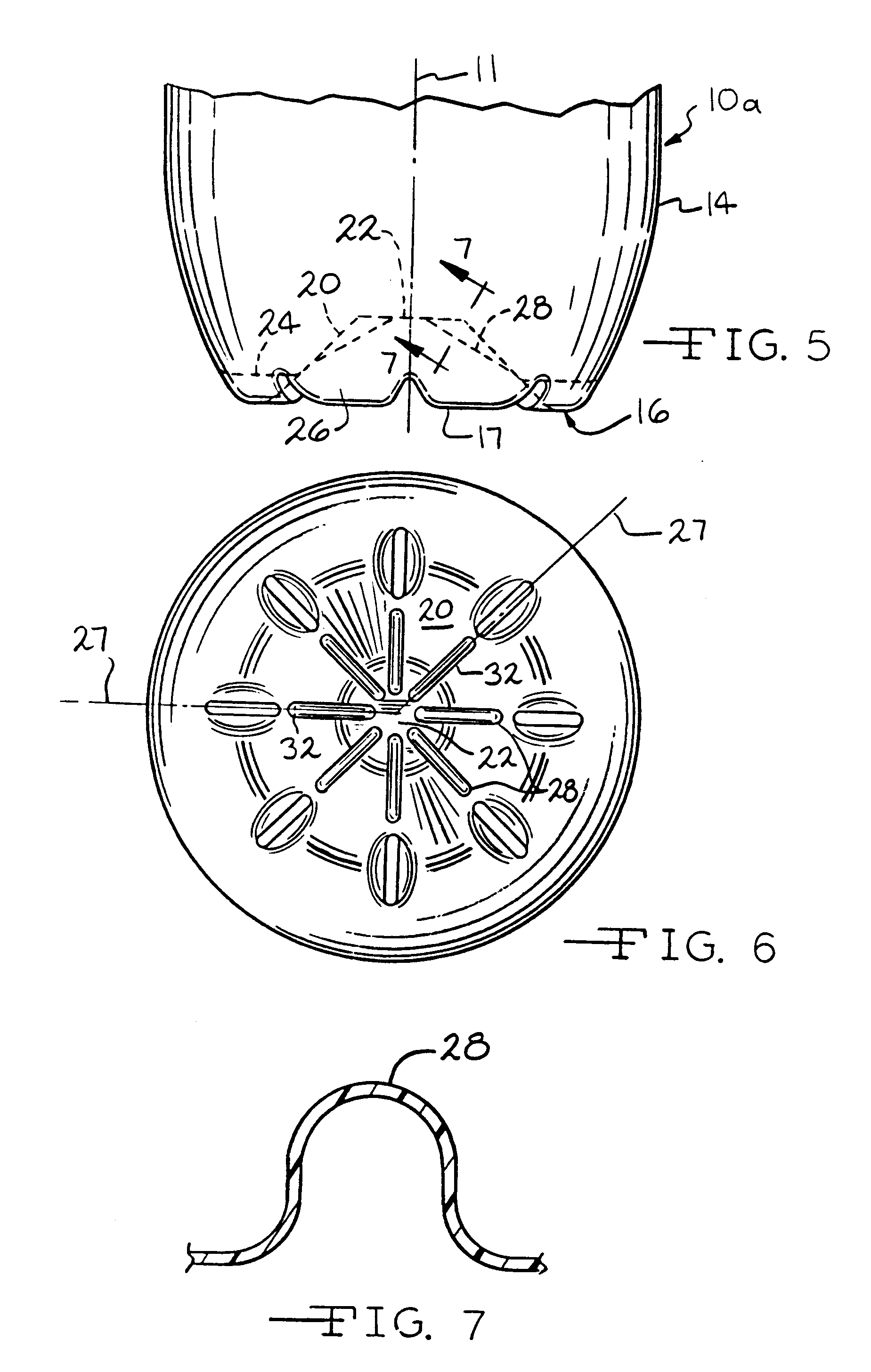
|
| (54) |
Blow moulded container with self- supporting base
Blasgeformter Behälter mit sich selbst tragendem Boden
Récipient moulé par soufflage avec base d'appui autoportante
|
| (84) |
Designated Contracting States: |
|
AT BE CH DE ES FR GB GR IT LI LU NL SE |
| (30) |
Priority: |
20.06.1988 US 209004
|
| (43) |
Date of publication of application: |
|
27.12.1989 Bulletin 1989/52 |
| (73) |
Proprietor: HOOVER UNIVERSAL, INC. |
|
Ann Arbor
Michigan 48104 (US) |
|
| (72) |
Inventor: |
|
- Howard, Carl Robert, Jr.
Ypsilanti
Michigan 48197 (US)
|
| (74) |
Representative: Williams, Trevor John et al |
|
J.A. Kemp & Co.
14 South Square, Gray's Inn
GB-London WC1R 5EU
GB-London WC1R 5EU (GB) |
| (56) |
References cited: :
EP-A- 0 029 639
GB-A- 2 044 211
|
FR-A- 1 504 290
US-A- 3 935 955
|
|
| |
|
|
|
|
| |
|
| Note: Within nine months from the publication of the mention of the grant of the European
patent, any person may give notice to the European Patent Office of opposition to
the European patent
granted. Notice of opposition shall be filed in a written reasoned statement. It shall
not be deemed to
have been filed until the opposition fee has been paid. (Art. 99(1) European Patent
Convention).
|
Background and Summary of the Invention
[0001] The present invention relates to hollow plastic containers and, more particularly,
to blow molded plastic containers with self-supporting bases. The base has sufficient
strength to withstand internal pressures like those encountered in the packaging of
carbonated beverages and the like, and in addition has distinct supporting feet which
enable the container to stand without rocking.
[0002] With the movement to plastic bottles for packaging carbonated beverages, the art
has moved to plastic containers with self-supporting bases. Such a container must
be able to withstand the internal pressure necessary to maintain the desired carbonation.
Such a pressure is on the order of 5.2 bar (75 p.s.i.).
[0003] Several types of containers exist in the art that include integral bases with molded
bottom configurations. However, there still exists a need for a container of this
type which requires a reasonable amount of material in the base, withstands internal
pressures and will stand upright with out rocking.
[0004] The present invention provides a container having a tubular body and an integral
base, the junction of the two having a smooth, continuous exterior surface. The present
invention eliminates any sharp bends deviations, or the like at the junction of the
body and base. The present invention provides the container with good distribution
of plastic throughout the container surface. Also, the present invention eliminates
stress cracks and enables the use of a minimum amount of plastic material to mold
the container. Also, when the container is full of a carbonated beverage or the like,
the container will withstand the pressure necessary to maintain carbonation and will
exhibit a very sturdy and rigid outer body. Once the beverage has been removed from
the container, the container is very flexible and enables the container to be discarded
and the plastic recycled.
[0005] GB-A-2 044 211 discloses a container in accordance with the prior art portion of
claim 1. In order to improve the resistance to internal pressure causing deformation,
the present invention, as defined in claim 1, provides a truly frustoconical inner
wall extending well above radial foot-defining grooves with the grooves themselves
being generally of inverted V-shaped as upwardly projecting ribs when viewed in cross-section.
The strengthening effect resistive of deformation is emphasised by the substantial
extent, twice the depth of the ribs, to which the frustoconical wall extends above
the ribs.
[0006] In a preferred embodiment, further strengthening ribs are provided, preferably radially
aligned with the first ribs, with the direction of projection of the further ribs
being opposite to that of the first ribs so as to provide a cooperating action to
resist distending of the body under higher internal pressure.
[0007] From the subsequent description and claims taken in conjunction with the accompanying
drawings, other objects and advantages of the present invention will become apparent
to those skilled in the art.
Brief Description of the Drawings
[0008]
Figure 1 is a side elevation view of a container in accordance with the present invention;
Figure 2 is a bottom plan of the container in Figure 1;
Figure 3 is an enlarged sectional view of a portion of the container as seen from
substantially the line 3-3 in Figure 2;
Figure 4 is an enlarged sectional view of a portion of the container as seen from
substantially the line 4-4 in Figure 2;
Figure 5 is a fragmentary side elevational view of a modified form of container of
the present invention;
Figure 6 is a bottom plan view of the container shown in Figure 5;
Figure 7 is an enlarged sectional view of a portion of the container as seen from
substantially the line 7-7 Figure 5.
Detailed Description of the Preferred Embodiment
[0009] With reference to the drawing, the blow molded plastic container of this invention
is illustrated and designated generally at 10 in Fig. 1. The container 10 includes
an integral tapered top portion 13 which includes a flange 12 and a threaded neck
18. The container also has a hollow tubular body 14 and an integral base 16.
[0010] The tubular thin wall body 14 is manufactured, as is the entire container, from a
blow molded plastic material such as polyethylene terephthalate (PET).
[0011] The base 16 includes a frusto-conical upwardly narrowing inner wall 20 and a substantially
circular and planar wall 22 projecting into the interior of the hollow tubular body
14.
[0012] Outwardly of the inner wall 20, the container 10 has a downwardly concave annular
chamber 23 bounded on the radially inner side by the wall 20 and on the radially outer
side by the outer wall 25 (Fig. 3) of the base 16. A plurality of internal ribs 24
are formed in these base 16 between the walls 20 and 25, the ribs 24 being symmetrical
relative to the longitudinal axis 11 of the container 10. A plurality of feet 26 are
formed between adjacent ribs 24 to enable the container 10 to stand upright.
[0013] The ribs 24 are formed by elongated narrow indentations formed on the surface of
the base 16 as seen in Figures 2-4 so that the ribs 24 extend radially of the base
16. The positioning of the ribs 24 such that the ribs 24 are on radii about 30° to
60° apart and preferably about 45° apart, about the circular base.
[0014] The ribs 24 are of generally inverted V-shape in cross-section when viewed transverse
to the longitudinal axes of the ribs 24, as seen in Figure 4. The intersection of
the V, forming the ribs 24, along the ribs longitudinal axis 27 is somewhat planar,
as seen in Figures 3 and 4.
[0015] The ribs 24 are all of substantially the same vertical height and are of small height
so that they are all positioned well below the planar top wall 22. Thus, a ratio of
the distance "x" from the rounded bottom 17 of the base 16 to the planar top wall
22 to the distance "y" from the bottom 17 to the top of the ribs 24 is about 3:1.
The positioning of the ribs 24 below the planar top 22 enhances the strength of the
container base 16. Also, the positioning of the ribs 24 enables the container 10 to
stand level and to be resistive to incidental tipping. The feed 26 also include angular
side walls 31 that form the legs of the rounded, flattened inverted V-shape indentation
of the ribs 24.
[0016] A modified form of the container of this invention is shown in Figs. 5-7 and indicated
generally at 10a. Like elements will be identified with the same references numerals.
[0017] The base 16 in the container 10a includes all of the structure in the base 16 in
the container 10 and in addition includes a second set of reinforcing or stiffening
ribs 28 (Fig. 6) as shown in Fig. 5. The ribs 28 are formed in the frusto-conical
wall 20 and the top wall 22 and are located above the ribs 24. The ribs 28 are of
an internal design having an overall U-shaped cross-section when viewed transverse
to the rib's longitudinal axis 32, as shown in Figure 7. Also, the ribs 28 may protrude
from the base 16 and have a bulging inverted U-shaped configuration in cross-section
when viewed transverse to the longitudinal axis 32 of the ribs 28. The ribs 28 are
aligned with the ribs 24 in a direction radially of the base 16. Thus, the axes 27
and 32 of the ribs 24 and 28 are substantially coincident.
[0018] The ribs 28 add additional support and strength to the base 16 and prevent the generally
concave bottom of the container 10a from inverting when filled with a carbonated beverage
under a pressure of about 5.2 bar (75 p.s.i.).
1. A blow moulded plastic container (10) comprising: a hollow tubular body (14) having
a side wall of annular shape, and terminating at its lower end in a integral aligned
base (16); said base having a reentrant inner wall (20) projecting upwardly into said
hollow tubular body, a top wall (22) at the upper end of said inner wall, and an annular
downwardly concave chamber (23) extending about said inner wall (20), said chamber
having an outer wall which merges at its upper end with said tubular side wall (14)
and at its lower end with said inner wall (20) to form a bottom surface (17), a plurality
of radially extending hollow ribs (24) formed in said bottom surface so as to extend
upward therefrom a small distance so as to intersect said inner and outer walls at
a position below said top wall; said bottom surface between said ribs forming a plurality
of container support feet (17) each of which is of substantial width in a direction
circumferentially of said base relative to said ribs (24) to provide firm support
for said container (10), said ribs being symmetrically arranged relative to the longitudinal
axis of said container to provide for a symmetrically uniform support of said container
on said feet without tipping of the container, characterised in that said inner wall
(20) is of truncated frustoconical shape, in that the tops of the hollow ribs (24)
where they intersect said inner and outer walls are well below the top wall (22) extending
to a height of substantially one-third of the height of the top wall (22) from the
bottom surface (17) and in that the ribs (24), in cross-section when viewed transverse
to their longitudinal axes (27), have an inverted V-shape with the feet (17) formed
between adjacent ribs (24) having rounded sides and bottoms providing the container
with a smooth continuous outer surface.
2. A container according to claim 1, further comprising a plurality of second hollow
ribs (32) formed in said base frustoconical shaped inner wall (20) and in said top
wall (22) for further stiffening said base (16) against deformation by internal pressure
in said container.
3. A container according to claim 2, wherein said second ribs (32) extend radially with
respect to the longitudinal axis (1) of said container (10) and are aligned with the
first ribs (24).
1. Geblasener Kunststoffbehälter (10) mit: einem hohlen, röhrenförmigen Körper (14) mit
einer Seitenwand von ringförmiger Gestalt, die an ihrem unteren Ende in einem integral
ausgerichteten Boden (16) endet, wobei der Boden eine einspringende innere Wandung
(20), die sich nach oben in den hohlen, röhrenförmigen Körper fortsetzt, eine obere
Wandung (22) am oberen Ende der inneren Wandung und ein ringförmig abwärts gerichtetes,
konkaves Abteil (23), das sich um die innere Wandung (20) erstreckt, hat, wobei das
Abteil eine äußere Wand hat, die an ihrem oberen Ende in die ringförmige Seitenwand
(14) und an ihrem unteren Ende in die innere Wandung (20) übergeht, um eine Bodenfläche
(17) zu bilden, einer Mehrzahl von sich radial erstreckenden, hohlen Rippen (24),
die in der Bodenoberfläche so gebildet sind, daß sie sich davon so um einen kleinen
Abstand nach oben erstrecken, daß sie die innere und äußere Wandung in einer Position
unterhalb der oberen Wandung schneiden, wobei die Bodenfläche zwischen den Rippen
eine Mehrzahl von Behälterstandfüßen (17) bildet, von denen jeder in Umfangsrichtung
des Bodens relativ zu den Rippen (24) von wesentlicher Breite ist, um eine sichere
Unterstützung des Behälters (10) vorzusehen, wobei die Rippen relativ zur Längsachse
des Behälters symmetrisch angeordnet sind, um eine symmetrisch gleichförmige Unterstützung
des Behälters auf den Füßen ohne Kippen des Behälters zu bilden, dadurch gekennzeichnet,
daß die innere Wandung (20) von abgeschnitten kegelstumpfförmiger Gestalt ist, daß
die Oberseiten der hohlen Rippen (24), wo diese die innere und äußere Wandung schneiden,
hinreichend unterhalb der oberen Wand (22) sind und sich zu einer Höhe von im wesentlichen
einem Drittel der Höhe der oberen Wandung (22) von der Bodenfläche (17) erstrecken,
und daß die Rippen (24) im Querschnitt, wenn sie senkrecht zu ihren Längsachsen (27)
gesehen werden, eine umgekehrte V-Form haben, wobei die zwischen benachbarten Rippen
(24) gebildeten Füße (17) abgerundete Seiten und Böden haben, die den Behälter mit
einer glatten, kontinuierlichen äußeren Oberfläche versehen.
2. Behälter nach Anspruch 1, mit einer Mehrzahl von zweiten hohlen Rippen (32), die in
der unteren kegelstumpfförmigen inneren Wandung (20) und in der oberen Wand (22) gebildet
sind, zur weiteren Versteifung des Bodens (16) gegenüber einer Verformung durch inneren
Druck im Behälter.
3. Behälter nach Anspruch 2, bei dem die zweiten Rippen (32) sich bezüglich der Längsachse
(1) des Behälters (10) radial erstrecken und mit den ersten Rippen (24) ausgerichtet
sind.
1. Récipient (10) en matière plastique moulée par soufflage, comportant : un corps tubulaire
creux (14) comportant une paroi latérale de forme annulaire et se terminant à son
extrémité inférieure par une base alignée (16) qui en fait partie intégrante ; ladite
base comportant une paroi intérieure rentrante (20) faisant saillie vers le haut dans
le corps tubulaire creux, une paroi supérieure (22) à l'extrémité supérieure de la
paroi inférieure, et une chambre annulaire (23) concave vers le bas et s'étendant
autour de la paroi intérieure (20), ladite chambre comportant une paroi extérieure
qui fusionne à son extrémité supérieure avec la paroi latérale tubulaire (14) et à
son extrémité inférieure avec la paroi inférieure (20) pour former une surface de
fond (17), une pluralité de nervures creuses (24) s'étendant radialement et formées
dans ladite surface de fond de manière à s'étendre vers le haut depuis cette dernière
sur une faible distance afin d'intersecter les parois intérieure et extérieure à un
endroit situé en-dessous de la paroi supérieure ; ladite surface de fond entre les
nervures formant une pluralité de pieds (17) de support de récipient dont chacun a
une largeur notable dans la direction circonférentielle de ladite base par rapport
aux nervures (24) de manière à procurer un support ferme au récipient (10), les nervures
étant disposées symétriquement par rapport à l'axe longitudinal du récipient de manière
à procurer un support symétriquement uniforme du récipient sur les pieds sans basculement
du récipient, caractérisé en ce que la paroi intérieure (20) a une forme tronconique,
et en ce que les sommets des nervures creuses (24) où celles-ci intersectent les parois
intérieure et extérieure se trouvent bien en-dessous de la paroi supérieure (22) et
s'étendent jusqu'à une hauteur égale sensiblement au tiers de la hauteur de la paroi
supérieure (22) depuis la surface de fond (17) et en ce que les nervures (24) ont
en section droite, vue transversalement à leurs axes longitudinaux (27), la forme
d'un V inversé, les pieds (17) formés entre les nervures adjacentes (24) ayant des
côtés et des bases arrondis donnant au récipient une surface extérieure continue régulière.
2. Récipient selon la revendication 1, comprenant, en outre, une pluralité de secondes
nervures creuses (32) formées dans la paroi intérieure tronconique (20) de la base
et dans la paroi supérieure (22) pour renforcer davantage la base (16) pour qu'elle
ne soit pas déformée par la pression interne dans le récipient.
3. Récipient selon la revendication 2, dans lequel les secondes nervures (32) s'étendent
radialement par rapport à l'axe longitudinal (1) du récipient (10) et sont alignées
avec les premières nervures (24).