|
(11) | EP 0 354 311 B1 |

| (12) | EUROPEAN PATENT SPECIFICATION |
|
|
| (54) |
Direct generation of ultrafast electrical pulses Direkte Erzeugung ultraschneller elektrischer Impulse Génération directe d'impulsions électriques ultrarapides |
|
|
|||||||||||||||||||||||||||||||
| Note: Within nine months from the publication of the mention of the grant of the European patent, any person may give notice to the European Patent Office of opposition to the European patent granted. Notice of opposition shall be filed in a written reasoned statement. It shall not be deemed to have been filed until the opposition fee has been paid. (Art. 99(1) European Patent Convention). |
[0001] This invention relates to the generation of signals in the Tera Hertz frequency range and the detection thereof. In particular, this invention pertains to an ultrafast pulse generator usable for logic operation or as an oscillator or signal carrier for communications.
[0002] An important aspect of computer cycling speed is the time necessary for communication between logic circuitry and/or memory circuits on a particular chip. By increasing packing density and reducing the physical space between such elements, processing speeds may be increased by reducing the signal path length. A corresponding requirement to attain higher processing speeds is the need for timing circuits which operate at very high frequencies to provide stable clock pulses.
[0003] Reference is made to M.B. Ketchen, et al, "Generation of Subpicosecond Electrical Pulses on Coplaner Transmission Lines", Appl. Phys. Lett. 48(12), 24 March 1986, pp. 751-753. This publication describes techniques to generate ultrashort electrical pulses by photoconductively shorting charged transmission lines and narrow gaps. The technique photoconductively shorts the line by bridging using laser pulses as reported in that article, a transmission line having a design impedance of 100Ω was made using three parallel 5-µm wide aluminum lines which were separated from each other by 10-µm. That transmission line together with its contact pads was fabricated on an intrinsic silicon on sapphire (SOS) wafer. After fabrication, the wafer was heavily ion implanted to reduce the carrier lifetime. The transmission line was photoconductively shorted utilizing 80fs laser pulses. The exciting beam had a spot diameter of 10-µm which bridged two of the three parallel transmission lines in a sliding contact arrangement. By utilizing a sampling beam coupled to a multichannel analyzer, subpicosecond electrical pulses were measured having an actual pulse width less than 0.6ps.
[0004] While such demonstrated pulse speed is an improvement over existing technology, further gains are necessary. Specifically, since the laser excitation speed is in the order of 0.08ps it is possible to drive switches at higher rates consistent with the input laser switching time. Prior to this invention further gains in cycling speed have not been demonstrated.
[0005] Given this background, it is an object of this invention to provide a system that generates ultrashort electrical pulses which are independent of photoconductive carriers and thus independent of carrier lifetime.
[0006] It is a further object of this invention to define a method for the generation of ultrashort electrical pulses utilizing capacitive change techniques.
[0007] Yet another object of this invention is to directly generate ultrafast electrical pulses by employing optical rectification effects.
[0008] These and other objects of this invention are accomplished by utilizing two techniques for the generation of ultrashort electrical pulses, in both cases those pulses being independent of carriers and thereby of carrier lifetime.
[0009] In a first method, the electrical pulses are generated directly by the use of optical rectification effect (a χ(2) process). By utilizing values as set forth in Auston et al, for the electro-optic material lithium tantalate, a 1kW pulse focussed to 10µ diameter spot will produce an electric field of 10V/cm across the 10-µm focal spot. In terms of geometry, this corresponds to 10mV across the transmission line. Such a value is comparable to that reported in Ketchen et al, supra. Such a pulse would be coupled to the line and thus could be used for driving devices, providing timing pulses, optical sampling, and the like. This technique of electrical pulse generation provides important advantages over current methods which utilize photoconductivity. Photoconductivity is an operative process but, as discussed herein requires special preparation of a photoconductor and the switching speed is limited by the carrier lifetime. By this technique, such preparation is eliminated yet, higher speeds are achieved.
[0010] In the second method, by changing the effective capacitance on the transmission line in the spot illuminated by the laser, very short electrical pulses may be generated. This change is due to the non-linear response of the substrate. In both embodiments, a modified pattern from that illustrated in Ketchen et al is employed. Only two transmission lines are employed. The lines are deposited on an insulating substrate with a dielectric constant that responds to the presence of light in the following manner:
Utilizing this equation, ε₂ describes the strength of the optical Kerr response. Then, consider a simplified situation for a capacitor filled with a dielectric characterized by the dielectric constant ε. The charge Q on the capacitor is defined by:
where, C is the capacitance and V is the voltage. For this simplified example,
where A is a constant depending on the particular line geometry. It will now be shown that the operation of the device is independent of A.
[0011] Thus, if it is possible to change ε instantaneously, that is in a time very short when compared to the carrier transport, it is also possible to change V on the same time scale. Thus, assuming no charge transport, the change in V will be given by:
Then, consider the following estimate for δV utilizing
ε₀ = 2.5 at light frequencies and ε₀ = 4 at THz frequencies, which are defined to be a reasonable assumption. Then, consider a 10kW, 100fs pulse focussed to a 10-µm diameter spot. This will provide an intensity of 10GW/cm² which corresponds to E² = 5 x 10⁷ in esu units. Thus, δε is calculated to be 5 x 10⁻⁴ and for an assumable V of 20 volts, δV is 2.5mV. As will be pointed out herein, this value can be derived.
[0012] Ways of carrying out the invention are described in detail below with reference to drawings which illustrate only specific embodiments, in which:
- Fig. 1
- is a plan view of a coplanar transmission line as utilized in the prior art to explain the operational method of this invention,
- Fig. 2
- is a schematic cross-sectional view of the wafer and transmission lines of Fig. 1, and
- Fig. 3
- is a graph illustrating the measured ultrashort pulse of this invention.
[0013] Referring now to Figs. 1 and 2, the transmission line used to generate ultrashort electrical pulses in accordance with this invention is depicted. The transmission line comprises two parallel 5µm wide, 0.5µm thick aluminum lines 10 and 12. The separation distance X is 10µm. The design impedance for such a transmission line is approximately 100Ω. For a length of approximately 20mm the measured DC resistance of a single line 10 or 12 is 200Ω.
[0014] The transmission line comprising lines 10 and 12 is fabricated on an electro-optic wafer (e.g. lithium tantalate or lithium niobate) illustrated in cross-section in Fig. 2.
[0015] In accordance with the first embodiment of this invention, the electrical pulses are generated directly utilizing the optical rectification effect. That is, the voltage across the transmission line is proportional to χ(2)E², where χ(2) describes the strength of the optical rectification effect for the electro-optic material and E is the electric field strength of the focussed laser pulse. By selection of appropriate values from Auston et al, "Cherenkov Radiation From Femtosecond Optical Pulses and Electro-Optic Media", Phys. Rev. Letters 53,1555 (1984), a suitable electro-optic material was chosen to be lithium tantalate. A 1kW pulse is focussed through a 10µm diameter spot 16 illustrated in Fig. 1. The focal spot 16 will produce an electric field of 10V/cm. Given the geometry of the transmission line of Fig. 1, such corresponds to 10mV across the transmission line. That value is comparable to values reported in Ketchen et al, supra. This pulse is coupled to the transmission line and employed as required. For example, it can be employed to drive devices, provide timing pulses, for optical sampling or the like.
[0016] By employing optical rectification to generate fast voltage pulses, the effects of carrier relaxation are eliminated. This technique overcomes the limitations of utilizing photoconductive effects by eliminating the requirement of the use of a photoconductive layer and the preparation of a photoconductor. In addition, the pulse width is no longer limited by the carrier lifetime in the photoconductor.
[0017] At a point on the transmission line downstream from the generation point, the generated electrical pulse is measured by standard optoelectronic sampling techniques applied to the coplanar transmission line geometry. These techniques include electro-optic sampling as described in the publication by J.A. Valdmanis, G.A. Mourou and C.W. Gabel, "Subpicosecond Electrical Sampling", in IEEE, J. Quantum Electronics, Vol. QE-19, 664 (1983), and sampling using photoconductive switches as described by Ketchen et al. The electro-optic technique can be directly applied to the electro-optic chip shown in Fig. 1, while for the photoconductive switches, the transmission line must be connected to the SOS measuring chip. An expected electrical pulse shape is shown in Fig. 3.
[0018] In accordance with the second embodiment of this invention, pulse generation is based on changing the effective capacitance on the transmission line in the spot 16 illuminated by the laser. The change is due to the non-linear optical Kerr effect response of the substrate, which in this embodiment is chosen to have a large optical Kerr effect. The transmission pattern of Fig. 1 is employed, the substrate is an insulating material having a value of ε₂ ≈ 10⁻¹¹esu. The substrate has a dielectric constant that responds to the presence of light in accordance with the following equation:
where, ε is the dielectric constant, ε₀ is the linear dielectric constant and ε₂ is the strength of the optical Kerr response. Both lithium tantalate and lithium niobate may be used but would have to be driven harder.
[0019] Consider then, the situation where a capacitor is filled with a dielectric which may be characterized by the dielectric constant ε. The charge Q on the capacitor is Q = CV where C is the capacitance and V is the voltage across the two lines of the transmission line. In this simplified example, C = Aε, where A is a constant dependent on the particular embodiment. It will be shown that the operation of the device is independent of A. Thus, if ε can be changed instantaneously, that is in a time very short when compared to the carrier transport, the change in voltage can be accomplished in the same time scale.
[0020] Thus, assuming no charge transport, the change in V will be
The value of δV using ε₂ ≈ 10⁻¹¹esu, ε₀ = 2.5 at light frequencies and ε₀ = 4 at THz frequencies is a value that can be obtained by this invention.
[0021] Next, consider a 10kW, 100fs pulse focussed to a 10-µm diameter spot across the transmission line. This yields an intensity of 10GW/cm² corresponding to E² = 5 x 10⁷ when taken in esu units. Thus, δε is calculated to be 5 x 10⁻⁴. For a value of V of 20 volts, δV is 2.5mV. It can be appreciated that this value can be observed and thus very fast voltage pulses can be generated compared to those techniques which employ photoconductivity.
[0022] Many materials are suitable for use as the substrate exhibiting an optical Kerr effect are listed in T.Y. Chang, "Optical Engineering", 20, p. 220, (1981). Examples include lithium tantalate, lithium niobate, and undoped GaAs. Of those, GaAs exhibits a large optical Kerr effect. Generally, the wavelength of the driving light pulse must be longer than that corresponding to the bandgap of the substrate in order to not generate photocarriers.
1. A method of generating a subpicosecond electrical pulse comprising the steps of:
providing a transmission line having a pair of conductive lines (10, 12) on a substrate of an electro-optic material; and
focussing a laser pulse across said transmission line to generate a subpicosecond electrical pulse directly on the transmission line (10, 12) by an optical rectification effect exhibited by said substrate which is coupled to said transmission line (10, 12) to produce said electrical pulse.
providing a transmission line having a pair of conductive lines (10, 12) on a substrate of an electro-optic material; and
focussing a laser pulse across said transmission line to generate a subpicosecond electrical pulse directly on the transmission line (10, 12) by an optical rectification effect exhibited by said substrate which is coupled to said transmission line (10, 12) to produce said electrical pulse.
2. The method of claim 1, wherein said laser pulse is focussed to produce a spot (16)
having a diameter in the range of 10 µm or approximately equal to the line separation
in said transmission line (10, 12).
3. The method of claim 1 or 2, wherein said electrical pulse produced by said optical
rectification effect has an electric field in the range of 10V/cm.
4. The method of one or more of the preceding claims 1 to 3, wherein said optical rectification
effect causes a pulse of voltage whose magnitude is proportional to the intensity
of said laser pulse, and whose pulse duration is approximately the same as that of
said laser pulse.
5. A method of generating a subpicosecond electrical pulse comprising the steps of:
providing a transmission line having a pair of conductive lines (10, 12) on an insulating substrate of an electro-optic material having an optical Kerr effect; and
focussing a laser pulse across said transmission line to change the effective capacitance of said substrate in the volume of material defined by the laser focal spot (16) across said transmission line (10, 12) and thereby create a subpicosecond pulse on said transmission line.
providing a transmission line having a pair of conductive lines (10, 12) on an insulating substrate of an electro-optic material having an optical Kerr effect; and
focussing a laser pulse across said transmission line to change the effective capacitance of said substrate in the volume of material defined by the laser focal spot (16) across said transmission line (10, 12) and thereby create a subpicosecond pulse on said transmission line.
6. The method of claim 5, wherein said substrate has a dielectric constant of
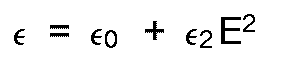
where ε₀ is the linear value of said substrate dielectric constant and ε₂E² is the field effect produced by incident laser light.
where ε₀ is the linear value of said substrate dielectric constant and ε₂E² is the field effect produced by incident laser light.
7. The method of claim 5 or 6, wherein said change in dielectric constant of said substrate
occurs in a time very short compared to the carrier transport through said substrate.
8. The method of one or more of the preceding claims 5 to 7, wherein said laser pulse
is a 10kW, 100fs pulse focussed to a 10-µm diameter spot (16) on said transmission
line (10, 12).
9. The method of one or more of the preceding claims 5 to 8, where said laser pulse has
a wavelength longer than that corresponding to the bandgap of said substrate.
10. The method of one or more of the preceding claims 1 to 9 wherein the electro-optic
material used showing the optical rectification effect or an optical Kerr effect is
one of lithium tantalate or lithium niobate.
11. The method of one or more of the preceding claims 5 to 9, where said substrate is
GaAs.
12. The method of one or more of the preceding claims 1 to 11 further comprising the step
of optically sampling said transmission line (10, 12) to sense said subpicosecond
pulse.
1. Verfahren zur Erzeugung eines elektrischen Subpikosekundenimpulses, das folgende Schritte
umfaßt:
Bereitstellen einer Übertragungsleitung mit einem Paar elektrisch leitender Leitungen (10, 12) auf einem Substrat aus einem elektrooptischen Material; und
Fokussieren eines Laserimpulses über der Übertragungsleitung, um einen elektrischen Subpikosekundenimpuls durch einen optischen Gleichrichtereffekt, den das Substrat zeigt, das mit der Übertragungsleitung (10, 12) zur Herstellung des elektrischen Impulses verbunden ist, direkt auf der Übertragungsleitung (10, 12) zu erzeugen.
Bereitstellen einer Übertragungsleitung mit einem Paar elektrisch leitender Leitungen (10, 12) auf einem Substrat aus einem elektrooptischen Material; und
Fokussieren eines Laserimpulses über der Übertragungsleitung, um einen elektrischen Subpikosekundenimpuls durch einen optischen Gleichrichtereffekt, den das Substrat zeigt, das mit der Übertragungsleitung (10, 12) zur Herstellung des elektrischen Impulses verbunden ist, direkt auf der Übertragungsleitung (10, 12) zu erzeugen.
2. Verfahren gemäß Anspruch 1, wobei der Laserimpuls so fokussiert wird, daß ein Brennpunkt
(16) entsteht, der einen Durchmesser in der Größenordnung von 10µm oder ungefähr gleich
dem Leitungsabstand in der Übertragungsleitung (10, 12) hat.
3. Verfahren gemäß Anspruch 1 oder 2, wobei der durch den optischen Gleichrichtereffekt
erzeugte elektrische Impuls eine elektrische Feldstärke in der Größenordnung von 10V/cm
hat.
4. Verfahren gemäß einem oder mehreren der vorhergehenden Ansprüche 1 bis 3, wobei der
optische Gleichrichtereffekt einen Spannungsimpuls erzeugt, dessen Größe zur Intensität
des Laserimpulses proportional ist und dessen Impulslänge ungefähr gleich der des
Laserimpulses ist.
5. Verfahren zur Erzeugung eines elektrischen Subpikosekundenimpulses, das folgende Schritte
umfaßt:
Bereitstellen einer Übertragungsleitung mit einem Paar elektrisch leitender Leitungen (10, 12) auf einem Substrat aus einem elektrooptischen Material, das einen optischen Kerr-Effekt zeigt; und
Fokussieren eines Laserimpulses über der Übertragungsleitung, um die wirksame Kapazität des Substrats innerhalb des Bereichs des Materials zu ändern, der vom Brennpunkt (16) des Lasers über der Übertragungsleitung (10, 12) eingenommen wird, und dabei einen Subpikosekundenimpuls auf der Übertragungsleitung zu erzeugen.
Bereitstellen einer Übertragungsleitung mit einem Paar elektrisch leitender Leitungen (10, 12) auf einem Substrat aus einem elektrooptischen Material, das einen optischen Kerr-Effekt zeigt; und
Fokussieren eines Laserimpulses über der Übertragungsleitung, um die wirksame Kapazität des Substrats innerhalb des Bereichs des Materials zu ändern, der vom Brennpunkt (16) des Lasers über der Übertragungsleitung (10, 12) eingenommen wird, und dabei einen Subpikosekundenimpuls auf der Übertragungsleitung zu erzeugen.
6. Verfahren gemäß Anspruch 5, wobei das Substrat folgende Dielektrizitätskonstante hat:
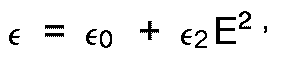
wobei ε₀ der lineare Wert der Dielektrizitätskonstanten des Substrats ist und ε₂E² den vom einfallenden Laserlicht bewirkten Feldeffekt darstellt.
wobei ε₀ der lineare Wert der Dielektrizitätskonstanten des Substrats ist und ε₂E² den vom einfallenden Laserlicht bewirkten Feldeffekt darstellt.
7. Verfahren gemäß Anspruch 5 oder 6, wobei die Änderung der Dielektrizitätskonstanten
des Substrats während einer Zeitdauer auftritt, die verglichen mit dem Ladungsträgertransport
durch das Substrat sehr klein ist.
8. Verfahren gemäß einem oder mehreren der vorhergehenden Ansprüche 5 bis 7, wobei der
Laserimpuls ein 100fs-Impuls von 10kW ist, der auf einen Punkt (16) von 10µm Durchmesser
auf der Übertragungsleitung (10, 12) fokussiert ist.
9. Verfahren gemäß einem oder mehreren der vorhergehenden Ansprüche 5 bis 8, wobei der
Laserimpuls eine Wellenlänge hat, die länger ist als die, die der Bandlücke des Substrats
entspricht.
10. Verfahren gemäß einem oder mehreren der vorhergehenden Ansprüche 1 bis 9, wobei das
verwendete elektrooptische Material, das einen optischen Gleichrichtereffekt oder
einen optischen Kerr-Effekt zeigt, eines der Materialien Lithiumtantalat oder Lithiumniobat
ist.
11. Verfahren gemäß einem oder mehreren der vorhergehenden Ansprüche 5 bis 9, wobei das
Substrat GaAs ist.
12. Verfahren gemäß einem oder mehreren der vorhergehenden Ansprüche 1 bis 11, das darüber
hinaus den Schritt des optischen Abtastens der Übertragungsleitung (10, 12) umfaßt,
um den Subpikosekundenimpuls zu erfassen.
1. Procédé pour la génération d'une impulsion électrique de l'ordre de la sous-picoseconde,
comprenant les étapes de:
fournir une ligne de transmission ayant une paire de lignes conductrices (10, 12) sur un substrat fait dans un matériau électro-optique; et
focaliser une impulsion laser sur la ligne de transmission pour engendrer une impulsion électrique de l'ordre de la sous-picoseconde directement sur la ligne de transmission (10, 12) par un effet de redressement optique présenté par ledit substrat qui est couplé à ladite ligne de transmission (10, 12) pour produire ladite impulsion électrique.
fournir une ligne de transmission ayant une paire de lignes conductrices (10, 12) sur un substrat fait dans un matériau électro-optique; et
focaliser une impulsion laser sur la ligne de transmission pour engendrer une impulsion électrique de l'ordre de la sous-picoseconde directement sur la ligne de transmission (10, 12) par un effet de redressement optique présenté par ledit substrat qui est couplé à ladite ligne de transmission (10, 12) pour produire ladite impulsion électrique.
2. Procédé selon la revendication 1, dans lequel ladite impulsion laser est focalisée
pour produite un point (16) ayant un diamètre de l'ordre de 10 µm ou approximativement
égal à la séparation des lignes dans ladite ligne de transmission (10, 12).
3. Procédé selon les revendications 1 ou 2, dans lequel ladite impulsion électrique produite
par ledit effet de redressement optique a un champ électrique de l'ordre de 10V/cm.
4. Procédé selon l'une quelconque ou plusieurs des revendications précédentes 1 à 3,
dans lequel ledit effet de redressement optique provoque une impulsion de tension
dont l'amplitude est proportionnelle à l'intensité de la dite impulsion laser, et
dont la durée d'impulsion est approximativement la même que celle de ladite impulsion
laser.
5. Procédé pour la génération d'une impulsion électrique de l'ordre de la sous-picoseconde,
comprenant les étapes de:
fournir une ligne de transmission ayant une paire de lignes ccnductrices (10, 12) sur un substrat isolant fait dans un matériau électro-optique ayant un effet optique de Kerr; et
focaliser une impulsion laser dans ladite ligne de transmission pour changer la puissance efficace dudit substrat dans le volume de matériau défini par le point focal laser (16) dans ladite ligne de transmission (10, 12) et pour créer de ce fait une impulsion de l'ordre de la sous-picoseconde sur ladite ligne de transmission.
fournir une ligne de transmission ayant une paire de lignes ccnductrices (10, 12) sur un substrat isolant fait dans un matériau électro-optique ayant un effet optique de Kerr; et
focaliser une impulsion laser dans ladite ligne de transmission pour changer la puissance efficace dudit substrat dans le volume de matériau défini par le point focal laser (16) dans ladite ligne de transmission (10, 12) et pour créer de ce fait une impulsion de l'ordre de la sous-picoseconde sur ladite ligne de transmission.
6. Procédé selon la revendication 5, dans lequel ledit substrat a une constante diélectrique
de
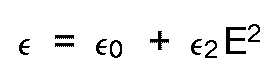
où ε₀ est la valeur linéaire de ladite constante diélectrique du substrat , et ε₂E² est l'effet de champ produit par de la lumière laser incidente.
où ε₀ est la valeur linéaire de ladite constante diélectrique du substrat , et ε₂E² est l'effet de champ produit par de la lumière laser incidente.
7. Procédé selon les revendications 4 ou 5, dans lequel ledit changement de constante
diélectrique dudit substrat se fait en un temps très court en comparaison du transport
de porteurs dans ledit substrat.
8. Procédé selon l'une quelconque ou plusieurs des revendications précédentes 5 à 7,
dans lequel ladite impulsion laser est une impulsion de 10KW, 100fs focalisée sur
un point (16) ayant un diamètre de 10-µm sur ladite ligne de transmission (10, 12).
9. Procédé selon l'une quelconque ou plusieurs des revendications précédentes 5 à 8,
dans lequel ladite impulsion laser a une longueur d'onde plus grande que celle correspondant
à l'intervalle de bande dudit substrat.
10. Procédé selon l'une quelconque ou plusieurs des revendications précédentes 1 à 9,
dans lequel le matériau électro-optique utilisé présentant l'effet de redressement
optique ou un effet de Kerr, est un matériau fait de tantalate de lithium ou de niobate
de lithium.
11. Procédé selon l'une quelconque ou plusieurs des revendications précédentes 5 à 9,
dans lequel ledit substrat est GaAs.
12. Procédé selon l'une quelconque ou plusieurs des revendications précédentes 1 à 11,
comprenant en outre l'étape d'échantillonnage optique de ladite ligne de transmission
(10, 12) pour détecter ladite impulsion de l'ordre de la sous-picoseconde.