|
(11) | EP 0 355 348 B2 |

| (12) | NEW EUROPEAN PATENT SPECIFICATION |
|
|
| (54) |
Superoxide dismutase composition Superoxide Dismutase-Zusammensetzung Composition à base de superoxyole dismutase |
|
|
|||||||||||||||||||||||||||||||
[0001] The superoxide dismutase, which will be referred to as SOD hereinafter, composition of the present invention is valuable in the prevention and treatment of tissue disorders caused by superoxides.
[0002] Namely, it may be employed as, for example, an antiinflammatory agent or a remedy for ischemic cardiac diseases.
[0003] A preparation of SOD extracted from bovine liver has been already marketed in Western Germany as a remedy for, e.g., rheumatoid arthritis.
[0004] Although this preparation is a valuable medicine, it is accompanied by a problem in that it shows an antigenicity when administered to man since it originates from bovine. In order to overcome this problem, it has been recently attempted to produce SOD originating from human on a large scale through genetic recombination techniques (cf. EP-AI-180964 and EP-AI-173280). However the purified SODs so obtained, in particular human Cu - Zn SOD, are poor in stability.
[0005] A highly purified human Cu - Zn SOD is unstable and has some problems in that it is liable to be inactivated when formulated into a lyophilized powder or when stored in the form of, for example, an aqueous solution or a powder. and that it would suffer from clouding caused by polymerization.
[0006] Accordingly, it is an object of the present invention to provide a stable human Cu - Zn SOD composition.
[0007] As a result of intensive studies, the present inventors have found that a phosphate such as sodium phosphate and an alkali metal chloride such as sodium chloride are effective in stabilizing a highly pure human Cu - Zn SOD and that the combined use of sucrose therewith would give a stable human Cu - Zn SOD composition scarcely suffering from any decrease in the activity or denaturation caused by, for example, polymerization, thus completing the present invention.
[0008] The present invention relates to a SOD composition comprising a phosphate, an alkali metal chloride and sucrose, wherein the SOD is human Cu - Zn SOD.
[0009] Further the abovementioned human Cu - Zn SOD prepared through genetic recombination techniques may also be employed.
[0010] The present invention is particularly useful for a recombinant human Cu - Zn SOD produced by, for example, recombinant E. coli. Human Cu - Zn SOD is particularly preferable from the viewpoint of clinical administration to man.
[0011] Examples of the alkali metal chloride to be used in the present invention include sodium chloride and potassium chloride, among which sodium chloride is usually employed.
[0012] In the present invention, any phosphate may be used so long as it is pharmacologically acceptable. Alkaline metal phosphates, in particular sodium phosphate, are preferable.
[0013] The amounts of the components of the SOD composition of the present invention may vary widely without any restriction, so long as the human Cu - Zn SOD can be stabilized thereby.
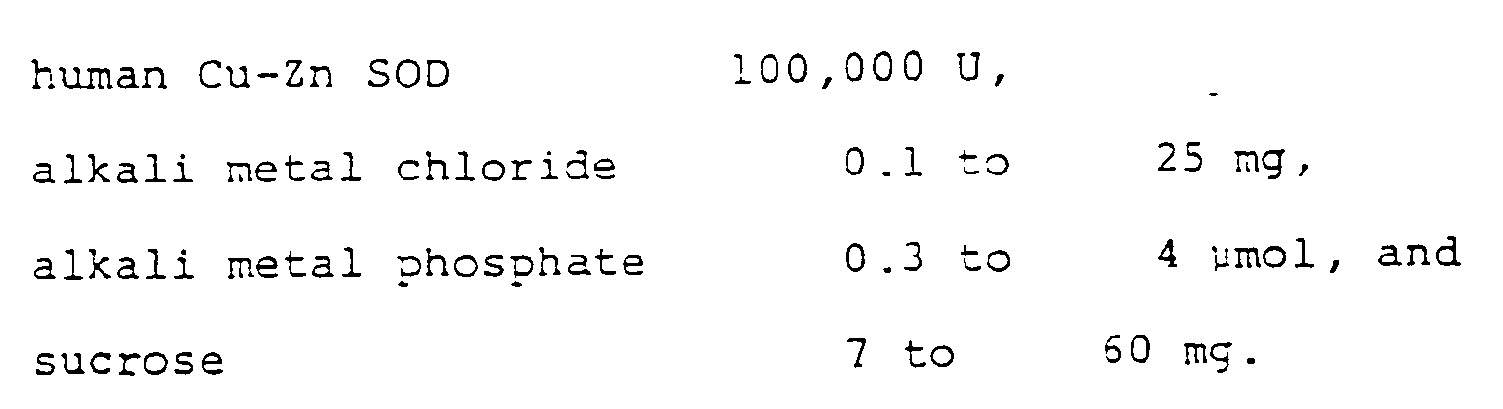
[0014] For example, the phosphate may be used in an amount of about 0.05 µmol or above, preferably 0.1 to 20 µmol and still preferably 0.3 to 4 wmol; the alkali metal chloride may be employed in an amount of about 0.05 mg or above, preferably 0.1 to 50 mg and still preferably 0.1 to 25 mg; and sucrose may be employed in an amount of about 1 mg or above and preferably about 3 mg or above, each per 100,000 U of the SOD. Although the upper limit of the sucrose content is not particularly specified. from the practical viewpoint it is preferably used in an amount not exceeding about 150 mg. Still preferably. the sucrose may be used in an amount of 7 to 60 mg.
[0015] The SOD composition of the present invention may be formulated into, for example, oral preparations, injections or external preparations optionally together with, for example, fillers or adjuvants.
[0016] These fillers and adjuvants may be selected from among those conventionally used in the art depending on the purpose. Examples thereof include water, sugars, sugar alcohols, amino acids, proteins and inorganic salts. The amount of these additives is not particularly restricted. They may be usually added in an amount of 0 to 5 g, preferably 0 to 2 g, per 100,000 U of the human Cu - Zn SOD.
[0017] Therefore the SOD composition of the present invention has the following composition per 100,000 U of the SOD protein:
[0018] The SOD composition af the present invention may be prepared by, for example, the following method.
[0019] When a highly purified human Cu - Zn SOD is to be employed, the SOD, an alkali metal chloride, preferably sodium chloride, and sucrose are dissolved in a solution such as a phosphate buffer in an arbitrary order. Thus the SOD composition of the present invention is obtained in the form of an aqueous solution. This aqueous solution may be further lyophilized to give the SOD composition of the present invention in the form of a powder.
[0020] When the human Cu - Zn SOD to be used contains an alkali metal chloride such as sodium chloride originating from the preparation process, an additional alkali metal chloride may be added thereto, if required. Then sucrose is added thereto and the obtained mixture is dissolved in a phosphate buffer, optionally followed by lyophilization.
[0021] When a chromatographic treatment with the use of, for example, a Sephadex@ column is to be used in the final step of the preparation of the human Cu - Zn SOD, the resin has been preliminary equilibrated with a phosphate buffer containing an alkali metal chloride and having a pH value of about 5.0 to 9, preferably about 5.5 to 8. Then the SOD is adsorbed on the column and eluted with the same phosphate buffer. Subsequently sucrose is added to the eluate to give the SOD composition of the present invention in the form of an aqueous solution. Alternatively. the eluate is lyophilized, either as such or after being concentrated, and then sucrose is added thereto. The obtained mixture is dissolved in water to thereby give the SOD composition of the present invention. The obtained aqueous solution may be further lyophilized to thereby give a powder. if desired.
[0022] Alternatively, when a phosphate buffer is not employed, the addition of the phosphate may be conducted in the following manner. Namely, a phosphate such as an alkali metal phosphate an alkali metal monohydrogen phosphate or an alkali metal dihydrogen phosphate is added to the human Cu - Zn SOD together with sucrose to give an aqueous solution, which may be then optionally lyophilized. The lyophilization is made by a usual method, for example, as follows:
[0023] The aqueous solution containing 5 % by weight to 50 % by weight in total amount of human Cu - Zn SOD, alkali metal chlorides, phosphates, sucrose and if necessary, further additives, is freezed at -20°C to -200°C, usually -30°C to -80°C and dried under reduced pressure below 1.33 kPa (10 torr, 10 mmHg) usually below 133,3 Pa (1 torr), preferably below 13.3 Pa (0.1 torr).
[0024] The activity of the human Cu - Zn SOD to be used in the present invention is determined by the xanthine- xanthine oxidase method reported by McCord and Fridovich (cf. J. Biol., Chem., 244, 6049 (1969)).
[0025] A powdery sample is stored in the dark at 65°C for two weeks while a change in the SOD activity is monitored and the amount of the aggregated SOD formed through denaturation is determined. A sample in the form of an aqueous solution is stored at room temperature under irradiating at 1000 lux for two weeks while a change in the SOD activity is monitored and the amount of the aggregated SOD is determined.
[0026] As the specimen, a known h-SOD (human Cu - Zn SOD) obtained by genetic recombination techniques which is highly pure and thus substantially free from any salt is employed. An aqueous solution of a specimen (control) is prepared by dissolving 700,000 U of said highly pure h-SOD in distilled water, adjusting the pH value to 7 and adjusting the total volume to 10 ml.
[0027] A specimen of the SOD composition of the present invention is prepared by dissolving 700,000 U of said highly pure h-SOD (human Cu - Zn SOD) 150 mg of sucrose in a 0.5 mM sodium phosphate buffer containing 1 mg/mf of sodium chloride, adjusting the pH value of the obtained solution to 7 and adjusting the total volume thereof to 10 ml.
[0028] Further an aqueous solution obtained in the same manner as the one described above is lyophilized to thereby give lyophilized powdery specimen. Table 1 shows the composition of each specimen.
[0030] In the above Table 2, the activity data are expressed each in the ratio (%) to the initial activity while the gel filtration data show each the content (%) of the aggregation SOD. At the initiation, no aggregation SOD is present (0 %).
[0031] Therefore the combined use of the phosphate, sodium chloride and sucrose completely inhibits the formation of the aggregation SOD without lowering the activity thereof.
[0032] These results obviously indicate that the composition of the present invention has a remarkably elevated SOD stability as compared with the control.
Example 1
[0033] 100,000 U of a highly pure h-SOD (human Cu - Zn SOD) and 30 mg of sucrose were dissolved in 10 ml of a 0.5 mM phosphate buffer containing 5 mg of sodium chloride. The obtained solution was lyophilized to give the SOD composition of the present invention having the following composition:
Example 2
[0034] The human Cu - Zn SOD composition of the following composition was prepared according to the above mentioned process:
Example 3
[0035] The human Cu - Zn SOD composition of the following composition was prepared according to the above
Example 4
[0036] A lyophilized human Cu - Zn SOD powder having the following composition was prepared:
human Cu - Zn SOD 700,000 U,
sodium phosphate 5 wmol, and
sodium chose 10 mg.
200 mg of sucrose was added thereto and the obtained mixture was dissolved in 10 ml of distilled water. The pH value of the soltuion was adjusted to 6.5. After filtration and sterilization, 5 ml of the solution was filled in a vial and lyophilized to give a lyophilized preparation.
1. A superoxide dismutase (SOD) composition comprising a phosphate, an alkali metal
chloride and suc- crose, wherein said SOD is human Cu-Zn SOD.
2. An SOD composition as set forth in Claim 1, wherein said phosphate is an alkaline
metal phosphate.
3. An SOD composition as set forth in Claim 1 comprising the following components:
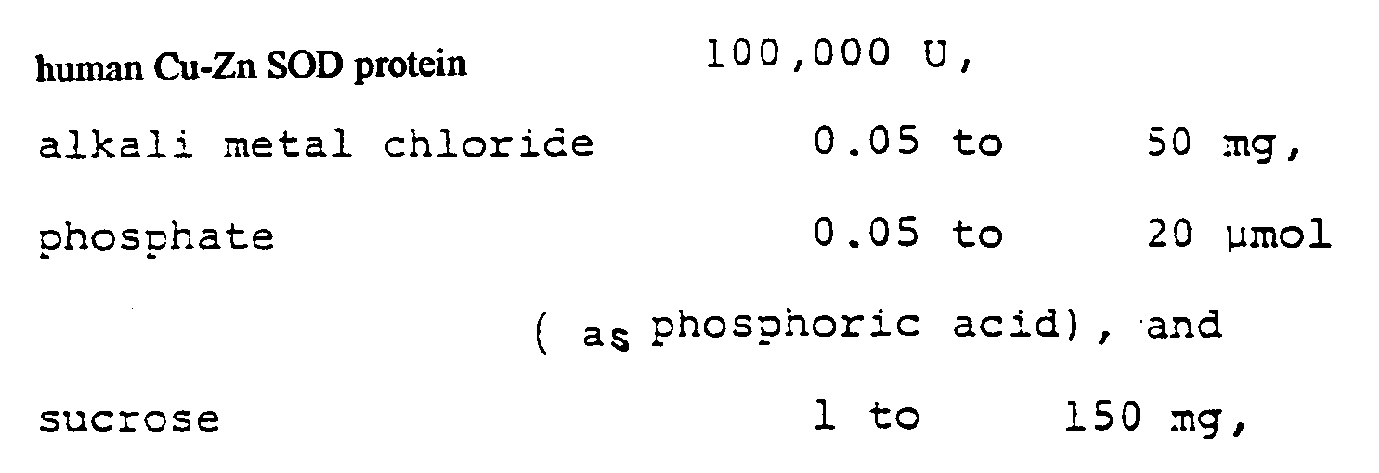
together with 0 to about 5 g of other additives such as fillers or adjuvants.
together with 0 to about 5 g of other additives such as fillers or adjuvants.
4. An SOD composition as set forth in Claim 4 comprising the following components:
1. Superoxiddismutase (SOD)-Zusammensetzung, welche ein Phosphat, ein Alkalimetallchlorid
und Saccharose umfaßt, worin SOD menschliches Cu-Zn SOD ist.
2. SOD-Zusammensetzung nach Anspruch 1, worin das Phosphat ein Alkalimetallphosphat
ist.
3. SOD-Zusammensetzung nach Anspruch 1, welche die folgenden Komponenten umfaßt:
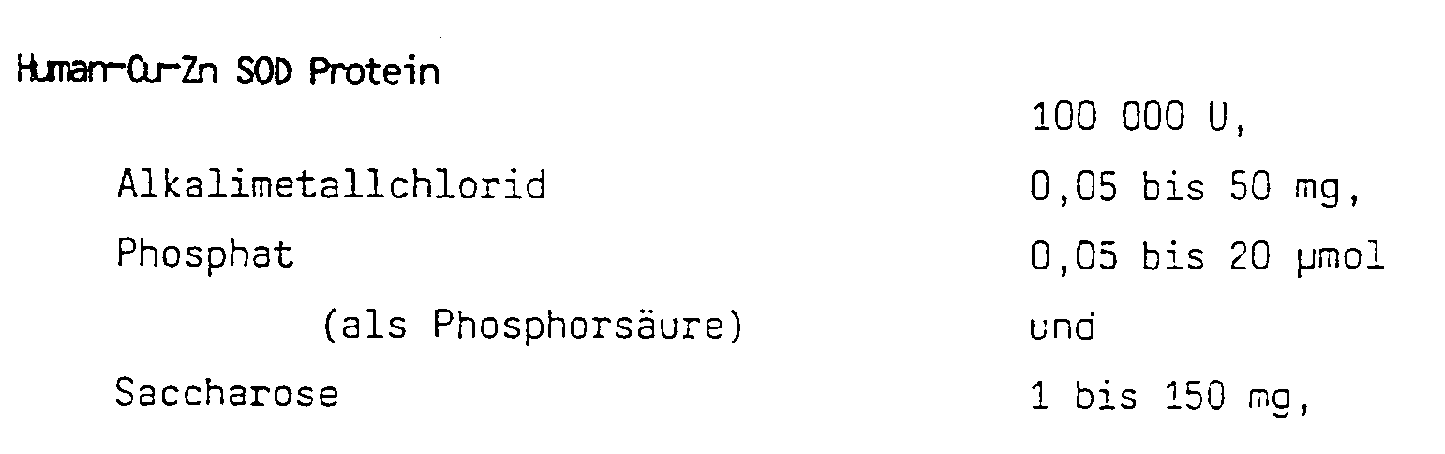
zusammen mit 0 bis ungefähr 5 g anderer Additive wie Füllmittel oder Adjuvantien.
zusammen mit 0 bis ungefähr 5 g anderer Additive wie Füllmittel oder Adjuvantien.
4. SOD-Zusammensetzunq nach Anspruch 4, welche die folgenden Komponenten umfaßt:

1. Une composition à base de superoxyde dismutase (SOD) comprenant un phosphate, un
chlorure de métal alcalin et du sucrose, dans laquelle ladite SOD est de la SOD Cu-Zn
humaine.
2. Une composition à base de SOD comme indiquée à la revendication 1, dans laquelle
ledit phosphate est un phosphate de métal alcalin.
3. Une composition à base de SOD comme indiquée à la revendication 1 comprenant les
composants suivants:
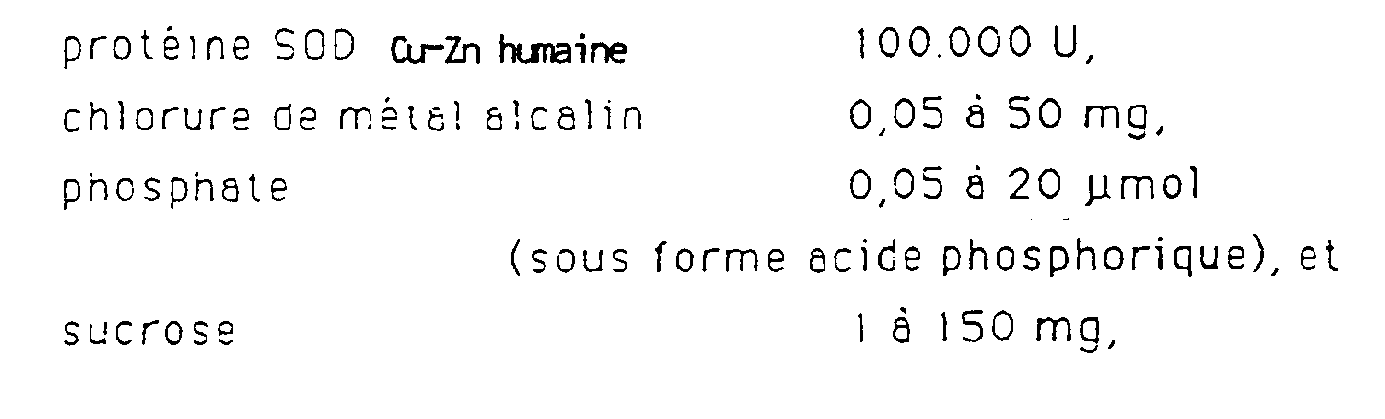
conjointement à de 0 à environ 5g d'autres additifs tels que des agents de remplissage ou des adjuvants,
conjointement à de 0 à environ 5g d'autres additifs tels que des agents de remplissage ou des adjuvants,
4. Une composition à base de SOD comme indiquée à la revendication 1 comprenant les
composants suivants:
