|
(11) | EP 0 356 784 B1 |

| (12) | EUROPEAN PATENT SPECIFICATION |
|
|
| (54) |
Liquid detergent composition Flüssiges Reinigungsmittel Composition détergente liquide |
|
|
|||||||||||||||||||||||||||||||
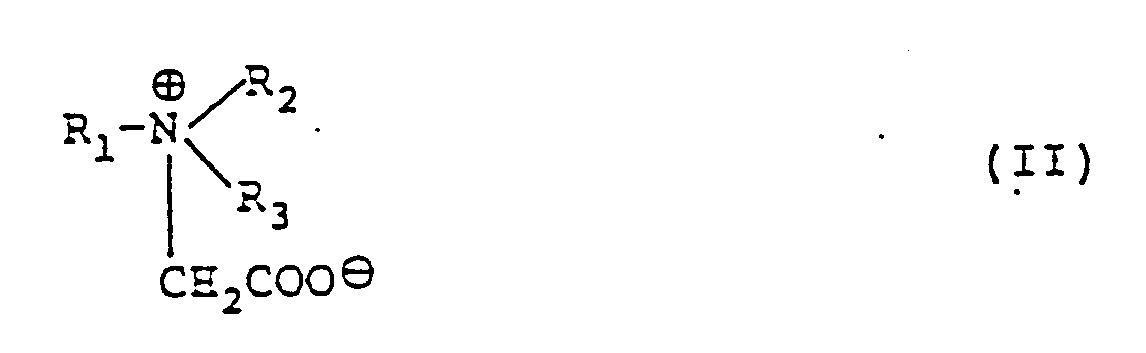
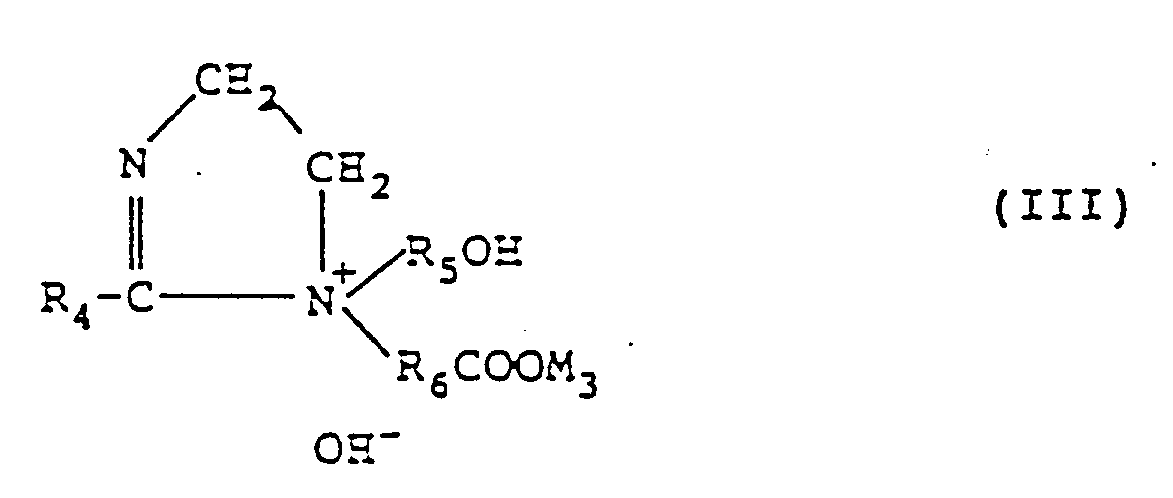
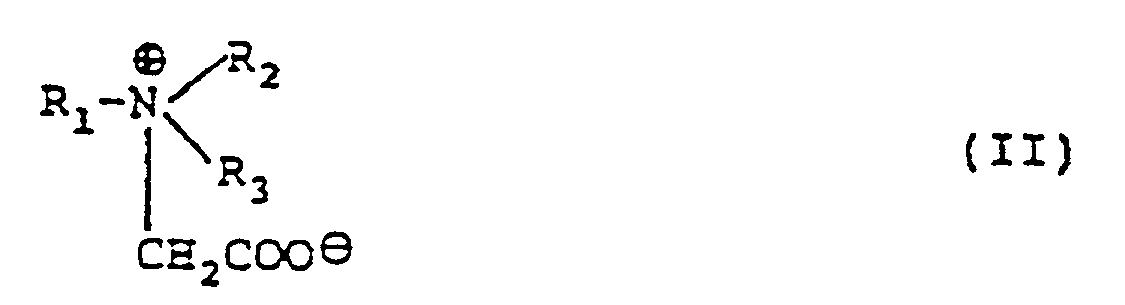
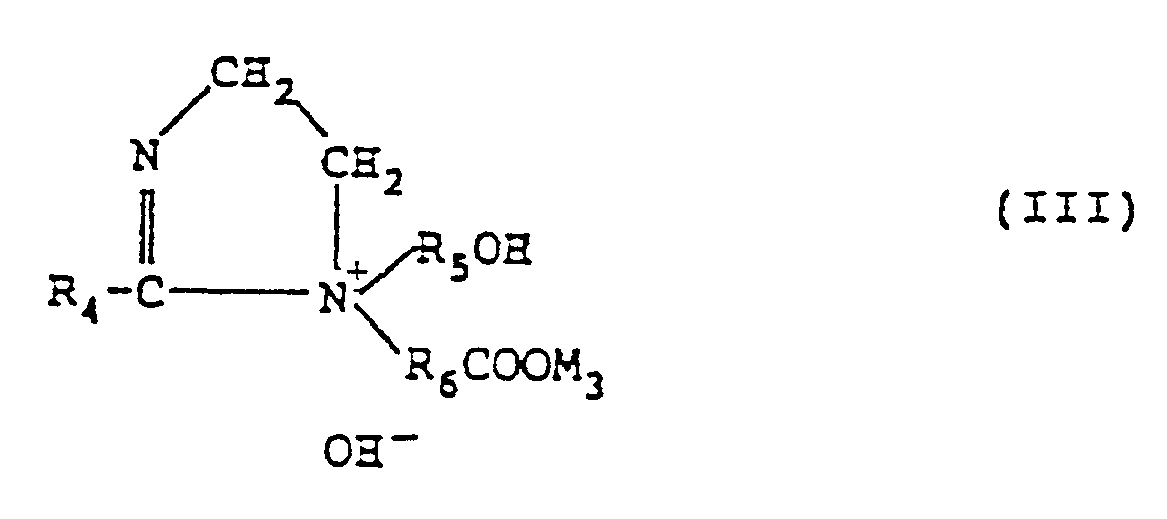
|
||||||||||||||||||||||||||||||||
| Note: Within nine months from the publication of the mention of the grant of the European patent, any person may give notice to the European Patent Office of opposition to the European patent granted. Notice of opposition shall be filed in a written reasoned statement. It shall not be deemed to have been filed until the opposition fee has been paid. (Art. 99(1) European Patent Convention). |
FIELD OF THE INVENTION
[0001] This invention relates to a novel liquid detergent composition. More particularly, it relates to a liquid detergent composition useful as hair shampoo, body shampoo, liquid face soap, and dishwashing detergent.
BACKGROUND OF THE INVENTION
[0002] Anionic surface active agents, such as alkyl benzenesulfonates, higher alcohol sulfates, alkyl ether sulfates, and higher fatty acid salts, have widely been used in detergents, such as shampoo. The detergents containing these surface active agents are unsatisfactory in mildness to the skin. On the other hand, there is now a tendency that an N-acylglutamic acid salt obtained by subjecting one of amino acids, glutamic acid to acylation is incorporated into hair shampoo or body shampoo not only because of its mildness to the skin but because of its inhibitory effect on growth of harmful microorganisms causing skin diseases.
[0003] However, an aqueous solution of the N-acylglutamate per se lacks detergency and foamability for cleaning off extremely oily dirt, for example, hair applied with pomade.
[0004] It has been proposed to use the N-acylglutamate in combination with an alkyl betain or imidazoline surface active agent to thereby improve detergency and foamability without impairing mildness to the skin as disclosed in JP-B-50-23682 and JP-B-51-42603 (the term "JP-B" as used herein means an "examined Japanese patent publication"), but these detergents are still unsatisfactory in detergency and foamability.
[0005] FR-A-2 457 891 discloses a transparent detergent composition comprising a basic salt of a optically-active N-(long-chain acyl) acidic amino acid which is obtained by reacting 1 mol of the optically-active N-(long-chain acyl) acidic amino acid with 1 to 2 mols of a basic amino acid. As a further component of the detergent composition, other detergents can be used, for example detergents of the betaine type.
SUMMARY OF THE INVENTION
[0006] One object of this invention is to provide a liquid detergent composition exhibiting excellent foamability, detergency and low-temperature stability while retaining mildness to the skin.
[0007] That is, the present invention relates to a detergent composition containing an N-acylaspartic acid or a salt thereof represented by formula (I):
wherein R represents an alkyl or alkenyl group having from 7 to 21 carbon atoms; and M₁ and M₂ each represents a hydrogen atom or a cation derived from Na, K, NH₄ or an alkanolamine, and a nitrogen-containing surface active agent selected from the group consisting of an alkylbetaine or alkylamidebetaine represented by formula (II):
wherein R₁ represents an alkyl or alkenyl group having from 10 to 22 carbon atoms which may contain an amide linkage in the chain thereof; and R₂ and R₃ each represents an alkyl group having from 1 to 3 carbon atoms, and an imidazoline compound represented by formula (III):
wherein R₄ represents an alkyl or alkenyl group having from 4 to 18 carbon atoms; R₅ represents an alkylene group having from 1 to 4 carbon atoms; R₆ represents an alkylene group having from 1 to 4 carbon atoms or a hydroxyl-substituted alkylene group having from 1 to 4 carbon atoms; and M₃ represents a hydrogen atom or a cation derived from Na, K, NH₄ or an alkanolamine.
DETAILED DESCRIPTION OF THE INVENTION
[0008] The N-acylaspartic acid or a salt thereof represented by formula (I) which can be used in the detergent composition of the present invention includes an L-form, a D-form, and a mixture thereof. It can be synthesized, for example, by reacting aspartic acid and a fatty acid halide having from 8 to 22 carbon atoms in the presence of a basic catalyst.
[0009] Specific examples of the N-acylaspartic acid or a salt thereof which can be used suitably are N-lauroylaspartic acid, N-myristoylaspartic acid, N-palmitoylaspartic acid, N-stearoylaspartic acid, N-palmitoylaspartic acid, N-oleoylaspartic acid, and N-cocoylaspartic acid, and their salts, e.g., sodium salts, potassium salts, monoethanolammonium salts, diethanolammonium salts, and triethanolammonium salts.
[0010] The nitrogen-containing surface active agent which can be used in the detergent composition of the present invention can be selected from alkylbetaines and alkylamidebetaines represented by formula (II) and imidazoline compounds represented by formula (III).
[0011] The compounds of formula (II) can be obtained by reacting a tertiary amine whose nitrogen atom having an alkyl or alkenyl group containing from 10 to 22 carbon atoms which may contain an amide linkage in the chain thereof and two alkyl groups containing from 1 to 3 carbon atoms with a monohalogenated acetic acid salt. For example, lauryldimethylaminoacetic acid betaine can be synthesized by heating a mixture of lauryldimethylamine and sodium monochloroacetate.
[0012] Specific examples of the compounds of formula (II) include alkylbetaines having an alkyl group containing from 10 to 18 carbon atoms as the moiety R₁, e.g., lauryldimethylaminoacetic acid betaine, myristyldimethylaminoacetic acid betaine, stearyldimethylaminoacetic acid betaine, oleyldimethylaminoacetic acid betaine, laurylmethylethylaminoacetic acid betaine, and laurylmethyl-n-propylaminoacetic acid betaine; and alkylamidebetaines containing from 10 to 22 carbon atoms and having an amide linkage in the chain thereof, e.g., lauramidopropyldimethylaminoacetic acid betaine, myristamidopropyldimethylaminoacetic acid betaine, stearamidopropyldimethylaminoacetic acid betaine, oleamidopropyldimethylaminoacetic acid betaine, palmitamidopropyldimethylaminoacetic acid betaine, coconut oil fatty acid amidopropyldimethylaminoacetic acid betaine, lauramidopropylmethylethylaminoacetic acid betaine, lauramidopropylmethyl-n-propylaminoacetic acid betaine, lauramidoethyldimethylaminoacetic acid betaine, and lauramidobutyldimethylaminoacetic acid betaine.
[0013] The compounds of formula (III) can be prepared by reacting a long-chain fatty acid having from 5 to 19 carbon atoms with a β-hydroxyalkylethylenediamine containing from 1 to 4 carbon atoms in its alkyl moiety to obtain a 1-hydroxyalkyl-2-long chain alkylimidazoline, which is then reacted with a monohalogenated lower carboxylic acid having an alkylene or hydroxyl-substituted alkylene group containing from 1 to 4 carbon atoms or its salt with sodium, potassium, NH₄ or an alkanolamine in the same manner as for the reaction between a tertiary amine and a monohalogenated acetate in the synthesis of the compounds of formula (II).
[0014] Specific examples of the imidazoline compounds of formula (III) are shown below:
In the liquid detergent composition according to the present invention, the ratio of the N-acylaspartic acid or a salt thereof to the N-containing surface active agent is not particularly limited, and a synergistic effect can be produced as long as these two components are used in combination. Particularly excellent performance properties can be assured with a weight ratio of the N-acylaspartic acid or a salt thereof to the N-containing surface active agent falling within a range of from 1:5 to 5:1. The imidazoline compounds of formula (III) are preferred to the compounds of formula (II) to be combined with the N-acylaspartic acid or a salt thereof.
[0015] The detergent composition according to the present invention is mild to the skin, has excellent foamability even in the presence of oily dirt, and exhibits excellent detergency for heavy oily dirt.
[0016] If desired, the detergent composition of the present invention may further contain commonly employed adjuncts, diluents, thickeners and builders, such as hydrotrops, flavors, dyes, fluorescent dyes, and organic or inorganic builders.
[0017] The present invention is now illustrated in greater detail by way of the following Examples, but it should be understood that the present invention is not deemed to be limited thereto.
EXAMPLE 1
[0018] A liquid detergent composition containing sodium N-lauroyl-L-aspartate and lauryldimethylaminoacetic acid betain in proportions shown in Table 1 was prepared. The resulting detergent was evaluated for foamability, detergency and mildness to the skin according to the following test methods. The results obtained are shown in Table 1.
1) Foamability:
[0019] The detergent was 200-fold diluted with distilled water. A 20 ml portion of the thus diluted detergent was put in a 100 ml-volume measuring cylinder with a ground-glass stopper together with 1 g of triolein as an oil component. The cylinder was stoppered and given 20 vertical sharp shakings. Immediately after the shaking, the stopper was removed, the cylinder was placed horizontally, and the volume of the foam was read out.
2) Detergency:
[0020] Slide glass was dipped in a model dirt having the following composition for 1 to 2 seconds and then air-dried. The slide glass having adhered thereto the dirt was washed with the liquid detergent composition 200-fold diluted with distilled water (content of surface active agent: 0.1% by weight) at 25°C for 3 minutes under rotation of 250 rpm and then rinsed with distilled water at 25°C for 1 minute by means of a Leenerts improved detergency testing machine. The slide glass was air-dirted, and the residual oil was determined. A detergency (%) can be calculated from equation:
wherein Ws is the amount of the deposited oily dirt before washing; and Ww is the amount of the oily dirt remaining after washing.
| Composition of Model Dirt: | |
| Soybean oil (JP) | 10 g |
| Beef tallow (JP) | 10 g |
| Monoolein | 0.25 g |
| Oil red | 0.1 g |
| Chloroform | 60 ml |
3) Mildness:
[0021] A ultraviolet-visible detector ("UV-8010" manufactured by Toso K.K.; detection wavelength: 220 nm) was connected to a high performance liquid chromatograph ("CCPM" manufactured by Toso K.K.), and a column ("TSK-GEL 3000XL") was fitted to the chromatograph. In a phosphoric acid buffer (pH 6.8) were dissolved 9 ml of a protein aqueous solution containing 0.025% by weight of egg yolk albumin and 1 ml of the detergent composition containing 10% by weight of the surface active agent to prepare a sample. The sample (50 µl) was passed through the column and then eluted with a phosphoric acid buffer (pH 6.8) at a flow rate of 1 ml/min. The elution peak height (Hs) of egg yolk albumin in the fraction collected between 11 to 12 minutes from the start of elution was measured. Then, a sample prepared in the same manner except for using 1 ml of pure water in place of the detergent composition was subjected to the same chromatography, and the peak height (H₀) assigned to egg yolk albumin was measured. The percent denaturation of protein was calculated from equation:
Mildness was rated from the results obtained according to the following scale.
| Percent Denaturation | Rate |
| less than 10% | excellent |
| 10 to 60% | good |
| 60 to 80% | no good |
| more than 80% | poor |
COMPARATIVE EXAMPLE 1
[0022] A liquid detergent composition containing sodium N-lauroyl-L-aspartate or lauryldimethylaminoacetic acid betaine in a proportion shown in Table 1 was prepared. The properties of the resulting detergent were evaluated in the same manner as in Example 1, and the results obtained are shown in Table 1.
COMPARATIVE EXAMPLE 2
[0023] A liquid detergent composition was prepared in the same manner as in Example 1, except for using sodium N-lauroyl-L-glutaminate in place of sodium N-lauroyl-L-asparate in a proportion shown in Table 1. The resulting detergent was evaluated in the same manner as in Example 1, and the results obtained are shown in Table 1.
EXAMPLE 2
[0024] A liquid detergent composition containing sodium N-lauroyl-L-asparate and coconut oil fatty acid amidopropyldimethylaminoacetic acid betaine in proportions shown in Table 2 was prepared. The resulting detergent was evaluated in the same manner as in Example 1, and the results obtained are shown in Table 2.
COMPARATIVE EXAMPLE 3
[0025] A liquid detergent composition containing sodium N-lauroyl-L-asparate or coconut oil fatty acid amidopropyldimethylaminoacetic acid betaine in a proportion shown in Table 2 was prepared. The resulting detergent was evaluated in the same manner as in Example 1, and the results obtained are shown in Table 2.
COMPARATIVE EXAMPLE 4
[0026] A liquid detergent composition was prepared in the same manner as in Example 2, except for using sodium N-lauroyl-L-glutaminate in place of sodium N-lauroyl-L-asparate in a proportion shown in Table 2. The resulting detergent was evaluated in the same manner as in Example 1, and the results obtained are shown in Table 2.
EXAMPLE 3
[0027] A liquid detergent composition containing sodium N-lauroyl-L-aspartate and the imidazoline compound represented by formula (III-a) in proportions shown in Table 3 was prepared. The resulting detergent was evaluated in the same manner as in Example 1, and the results obtained are shown in Table 3.
COMPARATIVE EXAMPLE 5
[0028] A liquid detergent composition was prepared in the same manner as in Example 3, except for using either one of sodium N-lauroyl-L-aspartate and the imidazoline compound. The resulting detergent was evaluated in the same manner as in Example 1, and the results obtained are shown in Table 3.
COMPARATIVE EXAMPLE 6
1. A liquid detergent composition containing an N-acylaspartic acid or a salt thereof
represented by formula (I):
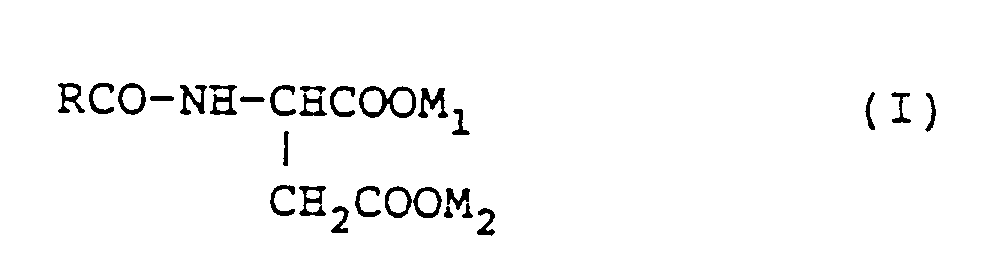
wherein R represents an alkyl or alkenyl group having from 7 to 21 carbon atoms; and M₁ and M₂ each represents a hydrogen atom or a cation derived from Na, K, NH₄ or an alkanolamine,
and a nitrogen-containing surface active agent selected from the group consisting of an alkylbetaine or an alkylamidebetaine represented by formula (II):
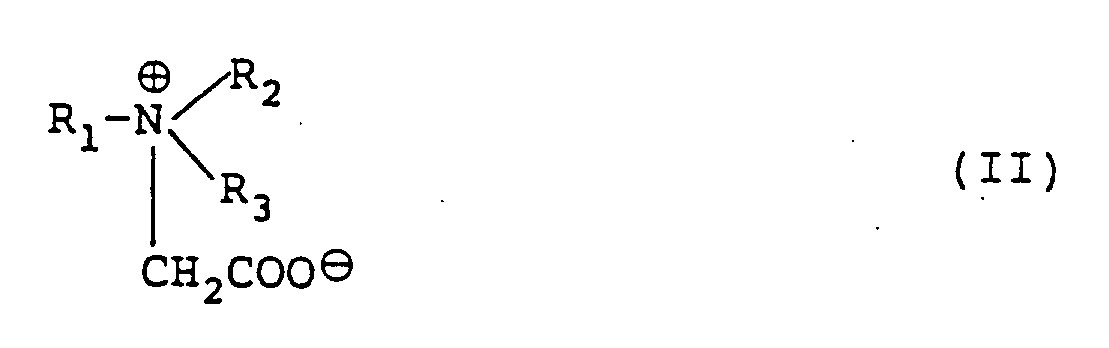
wherein R₁ represents an alkyl or alkenyl group having from 10 to 22 carbon atoms which may contain an amide linkage in the chain thereof; and R₂ and R₃ each represents an alkyl group having from 1 to 3 carbon atoms, and an imidazoline compound represented by formula (III):
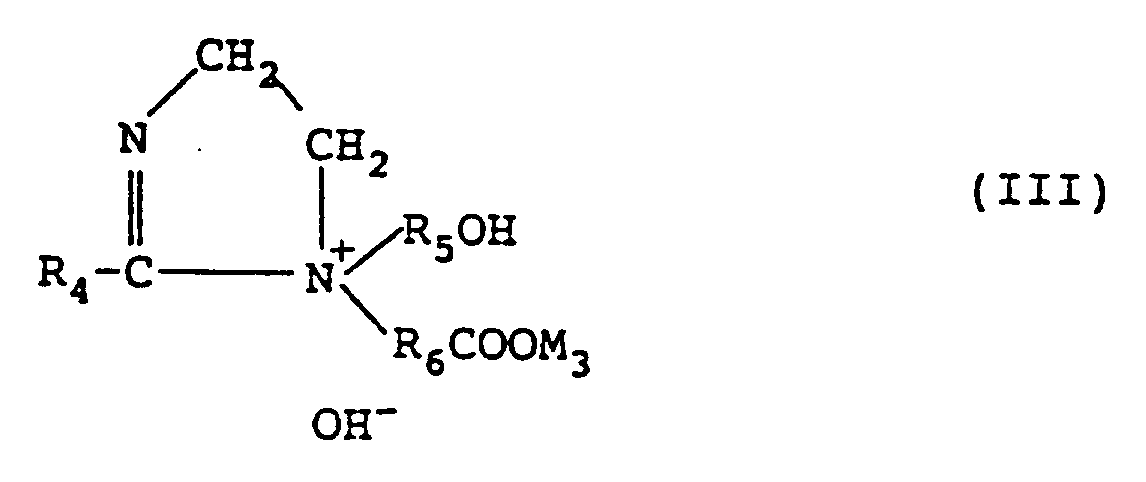
wherein R₄ represents an alkyl or alkenyl group having from 4 to 18 carbon atoms; R₅ represents an alkylene group having from 1 to 4 carbon atoms; R₆ represents an alkylene group having from 1 to 4 carbon atoms or a hydroxyl-substituted alkylene group having from 1 to 4 carbon atoms; and M₃ represents a hydrogen atom or a cation derived from Na, K, NH₄ or an alkanolamine.
wherein R represents an alkyl or alkenyl group having from 7 to 21 carbon atoms; and M₁ and M₂ each represents a hydrogen atom or a cation derived from Na, K, NH₄ or an alkanolamine,
and a nitrogen-containing surface active agent selected from the group consisting of an alkylbetaine or an alkylamidebetaine represented by formula (II):
wherein R₁ represents an alkyl or alkenyl group having from 10 to 22 carbon atoms which may contain an amide linkage in the chain thereof; and R₂ and R₃ each represents an alkyl group having from 1 to 3 carbon atoms, and an imidazoline compound represented by formula (III):
wherein R₄ represents an alkyl or alkenyl group having from 4 to 18 carbon atoms; R₅ represents an alkylene group having from 1 to 4 carbon atoms; R₆ represents an alkylene group having from 1 to 4 carbon atoms or a hydroxyl-substituted alkylene group having from 1 to 4 carbon atoms; and M₃ represents a hydrogen atom or a cation derived from Na, K, NH₄ or an alkanolamine.
2. A liquid detergent composition as claimed in claim 1, wherein R₁ in formula (II) contains
from 10 to 18 carbon atoms.
3. A liquid detergent composition as claimed in claim 1, wherein said nitrogen-containing
surface active agent is the imidazoline compound.
4. A liquid detergent composition as claimed in claim 1, wherein said N-acylaspartic
acid or a salt thereof and said N-containing surface active agent are present at a
weight ratio of from 1:5 to 5:1.
1. Flüssige Detergenszusammensetzung, enthaltend eine N-Acylasparagainsäure oder ein
Salz davon, dargestellt durch die Formel (I):
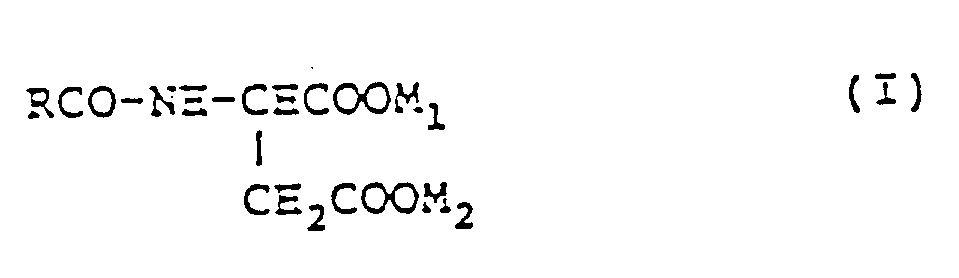
worin R eine Alkyl oder Alkenylgruppe mit 7 bis 21 Kohlenstoffatomen darstellt; und M₁ und M₂ jeweils ein Wasserstoffatom oder ein Kation, abgeleitet von Na, K, NH₄ oder einem Alkanolamin, darstellen, und ein stickstoffhaltiges oberflächenaktives Mittel, ausgewählt aus einem Alkylbetain oder einem Alkylamidbetain, dargestellt durch die Formel (II):
worin R₁ eine Alkyl- oder eine Alkenylgruppe mit 10 bis 22 Kohlenstoffatomen darstellt, die eine Amidbrücke in ihrer Kette enthalten kann; und R₂ und R₃ jeweils eine Alkylgruppe mit 1 bis 3 Kohlenstoffatomen darstellen;
und einer Imidazolinverbindung, dargestellt durch die Formel (III):
worin R₄ eine Alkyl- oder Alkenylgruppe mit 4 bis 18 Kohlenstoffatomen darstellt; R₅ stellt eine Alkylengruppe mit 1 bis 4 Kohlenstoffatomen dar, R₆ stellt eine Alkylengruppe mit 1 bis 4 Kohlenstoffatomen oder eine Hydroxyl-substituierte Alkylengruppe mit 1 bis 4 Kohlenstoffatomen dar, und M₃ stellt ein Wasserstoffatom oder ein Kation, abgeleitet aus Na, K, NH₄ oder einem Alkanolamin, dar.
worin R eine Alkyl oder Alkenylgruppe mit 7 bis 21 Kohlenstoffatomen darstellt; und M₁ und M₂ jeweils ein Wasserstoffatom oder ein Kation, abgeleitet von Na, K, NH₄ oder einem Alkanolamin, darstellen, und ein stickstoffhaltiges oberflächenaktives Mittel, ausgewählt aus einem Alkylbetain oder einem Alkylamidbetain, dargestellt durch die Formel (II):
worin R₁ eine Alkyl- oder eine Alkenylgruppe mit 10 bis 22 Kohlenstoffatomen darstellt, die eine Amidbrücke in ihrer Kette enthalten kann; und R₂ und R₃ jeweils eine Alkylgruppe mit 1 bis 3 Kohlenstoffatomen darstellen;
und einer Imidazolinverbindung, dargestellt durch die Formel (III):
worin R₄ eine Alkyl- oder Alkenylgruppe mit 4 bis 18 Kohlenstoffatomen darstellt; R₅ stellt eine Alkylengruppe mit 1 bis 4 Kohlenstoffatomen dar, R₆ stellt eine Alkylengruppe mit 1 bis 4 Kohlenstoffatomen oder eine Hydroxyl-substituierte Alkylengruppe mit 1 bis 4 Kohlenstoffatomen dar, und M₃ stellt ein Wasserstoffatom oder ein Kation, abgeleitet aus Na, K, NH₄ oder einem Alkanolamin, dar.
2. Flüssige Detergenszusammensetzung nach Anspruch 1, worin R₁ in der Formel (II) 10
bis 18 Kohlenstoffatomen enthält.
3. Flüssige Detergenszusammensetzung nach Anspruch 1, worin das stickstoffhaltige oberflächenaktive
Mittel die Imidazolinverbindung ist.
4. Flüssige Detergenszusammensetzung nach Anspruch 1, worin die N-Acylasparaginsäure
oder ein Salz davon und das N-haltige oberflächenaktive Mittel in einem Gewichtsverhältnis
von 1:5 bis 5:1 vorliegen.
1. Composition détergente liquide contenant un acide N-acylaspartique ou un de ses sels
représenté par la formule (I):

dans laquelle R représente un groupe alkyle ou alcényle ayant de 7 à 21 atomes de carbone; et M₁ et M₂ représentent chacun un atome d'hydrogène ou un cation dérivé de Na, K, NH₄, ou d'une alcanolamine,
et un agent tensio-actif contenant de l'azote choisi dans le groupe formé d'une alkylbétaïne ou d'une alkylamidebétaïne représentée par la formule (II):
dans laquelle R₁ représente un groupe alkyle ou alcényle ayant de 10 à 22 atomes de carbone qui peut contenir une liaison amide dans sa chaîne; et R₂ et R₃ représentent chacun un groupe alkyle ayant de 1 à 3 atomes de carbone, et un composé imidazoline représenté par la formule (III):
dans laquelle R₄ représente un groupe alkyle ou alcényle ayant de 4 à 18 atomes de carbone; R₅ représente un groupe alkylène ayant de 1 à 4 atomes de carbone; R₆ représente un groupe alkylène ayant de 1 à 4 atomes de carbone ou un groupe alkylène substitué par un hydroxyle ayant de 1 à 4 atomes de carbone; et M₃ représente un atome d'hydrogène ou un cation dérivé de Na, K, NH₄ ou d'une alcanolamine.
dans laquelle R représente un groupe alkyle ou alcényle ayant de 7 à 21 atomes de carbone; et M₁ et M₂ représentent chacun un atome d'hydrogène ou un cation dérivé de Na, K, NH₄, ou d'une alcanolamine,
et un agent tensio-actif contenant de l'azote choisi dans le groupe formé d'une alkylbétaïne ou d'une alkylamidebétaïne représentée par la formule (II):
dans laquelle R₁ représente un groupe alkyle ou alcényle ayant de 10 à 22 atomes de carbone qui peut contenir une liaison amide dans sa chaîne; et R₂ et R₃ représentent chacun un groupe alkyle ayant de 1 à 3 atomes de carbone, et un composé imidazoline représenté par la formule (III):
dans laquelle R₄ représente un groupe alkyle ou alcényle ayant de 4 à 18 atomes de carbone; R₅ représente un groupe alkylène ayant de 1 à 4 atomes de carbone; R₆ représente un groupe alkylène ayant de 1 à 4 atomes de carbone ou un groupe alkylène substitué par un hydroxyle ayant de 1 à 4 atomes de carbone; et M₃ représente un atome d'hydrogène ou un cation dérivé de Na, K, NH₄ ou d'une alcanolamine.
2. Composition détergente liquide selon la revendication 1, dans laquelle R₁ dans la
formule (II) contient de 10 à 18 atomes de carbone.
3. Composition détergente liquide selon la revendication 1, dans laquelle ledit agent
tensio-actif contenant de l'azote est le composé imidazoline.
4. Composition détergente liquide selon la revendication 1, dans laquelle ledit acide
N-acylaspartique ou un de ses sels et ledit agent tensio-actif contenant de l'azote
sont présents en un rapport pondéral de 1:5 à 5:1.