| (19) |
 |
|
(11) |
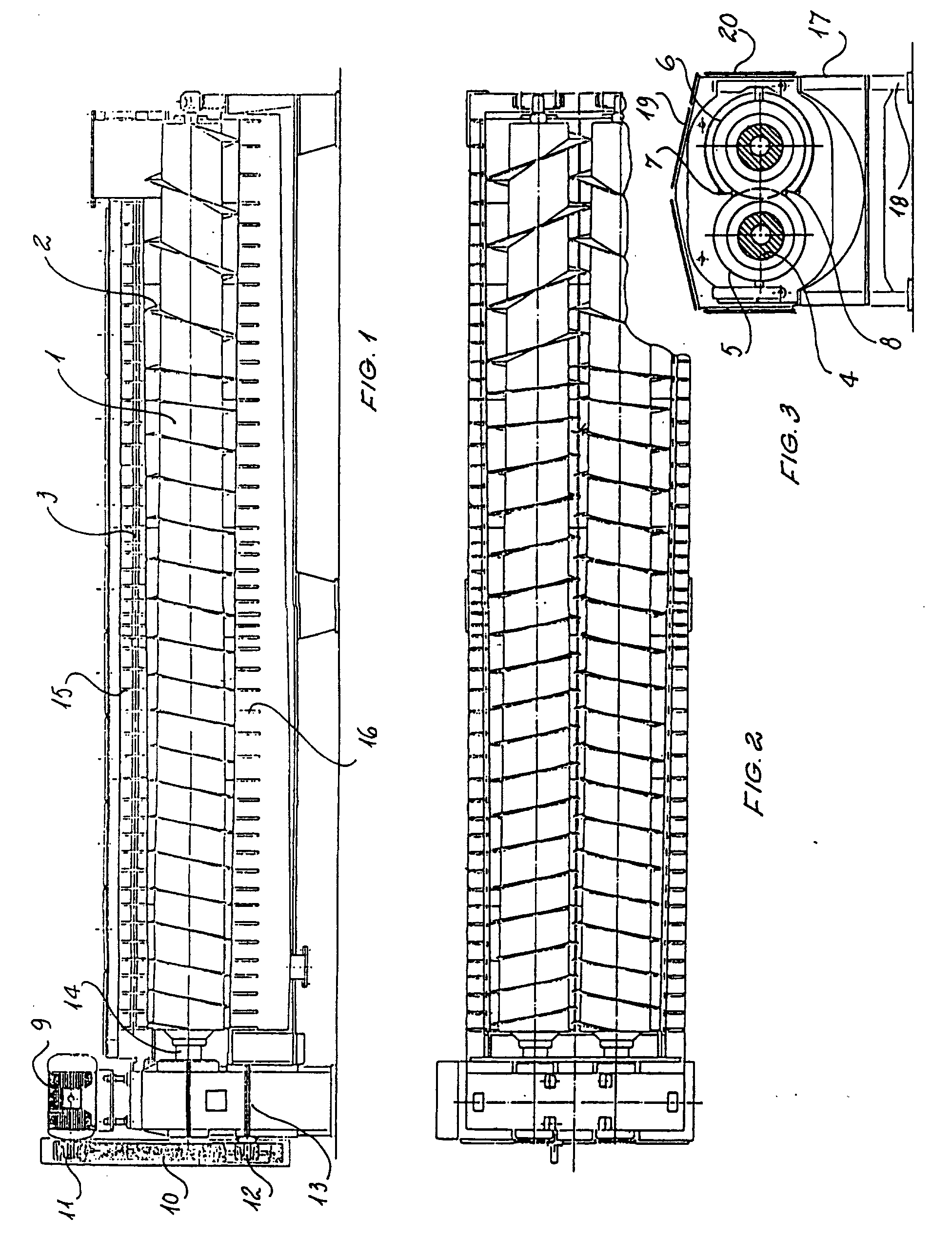
EP 0 358 837 B2 |
| (12) |
NEW EUROPEAN PATENT SPECIFICATION |
| (45) |
Date of publication and mentionof the opposition decision: |
|
02.07.2003 Bulletin 2003/27 |
| (45) |
Mention of the grant of the patent: |
|
16.03.1994 Bulletin 1994/11 |
| (22) |
Date of filing: 14.09.1988 |
|
| (51) |
International Patent Classification (IPC)7: B30B 9/16 |
|
| (54) |
Dehydrating screw press with two or more helical elements with intermeshing profiles
Entwässerungsschneckenpresse mit zwei oder mehr schraubenförmigen Elementen mit ineinandergreifenden
Profilen
Presse de déshydratation à vis à deux ou plusieurs éléments hélicoidaux à profils
s'emboîtant
|
| (84) |
Designated Contracting States: |
|
AT BE CH DE ES FR GB GR IT LI LU NL SE |
| (43) |
Date of publication of application: |
|
21.03.1990 Bulletin 1990/12 |
| (73) |
Proprietor: FRATELLI BABBINI & C. sas |
|
I-47012 Civitella di Romagna (Forli) (IT) |
|
| (72) |
Inventor: |
|
- Babbini, Lionello
I-47012 Civitella di Romagna (Forli) (IT)
|
| (74) |
Representative: Modiano, Guido, Dr.-Ing. et al |
|
Modiano & Associati SpA
Via Meravigli, 16
20123 Milano
20123 Milano (IT) |
| (56) |
References cited: :
DE-C- 883 338
GB-A- 904 328
US-A- 2 567 219
|
GB-A- 677 794
GB-A- 1 140 237
|
|
| |
|
|
|
|
| |
|
[0001] The invention refers to a deshydrating screw press with two helical elements, which
avoids partial interference zones of the spirals on the product to treat. By using
the above mentioned elements side by side, a combined effect of complete conical interference
is obtained, in the interspace between their shafts, with a push of the two intersecting
spirals, with movement in opposition, which compels the axial advancement of the product.
[0002] The screw presses are used to deshydrate fibrous materials containing liquid; they
are particularly used in the sugar beat treatment, in fodder deshydratation, to extract
oils and produce meals for fodders from food stuff recovers such as fish and other.
The said presses use two or more helical elements which let the product advance from
an end, pressing it inside a filtering cage from which the liquid gets out steadily,
while the anhydrous residue is discharged from the other end. This causes a bicylindrical
interference space of the spiral filtering cage, which gives rise to non-interference
zones, as well as other zones with limited interference of the spirals. This intervention
difformity and even of non-intervention of the spiral does not grant a uniformity
of pressure of the product and causes losses of delivery. In particularly, when the
helical elements are used side by side, zones of limited and even of no interference
of the spirals occur, where difficulties can be noted in letting the product advance.
Consequently, this one tends to stagnate and in particular, owing to the lateral over-stressing
caused by the spirals in these zones, heaping may occur with relevant heavy problems.
Moreover the difform advancement of the product causes void spaces which crush and
damage the anhydrous residue. Therefore, one can affirm that the speed allowed by
the installation cannot be completely made most of, because it must be steadily in
conformity with the product to treat and production must steadily be checked to enable
timely intervention. In fact, GB-A-677 794 discloses a deshydrating screw press with
two helical elements with constant profile as defined in the pre-characterising part
of claim 1.
[0003] These inconveniences are obviated by a deshydrating screw press with two helical
elements with constant profile, working in a filtering cage according to their inteference
space, as defined in claim 1, which ensures uniformity in the pressing action of the
helical element spiral that is steadily operating with space interference to wall
limit. In the interspace between the shafts of the helical elements fitted side by
side, the system allows the combined effect of complete interference with push of
the intersecting parts of the in opposition turning spirals which compels the axial
forward move of the product. In connection, since there are no zones without or with
limited interference, the system enables to adjust the delivery to the speed of the
propellers. In particular, the smaller space existing in the central intermediate
part between the two helical elements, carried out according to the invention, in
comparison with the one existing in the already mentioned union with truncated-cone
interference, avoids heap-of product; on the contrary, since the two intersecting
spirals operate with complete interference up to the wall limit of the two shafts,
the gradual axial move of the product is ensured.
[0004] Substantially, the product to deshydrate in advancing movement is pressed by the
rotating motion of two screw elements with conical shaft 1 and also conical spiral
2 - total and regular - to operate in a correspondence space to wall limit of the
filtering cage 3. If the helical elements with regular total conical interference
are used side by side, since the lifting upwards of the spiral 2 is in them in accordance
with a like section reduction 4 of its shaft 1, each spiral is allowed to work with
profile continuity up to wall limit of the shaft of the other helical element, thus
avoiding zones of either no or limited interference on the treated product in the
intermediate space between the shafts. Moreover, the movement in opposition of the
two or more pressing elements causes a combined effect of complete interference given
by the two reciprocally intersecting spirals which compels the axial advancing motion
of the product. The filtering cage used for the press with two helical elements consists
of two components 5 and 6 connected on slanting converging lines 7 and 8 fitted on
interference limit of the two intersected spirals.
[0005] An execution version of a deshydrating press, with two helical helements fitted side
by side, is illustrated in the schematic drawings of table 1. With reference to this
table, fig. 1 is the vertical longitudinal section of the press with side view of
a helical element to point out the conical interference spiral which operates up to
wall limit of the filtering cage. Fig. 2 is a partial view of horizontal longitudinal
section of the press, with view from above of the two flanked helical elements to
show the intermediate zone between the two shafts where the interference of the two
spirals can be noted, each one of which is working up to wall limit of the other one's
shaft. Fig 3 is a view of the press transversal section to show the interference fields
of the two spirals.
[0006] For the press operation, motor 9 is started which, by means of transmission 10 with
pulleys 11 and 12, transmits the movements, through reducer 13 on shafts 14, to the
helical elements with conical shafts 1 and conical spirals 2. The biconical filtering
cage is kept, by the modular grupping U-bolts 15 and 16, in the frame 17 on base 18
and is contained in carter 19 complete with inspection lids 20.
[0007] In the executions, the use of helical elements is foreseen with constant profile
shafts and spirals. The components may fitted in different connections and replaced
with other technically equivalent ones.
1. Dehydrating screw press, comprising a pair of rotatable helical elements rotating
in opposite directions each of which comprises a conical shaft (1) and conical spiral
(2), the conical spirals of the helical elements having opposite pitch angles, said
pair of rotatable helical elements being fitted side by side such that each conical
spiral operates throughout the entire operative longitudinal extension of the press
with profile continuity up to the wall limit of the respective conical shaft of the
opposite helical element, the press further comprising a filtering cage (3) arranged
about said pair of helical elements, wherein said conical spirals have thin threads
which have a small thickness as compared to the distance between two consecutive threads,
characterized in that said filtering cage (3) consists of two structurally distinct constituent parts (5
and 6) connected on converging lines (7 and 8) at the interference limit of the two
intersected spirals and arranged such that said spirals operate throughout the entire
operative longitudinal extension of the press with profile continuity up to the wall
limit of said filtering cage.
1. Entwässerungsschneckenpresse mit einem Paar von rotierbaren, schraubenförmigen Elementen,
die in entgegengesetzter Richtung rotieren, von denen jedes einen konischen (kegelförmigen)
Schaft (1) und eine konische Spirale (2) aufweist, wobei die konische Spiralen der
schraubenförmigen Elemente entgegengesetzte Steigungswinkel aufweisen, wobei das Paar
der drehbaren, schraubenförmigen Elemente in der Weise nebeneinander angeordnet sind,
daß jede der konischen Spiralen über die vollständige operative Längserstreckung der
Presse mit einer Profilkontinuität zur Wand arbeitet, die von dem entsprechenden konischen
Schaft des gegenüberliegenden schraubenförmigen Elementes gebildet ist und wobei die
Presse darüber hinaus ein um das Paar der schraubenförmigen Elemente angeordnetes
Filtergehäuse (3) aufweist, wobei die genannten konischen Spiralen dünne Gewinde aufweisen
mit einer geringen Dicke verglichen zum Abstand zwischen zwei aufeinanderfolgenden
Gewinde,
dadeurch gekennzeichnet,
daß das genannte Filtergehäuse (3) aus zwei der Struktur nach verschiedenen Bestandteilen
(5 und 6) besteht, die an einer konvergierenden Linie (7 und 8) an der Eingriffsgrenze
der beiden sich schneidenden Spiralen verbunden und derart angeordnet sind, daß die
Spiralen in gleicher Weise über die gesamte operative Längserstreckung der Presse
mit einer Profilstetigkeit bis zu den Begrenzungswänden des Filtergehäuses arbeiten.
1. Presse de déshydratation à vis, comprenant une paire d'éléments tournants en hélice
qui tournent dans des directions opposées, donc chacun comprend un arbre conique (1)
et une spirale conique (2), les spirales coniques des éléments en hélice possédant
des angles d'attaque opposés, ladite paire d'éléments tournants en hélice étant montée
côte-à-côte de telle façon que chaque spirale conique agisse sur toute l'extension
longitudinale de fonctionnement totale de la presse avec une continuité de profil
jusqu'à la limite de paroi de l'arbre conique respectif de l'élément en hélice opposé,
presse comprenant, de plus, une cage de filtration (3) placée autour de ladite paire
d'éléments en hélice, dans laquelle lesdites spirales coniques possèdent des filets
minces qui ont une petite épaisseur par rapport à la distance entre deux filets successifs,
caractérisée en ce que ladite cage de filtration (3) est constituée de deux parties constituantes structurellement
distinctes (5 et 6) montées sur des lignes convergentes (7 et 8) à la limite d'interférence
des deux spirales se coupant et disposées de telle façon que lesdites spirales agissent
sur toute l'extension longitudinale de fonctionnement totale de la presse avec une
continuité de profil jusqu'à la limite de paroi de ladite cage de filtration.