|
(11) | EP 0 372 621 A1 |

| (12) | EUROPEAN PATENT APPLICATION |
|
|
|
|
|||||||||||||||||||||||||||
| (54) | Preparation of difluorobenzenes containing electron withdrawing substituents |
| (57) 3,4-Difluoro substituted benzenes are prepared by reacting 3,4-dihalo substituted
benzenes with an effective amount of KF or CsF, in a polar aprotic solvent, at an
elevated temperature, under substantially anhydrous conditions. The product can be
removed as it is formed or the reaction may be run at the autogenous pressures generated
by the reaction mixture in a sealed reactor. |
[0001] The present invention concerns a process for the preparation of ring-fluorinated benzonitriles and benzotrifluorides from the corresponding ring-chlorinated benzonitriles and benzotrifluorides. More particularly, the present invention is directed to a process for the preparation of 3,4-difluorobenzonitrile and 3,4--difluorobenzotrifluoride using potassium fluoride (KF) and/or cesium fluoride (CsF) as the fluorinating agent.
[0002] Difluorobenzotrifluorides and benzonitriles are useful intermediates for the manufacture of herbicides. For example, U.S. Patent 4,642,338 discloses the use of 3,4-difluorobenzotrifluoride in the preparation of aryloxyphenoxy herbicides that control grassy weeds in the presence of broadleaf crops. Similarly, European Patent Application Publication 302,203 discloses the use of 3,4-difluorobenzonitrile in the preparation of aryloxyphenoxy herbicides that control grassy weeds in the presence of broadleaf crops and in the presence of certain cereal grains. Furthermore, benzonitriles and benzotrifluorides can be interconverted by well-known organic reactions, as shown by the following scheme:
[0003] Conventional methods of preparing fluorinated aromatic compounds are based primarily on diazotization routes involving a number of steps. In U.S. Patent 4,642,338, for example, 3,4-difluorobenzotrifluoride was prepared by (a) reacting 4-chloro-3-nitrobenzotrifluoride with KF, (b) reducing the nitro group to an amine, (c) diazotizing and preparing the fluoroborate salt and (d) decomposing to the desired product, as shown by the following scheme:
A similar scheme was employed by Schaefer et al. in Can. J.Chem., 57, 802 (1979).
[0004] Although highly fluorinated aromatic compounds can be prepared from perhalogenated aromatic compounds or perhalogenated aromatic compounds containing one or more electron-withdrawing substituents by the action of alkali metal fluorides, it was believed that this reaction was of preparative interest only for producing completely halogenated compounds and that reactions between incompletely halogenated aromatic compounds and KF were accompanied by numerous side reactions and poor yields. (See, for example, Yokobson et al. in Synthesis, 652, October 1976).
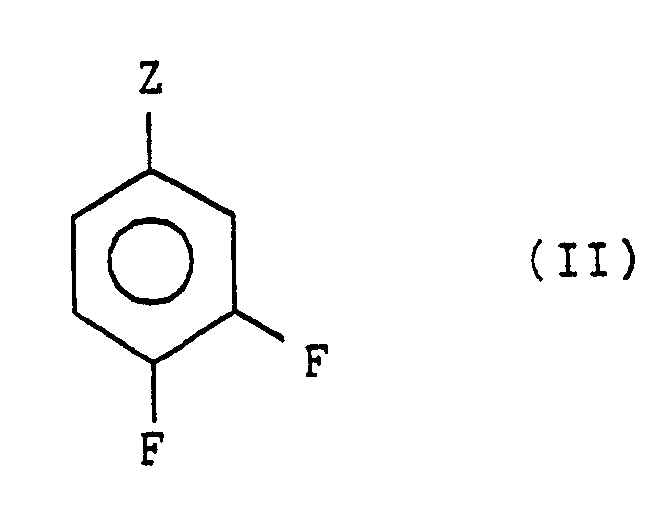
[0005] Surprisingly, contrary to this belief, it has now been found that incompletely ring-fluorinated benzotrifluorides and benzonitriles can be prepared in good yield by the action of KF or CsF on the corresponding ring-chlorinated benzotrifluorides and benzonitriles. The present invention is directed to a process for preparing a 3,4-difluoro substituted benzene of the formula
wherein:
Z is -CF₃ or -CN
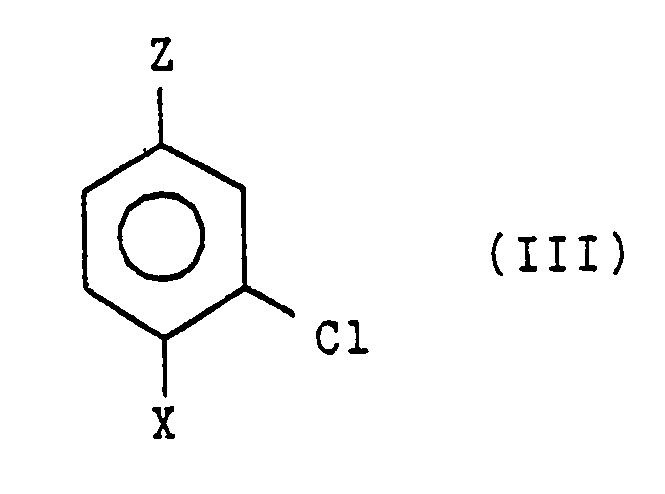
which comprises reacting a 3,4-dihalo substituted benzene of the formula
wherein:
X is -F or -Cl; and
Z is as defined before;
with an effective amount of KF or CsF in a polar aprotic solvent, the reaction medium containing less than 500 parts per million water, at a temperature from 140 to 300°C, and recovering the 3,4-difluoro substituted benzene from the reaction mixture.
[0006] Surprisingly, the present invention allows for the preparation of incompletely fluorinated benzotrifluorides and benzonitriles from the corresponding incompletely chlorinated benzotrifluorides and benzonitriles in good yield with a minimum of side reactions. The conversion may be effectively accomplished with both CsF and the much less expensive KF.
[0007] The conversion of a 3,4-dichloro substituted benzene (formula I in the following scheme) to 3,4 -difluoro substituted benzene (formula II in the following scheme) is a stepwise process which involves the intermediacy of a singularly fluorine-exchanged compound (formula III in the following scheme), either 3--fluoro-4-chloro substituted benzene and/or 3-chloro-4--fluoro substituted benzene.
[0008] Optionally, the reaction can be conducted in a fashion so that the singularly fluorine-exchanged fluorochloro substituted benzene is obtained as the major product.
[0009] KF and CsF are the fluorinating agents employed in the present reaction and are commercially available compounds. Substantially anhydrous and finely-divided KF or CsF are preferred. Amorphous or spray-dried forms are particularly preferred. Substantially anhydrous KF and CsF can be prepared, for example, by drying in vacuo at 140-250°C for several hours.
[0010] 3,4-Dichlorobenzotrifluoride and 3,4-dichlorobenzonitrile are also commercially available compounds.
[0011] Polar aprotic diluents are employed as the reaction medium in the present process. Suitable polar aprotic diluents include dimethyl sulfoxide (DMSO), dimethylformamide (DMF), dimethyl acetamide (DMA), hexamethyl phosphoric acid triamide (HMPA), sulfolane, N-methyl pyrrolidinone (NMP), N-cyclohexyl pyrrolidinone (NCHP), 1,3-dimethyl-2-imidazolidinone (DMI), 1,3-dimethyl-3,4,5,6-tetrahydro-2-(1H)pyrimidone (DMTHP), and benzonitrile. Preferred diluents include NMP, DMI, DMTHP, DMSO and sulfolane.
[0012] Optionally, the reaction may be conducted in the presence of
(a) an acid scavenger, such as, an alkali metal carbonate, and/or
(b) in the case of employing KF as the fluorinating agent, a phase-transfer catalyst.
[0013] The present reaction is conducted under substantially anhydrous conditions at elevated temperatures of from 140 to 300°C. Preferred temperature ranges for 3,4-difluorobenzotrifluoride are from 175 to 275°C when CsF is used, and from 240 to 295°C when KF is used. Preferred temperature ranges for 3,4 -difluorobenzonitrile are from 160 to 250°C when CsF is used, and from 220 to 275°C when KF is used.
[0014] Pressures of from atmospheric to greater than atmospheric are typically employed. For CsF, which is more reactive than KF, it is most convenient to operate at atmospheric pressure. For KF, which is less expensive than but also less reactive than CsF, it is also possible to operate at atmospheric pressure. With KF, however, it is sometimes advantageous to operate at the autogenous pressure generated by the diluent, starting material and product in a sealed reactor at the preferred reaction temperatures. Such pressures typically range from slightly above atmospheric to about 500 pounds per square inch (psi) [about 3,450 kilopascals (kPA)] and depend upon the volume of the reactor. Optionally, the reaction can be run under pressure in a suitably designed reactor equipped with a distillation column so the product can be removed as formed.
[0015] Water is detrimental to the reaction and substantially anhydrous reaction conditions are preferred. By substantially anhydrous is meant that the reaction medium contains less than about 500 parts per million (ppm) of water. Preferably the reaction medium contains less than about 150 ppm of water. Substantially anhydrous conditions may be achieved employing standard drying techniques. For example, a typical laboratory reactor can be dried by distilling the polar aprotic solvent under a vacuum before addition of the reactants. Optionally, a small amount (5 to 10 percent by weight of the polar aprotic solvent) of a non-polar solvent such as an aromatic hydrocarbon (for example, toluene or xylene) may be added to the polar aprotic solvent to aid in the removal of water by azeotropic distillation. Residual water in the reactor system is also often removed by azeotropic distillation.
[0016] The amount of polar aprotic solvent is not critical, but it is advantageous to employ enough solvent to keep the starting material in solution at reaction temperatures, generally from 2 to 25 parts by weight of the solvent per part by weight of the substituted benzene starting material. The relative proportions of reactants to be employed are not critical because some of the product will be formed when employing any proportion of reactants. The reaction consumes the reactants, however, in the ratio of one mole of fluorinating agent per mole of exchangeable chlorine atoms present in the starting material. For example, with 3,4-dichlorobenzonitrile as the starting material, 2 molar equivalents of KF or CsF per mole of starting material are consumed. Usually from 1.0 to 3.0 moles of KF or CsF are employed per mole of exchangeable chlorine in the starting material.
[0017] The present reaction is typically conducted in the presence of agitation sufficient to maintain an essentially uniform dispersion of the reactants in the solvent.
[0018] Catalysts are optionally employed to increase the reaction rate. Suitable catalysts include phase-transfer catalysts. The catalyst is added to the present reaction mixture in an amount of from 0.0001 to 0.1 mole per mole of starting material. Advantageously from 0.001 to 0.075 molar equivalents and preferably from 0.01 to 0.05 molar equivalents of catalyst are employed.
[0019] Phase-transfer catalysts are well-known compounds and include (a) quaternary phosphonium salts containing 10 or more carbon atoms and (b) macrocyclic polyethers commonly known as crown ethers. Suitable crown ether catalysts include 18-crown-6; dicyclohexano-18-crown-6; dibenzo-18-crown-6; 15-crown-5. A related catalyst species, tris(3,6-dioxa-heptyl)-amine, is also efficacious. Suitable quaternary phosphonium salts include the tetra-n-alkylphosphonium salts. The anion of the phosphonium salts is F⊖, which may be derived from any anion which readily converts to F⊖, such as, for example, Cl⊖, Br⊖, I⊖, OH⊖ or OAc⊖, under the reaction conditions.
[0020] Acid scavengers are optionally employed in the present reaction to consume or inactivate traces of HCl or HF which may be present or generated during the reaction. Suitable acid scavengers include alkali metal carbonates such as anhydrous K₂CO₃ and anhydrous Na₂CO₃. A preferred acid scavenger is anhydrous K₂CO₃. The acid scavengers are added to the present reaction mixture in an amount of from 0.001 to 0.1 mole per mole of benzonitrile or benzotrifluoride starting material. Preferably, from 0.03 to 0.05 molar equivalents are employed.
[0021] The 3,4-difluorobenzonitrile or 3,4-difluorobenzotrifluoride can be recovered from the reaction mixture by conventional techniques such as extraction and/or distillation. Preferably, the product is removed from the reaction mixture as it is formed. Optionally, the reactant compound may be added as the product is removed.
[0022] The product may be separated from starting material and/or intermediate fluorochloro substituted benzenes by fractional distillation.
[0023] In carrying out the present reaction, neither the rate nor the order of addition of the reactants is critical. Usually, the solvent and fluorinating agent are added to an appropriate reaction vessel and the reaction is dried by distilling a small portion of the solvent. The starting material or precursor compound is then added to the reaction vessel. The reaction mixture is then heated to a temperature high enough to maintain a satisfactory reaction rate. The product may be recovered from the reaction mixture after completion of the reaction by extraction and or distillation. Alternatively, the product may be removed from the reaction mixture by fractional distillation as it is formed. If an acid scavenger, a non-polar solvent, or catalyst is employed in the reaction, then they are advantageously added to the solvent/fluorinating agent mixture prior to drying the reactor vessel.
[0024] The following examples illustrate the process of the present invention and should not be construed as limiting.
[0025] In the following examples, the fluorinating agents were dried in a vacuum oven at 150°C for at least 24 hours (hr). Solvents were dried by distillation from calcium hydride. Also, the following terms are used:
DCBCN = 3,4-dichlorobenzonitrile
DFBCN = 3,4-difluorobenzonitrile
FCBCN = fluorochlorobenzonitrile
NMP = N-methyl pyrrolidinone
DMI = 1,3-dimethyl-2-imidazolinone
DMTHP = 1,3-dimethyl-3,4,5,6-tetrahydro-2-(1H) pyrimidone, and
DMSO = dimethyl sulfoxide.
Example 1
[0026] A 600 milliliter (mL) Hastelloy™ C pressure reactor was charged with 28.35 grams (g) of KF, 150 mL of NMP, 20.5 g of DCBCN and 10.06 g of naphthalene (internal standard). The reactor was sealed and pressure tested. The reaction mixture was stirred at 235°C for 40 hr. After cooling and venting the reactor, the reaction mixture was analyzed by gas chromatography. The analysis indicated a 21 percent yield of DFBCN.
Example 2
[0027] A 600 mL Hastelloy™ C pressure reactor was charged with 18.5 g of KF, 200 mL of sulfolane, 20 g of DCBCN, 2.0 g of tetraphenyl phosphonium chloride (phase-transfer catalyst) and 4.03 g of naphthalene (internal standard). The reactor was sealed and pressure tested. The reaction mixture was stirred at 225°C for 64 hr. After cooling and venting the reactor, the reaction mixture was analyzed by gas chromatography. The analysis indicated a 37 percent yield of FCBCN and 15 percent yield of DFBCN.
Example 3
[0028] A 300 mL stainless steel pressure reactor was charged with 34.8 g (0.6 mol) of KF, 120 mL of DMI and 34.8 g (0.2 mol) of DCBCN. The reactor was sealed and pressure tested. The reaction mixture was stirred at 250°C for 24 hr. After cooling and venting, the product was isolated by extraction with ethyl acetate. A gas chromatographic analysis of the extract with biphenyl added to the extract as an internal standard indicated a 14 percent yield of FCBCN and a 46 percent yield of DFBCN.
Example 4
[0029] A 250 mL round bottom flask was equipped with a concentric tube distillation column, thermometer, magnetic stirrer and a distillation head with a nitrogen purge. The distillation column and head were wrapped with electrical tape and controlled at 160 and 130°C respectively. The flask was charged with 34.8 g (0.6 mol) of KF, 120 mL of DMTHP and 34 g (0.2 mol) of DCBCN. The reaction mixture was heated with stirring at 240°C for 23 hr and 8.71 g of distillate was collected. The temperature was increased to 245°C for an additional 2 1/4 hr and additional distillate was collected. Analysis of the combined distillate indicated a 26 percent yield of FCBCN and a 39 percent yield of DFBCN.
Example 5
[0030] DMSO solvent (155 mL) and CsF (50 g; 0.33 mol) were charged into a 250 mL 4-necked glass round bottom flask. The flask was equipped with a concentric tube distillation column, mechanical stirrer and thermowell. N₂ was purged through the flask and distillation system. The distillation system was vacuum-jacketed. The system was dried under a vacuum of 120 mm Hg (15.8 kilopascals) and a pot temperature of 135°C. The vacuum was released, the N₂ purge installed and the reactor temperature increased to 160°C. DCBCN (10 g; 0.06 mol) was added and the reaction temperature maintained at 160°C for 11 hr. The vacuum was reestablished at 120 mm Hg (15.8 kilopascals) and the product distilled overhead with the DMSO solvent. The distillate (61.2 g) contained 10.6 percent DFBCN 6.7 g (80 percent yield). The intermediate FCBCN was 1.5 percent in the reaction mixture equivalent to 1.5 g (17 percent yield).
Example 6
[0031] DMI solvent (300 mL) and KF (70 g; 1.2 mol) were charged into a 500 mL 4-necked glass round bottom flask. The flask was equipped with a 15-tray Oldershaw™ column, mechanical stirrer, thermowell and powder addition funnel. N₂ was purged through the flask and distillation system. The distillation system was vacuum-jacketed. The system was dried under a vacuum of 100 mm Hg (13.3 kilopascals) and the pot temperature was 160°C. About 25 mL of DMI and water were removed. The vacuum was released, the N₂ purge and powder addition funnel were installed and the reactor temperature was increased to 220°C. The starting material DCBCN (62 g; 0.36 mol) was added slowly in order to maintain a concentration of DCBCN and FCBCN at about 5 percent. The product DFBCN was distilled overhead. The distillate was 140 g of DMI and DFBCN. Gas chromatographic analysis of the distillate indicates that DFBCN was 25 percent 35 g (70 percent yield). The FCBCN intermediate was 1 percent, 1.4 g. The distillate was redistilled to yield 14 g of pure DFBCN.
Example 7
[0032] DMI solvent (300 mL) and KF (70 g; 1.2 mol) were charged to a 500 mL 4-necked glass round bottom flask. The flask was equipped with a 15-tray Oldershaw™ column, mechanical stirrer, thermowell and powder addition funnel. N₂ was purged through the flask and distillation system. The distillation system was vacuum-jacketed. The system was dried under a vacuum of 100 mm Hg (13.3 kilopascals) and pot temperature of 160°C. A total of 25 mL of DMI and water were removed. The vacuum was released, the N₂ purge and powder addition funnel were installed. The reactor temperature was increased to 227°C. The starting material DCBCN (62 g; 0.36 mol) was added slowly in order to maintain a concentration of starting material and intermediate at about 10 percent. The product DFBCN was distilled overhead. The distillate, cut #1, was 25.8 g, containing 83 percent, 21.4 g DFBCN. Cut #2 was 52.6 g of DMI and DFBCN 65 percent, 33 g; total moles of DFBCN were (0.3999 m) 80.0 percent. The FCBCN intermediate was 4.2 g (0.027 m) 5.4%.
Example 8
[0033] To a 1 liter (L), 3-necked flask equipped with a stirrer, heat source, thermometer and temperature controller, and a 7-tray, 1˝ I.D. sieve plate (Oldershaw™) fractionating column, was charged 600 milliliters (mL) of DMSO, 159.9 g (1.05 mole) of dried CsF and 3 g of K₂CO₃ (acid scavenger). Approximately 40 mL of solvent was distilled in vacuo at 150 mm Hg (20 kilopascals) to dry the system, and then 107.5 g (0.5 mole) of 3,4-dichlorobenzotrifluoride (Hooker Chemical Co.) was added. The mixture was heated to 177°C at atmospheric pressure, at which point refluxing was observed in the distillation column. Heating was continued until the head temperature dropped to approximately 100°C (2 hr) and then takeoff was commenced at such a rate as to hold the head temperature under 120°C. After a total of 5.5 hr, a total of 20.8 g of distillate had been collected. Analysis (glpc) showed the presence of 15.7 g of 3,4-difluorobenzotrifluoride and 4.0 g of 3-chloro-4-fluorobenzotrifluoride. Further heating of the reaction mixture for a total of 19 hr gave an additional 29 g of distillate. Analysis of all fractions showed that a total of 21.7 g of the 3,4-difluorobenzotrifluoride was produced.
[0034] Redistillation of the volatile fractions gave purified 3,4-difluorobenzotrifluoride, b.p. 102°C, as well as the intermediate, 3-chloro-4-fluorobenzotrifluoride, b.p. 140°C.
Example 9
[0035] To the apparatus described in Example 8 was charged 600 mL of DMSO. After distillation (atmospheric) of approximately 30 mL of DMSO to dry the system, 228 g (1.5 moles) of dry CsF, 107.5 g (0.5 mole) of dry 3,4-dichlorobenzotrifluoride and 3 g of K₂CO₃ were added. The mixture was heated with stirring to 180°C at atmospheric pressure and total reflux on the distillation head. When the head temperature had dropped to 110°C (2 hr), takeoff was initiated. The distillation was continued, adjusting the takeoff rate so as to keep the head temperature below 120°C until the rate of production of 3,4-difluorobenzotrifluoride dropped off markedly (13 hr). Analysis of the distillate showed that 44.8 g of 3,4-difluorobenzotrifluoride and 5.4 g of approximately 85:15 ratio of 3-chloro-4-fluoro- and 4-chloro-3-fluorobenzotrifluoride had been recovered.
Example 10
[0036] To the apparatus described in Example 8 was charged 600 mL of DMSO, and the system was dried by distilling 30 mL of the material at atmospheric pressure. There was then added 108 g (0.71 mole) of dry CsF, 99.3 g (0.5 mole) of a dry mixture of approximately 85 percent 3-chloro-4-fluoro- and 15 percent 4-chloro-3-fluorobenzotrifluorides, and 3 g K₂CO₃. The mixture was heated with stirring to 177-186°C at atmospheric pressure while a distillate (28.4 g), approximately consisting of 63 percent 3,4-difluorobenzotrifluoride and 35 percent starting chlorofluoro derivative, was collected at 106-120°C head temperature over 4.3 hr. Vacuum was then applied to the system and an additional 36.6 g of volatile material was collected. Analysis of the combined distillation cuts showed that 19.6 g of 3,4-difluorobenzotrifluoride and 42.1 g of the starting chlorofluorobenzotrifluorides had been recovered.
Example 11
[0037] To the apparatus described in Example 8 was charged 600 mL of sulfolane and approximately 40 mL of the solvent was removed at approximately 100 mm Hg (13.3 kilopascals) pressure to dry the system. There was then added 61 g (1.05 mole) of dry KF, 107.5 g (0.5 mole) dry 3,4-dichlorobenzotrifluoride, 3 g of K₂CO₃ and 5 g (0.019 mole) of 18-crown-6 ether. The mixture was heated to 203-210°C at 1 atm. with a very slow takeoff rate over 24 hr, and then the pressure was reduced to 13.3 kilopascals and distillation of the remaining benzotrifluoride derivatives was completed. Analysis showed that 2.2 g of 3,4-difluorobenzotrifluoride, 53.6 g of approximately 85:15 mixture of 3-chloro-4-fluoro- and 4-chloro-3-fluorobenzotrifluorides, plus 16.5 g of the starting material, 3,4-dichlorobenzotrifluoride, had been recovered.
Example 12
[0038] To the apparatus described in Example 8 was charged 600 mL of NMP, 159.9 g (1.05 mole) of CsF and 3 g of K₂CO₃. Approximately 20 mL of solvent was distilled at atmospheric pressure to dry the system. There was then charged 99 g (01.5 mole) of an 85:15 mixture of 3-chloro-4-fluoro- and 4-chloro-3-fluorobenzotrifluorides, and the mixture was heated to 192°C at atmospheric pressure and total reflux. When the head temperature dropped to 110°C (1 hr), distillation was commenced at a rate such as to maintain the head temperature below 125°C. After 19 hr, the reaction appeared to have slowed appreciably, so the remaining volatiles were stripped. Analysis of the combined distillation cuts showed the presence of 39.1 g of 3,4-difluorobenzotrifluoride and 31 g recovered starting chlorofluorobenzotrifluorides.
Example 13
[0039] A series of experiments were conducted under pressure in either a 300 mL or 600 mL Hastelloy™ "C" pressure reactor. The fluorinating agents were dried in a vacuum oven at 150°C for at least 24 hr. Solvents were dried by distillation from calcium hydride. The starting material, fluorinating agent and diluent were introduced into the pressure reactor with a known amount of 1,3-diethylbenzene which served as an internal standard. The reactor was sealed and pressure tested. After the indicated times and temperatures, the reactor was cooled and vented and the reaction mixture was analyzed by gas chromatography. The experimental conditions and the results of these experiments are summarized in Table I.
1. A process for preparing a 3,4-difluoro substituted benzene of the formula
wherein:
Z is -CF₃ or -CN,
which comprises reacting a 3,4-dihalo substituted benzene of the formula
wherein:
X is -F or -Cl; and
Z is as defined before;
with an effective amount of KF or CsF in a polar aprotic solvent, the reaction medium containing less than 500 parts per million water, at a temperature from 140 to 300°C, and recovering the 3,4-difluoro substituted benzene from the reaction mixture.
wherein:
Z is -CF₃ or -CN,
which comprises reacting a 3,4-dihalo substituted benzene of the formula
wherein:
X is -F or -Cl; and
Z is as defined before;
with an effective amount of KF or CsF in a polar aprotic solvent, the reaction medium containing less than 500 parts per million water, at a temperature from 140 to 300°C, and recovering the 3,4-difluoro substituted benzene from the reaction mixture.
2. The process of Claim 1 in which X is -Cl.
3. The process of Claim 1 or 2 in which Z is -CN.
4. The process of Claim 1 or 2 in which Z is -CF₃.
5. The process of Claim 3 in which the fluorinating agent is KF and the temperature
is from 220 to 275°C.
6. The process of Claim 4 in which the fluorinating agent is KF and the temperature
is from 220 to 295°C.
7. The process as claimed in any one of the preceding claims in which the polar aprotic
solvent is dimethyl sulfoxide, sulfolane, N-methyl pyrrolidinone, 1,3--dimethyl-2-imidazolidinone
or 1,3-dimethyl-3,4,5,6-tetrahydro-2-(1H) pyrimidone.
8. The process of Claim 5, 6 or 7 in which from 1.0 to 3.0 molar equivalents of KF
per exchangeable -Cl atom are employed.
9. The process as claimed in any one of the preceding claims in which the reaction
is carried out in the presence of a phase transfer catalyst or an acid scavenger.
10. The process as claimed in any one of the preceding claims in which the reaction
is carried out at the autogenous pressure generated by the reaction mixture in a sealed
reactor.