|
(11) | EP 0 379 761 A1 |

| (12) | EUROPEAN PATENT APPLICATION |
|
|
|
|
||||||||||||||||||||||||
|
|||||||||||||||||||||||||
| (54) | Unsaturated polyesters and their preparation |
| (57) The claimed polyesters having alternating structures of saturated and unsaturated
esters are prepared by direct esterification of a bis(hydroxyalkyl) ester of an aromatic
diacid with an unsaturated diacid or an unsaturated diacid anhydride. |
[0001] This invention relates to the formation of unsaturated polyester resins with a novel structure from monomeric diesters, namely bis(hydroxyalkyl) esters, of aromatic dicarboxylic acids. These diesters are prepared from the reaction of the diacids with alkylene oxides. These resins are produced in less time and are equivalent in performance relative to standard polyesters.
[0002] Unsaturated polyesters are prepared in two fashions; single stage esterifications, where all the ingredients are added initially, and a two-stage cook, where the slow reacting saturated diacid is esterified first before adding the unsaturated diacid. With the first method, random copolymerizations occur with phthalic anhydride and block esterifications, with the unsaturated groups internal, occur with isophthalic or terephthalic acid. The two-stage cook produces block polymers with the unsaturation at the ends of the polymer chain. The latter method produces polyesters with superior heat and corrosion resistance. However, it is time consuming.
[0003] Mayer, U.S. Patent 3,252,941 devised a method for lowering the time necessary for the reaction, but it suffers from a lowering of the physical properties of the cured plastic.
[0004] Miyamoto et al, U.S. Patent 4,306,056 used propylene oxide as an esterification agent for isophthalic acid by direct esterification to yield a high molecular weight isophthalic oligoester. This process is highly complicated and does not reduce the esterification time in the second stage--the slowest section of a two-stage cook.
[0005] We have now found that novel polyesters may be prepared by direct esterification of bis(hydroxyalkyl) esters of aromatic diacids with unsaturated anhydrides or diacids to form unsaturated polyes ters having an alternating structure of saturated and unsaturated esters.
[0006] The unsaturated polyesters of the present invention differ from those of the prior art in that they consist of alternating units of saturated and unsaturated esters.
[0007] The polyesters of the invention comprise a recurring unit I
alternating with a recurring unit II selected from
wherein the sum of m + n is ≧ 1.9, each R is hydrogen, alkyl, aralkyl or aryl, and the various Rs may be the same or different, the ratio of x to y is 1:1 to 1:4 and z is a positive integer.
[0008] While their alkyl or aryl substituted derivatives may also be used, the aromatic dicarboxylic acids preferred for use in the present invention are phthalic acid, isophthalic acid and terephthalic acid. Thus, in each unit I above, each of the four Rs attached to the benzene ring is preferably hydrogen.
[0009] The alkylene oxides employed to form the bis(hydroxyalkyl) esters of the aromatic dicarboxylic acids preferably have 2 to 10 carbon atoms. Preferred examples are ethylene oxide, propylene oxide and 1,2-butene oxide and mixtures thereof, especially propylene oxide and mixtures thereof with one or both of the other two. Thus, in the above general formulae, preferably three of the four Rs in each group (OCR₂-CR₂) is hydrogen and the remaining R is methyl or ethyl.
[0010] Preferably, the mono(alkylene glycol) derivative content of the polyester is at least about 90% and the di(alkylene glycol) derivative content of the polyester is not more than about 10%. That is to say, the preferred top limit for m + n in the general formula is about 2.2. Best results are obtained when the bis(hydroxyalkyl) ester contains 2 moles of alkylene oxide, preferably propylene oxide, per mole of aromatic dicarboxylic acid.
[0011] The unsaturated acid may be derived from maleic acid, maleic anhydride, fumaric acid, itaconic acid, citraconic acid, mesaconic acid and the like.
[0012] The unsaturated polyesters are prepared by condensation of the unsaturated acid or anhydride with the diester reaction product of the unsaturated diacid with an alkylene oxide.
[0013] The ratio of moles of saturated diester to unsaturated diester in the polyester can be 1:1 to 1:4, with 1:1 being preferred for optimum performance improvements. An excess of glycol units relative to acids is desired to regulate the acid number and viscosity of the resin. This excess can be varied from 1-20 mole-% based on total acids and can be derived from the alkylene oxide used to prepare the hydroxyalkyl diester, or it can be different.
[0014] After condensation to the desired molecular weight, which will vary depending upon the final application, the unsaturated polyester is usually diluted in an unsaturated monomer for viscosity reduction. The monomer can be, for example, styrene, vinyl toluene, methyl methacrylate, and the like.
EXAMPLE I
[0016] Into a 1 liter autoclave was added 249g (1.5 moles) of isophthalic acid. Propylene oxide, 261g (4.5 moles), and 1.5g of triethylamine were added and the reactor flushed and then pressurized to 150 psig with nitrogen. The whole was heated for 90 minutes at 100°C. After cooling to ambient temperature, the residual acid was filtered and the excess propylene oxide was removed at reduced pressure to give a viscous, yellow liquid ester in 84-95% yield based on unreacted isophthalic acid. The acid number was 15-20 on a solids basis. A portion of the product was hydrolyzed with caustic and the aqueous solution was analyzed by gas chromatography. Dipropylene glycol content, expressed as a function of the total glycols, was 4-7 weight percent.
[0017] The product was dissolved in 600 ml of methylene chloride and extracted with 30 ml of 10% HCl, and three 30 ml portions of water. After removal of the solvent and water, the product was suitable for esterification. Reaction of 490g of the ester product, (18.8 acid number, 5.5% dipropylene glycol content), with 165g of maleic anhydride and 36.9g of propylene glycol (10% excess), gave an unsaturated polyester with an acid number of 5.4 and a Gardner-Holt viscosity of a 60% solids solution of zero. The Gardner color was 1-2. Without the acid wash, the Gardner color of the polyester was 4-5.
EXAMPLE II
[0018] Into a 1 liter autoclave was added 332g of isophthalic acid, 255g of propylene oxide and 4g of triethylamine. The mixture was heated to 100°C, and after 20 minutes the exothermic reaction heated the contents to 150C. The reactants were cooled to 100C and allowed to react for a total of three hours. Methylene chloride was added to the reactor after cooling to ambient temperature and the amber contents removed, no acid remains. Extraction of the solution with 10% aqueous phosphoric acid and removal of the solvent gave a light yellow, fluid ester product with an acid number of 0.5 and a dipropylene glycol content of 6%.
COMPARATIVE EXAMPLE A
[0019] Into a 2 liter 5-neck flask fitted with a nitrogen inlet, thermometer, sampling port, stirrer and reflux condenser and maintained at 110°C, was added 2 moles of isophthalic acid and 4.4 moles of propylene glycol. After 6 hours at 190-200°C pot temperature, a polyester was prepared with an acid number of 15.1. The mass was cooled to room temperature and 2 moles of maleic anhydride was added. The esterification was conducted at 200-225°C for 6 hours to give a final resin with an acid number of 10.9 and Gardner-Holt viscosity of Q when diluted to 60% solids with methyl cellosolve. The resin was diluted to 65% solids in styrene and inhibited with 100 ppm of tert-butyl catechol.
EXAMPLE III
[0020] Bis-hydroxypropyl isophthalate (1.68 moles), with an acid number of 15. 7 and a molecular weight determined by saponification equivalent of 285, was added to the resin flask used in the comparative example A. An equimolar amount, 1.68 moles, of maleic anhydride was added alongwith 36.9g of propylene glycol; the amount is equal to the moles of acid in the diester plus a 10 mole-% excess on total acid functionality. The esterification was conducted in an identical manner to the second stage esterification of the comparative example. At the end of 6 hours the polyester had an acid number of 5.4 and a Gardner-Holt viscosity of 0, as a 60% solids solution. This resin was diluted in inhibited styrene to 65% solids.
EXAMPLE IV
[0021] Bis-hydroxpropyl isophthalate (528.8g), acid number 16 and molecular weight of 285, was added along with 1.85 moles of maleic anhydride and 34.6g of propylene glycol. The excess of glycol relative to acids was 8 mole-%. Esterification conducted for 6 hours in the manner above, gave a resin with a 7.5 acid number and P Gardner-Holt viscosity as a 60% solids solution. The resin was diluted in styrene. The acid number-time relationship between the comparative example and Examples III and IV is shown in Table I.
TABLE I
It can be seen that the esterifications of the invention proceed at a faster rate
than that of the comparative example.| Time, Min | Acid Number for Example | ||
| A | III | IV | |
| 100 | 35 | 26 | 34.5 |
| 150 | 27.5 | 19 | 26 |
| 200 | 21.5 | 13.5 | 19 |
| 250 | 16.5 | 9 | 13.5 |
| 300 | 13 | 6.5 | 9.5 |
| 340 | 11.5 | 5.5 | 7.5 |
COMPARATIVE EXAMPLE B
[0022] Isophthalic acid and propylene glycol were reacted in the same manner as comparative example A to an acid number of 11.8 at 100% solids. Fumaric acid, 2 moles, was added at room temperature and the mass was further esterified over the course of 6 hours to give a resin with a 60% solids acid number of 9.0 and a Gardner-Holt viscosity of P.
EXAMPLE V
[0023] Bis-hydroxypropyl isophthalate, 500g, molecular weight 280, was added, along with 207g of fumaric acid and 38.5g of propylene glycol, to the esterification flask. After 5 hours at the same conditions as the comparative example B, the resin had an acid number of 9.8 and a Gardner-Holt viscosity of M-N as a 60% solids solution. The acid number-time relationship is shown in Table II.
TABLE II
Again, it can be seen that the esterification of the present invention has a faster
rate than that of the comparative example.| Time, Min | Acid Number for Example | |
| B | V | |
| 100 | 39 | 34 |
| 150 | 29 | 23 |
| 200 | 23 | 18 |
| 250 | 17 | 13 |
| 300 | 12.5 | 9 |
| 340 | 11 | 8 |
1. A method of preparing a novel polyester comprising condensing (a) at least one
of unsaturated diacids and their anhydrides with (b) at least one bis(hydroxyalkyl)
ester of an aromatic diacid in a mole ratio of (b):(a) of from about 1:1 to about
1:4.
2. The method of claim 1 wherein said unsaturated diacid and/or anhydride is selected
from maleic acid, fumaric acid, itaconic acid, citraconic acid and mesaconic acid
and their anhydrides.
3. The method of claim 1 or claim 2 wherein said aromatic diacid is selected from
phthalic acid, isophthalic acid, terephthalic acid and substituted derivatives thereof
wherein each substituent is alkyl or aryl.
4. The method of any one of claims 1 to 3 wherein said bis(hydroxyalkyl) ester of
an aromatic dicarboxylic acid is formed from at least one an alkylene oxide having
from 2 to 10 carbon atoms.
5. A polyester comprising a recurring unit I
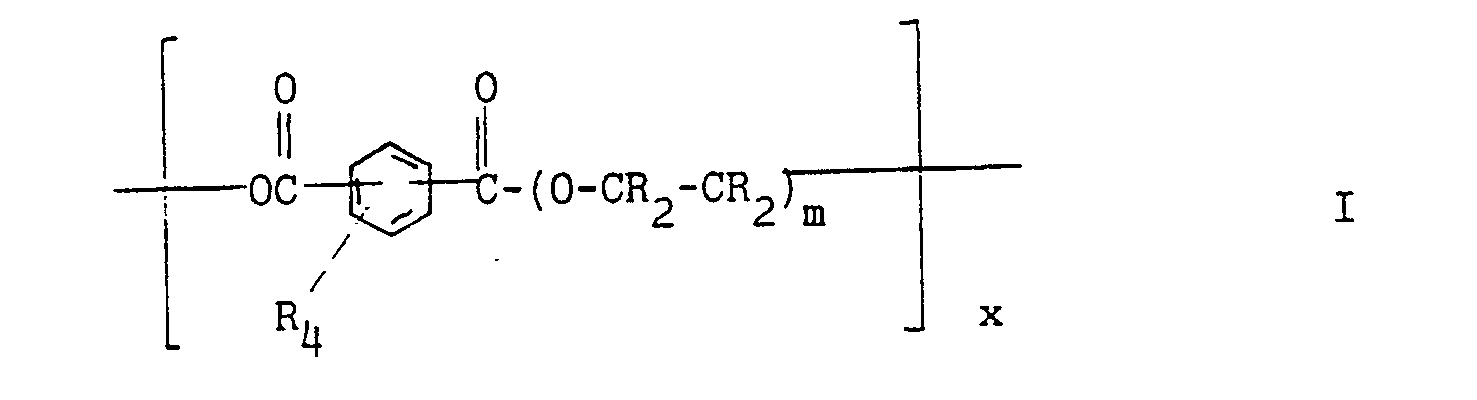
alternating with a recurring unit II selected from
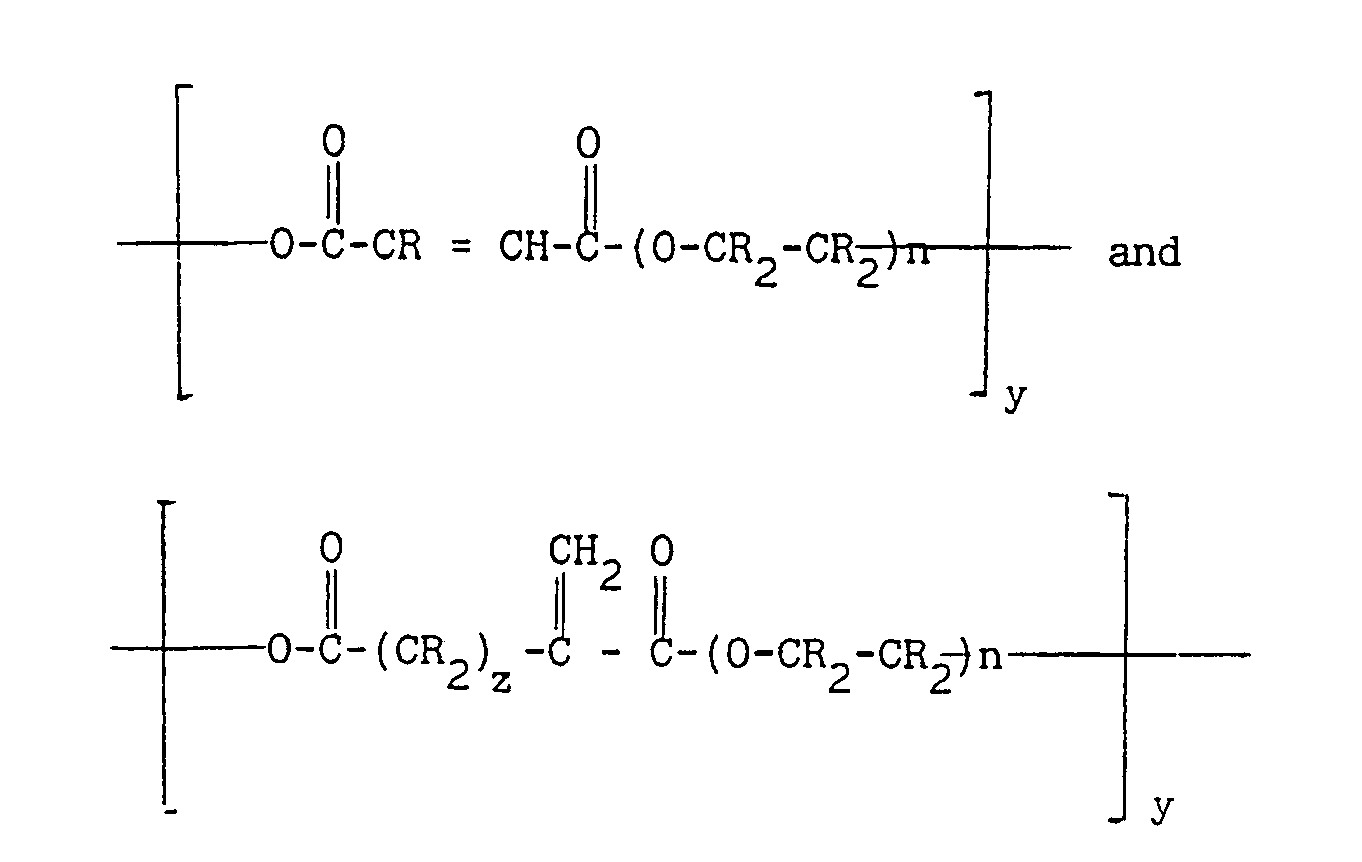
wherein the sum of m + n is at least about 1.9, each R is hydrogen, alkyl, aralkyl or aryl, and the various Rs are the same or different, the ratio of x to y is 1:1 to 1:4, and Z is a positive integer.
alternating with a recurring unit II selected from
wherein the sum of m + n is at least about 1.9, each R is hydrogen, alkyl, aralkyl or aryl, and the various Rs are the same or different, the ratio of x to y is 1:1 to 1:4, and Z is a positive integer.
6. A polyester as claimed in claim 5 wherein each recurring unit I is derived from
aromatic dicarboxylic acid selected from phthalic acid, isophthalic acid, terephthalic
acid and substituted derivatives thereof wherein each substituent is alkyl or aryl
and alkylene oxide having from 2 to 10 carbon atoms.
7. A polyester as claimed in claim 5 or claim 6 wherein said recurring units II are
derived from at least one unsaturated dicarboxylic acid and/or anhydride thereof selected
from maleic acid fumaric acid, itaconic acid, citraconic acid and mesaconic acid and
their anhydrides.
8. An alternating copolyester of bis-hydroxypropyl isophthalate and maleic anhydride.
9. An alternating copolyester of bis-hydroxypropyl isophthalate and fumaric acid.
10. A composition comprising a polyester as claimed in any one of claims 5 to 9 and
an unsaturated monomer.
Claims for the following Contracting State(s): ES
1. A method of preparing novel polyesters comprising condensing (a) at least one of
unsaturated diacids and their anhydrides with (b) at least one bis(hydroxyalkyl) ester
of an aromatic diacid in a mole ratio of (b):(a) of from about 1:1 to about 1:4.
2. The method of claim 1 wherein said at least one unsaturated diacid and/or anhydride
is selected from maleic acid, fumaric acid, itaconic acid, citraconic acid and mesaconic
acid and their anhydrides.
3. The method of claim 1 or claim 2 wherein said at least one aromatic diacid is selected
from phthalic acid, isophthalic acid, terephthalic acid and substituted derivatives
thereof wherein each substituent is alkyl or aryl.
4. The method of any one of claims 1 to 3 wherein said bis(hydroxyalkyl) ester of
an aromatic dicarboxylic acid is formed from at least one alkylene oxide having from
2 to 10 carbon atoms.
5. A method as claimed in any one of claims 1 to 4 in which bis(hydroxypropyl) isophthalate
is condensed with maleic anhydride.
6. A method as claimed in any one of claims 1 to 4 in which bis-hydroxypropyl isophthalate
is condensed with fumaric acid.
7. A method as claimed in any one of claims 1 to 6 in which the polyester comprises
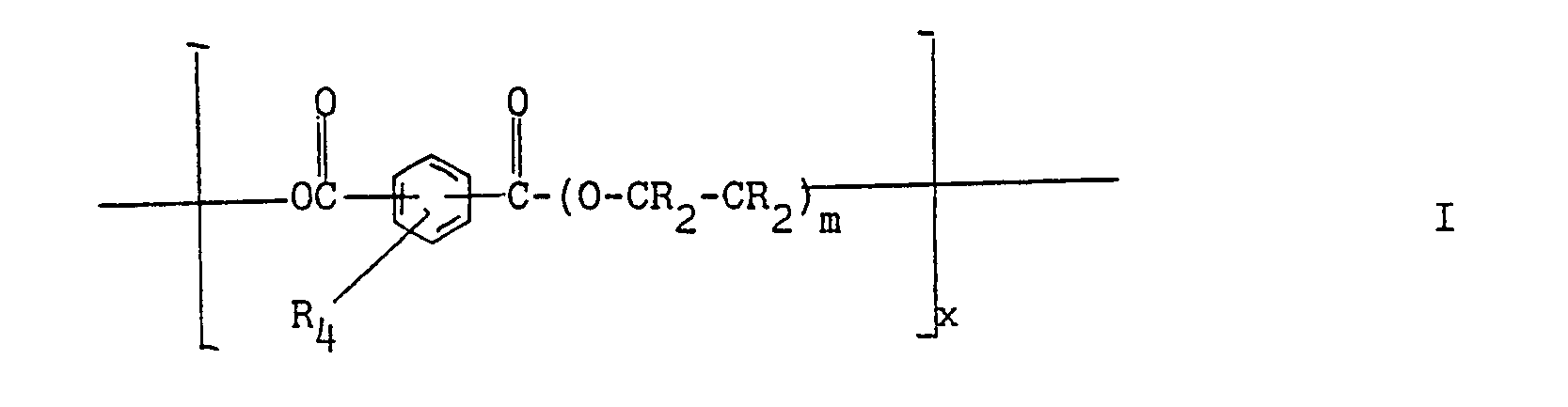
a recurring unit I
alternating with a recurring unit II selected from
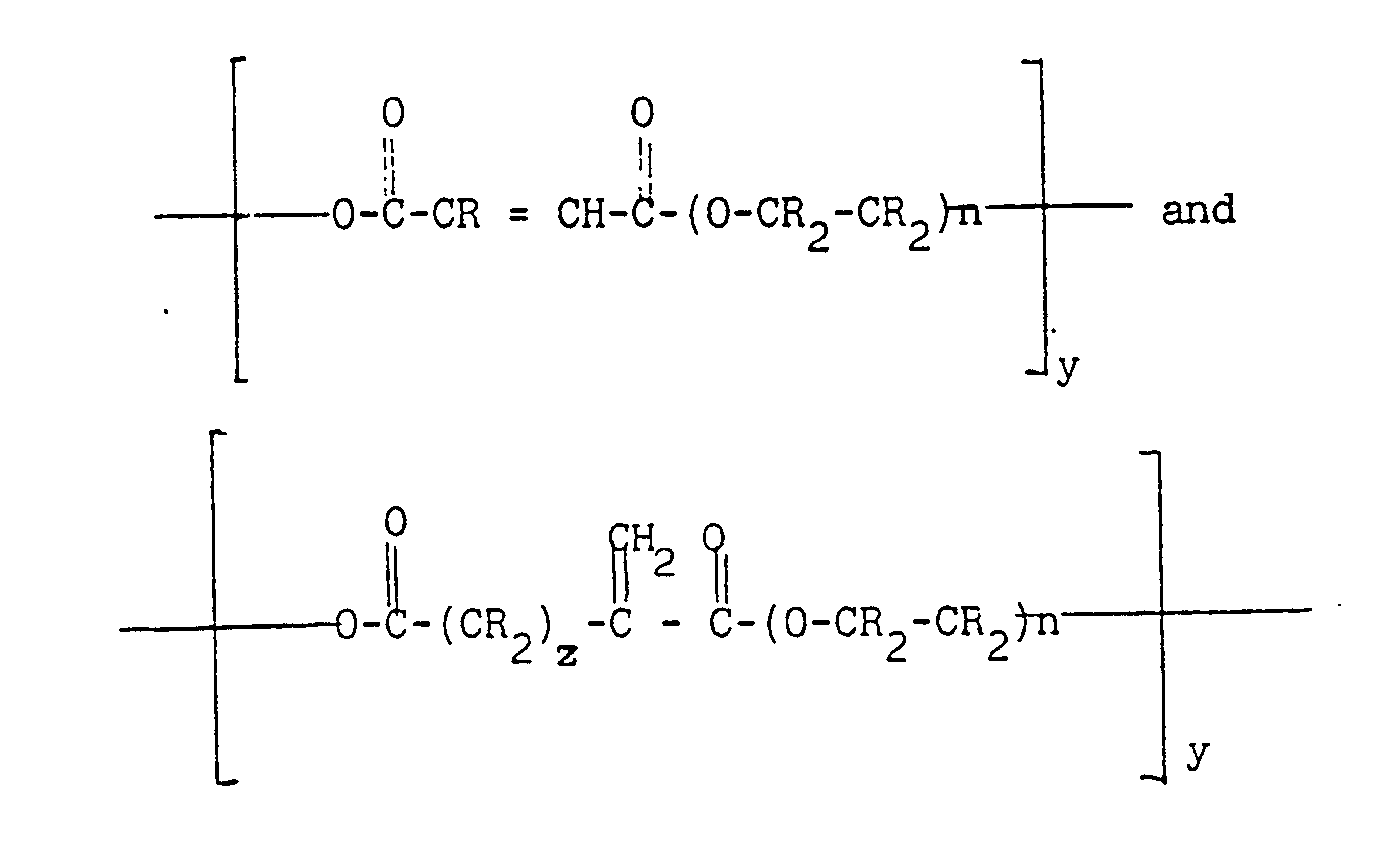
wherein the sum of m + n is at least about 1.9, each R is hydrogen, alkyl, aralkyl or aryl, and the various Rs are the same or different, the ratio of x to y is 1:1 to 1:4, and z is a positive integer.
alternating with a recurring unit II selected from
wherein the sum of m + n is at least about 1.9, each R is hydrogen, alkyl, aralkyl or aryl, and the various Rs are the same or different, the ratio of x to y is 1:1 to 1:4, and z is a positive integer.
8. A method as claimed in any one of claims 1 to 7 in which the polyester is diluted
with an unsaturated monomer.