|
(11) | EP 0 380 052 B1 |

| (12) | EUROPEAN PATENT SPECIFICATION |
|
|
| (54) |
Process for preparing alkyl halogenides Verfahren zur Herstellung von Alkylhalogeniden Procédé pour la préparation d'halogénures d'alkyle |
|
|
|||||||||||||||||||||||||||||||
| Note: Within nine months from the publication of the mention of the grant of the European patent, any person may give notice to the European Patent Office of opposition to the European patent granted. Notice of opposition shall be filed in a written reasoned statement. It shall not be deemed to have been filed until the opposition fee has been paid. (Art. 99(1) European Patent Convention). |
[0001] The present invention relates to a novel process for preparing alkyl halogenides. More particularly, the present invention relates to a process for preparing alkyl halogenides comprising reacting a tertiary alkyl halogenide with an ethylene derivative in the presence of a liquid catalyst comprising aluminum chloride and an alkylbenzene.
[0002] Alkyl halogenides can be prepared through an addition reaction of a tertiary alkyl halogenide and an ethylene derivative in the presence of a catalyst comprising aluminum chloride, and this reaction is known as a Friedel-Crafts related reaction (see, for example, G. A. Olah, "Friedel Crafts and Related Reactions", Vol. II, 1133 (1964), Interscience Publishers (N.Y.)).
[0003] The handling of aluminum chloride in an industrial scale is very difficult, since aluminum chloride solidifies and clogs a supply inlet or a supply line of a reaction system because it is a hygroscopic solid, or it tends to generate a corrosive gas which prevents smooth operation of the production apparatus and sometimes significantly deteriorates the catalytic activity.
[0004] Further, aluminum chloride has a high catalytic activity only in the temperature range between -40°C and -10°C. Therefore, it requires a cooling equipment and large energy costs. In addition, aluminum chloride provides a final product in an unsatisfactory yield of 50 to 75 % at highest.
[0005] One object of the present invention is to provide a catalyst for a reaction of a tertiary alkyl halogenide and an ethylene derivative to prepare an alkyl halogenide, which catalyst has a high catalytic activity at a comparatively high temperature and is safely and stably supplied.
[0006] Another object of the present invention is to provide a novel process for preparing alkyl halogenides in a high yield.
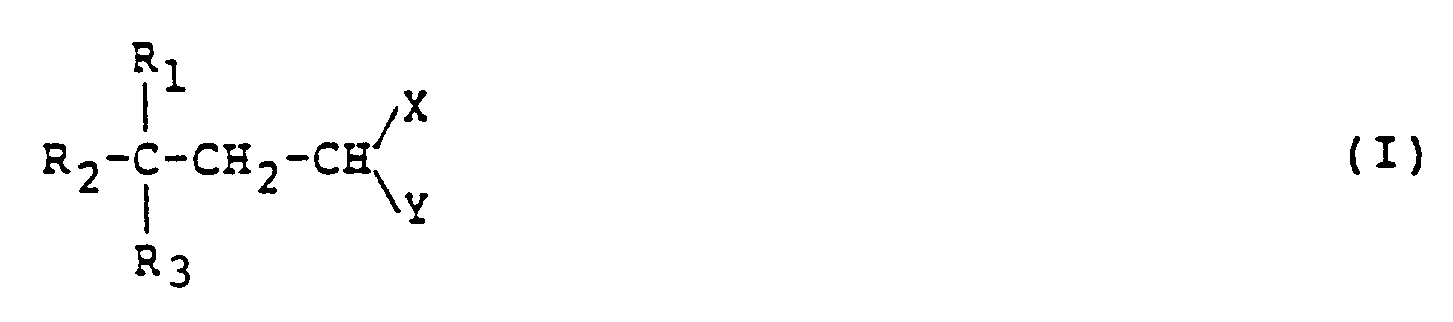
[0007] These and other objects are accomplished by a process for preparing alkyl halogenides of the formula I:
wherein R₁, R₂ and R₃ are the same or different and each is a C₁₋₄- alkyl group, X is a chlorine atom or a bromine atom and Y is a hydrogen atom or a halogen atom,
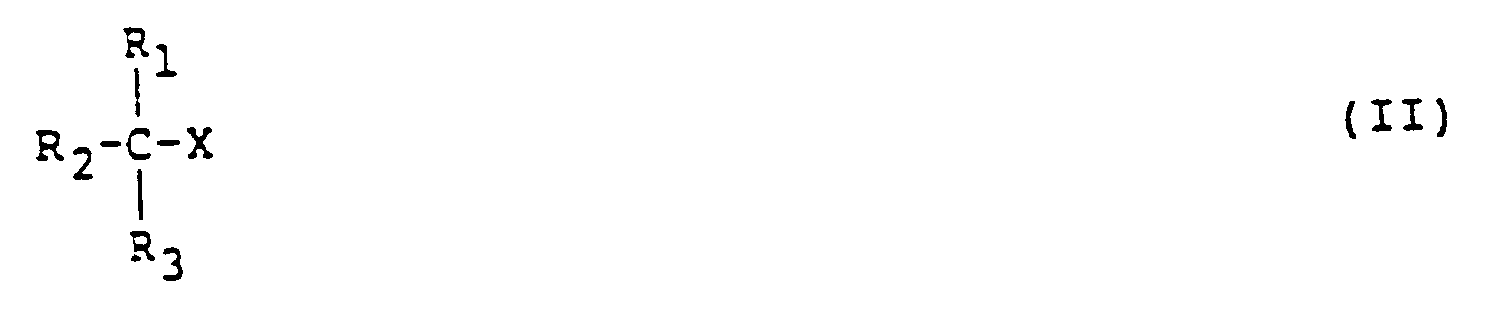
which process comprises reacting a tertiary alkyl halogenide of the formula II:
wherein R₁, R₂, R₃ and X are the same as defined above with an ethylene derivative of the formula:
CH₂=CH-Y (III)
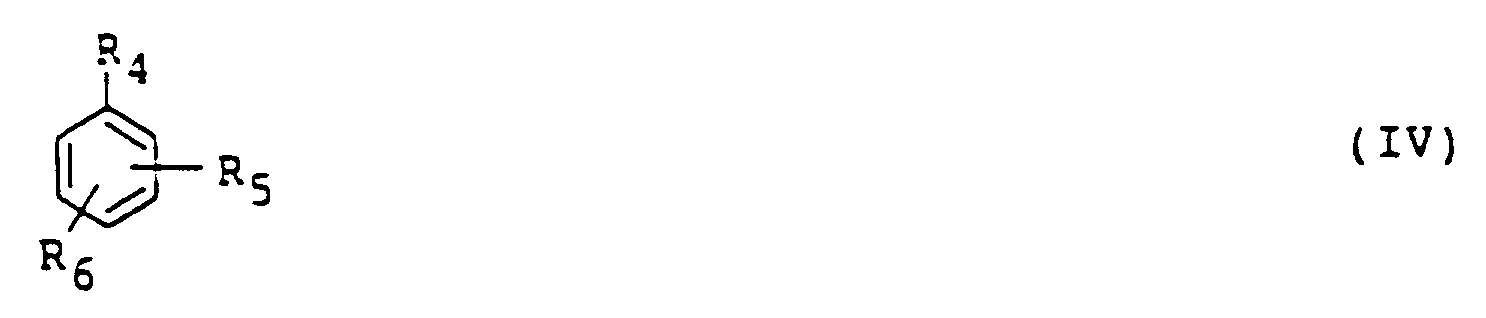
wherein Y is the same as defined above in the presence of a liquid catalyst comprising a complex compound of aluminium chloride and an alkylbenzene of the formula:
wherein R₄, R₅ and R₆ are the same or different and each is a C₁₋₄- alkyl group or a hydrogen atom provided that at least one of them is a C₁₋₄- alkyl group.
[0008] In the general formulas, the C₁₋₄- alkyl group for R₁, R₂ and R₃ is a methyl group, an ethyl group, a propyl group or a butyl group. The substituent Y includes the hydrogen atom and the halogen atoms such as fluorine atom, a chlorine atom, a bromine atom and a iodine atom.
[0009] According to the present invention, the alkyl halogenide (I) is effectively prepared. Examples of the alkyl halogenide (I) are 1-chloro-3,3-dimethylbutane, 1-bromo-3,3-dimethylbutane, 1,1-dichloro-3,3-dimethylbutane, 1,1-dibromo-3,3-dimethylbutane, 1-bromo-1-chloro-3,3-dimethylbutane, 1-chloro-3,3-dimethylpentane, 1-bromo-3,3-dimethylpentane, 1,1-dibromo-3,3-dimethylpentane, 1,1-dichloro-3,3-dimethylpentane, 1-chloro-3,3,4-trimethylpentane and 1-bromo-3,3,4-trimethylpentane.
[0010] As the halogen atom for X of the tertiary halogenated alkyl (II), a chlorine atom or a bromine atom is preferred.
[0011] Specific examples of the tertiary alkyl halogenide (II) are tert.-butyl chloride, tert.-butyl bromide, 2-chloro-2-methylbutane, 2-bromo-2-methylbutane, 2-chloro-2-methylpentane, 2-bromo-2-methylpentane, 2-chloro-2-methylhexane, 2-bromo-2-methylhexane, 2-chloro-2,3-dimethylbutane and 2-bromo-2,3-dimethylbutane.
[0012] Specific examples of the ethylene derivative (III) are ethylene, vinyl fluoride, vinyl chloride, vinyl bromide and vinyl iodide.
[0013] The C₁₋₄- alkyl group for R₄, R₅ and R₆ of the alkyl benzene (IV) is methyl, ethyl, propyl or butyl. Specific examples of the alkylbenzene are toluene, xylene, mesitylene, ethylbenzene, cymene (e.g. m-cymene), cumene, tert.-butyltoluene, di-tert.-butyltoluene, diethylbenzene, diisopropylbenzene and methyldiisopropylbenzene (e.g. 1-methyl-3,5-diisopropylbenzene). Among them, ethylbenzene, m-cymene and 1-methyl-3,5-diisopropylbenzene are preferred. The isomers of the alkylbenzene which have two or three substituents on the benzene ring can be used. A mixture of two or more alkylbenzenes may be used.
[0014] The catalyst to be used in the present invention is a liquid catalyst comprising a complex compound of aluminum chloride and the alkylbenzene (IV). The catalyst may contain hydrogen chloride which may be produced in the production of the catalyst.
[0015] The catalyst can be prepared according to any preparation mode. For example, aluminum metal and the alkylbenzene (IV) are reacted in a specified ratio at a temperature of 30°C to 150°C, preferably 40°C to 110°C under atmospheric pressure or elevated pressure while supplying hydrogen chloride gas. Alternatively, anhydrous aluminum chloride and the alkylbenzene (IV) are reacted in a specified ratio at a temperature of -30°C to +150°C, preferably -20°C to +110°C under atmospheric pressure or elevated pressure while supplying hydrogen chloride gas.
[0016] In any case, the amounts of the alkylbenzene (IV) and the hydrogen chloride gas are not critical. Preferably, the alkylbenzene (IV) is used in an amount of 0.3 to 10 moles, and the hydrogen chloride gas is used in an amount of 0.4 to 20 moles, per one mole of metal aluminum or anhydrous aluminum chloride. When the alkylbenzene (IV) is used in an excess amount, the formed complex compound and the alkylbenzene separate in two phases, and the complex compound can be easily recovered by any of the conventional methods such as separation.
[0017] The concentration of aluminum chloride in the liquid catalyst is from 20 to 60 % by weight, preferably from 30 to 55 % by weight.
[0018] The molar ratio of the tertiary alkyl halogenide (II) to the ethylene derivative (III) is not critical. Usually, said molar ratio is from 1:0.2 to 1:5, preferably from 1:0.5 to 1:3.
[0019] The amount of the catalyst to be used in the present process is from 0.001 to 0.3 mole, preferably from 0.005 to 0.1 mole in terms of aluminum chloride per one mole of the tertiary alkyl halogenide (II).
[0020] The reaction temperature in the present process is usually from -30°C to +50°C. When the reaction temperature is lower than -30°C, the reaction rate becomes too low, while when the reaction temperature is higher than 50°C, the catalyst tends to be deactivated and/or side reactions tend to proceed. Preferably, the reaction temperature is from -15°C to +20°C.
[0021] The reaction pressure is usually from 1 to 99 bar abs. (0 to 100 kg/cm²), preferably from 1 to 10.8 bar abs. (0 to 10 kg/cm²) in view of handleability and apparatus design.
[0022] Although the reaction according to the present invention may be carried out in the absence of a solvent, a solvent which is inactive to the reaction can be used. Examples of the solvent are methylene dichloride, 1,2-dichloroethane, chloroform, carbon tetrachloride, n-tridecane, n-pentane and o-dichlorobenzene.
[0023] The produced alkyl halogenide (I) can be recovered from the reaction mixture by any of conventional methods such as distillation after removing the catalyst from the reaction mass by any of the conventional methods.
[0024] Practically and presently preferred embodiments of the present invention will be illustrated by following examples.
Reference Examples 1, 2, 6-9, 12, 13 & 17 (Preparation method (a) of the catalyst)
[0025] In a pressure reaction vessel, the alkylbenzene shown in Table 1 and metallic aluminum were charged in amounts shown in Table 1. Through the mixture, hydrogen chloride gas was bubbled at a temperature of Table 1 under pressure of Table 1.
[0026] During the reaction, generated hydrogen gas was removed continuously when the pressure was atmospheric pressure, or at certain intervals when the pressure is elevated pressure. When the excess amount of the alkylbenzene was used, a brown liquid complex compound (catalyst) comprising aluminum chloride and the alkylbenzene was recovered by separation.
Reference Examples 3-5, 10, 11 & 14-16 (Preparation method (b) of the catalyst)
[0028] In a pressure reaction vessel, the alkylbenzene shown in Table 1 and anhydrous aluminum chloride were charged in amounts shown in Table 1. Through the mixture, hydrogen chloride gas was bubbled at a temperature of Table 1 under pressure of Table 1.
[0029] When the excess amount of the alkylbenzene was used, a brown liquid complex compound (catalyst) comprising aluminum chloride and the alkylbenzene was recovered by separation.
Examples 1-7
[0031] In a 300 ml four-necked round glass flask equipped with a thermometer, a magnetic stirrer covered with polytetrafluoroethylene was placed, and the tertiary alkyl halogenide shown in Table 2 (0.5 mole) was charged and kept at 0°C.
[0032] Then, the liquid catalyst prepared in each of Reference Examples and the ethylene derivative shown in Table 2 (0.55 mole) were continuously charged over about 2 hours through different inlets under atmospheric pressure.
[0033] Since the reaction was exothermic, the internal temperature was adjusted at 0°C with a cooling bath. After the supply of the liquid catalyst and the ethylene derivative, the internal temperature was kept at 0°C for one hour to complete the reaction.
[0034] The conversion and the selectivity in Table 2 were calculated according to the following equations:
wherein A is an amount (mole) of the charged tertiary alkyl palogenide, B is an amount (mole) of the recovered tertiary alkyl halogenide, and C is an amount (mole) of the produced alkyl halogenide.
Example 8
[0035] In the same manner as in Example 2 but keeping the internal temperature at about 8°C and using 2.30 % by mole of the liquid catalyst prepared in Reference Example 6, the reaction was carried out. The results are shown in Table 2.
Comparative Example 1
[0036] In the same manner as in Example 1 but using commercially available anhydrous aluminum chloride particles which had been ground in place of the liquid catalyst of the present invention and charging it in one portion, the reaction was carried out. The results are shown in Table 2.
Comparative Example 2
[0037] In the same manner as in Example 8 but using the same anhydrous aluminum chloride as used in Comparative Example 1 in place of the catalyst of the present invention, the reaction was carried out. The results are shown in Table 2.
Example 9
[0038] In a 300 ml glass autoclave equipped with a thermometer and a stirrer, the tertiary alkyl halogenide shown in Table 2 (0.5 mole) was charged, and the internal temperature was adjusted at 0°C.
[0039] Then, the liquid catalyst prepared in Reference Example 10 and the ethylene derivative shown in Table 2 (0.55 mole) were continuously charged over about 2 hours through different inlets under internal pressure of 1 to 3 bar abs. (0 to 2 kg/cm²).
[0040] Since the reaction was exothermic, the internal temperature was kept at 0°C with a cooling bath. After the supply of the liquid catalyst and the ethylene derivative, the internal temperature was kept at 0°C for one hour to complete the reaction.
[0041] After the reaction completed, the reaction product was analyzed in the same manner as in Example 1.
Examples 10, 11 & 12
[0044] In the same manner as in Example 9 but keeping the reaction temperature at -10°C in Example 10, at -5°C in Example 11 or +15°C in Example 12 and using the catalyst shown in Table 2, the reaction was carried out. The results are shown in Table 2.
Example 13
[0045] In the same manner as in Example 9 but adjusting the reaction pressure at 6 bar abs. (5 kg/cm²) and using the catalyst shown in Table 2, the reaction was carried out. The results are shown in Table 2.
Example 14
[0046] In the same manner as in Example 9 but using 1,2-dichloroethane (20 g) as a solvent and the catalyst shown in Table 2, the reaction was carried out. The results are shown in Table 2.
Examples 15-19
1. A process for preparing alkyl halogenides of the formula I:

wherein R₁, R₂ and R₃ are the same or different and each is a C₁₋₄- alkyl group, X is a chlorine atom or a bromine atom and Y is a hydrogen atom or a halogen atom,
which process comprises reacting a tertiary alkyl halogenide of the formula II:
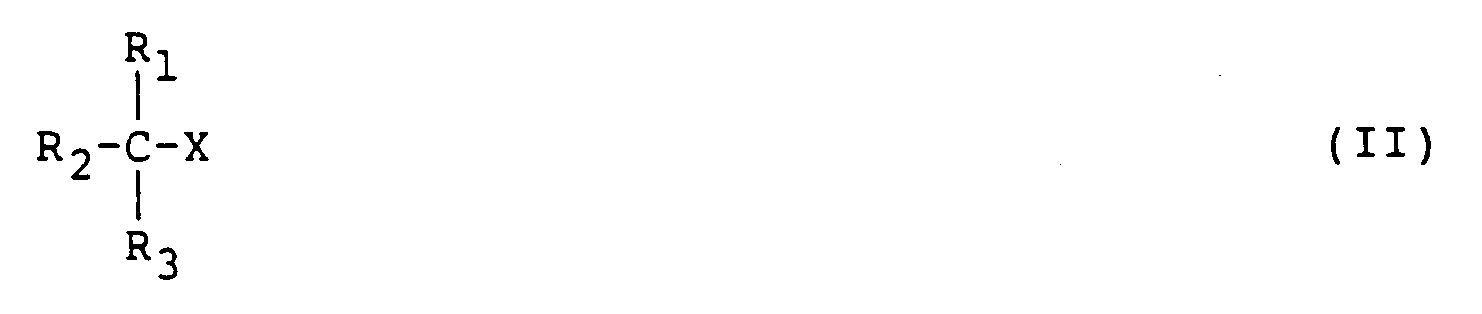
wherein R₁, R₂, R₃ and X are the same as defined above with an ethylene derivative of the formula III:
CH₂=CH-Y (III)
wherein Y is the same as defined above in the presence of a liquid catalyst comprising a complex compound of aluminum chloride and an alkylbenzene of the formula IV:

wherein R₄, R₅ and R₆ are the same or different and each is a C₁₋₄- alkyl group or a hydrogen atom provided that at least one of them is a C₁₋₄- alkyl group.
wherein R₁, R₂ and R₃ are the same or different and each is a C₁₋₄- alkyl group, X is a chlorine atom or a bromine atom and Y is a hydrogen atom or a halogen atom,
which process comprises reacting a tertiary alkyl halogenide of the formula II:
wherein R₁, R₂, R₃ and X are the same as defined above with an ethylene derivative of the formula III:
CH₂=CH-Y (III)
wherein Y is the same as defined above in the presence of a liquid catalyst comprising a complex compound of aluminum chloride and an alkylbenzene of the formula IV:
wherein R₄, R₅ and R₆ are the same or different and each is a C₁₋₄- alkyl group or a hydrogen atom provided that at least one of them is a C₁₋₄- alkyl group.
2. The process according to claim 1, wherein the tertiary alkyl halogenide of the formula
II is at least one of tert.-butyl chloride, tert.-butyl bromide, 2-chloro-2-methylbutane
and 2-bromo-2-methylbutane.
3. The process according to claim 1, wherein the ethylene derivative is at least one
of ethylene, vinyl chloride and vinyl bromide.
of ethylene, vinyl chloride and vinyl bromide.
4. The process according to claim 1, wherein the alkyl halogenide of the formula I is
at least one
of 1-chloro-3,3-dimethylbutane, 1-bromo-3,3-dimethylbutane, 1-bromo-1-chloro-3,3-dimethylbutane, 1,1-dichloro-3,3-dimethylbutane, 1-chloro-3,3-dimethylpentane and 1,1-dibromo-3,3-dimethylpentane.
of 1-chloro-3,3-dimethylbutane, 1-bromo-3,3-dimethylbutane, 1-bromo-1-chloro-3,3-dimethylbutane, 1,1-dichloro-3,3-dimethylbutane, 1-chloro-3,3-dimethylpentane and 1,1-dibromo-3,3-dimethylpentane.
5. The process according to claim 1, wherein the alkylbenzene is at least one
of toluene, xylene, mesitylene, ethylbenzene, cymene and methyldiisopropylbenzene.
of toluene, xylene, mesitylene, ethylbenzene, cymene and methyldiisopropylbenzene.
6. The process according to claim 5, wherein the alkylbenzene is at least one
of ethylbenzene, m-cymene and 1-methyl-3,5-diisopropylbenzene.
of ethylbenzene, m-cymene and 1-methyl-3,5-diisopropylbenzene.
7. The process according to claim 1, wherein the molar ratio of the tertiary alkyl halogenide
and the ethylene derivative is from 1:0.2 to 1:5.
8. The process according to claim 1, wherein the liquid catalyst is used in an amount
of 0.001 to 0.3 mole in terms of aluminum chloride per one mole of the tertiary alkyl
halogenide.
9. The process according to claim 8, wherein the liquid catalyst is used in an amount
of 0.005 to 0.1 mole in terms of aluminum chloride per one mole of the tertiary alkyl
halogenide.
10. The process according to claim 1, wherein the concentration of aluminum chloride in
the liquid catalyst is from 20 to 60 % by weight.
11. The process according to claim 10, wherein the concentration of the aluminum chloride
in the liquid catalyst is from 30 to 55 % by weight.
12. The process according to claim 1, wherein the reaction temperature is from -30°C to
+50°C.
13. The process according to claim 12, wherein the reaction temperature is from -15°C
to +20°C.
1. Verfahren zur Herstellung von Alkylhalogeniden der Formel I
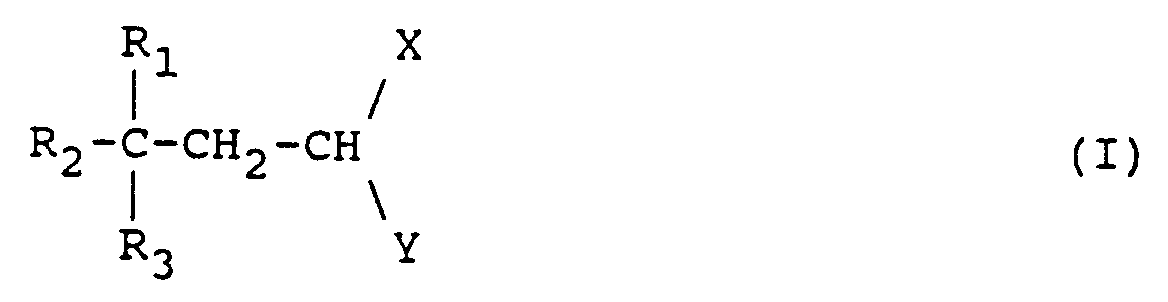
in der R₁, R₂ und R₃ gleiche oder verschiedene Bedeutungen haben und jeweils einen C₁₋₄-Alkylrest bedeuten, X ein Chlor- oder Bromatom bedeutet, und Y ein Wasserstoff- oder Halogenatom bedeutet, wobei das Verfahren die Umsetzung eines tertiären Alkylhalogenids der Formel II
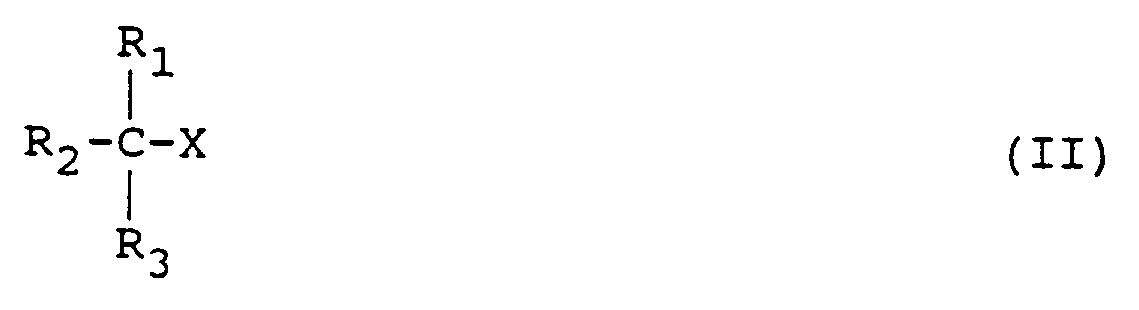
in der R₁, R₂, R₃ und X die vorstehend definierte Bedeutung haben, mit einem Ethylenderivat der Formel III
CH₂=CH-Y (III)
in der Y die vorstehend definierte Bedeutung hat, in Gegenwart eines flüssigen Katalysators mit einem Gehalt an einer Komplexverbindung von Aluminiumchlorid und einem Alkylbenzol der Formel
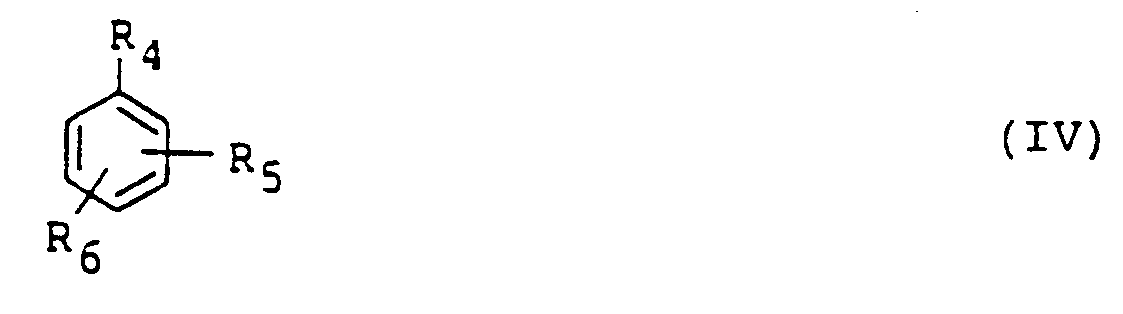
in der R₄, R₅ und R₆ gleich oder verschieden sind und jeweils einen C₁₋₄-Alkylrest oder ein Wasserstoffatom bedeuten, wobei mindestens einer der Reste davon einen C₁₋₄-Alkylrest bedeutet, umfaßt.
in der R₁, R₂ und R₃ gleiche oder verschiedene Bedeutungen haben und jeweils einen C₁₋₄-Alkylrest bedeuten, X ein Chlor- oder Bromatom bedeutet, und Y ein Wasserstoff- oder Halogenatom bedeutet, wobei das Verfahren die Umsetzung eines tertiären Alkylhalogenids der Formel II
in der R₁, R₂, R₃ und X die vorstehend definierte Bedeutung haben, mit einem Ethylenderivat der Formel III
CH₂=CH-Y (III)
in der Y die vorstehend definierte Bedeutung hat, in Gegenwart eines flüssigen Katalysators mit einem Gehalt an einer Komplexverbindung von Aluminiumchlorid und einem Alkylbenzol der Formel
in der R₄, R₅ und R₆ gleich oder verschieden sind und jeweils einen C₁₋₄-Alkylrest oder ein Wasserstoffatom bedeuten, wobei mindestens einer der Reste davon einen C₁₋₄-Alkylrest bedeutet, umfaßt.
2. Verfahren nach Anspruch 1, wobei es sich beim tertiären Alkylhalogenid der Formel
II um mindestens eine der Verbindungen tert.-Butylchlorid, tert.-Butylbromid, 2-Chlor-2-methylbutan
und 2-Brom-2-methylbutan handelt.
3. Verfahren nach Anspruch 1, wobei es sich beim Ethylenderivat um mindestens eines der
Produkte Ethylen, Vinylchlorid und Vinylbromid handelt.
4. Verfahren nach Anspruch 1, wobei es sich beim Alkylhalogenid der Formel I um mindestens
eine der Verbindungen 1-Chlor-3,3-dimethylbutan, 1-Brom-3,3-dimethylbutan, 1-Brom-1-chlor-3,3-dimethylbutan,
1,1-Dichlor-3,3-dimethylbutan, 1-Chlor-3,3-dimethylpentan und 1,1-Dibrom3,3-dimethylpentan
handelt.
5. Verfahren nach Anspruch 1, wobei es sich beim Alkylbenzol um mindestens eine der Verbindungen
Toluol, Xylol, Mesitylen, Ethylbenzol, Cymol und Methyldiisopropylbenzol handelt.
6. Verfahren nach Anspruch 5, wobei es sich beim Alkylbenzol um mindestens eine der Verbindungen
Ethylbenzol, m-Cymol und 1-Methyl-3,5-diisopropylbenzol handelt.
7. Verfahren nach Anspruch 1, wobei das Molverhältnis des tertiären Alkylhalogenids und
des Ethylenderivats 1:0,2 bis 1:5 beträgt.
8. Verfahren nach Anspruch 1, wobei der flüssige Katalysator in einer Menge von 0,001
bis 0,3 Mol, angegeben als Aluminiumchlorid, pro 1 Mol des tertiären Alkylhalogenids
verwendet wird.
9. Verfahren nach Anspruch 8, wobei der flüssige Katalysator in einer Menge von 0,005
bis 0,1 Mol, angegeben als Aluminiumchlorid, pro 1 Mol des tertiären Alkylhalogenids
verwendet wird.
10. Verfahren nach Anspruch 1, wobei die Konzentration an Aluminiumchlorid im flüssigen
Katalysator 20 bis 60 Gew.-% beträgt.
11. Verfahren nach Anspruch 10, wobei die Konzentration des Aluminiumchlorids im flüssigen
Katalysator 30 bis 55 Gew.-% beträgt.
12. Verfahren nach Anspruch 1, wobei die Reaktionstemperatur -30 bis +50°C beträgt.
13. Verfahren nach Anspruch 12, wobei die Reaktionstemperatur -15 bis +20°C beträgt.
1. Procédé de préparation d'halogénures d'alkyles de formule I :
dans laquelle R₁, R₂ et R₃ sont identiques ou différents et représentent chacun un groupement alkyle en C₁-C₄, X représente un atome de chlore ou un atome de brome et Y représente un atome d'hydrogène ou un atome d'halogène,
lequel procédé comprend la réaction d'un halogénure d'alkyle tertiaire de formule II :
dans laquelle R₁, R₂, R₃ et X sont tels que définis ci-dessus, avec un dérivé de l'éthylène de formule III :
CH₂ = CH - Y (III)
dans laquelle Y est tel que défini ci-dessus, en présence d'un catalyseur liquide comprenant un composé complexe du chlorure d'aluminium et un alkylbenzène de formule IV :
dans laquelle R₄, R₅ et R₆ sont identiques ou différents et représentent chacun un groupement alkyle en C₁-C₄ ou un atome d'hydrogène à condition qu'au moins l'un d'entre eux représente un groupement alkyle en C₁-C₄.
dans laquelle R₁, R₂ et R₃ sont identiques ou différents et représentent chacun un groupement alkyle en C₁-C₄, X représente un atome de chlore ou un atome de brome et Y représente un atome d'hydrogène ou un atome d'halogène,
lequel procédé comprend la réaction d'un halogénure d'alkyle tertiaire de formule II :
dans laquelle R₁, R₂, R₃ et X sont tels que définis ci-dessus, avec un dérivé de l'éthylène de formule III :
CH₂ = CH - Y (III)
dans laquelle Y est tel que défini ci-dessus, en présence d'un catalyseur liquide comprenant un composé complexe du chlorure d'aluminium et un alkylbenzène de formule IV :
dans laquelle R₄, R₅ et R₆ sont identiques ou différents et représentent chacun un groupement alkyle en C₁-C₄ ou un atome d'hydrogène à condition qu'au moins l'un d'entre eux représente un groupement alkyle en C₁-C₄.
2. Procédé selon la revendication 1, dans lequel l'halogénure d'alkyle tertiaire de formule
II est au moins l'un des suivants : chlorure de t-butyle, bromure de t-butyle, 2-chloro-2-méthylbutane
et 2-bromo-2-méthylbutane.
3. Procédé selon la revendication 1, dans lequel le dérivé de l'éthylène est au moins
l'un des suivants : éthylène, chlorure de vinyle et bromure de vinyle.
4. Procédé selon la revendication 1, dans lequel l'halogénure d'alkyle de formule I est
au moins l'un des suivants : 1-chloro-3,3-diméthylbutane, 1-bromo-3,3-diméthylbutane,
1-bromo-1-chloro-3,3-diméthylbutane, 1,1-dichloro-3,3-diméthylbutane, 1-chloro-3,3-diméthylpentane
et 1,1-dibromo-3,3-diméthylpentane.
5. Procédé selon la revendication 1, dans lequel l'alkylbenzène est au moins l'un des
suivants : toluène, xylène, mésitylène, éthylbenzène, cymène et méthyldiisopropylbenzène.
6. Procédé selon la revendication 5, dans lequel l'alkylbenzène est au moins l'un des
suivants : éthylbenzène, m-cymène et 1-méthyl-3,5-diisopropylbenzène.
7. Procédé selon la revendication 1, dans lequel le rapport molaire de l'halogénure d'alkyle
tertiaire au dérivé de l'éthylène est compris entre 1:0,2 et 1:5.
8. Procédé selon la revendication 1, dans lequel le catalyseur liquide est utilisé en
une quantité comprise entre 0,001 à 0,3 mol en termes de mole de chlorure d'aluminium
par mole de l'halogénure d'alkyle tertiaire.
9. Procédé selon la revendication 8, dans lequel le catalyseur liquide est utilisé en
une quantité comprise entre 0,005 et 0,1 mol en termes de mole de chlorure d'aluminium
par mole de l'halogénure d'alkyle tertiaire.
10. Procédé selon la revendication 1, dans lequel la concentration en chlorure d'aluminium
du catalyseur liquide est comprise entre 20 et 60 % en poids.
11. Procédé selon la revendication 10, dans lequel la concentration en chlorure d'aluminium
du catalyseur liquide est comprise entre 30 et 55 % en poids.
12. Procédé selon la revendication 1, dans lequel la température réactionnelle est comprise
entre -30 et +50°C.
13. Procédé selon la revendication 12, dans lequel la température réactionnelle est comprise
entre -15 et +20°C.