|
(11) | EP 0 380 331 B1 |

| (12) | EUROPEAN PATENT SPECIFICATION |
|
|
| (54) |
(Di-tert-butylhydroxyphenyl)-thio derivatives, their preparation and use Di-tert-butyl-hydroxyphenylthioderivate, deren Herstellung und Verwendung Dérivés (di-tert-butylhydroxyphényl)thio, leur préparation et leur utilisation |
|
|
|||||||||||||||||||||||||||||||
| Note: Within nine months from the publication of the mention of the grant of the European patent, any person may give notice to the European Patent Office of opposition to the European patent granted. Notice of opposition shall be filed in a written reasoned statement. It shall not be deemed to have been filed until the opposition fee has been paid. (Art. 99(1) European Patent Convention). |
[0001] This invention relates to di-tert-butylhydroxyphenylthio derivatives which may be useful as medicines and their production and use. More particularly, it relates to those intramolecularly having residues derived from saturated aliphatic acid, which inhibit the incorporation of LDL (Low Density Lipoprotein) by preventing the denaturation of LDL and are therefore useful as anti-arteriosclerosis agents.
[0002] In addition, the said derivatives have preventative activity against oxidation of lipid and lipoxygenase inhibitory actions, based on their anti-oxidation activities.
[0003] Atherosclerosis is thought to occur in an initial but significant stage of arteriosclerosis, in such a manner that lipoid material mainly consisting of cholesterol moves into the arterial wall to form foam cells accompanied by hyperplasia and consequent sclerosis. Atherosclerosis has been thought not to occur due to a single factor but accumulated factors over a long period of time, such as hypertension, hyperlipemia, excessive cigarette smoking, obesity, diabetes mellitus, hyperuricemia, stress, heredity, lack of exercise. Among those factors, the behavior of cholesterol existing as LDL in blood is noted. What is especially important are penetration of LDL into the arterial wall and the incorporation of LDL into macrophages, and the subsequent accumulation of cholesterol at the wall and the vessel disorder. On the other hand, the following factors are considered to promote the occurrence of atherosclerosis: the increase of blood cholesterol due to the troubles on the incorporation of LDL into liver and the metabolism of LDL in liver, the hydrodynamic state of blood due to the change in the physical properties of red blood cell, etc., the damage of endothelium, the abnormal hyperplasia of the arterial wall and the depression of the lipid utilization in arterial tissues.
[0004] For the drug therapy of atherosclerosis, there have heretofore been used anti-arteriosclerosis agents such as pyridinol carbamate; lipid lowering agents such as clofibrate, nicotinic acid, alpha-tyroxine and cholestyramine; and anti-platelet agents such as dipyridamole and aspirin, etc. Also, di-tert-butylphenol derivatives having anti-arteriosclerosis activity are disclosed in JP. Publn. No. 77-27144, JP. Publn. No. 85-39262, JP. Publn. No. 77-125171, or the like. Further, structurally related compounds having anti-oxidative activity are disclosed in JP. Unexam. Publn. No. 74-75551, JP. Unexam. Publn. No. 74-75552, JP. Unexam. Publn. No. 83-90545, JP. Unexam. Publn. No. 86-191670, JP. Unexam. Publn. No. 86-197554, JP. Unexam. Publn. No. 86-210073, JP. Unexam. Publn. No. 86-218570, JP. Unexam. Publn. No. 86-268664, JP. Unexam. Publn. No. 88-310820, JP. Unexam. Publn. No. 88-310821, USP 4,076,841 and Chemical Abstract (C.A.) Vol. 94, 30290c, 1981.
[0005] It is generally considered that normal LDL are not incorporated by reticuloenthelial cells (scavenger cells) such as macrophages and kupffer cells, but denaturated LDL are incorporated through a receptor thereto. Also, it is considered that even when a large amount of cholesterol is accumulated in cells, the receptor for denaturated LDL does not decrease in number in cells, so that the accumulation of cholesterol is unlimitedly enhanced whereby the conversion of reticuloenthelial cells into foam cells may take place resulting in estalishment of arteriosclerosis.
[0006] According to the above consideration, atherosclerosis may be prevented by inhibiting the production of denatured LDL. Development of drugs which can inhibit the production of denatured LDL has thus been desired, but satisfaction is presently not obtained in this respect.
[0007] Thus, the present invention provides (Di-tert-Butylhydroxyphenyl)thio derivatives of the formula:
wherein R is cyano, carbamoyl, or 5-tetrazolyl; n is an integer of from 2 to 6; provided that when R is cyano, n is not 2.
[0008] The invention includes the use of these compounds or a pharmaceutically or veterinarily acceptable salt thereof in the manufacture of a medicament for the treatment or proplylaxis of arteriosclerosis or atheriosclerosis.
[0009] Said compounds which inhibit LDL from being incorporated by macrophages and oxidizing fatty acids are useful in treating arteriosclerosis.
[0010] As the result of an extensive study, the present invention provides compounds of the following formula:
wherein R is cyano, carbamoyl, or 5-tetrazolyl; n is an integer of from 2 to 6, provided that when R is cyano, n is not 2; and pharmaceutically acceptable salts thereof.
[0011] In the formula (I), the alkylene represented by "-(CH₂)n-" includes ethylene, trimethylene, tetramethylene, pentamethylene, hexamethylene. When R is cyano, n is preferably 3 to 6.
[0012] When R is carbamoyl, n is preferably an integer of from 2 to 6 and especially 5. When R is 5-tetrazolyl, n is preferably an integer of from 2 to 6.
[0013] In this specification, 5-tetrazolyl means 5-1H-tetrazolyl or 5-2H-tetrazolyl or their mixture.
[0014] Salts of the compound of formula (I) when R is free tetrazolyl represents salts with alkali metal (e.g., lithium, sodium, potassium, or the like), with alkaline earth metal (e.g., calcium, magnesium, or the like), with organic base (e.g., triethylamine, 2-aminobutane, tert-butylamine, diisopropylethylamine, n-butylmethylamine, n-butyldimethylamine, tri-n-butylamine, dicyclohexylamine, N-isopropylcyclohexylamine, furfurylamine, benzylamine, methylbenzylamine dibenzylamine N,N-dimethylbenzylamine, 2-chlorobenzylamine 4-methoxybenzylamine, 1-napthylmethylamine, diphenylbenzylamine, triphenylamine, 1-napthylamine, 1-aminoanthracene, 2-aminoanthracene, dehyroabiethylamine, N-methylmorpholine, pyridine, with amino acid (e.g. lysine, arginine, histidine.) The compounds of this invention can be prepared as shown below.
[0015] The compounds (I) of this invention are prepared by reacting 2,6-di-tert-butyl-4-mercaptophenol (disclosed in JP Unexamin. Publn. No. 86- 268664) with an alkylating agent, optionally followed by acid amide formation, tetrazole formation, and/or salt formation. That is, the compounds (I) of this invention are prepared by reacting 2,6-di-tert-butyl-4-mercaptophenol of the formula (II):
with an alkylating agent, optionally followed by acid amide formation, or tetrazole formation. If necessary, the compounds (I) of this invention may be subjected to salt formation to give their pharmaceutically or veterinarily acceptable salts.
[0016] Each reaction is described in more detail as follows.
① R is -CN:
In the reaction scheme above, n is an integer of from 3 to 6.
[0018] This reaction may be carried out using halogenoalkanonitrile as an alkylating agent in a conventional procedure for sulfide synthesis.
[0019] As the halogenoalkanonitrile used in this reaction, 3-bromopropionitrile, 4-bromobutylonitrile, 5-bromopentancarbonitrile, 6-bromohexancarbonitrile, are exemplified.
[0020] The reaction may be carried out in the presence of a base (e.g., sodium hydroxide, potassium hydroxide, calcium hydroxide, calcium carbonate, pyridine, triethylamine, tetrabutylammonium hydroxide,) in a solvent such as alcohol (e.g., methanol, ethanol, propanol, tert-butanol, ether (e.g., diethyl ether, tetrahydrofuran,), halogenated hydrocarbon (e.g., chloroform, dichloromethane,), or N,N-dimethylacetamide at cooling to room temperature or under reflux for a period of about 10 minutes to several ten hours. In the case where water-immiscible solvents such as halogenated hydrocarbon (e.g., dichloromethane, chloromethane, dichloroethane, or aromatic hydrocarbon (e.g., benzene) are used, the reaction may be carried out in a heterogeneous phase of an organic layer and an aqueous layer in the presence of a phase transfer catalyst (e.g., hexadecyl-tri-n-butylphosphonium bromide) for acceleration of the reaction.
② R is 5-1H-tetrazolyl and/or its tautomer 5-2H- tetrazolyl:
In the reaction scheme above, n is an integer of from 2 to 6.
[0022] The reaction is performed in a conventional manner disclosed in A. Nohara et al., J. Med. Chem., 22, 290, 1979; W.G. Finnegan et al., J. Am. Chem. Soc., 80, 3908, (1958); E.P.Vacek et al., Synthesis, 1133, (1987). That is to say, the reaction may be carried out using an azide salt such as ammonium azide, sodium azide, lithium azide, aluminum azide, in a solvent such as 1-methyl-2-pyrrolidone, dimethylformamide, diethylsulfoxide, ether (e.g., diethyl ether, tetrahydrofuran) or the like, if necessary, in the presence of a phase-transfer catalyst such as triethylammonium chloride, ammonium chloride, tetramethylammonium chloride under heating for a period of several hours.
[0023] The salt of tetrazole (IB) can be prepared in a conventional manner, for example, by reacting the tetrazole (IB) in a solvent with a theoretical amount of an suitable base such as an alkali metal or alkaline earth metal hydroxide or carbonate, ammonium hydroxide, ammonia, or an organic amine. The salt can be isolated by freeze-drying or by filtration if it is sufficiently insoluble in the solvent.
③ R is carbamoyl:
In the reaction scheme above, n is an integer of from 2 to 6.
[0024] In this step, the carboxylic acids (III) are converted into the acid amides (IC) of this invention.
[0025] This step can be achieved by a) an acid anhydride method, b) an acid halide method, or c) an active ester method.
[0026] In the acid anhydride method, an acid anhydride of carboxylic acid (III), or usually in a form of a mixed acid anhydride of carboxylic acid (III) is treated with ammonia. The mixed acid anhydride is prepared by reacting the carboxylic acid (III) in the presence of an organic base (e.g., triethylamine, pyridine) with monoalkyl chloroformate (e.g., ethyl chloroformate, isobutyl chloroformate, or the like) in a solvent such as chlorinated hydrocarbon (e.g., chloroform, dichloromethane, dichloroethane, or the like) at a temperature of -20 °C to 40 °C. The mixed acid anhydride can be prepared by treatment of the carboxylic acid with trifluoroacetic anhydride in the same manner as mentioned above. Thus the prepared mixed acid anhydride is treated with a conc. aqueous ammonia or ammonia gas in a water-miscible solvent such as ether (e.g., dioxane, tetrahydrofuran) or ketone (e.g., acetone) at 0 °C to 50 °C optionally under pressure to give the acid amide (IC).
[0027] In an acid halide method, the acid halide which is prepared by treating the carboxylic acid (III) with thionyl chloride or phosgene in the presence of an organic base or treating the powdered alkali salt of carboxylic acid (III) with oxalyl chloride in a solvent such as chlorinated hydrocarbon (e.g., chloroform, dichloromethane, dichloroethane) is treated with conc. aqueous ammonia or ammonia gas in the same manner as mentioned above to give the acid amide (IC).
[0028] In the active ester method, the acid amide can be directly prepared from the carboxylic acid (III) by treating with an aqueous ammonia in the presence of a condensing agent such as dicyclohexylcarbodiimide (DCC). The active ester of carboxylic acid (III) can be converted into the acid amide (IC) by reacting with an aqueous ammonium or ammonia gas in a water-miscible solvent such as ether (e.g., dioxane, tetrahydrofuran, alcohol (e.g., methanol, ethanol) ketone (e.g., acetone) at room temperature.
[0029] The carboxylic acid (III) can be prepared by reacting the compound represented by the formula (II) with an alkylating agent according to a known synthetic method for a sulfide.
[0030] As the alkylating agent, halogenated fatty acids such as a haloalkanoic acid (e.g., 2-bromoethanoic acid, 3-bromopentanoic acid, 4-bromohexanoic acid) is exemplified.
[0031] The compounds (I) of this invention can strongly inhibit the incorporation of LDL into macrophages. Therefore, they are useful for prevention and treatment of arteriosclerosis.
[0032] The compounds (I) of this invention can be administered orally or parenterally to patients. For the oral administration, they are normally formulated into conventional preparation form such as solid preparations (e.g., tablets, powders, capsules, granyles) or liquid preparations (e.g., aqueous dispersion, oily suspension, syrups, elixirs). For the parenteral administration, they are usually applied via injectable form, such as that of aqueous solutions or oily dispersions. On the formulation of the above preparations, there may be used excipients, binding agent, lubricants, solvents, solubilizers, emulsifiers, dispersants, and the like. Other additives such as preservatives and stabilizing agents may be also used.
[0033] The dosage of the compounds (I) of this invention varies with the dosage form, age, bodyweight, symptom of the patient, or the like but usually ranges from about 5 to 1000 mg per day, preferably, 20 mg to 200 mg per day for oral administration and 0.5 mg to 500 mg per day, preferably, 5 mg to 50 mg per day for parenteral administration.
[0034] Practical and presently preferred embodiments for this invention are shown in the following Examples, but it should be understood that these examples are given only for the illustrative purposes and do not limit the scope of the present invention thereto.
Referential Example 1
[0036] To a solution of 15 g of 2,6-di-tert-butyl-4-mercaptophenol II in 90 ml of ethanol was added 12.6 ml (1 eq.) of 5N-sodium hydroxide in a nitrogen atmosphere under ice-cooling. The mixture was stirred at the same temperature for 5 minutes and 5.22 ml (1 eq.) of 3-bromopropionitrile was added thereto and the resultant mixture was stirred for 1 hour at room temperature. The reaction mixture was poured into water and extracted with ethyl acetate. The organic layer was washed with water, dried over magnesium sulfate and concentrated under reduced pressure. The residue was recrystallized with ethyl ether-n-hexane to give 14.63 g of the aimed product as first crop (mp. 94.5 - 95 °C). The mother liquour was crystallized to give 3.00 g of the aimed product as second crop (mp. 94 - 95 °C) Yield 96.1 %.
[0037] Anal. Calcd. (%) for C₁₇H₂₅NOS = 291.44 : C, 70.05; H, 8.65; N, 4.81; S, 11.00; Found (%): C, 70.07; H, 8 .65; N, 4.81; S, 11.01.
[0039] NMR δ ppm(CDCl₃) : 1.44(s, 18H), 2.56(t, J=7.6Hz, 2H), 3.00 (t, J=7.6 Hz, 2H), 5.35(s, 1H), 7.30 (s, 2H).
Examples 1 to 4
(General Procedure)
[0041] To a solution of A (weight) of 2,6-di-tert-butyl-4-mercaptophenol in B (ml) of ethanol was added C (ml) of 5 N sodium hydroxide while cooling with ice in a nitrogen atmosphere. The resultant mixture was kept at the same temperature for 5 minutes, D (weight) of bromoalkanonitrile was added thereto, and the mixture was stirred for 1 hour at room temperature. The reaction mixture was poured into water and extracted with ethyl acetate. The organic layer was washed with water, dried over magnesium sulfate, and concentrated under reduced pressure. The residue was chromatographed on silica gel. The fractions eluted with n-hexane-ethyl acetate (10:1 to 4:1) were collected and concentrated under reduced pressure. The residue was recrystallized from ethyl ether - n-hexane to give E (weight) of the aimed product. According to the above general procedure, the following compounds were obtained.
[0042] The reaction conditions are shown in Table 1 and physical constants in Table 2.
4-(3,5-Di-tert-butyl-4-hydroxy)phenylthiobutylonitrile Ia,
5-(3,5-Di-tert-butyl-4-hydroxy)phenylthiopentanonitrile Ib,
6-(3,5-Di-tert-butyl-4-hydroxy)phenylthiohexanonitrile Ic, and
7-(3,5-Di-tert-butyl-4-hydroxy)phenylthioheptanonitrile Id.
Example 5
[0044] To a solution of 10.0 g of 3-(3.5-di-tert-butyl-4-hydroxy)phenylthiopropanonitrile Ie′ in 300 ml of 1-methyl-2-pyrrolidinone were added 7.3 g of triethylamine hydrochloride and 6.7 g of sodium azide and the mixture was heated at 150 °C overnight under stirring. The reaction mixture was poured into water and extracted with ethyl acetate. The organic layer was washed with water, dried over magnesium sulfate, and concentrated under reduced pressure. The residue was chromatographed on silica gel and the fractions eluted with ethyl acetate were collected and recrystallized from ethyl acetate - toluene to give 2.7 g of the aimed product Ie in 23.5 % yield. mp. 187 to 188 °C.
[0045] Anal. Calcd. (%) for C₁₇H₂₆N₄OS=334.48: C, 61.04; H, 7.84; N, 16.75; S, 9.59; Found (%): C, 61.22; H, 7.76; N, 16.63; S, 9.56.
Examples 6 to 9
(General Procedure)
[0049] To a solution of A (weight) of 3-(3,5-di-tert-butyl-4-hydroxy)phenylthiopropanonitrile Ie′ in B (ml) of 1-methyl-2-pyrrolidinone were added C (weight) of triethylamine hydrochloride and D (weight) of sodium azide and the mixture was heated at 150 °C overnight under stirring. The reaction mixture was poured into water and extracted with ethyl acetate. The organic layer was washed with water, dried over magnesium sulfate, and concentrated under reduced pressure. If required, the residue was chromatographed on silica gel and the fractions eluted with ethyl acetate were collected and recrystallized from benzene - n-hexane to give E (weight) of the aimed product.
[0050] According to the above general procedure, the reaction was conducted under the conditions as shown in Table 3 to give the products as shown below and in Table 4.
5-[3-(3,5-Di-tert-butyl-4-hydroxy)phenylthiopropyl]tetrazole If,
5-[4-(3,5-Di-tert-butyl-4-hydroxy)phenylthiobutyl]tetrazole Ig,
5-[5-(3,5-Di-tert-butyl-4-hydroxy)phenylthiopentyl]tetrazole Ih,
and
5-[6-(3,5-Di-tert-butyl-4-hydroxy)phenylthiohexyl]tetrazole Ii.
Referential Example 2
Preparation of 6-(3,5-di-tert-butyl-4-hydroxy)phenylthiohexanoic acid III (Compound disclosed in JP. Appln. No. 88-157849)
[0052] To a solution of 2.0 g of 2,6-di-tert-butyl-4-mercaptophenol II in 18 ml of ethanol was added 3.36 ml of 5N sodium hydroxide in a nitrogen atmosphere while being cooled with ice. The resultant mixture was kept at the same temperature for 5 minutes, 1.63 g of 5-bromopentanoic acid was added thereto. The mixture was stirred for 1 hour and then allowed to stand at room temperature overnight. The reaction mixture was poured into water and acidified with 2N hydrochloric acid in the presence of ethyl acetate. The mixture was extracted with ethyl acetate and the organic layer was washed with water, dried over magnesium sulfate, and concentrated under reduced pressure to give oily residue, which was chromatographed on silica gel. The fractions eluted with toluene - ethyl acetate (9:1 to 2:1) were collected and recrystallized from ethyl ether - n-hexane to give 1.75 g (first crop, mp. 57 - 57.5 °C) and then 400 mg (second crop, mp. 57 - 57.5 °C) from the mother liquour. Yield 72.7 %.
Example 10
[0054] To a solution of 2.0 g of 6-(3,5-di-tert-butyl-4-hydroxy)phenylthiohexanoic acid III in 40 ml of chloroform were added 1.58 ml of triethylamine and then 0.65 ml of ethyl chloroformate in a nitrogen atmosphere under ice-cooling. The resultant mixture was stirred at 25 to 40 °C for 4 hours and then ammonia gas was slowly introduced under ice-cooling. The reaction mixture was concentrated under reduced pressure to give a crystalline residue, which was then washed with water. The residue was dissolved in ethyl acetate and applied on silica gel column. The fractions eluted with ethyl acetate were collected and recrystallized from ethyl acetate - n-hexane to give 1.58 g of the aimed product Ij in 79.3 % yield. Mp. 138 to 141 °C.
[0055] Anal. Calcd. (%) for C₂₀H₃₃NO₂S·0.2H₂O: C, 67.64; H, 9.48; N, 3.94; S, 9.03; Found (%) : C, 67,82; H, 9.43; N, 3.64; S, 9.10.
[0057] NMR δ ppm(d-DMSO) : 1.30∼1.60(m, 24H), 2.00 (t, J=7Hz, 2H), 2.80(t, J=7Hz, 2H), 6.67(br, s, 2H), 7.02(s, 2H), 7.20 (br, s, 2H).
Test Example 1
[0059] SD strain rats (body weight, about 200g) were sacrificed by cutting down their heads, and the brains were taken out. The brains were homogenated with a 4-fold amount of 0.05 M phosphate-sodium chloride buffer (pH 7.4) and centrifugd at 1,000 x g for 10 minutes. The supernatant was kept at -80 °C for storage.
[0060] The supernatant was diluted with a 2-fold amount of the same phosphate - sodium chloride buffer as above, and 0.48 ml of the dilution was combined with 30 µl of ethanol per se (vehicle) or ethanol solution contaning a test compound (final concentration: 0.01 mM), followed by incubation at 37 °C for 30 minutes. The reaction was terminated by addition of 0.1 % butylhydroxytoluene (BHT) in ethanol (20 µl) and 25 % metaphosphoric acid (125 µl) and subjected to elimination of proteins. The peroxidized lipid in the supernatant was measured by the thiobarbituric acid (TBA) method according to the description in Ohkawa et al. : Anal. Biochem., Vol . 95, page 351 (1979). The amount of peroxidized lipid produced was compared with that in the vehicle applied group and expressed in % control. The results are shown in Table 5.
1. The use of a compound of the formula:
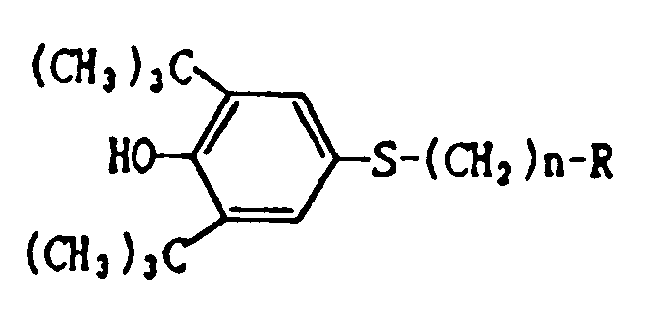
wherein R is cyano, carbamoyl, or 5-tetrazolyl; n is an integer of 2 to 6; provided that when R is cyano, n is not 2, or a pharmaceutically or veterinarily acceptable salt thereof in the manufacture of a medicament for the treatment or prophylaxis of arteriosclerosis or atherosclerosis.
wherein R is cyano, carbamoyl, or 5-tetrazolyl; n is an integer of 2 to 6; provided that when R is cyano, n is not 2, or a pharmaceutically or veterinarily acceptable salt thereof in the manufacture of a medicament for the treatment or prophylaxis of arteriosclerosis or atherosclerosis.
2. The use as claimed in claim 1 wherein the compound is
4-(3,5-Di-tert-butyl-4-hydroxy)phenylthiobutylonitrile,
5-(3,5-Di-tert-butyl-4-hydroxy)phenylthiopentanonitrile,
6-(3,5-Di-tert-butyl-4-hydroxy)phenylthiohexanonitrile,
7-(3,5-Di-tert-butyl-4-hydroxy)phenylthioheptanonitrile, 5-[2-(3,5-Di-tert-butyl-4-hydroxy)phenylthioethyl]tetrazole, 5-[3,5-Di-tert-butyl-4-hydroxy)phenylthiopropyl]tetrazole, 5-[4-(3,5-Di-tert-butyl-4-hydroxy)phenylthiobutyl]tetrazole, 5-[5-(3,5-Di-tert-butyl-4-hydroxy)phenylthiopentyl]tetrazole, or
6-(3,5-Di-tert-butyl-4-hydroxy)phenylthiohexanamide.
4-(3,5-Di-tert-butyl-4-hydroxy)phenylthiobutylonitrile,
5-(3,5-Di-tert-butyl-4-hydroxy)phenylthiopentanonitrile,
6-(3,5-Di-tert-butyl-4-hydroxy)phenylthiohexanonitrile,
7-(3,5-Di-tert-butyl-4-hydroxy)phenylthioheptanonitrile, 5-[2-(3,5-Di-tert-butyl-4-hydroxy)phenylthioethyl]tetrazole, 5-[3,5-Di-tert-butyl-4-hydroxy)phenylthiopropyl]tetrazole, 5-[4-(3,5-Di-tert-butyl-4-hydroxy)phenylthiobutyl]tetrazole, 5-[5-(3,5-Di-tert-butyl-4-hydroxy)phenylthiopentyl]tetrazole, or
6-(3,5-Di-tert-butyl-4-hydroxy)phenylthiohexanamide.
3. The use as claimed in Claim 1 or Claim 2 wherein the compound is prepared by reacting
2,6-di-tert-butyl-4-mercaptophenol with an alkylating agent, optionally followed by
acid amide formation, or tetrazole formation, and optionally subjecting the resulting
compound to salt formation.
4. The use as claimed in any preceding claim wherein the medicament comprises a pharmaceutically
or veterinarially acceptable diluent, excipient, carrier, stabiliser, binding agent,
lubricant, solvent, solubilizer or dispersant.
1. Verwendung einer Verbindung der Formel:
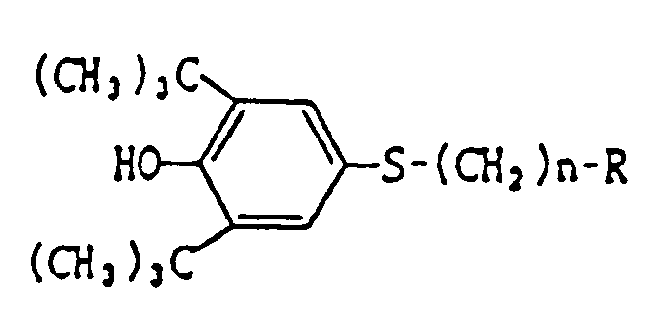
wobei R Cyano, Carbamoyl oder 5-Tetrazolyl ist; n eine ganze Zahl von 2 bis 6 ist; unter der Voraussetzung, dass R Cyano ist, bedeutet n nicht 2, oder eines pharmazeutisch oder veterinärmedizinisch geeigneten Salzes davon für die Herstellung eines Arzneimittels für die Behandlung oder Prophylaxe von Arteriosklerose oder Atherosklerose.
wobei R Cyano, Carbamoyl oder 5-Tetrazolyl ist; n eine ganze Zahl von 2 bis 6 ist; unter der Voraussetzung, dass R Cyano ist, bedeutet n nicht 2, oder eines pharmazeutisch oder veterinärmedizinisch geeigneten Salzes davon für die Herstellung eines Arzneimittels für die Behandlung oder Prophylaxe von Arteriosklerose oder Atherosklerose.
2. Verwendung nach Anspruch 1, wobei die Verbindung 4-(3,5-Di-tert-butyl-4-hydroxy)phenylthiobutylnitril,
5-(3,5-Di-tert-butyl-4-hydroxy)phenylthiopentanonitril, 6-(3,5-Di-tert-butyl-4-hydroxy)phenylthiohexanonitril,
7-(3,5-Di-tert-butyl-4-hydroxy)phenylthioheptannitril, 5-[2-(3,5-Di-tert-butyl-4-hydroxy)phenylthioethyl]tetrazol,
5-[3,5-Di-tert-butyl-4-hydroxy)phenylthiopropyl]tetrazol, 5-[4-(3,5-Di-tert-butyl-4-hydroxy)phenylthiobutyl]tetrazol,
5-[5-(3,5-Di-tert-butyl-4-hydroxy)phenylthiopentyl]tetrazol oder 6-(3,5-Di-tert-butyl-4-hydroxy)phenylthiohexanamid
ist.
3. Verwendung nach Anspruch 1 oder Anspruch 2, wobei die Verbindung durch Umsetzen von
2,6-Di-tert-butyl-4-mercaptophenol mit einem Alkylierungsmittel hergestellt ist, gewünschtenfalls
mit anschliessender Säureamidbildung oder Tetrazolbildung und gewünschtenfalls Salzbildung
der sich ergebenden Verbindung.
4. Verwendung nach einem der vorhergehenden Ansprüche, wobei das Arzneimittel ein pharmazeutisch
oder veterinärmedizinisch geeignetes Verdünnungsmittel, ein Exzipienz, einen Träger,
einen Stabilisator, ein Bindemittel, ein Gleitmittel, ein Lösungsmittel, einen Lösungsvermittler
oder ein Dispergiermittel umfasst.
1. Utilisation d'un composé de formule
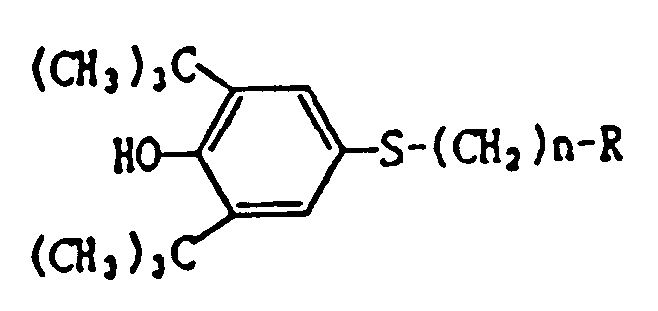
dans laquelle R est le radical cyano, carbamoyle ou 5-tétrazolyle ; n est un entier de 2 à 6 ; du moment que, quand R est le radical cyano, n est différent de 2, ou l'un de ses sels acceptables d'un point de vue pharmaceutique ou vétérinaire, dans la fabrication d'un médicament destiné au traitement ou à la prophylaxie de l'artériosclérose ou de l'athérosclérose.
dans laquelle R est le radical cyano, carbamoyle ou 5-tétrazolyle ; n est un entier de 2 à 6 ; du moment que, quand R est le radical cyano, n est différent de 2, ou l'un de ses sels acceptables d'un point de vue pharmaceutique ou vétérinaire, dans la fabrication d'un médicament destiné au traitement ou à la prophylaxie de l'artériosclérose ou de l'athérosclérose.
2. Utilisation selon la revendication 1, dans laquelle le composé est le 4-(3,5-di-tert-butyl-4-hydroxy)phénylthiobutylonitrile,
le 5-(3,5-di-tert-butyl-4-hydroxy)phénylthiopentanonitrile, le 6-(3,5-di-tert-butyl-4-hydroxy)phénylthiohexanonitrile,
le 7-(3,5-di-tert-butyl-4-hydroxy)phénylthioheptanonitrile, le 5-[2-(3,5-di-tert-butyl-4-hydroxy)phénylthioéthyl]tétrazole,
le 5-[3,5-di-tert-butyl-4-hydroxy)-phénylthiopropyl]tétrazole, le 5-[5-(3,5-di-tert-butyl-4-hydroxy)phénylthiopentyl]tétrazole,
ou le 6-(3,5-di-tert-butyl-4-hydroxy)phénylthiohexanamide.
3. Utilisation selon la revendication 1 ou 2, dans laquelle on prépare le composé en
faisant réagir du 2,6-di-tert-butyl-4-mercaptophénol avec un agent d'alkylation, puis
éventuellement on forme un amide d'acide ou un tétrazole, puis éventuellement en soumettant
à une salification le composé obtenu.
4. Utilisation selon l'une quelconque des revendications précédentes, dans laquelle le
médicament comprend un diluant, un excipient, un véhicule, un stabilisant, un liant,
un lubrifiant, un solvant, un solubilisateur ou un dispersant, acceptables d'un point
de vue pharmaceutique ou vétérinaire.