|
(11) | EP 0 381 853 B1 |

| (12) | EUROPEAN PATENT SPECIFICATION |
|
|
| (54) |
Stabilized sulfur dissolving compositions Stabilisierte, Schwefel lösende Zusammensetzungen Des compositions dissolvantes pour souffre stabilisées |
|
|
|||||||||||||||||||||||||||||||
| Note: Within nine months from the publication of the mention of the grant of the European patent, any person may give notice to the European Patent Office of opposition to the European patent granted. Notice of opposition shall be filed in a written reasoned statement. It shall not be deemed to have been filed until the opposition fee has been paid. (Art. 99(1) European Patent Convention). |
[0001] This invention relates to a composition of matter which is an organic di- or polysulfide incorporating a catalytic amount of an amine/mercaptan mixture and a stabilizer to provide a sulfur-solvent capable of dissolving unexpectedly large amounts of sulfur at a high rate with low loss of catalyst activity on storage.
[0002] In the processing of sour gas wells, sulfur may form deposits that can plug the well and cease production. These deposits have been prevented or dissolved by flowing solvents such as carbon disulfide, mineral and spindle oils, organic solvents and aqueous alkylamines downhole to dissolve the sulfur plug. The solvent is injected downhole and the well is allowed to soak for sufficient time to dissolve any existing sulfur plugs. Alternatively, the solvent can be injected continuously in amounts sufficient to prevent the formation of sulfur deposits. The above systems all have various disadvantages such as toxicity, flammability, corrosivity and limited ability to dissolve sulfur.
[0003] Dialkyl disulfides, either alone or blended with dialkyl sulfides, as disclosed in U. S. Patent 3,531,160, have become the sulfur solvents of choice. Hyne et al. [Alberta Sulfur Research, Ltd. (ASRL), Quarterly Bulletin, Vol. XVIII, Nos. 2, 3 and 4, 1982, pp. 44+] have shown that lower dialkyl disulfides, especially dimethyl disulfide (DMDS) are preferred. Alone, the disulfides take up only a limited amount of sulfur; however, in conjunction with a suitable catalyst system, they can take up approximately 1.5 times their weight in sulfur at room temperature.
[0004] U. S. Patent 3,846,311 teaches that a composition of one or more dialkyl disulfides and up to 10 weight percent of an unsubstituted saturated, aliphatic amine is capable of consuming over 200 weight percent sulfur after aging the composition. French patents 2,152,532 and 2,159,320 disclose similar compounds which are useful without aging. It is also taught in the art that adding a small amount of sulfur (5-40 weight percent) to the above compositions accelerates the rate of sulfur uptake (U. S. Patent 4,239,630).
[0005] U. S. Patent 4,290,900 teaches that the above sulfideamine composition is not as effective if vaporization occurs, which is often the case in deep wells where temperatures greater than 250°F may be encountered. Therefore, they disclose the use of a composition of a dialkyl disulfide and a fatty acid amine (> 30 wt. %) which has been aged. Further, U. S. Patent 4,248,717 teaches that the addition of 60 weight percent sulfur to the above composition accelerates sulfur uptake.
[0006] EP-A-0 289 950 describes a composition, useful for dissolving sulfur, which comprises a disulfide or polysulfide and a catalyst comprising one or more polyalkyleneoxyamines or polyamines.
[0007] Hyne et al. (ASRL Quarterly Bulletin, Vol. XX, No. 3, pp. 1+) show that sodium hydrosulfide (NaSH) and dimethylformamide (used as a co-solvent) is an effective system for catalyzing sulfur uptake using DMDS. They also demonstrated, as reported in the aforementioned ASRL Quarterly Bulletin Vol. XVIII, that a variety of alkali salts of a series of thiophenols, in conjunction with dimethylformamide (DMF), catalyze sulfur uptake. It is known that the sulfur recovery systems of Hyne et al. have one major drawback; they are not storage-stable and lose activity within 3-10 days when standing at room temperature.
[0008] This invention is a composition comprising a di- or polysulfide, and a catalytic amount of a mixture comprising an amine and a mercaptan to which is added a suitable amount of a stabilizing agent to inhibit loss of catalytic activity.
[0009] This invention is a superior, storage-stable composition for dissolving sulfur. The composition may be used whenever a requirement for sulfur removal exists. One application is to dissolve or prevent sulfur plugs in sour and super-sour oil and gas wells.
[0010] A disulfide or a polysulfide of a low sulfur rank can be used for the composition of this invention. The sulfur rank is defined as the average of the number of sulfur atoms between the two alkyl groups in a mixture of di- and polysulfides. A rank greater than 2 but less than 3 is considered low. A low sulfur rank is preferred since a polysulfide with a sulfur rank greater than 3 will have a limited capacity to take up additional sulfur.
[0011] The disulfide or polysulfide component of the composition of this invention has the formula
R¹SSASR²
wherein R¹ and R² are independently selected from alkyl, aryl, alkaryl, alkoxyalkyl or hydroxyalkyl radicals of 1-24 carbons and A is the average number of internal sulfur atoms in the sulfide and ranges from 0 to 3. The most preferred embodiment is when R¹ and R² are methyl and A is 0, i.e., dimethyl disulfide.
[0012] Suitable amines of the catalyst mixture are selected from amines of the structure
R³R⁴R⁵N
wherein R³, R⁴ and R⁵ are independently hydrogen, alkyl, alkaryl, aryl, cycloalkyl, hydroxyalkyl or alkoxyalkyl, and R³ and R⁴ may, together with the nitrogen, form a heterocyclic ring such as pyrrolidine, piperidine, morpholine or pyridine. The alkyl moiety of these amines generally contain from 1 to 30 carbon atoms.
[0013] Also suitable are polyamines of the general structure
wherein R⁶-R¹² are independently selected from hydrogen, alkyl, cycloalkyl, aryl or alkaryl groups where the alkyl moieties have from 1 to 25 carbon atoms and x is an integer from 0 to 25. R⁶ and R⁷ and R¹¹ and R¹² may also, with the nitrogen, form a heterocyclic ring such as pyrrolidine, piperidine or morpholine. Bicyclic amines such as 1,4-diazabicyclo [2.2.2]-octane, 1,5. diazabicyclo-[4.3.0]non-5-ene, and 1,8-diazabicyclo [5.4.0]undec-7-ene are also suitable catalysts.
[0014] The formulas 1, 2, 3, and 4 shown below are given as examples to demonstrate the types of polyalkyleneoxyamines and -polyamines that will act as catalysts for sulfur-uptake by disulfides or polysulfides of low sulfur rank.
where R¹³, R¹⁴, R¹⁵, R¹⁶, R¹⁷, R²⁰, R²², R²³, R²⁴, R²⁵, R²⁶, R²⁷, and R²⁸ are independently H, alkyl, alkaryl, hydroxyalkyl, alkoxyalkyl, haloalkyl, wherein the alkyl moieties have from 1 to 20 carbon atoms, or phenyl; R¹⁸ R¹⁹, and R²⁹ are independently H, alkyl, hydroxyalkyl, alkoxyalkyl, alkaryl wherein the alkyl moieties have from 1 to 10 carbon atoms, aryl, or -CONH₂; R²¹ is the hydrocarbon residue of a triol; and b, c, d, e, f, g, h, x, y, and z are independently values of 0-200, provided, however, that the total of such values is no less than 2.
[0015] Jeffamines®, a series of polyalkyleneoxyamines produced by the Texaco Chemical Company, are exemplary of the type of compounds that are suitable in the catalytic mixture for sulfur-uptake by disulfides or polysufides of low sulfur rank. Furthermore, any polyalkylene-oxy-compound which contains an amine functionality will be active. Additionally, formula 4 shows the hydrocarbon residue of a triol, such as glycerol, (R¹¹) as the base of the compound, although any other similar polyalkyleneoxyamine which incorporates any polyol as its base should also be effective.
[0016] Examples of Jeffamine® products which are preferred for this invention include those identified below under the alpha-numeric product designation.
Mixtures of one or more of the aforementioned amine catalysts are also suitable. The amines are incorporated in the composition in amounts sufficient to improve the sulfur uptake of the di- or polysulfide and preferably in an amount ranging from 10 ppm to 20 weight%, with 1-2 wt% being most preferred.
[0017] The catalyst mixture of this invention contains one or more mercaptans of the formula
R³⁰SH
where R³⁰ is independently alkyl, cycloalkyl, aryl, alkaryl, hydroxyalkyl or alkoxyalkyl wherein the alkyl moieties have from 1 to 25 carbon atoms. Also suitable are heterocyclic mercaptans such as 2-mercapto-benzothiazole and 4-mercaptopyridine and di- and polymercaptans such as ethanedithiol and propylenedithiol. The preferred mercaptans for use in the catalytic mixture of this invention include C₁-C₂₅ alkyl mercaptans. The most preferred are C₈-C₁₂ alkyl mercaptans.
[0018] The mercaptans are incorporated in the composition in amounts sufficient to activate the amine catalyst and enhance catalyst activity. Amounts within the range of 10 parts per million (ppm) to 20 weight%, preferably from 0.5 to 3%, based on the composition weight, are normally used.
[0019] The stabilizers which are useful in the composition of this invention in amounts sufficient to inhibit loss of catalytic activity on storage include compounds having the formula
R³¹-R³⁵ are independently hydroxy, linear or branched alkyl, cycloalkyl, aryl, alkaryl, hydroxy or alkoxyalkyl, hydroxy or alkoxy aryl, thioalkyl, thioaryl, amino alkyl or amino aryl wherein the alkyl moieties have from 1 to 25 carbon atoms. Examples of these stabilizers include hydroquinine, 2,6-di-tert-butyl-4-methylphenol (BHT), catechol and 4-tert-butyl-catechol (TBC).
[0020] Also suitable are compounds having the structure
R³⁶R³⁷NOR³⁸
wherein R³⁶ and R³⁷ are independently alkyl, aryl, alkaryl, hydroxy or alkoxyalkyl wherein the alkyl moieties have from 1 to 25 carbon atoms, and R³⁸ is selected from hydrogen, alkyl, aryl, alkaryl, hydroxyalkyl or alkoxyalkyl wherein the alkyl moieties have from 1 to 25 carbon atoms. N,N-Diethylhydroxylamine (DEHA) is the most preferred stabilizer.
[0021] Amounts of the stabilizer, based on the weight of the composition, range generally from 10 ppm to 100,000 ppm, preferably from 500 to 1500 ppm with 1,000 ppm the most preferred.
EXAMPLES
EXAMPLE 1
[0022] To 290.4g of DMDS is added 1.5g Jeffamine® D230 and the mixture is stirred for three hours. 2.7g Jeffamine® ED600 and 2.7g of t-butylmercaptan are then added. Two 100mL aliquots were taken and to one was added the stabilizer 0.1g DEHA and to the other the stabilizer 0.1g t-butylcatechol (TBC). The sulfur uptake activity of these solutions after aging in storage was measured by adding 3.5g powdered sulfur to 9.5g of solvent and noting the time it takes for complete dissolution. The results of both fresh and aged solutions, summarized in Table 1, demonstrate the efficiency of DEHA and TBC as stabilizers of catalytic activity on storage of the sulfur-solvent composition.
[0023] A second set of tests was run following the procedure of Example 1 except that t-nonyl mercaptan was used instead of t-butylmercaptan. These results, also in Table 1, further show the efficacy of DEHA and TBC as stabilizers.
TABLE 1
| Example | Mercaptan | Stabilizer | Sulfur Uptake Times (sec.) Aged | ||
| Fresh | 40 days | 136 days | |||
| 1 | t-Butyl | - | 53 | 63 | 750 |
| t-Butyl | 0.1% DEHA | 53 | 45 | 50 | |
| t-Butyl | 0.1% TBC | 53 | 49 | 55 | |
| 2 | t-Nonyl | - | 51 | 571 | 960 |
| t-Nonyl | 0.1% DEHA | 51 | 53 | 50 | |
| t-Nonyl | 0.1% TBC | 51 | 73 | 210 | |
1. A storage-stable composition for the dissolution of sulfur which comprises a major
proportion of a sulfide of the formula R¹SSASR² where R¹ and R² are independently alkyl, aryl, alkaryl, alkoxyalkyl or hydroxyalkyl
radicals wherein the alkyl moiety has from 1 to 24 carbon atoms and A is an average
number ranging from 0 to 3, a catalytic amount of a mixture of an amine and a mercaptan,
and a stabilizing component in amount sufficient to inhibit loss of catalyst activity
on storage, wherein said stabilizing component is a substituted phenol of the general
structure
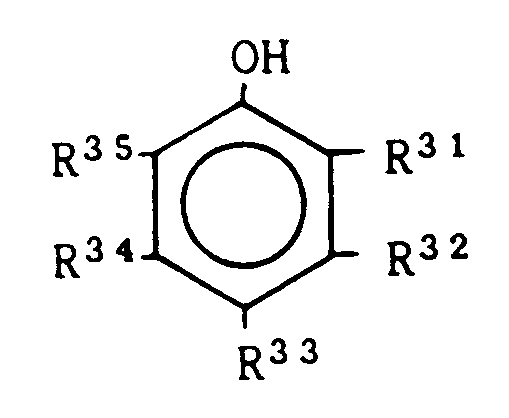
wherein R³¹, R³², R³³, R³⁴ and R³⁵ are independently hydroxy, linear or branched alkyl, cycloalkyl, aryl, alkaryl, hydroxyalkyl, alkoxyalkyl, hydroxyaryl, alkoxyaryl, thioalkyl, thioaryl, amino alkyl or amino aryl radicals wherein the alkyl moieties have from 1 to 25 carbon atoms, or a compound having the structure
R³⁶R³⁷NOR³⁸
wherein R³⁶ and R³⁷ are independently alkyl, aryl, alkaryl, hydroxyalkyl or alkoxyalkyl radicals wherein the alkyl moieties have from 1 to 25 carbon atoms and R³⁸ is a hydrogen, alkyl, aryl, alkaryl, hydroxyalkyl or alkoxyalkyl radical wherein the alkyl moieties have from 1 to 25 carbon atoms.
wherein R³¹, R³², R³³, R³⁴ and R³⁵ are independently hydroxy, linear or branched alkyl, cycloalkyl, aryl, alkaryl, hydroxyalkyl, alkoxyalkyl, hydroxyaryl, alkoxyaryl, thioalkyl, thioaryl, amino alkyl or amino aryl radicals wherein the alkyl moieties have from 1 to 25 carbon atoms, or a compound having the structure
R³⁶R³⁷NOR³⁸
wherein R³⁶ and R³⁷ are independently alkyl, aryl, alkaryl, hydroxyalkyl or alkoxyalkyl radicals wherein the alkyl moieties have from 1 to 25 carbon atoms and R³⁸ is a hydrogen, alkyl, aryl, alkaryl, hydroxyalkyl or alkoxyalkyl radical wherein the alkyl moieties have from 1 to 25 carbon atoms.
2. The composition of claim 1 wherein said amine has the formula R³R⁴R⁵N where R³,R⁴
and R⁵ are independently hydrogen, alkyl, alkaryl, aryl, cycloalkyl, hydroxyalkyl
or alkoxyalkyl radicals wherein the alkyl moieties have from 1 to 30 carbon atoms
and R³ and R⁴ may, with the nitrogen form a heterocyclic ring.
3. The composition of claim 1 wherein said amine is a polyamine of the formula
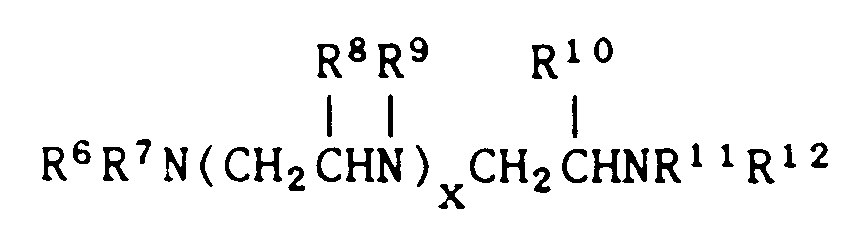
wherein R⁶ to R¹²are independently hydrogen, alkyl, aryl, cycloalkyl or alkaryl radicals wherein the alkyl moieties have from 1 to 25 carbon atoms and x is an integer from 0 to 25, and optionally, wherein R⁶, R⁷, R¹¹ and R¹² may, with the nitrogen form a heterocyclic ring.
wherein R⁶ to R¹²are independently hydrogen, alkyl, aryl, cycloalkyl or alkaryl radicals wherein the alkyl moieties have from 1 to 25 carbon atoms and x is an integer from 0 to 25, and optionally, wherein R⁶, R⁷, R¹¹ and R¹² may, with the nitrogen form a heterocyclic ring.
4. The compositions of anyone of claims 1 to 3 wherein the mercaptan is of the formula
R³⁰SH
where R³⁰ is independently an alkyl, aryl, alkaryl, cycloalkyl, alkoxyalkyl or hydroxyalkyl radical wherein the alkyl moieties have from 1 to 25 carbon atoms.
R³⁰SH
where R³⁰ is independently an alkyl, aryl, alkaryl, cycloalkyl, alkoxyalkyl or hydroxyalkyl radical wherein the alkyl moieties have from 1 to 25 carbon atoms.
5. The composition of anyone of claims 1 to 4 where R¹ and R² are alkyl radicals.
6. The composition of claim 5 where R¹ and R² are C₁-C₄ alkyl radicals and A is 0 to
1.5.
7. The composition of claim 6 where R¹ and R² are methyl and where A is 0.
8. The composition of claim 1 wherein said aliphatic amine is triethylamine.
9. The composition of claim 1 wherein said amine is a polyamine of the formula

where R¹³⁻¹⁷ are independently hydrogen, alkyl, alkaryl, hydroxyalkyl, alkoxyalkyl or haloalkyl radicals wherein the alkyl moieties have from 1 to 20 carbon atoms, or phenyl; R¹⁸⁻¹⁹ are independently hydrogen, alkyl, hydroxyalkyl, alkoxyalkyl, alkaryl radicals wherein the alkyl moieties have from 1 to 10 carbon atoms, aryl or -CONH₂; and b, x, y and z are independent values of 0 to 200 provided, however, that the total of such values is no less than 2.
where R¹³⁻¹⁷ are independently hydrogen, alkyl, alkaryl, hydroxyalkyl, alkoxyalkyl or haloalkyl radicals wherein the alkyl moieties have from 1 to 20 carbon atoms, or phenyl; R¹⁸⁻¹⁹ are independently hydrogen, alkyl, hydroxyalkyl, alkoxyalkyl, alkaryl radicals wherein the alkyl moieties have from 1 to 10 carbon atoms, aryl or -CONH₂; and b, x, y and z are independent values of 0 to 200 provided, however, that the total of such values is no less than 2.
10. The composition of claim 1 wherein said amine is a polyamine of the formula

where R¹³⁻¹⁷ are independently hydrogen, alkyl, alkaryl, hydroxyalkyl, alkoxyalkyl or haloalkyl radicals wherein the alkyl moieties have from 1 to 20 carbon atoms, or phenyl; R¹⁸⁻¹⁹ are independently hydrogen, alkyl, hydroxyalkyl, alkoxyalkyl, alkaryl radicals wherein the alkyl moieties have from 1 to 10 carbon atoms, aryl or -CONH₂; and x, y and z are independent values of 0 to 200 provided, however, that the total of such values is no less than 2.
where R¹³⁻¹⁷ are independently hydrogen, alkyl, alkaryl, hydroxyalkyl, alkoxyalkyl or haloalkyl radicals wherein the alkyl moieties have from 1 to 20 carbon atoms, or phenyl; R¹⁸⁻¹⁹ are independently hydrogen, alkyl, hydroxyalkyl, alkoxyalkyl, alkaryl radicals wherein the alkyl moieties have from 1 to 10 carbon atoms, aryl or -CONH₂; and x, y and z are independent values of 0 to 200 provided, however, that the total of such values is no less than 2.
11. The composition of claim 1 wherein said amine is a polyamine of the formula

where R¹³⁻¹⁶ and R²⁰ are independently hydrogen, alkyl, alkaryl, hydroxyalkyl, alkoxyalkyl or haloalkyl radicals wherein the alkyl moieties have from 1 to 20 carbon atoms, or phenyl; R¹⁸ is hydrogen, alkyl, hydroxyalkyl, alkoxyalkyl, alkaryl wherein the alkyl moieties have from 1 to 10 carbon atoms, aryl or -CONH₂; and x, y and z are independent values of 0 to 200 provided, however, that the total of such values is no less than 2.
where R¹³⁻¹⁶ and R²⁰ are independently hydrogen, alkyl, alkaryl, hydroxyalkyl, alkoxyalkyl or haloalkyl radicals wherein the alkyl moieties have from 1 to 20 carbon atoms, or phenyl; R¹⁸ is hydrogen, alkyl, hydroxyalkyl, alkoxyalkyl, alkaryl wherein the alkyl moieties have from 1 to 10 carbon atoms, aryl or -CONH₂; and x, y and z are independent values of 0 to 200 provided, however, that the total of such values is no less than 2.
12. The composition of claim 1 wherein said amine is a polyamine of the formula
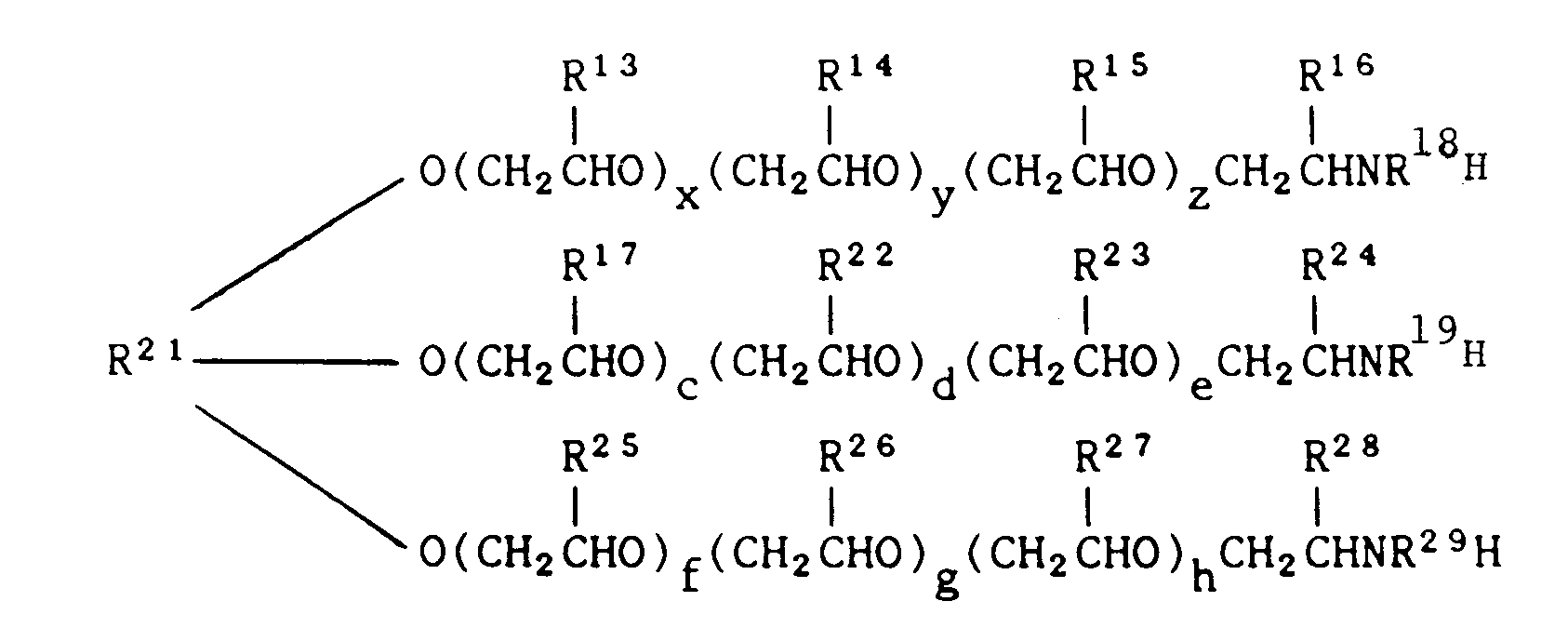
where R¹³⁻¹⁷ and R²²⁻²⁸ are independently hydrogen, alkyl, alkaryl, hydroxyalkyl, alkoxyalkyl or haloalkyl radicals wherein the alkyl moieties have from 1 to 20 carbon atoms, or phenyl; R¹⁸⁻¹⁹ and R²⁹ are independently hydrogen, alkyl, hydroxyalkyl, alkoxyalkyl, alkaryl radicals wherein the alkyl moieties have from 1 to 10 carbon atoms, aryl or -CONH₂; R²¹ is the hydrocarbon residue of a triol; and c, d, e, f, g, h, x, y and z are independent values of 0 to 200 provided, however, that the total of such values is no less than 2.
where R¹³⁻¹⁷ and R²²⁻²⁸ are independently hydrogen, alkyl, alkaryl, hydroxyalkyl, alkoxyalkyl or haloalkyl radicals wherein the alkyl moieties have from 1 to 20 carbon atoms, or phenyl; R¹⁸⁻¹⁹ and R²⁹ are independently hydrogen, alkyl, hydroxyalkyl, alkoxyalkyl, alkaryl radicals wherein the alkyl moieties have from 1 to 10 carbon atoms, aryl or -CONH₂; R²¹ is the hydrocarbon residue of a triol; and c, d, e, f, g, h, x, y and z are independent values of 0 to 200 provided, however, that the total of such values is no less than 2.
13. The composition of claim 4 where R³⁰ is an alkyl radical having from 8 to 12 carbon
atoms.
14. The composition of anyone of claims 1 to 13 wherein said stabilizing component is
t-butylcatechol.
15. The composition of anyone of claims 1 to 13 wherein said stabilizing component is
N,N-diethylhydroxylamine.
16. The composition of claim 7 wherein said amine has the formula
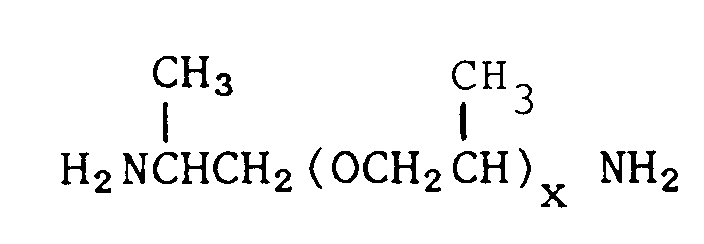
where x is an average value of from 2 to 3 and is present in the amount of from 0.5 to 3.0% said mercaptan is n-octyl, sec-octyl, t-dodecyl or sec-dodecyl mercaptan or mixtures of these present in the amount of from 0.5 to 3.0%, and said stabilizer component is N,N-diethylhydroxylamine present in the amount of 500 to 1500 parts per million, all said amounts based on the weight of the composition.
where x is an average value of from 2 to 3 and is present in the amount of from 0.5 to 3.0% said mercaptan is n-octyl, sec-octyl, t-dodecyl or sec-dodecyl mercaptan or mixtures of these present in the amount of from 0.5 to 3.0%, and said stabilizer component is N,N-diethylhydroxylamine present in the amount of 500 to 1500 parts per million, all said amounts based on the weight of the composition.
17. The composition of claim 7 wherein said amine has the formula

where x and y are each positive values and together total an average value between about 2 and 3, and z is an average value between about 8 and 9 and is present in the amount of from 0.5 to 3.0%, said mercaptan is n-octyl, sec-octyl, t-dodecyl or sec-dodecyl mercaptan or mixtures of these present in the amount of from 0.5 to 3.0%, and said stabilizer component is N,N-diethylhydroxylamine present in the amount of 500 to 1500 parts per million, all said amounts based on the weight of the composition.
where x and y are each positive values and together total an average value between about 2 and 3, and z is an average value between about 8 and 9 and is present in the amount of from 0.5 to 3.0%, said mercaptan is n-octyl, sec-octyl, t-dodecyl or sec-dodecyl mercaptan or mixtures of these present in the amount of from 0.5 to 3.0%, and said stabilizer component is N,N-diethylhydroxylamine present in the amount of 500 to 1500 parts per million, all said amounts based on the weight of the composition.
1. Lagerstabile Masse zur Auflosung von Schwefel, dadurch gekennzeichnet, daß sie einen Hauptteil eines Sulfids der Formel R¹SSASR², worin R¹ und R² unabhängig voneinander für Alkyl-, Aryl-, Alkaryl-, Alkoxyalkyl-
oder Hydroxyalkylreste stehen, wobei die Alkylgruppierung 1 bis 24 Kohlenstoffatome
hat, und A eine Durchschnittszahl im Bereich von 0 bis 3 ist, eine katalytische Menge
eines Gemisches aus einem Amin und einem Mercaptan und stabilisierende Komponente
in einer genügenden Menge, daß ein Verlust der Katalysatoraktivität bei der Lagerung
gehemmt wird, enthält, wobei die stabilisierende Komponente ein substituiertes Phenol
der allgemeinen Formel
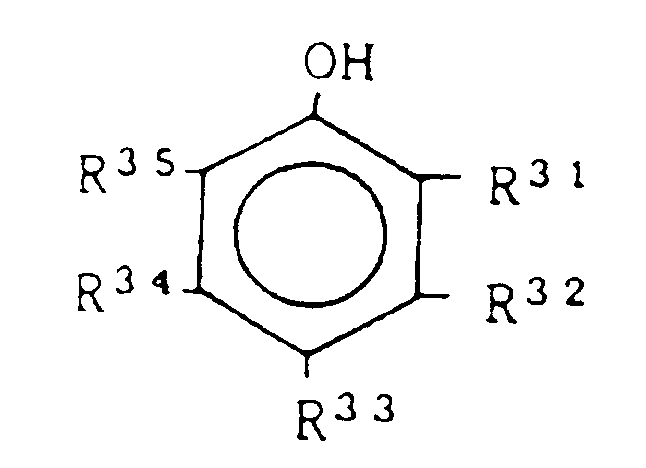
worin R³¹, R³², R³³, R³⁴ und R³⁵ unabhängig voneinander für Hydroxy-, lineare oder verzweigte Alkyl-, Cycloalkyl-, Aryl-, Alkaryl-, Hydroxyalkyl-, Alkoxyalkyl-, Hydroxyaryl-, Alkoxyaryl-, Thioalkyl-, Thioaryl-, Aminoalkyl- oder Aminoarylreste stehen, wobei die Alkylgruppierungen 1 bis 25 Kohlenstoffatome aufweisen oder eine Verbindung mit der Formel
R³⁶R³⁷NOR³⁸
worin R³⁶ und R³⁷ unabhängig voneinander für Alkyl-, Aryl-, Alkaryl-, Hydroxyalkyl- oder Alkoxyalkylreste stehen, wobei die Alkylgruppierungen 1 bis 25 Kohlenstoffatome aufweisen, und R³⁸ für Wasserstoff, einen Alkyl-, Aryl-, Alkaryl-, Hydroxyalkyl- oder Alkoxyalkylrest steht, wobei die Alkylgruppierungen 1 bis 25 Kohlenstoffatome haben, ist.
worin R³¹, R³², R³³, R³⁴ und R³⁵ unabhängig voneinander für Hydroxy-, lineare oder verzweigte Alkyl-, Cycloalkyl-, Aryl-, Alkaryl-, Hydroxyalkyl-, Alkoxyalkyl-, Hydroxyaryl-, Alkoxyaryl-, Thioalkyl-, Thioaryl-, Aminoalkyl- oder Aminoarylreste stehen, wobei die Alkylgruppierungen 1 bis 25 Kohlenstoffatome aufweisen oder eine Verbindung mit der Formel
R³⁶R³⁷NOR³⁸
worin R³⁶ und R³⁷ unabhängig voneinander für Alkyl-, Aryl-, Alkaryl-, Hydroxyalkyl- oder Alkoxyalkylreste stehen, wobei die Alkylgruppierungen 1 bis 25 Kohlenstoffatome aufweisen, und R³⁸ für Wasserstoff, einen Alkyl-, Aryl-, Alkaryl-, Hydroxyalkyl- oder Alkoxyalkylrest steht, wobei die Alkylgruppierungen 1 bis 25 Kohlenstoffatome haben, ist.
2. Masse nach Anspruch 1, dadurch gekennzeichnet, daß das Amin die Formel R³R⁴R⁵N hat, worin R³, R⁴ und R⁵ unabhängig voneinander für
Wasserstoff, Alkyl-, Alkaryl-, Aryl-, Cycloalkyl-, Hydroxyalkyl- oder Alkoxyalkylreste
stehen, wobei die Alkylgruppierungen 1 bis 30 Kohlenstoffatome haben, und R³ und R⁴
mit dem Stickstoffatom einen heterocyclischen Ring bilden können.
3. Masse nach Anspruch 1, dadurch gekennzeichnet, daß das Amin ein Polyamin der Formel
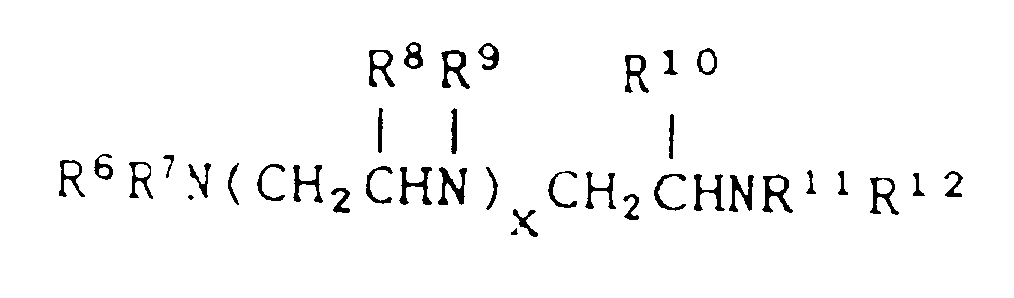
ist, worin R⁶ bis R¹² unabhängig voneinander für Wasserstoff, Alkyl-, Aryl-, Cycloalkyl-, oder Alkarylreste stehen, bei denen die Alkylgruppierungen 1 bis 25 Kohlenstoffatome haben, und x eine ganze Zahl von 0 bis 25 ist, und wobei ggf. R⁶, R⁷, R¹¹ und R¹² mit dem Stickstoffatom einen heterocyclischen Ring bilden.
ist, worin R⁶ bis R¹² unabhängig voneinander für Wasserstoff, Alkyl-, Aryl-, Cycloalkyl-, oder Alkarylreste stehen, bei denen die Alkylgruppierungen 1 bis 25 Kohlenstoffatome haben, und x eine ganze Zahl von 0 bis 25 ist, und wobei ggf. R⁶, R⁷, R¹¹ und R¹² mit dem Stickstoffatom einen heterocyclischen Ring bilden.
4. Massen nach einem der Ansprüche 1 bis 3, dadurch gekennzeichnet, daß das Mercaptan die Formel
R³⁰SH
hat, worin R³⁰ unabhängig für einen Alkyl-, Aryl-, Alkaryl-, Cycloalkyl-, Alkoxyalkyl- oder Hydroxyalkylrest steht, wobei die Alkylgruppierungen 1 bis 25 Kohlenstoffatome aufweisen.
R³⁰SH
hat, worin R³⁰ unabhängig für einen Alkyl-, Aryl-, Alkaryl-, Cycloalkyl-, Alkoxyalkyl- oder Hydroxyalkylrest steht, wobei die Alkylgruppierungen 1 bis 25 Kohlenstoffatome aufweisen.
5. Masse nach einem der Ansprüche 1 bis 4, dadurch gekennzeichnet, daß R¹ und R² Alkylreste sind.
6. Masse nach Anspruch 5, dadurch gekennzeichnet, daß R¹ und R² für C₁-C₄-Alkylreste stehen und daß A 0 bis 1,5 ist.
7. Masse nach Anspruch 6, dadurch gekennzeichnet, daß R¹ und R² für Methyl stehen und daß A den Wert 0 hat.
8. Masse nach Anspruch 1, dadurch gekennzeichnet, daß das aliphatische Amin Triethylamin ist.
9. Masse nach Anspruch 1, dadurch gekennzeichnet, daß das Amin ein Polyamin der Formel

ist, worin R¹³⁻¹⁷ unabhängig voneinander für Wasserstoff, Alkyl-, Alkaryl-, Hydroxyalkyl- oder Halogenalkylreste, wobei die Alkylgruppierungen 1 bis 20 Kohlenstoffatome aufweisen, oder Phenyl stehen; R¹⁸⁻¹⁹ unabhängig voneinander für Wasserstoff, Alkyl-, Hydroxyalkyl-, Alkoxyalkyl-, Alkarylreste stehen, wobei die Alkylgruppierungen 1 bis 10 Kohlenstoffatome aufweisen, Aryl oder -CONH₂ stehen; und b, x, y und z voneinander unabhängige Werte von 0 bis 200 sind, mit der Maßgabe jedoch, daß die Gesamtsumme dieser Werte nicht weniger als 2 ist.
ist, worin R¹³⁻¹⁷ unabhängig voneinander für Wasserstoff, Alkyl-, Alkaryl-, Hydroxyalkyl- oder Halogenalkylreste, wobei die Alkylgruppierungen 1 bis 20 Kohlenstoffatome aufweisen, oder Phenyl stehen; R¹⁸⁻¹⁹ unabhängig voneinander für Wasserstoff, Alkyl-, Hydroxyalkyl-, Alkoxyalkyl-, Alkarylreste stehen, wobei die Alkylgruppierungen 1 bis 10 Kohlenstoffatome aufweisen, Aryl oder -CONH₂ stehen; und b, x, y und z voneinander unabhängige Werte von 0 bis 200 sind, mit der Maßgabe jedoch, daß die Gesamtsumme dieser Werte nicht weniger als 2 ist.
10. Masse nach Anspruch 1, dadurch gekennzeichnet, daß das Amin ein Polyamin der Formel
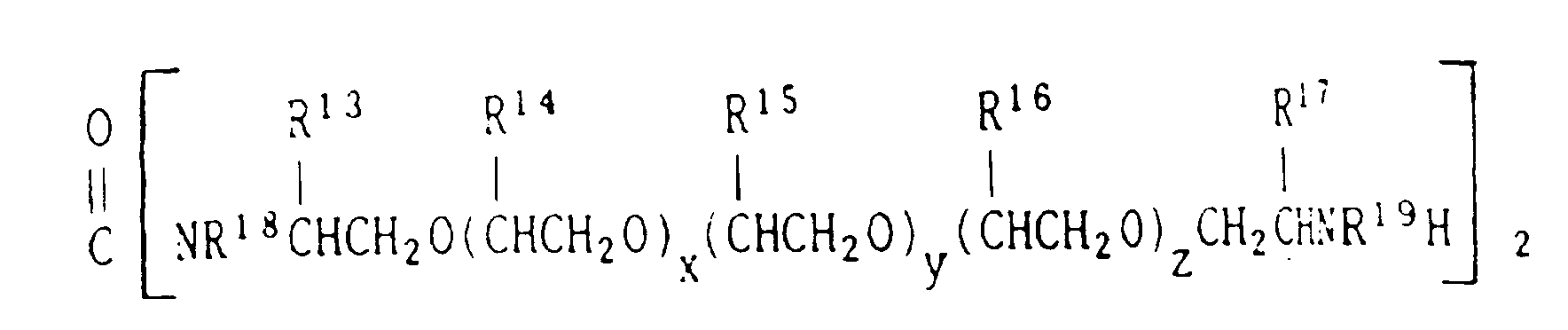
ist, worin R¹³⁻¹⁷ unabhängig für Wasserstoff, Alkyl-, Alkaryl-, Hydroxyalkyl-, Alkoxyalkyl- oder Halogenalkylreste, wobei die Alkylgruppierungen 1 bis 20 Kohlenstoffatome aufweisen, oder Phenyl stehen; R¹⁸⁻¹⁹ unabhängig voneinander für Wasserstoff, Alkyl-, Hydroxyalkyl-, Alkoxyalkyl-, Alkarylreste, wobei die Alkylgruppierungen 1 bis 10 Kohlenstoffatome aufweisen, Aryl oder -CONH₂ stehen und x, y und z voneinander unabhängige Werte von 0 bis 200 sind, jedoch mit der Maßgabe, daß die Gesamtsumme dieser Werte nicht weniger als 2 ist.
ist, worin R¹³⁻¹⁷ unabhängig für Wasserstoff, Alkyl-, Alkaryl-, Hydroxyalkyl-, Alkoxyalkyl- oder Halogenalkylreste, wobei die Alkylgruppierungen 1 bis 20 Kohlenstoffatome aufweisen, oder Phenyl stehen; R¹⁸⁻¹⁹ unabhängig voneinander für Wasserstoff, Alkyl-, Hydroxyalkyl-, Alkoxyalkyl-, Alkarylreste, wobei die Alkylgruppierungen 1 bis 10 Kohlenstoffatome aufweisen, Aryl oder -CONH₂ stehen und x, y und z voneinander unabhängige Werte von 0 bis 200 sind, jedoch mit der Maßgabe, daß die Gesamtsumme dieser Werte nicht weniger als 2 ist.
11. Masse nach Anspruch 1, dadurch gekennzeichnet, daß das Amin ein Polyamin der Formel

worin R¹³⁻¹⁶ und R²⁰ unabhängig voneinander für Wasserstoff, Alkyl-, Alkaryl-, Hydroxyalkyl-, Alkoxyalkyl- oder Halogenalkylreste, wobei die Alkylgruppierungen 1 bis 20 Kohlenstoffatome aufweisen, oder Phenyl stehen, R¹⁸ für Wasserstoff, Alkyl, Hydroxyalkyl, Alkoxyalkyl, Alkaryl, wobei die Alkylgruppierungen 1 bis 10 Kohlenstoffatome aufweisen, Aryl oder -CONH₂ steht; und x, y und z voneinander unabhängige Werte von 0 bis 200 sind, jedoch mit der Maßgabe, daß die Gesamtsumme dieser Werte nicht weniger als 2 ist.
worin R¹³⁻¹⁶ und R²⁰ unabhängig voneinander für Wasserstoff, Alkyl-, Alkaryl-, Hydroxyalkyl-, Alkoxyalkyl- oder Halogenalkylreste, wobei die Alkylgruppierungen 1 bis 20 Kohlenstoffatome aufweisen, oder Phenyl stehen, R¹⁸ für Wasserstoff, Alkyl, Hydroxyalkyl, Alkoxyalkyl, Alkaryl, wobei die Alkylgruppierungen 1 bis 10 Kohlenstoffatome aufweisen, Aryl oder -CONH₂ steht; und x, y und z voneinander unabhängige Werte von 0 bis 200 sind, jedoch mit der Maßgabe, daß die Gesamtsumme dieser Werte nicht weniger als 2 ist.
12. Masse nach Anspruch 1, dadurch gekennzeichnet, daß das Amin ein Polyamin der Formel
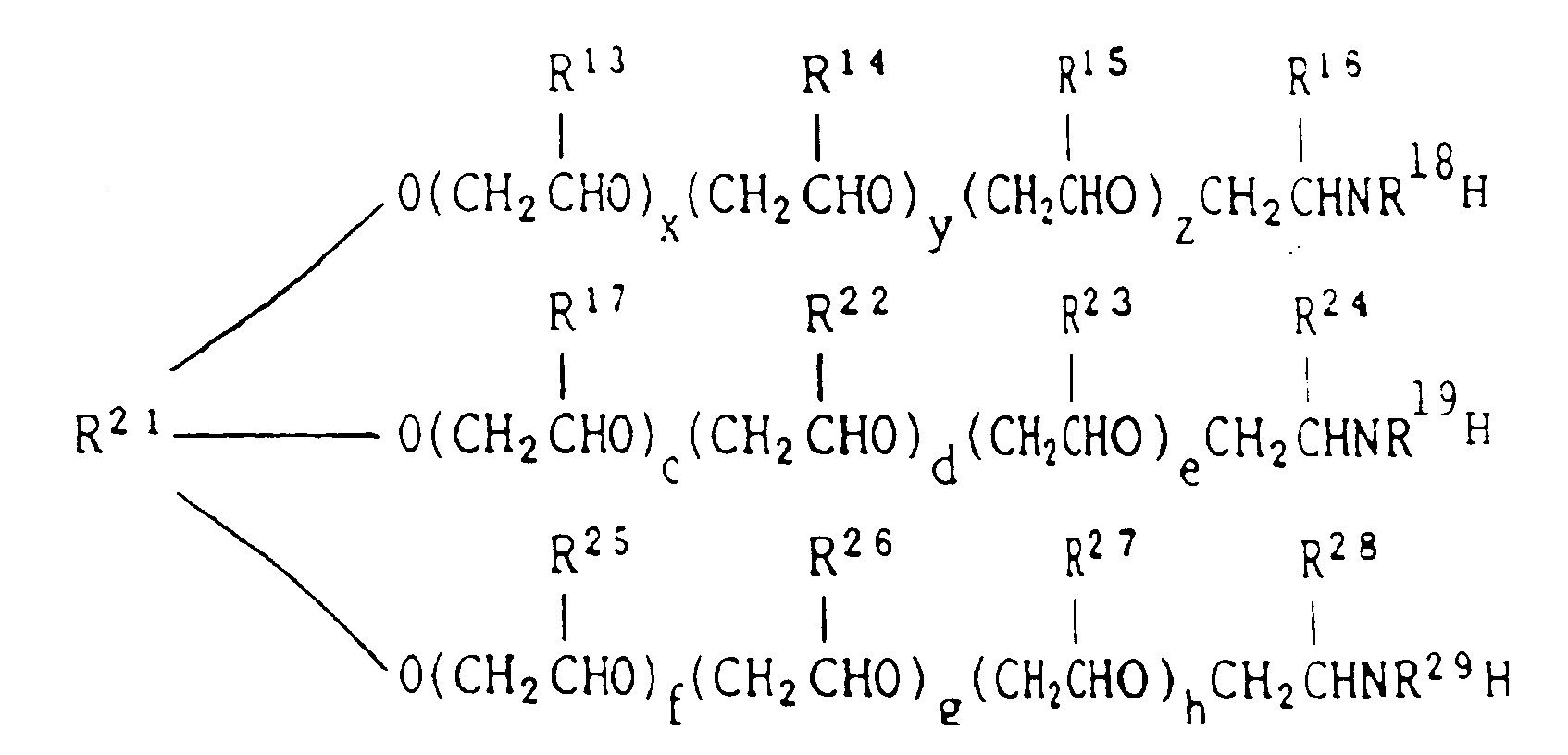
ist, worin R¹³⁻¹⁷ und R²²⁻²⁸ unabhängig voneinander für Wasserstoff, Alkyl-, Alkaryl-, Hydroxyalkyl-, Alkoxyalkyl- oder Halogenalkylreste, wobei die Alkylgruppierungen 1 bis 20 Kohlenstoffatome aufweisen, oder Phenyl stehen; R¹⁸⁻¹⁹ und R²⁹ unabhängig voneinander für Wasserstoff, Alkyl-, Hydroxyalkyl-, Alkoxyalky-, Alkarylreste, wobei die Alkylgruppierungen 1 bis 10 Kohlenstoffatome aufweisen, Aryl oder -CONH₂ stehen; R²¹ der Kohlenwasserstoffrest eines Triols ist; und c, d, e, f, g, h, x, y und z voneinander unabhängige Werte von 0 bis 200 sind, jedoch mit der Maßgabe, daß die Gesamtsumme dieser Werte nicht weniger als 2 ist.
ist, worin R¹³⁻¹⁷ und R²²⁻²⁸ unabhängig voneinander für Wasserstoff, Alkyl-, Alkaryl-, Hydroxyalkyl-, Alkoxyalkyl- oder Halogenalkylreste, wobei die Alkylgruppierungen 1 bis 20 Kohlenstoffatome aufweisen, oder Phenyl stehen; R¹⁸⁻¹⁹ und R²⁹ unabhängig voneinander für Wasserstoff, Alkyl-, Hydroxyalkyl-, Alkoxyalky-, Alkarylreste, wobei die Alkylgruppierungen 1 bis 10 Kohlenstoffatome aufweisen, Aryl oder -CONH₂ stehen; R²¹ der Kohlenwasserstoffrest eines Triols ist; und c, d, e, f, g, h, x, y und z voneinander unabhängige Werte von 0 bis 200 sind, jedoch mit der Maßgabe, daß die Gesamtsumme dieser Werte nicht weniger als 2 ist.
13. Masse nach Anspruch 4, dadurch gekennzeichnet, daß R³⁰ für einen Alkylrest mit 8 bis 12 Kohlenstoffatomen steht.
14. Masse nach einem der Ansprüche 1 bis 13, dadurch gekennzeichnet, daß die stabilisierende Komponente t-Butylbrenzcatechin ist.
15. Masse nach einem der Ansprüche 1 bis 13, dadurch gekennzeichnet, daß die stabilisierende Komponente N,N-Diethylhydroxylamin ist.
16. Masse nach Anspruch 7, dadurch gekennzeichnet, daß das Amin die Formel
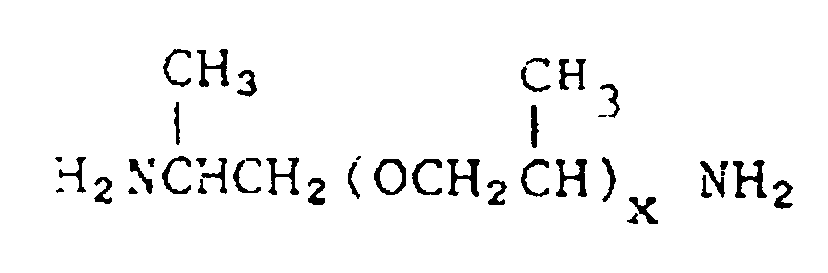
hat, worin x ein Mittelwert von 2 bis 3 ist, und daß es in einer Menge von 0,5 bis 3,0 % vorliegt, daß das Mercaptan n-Octyl-, sec-Octyl-, t-Dodecyl- oder sec-Dodecylmercaptan oder Gemische davon in einer Menge von 0,5 bis 3,0 % ist und daß die Stabilisatorkomponente N,N-Diethylhydroxylamin in einer Menge von 500 bis 1500 Teile pro Million ist, wobei alle Mengen auf das Gewicht der Masse bezogen sind.
hat, worin x ein Mittelwert von 2 bis 3 ist, und daß es in einer Menge von 0,5 bis 3,0 % vorliegt, daß das Mercaptan n-Octyl-, sec-Octyl-, t-Dodecyl- oder sec-Dodecylmercaptan oder Gemische davon in einer Menge von 0,5 bis 3,0 % ist und daß die Stabilisatorkomponente N,N-Diethylhydroxylamin in einer Menge von 500 bis 1500 Teile pro Million ist, wobei alle Mengen auf das Gewicht der Masse bezogen sind.
17. Masse nach Anspruch 7, dadurch gekennzeichnet, daß das Amin die Formel

hat, worin x und y jeweils positive Werte sind und miteinander einen Gesamtmittelwert zwischen etwa 2 und 3 haben, und z ein Mittelwert zwischen etwa 8 und 9 ist, daß dieses in einer Menge von 0,5 bis 3,0 % vorliegt, daß das Mercaptan n-Octyl-, sec-Octyl-, t-Dodecyl- oder sec-Dodecylmercaptan oder Gemische davon in einer Menge von 0,5 bis 3,0 % ist und daß die Stabilisatorkomponente N,N-Diethylhydroxylamin in einer Menge von 500 bis 1500 Teilen pro Million ist, wobei alle Mengen auf das Gewicht der Masse bezogen sind.
hat, worin x und y jeweils positive Werte sind und miteinander einen Gesamtmittelwert zwischen etwa 2 und 3 haben, und z ein Mittelwert zwischen etwa 8 und 9 ist, daß dieses in einer Menge von 0,5 bis 3,0 % vorliegt, daß das Mercaptan n-Octyl-, sec-Octyl-, t-Dodecyl- oder sec-Dodecylmercaptan oder Gemische davon in einer Menge von 0,5 bis 3,0 % ist und daß die Stabilisatorkomponente N,N-Diethylhydroxylamin in einer Menge von 500 bis 1500 Teilen pro Million ist, wobei alle Mengen auf das Gewicht der Masse bezogen sind.
1. Composition stable à l'entreposage pour la dissolution de soufre, qui comprend une
proportion dominante d'un sulfure de formule R¹SSASR² dans laquelle R¹ et R² représentent, indépendamment, des radicaux alkyle, aryle,
alkaryle, alkoxyalkyle ou hydroxyalkyle dont la portion alkyle a 1 à 24 atomes de
carbone et A est un nombre moyen allant de 0 à 3, une quantité catalytique d'un mélange
d'une amine et d'un mercaptan et un composant stabilisant en quantité suffisante pour
inhiber une perte d'activité du catalyseur pendant l'entreposage, où ledit composant
stabilisant est un phénol substitué de structure générale
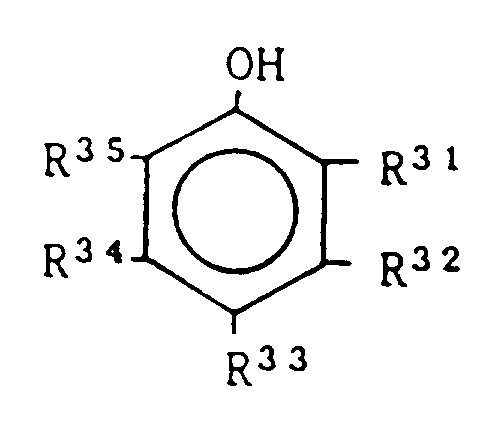
dans laquelle R³¹, R³², R³³, R³⁴ et R³⁵ représentent, indépendamment, des radicaux hydroxy, alkyle linéaires ou ramifiés, cycloalkyle, aryle, alkaryle, hydroxyalkyle, alkoxyalkyle, hydroxyaryle, alkoxyaryle, thioalkyle, thioaryle, aminoalkyle ou aminoaryle dont les portions alkyle ont 1 à 25 atomes de carbone, ou un composé de structure
R³⁶R³⁷NOR³⁸
dans laquelle R³⁶ et R³⁷ représentent, indépendamment, des radicaux alkyle, aryle, alkaryle, hydroxyalkyle ou alkoxyalkyle dont les portions alkyle ont 1 à 25 atomes de carbone et R³⁸ est un atome d'hydrogène, un radical alkyle, aryle, alkaryle, hydroxyalkyle ou alkoxyalkyle dont les portions alkyle ont 1 à 25 atomes de carbone.
dans laquelle R³¹, R³², R³³, R³⁴ et R³⁵ représentent, indépendamment, des radicaux hydroxy, alkyle linéaires ou ramifiés, cycloalkyle, aryle, alkaryle, hydroxyalkyle, alkoxyalkyle, hydroxyaryle, alkoxyaryle, thioalkyle, thioaryle, aminoalkyle ou aminoaryle dont les portions alkyle ont 1 à 25 atomes de carbone, ou un composé de structure
R³⁶R³⁷NOR³⁸
dans laquelle R³⁶ et R³⁷ représentent, indépendamment, des radicaux alkyle, aryle, alkaryle, hydroxyalkyle ou alkoxyalkyle dont les portions alkyle ont 1 à 25 atomes de carbone et R³⁸ est un atome d'hydrogène, un radical alkyle, aryle, alkaryle, hydroxyalkyle ou alkoxyalkyle dont les portions alkyle ont 1 à 25 atomes de carbone.
2. Composition suivant la revendication 1, dans laquelle l'amine répond à la formule
R³R⁴R⁵N dans laquelle R³, R⁴ et R⁵ représentent, indépendamment, de l'hydrogène, des
radicaux alkyle, alkaryle, aryle, cycloalkyle, hydroxyalkyle ou alkoxyalkyle dont
les portions alkyle ont 1 à 30 atomes de carbone et R³ et R⁴ peuvent former avec l'azote
un noyau hétérocyclique.
3. Composition suivant la revendication 1, dans laquelle l'amine est une polyamine de
formule
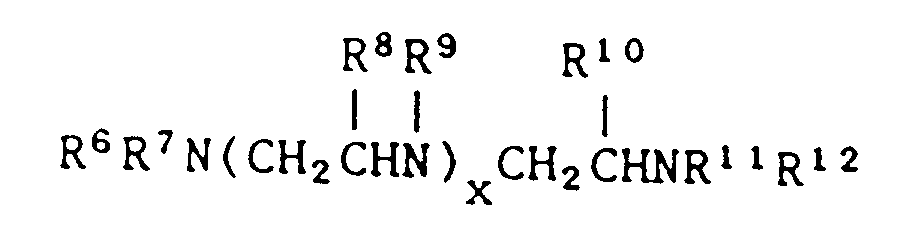
dans laquelle R⁶ à R¹² représentent, indépendamment, l'hydrogène, des radicaux alkyle, aryle, cycloalkyle ou alkaryle dont les portions alkyle ont 1 à 25 atomes de carbone et x est un nombre entier de 0 à 25 et, à titre facultatif, dans laquelle R⁶, R⁷, R¹¹ et R¹² peuvent former avec l'azote un noyau hétérocyclique.
dans laquelle R⁶ à R¹² représentent, indépendamment, l'hydrogène, des radicaux alkyle, aryle, cycloalkyle ou alkaryle dont les portions alkyle ont 1 à 25 atomes de carbone et x est un nombre entier de 0 à 25 et, à titre facultatif, dans laquelle R⁶, R⁷, R¹¹ et R¹² peuvent former avec l'azote un noyau hétérocyclique.
4. Compositions suivant l'une quelconque des revendications 1 à 3, dans lesquelles le
mercaptan répond à la formule
R³⁰SH
dans laquelle R³⁰ représente, indépendamment, un radical alkyle, aryle, alkaryle, cycloalkyle, alkoxyalkyle, ou hydroxyalkyle dont les portions alkyle ont 1 à 25 atomes de carbone.
R³⁰SH
dans laquelle R³⁰ représente, indépendamment, un radical alkyle, aryle, alkaryle, cycloalkyle, alkoxyalkyle, ou hydroxyalkyle dont les portions alkyle ont 1 à 25 atomes de carbone.
5. Composition selon l'une quelconque des revendications 1 à 4, dans laquelle R¹ et R²
sont des radicaux alkyle.
6. Composition suivant la revendication 5, dans laquelle R¹ et R² sont des radicaux alkyle
en C₁ à C₄ et A a une valeur de 0 à 1,5.
7. Composition suivant la revendication 6, dans laquelle R¹ et R² sont des radicaux méthyle
et A est égal à 0.
8. Composition suivant la revendication 1, dans laquelle l'amine aliphatique est la triéthylamine.
9. Composition suivant la revendication 1, dans laquelle l'amine est une polyamine de
formule

dans laquelle R¹³ à R¹⁷ représentent, indépendamment, de l'hydrogène, des radicaux alkyle, alkaryle, hydroxyalkyle, alkoxyalkyle ou halogénalkyle dont les portions alkyle ont 1 à 20 atomes de carbone, ou un radical phényle ; R¹⁸ et R¹⁹ représentent, indépendamment, l'hydrogène, des radicaux alkyle, hydroxyalkyle, alkoxyalkyle, alkaryle dont les portions alkyle ont 1 à 10 atomes de carbone, aryle ou -CONH₂ ; et b, x, y et z ont des valeurs indépendantes de 0 à 200, pourvu, toutefois, que le total de ces valeurs ne soit pas inférieur à 2.
dans laquelle R¹³ à R¹⁷ représentent, indépendamment, de l'hydrogène, des radicaux alkyle, alkaryle, hydroxyalkyle, alkoxyalkyle ou halogénalkyle dont les portions alkyle ont 1 à 20 atomes de carbone, ou un radical phényle ; R¹⁸ et R¹⁹ représentent, indépendamment, l'hydrogène, des radicaux alkyle, hydroxyalkyle, alkoxyalkyle, alkaryle dont les portions alkyle ont 1 à 10 atomes de carbone, aryle ou -CONH₂ ; et b, x, y et z ont des valeurs indépendantes de 0 à 200, pourvu, toutefois, que le total de ces valeurs ne soit pas inférieur à 2.
10. Composition suivant la revendication 1, dans laquelle l'amine est une polyamine de
formule

dans laquelle R¹³ à R¹⁷ représentent indépendamment de l'hydrogène, des radicaux alkyle, alkaryle, hydroxyalkyle, alkoxyaryle ou halogénalkyle dont les portions alkyle ont 1 à 20 atomes de carbone, ou phényle, R¹⁸ et R¹⁹ représentent, indépendamment, de l'hydrogène, des radicaux alkyle, hydroxyalkyle, alkoxyalkyle, alkaryle dont les portions alkyle ont 1 à 10 atomes de carbone, aryle ou -CONH₂ ; et x, y et z ont des valeurs indépendantes de 0 à 200 pourvu, toutefois, que le total de ces valeurs ne soit pas inférieur à 2.
dans laquelle R¹³ à R¹⁷ représentent indépendamment de l'hydrogène, des radicaux alkyle, alkaryle, hydroxyalkyle, alkoxyaryle ou halogénalkyle dont les portions alkyle ont 1 à 20 atomes de carbone, ou phényle, R¹⁸ et R¹⁹ représentent, indépendamment, de l'hydrogène, des radicaux alkyle, hydroxyalkyle, alkoxyalkyle, alkaryle dont les portions alkyle ont 1 à 10 atomes de carbone, aryle ou -CONH₂ ; et x, y et z ont des valeurs indépendantes de 0 à 200 pourvu, toutefois, que le total de ces valeurs ne soit pas inférieur à 2.
11. Composition suivant la revendication 1, dans laquelle l'amine est une polyamine de
formule

dans laquelle R¹³ à R¹⁶ et R²⁰ représentent, indépendamment, de l'hydrogène, des radicaux alkyle, alkaryle, hydroxyalkyle, alkoxyalkyle ou halogénalkyle dont les portions alkyle ont 1 à 20 atomes de carbone, ou phényle ; R¹⁸ représente l'hydrogène, des radicaux alkyle, hydroxyalkyle, alkoxyalkyle, alkaryle dont les portions alkyle ont 1 à 10 atomes de carbone, aryle ou -CONH² ; et x, y et z ont des valeurs indépendantes de 0 à 200, pourvu toutefois que le total de ces valeurs ne soit pas inférieur à 2.
dans laquelle R¹³ à R¹⁶ et R²⁰ représentent, indépendamment, de l'hydrogène, des radicaux alkyle, alkaryle, hydroxyalkyle, alkoxyalkyle ou halogénalkyle dont les portions alkyle ont 1 à 20 atomes de carbone, ou phényle ; R¹⁸ représente l'hydrogène, des radicaux alkyle, hydroxyalkyle, alkoxyalkyle, alkaryle dont les portions alkyle ont 1 à 10 atomes de carbone, aryle ou -CONH² ; et x, y et z ont des valeurs indépendantes de 0 à 200, pourvu toutefois que le total de ces valeurs ne soit pas inférieur à 2.
12. Composition suivant la revendication 1, dans laquelle l'amine est une polyamine de
formule
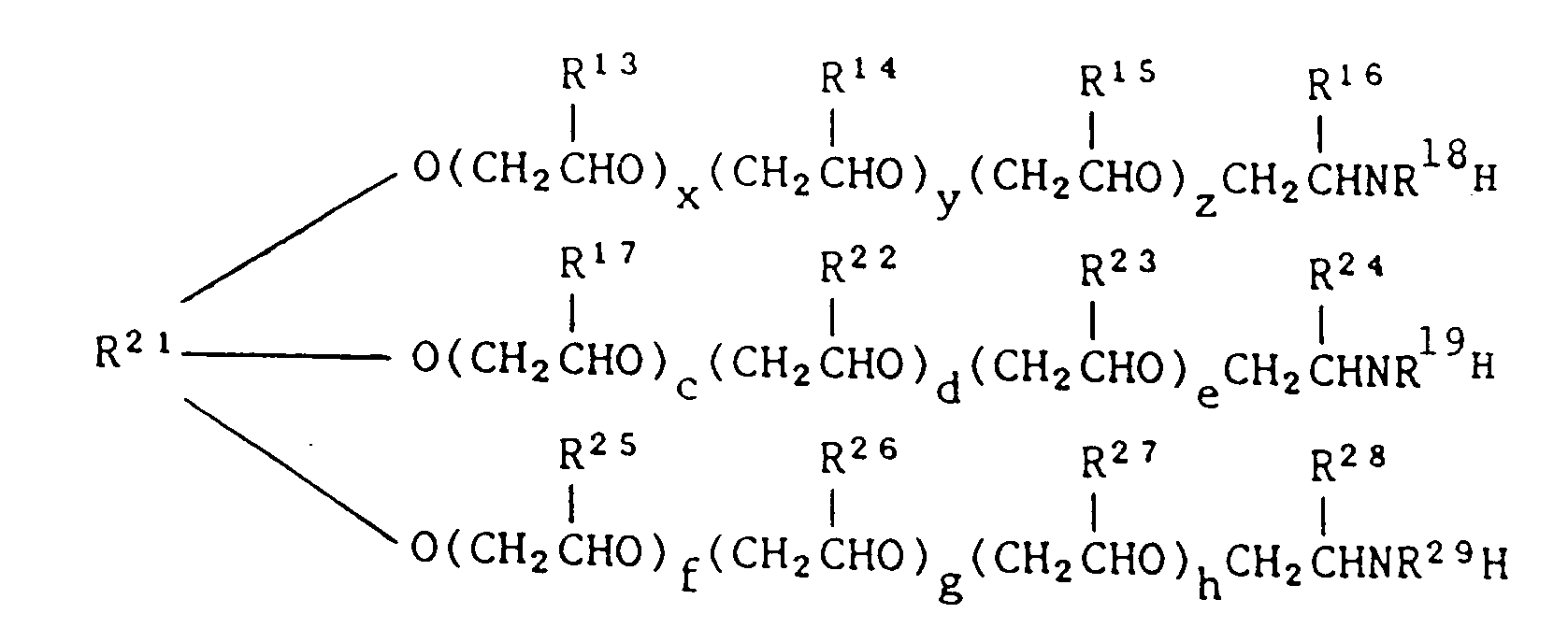
dans laquelle R¹³ à R¹⁷ et R²² à R²⁸ représentent, indépendamment, de l'hydrogène, des radicaux alkyle, alkaryle, hydroxyalkyle, alkoxyalkyle ou halogénalkyle dont les portions alkyle ont 1 à 20 atomes de carbone, ou phényle ; R¹⁸, R¹⁹ et R²⁹ représentent indépendamment de l'hydrogène, des radicaux alkyle, hydroxyalkyle, alkoxyalkyle, alkaryle, dont la portion alkyle a 1 à 10 atomes de carbone ; aryle ou -CONH² ; R²¹ est le résidu hydrocarboné d'un triol ; et c, d, e, f, g, h, x, y et z ont des valeurs indépendantes de 0 à 200 pourvu toutefois que le total de ces valeurs ne soit pas inférieur à 2.
dans laquelle R¹³ à R¹⁷ et R²² à R²⁸ représentent, indépendamment, de l'hydrogène, des radicaux alkyle, alkaryle, hydroxyalkyle, alkoxyalkyle ou halogénalkyle dont les portions alkyle ont 1 à 20 atomes de carbone, ou phényle ; R¹⁸, R¹⁹ et R²⁹ représentent indépendamment de l'hydrogène, des radicaux alkyle, hydroxyalkyle, alkoxyalkyle, alkaryle, dont la portion alkyle a 1 à 10 atomes de carbone ; aryle ou -CONH² ; R²¹ est le résidu hydrocarboné d'un triol ; et c, d, e, f, g, h, x, y et z ont des valeurs indépendantes de 0 à 200 pourvu toutefois que le total de ces valeurs ne soit pas inférieur à 2.
13. Composition suivant la revendication 4, dans laquelle R³⁰ est un radical alkyle ayant
8 à 12 atomes de carbone.
14. composition suivant l'une quelconque des revendications 1 à 13, dans laquelle le composant
stabilisant est le tertio-butylcatéchol.
15. Composition suivant l'une quelconque des revendications 1 à 13, dans laquelle le composant
stabilisant est la N,N-diéthylhydroxylamine.
16. Composition suivant la revendication 7, dans laquelle l'amine répond à la formule
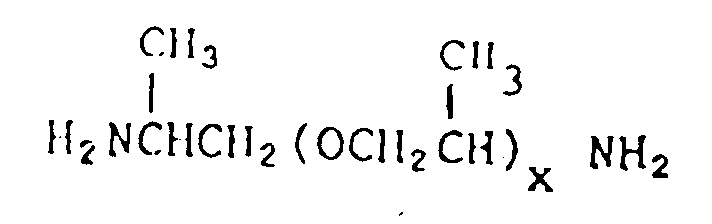
dans laquelle x a une valeur moyenne de 2 à 3, et est présente en quantité de 0,5 à 3,0 %, ledit mercaptan est le n-octyl-, le sec.-octyl-, tertio-dodécyl- ou le sec.-dodécylmercaptan ou des mélanges de ces mercaptans et est présent en quantité de 0,5 à 3,0 %, et le composant stabilisant est la N,N-diméthylhydroxylamine présente en quantité de 500 à 1500 parties par million, toutes ces quantités étant basées sur le poids de la composition.
dans laquelle x a une valeur moyenne de 2 à 3, et est présente en quantité de 0,5 à 3,0 %, ledit mercaptan est le n-octyl-, le sec.-octyl-, tertio-dodécyl- ou le sec.-dodécylmercaptan ou des mélanges de ces mercaptans et est présent en quantité de 0,5 à 3,0 %, et le composant stabilisant est la N,N-diméthylhydroxylamine présente en quantité de 500 à 1500 parties par million, toutes ces quantités étant basées sur le poids de la composition.
17. Composition suivant la revendication 7, dans laquelle l'amine répond à la formule
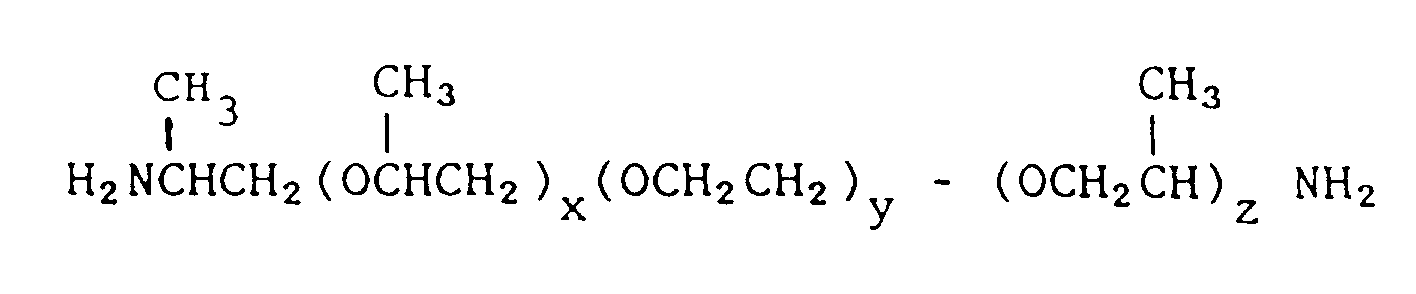
dans laquelle x et y ont chacun des valeurs positives et totalisent ensemble une valeur moyenne comprise entre environ 2 et 3, et z a une valeur moyenne d'environ 8 à 9, et elle est présente en quantité de 0,5 à 3,0 %, le mercaptan est le n-octyl-, le sec.-octyl-, le tertio-dodécyl- ou le sec.-dodécylmercaptan ou des mélanges de ces mercaptans et est présent en quantité de 0,5 à 3,0 %,, et le composant stabilisant est la N,N-diéthylhydroxylamine présente en quantités de 500 à 1500 parties par million, toutes ces quantités étant basées sur le poids de la composition.
dans laquelle x et y ont chacun des valeurs positives et totalisent ensemble une valeur moyenne comprise entre environ 2 et 3, et z a une valeur moyenne d'environ 8 à 9, et elle est présente en quantité de 0,5 à 3,0 %, le mercaptan est le n-octyl-, le sec.-octyl-, le tertio-dodécyl- ou le sec.-dodécylmercaptan ou des mélanges de ces mercaptans et est présent en quantité de 0,5 à 3,0 %,, et le composant stabilisant est la N,N-diéthylhydroxylamine présente en quantités de 500 à 1500 parties par million, toutes ces quantités étant basées sur le poids de la composition.