| (19) |
 |
|
(11) |
EP 0 382 266 A1 |
| (12) |
EUROPEAN PATENT APPLICATION |
| (43) |
Date of publication: |
|
16.08.1990 Bulletin 1990/33 |
| (22) |
Date of filing: 09.03.1988 |
|
| (51) |
International Patent Classification (IPC)5: E04H 12/22 |
|
| (84) |
Designated Contracting States: |
|
DE ES FR GB IT NL |
| (30) |
Priority: |
10.03.1987 GB 8705655
|
| (62) |
Application number of the earlier application in accordance with Art. 76 EPC: |
|
88302021.6 / 0282269 |
| (71) |
Applicant: Demarest, Vincent Michael |
|
Wallingford
Oxon OX9 6SL (GB) |
|
| (72) |
Inventor: |
|
- Demarest, Vincent Michael
Wallingford
Oxon OX9 6SL (GB)
|
| (74) |
Representative: Dunlop, Brian Kenneth Charles et al |
|
c/o Wynne-Jones, Lainé & James
22 Rodney Road
Cheltenham
Gloucestershire GL50 1JJ
Cheltenham
Gloucestershire GL50 1JJ (GB) |
|
| |
|
(57) A socket for an upright post of an external fence, the socket (11) having two components
(25, 26), each including two rigid flanges (27, 28), lying approximately perpendicular
to one another; the components (25, 26) being shiftable laterally relative to one
another to alter the dimensions of the socket (11) to suit post (10) of different
dimensions.
|
|
[0001] This invention relates to sockets for fences.
[0002] The invention consists in a socket for an upright post of an external fence, the
socket having two components each including two rigid flanges lying approximately
perpendicular to one another; the components being shiftable laterally relative to
one another to alter the dimensions of the socket to suit posts of different dimensions.
[0003] The invention may be performed in various ways and one specific embodiment with some
possible modifications will now be described by way of example with reference to the
accompanying drawings, in which:-
Figure 1 is a general perspective view of a section of a fence,
Figure 2 is a sectional end elevation through the fence at the position of an upright
post, and
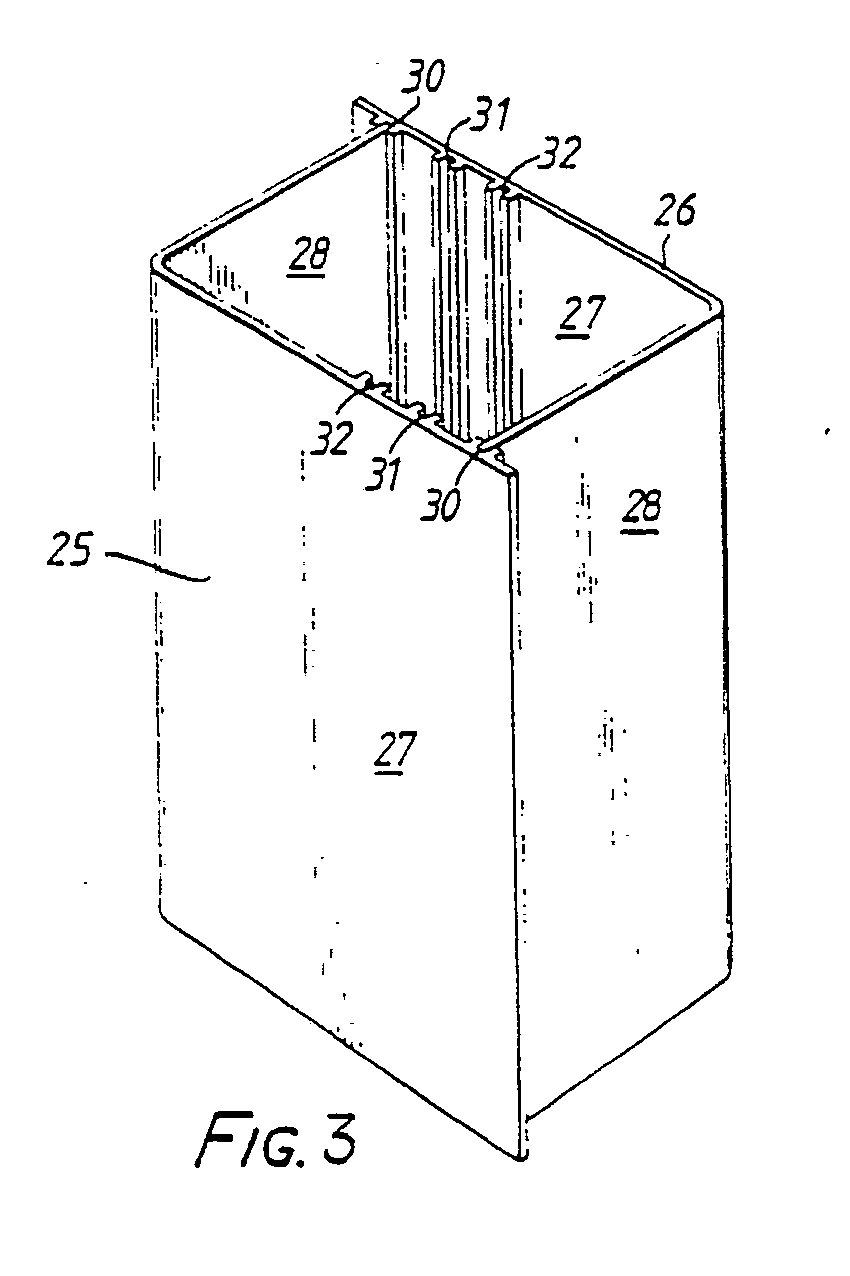
Figures 3 and 4 are a perspective and plan view of an adjustable post socket.
[0004] In this example the fence comprises a number of spaced upright posts 10 each of generally
I-section and preferably formed of steel or other metal with a suitable weatherproofing
coating. The lower end of each post is positioned in a preformed socket 11, which
is either positioned in an appropriate hole in the ground or located by concrete.
Between the upright posts are positioned individual prefabricated fence panels indicated
generally at 12.
[0005] The use of post sockets, as shown at 11, is an advantage for several reasons. The
sockets prevent earth or concrete coming into direct contact with the posts thus increasing
the life of the post by reducing corrosion, rust or decay. Also the posts can be readily
removed and replaced or, if damaged, new posts can be substituted.
[0006] To allow for posts of different dimensions the socket can be adjusted to suit. The
contruction illustrated in Figures 3 and 4 show the adaptability. Here the socket
is formed from two extruded plastic sections 25, 26 each having a longer wall 27 and
a shorter wall 28. On the inner surface of the long wall 27 there are three pairs
of ribs forming three shallow grooves 30, 31, 32 and each groove is designed to fit
closely to the edge of the opposing short wall 28. This construction allows the longitudinal
dimensions of the socket to be varied over the three possible distances and the transverse
dimension can be varied simply by cutting down the edge of the short wall 28. Figure
4 illustrates a possible modification in which the extreme lip 35 of the short wall
28 has an enlarged head or bead 39 arranged to fit into one of the corresponding undercut
grooves 40 in the corresponding long wall 27. It will be noted that the projecting
tip or toe of the bead 39 is directed inwardly towards the centre of the socket since
this arrangement assists in preventing accidental withdrawal.
[0007] The whole socket is intended to be surrounded with concrete or otherwise supported
by earth or walling to hold the socket which in turn supports the fence post or upright.
The adjustability of one single socket type allows for the use of various post sizes.
1. A socket for an upright post of an external fence, the socket (11) having two components
(25, 26), each including two rigid flanges (27, 28), lying approximately perpendicular
to one another; the components (25, 26) being shiftable laterally relative to one
another to alter the dimensions of the socket (11) to suit post (10) of different
dimensions.
2. A socket according to Claim 1, in at which at least one of the flanges (27) has
a groove or rib (30, 31, 32) to locate the edge of a flange (28) on the other component.