|
(11) | EP 0 383 800 B1 |

| (12) | EUROPEAN PATENT SPECIFICATION |
|
|
| (54) |
METHOD FOR REGULATING PLANT GROWTH USING SULFUR-CONTAINING ORGANIC ACIDS REGELVERFAHREN FÜR PFLANZENZUCHT MIT SCHWEFELHALTIGEN ORGANISCHEN SÄUREN PROCEDE DE REGULATION DE LA CROISSANCE DE PLANTES A L'AIDE D'ACIDES ORGANIQUES CONTENANT DU SOUFRE |
|
|
|||||||||||||||||||||||||||||||
| Note: Within nine months from the publication of the mention of the grant of the European patent, any person may give notice to the European Patent Office of opposition to the European patent granted. Notice of opposition shall be filed in a written reasoned statement. It shall not be deemed to have been filed until the opposition fee has been paid. (Art. 99(1) European Patent Convention). |
FIELD OF THE INVENTION
[0001] The present invention relates to polymers of thioglycolic and thiolactic acids useful in a process for increasing the rate of plant growth and the chlorophyll concentration in plants. In this process, plants are treated with dilute solutions of these polymers or certain other sulfur-containing organic acids.
BACKGROUND OF THE INVENTION
[0002] Various derivatives of organic acids have been proposed as plant growth regulators. For example, West German Patent 19 16 054 discloses the use of alpha-hydroxy- or alpha-ketoalkanoic acids, having 7 to 10 carbon atoms, and their derivatives, particularly amides, for promoting the growth of plants under drought conditions. U.S. Patent 3,148,049 discloses certain halogenated keto acids, such as halogenated acetoacetic acid, as plant growth regulators. U.S. Patent 3,351,653 discloses the use of fluorinated hydroxy acids and esters as herbicides. In 1970, Mikami, et al , Agr. Biol. Chem., 34, 977-979, reported test results of a number of hydroxy acids as plant growth regulators. Several of these, particularly, certain aromatic hydroxy acids, were shown to be root growth promoters. However, some of the simple acids, such as glycolic acid, caused suppression of root growth rather than root growth promotion. None of the hydroxy acids revealed any activity in the straight growth-promotion test used.
[0003] We have now discovered, to our surprise, that certain sulfur-containing organic acids do act as growth promoters and can increase chlorophyll concentration when applied to growing plants.
[0004] Thioglycolic acids having the formula H(S-CH₂-CO)nOH wherein n = 2, about 6 or 7 were disclosed in Staudinger et al. "Die Makromolekulare Chemie" (1960) Vol. XXXVII, p. 64, Dr. A. Hüthig Verlag Heidelberg. Moreover, Schöberl et al. disclose in Justus Liebig's "Annalen der Chemie" Vol. 595 (1955), p. 101, thioglycolic acids which may have the formula as defined above and wherein n may also be 9 to 11. The publications do not give any indication regarding a possible growth promotor activity.
SUMMARY OF THE INVENTION
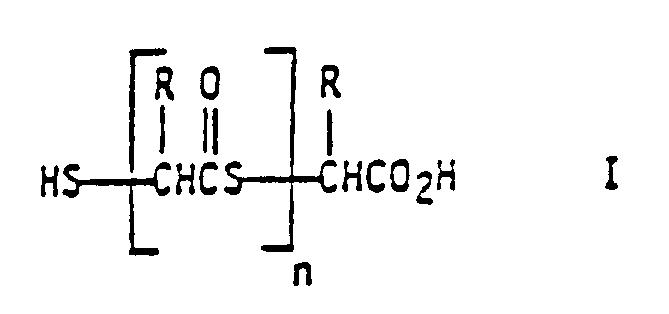
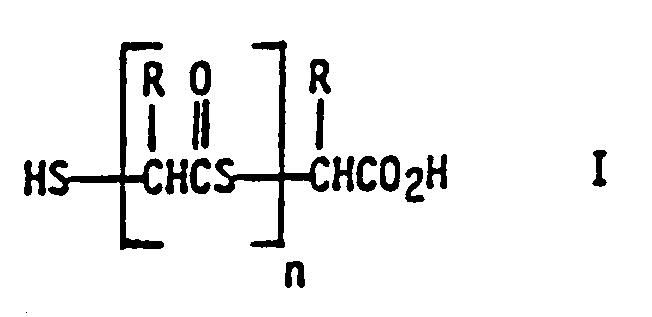
[0005] In accordance with this invention, there is provided a compound represented by the formula
where n is a small whole number from 1 to 10 and the Rs are the same or different and denote H or CH₃ with the proviso that n is not 1, 5, 6, 8, 9 or 10 when R is H.
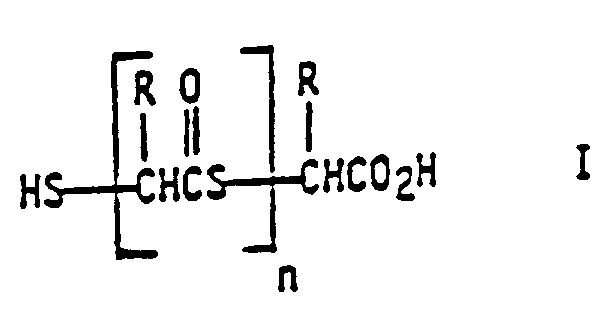
[0006] Further provided in accordance with this invention, is a process for increasing the rate of growth of a plant which comprises supplying to the plant an aqueous solution at a concentration of between 5 and 500 parts per million on a weight/volume basis of one or more sulfur-containing acids selected from the group consisting of thiolactic acid, 2,2'-dithiobisacetic acid, 2,2'-dithiobispropanoic acid, and a compound represented by Formula I, where n is a small whole number from 1 to 10 and the Rs are the same or different and denote H or CH₃.
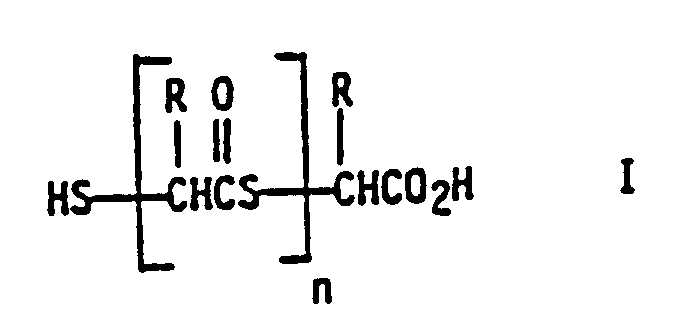
[0007] Also provided, in accordance with this invention, is a process for increasing the concentration of chlorophyll in a plant which comprises supplying to the plant an aqueous solution at a concentration of between 5 and 500 parts per million on a weight/volume basis of one or more sulfur-containing acids selected from the group consisting of thiolactic acid, 2,2'dithiobisacetic acid, 2,2'-dithiobispropanoic acid, and a compound represented by Formula I, where n is a small whole number from 1 to 10 and the Rs are the same or different and denote H or CH₃.
DETAILED DESCRIPTION OF THE INVENTION
[0008] The acids generally useful in the practice of this invention are certain sulfur-containing organic acids and condensation polymers obtained by condensing two or more molecules of certain thiol acids by the elimination of water. Mixed polymers of two different thiol acids may also be used. Exemplary acids used in the practice of this invention as noted above include thiolactic acid and the dithioacids: 2,2'-dithiobisacetic acid and 2,2'-dithiobispropanoic acid. Also useful in the practice of this invention are polymers of thiolactic acid, polymers of thioglycolic acid, copolymers of thioglycolic and thiolactic acids. These polymers are represented by the formula
where n is a small whole number from 1 to 10 and the Rs are the same or different and denote H or CH₃.
[0009] The activity of the acids used in the practice of this invention was discovered when they were tested in the duckweed promotion assay of Mitchell and Livingston, Methods of Studying Plant Hormones and Growth-Regulating Substances, USDA-ARS Agriculture Handbook, 336, pp. 66-67 (1968). This test showed that various sulfur-containing organic acids have growth-promoting abilities when used in the concentration of between 5 and 500 ppm (parts per million) on a weight/volume basis. Polymers of thioglycolic acid and thiolactic acid have shown good growth-promoting ability when used at a concentration of 10 ppm. In the case of polythiolactic acid, concentrations of 100 ppm proved to be somewhat growth inhibitory but they led to enhanced chlorophyll concentration in the plants. On the other hand, the dithiobis acids showed almost constant growth-promoting ability when used in concentrations from 10 ppm to 200 ppm.
[0010] An additional benefit derived from growing plants in the presence of the sulfur-containing acids of this invention is that the plants accumulate more chlorophyll. The presence of such acids in the growth medium, particularly at concentrations of from 5 to 500 ppm, preferably 10 ppm to 200 ppm on a weight/volume basis, greatly enhances the amount of chlorophyll accumulated per milligram of plant weight.
[0011] As noted above, the activity of the acids used in the practice of this invention was discovered when they were tested in the duckweed promotion assay. Since this assay involves growing the plants on an aqueous solution, it demonstrates the usefulness of the process in promoting the growth of plants in hydroponic culture. Likewise, the process of this invention is useful when plants are propagated by means of tissue culture. This is a particularly useful application of these acids, since many plants are now propagated commercially by means of tissue culture.
[0012] The acids used in the process of the present invention are seen to produce more than one growth-regulating effect on the plants. The particular growth-regulating effect produced by a plant depends, of course, on a number of variable's, including the acid or mixture of acids used, the concentration and total amounts of the acids used, the time at which the acids are applied, and the type of plant species which is treated. The amount of material added is the effective amount needed to obtain the response desired. In general, the acids are utilized in dilute aqueous solutions which contain the acids in concentrations of from 5 to 500 ppm on a weight/volume basis. For most applications, the preferred concentrations are from 10 ppm to 100 ppm. The most suitable concentrations for a particular application are readily determined by well-known screening tests, such as those given in the examples.
[0013] Solutions of the acids are conveniently applied to the plants in the water added for plant growth. This water may also contain nutrients required by the plants. Optionally, solutions of the acids may be sprayed onto or otherwise applied to the roots, stems, or leaves of the plants.
[0014] The following specific examples illustrate the present invention. They are not intended to limit the invention in any way. When concentrations are given in ppm, they are on a weight/volume basis. The thiolactic acid used in the examples was obtained from the Aldrich Chemical Company, Milwaukee, Wisconsin. It was converted into polythiolactic acid by heating 10.6 parts of the acid with 1 part of strong acid cation-exchange resin under reduced pressure for 72 hours at 105°-110°C. The resin was removed by filtration and unreacted thiolactic acid was removed by distillation under high vacuum. Polythioglycolic acid was prepared from thioglycolic acid using the same process as was used to prepare polythiolactic acid. The copolymer of thiolactic and thioglycolic acids was prepared in a similar manner by heating equimolar amounts of the starting acids in the presence of the strong acid ion-exchange resin. The presence of the
linkage in these polymers was shown by C¹³ NMR analysis.
[0015] The 2,2'-dithiobispropanoic acid was obtained by the slow addition of 2.5 ml of 30% hydrogen peroxide to a solution of 10.6 g of thiolactic acid in 15 ml of acetone at 5°C. The mixture was held at 5°C for 24 hours and then left at room temperature for 48 hours. The solvent was removed under reduced pressure and the residue was dissolved in chloroform. The chloroform solution was washed with water and dried before the solvent was removed under reduced pressure to give a residual syrup that was used in the experiments.
[0016] 2,2'-dithiobisacetic acid was prepared in a like manner by the hydrogen peroxide oxidation of thioglycolic acid.
EXAMPLE 1
[0017] Duckweed (Lemna minor L.) was grown following the general procedure of Mitchell and Livingston, Methods of Studying Plant Hormones and Growth Regulating Substances, USDA-ARS Agriculture Handbook, 336, pp. 66-67 (1968). Plants were grown on Nickell's medium as described in the handbook with the iron being present as the ferrous ion chelated with EDTA. One plant at the three-frond stage was placed in each flask. Flasks were incubated at 25°C for 16-18 days under 91.44-152.4m (300- to 500-foot) candles of light for 16 hours per day. The plants were harvested and dried before plant weight was measured. All reported values represent 3 to 5 replicates.
[0018] Experiments were performed in which various concentrations of the sulfur-containing acids were added to the duckweed growth medium. A control was run in which no acid was added. The results given in Table I demonstrate that growth is greatly enhanced when comparatively small concentrations of the acids are present in the medium.
TABLE I
| DUCKWEED GROWTH ASSAY | |||||
| Dry Weight (mg) Acid (ppm) | |||||
| 0 (Control) | 1 | 10 | 100 | 200 | |
| Thiolactic Acid | 37 ± 6 | 43 ± 3 | 65 ± 22 | 59 ± 11 | |
| Polythiolactic Acid | 37 ± 6 | 42 ± 8 | 56 ± 6 | 22 ± 6 | |
| Polythioglycolic Acid | 49 ± 3 | 38 ± 6 | 62 ± 9 | ||
| Copolymer of Thioglycolic and Thiolactic Acids | 49 ± 3 | 47 ± 4 | 63 ± 4 | ||
| 2,2'-Dithiobisacetic Acid | 35 ± 3 | 36 ± 6 | 55 ± 7 | 62 ± 6 | 59 ± 9 |
| 2,2-Dithiobispropanoic Acid | 35 ± 3 | 36 ± 4 | 49 ± 3 | 54 ± 7 | 56 ± 4 |
EXAMPLE 2
[0019] The general procedure of Example 1 was followed and the chlorophyll content of the harvested plants was determined by the method of Kirk, Planta, 78, 200-207 (1968). Samples of preweighed dried duckweed were suspended in 80% acetone. The mixture was homogenized for 30 seconds using a POLYTRON® Brand Homogenizer (Brinkman Instruments, Westbury, New York). The mixture was centrifuged and absorption of the supernatant was read at 663 and 645 nm. From these readings, the number of micrograms of chlorophyll per milligram of dry weight was determined using the nomogram of Kirk. The results given in Table II show that the sulfur-containing organic acids used in the process of this invention increase the chlorophyll content of plants. This is particularly evident when the acids are present in the growth medium at concentrations of 100 ppm and higher.
TABLE II
| DUCKWEED CHLOROPHYLL CONCENTRATION ASSAY | |||||
| Acid | Chlorophyll (µg/mg) Acid Concentration (ppm) | ||||
| 0 (Control) | 1 | 10 | 100 | 200 | |
| Polythiolactic Acid | 2.2 | 6.9 | |||
| Polythioglycolic Acid | 1.9 | 3.0 | |||
| Copolymer of Thioglycolic and Thiolactic Acids | 1.9 | 3.6 | |||
| 2,2'-Dithiobisacetic Acid | 1.9 | 4.5 | 4.7 | 4.6 | |
| 2,2'Dithiobispropanoic Acid | 1.9 | 4.6 | 6.4 | ||
[0020] Thus, it is apparent that there has been provided, in accordance with the invention, an improved process for increasing the rate of plant growth and for increasing the chlorophyll content of plants which fully satisfies the objects, aims, and advantages set forth above. While the invention has been described in conjunction with specific embodiments thereof, it is evident that many alternatives, modifications, and variations will be apparent to those skilled in the art in light of the foregoing description. Accordingly, it is intended to include all such alternatives, modifications, and variations as set forth within the spirit and scope of the appended claims.
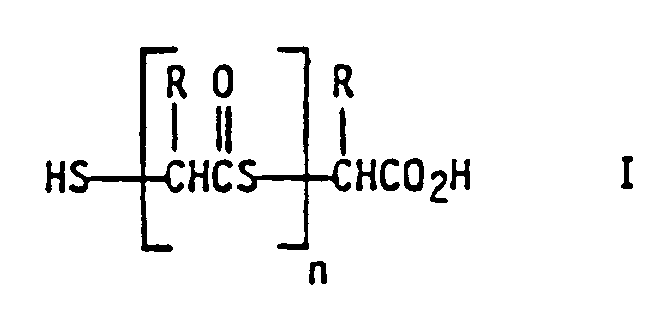
1. A compound represented by the formula
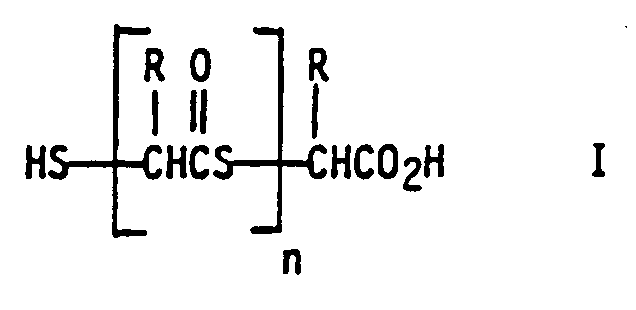
where n is a small whole number from 1 to 10 and the Rs are the same or different and denote H or CH₃ , with the proviso that n is not 1, 5, 6, 8, 9 or 10 when R is H.
where n is a small whole number from 1 to 10 and the Rs are the same or different and denote H or CH₃ , with the proviso that n is not 1, 5, 6, 8, 9 or 10 when R is H.
2. A process for increasing the rate of growth of a plant which comprises supplying to
the plant an aqueous solution at a concentration of between 5 and 500 parts per million
on a weight/volume basis of one or more sulfur-containing acids selected from the
group consisting of thiolactic acid, 2,2'-dithiobisacetic acid, 2,2'-dithiobispropanoic
acid, and a compound represented by the formula
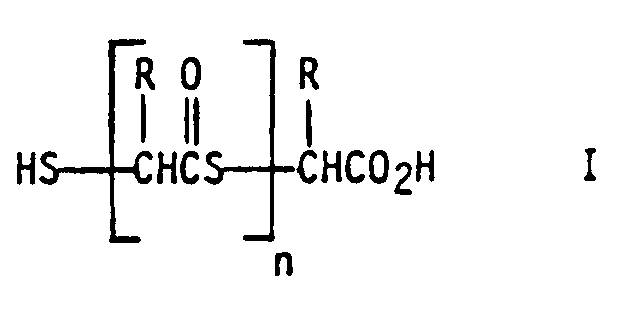
where n is a small whole number from 1 to 10 and the Rs are the same or different and denote H or CH₃.
where n is a small whole number from 1 to 10 and the Rs are the same or different and denote H or CH₃.
3. The process of claim 2 wherein the plant is Lemna minor L.
4. The process of claim 2 wherein the plant is grown in hydroponic or tissue culture.
5. A process for increasing the concentration of chlorophyll in a plant which comprises
supplying to the plant an aqueous solution at a concentration of between 5 and 500
parts per million on a weight/volume basis of one or more sulfur-containing acids
selected from the group consisting of thiolactic acid, 2,2'-dithiobisacetic acid,
2,2'-dithiobispropanoic acid, and a compound represented by the formula
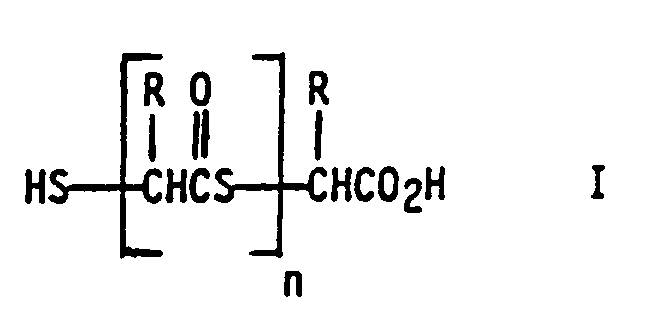
where n is a small whole number from 1 to 10 and the Rs are the same or different and denote H or CH₃.
where n is a small whole number from 1 to 10 and the Rs are the same or different and denote H or CH₃.
6. The process of claim 5 wherein the plant is Lemna minor L.
1. Eine Verbindung, dargestellt durch die Formel
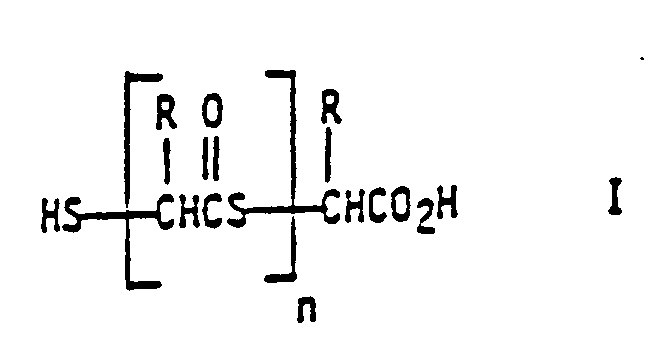
in welcher n eine kleine ganze Zahl von 1 bis 10 bedeutet und die Rs gleich oder verschieden sind und H oder CH₃ darstellen, unter der Voraussetzung, dass n nicht gleich 1, 5, 6, 8, 9 oder 10 ist, wenn R H bedeutet.
in welcher n eine kleine ganze Zahl von 1 bis 10 bedeutet und die Rs gleich oder verschieden sind und H oder CH₃ darstellen, unter der Voraussetzung, dass n nicht gleich 1, 5, 6, 8, 9 oder 10 ist, wenn R H bedeutet.
2. Ein Verfahren zur Erhöhung der Wachstumsgeschwindigkeit einer Pflanze, welches das
Zuführen einer wässerigen Lösung in einer Konzentration von zwischen 5 und 500 Teilen
pro Million auf einer Gewichts/Volumen-Basis von einer oder mehreren schwefelhaltigen
Säuren, ausgewählt aus der Gruppe bestehend aus Thiomilchsäure, 2,2'-Dithiodiessigsäurem
2,2'-Dithiodipropionsäure und eine Verbindung, dargestellt durch die Formel
in welcher n eine kleine ganze Zahl von 1 bis 10 ist und die Rs gleich oder verschieden sind und H oder CH₃ bedeuten, zu der Pflanze, umfasst.
in welcher n eine kleine ganze Zahl von 1 bis 10 ist und die Rs gleich oder verschieden sind und H oder CH₃ bedeuten, zu der Pflanze, umfasst.
3. Das Verfahren nach Anspruch 2, in welchem die Pflanze Lemna minor L ist.
4. Das Verfahren nach Anspruch 2, in welchem die Pflanze in Hydro- oder Gewebekultur
gezüchtet wird.
5. Ein Verfahren zur Erhöhung der Konzentration an Chlorophill in einer Pflanze, welches
die Zufuhr zu der Pflanze einer wässerigen Lösung in einer Konzentration von zwischen
5 und 500 Teilen pro Million auf einer Gewicht/Volumenbasis von einer oder mehreren
schwefelhaltigen Säuren, ausgewählt aus der Gruppe bestehend aus Thiomilchsäure, 2,2'-Dithiodiessigsäure,
2,2'-Dithiodipropionsäure und einer Verbindung, dargestellt durch die Formel
in welcher n eine kleine ganze Zahl von 1 bis 10 ist und die Rs gleich oder verschieden sind und H und CH₃ bedeuten, umfasst.
in welcher n eine kleine ganze Zahl von 1 bis 10 ist und die Rs gleich oder verschieden sind und H und CH₃ bedeuten, umfasst.
6. Das Verfahren nach Anspruch 5, in welchem die Pflanze Lemna minor L ist.
1. Composé représenté par la formule
dans laquelle n représente un petit nombre entier de 1 à 10 et les groupes R sont identiques ou différents et représentent H ou des groupes CH₃, sous réserve que n ne soit pas égal à 1, 5, 6, 8, 9 ou 10 lorsque R représente H.
dans laquelle n représente un petit nombre entier de 1 à 10 et les groupes R sont identiques ou différents et représentent H ou des groupes CH₃, sous réserve que n ne soit pas égal à 1, 5, 6, 8, 9 ou 10 lorsque R représente H.
2. Procédé pour augmenter la vitesse de croissance d'une plante, qui consiste à fournir
à la plante une solution aqueuse, à une concentration de 5 à 500 parties par million
en poids/volume, d'un ou plusieurs acides contenant du soufre choisis dans le groupe
consistant en acide thiolactique, acide 2,2'-dithiobisacétique, acide 2,2'-dithiobispropanoïque,
et un composé représenté par la formule
dans laquelle n représente un petit nombre entier de 1 à 10 et les groupes R sont identiques ou différents et représentent H ou des groupes CH₃.
dans laquelle n représente un petit nombre entier de 1 à 10 et les groupes R sont identiques ou différents et représentent H ou des groupes CH₃.
3. Procédé suivant la revendication 2, dans lequel la plante est Lemna minor L.
4. Procédé suivant la revendication 2, dans lequel la plante est cultivée en culture
hydroponique ou culture de tissus.
5. Procédé pour augmenter la concentration de chlorophylle dans une plante, qui consiste
à fournir à la plante une solution aqueuse, à une concentration de 5 à 500 parties
par million en poids/volume, d'un ou plusieurs acides contenant du soufre choisis
dans le groupe consistant en acide thiolactique, acide 2,2'-dithiobisacétique, acide
2,2'-dithiobispropanoïque, et un composé représenté par la formule
dans laquelle n représente un petit nombre entier de 1 à 10 et les groupes R sont identiques ou différents et représentent H ou des groupes CH₃.
dans laquelle n représente un petit nombre entier de 1 à 10 et les groupes R sont identiques ou différents et représentent H ou des groupes CH₃.
6. Procédé suivant la revendication 5, dans lequel la plante est Lemna minor L.