(57) A method which comprises the steps of: providing a heat-processible color photosensitive
material that has at least a light-sensitive silver halide, a reducing agent, a binder
and a dye-providing material on a support, which dye-providing material contains either
a dye portion represented by the following general formula (1) or a dye portion represented
by the following general formula (2) or both; performing imagewise exposure on said
photosensitive material; subsequent to or simultaneously with the imagewise exposure,
thermally developing said photosensitive material in close contact with an image-receiving
material; transferring onto said image-receiving material all or part of the diffusible
dye containing said dye portion which is formed from said dye-providing material as
a function of development; during or after the transfer, chelating part or all of
the diffusible dye with a metal to thereby form an image of the chelated dye in said
image-receiving material:
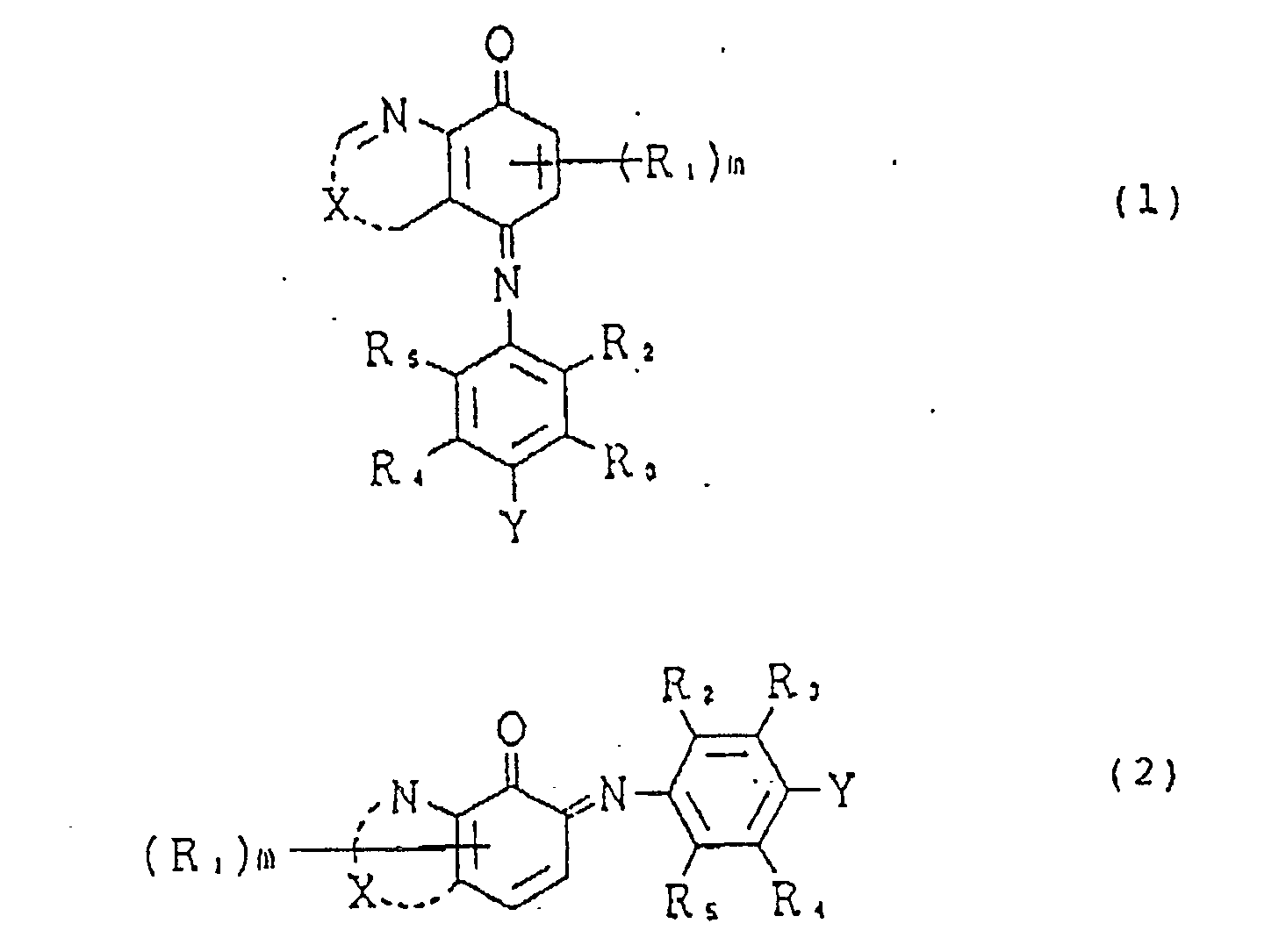
where X represent the atomic group necessary to form an aromatic nitrogenous heterocyclic
ring; R₁ is a hydrogen atom, a halogen atom or a monovalent organic group; m is an
integer of 0 or 1 - 3, provided that when m is 2 or 3, R₁ may be the same or different;
Y is a hydroxyl group or a group
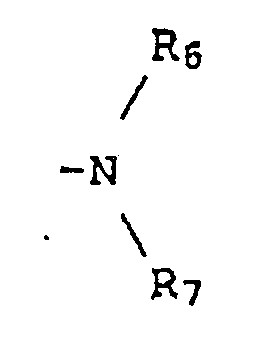
(where R and R₇ each represents a hydrogen atom or an optionally substituted alkyl
group); and R², R³, R⁴ and R⁵ each represents a hydrogen atom, a halogen atom, or
a monovalent organic group.
|
|
