|
(11) | EP 0 385 440 B1 |

| (12) | EUROPEAN PATENT SPECIFICATION |
|
|
| (54) |
Electrophotosensitive material Elektrophotoempfindliches Material Matériau électrophotosensible |
|
|
|||||||||||||||||||||||||||||||
| Note: Within nine months from the publication of the mention of the grant of the European patent, any person may give notice to the European Patent Office of opposition to the European patent granted. Notice of opposition shall be filed in a written reasoned statement. It shall not be deemed to have been filed until the opposition fee has been paid. (Art. 99(1) European Patent Convention). |
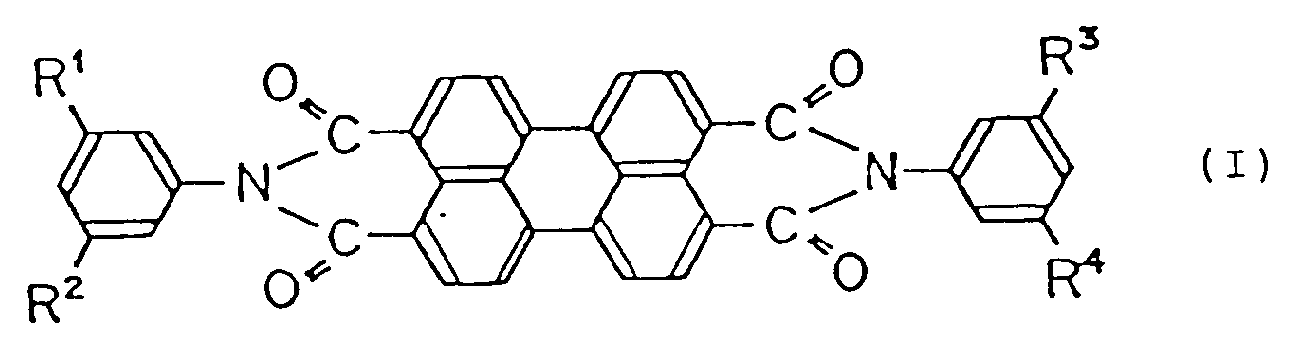
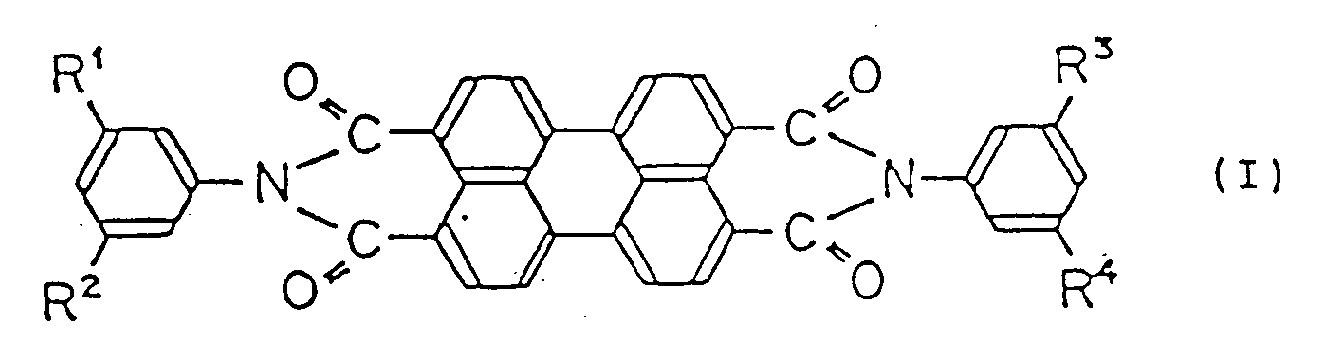
BACKGROUND OF THE INVENTION
[0001] The present invention relates to an electrophotosensitive material. More particularly the invention relates to electrophotosensitive materials ideally utilized for a picture imaging apparatus such as copying machine.
[0002] Recently, organic photosensitive materials are used as electrophotosensitive materials because the organic layers have wide freedom for functional desig as well as workability and are advantageous in production costs. It is well known that the high sensitive functional types of electrophotosensitive materials provide photosensitive layers wherein the electric charge generating with exposure to light function with a charge-generating ingredient and the electric charge-transferring function with a charge-transferring ingredient.
[0003] There is a variety of photosensitive layers with functional parted electrophotosensitive materials comprising a charge-generating layer at least containing a charge-generating ingredient, a charge-transferring layer at least containing a charge-transferring ingredient and a binder resin, and photosensitive single layer materials containing a charge-generating ingredient and a charge-transferring ingredient which are coated as a dispersion in a solvent on a substrate.
[0004] The photosensitive materials providing a photosensitive multilayer have an advantage in providing high sensitivity and wide availability for selecting photosensitive material, because the functions thereof are separated into two, the charge-generating layer and the charge-transferring layer.
[0005] Generally the negative electrificated photosensitive multilayer is structured as the conductive substrate is coated with a charge-generating layer, and a charge-transferring layer is further coated thereon, because the charge-transferring layer is a positive hole transfer type and gives durability to the surface which is also required. However, those photosensitive multilayers for negative electrification may generate ozone in the ambient atmosphere, causing the sensitive layer, when negative electrified, to deteriorate and to contaminate the environment, and a positive charged toner which is difficult to make, is necessary in the developing process.
[0006] On the other side, it is recognized that the single layer type photosensitive material is not only positively charged but able to use negatively charged toner to develop an electrostatic latent image in the photosensitive layer. It is advantageous in widely selecting toner for the preparation. However, the electrons and the positive holes are moved in one layer wherein either the electrons or the positive holes are trapped, causing the residual potential to increase. Moreover, it is yet a question that electrophotographic characteristics such as the electrification characteristics, the sensitivity and the residual potential depend much on the combination of charge-generating ingredient and charge-transferring ingredient.
[0007] In consideration of the problem abovementioned, the experiments to increase the sensitivity of a single layer type photosensitive material are proposed in the following documents: An electrophotosensitive material comprising a perylene pigment such as N,N′-dimethylperylene-3,4,9,10-tetracarboxydiimide and N,N′-di(3,5-dimethylphenyl)-perylene-3,4,9,10-tetracarboxydiimide as charge-generating ingredient, binder resin and acetonaphthylene as sensitizer in JP-A- 76840/1983, and an electrophotosensitive material comprising a perylene type pigment, polyvinylcarbazole resin as charge-transferring ingredient and terphenyl as sensitizer in JP-A- 119356/1984.
[0008] However, the these electrophotosensitive materials are not yet complete to obtain the sufficient sensitivity. Especially, because the perylene compounds have no spectrosensitivity to the long wave-length side, the charge-generating layer containing such a perylene compound yet result in obtaining insufficient sensitivity if it is combined with a halogen lamp of large spectro-energy for red.
SUMMARY OF THE INVENTION
[0009] It is an object of the present invention to provide a high sensitive single layer type electrophotosensitive material by finding out a combination of materials satisfying the special features necessary for the electrophotosensitive material.
[0010] It is a further object of this invention to provide a single layer type electrophotosensitive material superior in reproducibility.
[0011] The present invention contemplates the provision of an elecrophotosensitive material comprising a conductive substrate and a photosensitive layer formed thereon, the photosensitive layer containing a charge-generating ingredient and a charge-transferring ingredient in a binder resin ,
the charge-generating ingredient being a perylene compound represented by the following general formula (I):
wherein R¹, R², R³ and R⁴ are the same or different lower alkyl group substituent, and X-type metal-free phthalocyanine,
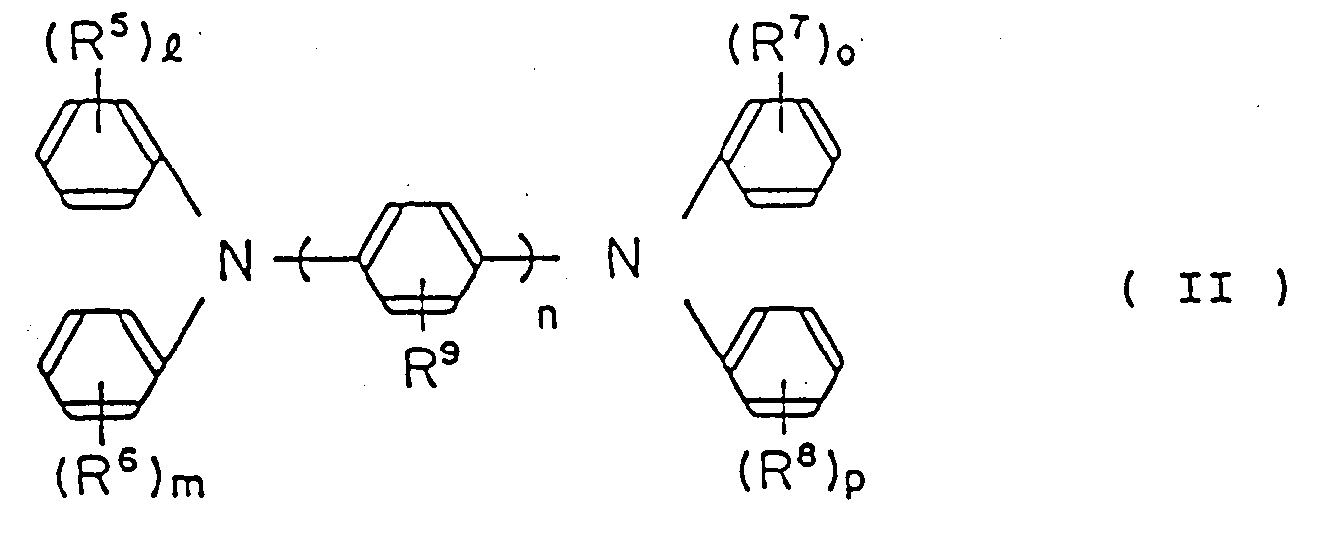
the charge-transferring ingredient being a diamine derivative represented by the following general formula (II):
wherein R⁵, R⁶, R⁷, R⁸ and R⁹ are the same or different, hydrogen atom, lower alkyl group, lower alkoxy group or halogen atom; and
n is an integer of from 1 to 3;
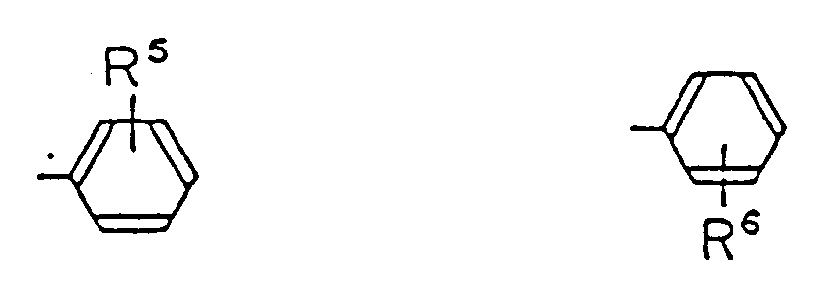
1, m, o and p are; respectively, an interger of from 0 to 2, at least one selected from the following group
may form a condensed ring with a benzene ring which may have a lower alkyl group, a lower alkoxy group or halogen atom as a substituent.
[0012] It has been found by the inventors that diamine derivatives represented by the general formula (II) as charge-generating material have good compatibility with the binder resin and small electric field strengh dependency for drift movability, and the positive-charging single layer type electrophotosensitive material combined with above mentioned diamine derivatives used as charge-transferring material and perylene type compound used as chage-generating material represented by the general formula (I) dispersed in a binder resin is excellent in charging property, sensitivity and residual potential. Furthermore, it is preferable to add X-type metal-free phthalocyanine as spectro-sensitizer into the photosensitive material in the range of 1.25 to 3.75 parts by weight of X-type metal-free phthalocyanine to 100 parts by weight of the perylene compound in order to achieve a shift of the range of spectrosensitivity to the long wave-length side and a high sensitivity.
[0013] If the rate of X-type metal-free phthalocyanine added is less than 1.25 parts by weight to 100 parts by weight of the perylene compound, no effect is obtained for increasing the sensivity to long wave-length side, and if the rate exceeds 3.75 parts by weight to 100 parts by weight of the perylene compound, the spectrosensivity becomes high in the long wavelength side and the performance of copying red-color become low.
[0014] The most preferable diamine derivative compound is represented by general formula (III):
which compound increase the reproducibity as well as the special features set forth in the above.
DETAILED DESCRIPTION
[0015] The charge-generating ingredient applied in the embodiment of the invention is a perylene compound represented by the general formula (I) set forth above, wherein R¹, R², R³ and R⁴ are alkyl groups having 1 to 6 carbon atoms such as methyl, ethyl, propyl, isopropyl, butyl, isobutyl, tert-butyl, penthyl and hexyl. Representative examples of the perylene compound are N,N′-di(3,5-dimethylphenyl)perylene-3,4,9,10-tetracarboxydiimide,
N,N′-di(3-methyl-5-ethylphenyl)perylene-3,4,9,10-tetracarboxydiimide,
N,N′-di(3,5-diethylphenyl)perylene-3,4,9,10-tetracarboxydiimide,
N,N′-di(3,5-dipropylphenyl)perylene-3,4,9,10-tetracarboxydiimide,
N,N′-di(3,5-diisopropylphenyl)perylene-3,4,9,10-tetracarboxydiimide,
N,N′-di(3-methyl-5-isopropylphenyl)perylene-3,4,9,10-tetracarboxydiimide,
N,N′-di(3,5-dibutylphenyl)perylene-3,4,9,10-tetracarboxydiimide,
N,N′-di(3,5-di-tert-butylphenyl)perylene-3,4,9,10-tetracarboxydiimide,
N,N′-di(3,5-dipentylphenyl)perylene-3,4,9,10-tetracarboxydiimide,
N,N′-di(3,5-dihexylphenyl)perylene-3,4,9,10-tetracarboxydiimide.
N,N′-di(3,5-dimethylphenyl)perylene-3,4,9,10-tetracarboxydiimide is preferable.
[0016] The charge-transferring ingredient utilized in the invention is a diamine derivative represented by the general formula (II) set forth above, wherein the lower alkyl group comprises methyl, ethyl, propyl, isopropyl, butyl, isobutyl, tert-butyl, penthyl and hexyl having 1 to 6 carbon atoms, preferably those alkyl groups having 1 to 4 carbon atoms; the lower alkoxy group comprises methoxy, ethoxy, propoxy, butoxy, isobutoxy, tert-butoxy, pentyloxy, hexyloxy having from 1 to 6 carbon atoms, preferably those alkoxy groups having from 1 to 4 carbon atoms; and halogen comprises fluorine, chlorine and iodine.
[0017] Examples of the compounds represented by the general formula (II) are following.
wherein R⁵, R⁶, R⁷, R⁸ and R⁹ are, the same or different, hydrogen atom, lower alkyl group, lower alkoxy group or halogen atom,
1, m, o and p are an integer of from 0 to 2,
n is an interger of from 1 to 3,
provided that R⁵, R⁶, R⁷ and R⁸ are not simultaneously hydrogen atom and at least one of 1, m, o and p of R⁵, R⁶, R⁷ and R⁸ which is not hydrogen atom, is 2.
[0018] Preferable diamine derivatives represented by general formula (IIa), wherein n=1 (p-phenylenediamine derivatives) are 1,4-bis(N,N′-diphenylamino)benzene, 1-(N,N-diphenylamino)-4-[N-(3-methylphenyl)-N-phenylamino]benzene, 1,4-bis[N-(3-methylphenyl)-N-phenylamino]benzene. Diamine derivatives other than those mentioned above are described on pages 13 to 20 of Japanese Patent Application No. 277158/1987.
[0019] Preferable diamine derivatives represented by general formula (IIa), wherein n=2 (benzidine derivatives), are 4,4′-bis(N,N′-diphenylamino)diphenyl,
4,4′-bis[N-(3-methylphenyl)-N-phenylamino]diphenyl,
4,4′-bis[N-(3-methoxyphenyl)-N-phenylamino]diphenyl,
4,4′-bis[N-(3-chlorophenyl)-N-phenylamino]diphenyl,
4-[N-(2-methylphenyl)-N-phenylamino]-4′-[N-(4-methylphenyl)-N-phenylamino]diphenyl,
4-[N-(2-methylphenyl)-N-phenylamino]-4′-[N-(3-methylphenyl)-N-phenylamino]diphenyl,
3,3′-dimethyl-4,4′-bis[N,N′-di(4-methylphenyl)amino]biphenyl,
3,3′-diethyl-4,4′-bis[N,N′-di(4-methylphenyl)amino]biphenyl.
Diamine derivatives other than those mentioned above are described on pages 21 to 28 of Japanese Patent Application No. 277158/1987.
[0020] Preferable diamine derivatives represented by general formula (IIa), wherein n=3 (4,4′-terphenyldiamine derivatives), are 4,4˝-bis(N,N-diphenylamino)-1,1′:4′,1˝-terphenyl, 4,4˝-bis[N-(3-methylphenyl)-N-phenylamino]-1,1′:4′,1˝-terphenyl. Diamine derivatives other than those mentioned above are described on pages 28 to 34 of Japanese Patent Application No. 277158/1987.
[0021] The most preferable diamine derivative represented by general formula (IIa) is 3,3′dimethyl-4,4′-bis[N,N-di(4-methylphenyl)amino]biphenyl, represented by the following general formula (III).
[0022] Preferable diamine derivatives of the invention represented by general formula (IIb), wherein n=1 (p-phenylenediamine derivatives), are
1-[N-(3,5-dimethylphenyl)-N-phenylamino]-4-(N,N-diphenylamino)benzene,
1-[N,N-di(3,5-dimethylphenyl)amino]-4-(N,N-diphenylamino)benzene,
1,4-bis[N-(3,5-dimethylphenyl)-N-phenylamino]benzene. Diamine derivatives other than those mentioned above are described on pages 13 to 21 of Japanese Patent Application No. 277159/1987.
[0023] Preferable diamine derivatives represented by general formula (IIb), wherein n=2 (benzidine derivatives), are
4,4-bis[N-(3,5-dimethylphenyl)-N-phenylamino]diphenyl,
4,4-bis[N-(3,5-dimethoxyphenyl)-N-phenylamino]diphenyl,
4,4-bis[N-(3,5-dichlorophenyl)-N-phenylamino]diphenyl,
4,4-bis[N-(3,5-dimethylphenyl)-N-(3-methylphenyl)amino]diphenyl,
4-[N-(2,4-dimethylphenyl)-N-phenylamino]-4′-[N-(3,5-dimethylphenyl)-N-phenylamino]diphenyl. Diamine derivatives other than those mentioned above are described on pages 21 to 29 of Japanese Patent Application No. 277159/1987.
[0024] Preferable diamine derivatives represented by general formula (IIb), wherein n=3 (4,4˝-terphenyldiamine derivatives), are
4,4˝-bis[N-(3,5-dimethylphenyl)-N-phenylamino]1,1′:4′,1˝-terpheny,
4-[N-(3,5-dimethylphenyl)-N-phenylamino]-4"-(N,N-diphenylamino)-1,1′:4′,1˝-terphenyl,
4-[N,N-bis(3,5-dimethylphenyl)amino]-4˝-(N,N-diphenylamino)-1,1′:4′,1˝-terphenyl. Diamine derivatives other than those mentioned above are described on pages 29 to 36 of Japanese Patent Application No. 277159/1987.
[0025] Preferable diamine derivatives represented by general formula (IIc), wherein n=1 (phenylenediamine derivatives) are
1,4-bis[N-(6-methylnaphthyl)-N-phenylamino]benzene,
1,4-bis(N-naphthyl-N-phenylamino)benzene,
1-(N-naphthyl-N-phenylamino)-4-[N-(6-methylnaphthyl)-N-phenylamino]benzene. Diamine derivatives other than those mentioned above are described on pages 13 to 19 of Japanese Patent Application No. 277161/1987.
[0026] Preferable diamine derivatives represented by general formula (IIc), wherein n=2 (benzidine derivatives), are
4,4′-bis(N-naphthyl-N-phenylamino)diphenyl,
4,4′-bis[N-(6-methylnaphthyl)-N-phenylamino]diphenyl,
4,4′-bis[N-(6-methoxynaphthyl)-N-phenylamino]diphenyl,
4,4′-bis[N-(6-chloronaphthyl)-N-phenylamino]diphenyl,
4,4′-bis[N-(6-methylnaphthyl)-N-(3-methylphenyl)amino]diphenyl,
4-[N-(6-methylnaphthyl)-N-phenylamino]-4′-[N-(6-methylnaphthyl)-N-(3-methylphenyl)amino]diphenyl,
4-[N-(4-methylnaphthyl)-N-phenylamino]-4′-[N-(6-methylnaphthyl)-N-phenylamino]diphenyl. Diamine derivatives other than those mentioned above are described on pages 19 to 25 of Japanese Patent Application No. 277161/1987.
[0027] Preferable diamine derivatives represented by general formula (IIc), wherein n=3 (4,4˝-terphenyldiamine derivatives), are
4,4˝-bis(N-naphthyl-N-phenylamino)-1,1′:4′,1˝-terphenyl,
4,4′-bis[N-(6-methylnaphthyl)-N-phenylamino]-1,1′:4′,1˝-terphenyl. Diamine derivatives other than those mentioned above are described on pages 25 to 30 of Japanese Patent Application No. 277161/1987.
[0028] Preferable diamine derivatives represented by general formula (IId), wherein n=1 (p-phenylenediamine derivatives), are
1,4-bis(N,N-dinaphthylamino)benzene,
1-(N,N-dinaphthylamino)-4-[N-(6-methylnaphthyl)-N-naphthylamino]benzene,
1,4-bis[N-(6-methylnaphthyl)-N-naphthylamino]benzene. Diamine derivatives other than those mentioned above are described on pages 13 to 22 of Japanese Patent Application No. 277162/1987.
[0029] Preferable diamine derivatives represented by general formula (IId), wherein n=2 (benzidine derivatives), are
4,4′-bis[N,N-di(6-methylnaphthyl)amino]diphenyl,
4,4′-bis[N-(6-methylnaphthyl)-N-naphthylamino]diphenyl,
4,4′-bis[N-(6-methoxynaphthyl)-N-naphthylamino]diphenyl,
4,4′-bis[N-(6-chloronaphthyl)-N-naphthylamino]diphenyl,
4-[N,N-di(6-methylnaphthyl)amino]-4′-[N-(6-methylnaphthyl)-N-naphthylamino]diphenyl,
4-[N-(4-methylnaphthyl)amino-N-naphthylamino]-4′-[N-(6-methylnaphthyl)-N-naphthylamino]diphenyl. Diamine derivatives other than those mentioned above are described on pages 22 to 30 of Japanese Patent Application No. 277162/1987.
[0030] Preferable diamine derivatives represented by general formula (IId), wherein n=3 (4,4˝-terphenyldiamine derivatives), are
4,4˝-bis(N,N-dinaphthylamino)-1,1′:4′,1˝-terphenyl,
4,4˝-bis[N-(6-methylnaphthyl)-N-naphthylamino]-1,1′:4′,1˝-terphenyl. Diamine derivatives other than those mentioned above are described on pages 30 to 38 of Japanese Patent Application No. 277162/1987.
[0031] The diamine derivatives represented by general formula (II) may be used either singly or jointly in the form of a mixture of two or more members. And the diamine derivatives aforementioned are not only having symmetrical molecular structure, taking no part in isomerization reaction caused by light irradiation and providing light stability but also show large drift mobility and low electric field strength dependency.
[0032] Therefore, a high sensitive and small residual potential electrophotosensitive material, though it is a material having single type photosensitive layer, can be obtained by combining the diamine derivatives which have peculiarities mentioned above and perylene compounds aforementioned.
[0033] The binder resins of the invention include styrene polymers, acryl-polymers, styrene-acryl polymers, polyethylene, ethylene-vinylacetate copolymers, olefine polymers such as chlorinated polyethylene, polypropylene, ionomers, polyvinyl chloride, vinylchloride-vinylacetate copolymers, polyester, alkyd resins, polyamido resins, polyurethanes, epoxy resins, polycarbonates, polyacrylates, polysulphones, diarylphthalates, silicon resins, ketonresins, polyvinyl-butylal resins, polyether resins, phenol resins and photohardening resins including epoxyacrylates. The most preferable polymer is poly(4,4′-cyclohexylidenediphenyl)carbonate because of the special features of providing wide selectivity for the solvent, capable of dissolving the binding resin as well as increasing the sensitivity of the photosensitive layer, promoting wear and abrasion resistance and reproducibility of the photosensitive layer.
[0034] The poly(4,4′-cyclohexylidenediphenyl)carbonate abovementioned allows tetrahydrofuran, methylethylketon, etc. to use as the solvent thereof recommendable from safety and health also handy points of view, which features completely differ from bisphenol-A-type-polycarbonate for which only chlorinated solvent such as dichloromethane, monochlorobenzene, etc. can be used.
[0035] The poly(4,4′-cyclohexylydenediphenyl)carbonate has preferably a molecular weight between 15,000 and 25,000 and a glass transition point of 58°C.
[0036] The mixing proportions of the perylene compounds, diamine derivatives, and the binder resins are not necessarily restricted and, according to the characteristics of the electrophotosensitive material, selected in an appropriate manner. However, the general proportion in an electrophotosensitive material is 2 to 20 parts by weight of perylene compound, preferably from 3 to 15 parts by weight of perylene compound, and 40 to 20 weight parts, preferably 50 to 100 parts by weight, of the diamine derivatives to 100 parts by weight of the binder resin. If the proporation of the perylene compound and the diamine derivative is smaller than above mentioned, then not only the photosensitivity of the sensitive material becomes insufficient but the residual potential increases. And if the proporation of the perylene compound and the diamine derivative exceed the proportion mentioned above, resistance to wear and abrasion of the photosensitive material becomes insufficient.
[0037] Generally, when a photosensitive material which contains the perylene compound in excess is used the positive electrification is insufficient. When the content of the perylene compound in the photosensitive material is too low, the sensitivity and other properties thereof are deteriorated. The photosensitive material of this invention is combining a specified perylene compound, a diamine derivative and X-type metal-free phthalocyanine. When the proportion of the perylene compound in the combination is small, the sensitivity and the surface potential are kept high, the residual potential is small and the positive electrification becomes superb.
[0038] A preferable X-type metal-free phthalocyanine used in this invention is to have a strong analysis peak in Blagg scattering angle (2 ± 0.2°) of 7.5°, 9.1°, 16.7°, 17.3°, 22.3°. The photosensitive layer wherein containing X-type metal-free phthalocyanine added in the propotion of 1.25 to 3.75 parts by weight to 100 parts by weight of perylene compound allows the spectro-sensitivity range of the photosensitive material expanding to the long wave-length side and sensitivity level of the material being high. However, if the photosensitive material containes X-type metal-free phthalocyanine in the range of less than 1.25 parts by weight to 100 parts by weight of perylene compound, spectro-sensitivity of that is not spreaded to long wave-length side, conversely, if it contained X type metal free phtalocyanin in the range of over 3.75 parts by weight to 100 parts by weight of perylene compound, the spectro-sensitivity of it becomes too high to repoduce the red-original.
[0039] An antioxidant is capable of well resisting degradation of the electro-transferring ingredient wherein having a chemical structure affected easily from oxidizing.
[0040] The antioxidant includes phenol antioxidants such as
2,6-di-tert-butyl-p-cresol,
triethyleneglycol-bis[3-(3-tert-butyl-5-methyl-4-hydroxyphenyl)propionate],
1,6-hexanediol-bis[3-(3,5-di-tert-butyl-4-hydroxyphenyl)propionate],
penthaerythryl-tetrakis[3-(3,5-di-tert-butyl-4-hydroxyphenyl)propionate],
2,2-thio-diethylenebis[3-(3,5-di-tert-butyl-4-hydroxyphenyl)propionate],
2,2-thiobis(4-methyl-6-tert-butylphenol),
N,N′-hexamethylenebis(3-5-di-tert-butyl-4-hydroxyhydrocyanamid) and
1,3,5-trimethyl-2,4,6-tris(3,5′-di-tert-butyl-4-hydroxybenzil)benzene, preferably 2,6,-di-tert-butyl-p-cresol.
[0041] The photosensitive material of the invention is obtained by preparing a coating solution containing the ingredients set forth above, coating it onto an electro-conductive substrate and drying.
[0042] The conductive substrate may be shaped in sheet or drum, and the material of the conductive substrate includes various kinds of conductive materials such as a simple body of metal including almite-processed or not almite-processed aluminium, aluminium alloys, copper, tin, platinum, gold, silver, vanadium, molibdenum, chromium, cadmium, titanium, nickel, palladium, indium, stainless steel, brass; plastic or glass material, formed layers of the abovementioned metals, indium oxide, tin oxide and the like by vapor deposition; a preferable substrate is a material treated by anodic oxidation with sulfuric acid almite method) and having sealed small holes on the surface with nickel acetate.
[0043] The conductive substrate may surface-treated by a surface preparation agent such as silane couplings and titanium couplings to increase adhesion of the substrate and the photosensitive layer coated thereonto.
[0044] In preparation of the above coating solutions, various solvents may be used depending on the type of the binder resin and others to be used. Examples of solvents, are alcohols such as methanol, ethanol, propanol, isopropanol, butanol and the like; paraffinic hydrocarbons such as n-hexan, octane and cyclohexane and the like; aromatic hydrocarbons such as benzene, toluene, xylene and the like; halogenated hydrocarbons such as dichloromethane, dichloroethane, carbon tetrachloride, chlorobenzene and the like; ethers such as tetrahydrofulane, ethyleneglycoldimethylether, ethyleneglycoldiethylether and the like; ketones such as acetone methylethylketone, cyclohexanone and the like; and esters such as ethyl acetate, methyl acetate and the like; and these are used either alone of in combination of two or more types. To increase dispersibility and workability of the coating solution, a surface active agent, and a leveling agent such as silicon oil, a sensitivity increasing agent such as those disclosed terphenyl, halonaphthoquinons and acenaphthylene may be applied. A preferable silicon oil is polydimethylsiloxane.
[0045] By preparing the coating solution, conventional methods of mixing and dispersing may be applied, such as paint shaker, mixer, ball mill, sand mill, atriter, and ultrasonic dispersion machine. By painting the coating solution, conventional methods may be applied, such as dip-coating, spray-coating, spin-coating, roller-coating, blade-coating, curtain-coating and bar-coating.
[0046] The thickness of the single layer type photosensitive material of the invention may be adequate, preferably 15 to 30 »m, more preferably 18 to 27 »m.
[0047] Thus, the electrophotosensitive material of this invention gives a high sensitivity and surface potential. Moreover, it shows small residual potentials, though it is a sensitive monolayer, as well as providing special features of superior positive electrification and good performance of copying red-color.
EXAMPLES
Example 1.
[0049] 100 parts by weight of poly-(4,4′-cyclohexylidene diphenyl)carbonate (produced by Mitsubishi gas kagaku K.K.; Brand name: Policarbonate Z), 8 parts by weight of N,N′-di(3,5-dimethylphenyl)perylene-3,4,9,10-tetracarboxydiimide, 0.2 parts by weight of X-type metal-free phthalocyanine (produced by Dainihon Ink K.K.), 100 parts by weight of 3,3′-dimethyl-4,4′-bis[N,N-di(4-methylphenyl)amino]biphenyl, 0.01 parts by weight of polydimethylsiloxane (produced by Shinetsu Kagaku K.K.) and a definite quantity of tetrahydrofuran were mixed and dispersed by a ultrasonic dispersion apparatus and applied to the alumited aluminium substrate pipe to form 23 »m of photosensitive layer and heated at 100 °C to produce electrophotosensitive material.
Example 2.
[0050] There was prepared a single-layer type electrophotosensitive material in the same manner as that of Example 1, except that 0.1 parts by weight of X-type metal-free phthalocyanine (produced by Dainihon Ink K.K.) were used.
Example 3.
[0051] There was prepared a single-layer type electrophotosensitive material in the same manner as that of Example 1, except that 0.3 parts by weigh of X-type metal-free phthalocyanine (produced by Dainihon Ink K.K.) was used.
Example 4.
[0052] There was prepared an electrophotosensitive material having the photosensitive layer in the thickness of 23 »m, in the same manner as Example 1, except that 3,3′-diethyl-4,4′-bis[N,N-di(4-methylphenyl)amino]biphenyl is used in place of 3,3′-dimethyl-4,4′-bis[N,N-di(4 methylphenyl)amino]biphenyl, and silicone oil (produced by Shinetsu Kagaku K.K.) was used in place of polydimethylsiloxiane.
Example 5.
[0053] There was prepared an electrophotosensitive material in the same manner as Example 4, except that 100 parts by weight of 4,4′-bis[N-(3,5-dimethylphenyl)-N-phenylamino]biphenyl was used in place of 3,3′-diethyl-4,4′-bis[N,N′-(4-methylphenyl)amino] biphenyl.
Example 6.
[0054] There was prepared an electrophotosensitive material in the same manner as Example 4, except that 100 parts by weight of 4,4′-bis[N-bis(6-methylnaphtyl)-N-naphtylamino]biphenyl was used in place of 3,3′-diethyl-4,4′-bis[N,N-di(4-methylphenyl)amino] biphenyl.
Example 7.
[0055] There was prepared an electrophotosensitive material in the same manner as Example 4, except that 100 parts by weight of 4,4′-bis[N-(6-methylnaphtyl)-N-naphtylamino]biphenyl was used in place of 3,3′-diethyl-4,4′-bis[N,N-di(4-methylphenyl)amino] biphenyl.
Example 8.
[0056] There was prepared an electrophotosensitive material in the same manner as that of Example 4, except that 0.05 parts by weight of X-type metal-free phthalocyanine (produced by Dainihon Ink K.K.) was used.
Example 9.
[0057] There was prepared an electrophotosensitive material in the same manner as that of Example 4, except that 0.4 parts by weight of X-type metal-free phthalocyanine (produced by Dainihon Ink K.K.) was used.
Example 10.
[0058] There was prepared a single-layer type electrophotosensitive material in the same manner as that of Example 1, except that 0.05 parts by weight of X-type metal-free phthalocyanine (produced by Dainihon Ink K.K.) was used.
Example 11.
[0059] There was prepared a single-layer type electrophotosensitive material in the same manner as that of Example 1, except that 0.4 parts by weight of X-type metal-free phthalocyanine (produced by Dainihon Ink K.K.) was used.
Comparative Example 1.
[0060] There was prepared a single-layer type electrophotosensitive material in the same manner as that of Example 1, except that 0.2 parts by weight of β-type metal-free phthalocyanine was used in place of 0.2 parts by weight of X-type metal-free phthalocyanine.
Comparative Example 2.
[0061] There was prepared a single-layer type electrophotosensitive material in the same manner as that of Example 1, except that 0.6 parts by weight β-type metal-free phthalocyanine was used in place of X-type metal-free phthalocyanine.
Comparative Example 3.
[0062] There was prepared an electrophotosensitive material in the same manner as Example 4, except that 100 parts by weight of N-ethyl-3-carbazolylaldehyde-N,N-diphenylhydrazone was used in place of 3,3′-diethyl-4,4′-bis[N,N-di(4-methylphenyl)amino] biphenyl.
Comparative Example 4
[0063] There was prepared a single-layer type electrophotosensitive material in the same manner as that of Example 4, except that 0.2 parts by weight of β-type metal-free phthalocyanine was used in place of X-type metal-free phthalocyanine.
[0064] To test for charging property and sensitive property, the electrophotosensitive materials obtained in Examples 1 to 9 and Comparative Examples 1 to 4 were each positive charged by an electrostatic test copier (produced by Gentek Company; Gentek Cincia 30M), then the surface potential: V s.p. (V), of each electrophotosensitive material was measured. At the same time, the surface of the electrophotosensitive material was exposed to light from a tungsten lamp of 10 lux to measure the time required for the aforementioned surface potential: V s.p., to decrease to 1/2 the initial magnitude and calculated the half-life exposure: E 1/2 (»J/cm²). The surface potential measured on elapse of 0.15 seconds following the exposure was reported as residual potential; V r.p. (V).
[0065] The reflection density of a red colour was calulated, by copying a gray coloured original having the same reflection density of a red coloured original, and calculating the following expression:
and estimating the copying performance of red colour.
[0066] The value obtained in above mentioned expression was evaluated with "X" for that less than 70%, and "Δ" for that in the range of 70 to 100% and "O" for that over 100%.
[0067] The result of the above mentioned tests of the electrophotosensitive materials obtained in Examples 1 to 11 and Comparative Examples 1 to 4 for charging property and sensitive property, are shown in the Table 1.
[0068] The data in Table 1 demonstrate that the electrophotosensitive materials of Examples 1 to 8 and 10 respectively excel in electrification characteristics and having a high sensivity and low residual potential, moreover provide good copying performance of red-color . The electrophotosensitive materials of Examples 8, 9 and 11 are also superior in electrification characteristics and have high sensitivity and low residual potential.
[0069] The electrophotosensitive material of the Comparative Examples 1, 3 and 4 show inferior sensitivity and excessive residual potential though the materials excel in copying performance of red-color. The electrophotosensitive material of Comparative Example 2 shows inferior in the copying performance of red-color .
1. An elecrophotosensitive material comprising a conductive substrate and a photosensitive
layer formed thereon, the photosensitive layer containing a charge-generating ingredient
and a charge-transferring ingredient in a binder resin,
the charge-generating ingredient being a perylene compound represented by the following general formula (I):
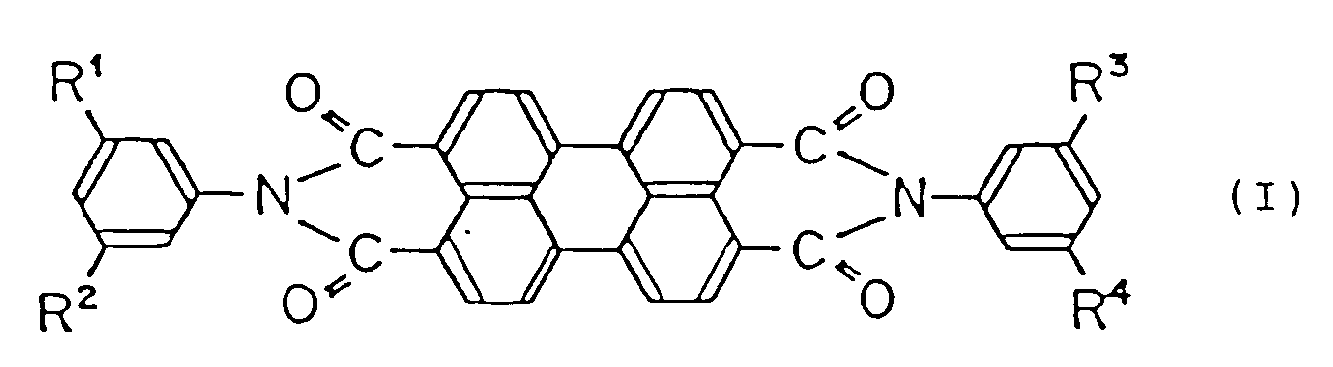
wherein R¹, R², R³ and R⁴ are the same or different lower alkyl group substituent; and X-type metal-free phthalocyanine,
the charge-transferring ingredient being a diamine derivative represented by the following general formula (II):
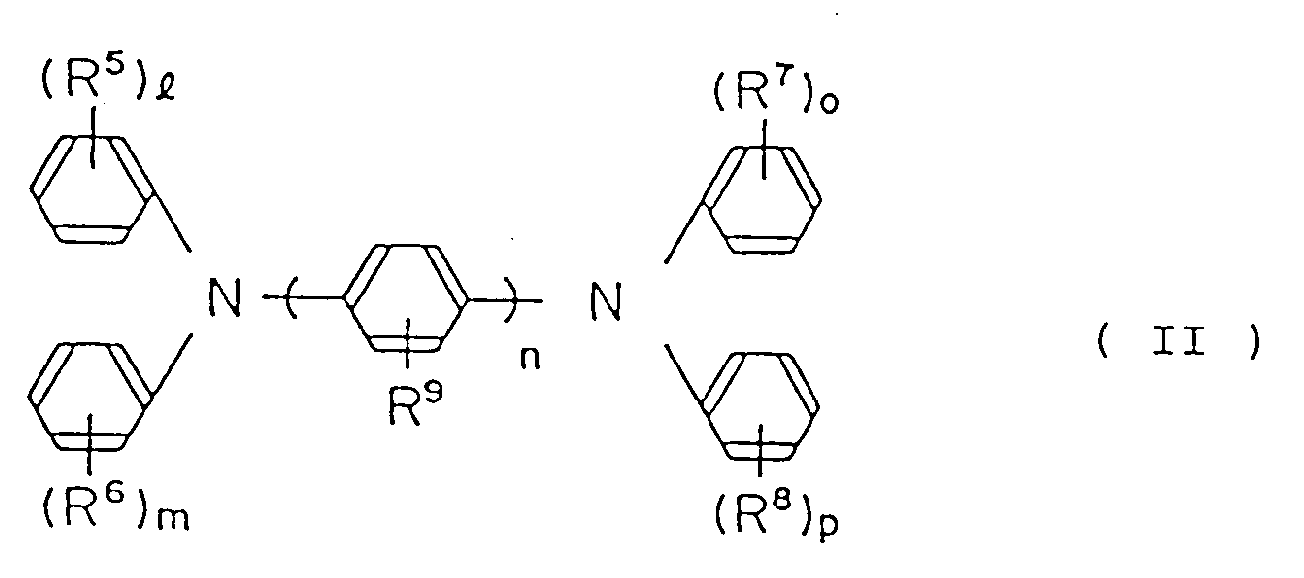
wherein R⁵, R⁶, R⁷, R⁸ and R⁹ are, the same or different, hydrogen atom, lower alkyl group, lower alkoxy group or halogen atom;
n is an integer of from 1 to 3;
1, m, o and p are, respectively, an integer of from 0 to 2; and at least one selected from the following group
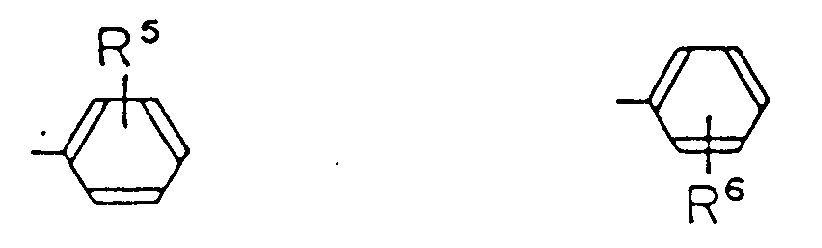
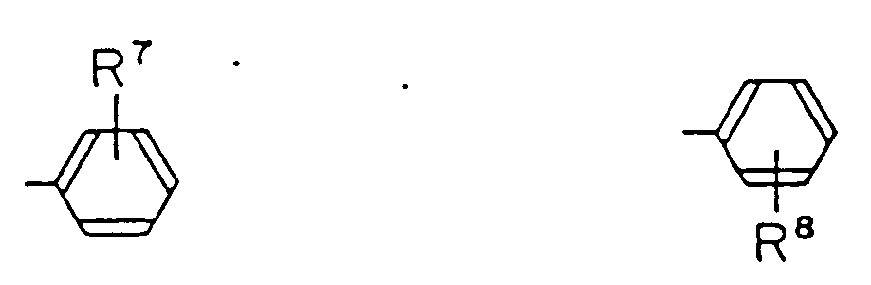
may form a condensed ring with a benzene ring which may have a lower alkyl group, a lower alkoxy group or halogen atom as a substituent.
the charge-generating ingredient being a perylene compound represented by the following general formula (I):
wherein R¹, R², R³ and R⁴ are the same or different lower alkyl group substituent; and X-type metal-free phthalocyanine,
the charge-transferring ingredient being a diamine derivative represented by the following general formula (II):
wherein R⁵, R⁶, R⁷, R⁸ and R⁹ are, the same or different, hydrogen atom, lower alkyl group, lower alkoxy group or halogen atom;
n is an integer of from 1 to 3;
1, m, o and p are, respectively, an integer of from 0 to 2; and at least one selected from the following group
may form a condensed ring with a benzene ring which may have a lower alkyl group, a lower alkoxy group or halogen atom as a substituent.
2. The electrophotosensitive material of claim 1 wherein the photosensitive layer contains
the X-type metal-free phthalocyanine at a rate of 1.25 to 3.75 parts by weight to
100 parts by weight of the perylene compound.
3. The electrophotosensitive material of claim 1 wherein the diamine derivative is represented
by the following general formula (IIa):
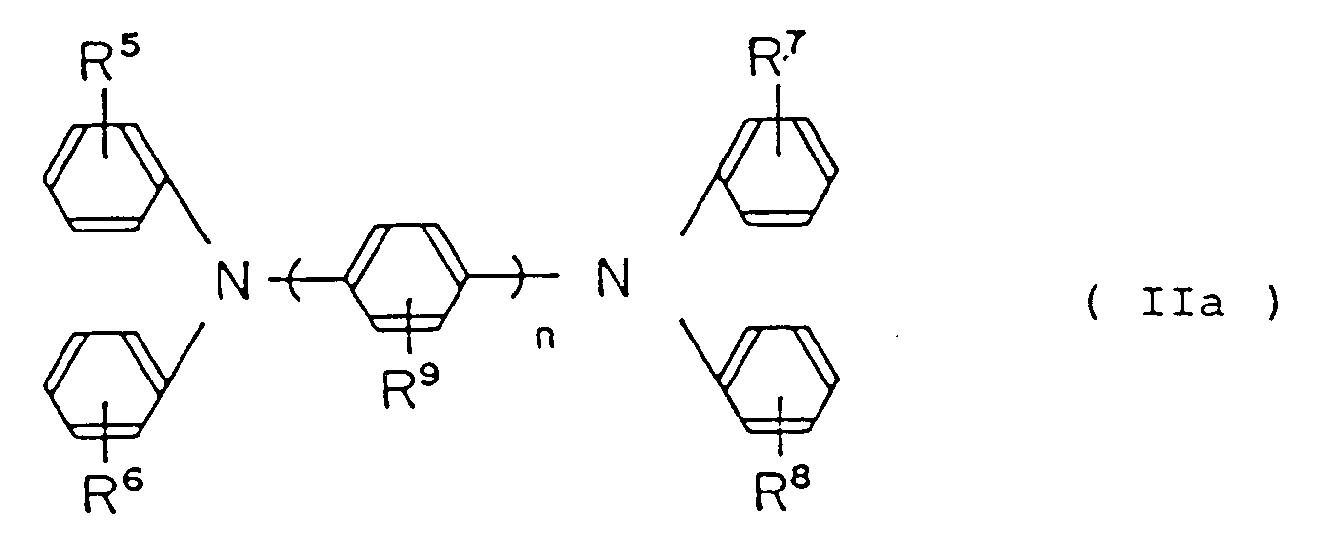
wherein R⁵, R⁶, R⁷, R⁸ and R⁹ are the same or different, hydrogen atom, lower alkyl group, lower alkoxy group or halogen atom, n is an integer of from 1 to 3.
wherein R⁵, R⁶, R⁷, R⁸ and R⁹ are the same or different, hydrogen atom, lower alkyl group, lower alkoxy group or halogen atom, n is an integer of from 1 to 3.
4. The electrophotosensitive material of claim 1 wherein the diamine derivative is represented
by the following general formula (IIb):
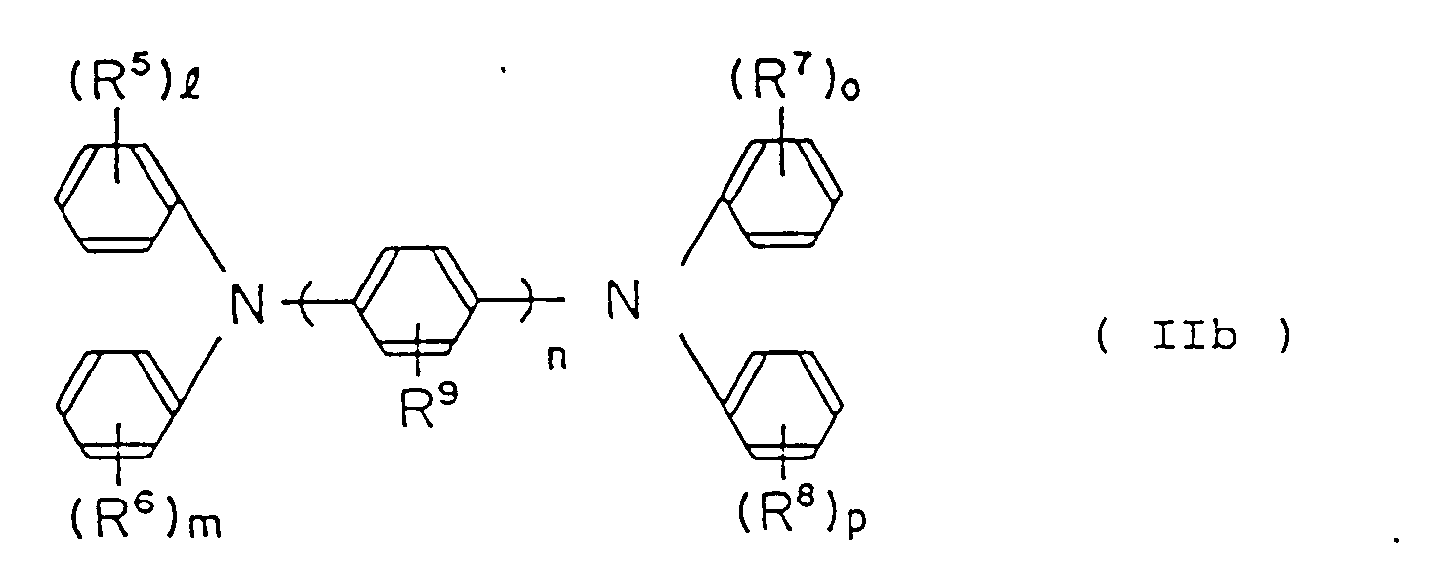
wherein R⁵, R⁶, R⁷, R⁸ and R⁹ are, the same or different, hydrogen atom, lower alkyl group, lower alkoxy group or halogen atom; 1, m, o and p are an integer of from 0 to 2; and n is an integer of from 1 to 3;
wherein R⁵, R⁶, R⁷, R⁸ and R⁹ are, the same or different, hydrogen atom, lower alkyl group, lower alkoxy group or halogen atom; 1, m, o and p are an integer of from 0 to 2; and n is an integer of from 1 to 3;
5. The electrophotosensitive material of claim 1 wherein the diamine derivative is represented
by the following general formula (IIc):
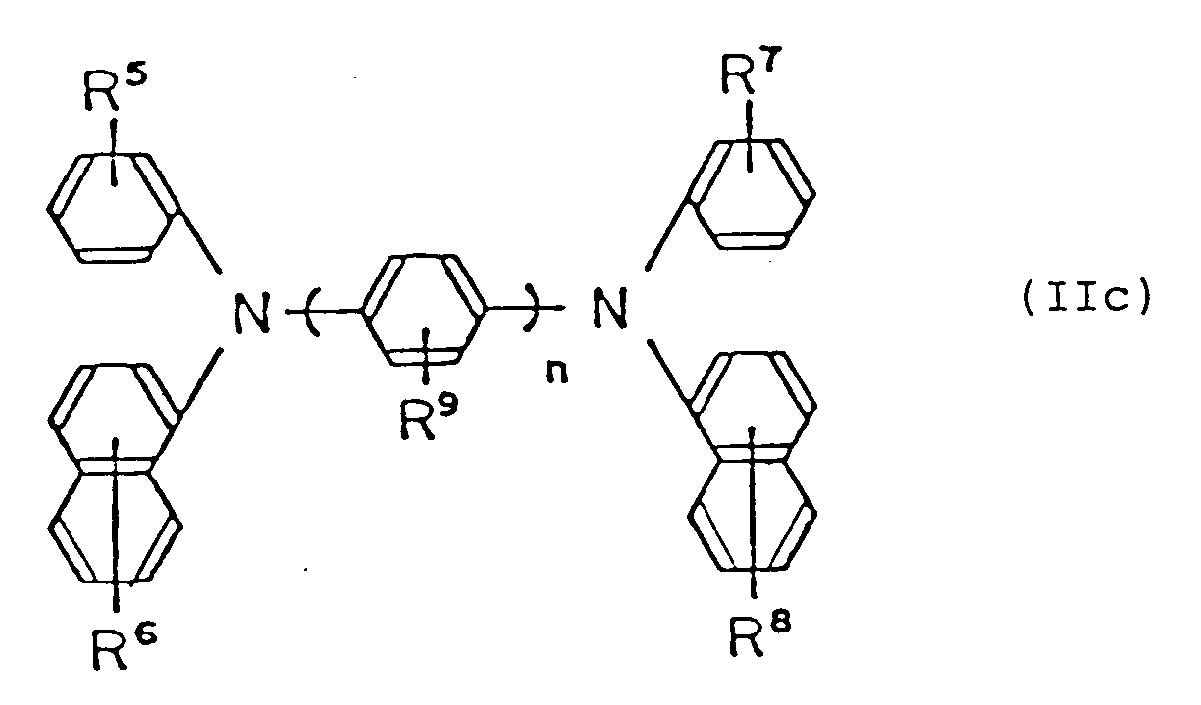
wherein R⁵, R⁶, R⁷, R⁸ and R⁹ are, the same or different, hydrogen atom, lower alkyl group, lower alkoxy group or halogen atom; and n is an integer of 1 to 3,
wherein R⁵, R⁶, R⁷, R⁸ and R⁹ are, the same or different, hydrogen atom, lower alkyl group, lower alkoxy group or halogen atom; and n is an integer of 1 to 3,
6. The electrophotosensitive material of claim 1 wherein the diamine derivative is represented
by the following general formula (IId):
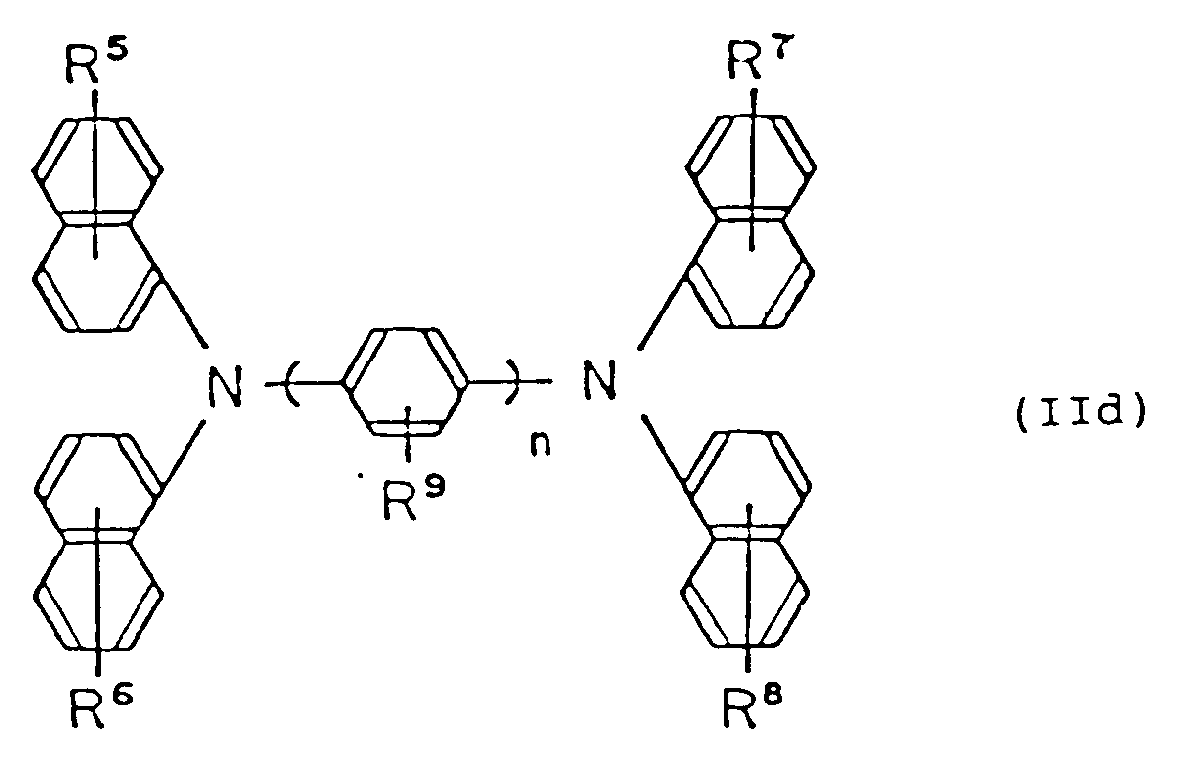
wherein R⁵, R⁶, R⁷, R⁸ and R⁹ are, the same or different, hydrogen atom, lower alkyl group, lower alkoxy group or halogen atom; and n is an integer of 1 to 3.
wherein R⁵, R⁶, R⁷, R⁸ and R⁹ are, the same or different, hydrogen atom, lower alkyl group, lower alkoxy group or halogen atom; and n is an integer of 1 to 3.
7. The electrophotosensitive material of claim 1 wherein the photosensitive layer contains
an antioxidant.
8. The electrophotosensitive material in claim 1 wherein the perylene compound is N,N′-bis(3,5-dimethylphenyl)perylene-3,4,9,10-tetracarboxydiimide.
9. The electrophotosensitive material of claim 1 wherein R⁵, R⁶, R⁷, R⁸ and R⁹ are, the
same or different, an alkyl group having 1 to 4 carbon atoms, an alkoxy group having
1 to 4 carbon atoms or a halogen atom.
10. The electrophotosensitive material of claim 3 wherein the diamine derivative is 3,3′-diethyl-4,4′-bis[N,N-di(4-methylphenyl)amino]biphenyl.
11. The electrophotosensitive material of claim 3 wherein said diamine derivative is 4,4′-bis[N-(3,5-dimethylphenyl)-N-phenylamino]biphenyl.
12. The electrophotosensitive material of claim 5 wherein the diamine derivative is 4,4′-bis[N-(6-methylnaphtyl)-N-phenylamino]biphenyl.
13. The electrophotosensitive material of claim 6 wherein the diamine derivative is 4,4′-bis[N-(6-methylnaphtyl)-N-naphtylamino]biphenyl.
14. The electrophotosensitive material of claim 1, wherein
the charge-generating ingredient is a perylene compound represented by the following general formula (I) :
wherein R¹, R², R³ and R⁴ are, the same or different, a lower alkyl group; and X-type metal-free phthalocyanine; and
the charge-transferring ingredient is 3,3′-dimethyl-4,4′-bis[N,N-di(4-methylphenyl)amino]biphenyl.
the charge-generating ingredient is a perylene compound represented by the following general formula (I) :
wherein R¹, R², R³ and R⁴ are, the same or different, a lower alkyl group; and X-type metal-free phthalocyanine; and
the charge-transferring ingredient is 3,3′-dimethyl-4,4′-bis[N,N-di(4-methylphenyl)amino]biphenyl.
15. The electrophotosensitive material of claim 14 wherein the photosensitive layer contains
X-type metal-free phthalocyanine at a rate of 1.25 to 3.75 parts by weight to 100
parts by weight of the perylene compound.
1. Elektrophotosensitives Material, das ein leitfähiges Substrat und eine darauf gebildete
photosensitive Schicht aufweist, wobei die photosensitive Schicht einen ladungserzeugenden
Bestandteil und einen ladungsübertragenden Bestandteil in einem Binderharz enthält,
wobei der ladungserzeugende Bestandteil eine Perylenverbindung, die durch die folgende allgemeine Formel (I) repräsentiert ist:
wobei R¹, R², R³ und R⁴ der gleiche oder ein verschiedener niederer Alkylsubstituent sind; und metallfreies Phthalocyanin vom X-Typ ist,
der ladungsübertragende Bestandteil ein Diaminderivat ist, das durch die folgende allgemeine Formel (II) repräsentiert ist:
wobei R⁵, R⁶, R⁷, R⁸ und R⁹ gleich oder verschieden ein Wasserstoffatom, eine niedere Alkylgruppe, eine niedere Alkoxygruppe oder ein Halogenatom sind;
n eine ganze Zahl von 1 bis 3 ist;
1, m, o und p jeweils eine ganze Zahl von 0 bis 2 sind; und mindestens eines aus der folgenden Gruppe
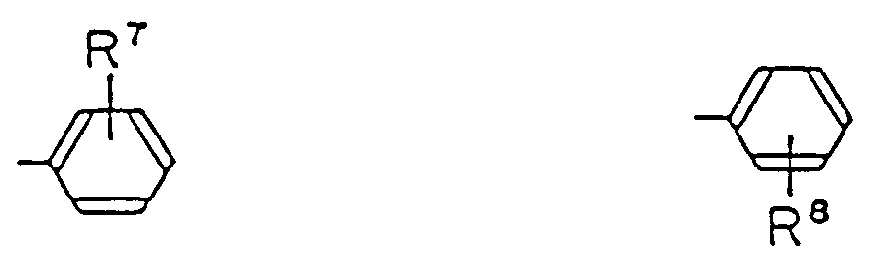
Ausgewählte einen verschmolzenen Ring mit einem Benzolring bilden kann, der eine niedere Alkylgruppe, eine niedere Alkoxygruppe oder ein Halogenatom als einen Substituenten haben kann.
wobei der ladungserzeugende Bestandteil eine Perylenverbindung, die durch die folgende allgemeine Formel (I) repräsentiert ist:
wobei R¹, R², R³ und R⁴ der gleiche oder ein verschiedener niederer Alkylsubstituent sind; und metallfreies Phthalocyanin vom X-Typ ist,
der ladungsübertragende Bestandteil ein Diaminderivat ist, das durch die folgende allgemeine Formel (II) repräsentiert ist:
wobei R⁵, R⁶, R⁷, R⁸ und R⁹ gleich oder verschieden ein Wasserstoffatom, eine niedere Alkylgruppe, eine niedere Alkoxygruppe oder ein Halogenatom sind;
n eine ganze Zahl von 1 bis 3 ist;
1, m, o und p jeweils eine ganze Zahl von 0 bis 2 sind; und mindestens eines aus der folgenden Gruppe
Ausgewählte einen verschmolzenen Ring mit einem Benzolring bilden kann, der eine niedere Alkylgruppe, eine niedere Alkoxygruppe oder ein Halogenatom als einen Substituenten haben kann.
2. Elektrophotosensitives Material nach Anspruch 1, wobei die photosensitive Schicht
das metallfreie Phthalocyanin vom X-Typ mit einer Rate von 1,25 bis 3,75 Gewichtsteilen
pro 100 Gewichtsteile der Perylenverbindung enthält.
3. Elektrophotosensitives Material nach Anspruch 1, wobei das Diaminderivat durch die
folgende allgemeine Formel (IIa) repräsentiert ist:
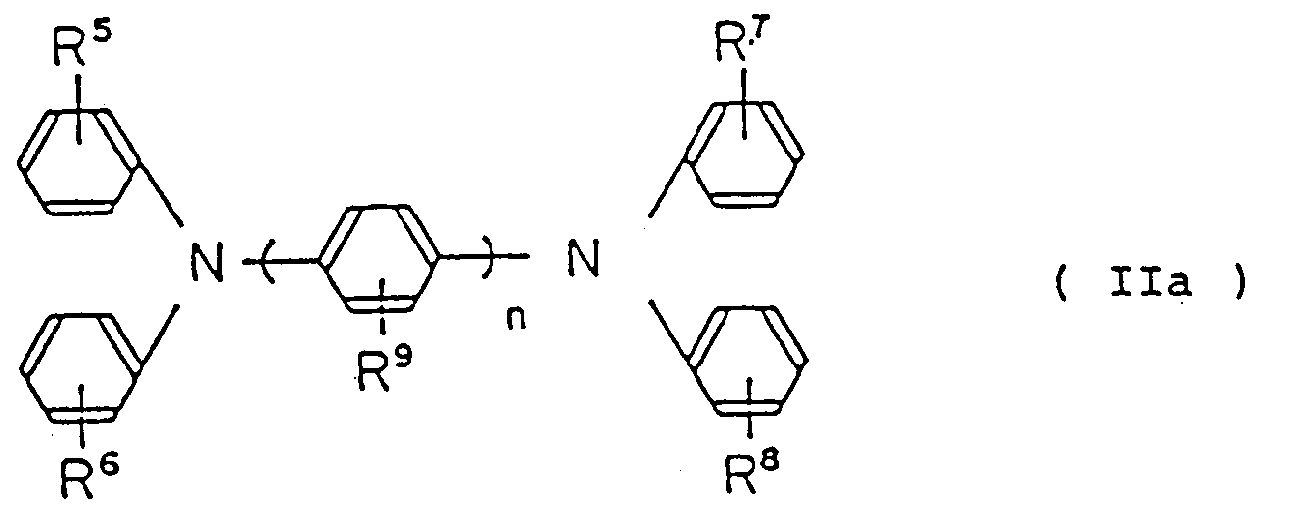
wobei R⁵, R⁶, R⁷, R⁸ und R⁹ gleich oder verschieden ein Wasserstoffatom, eine niedere Alkylgruppe, eine niedere Alkoxygruppe oder ein Halogenatom sind,
n eine ganze Zahl von 1 bis 3 ist.
wobei R⁵, R⁶, R⁷, R⁸ und R⁹ gleich oder verschieden ein Wasserstoffatom, eine niedere Alkylgruppe, eine niedere Alkoxygruppe oder ein Halogenatom sind,
n eine ganze Zahl von 1 bis 3 ist.
4. Elektrophotosensitives Material nach Anspruch 1, wobei das Diaminderivat durch die
folgende allgemeine Formel (IIb) repräsentiert ist:
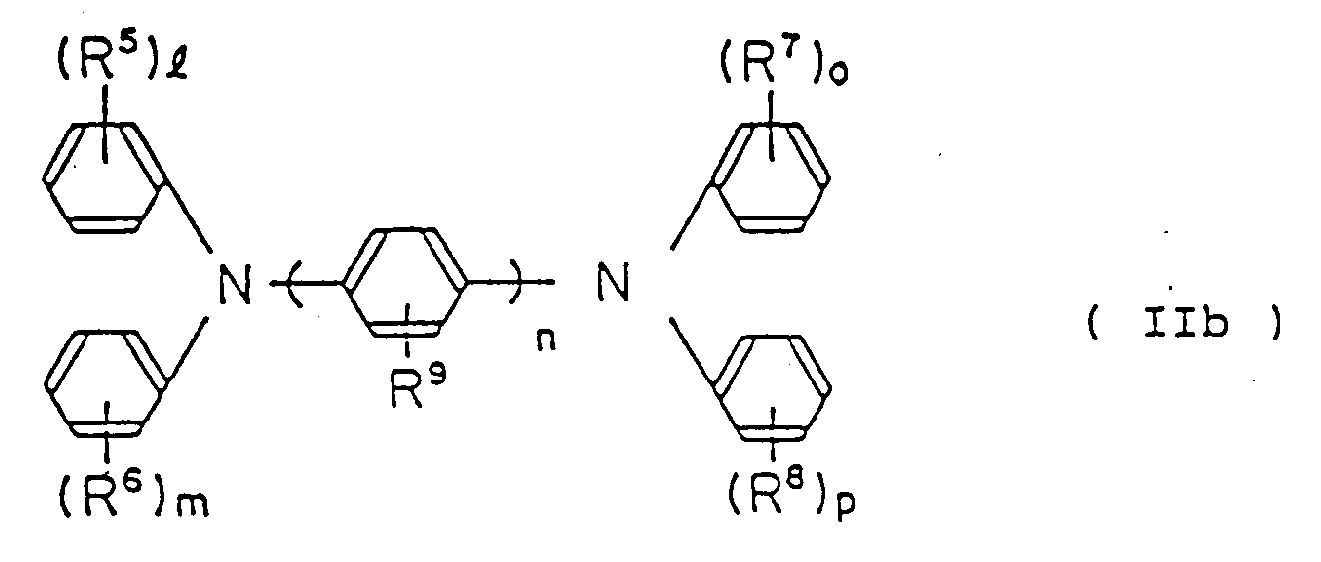
wobei R⁵, R⁶, R⁷, R⁸ und R⁹ gleich oder verschieden ein Wasserstoffatom, eine niedere Alkylgruppe, eine niedere Alkoxygruppe oder ein Halogenatom sind;
1, m, o und p eine ganze Zahl von 0 bis 2 sind; und
n eine ganze Zahl von 1 bis 3 ist.
wobei R⁵, R⁶, R⁷, R⁸ und R⁹ gleich oder verschieden ein Wasserstoffatom, eine niedere Alkylgruppe, eine niedere Alkoxygruppe oder ein Halogenatom sind;
1, m, o und p eine ganze Zahl von 0 bis 2 sind; und
n eine ganze Zahl von 1 bis 3 ist.
5. Elektrophotosensitives Material nach Anspruch 1, wobei das Diaminderivat durch die
folgende allgemeine Formel (IIc) repräsentiert ist:
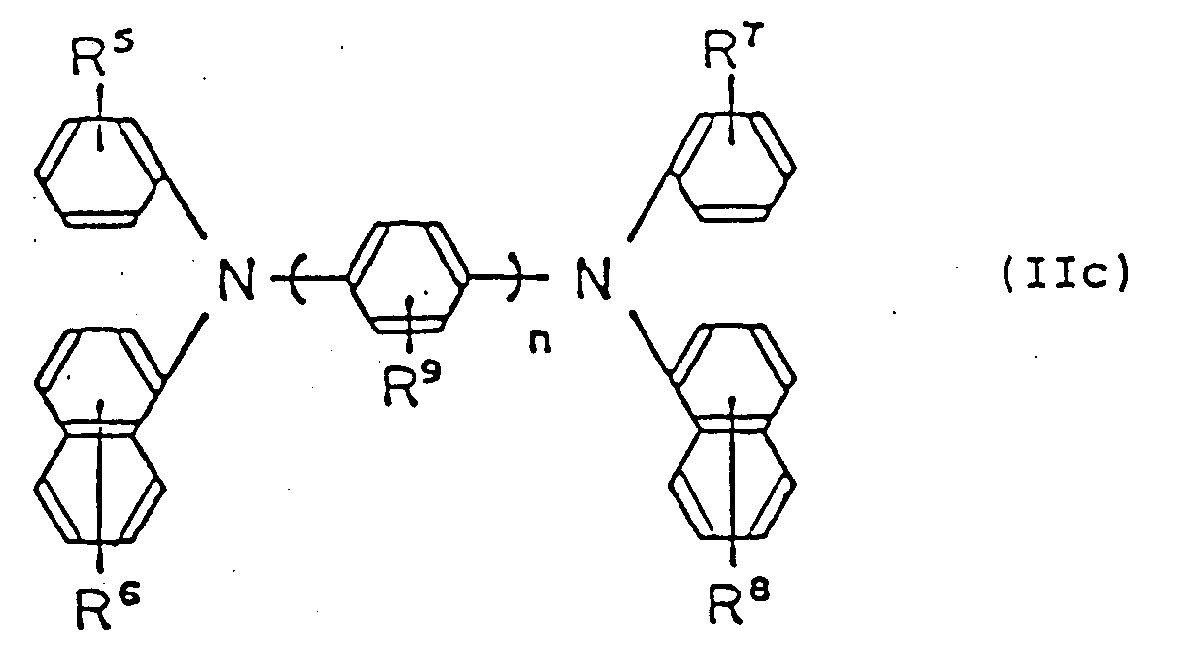
wobei R⁵, R⁶, R⁷, R⁸ und R⁹ gleich oder verschieden ein Wasserstoffatom, eine niedere Alkylgruppe, eine niedere Alkoxygruppe oder ein Halogenatom sind; und
n eine ganze Zahl von 1 bis 3 ist.
wobei R⁵, R⁶, R⁷, R⁸ und R⁹ gleich oder verschieden ein Wasserstoffatom, eine niedere Alkylgruppe, eine niedere Alkoxygruppe oder ein Halogenatom sind; und
n eine ganze Zahl von 1 bis 3 ist.
6. Elektrophotosensitives Material nach Anspruch 1, wobei das Diaminderivat durch die
folgende allgemeine Formel (IId) repräsentiert ist:
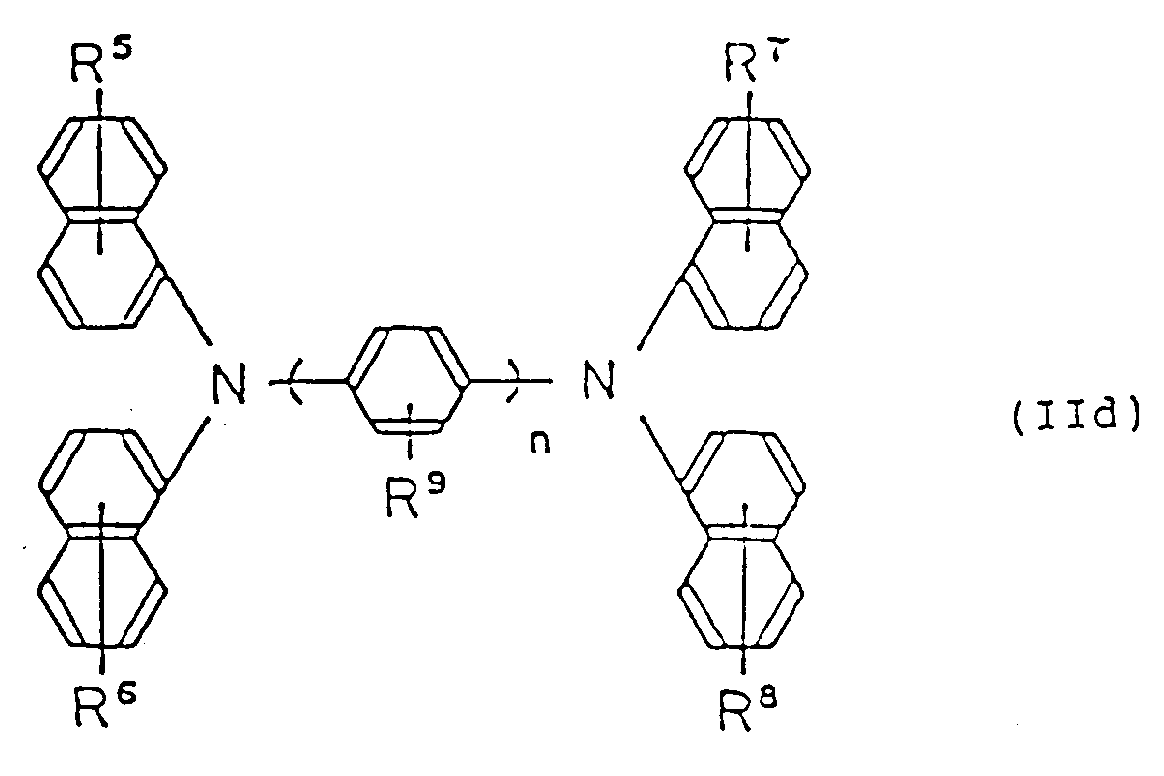
wobei R⁵, R⁶, R⁷, R⁸ und R⁹ gleich oder verschieden ein Wasserstoffatom, eine niedere Alkylgruppe, eine niedere Alkoxygruppe oder ein Halogenatom sind; und
n eine ganze Zahl von 1 bis 3 ist.
wobei R⁵, R⁶, R⁷, R⁸ und R⁹ gleich oder verschieden ein Wasserstoffatom, eine niedere Alkylgruppe, eine niedere Alkoxygruppe oder ein Halogenatom sind; und
n eine ganze Zahl von 1 bis 3 ist.
7. Elektrophotosensitives Material nach Anspruch 1, wobei die photosensitive Schicht
ein Antioxidans enthält.
8. Elektrophotosensitives Material nach Anspruch 1, wobei die Perylenverbindung N,N′-Bis(3,5-dimethylphenyl)-perylen-3,4,9,10-tetracarboxydiimid
ist.
9. Elektrophotosensitives Material nach Anspruch 1, wobei R⁵, R⁶, R⁷, R⁸ und R⁹ gleich
oder verschieden eine Alkylgruppe mit 1 bis 4 Kohlenstoffatomen, eine Alkoxygruppe
mit 1 bis 4 Kohlenstoffatomen oder ein Halogenatom sind.
10. Elektrophotosensitives Material nach Anspruch 3, wobei das Diaminderivat 3,3′-Diethyl-4,4′-bis[N,N-di(4-methylphenyl)amino]biphenyl
ist.
11. Elektrophotosensitives Material nach Anspruch 3, wobei das Diaminderivat 4,4′-Bis[N-(3,5-dimethylphenyl)-N-phenylamino]biphenyl
ist.
12. Elektrophotosensitives Material nach Anspruch 5, wobei das Diaminderivat 4,4′-Bis[N-(6-methylnaphthyl)-N-phenylamino]biphenyl
ist.
13. Elektrophotosensitives Material nach Anspruch 6, wobei das Diaminderivat 4,4′-Bis[N-(6-methylnaphthyl)-N-naphthylamino]biphenyl
ist.
14. Elektrophotosensitives Material nach Anspruch 1, wobei
der ladungserzeugende Bestandteil eine Perylenverbindung, die durch die folgende allgemeine Formel (I) repräsentiert ist:
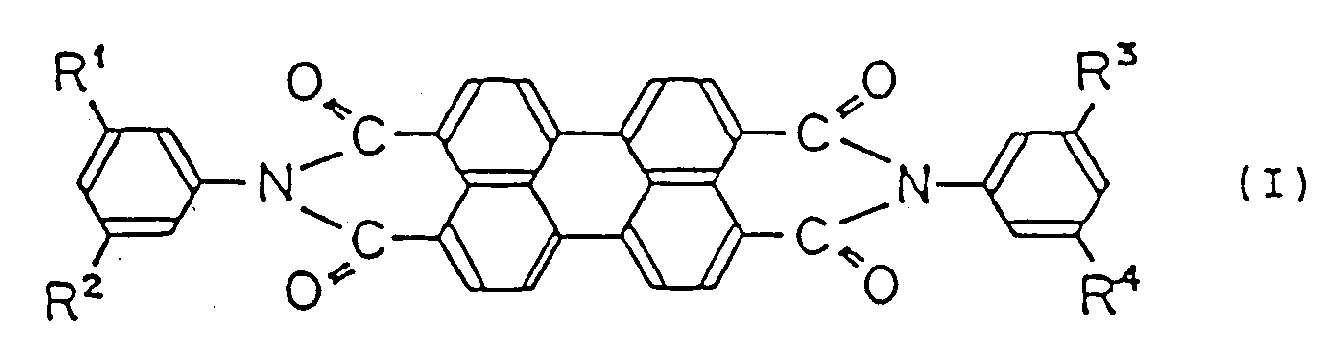
wobei R¹, R², R³ und R⁴ gleich oder verschieden eine niedere Alkylgruppe sind; und metallfreies Phthalocyanin vom X-Typ ist; und
der ladungsübertragende Bestandteil 3,3′-Dimethyl-4,4′-bis[N,N-di(4-methylphenyl)amino]biphenyl ist.
der ladungserzeugende Bestandteil eine Perylenverbindung, die durch die folgende allgemeine Formel (I) repräsentiert ist:
wobei R¹, R², R³ und R⁴ gleich oder verschieden eine niedere Alkylgruppe sind; und metallfreies Phthalocyanin vom X-Typ ist; und
der ladungsübertragende Bestandteil 3,3′-Dimethyl-4,4′-bis[N,N-di(4-methylphenyl)amino]biphenyl ist.
15. Elektrophotosensitives Material nach Anspruch 14, wobei die photosensitive Schicht
metallfreies Phthalocyanin vom X-Typ mit einer Rate von 1,25 bis 3,75 Gewichtsteilen
pro 100 Gewichtsteile der Perylenverbindung enthält.
1. Matériau électrophotosensible comprenant un substrat conducteur et une couche photosensible
disposée sur celui-ci, la couche photosensible contenant un élément générateur de
charges et un élément de transfert de charges dans une résine de liaison,
l'élément générateur de charges étant un dérivé de pérylène représenté par la formule générale suivante (I):
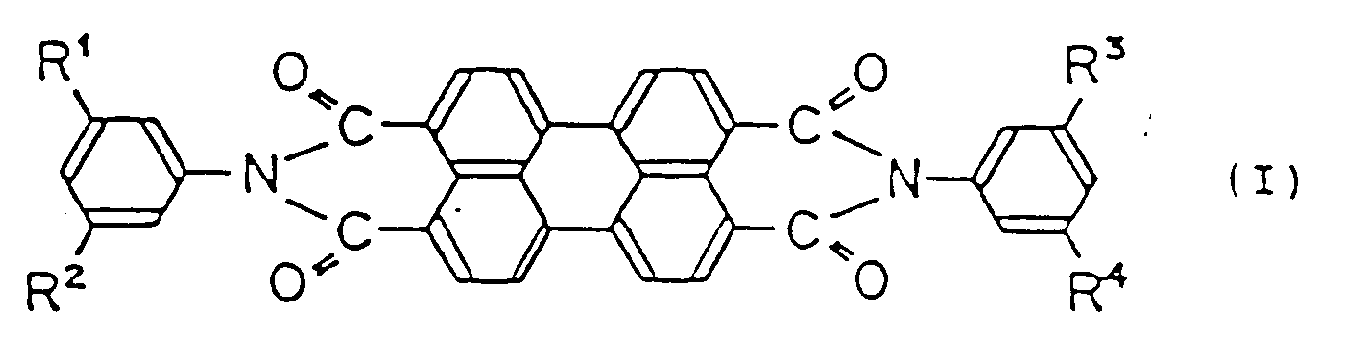
dans laquelle R¹, R², R³ et R⁴ sont identiques ou différents et représentent des substituants de type groupe alkyle inférieur, en présence de phtalocyanine de type X ne contenant pas de métal,
l'élément de transfert de charge étant un dérivé de diamine représenté par la formule générale suivante (II):
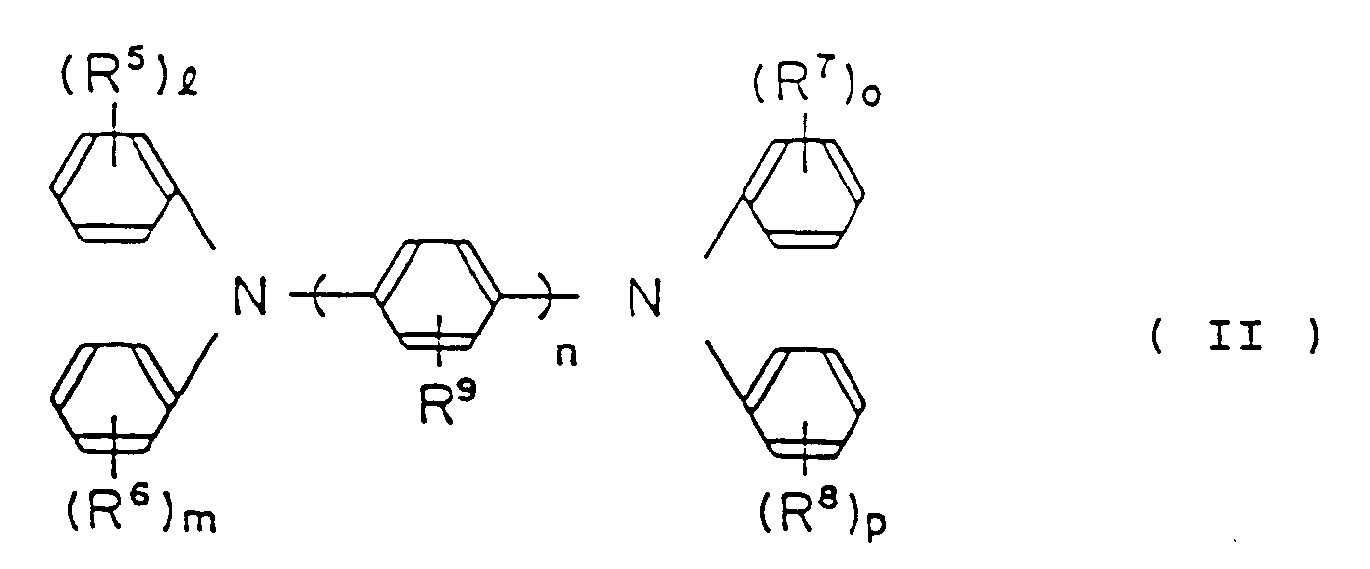
dans laquelle R⁵, R⁶, R⁷, R⁸ et R⁹ sont identiques ou différents et représentent un atome d'hydrogène, un groupe alkyle inférieur, un groupe alcoxy inférieur ou un atome de halogène; n étant un nombre entier allant de 1 à 3;
1, m, o et p étant, respectivement, des nombres entiers allant de 0 à 2, et l'un au moins des groupes suivants
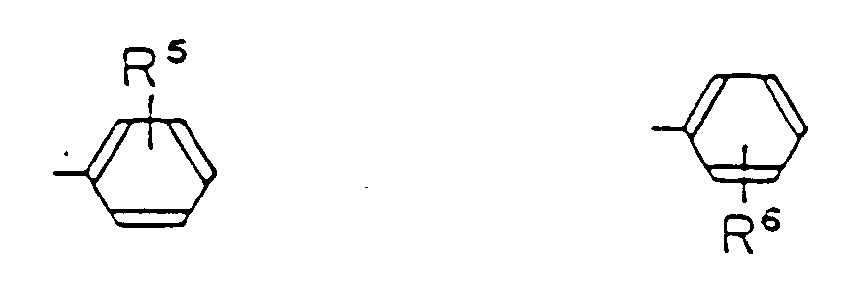
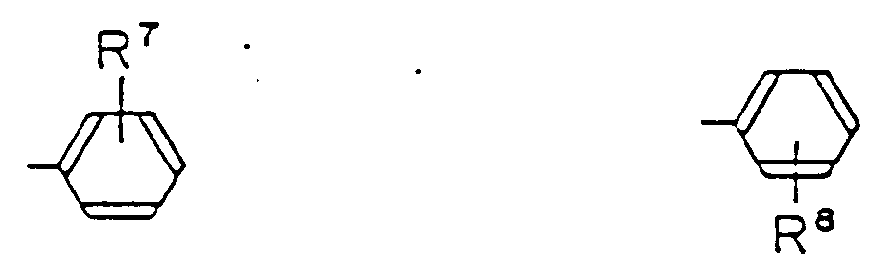
étant susceptible de former par condensation un cycle avec un noyau benzénique portant éventuellement un groupe alkyle inférieur, un groupe alcoxy inférieur ou un atome de halogène à titre de substituant.
l'élément générateur de charges étant un dérivé de pérylène représenté par la formule générale suivante (I):
dans laquelle R¹, R², R³ et R⁴ sont identiques ou différents et représentent des substituants de type groupe alkyle inférieur, en présence de phtalocyanine de type X ne contenant pas de métal,
l'élément de transfert de charge étant un dérivé de diamine représenté par la formule générale suivante (II):
dans laquelle R⁵, R⁶, R⁷, R⁸ et R⁹ sont identiques ou différents et représentent un atome d'hydrogène, un groupe alkyle inférieur, un groupe alcoxy inférieur ou un atome de halogène; n étant un nombre entier allant de 1 à 3;
1, m, o et p étant, respectivement, des nombres entiers allant de 0 à 2, et l'un au moins des groupes suivants
étant susceptible de former par condensation un cycle avec un noyau benzénique portant éventuellement un groupe alkyle inférieur, un groupe alcoxy inférieur ou un atome de halogène à titre de substituant.
2. Matériau électrophotosensible selon la revendication 1 dans lequel la couche photosensible
contient de la phtalocyanine de type X ne contenant pas de métal à raison de 1,25
à 3,75 parties en poids pour 100 parties en poids de dérivé de pérylène.
3. Matériau électrophotosensible selon la revendication 1 dans lequel le dérivé de diamine
est représenté par la formule générale suivante (IIa):
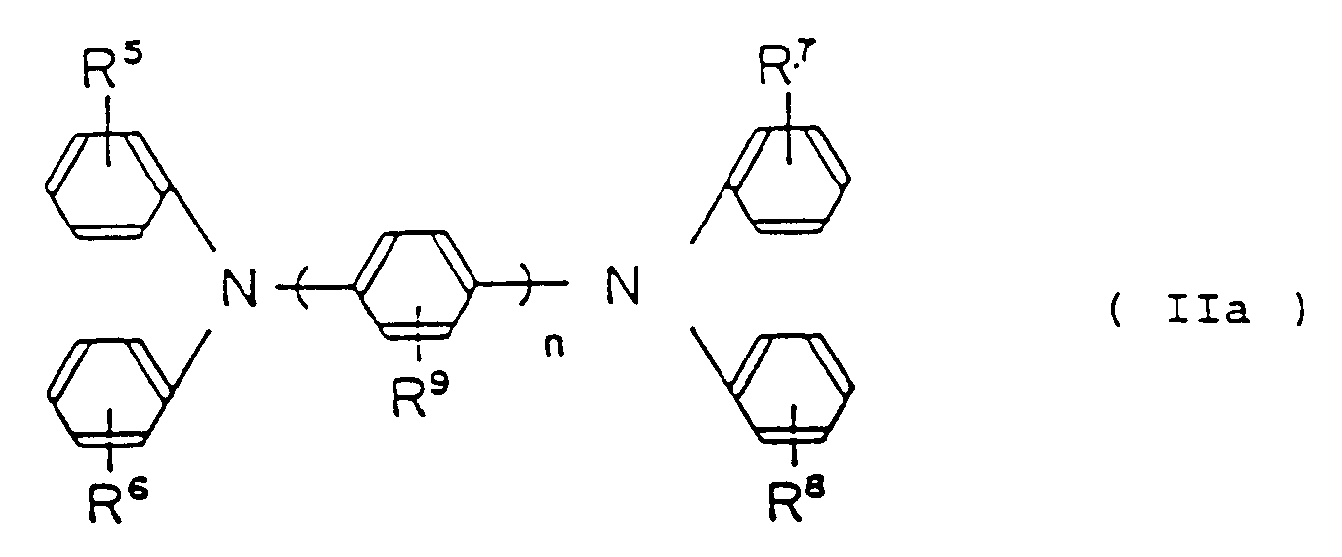
dans laquelle R⁵, R⁶, R⁷, R⁸ et R⁹ sont identiques ou différents et représentent un atome d'hydrogène, un groupe alkyle inférieur, un groupe alcoxy inférieur ou un atome de halogène; n étant un nombre entier allant de 1 à 3;
dans laquelle R⁵, R⁶, R⁷, R⁸ et R⁹ sont identiques ou différents et représentent un atome d'hydrogène, un groupe alkyle inférieur, un groupe alcoxy inférieur ou un atome de halogène; n étant un nombre entier allant de 1 à 3;
4. Matériau électrophotosensible selon la revendication 1 dans lequel le dérivé de diamine
est représenté par la formule générale suivante (IIb):
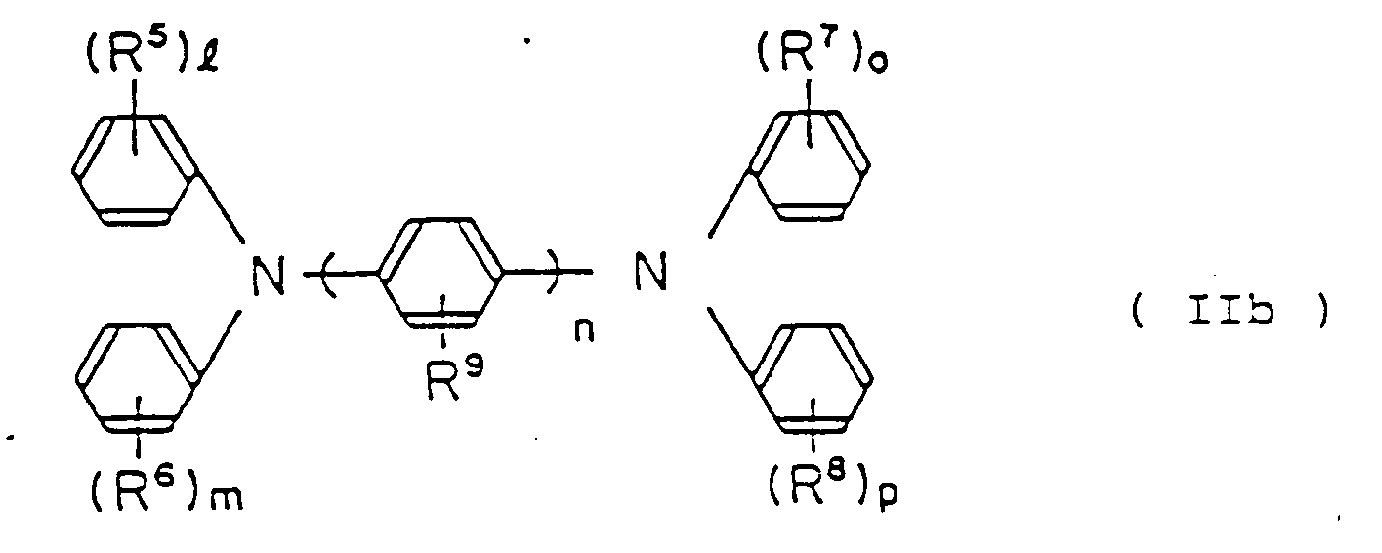
dans laquelle R⁵, R⁶, R⁷, R⁸ et R⁹ sont identiques ou différents et représentent un atome d'hydrogène, un groupe alkyle inférieur, un groupe alcoxy inférieur ou un atome de halogène; 1, m, o et p étant des nombres entiers allant de 0 à 2; et n étant un nombre entier allant de 1 à 3;
dans laquelle R⁵, R⁶, R⁷, R⁸ et R⁹ sont identiques ou différents et représentent un atome d'hydrogène, un groupe alkyle inférieur, un groupe alcoxy inférieur ou un atome de halogène; 1, m, o et p étant des nombres entiers allant de 0 à 2; et n étant un nombre entier allant de 1 à 3;
5. Matériau électrophotosensible selon la revendication 1 dans lequel le dérivé de diamine
est représenté par la formule générale suivante (IIc):
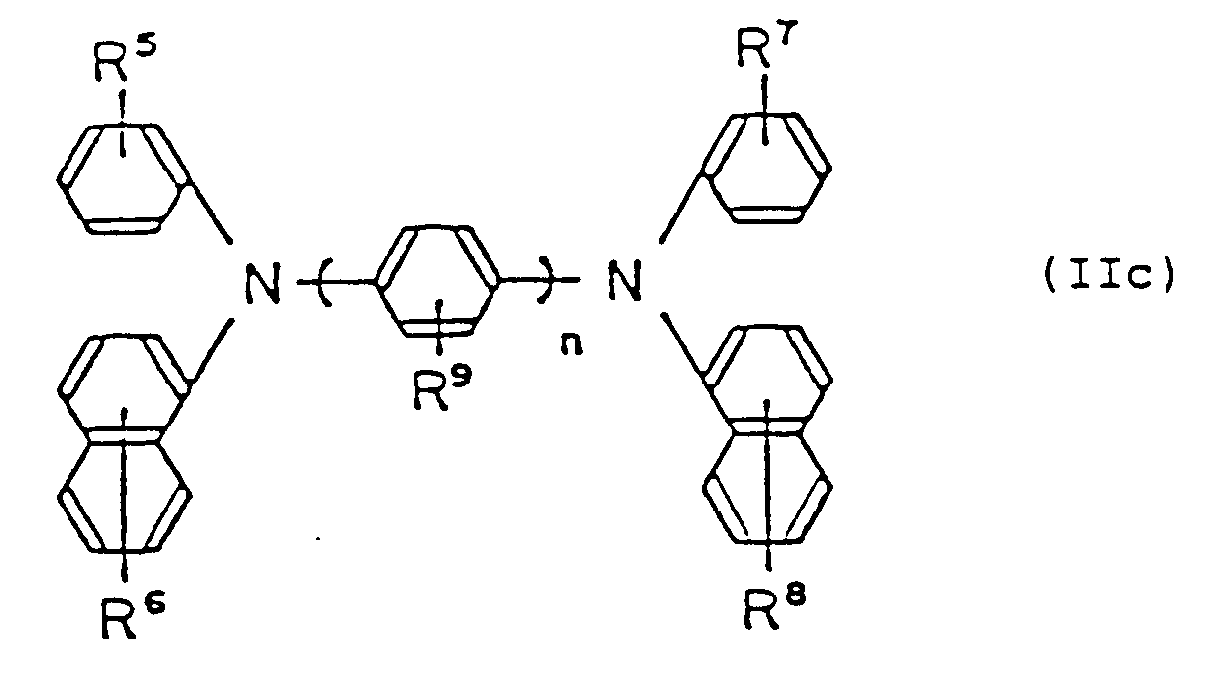
dans laquelle R⁵, R⁶, R⁷, R⁸ et R⁹ sont identiques ou différents et représentent un atome d'hydrogène, un groupe alkyle inférieur, un groupe alcoxy inférieur ou un atome de halogène; et n est un nombre entier allant de 1 à 3;
dans laquelle R⁵, R⁶, R⁷, R⁸ et R⁹ sont identiques ou différents et représentent un atome d'hydrogène, un groupe alkyle inférieur, un groupe alcoxy inférieur ou un atome de halogène; et n est un nombre entier allant de 1 à 3;
6. Matériau électrophotosensible selon la revendication 1 dans lequel le dérivé de diamine
est représenté par la formule générale suivante (IId):
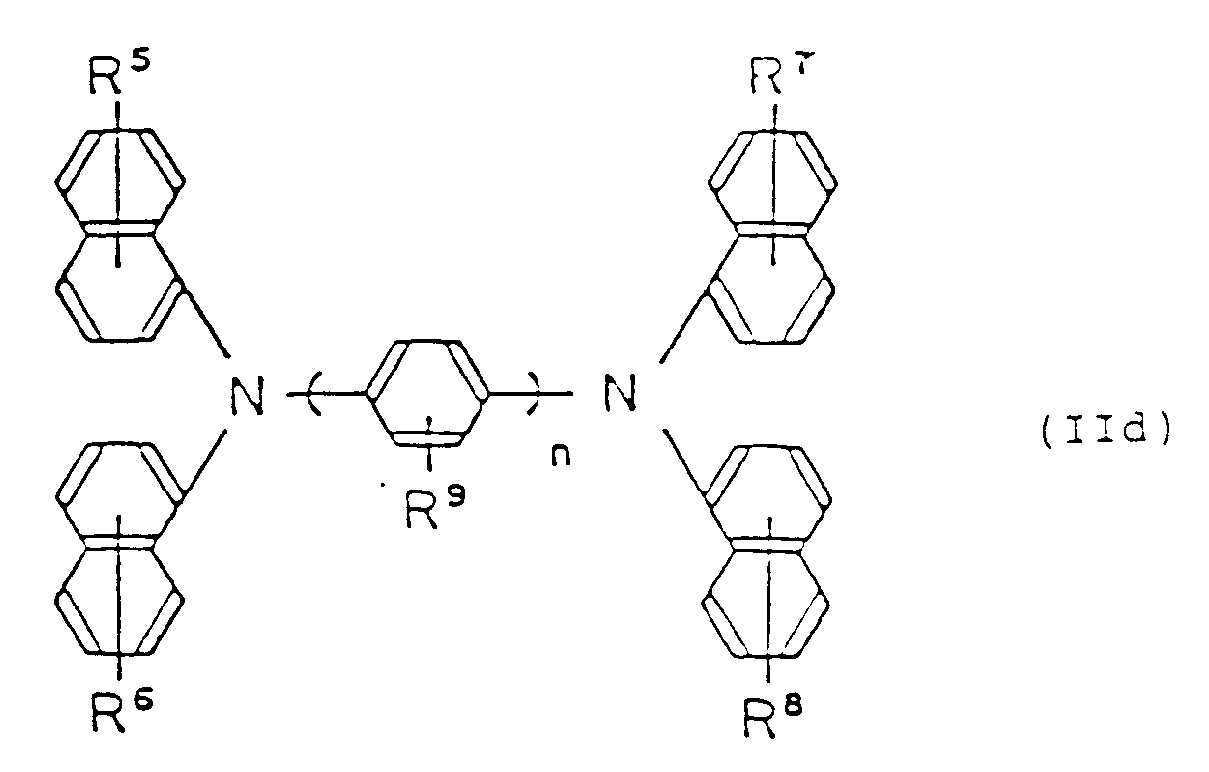
dans laquelle R⁵, R⁶, R⁷, R⁸ et R⁹ sont identiques ou différents et représentent un atome d'hydrogène, un groupe alkyle inférieur, un groupe alcoxy inférieur ou un atome de halogène; et n est un nombre entier allant de 1 à 3;
dans laquelle R⁵, R⁶, R⁷, R⁸ et R⁹ sont identiques ou différents et représentent un atome d'hydrogène, un groupe alkyle inférieur, un groupe alcoxy inférieur ou un atome de halogène; et n est un nombre entier allant de 1 à 3;
7. Matériau électrophotosensible selon la revendication 1 dans lequel la couche photosensible
contient un antioxydant.
8. Matériau électrophotosensible selon la revendication 1 dans lequel le dérivé de pérylène
est le N, N′-bis(3, 5-diméthylphényl)pérylène-3, 4, 9, 10-tétracarboxydiimide.
9. Matériau électrophotosensible selon la revendication 1 dans lequel R⁵, R⁶, R⁷, R⁸
et R⁹ sont identiques ou différents et représentent un groupe alkyle ayant de 1 à
4 atomes de carbone, un groupe alcoxy ayant de 1 à 4 atomes de carbone ou un atome
de halogène.
10. Matériau électrophotosensible selon la revendication 3 dans lequel le dérivé de diamine
est le 3, 3′-diéthyl-4, 4′-bis[N, N-di(4-méthylphényl)amino]biphényle.
11. Matériau électrophotosensible selon la revendication 3 dans lequel ledit dérivé de
diamine est le 4, 4′-bis[N-(3, 5-diméthylphényl)-N-phénylamino] biphényle.
12. Matériau électrophotosensible selon la revendication 5 dans lequel le dérivé de diamine
est le 4, 4′-bis[N-(6-méthylnaphtyl)-N-phénylamino]biphényle.
13. Matériau électrophotosensible selon la revendication 6 dans lequel le dérivé de diamine
est le 4, 4′-bis[N-(6-méthylnaphtyl)-N-naphtylamino]biphényle.
14. Matériau électrophotosensible selon la revendication 1, dans lequel
l'élément générateur de charges est un dérivé de pérylène représenté par la formule générale suivante (I):
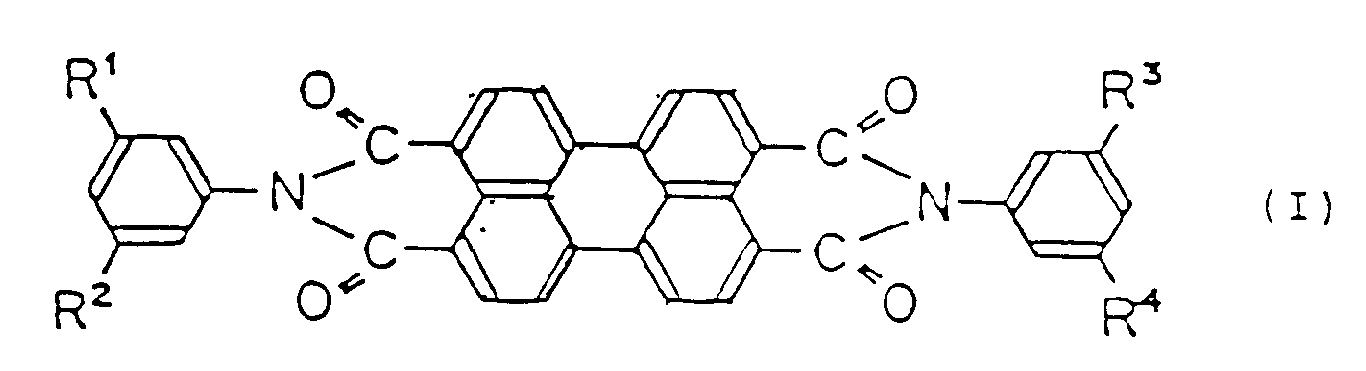
dans laquelle R¹, R², R³ et R⁴ sont identiques ou différents et représentent un groupe alkyle inférieur, en présence de phtalocyanine de type X ne contenant pas de métal; et
l'élément de transfert de charge est le 3, 3′-diméthyl-4, 4′-bis[N, N-di(4-méthylphényl)amino]biphényle.
l'élément générateur de charges est un dérivé de pérylène représenté par la formule générale suivante (I):
dans laquelle R¹, R², R³ et R⁴ sont identiques ou différents et représentent un groupe alkyle inférieur, en présence de phtalocyanine de type X ne contenant pas de métal; et
l'élément de transfert de charge est le 3, 3′-diméthyl-4, 4′-bis[N, N-di(4-méthylphényl)amino]biphényle.
15. Matériau électrophotosensible selon la revendication 14 dans lequel la couche photosensible
comprend de la phtalocyanine de type X ne contenant pas de métal à raison de 1,25
à 3,75 parties en poids pour 100 parties en poids de dérivé de pérylène.