|
(11) | EP 0 386 759 B1 |

| (12) | EUROPEAN PATENT SPECIFICATION |
|
|
| (54) |
Process for producing biaxially oriented nylon film Verfahren zum Herstellen von biaxial orientierten Nylon-Folien Procédé pour la fabrication de films en nylon à orientation biaxale |
|
|
|||||||||||||||||||||||||||||||
| Note: Within nine months from the publication of the mention of the grant of the European patent, any person may give notice to the European Patent Office of opposition to the European patent granted. Notice of opposition shall be filed in a written reasoned statement. It shall not be deemed to have been filed until the opposition fee has been paid. (Art. 99(1) European Patent Convention). |
BACKGROUND OF THE INVENTION
1. Field of the Invention
[0001] The present invention relates to a process for producing a biaxially oriented nylon single-layered or multilayered film. It can be used in fields of food packaging, industrial material and the like.
2.Description of the Related Arts
[0002] A nylon film which has been simultaneously biaxially oriented by a tubular film process has superior features in that mechanical and optical characteristics such as a mechanical strength and transparency are good.
[0003] A multilayered film of nylon 6 layer/polyvinylidene chloride layer (i.e., PVDC) is employed as a substrate improving a to-water barrier of such nylon film. However, there has been a problem in that incinerating the multilayered film produces harmful chlorine gas causing an acid rain which in turn causes an environmental destruction. Thus, various multilayered nylon films and having no polyvinylidene chloride have been proposed as a substrate causing no environmental problem and also having a superior to-oxygen barrier. Since, e.g., a multilayered film comprising a nylon layer, adhesive resin layer and polyolefin layer has a superior thermal shrinkage characteristic as well as superior barrier, a demand that it be used for a fresh meat packaging film or the like has been expected. Hitherto, a process for stably producing such biaxially oriented nylon multilayered film has been required. In addition, a multilayered film of nylon 6 layer/ethylene-vinyl acetate copolymeric saponification product (i.e., EVOH)/nylon 6 layer has been proposed and a process for stably producing this biaxially oriented multilayered film has been required.
[0004] In accordance with a prior-art tubular film process type for producing a biaxially oriented nylon film, since the thickness accuracy of a resulting film is generally low, it has tended to provide a poor winding appearance and produce defections in a secondary processing of the film, e.g., a printing, lamination or bag-making, which has restricted food packaging and industrial uses of the film. This is because a thickness unevenness of an addition or subtraction 2-6 % order will be appeared even when an extrusion die adjusts the thickness accuracy of the film in producing a rollstock film to be oriented and because in addition, the thickness unevenness will deteriorate twice or more in a progress of a film draw in accordance with the prior-art tubular film process. In addition, since the prior-art tubular film process could fail to stabilize a bubble under film draw operation, the bubble could rock and be occasionally ruptured.
[0005] Hitherto, in order to secure a molding stability in a biaxial draw operation of a polyamide resin film, a process in which a preheating is applied to the polyamide resin film before a biaxial draw operation thereof (Unexamined Japanese Patent Application Publication No. 57-41924), a process in which a draw magnification is regulated (Examined Japanese Patent Application Publication No. 49-47269), a process in which a draw temperature is regulated (Examined Japanese Patent Application Publication No. 53-15914) and the like have been proposed. However, none of these processes could accurately regulate desirable process conditions.
[0006] In particular, since an orientation stress in a film such as the multilayered film of nylon 6 layer/EVOH layer/nylon 6 layer is too high to continuously mold in accordance with the process in which the preheating is applied before the biaxial draw (Unexamined Japanese Patent Application Publication No. 57-41924), it is unpreferable.
[0007] Examined Japanese Patent Application publication No. 49-47269 proposed a process for producing a biaxially molecularly oriented poly-ε-capramide resin film comprising the steps of: quenching and solidifying a tubular film made of a molten and extruded poly-ε-capramide resin to maintain the resulting essentially amorphous and essentially hydrogen bond-free poly-ε-capramide resin tubular film in the state of a less than 2% water content; and performing a tube draw at a temperature of 45 to 70 °C inclusive before film draw so that respective machine direction draw magnification and transverse direction draw magnification of the tube draw are in the ranges of 2.0 to 4.0.
[0008] Examined Japanese Patent Application Publication No. 53-15914 proposed a process for biaxially drawing a tubular polyamide film comprising the steps of: heating a non-oriented tubular polyamide film at a temperature of 50 to 90 °C inclusive; then holding an atmospheric temperature between a draw start point and draw completion point at a temperature of 180 to 250 °C inclusive to fix the draw start point; and performing a simultaneous biaxial draw by a gas pressure at a machine direction draw magnification of 2.5 to 3.7 at a transverse direction draw magnification of 3.0 to 4.0 while restricting final machine and transverse direction draw magnification differences to within the ranges of 0.2 to 0.6.
[0009] However, such processes with the draw magnifications or draw temperature controlled could not accurately regulate process conditions for producing a good film.
[0010] From EP-A-189922 there is known a method of producing biaxially oriented film of thermoplastic resin wherein air is blown against a starting point for heating and stretching a tube, from the upstream side of the starting point, at a predetermined angle relative to the feeding direction of the film. Said air blow out angle is preferably within an angular scope of 30 to 50° relative to the feeding direction (machine direction) of said film.
SUMMARY OF THE INVENTION
[0012] It is the first object of the present invention to provide a process for especially producing a single-layered biaxially oriented nylon film out of biaxially oriented nylon films produced by tubular film process so that a molding condition in draw operation of the films is stabilized and the thickness accuracy of a resulting film is good.
[0013] In order to achieve the first object, various parameters characterizing draw operation were confirmed by experiments of producing the nylon film biaxially oriented by tubular film process. These experiments showed that selecting process conditions in response to the maximal draw stress σMD in film's machine direction (MD) and maximal draw stress σTD in film's transverse direction (TD) provided a good result.
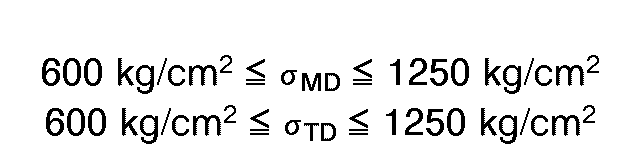
[0014] Accordingly, a first embodiment achieving the first object is characterized in that σMD and σTD are selected in the following expressions:
[0015] When both σMD and σTD exceed 1,300 kg/cm², a bubble under draw operation are frequently ruptured so that a continuous production of the film fails to continue. On the other hand, when both σMD and σTD are less than 600 kg/cm², the bubble under draw operation becomes unstable. Thus, it is more preferable that the upper limits of both σMD and σTD are selected to be 1,200 kg/cm² and the lower limits of both σMD and σTD are selected to be 700 kg/cm².
[0016] The second object of the present invention is to provide a process for producing a multilayered film comprising nylon layer and ethylene-vinyl acetate copolymeric saponification product (i.e., EVOH) layer and having a good to-oxygen barrier and high mechanical strength, the process being able to improve molding stability in biaxial draw and provide a good thickness accuracy of a resulting film.
[0017] In order to achieve the second object, various parameters characterizing draw operation were confirmed by experiments of producing the multilayered film biaxially oriented by tubular film process and comprising nylon layer and EVOH layer. These experiments showed that selecting process conditions in response to the maximal draw stress σMD in film's machine direction (MD) and maximal draw stress σTD in film's transverse direction (TD) provided a good result.
[0018] Accordingly, the second embodiment achieving the second object is characterized in that σMD and σTD are selected in the following expressions:
[0019] When both σMD and σTD exceed 1,250 kg/cm², a bubble under draw operation are frequently ruptured so that a continuous production of the film fails to continue. On the other hand, when both σMD and σTD are less than 600 kg/cm², the bubble under draw operation becomes unstable. Thus, it is more preferable that the upper limits of both σMD and σTD are selected to be 1,100 kg/cm² and the lower limits of both σMD and σTD are selected to be 700 kg/cm².
[0020] Herein, the multilayered film comprising nylon 6 layer and EVOH layer comprises, e.g., multilayered films respectively having a double-layer structure of nylon 6 layer/EVOH layer and a trilayer structure of nylon 6 layer/EVOH layer/nylon 6 layer.
[0021] Particular polyolefin providing the polyolefin layer comprise, e.g., polyethylene (i.e., PE), polypropylene (i.e., PP), ethylene-vinyl acetate copolymer (i.e., EVA), ionomer resin (i.e., IR), ethylene-acrylic acid copolymer (i.e., EAA), ethylene-ethyl acrylate copolymer (i.e., EEA), polybutene (i.e., PB), ethylen-methacrylic acid copolymer (i.e., EMAA) and etc. In view of heat-sealability, linear low-density polyethylene (i.e., L-LDPE), IR, EVA and EAA out of PE may be preferably employed.
[0022] A resin providing the adhesive resin layer may be selected if desired. A modified polyolefin resin, an EVA of a greater acetate content and the like may be listed for this resin. In view of a low smelling, the modified polyolefin resin out of these resins may be preferably employed.
[0023] For example, particular arrangements of this multilayered film are as follows: (i) a lamination of nylon 6/EVOH layer/adhesive resin layer/polyolefin layer arranged in this order; (ii) a lamination of nylon 6 layer/EVOH layer/nylon 6 layer/adhesive resin layer/polyolefin layer arranged in this order; (iii) a lamination of EVOH layer/nylon 6 layer/adhesive resin layer/polyolefin layer arranged in this order; (iv) a lamination of polyolefin layer/adhesive resin layer/nylon 6 layer/EVOH layer/adhesive resin layer/polyolefin layer arranged in this order; and (v) a lamination of polyolefin layer/adhesive resin layer/nylon 6 layer/EVOH layer/nylon 6 layer/adhesive resin layer/polyolefin layer arranged in this order.
[0024] For example, particular arrangements of this multilayered film are as follows: (i) a lamination of nylon 6-66 layer/EVOH layer; (ii) a lamination of nylon 6-66 layer/EVOH layer/nylon 6-66 layer arranged in this order; and (iii) a lamination of EVOH layer/nylon 6-66 layer/EVOH layer arranged in this order.
[0025] For example, particular arrangements of this multilayered film are as follows: (i) a lamination of nylon 6-66 layer/EVOH layer/adhesive resin layer/polyolefin layer arranged in this order; (ii) a lamination of nylon 6-66 layer/EVOH layer/nylon 6-66 layer/ adhesive resin layer/polyolefin layer arranged in this order; (iii) a lamination of EVOH layer/nylon 6-66 layer/adhesive resin layer/polyolefin layer arranged in this order; (iv) a lamination of polyolefin layer/adhesive resin layer/nylon 6-66 layer/EVOH layer/adhesive resin layer/polyolefin layer arranged in this order; and (v) a lamination of polyolefin
[0026] For example, particular arrangements of this multilayered film are as follows: (i) a lamination of nylon 6-66 layer/adhesive resin layer/polyolefin layer arranged in this order; and (ii) a lamination of polyolefin layer/adhesive resin layer/nylon 6-66 layer/adhesive resin
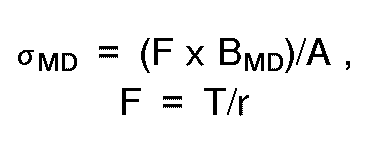
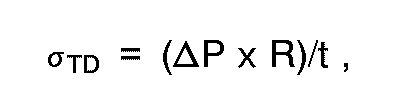
[0027] In accordance with the present invention, σMD and σTD are expressed by the following equations (1) and (2):
, wherein F represents a draw force (kg), BMD represents a draw magnification in the machine direction (MD), A represents a sectional area (cm²) of a rollstock film, T represents a torque (kgcm) of each of a pair of nip rolls, and r represents a radius (cm) of each of the pair of nip rolls. Computing the torque T from the reading of a load on a motor required to rotate the nip rolls provides the value of the draw force F in accordance with the equation (1).
, wherein Δ P represents an in-bubble pressure (kg/cm²), R represents a bubble radius (cm), and t represents a film thickness (cm). A measurement with a digital manometer provides the value of the in-bubble pressure ΔP.
.
BRIEF DESCRIPTION OF THE DRAWING
[0028] FIG.1 is a schematic illustration of an apparatus used in a production process of each embodiment of the present invention.
DETAILED DESCRIPTION OF THE PREFERRED EMBODIMENTS
[0029] Hereinafter, a first embodiment of the present invention achieving the first object of the present invention will be described with reference to FIG.1.
Experimental Example 1
[0030] An annular die with a 75 mm diameter extruded nylon 6 with a 3.7 relative viscosity ηr, in particular, UBE nylon 1024FD (Trademark, produced by Ube Industries, Ltd., having a 3.7 relative viscosity ηr). Then, the extruded nylon 6 was cooled in a cooling cistern at a water temperature of 15 °C to produce a tubular rollstock film 1 of a 120 micrometer thickness. Then, the rollstock film 1 was nipped between a pair of nip rolls 2 as shown in FIG.1. Then, the hollow interior of the rollstock film 1 was forcibly blown with a gas, and a heater 3 at 310 °C concurrently heated the rollstock film 1. An air ring 4 concurrently blew a 15 m³ /min capacity air 5 to a draw start point of the rollstock film 1 to expand the rollstock film 1 in the form of a bubble 6. A pair of nip rolls 7 positioned downstream of the bubble 6 drew up the bubble 6. Thus, a simultaneous biaxial draw operation was performed to produce a biaxially oriented nylon 6 film 8. A draw magnification in film's machine direction (MD) was 3.0 and a draw magnification in film's transverse direction (TD) was 3.2.
[0031] In the simultaneous biaxial draw operation, a pressure in the bubble 6, radius of the bubble 6, rotational speed of each of the pairs of nip rolls 2 and nip rolls 7, and load on and torque of a drive motor were selected to be particular values thereby to adjust the maximal stress σMD in film's machine direction (MD) and maximal stress σTD in film's transverse direction (TD) of the resulting film.
[0032] In accordance with Experimental Example 1, the maximal stress σMD in film's machine direction (MD) was 950 kg/cm² and the maximal stress σTD in film's transverse direction (TD) was 960 kg/cm².
[0033] These σMD and σTD were computed by the equations (1) and (2) wherein
wherein I represents motor current (A) in load operation, I₀ represents motor current (A) in no-load operation and N represents a rotational speed (rpm) of each of the nip rolls. The above specified value of torque T represents that of a particular nip roll of Experimental Example 1.
[0034] In the production of the biaxially oriented nylon 6 film according to Experimental Example 1 with σMD and σTD selected to be above values, a 24-hr continuous production of the film provided that no bubble 6 under draw operation experienced a rocking etc. The thickness accuracy of the resulting nylon 6 film 8 was very as good as an addition or subtraction 4% in thickness unevenness.
Experimental Examples 2 to 10
[0035] A biaxially oriented nylon 6 film 8 of each of Experimental Examples 2 to 10 was produced as that of Experimental Example 1. However, MD draw magnifications, TD draw magnifications, air capacities of the air ring 4, and selected temperatures of the heater 3 were different between Experimental Examples 2 to 10 as shown on Table 1.
[0036] An MD draw magnification of each of Experimental Examples 2 to 8 and 10 was 3.0 and that of Experimental Example 9 was 3.4.
[0037] A TD draw magnification of each of Experimental Examples 2 to 6, 9 and 10 was 3.2, that of Experimental Example 7 was 3.0 and that of Experimental Example 8 was 3.4.
[0038] An air capacity of the air ring 4 of each of Experimental Examples 2, 3 and 7 to 10 was 15 m³/min, that of Experimental Example 4 was 5 m³/min and that of Experimental Example 6 was 45 m³/min.
[0039] A selected temperature of the heater 3 of Experimental Example 2 was 330 °C, that of Experimental Example 3 was 280 °C, that of each of Experimental Examples 4 to 9 was 310 °C and that of Experimental Example 10 was 370 °C.
[0041] In each of Experimental Examples 2 to 10, the pressure in a bubble 6, radius of the bubble 6, rotational speed of each of the pairs of nip rolls 2 and nip rolls 7, and load on and torque of the drive motor were selected to be particular values in simultaneous draw operation so that the maximal stress σMD in film's machine direction (MD) and the maximal stress σTD in film's transverse direction (TD) essentially equaled the same adequate value.
[0042] In a production of a biaxially oriented nylon 6 film 8 of each Experimental Example with σMD and σTD selected to be respective suitable values, a 24-hr continuous production was performed, the molding stability of a bubble 6 under draw operation was watched and evaluated, and the thickness unevenness, i.e., thickness accuracy of a resulting biaxially oriented nylon 6 film 8 was measured and evaluated. In addition, the biaxially oriented nylon 6 film 8 was generally evaluated. The below Table 1 shows all of the results of the watch, particular evaluation and general evaluation.
Control Examples 1 to 8
[0043] A biaxially oriented nylon film of each of Control Examples or Controls 1 to 8 was produced as that of each of Experimental Examples 1 to 10. However, MD draw magnifications, TD draw magnifications, air capacities of the air ring 4, selected temperatures of the heater 3 and temperatures of cooling water were different between Control Examples 1 to 8 as shown on Table 1.
[0044] An MD draw magnification of each of Control Examples 1 to 4 and 8 was 3.0, that of Control Example 5 was 3.6, that of Control Example 6 was 2.4 and that of Control Example 7 was 3.4.
[0045] A TD draw magnification of each of Control Examples 1 to 6 and 8 was 3.2 and that of Control Example 7 was 3.4.
[0046] An air capacity of the air ring 4 of each of Control Examples 1, 2 and 5 to 8 was 15 m³/min, that of Control Example 3 was 0 m³/min and that of Control Example 4 was 55 m³/min.
[0047] A selected temperature of the heater 3 of Control Example 1 was 400 °C, that of Control Example 2 was 260 °C and that of each of Control Examples 3 to 8 was 310 °C.
[0048] A temperature of cooling water of each of Control Examples 1 to 7 was 15 °C and that of Control Example 8 was 45 °C.
[0049] In each of Control Examples 1 to 8 as in Experimental Examples 1 to 10, the pressure in a bubble 6, radius of the bubble 6 etc. were selected to be particular values in simultaneous draw operation so that the maximal stress σMD in film's machine direction (MD) and the maximal stress σTD in film's transverse direction (TD) essentially equaled the same adequate value.
[0050] In a production of a biaxially oriented nylon 6 film of each Control Example with σMD and σTD selected to be respective adequate values, a 24-hr continuous production was performed, the molding stability of a bubble 6 under draw operation was watched and evaluated, and the thickness accuracy of a resulting biaxially oriented nylon 6 film was measured and evaluated. In addition, the biaxially oriented nylon 6 film was generally evaluated. The below Table 1 shows all of the results of the watch, particular evaluation and general evaluation.
[0051] In Table 1, a legend Ⓞ in a molding stability column indicates a condition that a lay flat width variation in bubble is within an addition or subtraction 1%, no rupture in the bubble occurs and no unstable phenomenon, e.g., a vertical motion and a rocking occur, a legend ○ in the molding stability column indicates a condition that a lay flat width variation in bubble is within an addition or subtraction 3%, no rupture in bubble occurs and no unstable phenomenon occurs, and a legend x in the molding stability column indicates a condition that the bubble is ruptured or unstable phenomenon occurs, which makes a continuous molding of the film difficult. Respective legends ○ , △ and x in a thickness accuracy column indicate conditions with local thicknesses of an addition or subtraction 6% or less, an addition or subtraction 7 to 10% and an addition or subtraction 11% or more. A legend Ⓞ in a general evaluation column indicates optimum for industrial production, a legend ○ therein indicates favorability to industrial production, and legend x indicates incapability of industrial production.
[0052] Table 1 indicates that in accordance with Experimental Examples 1 to 10 and Control Examples 1 to 8, when both the maximal draw stress σMD in film's machine direction (MD) and maximal draw stress σTD in film's transverse direction (TD) are in the range of 600 kg/cm² to 1,300 kg/cm², a good molding stability of the bubble 6 and good thickness accuracy of the biaxially oriented nylon 6 film 8 are provided. In particular, it is more preferable that the upper limits of both σMD and σTD are 1,200 kg/cm² and the lower limits thereof are 700 kg/cm².
[0053] Consequently, since this first embodiment provides a good molding stability in biaxial draw of the nylon 6 film, the film is smoothly continuously produced. In addition, the thickness accuracy of a resulting biaxially oriented nylon 6 film is improved to provide a quality product.
[0054] Hereinafter, a second embodiment of the present invention achieving the second object of the present invention will be described with reference to FIG.1 as the first embodiment. The descriptions of the same or similar arrangements as those of the first embodiment will be eliminated or abridged.
Experimental Example 25
[0055] An extruder molded a multilayered rollstock film having the trilayer structure of a 49 micrometer thick nylon 6 layer/a 49 micrometer thick EVOH layer/a 49 micrometer thick nylon 6 layer. Then, a water cooling ring at a water temperature of 15 °C cooled the resulting multilayered rollstock film to produce a 147 micrometer thick tubular rollstock film 1. Experimental Example 25 employed the same nylon 6 as Experimental Example 1. An EVOH of a 38 mol% ethylene content was employed.
[0056] Then, the rollstock film 1 was nipped between a pair of nip rolls 2. Then, the hollow interior of the rollstock film 1 was forcibly blown with a gas, and a heater 3 at 310 °C concurrently heated the rollstock film 1. An air ring 4 concurrently blew a 15 m³/min capacity air 5 to a draw start point of the rollstock film 1 to expand the rollstock film 1 in the form of a bubble 6. A pair of nip rolls 7 positioned downstream of the bubble 6 drew up the bubble 6. Thus, a simultaneous biaxial draw operation was performed to produce a biaxially oriented multilayered film 8. A draw magnification in film's machine direction (MD) was 3.0 and a draw magnification in film's transverse direction (TD) was 3.2.
[0057] In the simultaneous biaxial draw operation, the pressure in the bubble 6, radius of the bubble 6, rotational speed of each of the pairs of nip rolls 2 and nip rolls 7, and load on and torque of a drive motor were selected to be particular values thereby to adjust the maximal stress σMD in film's machine direction (MD) and maximal stress σTD in film's transverse direction (TD) of the resulting film.
[0058] In accordance with Experimental Example 25, the maximal draw stress σMD in film's machine direction (MD) was 710 kg/cm² and the maximal draw stress σTD in film's transverse direction (TD) was 750 kg/cm².
[0059] These σMD and σTD were computed by the equations (1) and (2) wherein F=97 kg, BMD=3.0, A=0.41 cm², T=486 kgcm, r=5 cm, P=800x10⁻⁴ kg/cm², R=14.4 cm and t=15.3x10⁻⁴cm.
[0060] In the production of the biaxially oriented multilayered film according to Experimental Example 25 with σMD and σTD selected to be above values, a 24-hr continuous production of the film provided that no bubble 6 under draw operation experienced a rocking etc. and the molding stability of the bubble 6 was very good. The thickness accuracy of the resulting multilayered film 8 was as good as an addition or subtraction 5.0% in thickness unevenness.
Experimental Examples 26 to 36
[0061] Biaxially oriented multilayered films 8 of Experimental Examples 26 to 36 were produced as in Experimental Example 25. However, ethylene contents of EVOH, ratios between thicknesses of the first to third layers, MD draw magnifications, TD draw magnifications, air capacities of the air ring 4 and selected temperatures of the heater 3 were different between Experimental Examples 26 to 36 as shown on Table 4 provided hereinbelow. Only Experimental Example 36 provides a biaxially oriented multilayered film 8 having a double-layer structure of nylon 6 layer/EVOH layer. A thickness ratio of the former layer to the latter layer is 2:1.
[0062] In each of Experimental Examples 26 to 36, the pressure in a bubble 6, radius of the bubble 6, rotational speed of each of the pairs of nip rolls 2 and nip rolls 7, and load on and torque of the drive motor were selected to be particular values in simultaneous draw operation so that the maximal draw stress σMD in film's machine direction (MD) and maximal draw stress σTD in film's transverse direction (TD) essentially equaled the same adequate value.
[0063] In a production of a biaxially oriented multilayered film 8 of each Experimental Example with σMD and σTD selected to be respective adequate values, a 24-hr continuous production was performed, the molding stability of the bubble 6 under draw operation was watched and evaluated, and the thickness unevenness, i.e., thickness accuracy of a resulting biaxially oriented multilayered film 8 was measured and evaluated. In addition, the biaxially oriented multilayered film 8 was generally evaluated. The below Table 2 shows all of the results of the watch, particular evaluation and general evaluation.
Control Examples 20 to 27
[0064] Biaxially oriented multilayered films 8 of Control Examples 20 to 27 were produced as in Experimental Examples 25 to 36. However, ethylene contents of EVOH, ratios between respective layer thickness of first through the third layers, MD draw magnifications, TD draw magnifications, air capacities of the air ring 4 and selected temperatures of the heater 3 were different between Control Examples 20 to 27 as shown on Table 4 provided hereinbelow. Only in accordance with Control Examples 26 and 27, a preheating at 80 °C was applied to the multilayered film before biaxial draw operation.
[0065] In each of Control Examples 20 to 27 as in Experimental Examples 25 to 36, a pressure in the bubble 6, radius of the bubble 6 etc. were selected to be particular values in simultaneous draw operation so that the maximal stress σMD in film's machine direction (MD) and the maximal stress σTD in film's transverse direction (TD) essentially equaled the same suitable value.
[0066] In a production of a biaxially oriented multilayered film 8 of each Control Example with σMD and σTD selected to be respective adequate values, a 24-hr continuous production was performed, the molding stability of the bubble 6 under draw operation was watched and evaluated, and the thickness accuracy of a resulting biaxially oriented multilayered film 8 was measured and evaluated. In addition, the biaxially oriented multilayered film 8 was generally evaluated. The below Table 4 shows all of the results of the watch, particular evaluation and general evaluation.
[0068] Table 2 indicates that in accordance Experimental Examples 25 to 36, since both the maximal stress σMD in film's machine direction (MD) and maximal stress σTD in film's transverse direction (TD) are in the range of 600 kg/cm² to 1,250 kg/cm², a good molding stability of the bubble 6 under draw operation and good thickness accuracy of the biaxially oriented multilayered film 8 are provided. In particular, each of Experimental Examples 25, 27, 28, 30 to 33 and 36 with σMD and σTD selected to be in the range of 700 kg/cm² to 1,100 kg/cm² provides a better molding stability and thickness accuracy.
[0069] On the other hand, Table 2 indicates that since σMD and σTD of each of Control Examples 20, 21, 23 and 25 to 27 exceed 1,250 kg/cm² and σMD and σTD of each of Control Examples 22 and 24 are less than 600 kg/cm², at least one of the molding stability and thickness accuracy is defective.
[0070] Consequently, since the second embodiment provides a good molding stability in biaxial draw of the multilayered film comprising nylon 6 layer and EVOH layer, the continuous production of the film is smoothly performed. In addition, the thickness accuracy of a resulting biaxially oriented multilayered film is improved to provide a quality product.
1. A process for producing a single-layered biaxially oriented nylon film by tubular
film process, wherein a tublar nylon film, while being heated, is fed in one direction
and simultaneously stretched in both the longitudinal and transversal direction of
said film by a tensile force in the film's machine direction (MD) and in the film's
transverse direction (TD), wherein the hollow interior of said film is forceably blown
with a gas to expand said film in the form of a bubble,
characterized in that
respective maximal stress σMD in film's machine direction (MD) and maximal stress σTD in film's transverse direction (TD) of said single-layered nylon film are defined to be in the following ranges of :

wherein σMD and σTD are expressed by the respective following equations:
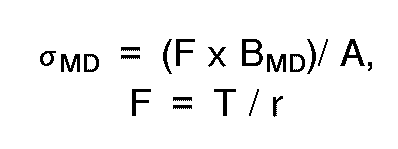
F representing a draw force (kg), BMD representing a draw magnification in the machine direction MD, A representing a sectional area (cm²) of a rollstock film, T representing a torque of a nip roll (kgcm), and r representing a radius of the nip roll (cm); and
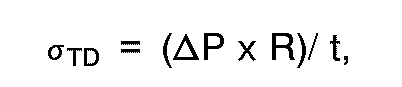
ΔP representing an in-bubble pressure (kg/cm²), R representing a radius of the bubble (cm), and t representing a thickness of the biaxially oriented multi-layered film.
characterized in that
respective maximal stress σMD in film's machine direction (MD) and maximal stress σTD in film's transverse direction (TD) of said single-layered nylon film are defined to be in the following ranges of :
wherein σMD and σTD are expressed by the respective following equations:
F representing a draw force (kg), BMD representing a draw magnification in the machine direction MD, A representing a sectional area (cm²) of a rollstock film, T representing a torque of a nip roll (kgcm), and r representing a radius of the nip roll (cm); and
ΔP representing an in-bubble pressure (kg/cm²), R representing a radius of the bubble (cm), and t representing a thickness of the biaxially oriented multi-layered film.
2. A process for producing a multi-layered biaxially oriented nylon film by a tubular
film process, wherein a tublar nylon film, while being heated, is fed in one direction
and simultaneously stretched in both the longitudinal and transversal direction of
said film by a tensile force in the film's machine direction (MD) and in the film's
transverse direction (TD), wherein the hollow interior of said film is forceably blown
with a gas to expand said film in the form of a bubble,
characterized in that
respective maximal stress σMD in film's machine direction (MD) and maximal stress σTD in film's transverse direction (TD) of said multi-layered nylon film are selected to be in the following ranges of:
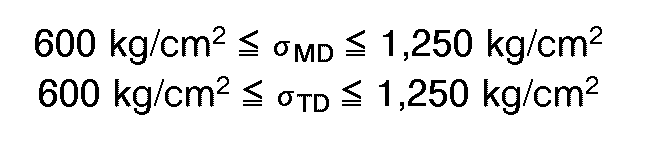
wherein σMD and σTD are expressed by the respective following equations:
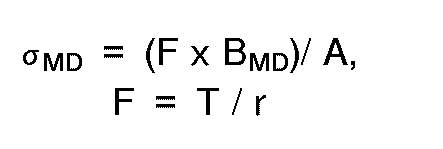
F representing a draw force (kg), BMD representing a draw magnification in the machine direction MD, A representing a sectional area (cm²) of a rollstock film, T representing a torque of a nip roll (kgcm), and r representing a radius of the nip roll (cm); and
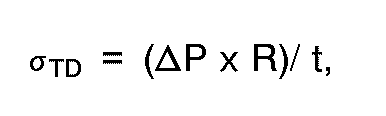
ΔP representing an in-bubble pressure (kg/cm²), R representing a radius of the bubble (cm), and t representing a thickness of the biaxially oriented multi-layered film.
characterized in that
respective maximal stress σMD in film's machine direction (MD) and maximal stress σTD in film's transverse direction (TD) of said multi-layered nylon film are selected to be in the following ranges of:
wherein σMD and σTD are expressed by the respective following equations:
F representing a draw force (kg), BMD representing a draw magnification in the machine direction MD, A representing a sectional area (cm²) of a rollstock film, T representing a torque of a nip roll (kgcm), and r representing a radius of the nip roll (cm); and
ΔP representing an in-bubble pressure (kg/cm²), R representing a radius of the bubble (cm), and t representing a thickness of the biaxially oriented multi-layered film.
1. Verfahren zum Herstellen einer einfach orientierten, biaxial orientierten Nylonfolie
mit Hilfe des Tubular-Folienverfahrens, bei welchem eine tubulare Nylonfolie, während
sie erwärmt wird, in eine Richtung zugeführt und gleichzeitig sowohl in Longitudinalrichtung
als auch in Transversalrichtung des Films mit Hilfe einer Zugkraft gestreckt wird
und zwar in die Folien-Vorschubrichtung (MD) und in die Folien-Querrichtung (TD),
wobei das hohle Innere der Folie mit Hilfe eines Gases aufgeblasen wird, um die Folie
in Form einer Blase zu expandieren,
dadurch gekennzeichnet, daß
die jeweilige maximale Spannung σMD in Folien-Vorschubrichtung (MD) und die maximale Spannung σTD in Folien-Querrichtung (TD) der einschichtigen Nylonfolie als in den folgenden Bereich liegend definiert werden:
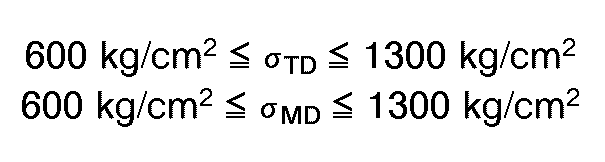
wobei σMD und σTD jeweils ausgedrückt sind durch die folgenden Gleichungen:
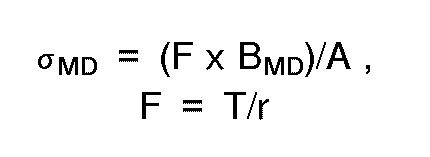
worin F eine Ziehkraft (kg) repräsentiert, BMD einen Kraftverstärkungsfaktor in MD-Richtung repräsentiert, A eine Querschnittsfläche (cm²) eines Wickelfilms repräsentiert, T ein Moment einer Spannrolle (kgcm) repräsentiert und r einen Radius der Spannrolle (cm) repräsentiert; und
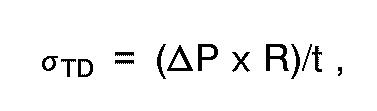
worin ΔP einen Blaseninnendruck (kg/cm²) repräsentiert, R einen Blasenradius (cm) repräsentiert und t die Dicke eines biaxial orientierten mehrschichtigen Filmes repräsentiert.
dadurch gekennzeichnet, daß
die jeweilige maximale Spannung σMD in Folien-Vorschubrichtung (MD) und die maximale Spannung σTD in Folien-Querrichtung (TD) der einschichtigen Nylonfolie als in den folgenden Bereich liegend definiert werden:
wobei σMD und σTD jeweils ausgedrückt sind durch die folgenden Gleichungen:
worin F eine Ziehkraft (kg) repräsentiert, BMD einen Kraftverstärkungsfaktor in MD-Richtung repräsentiert, A eine Querschnittsfläche (cm²) eines Wickelfilms repräsentiert, T ein Moment einer Spannrolle (kgcm) repräsentiert und r einen Radius der Spannrolle (cm) repräsentiert; und
worin ΔP einen Blaseninnendruck (kg/cm²) repräsentiert, R einen Blasenradius (cm) repräsentiert und t die Dicke eines biaxial orientierten mehrschichtigen Filmes repräsentiert.
2. Verfahren zum Herstellen einer mehrschichtig orientierten, biaxial orientierten Nylonfolie
mit Hilfe des Tubular-Folienverfahrens, bei welchem eine tubulare Nylonfolie, während
sie erwärmt wird, in einer Richtung zugeführt und gleichzeitig sowohl in Longitudinalrichtung
als auch in Transversalrichtung des Films mit Hilfe einer Zugkraft gestreckt wird
und zwar in die Folien-Vorschubrichtung (MD) und in die Folien-Querrichtung (TD),
wobei das hohle Innere der Folie mit Hilfe eines Gases aufgeblasen wird, um die Folie
in Form einer Blase zu expandieren,
dadurch gekennzeichnet, daß
die jeweilige maximale Spannung σMD in Folien-Vorschubrichtung (MD) und die maximale Spannung σTD in Folien-Querrichtung (TD) der mehrschichtigen Nylonfolie als in den folgenden Bereich liegend definiert werden:
wobei σMD und σTD jeweils ausgedrückt sind durch die folgenden Gleichungen:
worin F eine Ziehkraft (kg) repräsentiert, BMD einen Kraftverstärkungsfaktor in MD-Richtung repräsentiert, A eine Querschnittsfläche (cm²) eines Wickelfilms repräsentiert, T ein Moment einer Spannrolle (kgcm) repräsentiert und r einen Radius der Spannrolle (cm) repräsentiert; und
worin ΔP einen Blaseninnendruck (kg/cm²) repräsentiert, R einen Blasenradius (cm) repräsentiert und t die Dicke eines biaxial orientierten mehrschichtigen Filmes repräsentiert.
dadurch gekennzeichnet, daß
die jeweilige maximale Spannung σMD in Folien-Vorschubrichtung (MD) und die maximale Spannung σTD in Folien-Querrichtung (TD) der mehrschichtigen Nylonfolie als in den folgenden Bereich liegend definiert werden:
wobei σMD und σTD jeweils ausgedrückt sind durch die folgenden Gleichungen:
worin F eine Ziehkraft (kg) repräsentiert, BMD einen Kraftverstärkungsfaktor in MD-Richtung repräsentiert, A eine Querschnittsfläche (cm²) eines Wickelfilms repräsentiert, T ein Moment einer Spannrolle (kgcm) repräsentiert und r einen Radius der Spannrolle (cm) repräsentiert; und
worin ΔP einen Blaseninnendruck (kg/cm²) repräsentiert, R einen Blasenradius (cm) repräsentiert und t die Dicke eines biaxial orientierten mehrschichtigen Filmes repräsentiert.
1. Procédé pour produire, par un procédé d'obtention d'un film tubulaire , un film en
"Nylon" à simple couche et à orientation biaxiale, selon lequel un film tubulaire
en "Nylon" est introduit, tout en étant chauffé, dans une direction et simultanément
il est étiré dans le sens longitudinal et dans le sens transversal dudit film par
une force de traction s'exerçant dans le sens machine (SM) du film et dans le sens
transversal (ST) du film, et l'intérieur creux dudit film reçoit une insufflation
forcée d'un gaz pour provoquer une dilatation dudit film et le mettre sous forme d'une
bulle,
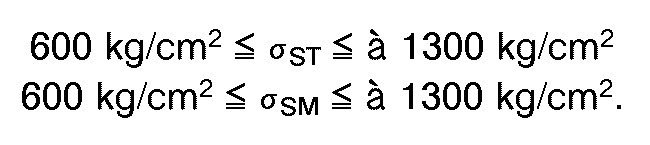
procédé caractérisé en ce que la contrainte maximale σSM dans le sens machine (SM) du film et la contrainte maximale σST dans le sens transversal (ST) du film sont les valeurs respectives définies, pour le film simple couche en "Nylon", de façon à se situer dans les intervalles suivants :
où σSM et σST sont exprimés par les équations suivantes :

F représentant une force d'étirage (kg), BSM représentant un taux d'étirage dans le sens de l'indice SM, A représentant une aire de section (cm²) d'un film pour rouleau, T représentant un couple agissant sur un rouleau pinceur (cm) et r représentant un rayon du rouleau pinceur (cm) et,
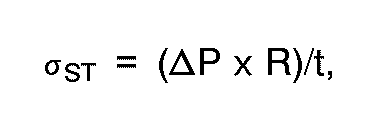
ΔP représentant une pression régnant à l'intérieur d'une bulle (kg/cm²) , R représentant un rayon de la bulle (cm) et t représentant une épaisseur du film multicouche à orientation biaxiale.
procédé caractérisé en ce que la contrainte maximale σSM dans le sens machine (SM) du film et la contrainte maximale σST dans le sens transversal (ST) du film sont les valeurs respectives définies, pour le film simple couche en "Nylon", de façon à se situer dans les intervalles suivants :
où σSM et σST sont exprimés par les équations suivantes :
F représentant une force d'étirage (kg), BSM représentant un taux d'étirage dans le sens de l'indice SM, A représentant une aire de section (cm²) d'un film pour rouleau, T représentant un couple agissant sur un rouleau pinceur (cm) et r représentant un rayon du rouleau pinceur (cm) et,
ΔP représentant une pression régnant à l'intérieur d'une bulle (kg/cm²) , R représentant un rayon de la bulle (cm) et t représentant une épaisseur du film multicouche à orientation biaxiale.
2. Procédé pour produire, par un procédé de production de film tubulaire, un film en
"Nylon" multicouche à orientation biaxiale, selon lequel un film tubulaire en "Nylon"
est soumis à avance, tout en étant chauffé, dans une direction et est simultanément
étiré dans la direction longitudinale (sens original) et dans le sens transversal
dudit film, la force de traction s'exerçant dans le sens machine (SM) du film et dans
le sens transversal (ST) du film, l'intérieur creux dudit film est soumis à une insufflation
forcée par un gaz pour provoquer une expansion de dilatation dudit film et le mettre
sous forme d'une bulle, procédé caractérisé en ce que la contrainte maximale σSM dans le sens machine du film et la contrainte maximale σST dans le sens transversal (ST) du film sont choisies respectivement, pour ledit film
multicouche en "Nylon" de manière à présenter les valeurs se situant dans la gamme
suivante :
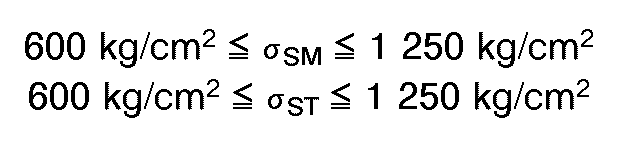
où σSM et σST sont exprimés par les équations respectives suivantes :
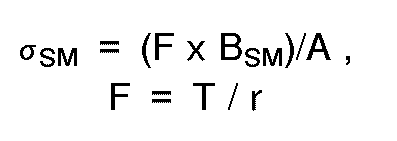
F représentant une force d'étirage (kg), BSM représentant un taux d'étirage dans le sens de l'indice SM, A représentant une aire de section (cm²) d'un film pour rouleau ou enroulement, T représentant un couple s'appliquant à un rouleau pinceur (kg/cm) et r représentant un rayon du rouleau pinceur (cm); et
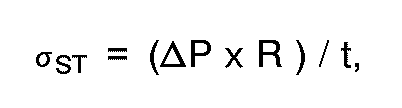
ΔP représentant une pression régnant à l'intérieur de la bulle (kg/cm²), R représentant un rayon de la bulle (cm), et T représentant une épaisseur du film multicouche à orientation biaxiale.
où σSM et σST sont exprimés par les équations respectives suivantes :
F représentant une force d'étirage (kg), BSM représentant un taux d'étirage dans le sens de l'indice SM, A représentant une aire de section (cm²) d'un film pour rouleau ou enroulement, T représentant un couple s'appliquant à un rouleau pinceur (kg/cm) et r représentant un rayon du rouleau pinceur (cm); et
ΔP représentant une pression régnant à l'intérieur de la bulle (kg/cm²), R représentant un rayon de la bulle (cm), et T représentant une épaisseur du film multicouche à orientation biaxiale.