|
(11) | EP 0 387 612 B1 |

| (12) | EUROPEAN PATENT SPECIFICATION |
|
|
| (54) |
Process for the preparation of beta-hydroxyketones Verfahren zur Herstellung von Beta-Hydroxyketonen Procédé pour la fabrication de bêta-hydroxycétones |
|
|
|||||||||||||||||||||||||||||||
| Note: Within nine months from the publication of the mention of the grant of the European patent, any person may give notice to the European Patent Office of opposition to the European patent granted. Notice of opposition shall be filed in a written reasoned statement. It shall not be deemed to have been filed until the opposition fee has been paid. (Art. 99(1) European Patent Convention). |
[0001] This invention relates to a process for the preparation of β-hydroxyketones by the catalytic hydrogenolysis of 3,5-substituted-isoxazolines using a transition metal catalyst in a fixed bed reactor.
Description of the Prior Art
[0002] It is known in the prior art, e.g. D. P. Cürran in J. Am. Chem. Soc. 105, 5826 (1983), that alkyl substituted Δ²isoxazolines can be catalytically reduced to β-hydroxyketones using Raney nickel catalysts. The general reaction can be expressed as follows:
The classical method for preparing β-hydroxyketones involved mixing isoxazoline, acids or buffers, and catalyst to form a slurry, adding the slurry to a reactor (known as a slurry reactor), and constantly agitating the slurry under increased temperature and pressure with addition of hydrogen gas to obtain β-hydroxyketone in from 60 to 90 percent yield. There are, however, several inherent disadvantages to this process.
[0003] As indicated in the above reaction, ammonia is a major by-product of this process. Since the prior art process was performed in single batch, slurry reactor, it required the addition of an excess amount of acid or buffer in order to react with the ammonia by-product and thereby avoid deactivation of the catalyst and/or the loss of the selectivity to β-hydroxy ketones.
[0004] The addition of acid to a pressurized reactor requires either 1) the use of expensive, non-corrosive acids such as boric acid, or 2) the use of glass-lined reactors suitable for use with corrosive acids such as hydrochloric acid. The excess unreacted acid in this process as well as the slurried catalyst must be removed, thereby increasing the downstream recovery costs.
[0005] A further disadvantage of this process is the substantial capital equipment cost attributed to the large reactor size which is required to afford economic feasibility on an industrial scale and which is also necessary to accommodate the agitation equipment required in slurry reactors.
Summary of the Invention
[0007] Another object of this invention is to produce β-hydroxyketones by a process that does not require the addition of buffers or acids.
[0008] The β-hydroxyketones are prepared in accordance with this invention by the catalytic hydrogenolysis of isoxazolines using a transition metal catalyst in a fixed bed reactor.
[0009] These and other objects will be apparent from the remaining specification and the appended claims.
Detailed Description
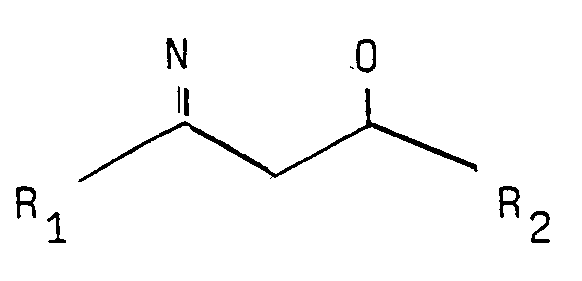
[0010] The present invention is directed to a means of providing β-hydroxyketones in high yields by the catalytic hydrogenolysis of isoxazolines having the general formula:
wherein R₁ and R₂ are each independently selected from hydrogen, alkyl, cycloalkyl or aromatic. The preferred isoxazolines have at least one of the groups R₁ and R₂ selected from an alkyl group, preferably a C₁ to C₂₀ alkyl and most preferably a C₁ to C₅ alkyl group.
[0011] Hydrogenolysis of the isoxazolines to form the β-hydroxyketones can be effected by contacting an aqueous solution of isoxazoline with hydrogen in the presence of a catalytic amount of a transition metal catalyst in a fixed bed reactor at temperatures from about 20° to 150°C, preferably from about 20°C to 50°C, and most preferably at 50°C and at pressures from about 105.3 to 1139.5 kPa (0 to 150 psig), preferably from about 139.8 to 656.9 kPa (5 to 80 psig), and is most preferably 656.9 kPa (80 psig). The concentration of isoxazoline in the aqueous solution is not per se critical to the invention and is limited only by the solubility of isoxazoline in water. The typical concentration is about 5 to 15 weight percent. Preferred transition metal catalysts include nickel, platinum, palladium, rhodium, ruthenium, copper and iridium, and most preferably is a Raney nickel catalyst.
[0013] Without further elaboration it is believed that one skilled in the art, using the preceding description, can utilize the present invention to its fullest extent. The following examples are provided to illustrate the invention in accordance with the principles of this invention but are not to be construed as limiting the invention in any way except as indicated in the appended claims. All parts and percentages are by weight unless otherwise indicated.
Example 1
[0014] This example describes the synthesis of 5-hydroxyhexan-3-one from the catalytic hydrogenolysis of 3-ethyl-5-methylisoxazoline using a transition metal catalyst in a fixed-bed reactor. Three samples of 3-ethyl-5-methylisoxazoline (ISO) were mixed with either water or a water-methanol mixture in varying proportions as indicated in Table 1. This mixture, together with a hydrogen stream, was passed through a tubular fixed-bed reactor having a length of 30.48 cm (12 inches) and an internal diameter of 1.02 cm (0.402 inches), and which contained a Raney nickel catalyst. The flow rate of the liquid reactants was between .5 and .6 ml/min., while the flow rate of hydrogen was about 300 SCCM (Standard Cubic Centimeters per Minute). The reaction conditions and results are as follows:
Table 1
| Sample No. | Liquid Feed Composition (wt.%) | Temp. (°C) | Pressure kPa(psig) | % Conversion | % Selectivity | ||
| Methanol | Water | ISO | |||||
| 1 | 81.6 | 13.9 | 4.5 | 20 | 105.3(0) | 100 | 71 |
| 20 | 415.6(45) | 100 | 47 | ||||
| 20 | 656.9(80) | 100 | 61 | ||||
| 2 | 13.9 | 81.6 | 4.5 | 20 | 105.3(0) | 51 | 77 |
| 20 | 415.6(45) | 100 | 78 | ||||
| 20 | 656.9(80) | 100 | 72 | ||||
| 3 | -- | 87 | 13 | 20 | 105.3(0) | 29 | 80 |
| 20 | 415.6(45) | 44 | 82 | ||||
| 20 | 656.9(80) | 51 | 82 | ||||
| 50 | 415.6(45) | 77 | 82 | ||||
| 50 | 656.9(80) | 100 | 81 | ||||
[0015] As is evident from the above results, β-hydroxyketones can be prepared successfully using a transition metal catalyst in a fixed-bed reactor with the following advantages over the slurry reactor:
1) no acid is required.
2) no methanol is required, since water can serve as both a solvent and a reactant.
3) the throughput of β-hydroxyketones can be increased by increasing the solubility of the isoxazoline in the reactant stream while the conversion and selectivity are maintained.
1. A process for the preparation of β-hydroxyketones comprising: the catalytic hydrogenolysis
of an aqueous solution of isoxazolines having the formula
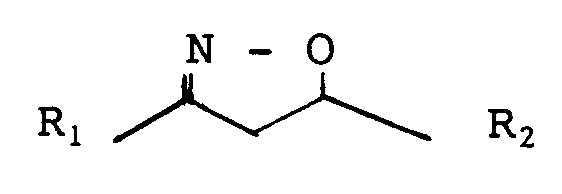
in a fixed-bed reactor containing a transition metal catalyst at a temperature from about 20° to 150°C and a pressure from about 105.3 to 1139.5 kPa (0 to 150 psig); wherein R₁ and R₂ are independently selected from hydrogen, alkyl, cycloalkyl or aromatic group; and wherein the aqueous solution of isoxazolines is substantially free of acids or buffers.
in a fixed-bed reactor containing a transition metal catalyst at a temperature from about 20° to 150°C and a pressure from about 105.3 to 1139.5 kPa (0 to 150 psig); wherein R₁ and R₂ are independently selected from hydrogen, alkyl, cycloalkyl or aromatic group; and wherein the aqueous solution of isoxazolines is substantially free of acids or buffers.
2. The process according to Claim 1, wherein R₁ and R₂ are independently selected from
a C₁ to C₂₀ alkyl.
3. The process according to Claim 1 or 2, wherein R₁ and R₂ are independently selected
from methyl or ethyl.
4. The process according to any one of Claims 1 to 3, wherein the transition metal catalyst
is selected from the group of nickel, platinum, palladium, rhodium, ruthenium, copper
and iridium.
5. The process according to any one of Claims 1 to 4, wherein the transition metal catalyst
is Raney nickel.
6. The process according to any one of Claims 1 to 5, wherein the temperature is between
20° and 50°C.
7. The process according to any one of Claims 1 to 6, wherein the pressure is from 139.8
to 656.9 kPa (5 to 80 psig).
8. The process according to Claim 1 comprising: the catalytic hydrogenolysis of an aqueous
solution of isoxazolines having the formula
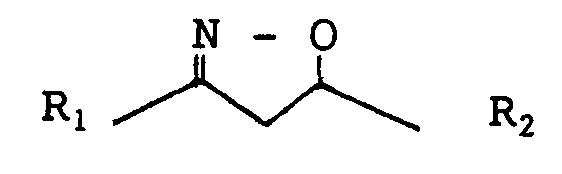
in a fixed bed reactor containing a Raney nickel catalyst at a temperature of about 50°C and a pressure of about 656.9 kPa (80 psig); wherein R₁ and R₂ are independently selected from methyl or ethyl.
in a fixed bed reactor containing a Raney nickel catalyst at a temperature of about 50°C and a pressure of about 656.9 kPa (80 psig); wherein R₁ and R₂ are independently selected from methyl or ethyl.
9. A continuous process for the preparation of β-hydroxyketones comprising the steps
of:
forming an aqueous solution of isoxazolines having the formula
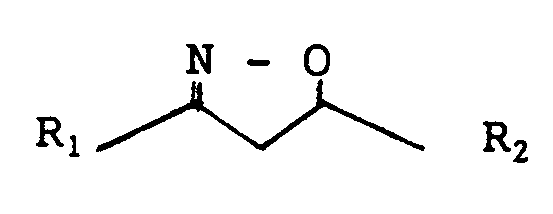
wherein R₁ and R₂ are independently selected from hydrogen, alkyl, cycloalkyl and aromatic group;
passing the solution, together with a stream of hydrogen through a fixed bed reactor containing a transition metal catalyst at a temperature from about 20° to 150°C and a pressure from about 105.3 to 1139.5 kPa (0 to 150 psig), to form β-hydroxyketones; and wherein the aqueous solution of isoxazolines is substantially free of acids or buffers.
forming an aqueous solution of isoxazolines having the formula
wherein R₁ and R₂ are independently selected from hydrogen, alkyl, cycloalkyl and aromatic group;
passing the solution, together with a stream of hydrogen through a fixed bed reactor containing a transition metal catalyst at a temperature from about 20° to 150°C and a pressure from about 105.3 to 1139.5 kPa (0 to 150 psig), to form β-hydroxyketones; and wherein the aqueous solution of isoxazolines is substantially free of acids or buffers.
1. Verfahren zur Herstellung von β-Hydroxyketonen, welches die katalytische Hydrogenolyse
einer wäßrigen Lösung von Isoxazolinen der Formel
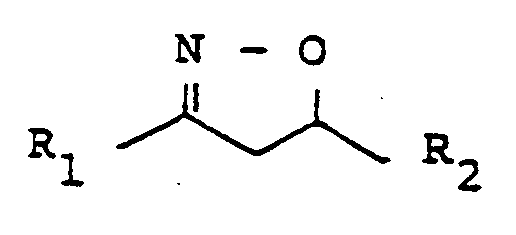
in einem einen Übergangsmetallkatalysator enthaltenden Festbettreaktor bei einer Temperatur von etwa 20 bis 150°C und einem Druck von etwa 105,3 bis 1139,5 kPa (0 bis 150 psig) umfaßt, wobei R₁ und R₂ unabhängig voneinander aus Wasserstoff, Alkyl-, Cycloalkyl- oder aromatischer Gruppe ausgewählt sind und wobei die wäßrige Lösung von Isoxazolinen im wesentlichen frei von Säuren oder Puffern ist.
in einem einen Übergangsmetallkatalysator enthaltenden Festbettreaktor bei einer Temperatur von etwa 20 bis 150°C und einem Druck von etwa 105,3 bis 1139,5 kPa (0 bis 150 psig) umfaßt, wobei R₁ und R₂ unabhängig voneinander aus Wasserstoff, Alkyl-, Cycloalkyl- oder aromatischer Gruppe ausgewählt sind und wobei die wäßrige Lösung von Isoxazolinen im wesentlichen frei von Säuren oder Puffern ist.
2. Verfahren nach Anspruch 1, wobei R₁ und R₂ unabhängig voneinander aus C₁- bis C₂₀-Alkyl
ausgewählt sind.
3. Verfahren nach Anspruch 1 oder 2, wobei R₁ und R₂ unabhängig voneinander aus Methyl
oder Ethyl ausgewählt sind.
4. Verfahren nach einem der Ansprüche 1 bis 3, bei dem der Übergangsmetallkatalysator
aus der Gruppe aus Nickel, Platin, Palladium, Rhodium, Rhutenium, Kupfer und Iridium
ausgewählt ist.
5. Verfahren nach einem der Ansprüche 1 bis 4, bei dem der Übergangsmetallkatalysator
Raney-Nickel ist.
6. Verfahren nach einem der Ansprüche 1 bis 5, bei dem die Temperatur zwischen 20 und
50°C beträgt.
7. Verfahren nach einem der Ansprüche 1 bis 6, bei dem der Druck 139,8 bis 656,9 kPa
(5 bis 80 psig) beträgt.
8. Verfahren nach Anspruch 1, welches die katalytische Hydrogenolyse einer wäßrigen Lösung
von Isoxazolinen der Formel
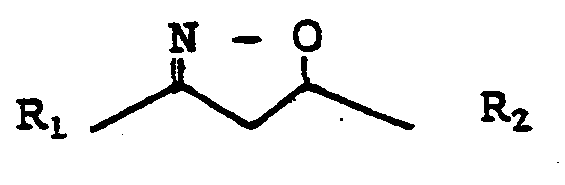
in einem einen Raney-Nickel-Katalysator enthaltenden Festbettreaktor bei einer Temperatur von etwa 50°C und einem Druck von etwa 656,9 kPa (80 psig) umfaßt, wobei R₁ und R₂ unabhängig voneinander aus Methyl oder Ethyl ausgewählt sind.
in einem einen Raney-Nickel-Katalysator enthaltenden Festbettreaktor bei einer Temperatur von etwa 50°C und einem Druck von etwa 656,9 kPa (80 psig) umfaßt, wobei R₁ und R₂ unabhängig voneinander aus Methyl oder Ethyl ausgewählt sind.
9. Kontinuierliches Verfahren zur Herstellung von β-Hydroxyketonen, bei dem eine wäßrige
Lösung von Isoxazolinen der Formel
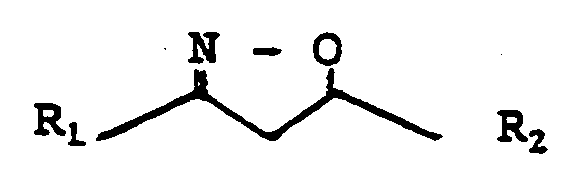
gebildet wird, wobei R₁ und R₂ unabhängig voneinander aus Wasserstoff, Alkyl-, Cycloalkyl- und aromatischer Gruppe ausgewählt sind, und die Lösung zusammen mit einem Wasserstoffstrom bei einer Temperatur von etwa 20 bis 150°C und einem Druck von etwa 105,3 bis 1139,5 kPa (0 bis 150 psig) durch einen einen Übergangsmetallkatalysator enthaltenden Festbettreaktor geleitet wird, um β-Hydroxyketone zu bilden, und wobei die wäßrige Lösung von Isoxazolinen im wesentlichen frei von Säuren oder Puffern ist.
gebildet wird, wobei R₁ und R₂ unabhängig voneinander aus Wasserstoff, Alkyl-, Cycloalkyl- und aromatischer Gruppe ausgewählt sind, und die Lösung zusammen mit einem Wasserstoffstrom bei einer Temperatur von etwa 20 bis 150°C und einem Druck von etwa 105,3 bis 1139,5 kPa (0 bis 150 psig) durch einen einen Übergangsmetallkatalysator enthaltenden Festbettreaktor geleitet wird, um β-Hydroxyketone zu bilden, und wobei die wäßrige Lösung von Isoxazolinen im wesentlichen frei von Säuren oder Puffern ist.
1. Procédé de fabrication de β-hydroxycétones comprenant: l'hydrogénolyse catalytique
d'une solution aqueuse d'isoxazolines de formule:
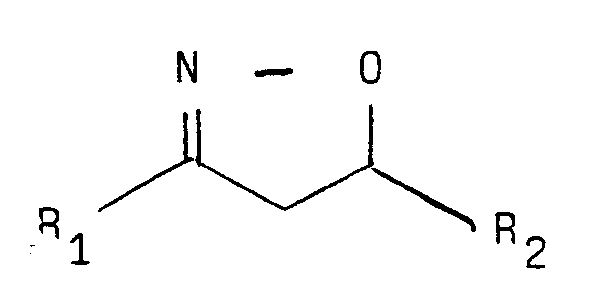
dans un réacteur à lit fixe contenant un métal de transition utilisé comme catalyseur à une température comprise entre 20°C et 150°C environ et à une pression comprise entre 105,3 et 1139,5 kPa environ (0 à 150 psig); où R1 et R2 sont indépendamment choisis parmi l'hydrogène, les groupes alkyle, cyclo-alkyle ou aromatique; et dans lequel la solution aqueuse d'isoxazolines est pratiquement dépourvue d'acides ou de tampons.
dans un réacteur à lit fixe contenant un métal de transition utilisé comme catalyseur à une température comprise entre 20°C et 150°C environ et à une pression comprise entre 105,3 et 1139,5 kPa environ (0 à 150 psig); où R1 et R2 sont indépendamment choisis parmi l'hydrogène, les groupes alkyle, cyclo-alkyle ou aromatique; et dans lequel la solution aqueuse d'isoxazolines est pratiquement dépourvue d'acides ou de tampons.
2. Procédé selon la Revendication 1, dans lequel R1 et R2 sont indépendamment choisis
parmi les alkyles en C1 à C20.
3. Procédé selon la Revendication 1 ou 2, dans lequel R1 et R2 sont indépendamment choisis
parmi les groupes méthyle ou éthyle.
4. Procédé selon l'une quelconque des Revendications 1 à 3, dans lequel le métal de transition
utilisé comme catalyseur est choisi parmi le groupe consistant en nickel, platine,
palladium, rhodium, ruthénium, cuivre et iridium.
5. Procédé selon l'une quelconque des revendications 1 à 4, dans lequel le métal de transition
utilisé comme catalyseur est du nickel de Raney.
6. Procédé selon l'une quelconque des Revendications 1 à 5, dans lequel la température
est comprise entre 20°C et 50°C.
7. Procédé selon l'une quelconque des Revendications 1 à 6, dans lequel la pression est
comprise entre 139,8 et 656,9 pKa (5 à 80 psig).
8. Procédé selon la Revendication 1 comprenant: l'hydrogénolyse catalytique d'une solution
aqueuse d'isoxazolines de formule:
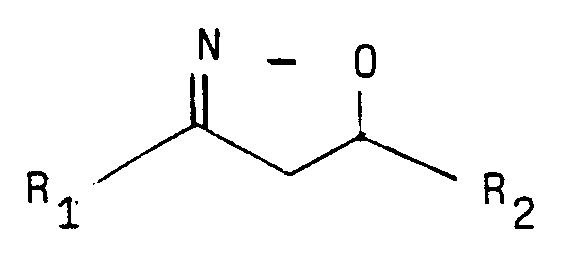
dans un réacteur à lit fixe contenant du nickel de Raney en tant que catalyseur, à une température d'environ 50°C et à une pression d'environ 656,9 kPa (80 psig); où R1 et R2 sont indépendamment choisis parmi les groupes méthyle ou éthyle.
dans un réacteur à lit fixe contenant du nickel de Raney en tant que catalyseur, à une température d'environ 50°C et à une pression d'environ 656,9 kPa (80 psig); où R1 et R2 sont indépendamment choisis parmi les groupes méthyle ou éthyle.
9. Procédé de fabrication continue de β-hydroxycétones comprenant les étapes de:
formation d'une solution aqueuse d'isoxazolines de formule:
où R1 et R2 sont indépendamment choisis parmi l'hydrogène, et les groupes alkyle, cyclo-alkyle et aromatique;
le passage de la solution, sous un flux d'hydrogène, dans un réacteur à lit fixe contenant un métal de transition utilisé comme catalyseur à une température comprise entre 20°C et 150°C environ et à une pression comprise entre 105,3 et 1139,5 kPa environ (0 à 150 psig environ), pour former des β-hydroxycétones; et dans lequel la solution aqueuse d'isoxazolines est pratiquement dépourvue d'acides ou de tampons.
formation d'une solution aqueuse d'isoxazolines de formule:
où R1 et R2 sont indépendamment choisis parmi l'hydrogène, et les groupes alkyle, cyclo-alkyle et aromatique;
le passage de la solution, sous un flux d'hydrogène, dans un réacteur à lit fixe contenant un métal de transition utilisé comme catalyseur à une température comprise entre 20°C et 150°C environ et à une pression comprise entre 105,3 et 1139,5 kPa environ (0 à 150 psig environ), pour former des β-hydroxycétones; et dans lequel la solution aqueuse d'isoxazolines est pratiquement dépourvue d'acides ou de tampons.