|
(11) | EP 0 389 180 A1 |

| (12) | EUROPEAN PATENT APPLICATION |
|
|
|
|
|||||||||||||||||||||||||||
| (54) | Peptides and their use in therapy |
| (57) An octapeptide of the formula:
wherein each A₁ and A₂, independently, is H, C₁₋₁₂ alkyl, C₇₋₁₀ phenylalkyl, R₁CO (where R₁ is C₁₋₂₀ alkyl, C₃₋₂₀ alkenyl, C₃₋₂₀ alkynyl, phenyl, naphthyl, or C₇₋₁₀ phenylalkyl), or R₂OCO (where R₂ is C₁₋₁₀ alkyl or C₇₋₁₀ phenylalkyl), provided that when one of A₁ or A₂ is R₁CO or R₂OCO, the other must be H; A₃ is CH₂-A₆ (where A₆ is pentafluorophenyl, naphthyl, pyridyl, phenyl, or o-, m-, or, more preferably, p-substituted phenyl, where the substituent is a halogen, NH₂, NO₂, OH, or C₁₋₃ alkyl); (I) indicates that tyrosine is iodinated on the phenyl ring at its 3 or 5 carbon positions; A₅ is Thr, Ser, Phe, Val, α-aminobutyric acid, or Ile, provided that when A₃ is phenyl, A₁ is H, and A₂ is H, A₅ cannot be Val; and A₇ is Thr, Trp, or β-Nal; or a pharmaceutically acceptable salt thereof. |
[0002] A number of somatostatin analogs exhibiting GH-release-inhibiting activity have been described in the literature, including analogs containing fewer than the naturally occurring fourteen amino acids. For example, Coy et al. U.S. Patent No. 4,485,101, the disclosure of which is to be regarded as hereby incorporated by reference, describe dodecapeptides having an N-terminal acetyl group, a C-terminal NH₂, D-Trp at position 6, and p-C1-Phe at position 4. (Herein, when no designation of configuration is given, the L-isomer is intended).
[0003] In general, the invention features in one aspect thereof an octapeptide of the formula:
wherein each A₁ and A₂, independently, is H, C₁₋₁₂ alkyl, C₇₋₁₀ phenylalkyl, R₁CO (where R₁ is C₁₋₂₀ alkyl, C₃₋₂₀ alkenyl, C₃₋₂₀ alkynyl, phenyl, naphthyl, or C₇₋₁₀ phenylalkyl), or R₂OCO (where R₂ is C₁₋₁₀ alkyl or C₇₋₁₀ phenylalkyl), provided that when one of A₁ or A₂ is R₁CO or R₂OCO, the other must be H; A₃ is CH₂-A₆ (where A₆ is pentafluorophenyl, naphthyl, pyridyl, phenyl, or o-, m-, or, more preferably, p-substituted phenyl, where the substituent is a halogen, NH₂, NO₂, OH, or C₁₋₃ alkyl); (I) indicates that tyrosine is iodinated on the phenyl ring at its 3 or 5 carbon positions; A₅ is Thr, Ser, Phe, Val, α-aminobutyric acid, or Ile, provided that when A₃ is phenyl, A₁ is H, and A₂ is H, A₅ cannot be Val; and A₇ is Thr, Trp, or β-Nal; or a pharmaceutically acceptable salt thereof.
[0004] In the formula given above, the configuration of the molecule at the carbon atom to which A₃ is bonded is not given, to indicate that the amino acid residue of which A₃ is a substituent can have the D- or L- configuration. In the formula given above, there is a bond shown between the two Cys residues to indicate cyclization;
but the Cys-Cys bond lines are omitted for convenience. By 3 0r 5 positions is meant carbon atoms in the ortho position relative to the -OH group of tyrosine.
[0005] Preferred compounds of this formula include D-β-Nal-Cys-Tyr(I)-D-Trp-Lys-Val-Cys-Thr-NH₂ (also termed [I]-BIM-23014C); D-Phe-Cys-Tyr(I)-D-Trp-Lys-α-Aminobutyric acid-Cys-Thr-NH₂; pentafluoro-D-Phe-Cys-Tyr(I)-D-Trp-Lys-Val-Cys-Thr-NH₂; N-Ac-D-β-Nal-Cys-Tyr(I)-D-Trp- Lys-Val-Cys-Thr-NH₂; D-β-Nal-Cys-Tyr(I)-D-Trp-Lys-Val-Cys-β-Nal-NH₂; D-Phe-Cys-Tyr-(I)-D-Trp-Lys-Val-Cys-β-Nal-NH₂; D-β-Nal-Cys-Tyr(I)-D-Trp-Lys-α-aminobutyric acid-Cys-Thr-NH₂; D-p-Cl-Phe-Cys-Tyr(I)-D-Trp-Lys-α-aminobutyric acid-Cys-Thr-NH₂; and acetyl-D-p-Cl-Phe-Cys-Tyr(I)-D-Trp-Lys-α-aminobutyric acid-Cys-Thr-NH₂.
[0006] In an alternative aspect, the invention features an octapeptide having a biological activity of somatostatin, having at amino acid position 3 a tyrosine residue, the tyrosine having an iodine atom at its 3 or 5 carbon position, or a parmaceutically acceptable salt of said octapeptide. By biological activity of somatostatin is meant a polypeptide exhibiting GH-releasing-inhibiting activity.
[0007] In preferred embodiments, a therapeutically effective amount of the compound is admixed with a pharmaceutically acceptable carrier substance (e.g. magnesium carbonate, lactose, or a phospholipid with which the therapeutic compound can form a micelle). The most preferred carrier substance is mannitol. Examples of such compositions include a pill, tablet, capsule, or liquid for oral administration to a human patient, a spreadable cream, gel, lotion, or ointment for application to the skin of a human patient in need of the compound, a liquid capable of being administered nasally as drops or spray, or a liquid capable of intravenous, parenteral, subcutaneous, or intraperitoneal administration. The pill, tablet or capsule can be coated with a substance capable of protecting the composition from the gastric acid in the patient's stomach for a period of time sufficient to allow the composition to pass undisintegrated into the patient's small intestine. The therapeutic composition can also be administered in the form of an oil emulsion or dispersion in conjunction with a lipophillic salt such as a pamoic acid. The therapeutic composition can also be in the form of a biodegradable sustained release formulation for intramuscular administration. For maximum efficacy, zero order release is desired. Zero order release can be obtained using an implantable or external pump, e.g., Infusaid ™ pump, to administer the therapeutic composition.
[0008] We have found our compounds to be active in inhibiting primarily the secretion of GH, and to a lesser extent that of insulin, and glucagon. Further, the aromatic lipophilic N-terminal end can provide long-lasting in vivo activity. Provision of iodine in the third amino acid increases the metabolic stability of the somatostatin octapeptide analog. Such analogs are thus longer acting GH suppressants.
[0009] Other features and advantages of the invention will be apparent from the following description by way of example only of preferred embodiments.
[0010] Our compounds of formula:
where A₁, A₂, A₃, A₅ and A₇ are each as defined above, are all octapeptide analogs of somatostatin which have 3- or 5-iodo-tyrosine at position 3; D-Trp at position 4; and optional modifications at positions 6 (A₅), and 8(A₇).
[0011] Alternatively, our compounds may be seen as polypeptides having somatostatin-like activity. We have found that D-β-naphthylalanine at position 1, and Tyr at position 3, modified to have an iodine atom at carbon position 3 or 5, and Val at position 6, are modifications which particularly enhance activity and stability.
[0012] The compounds can be provided in the form of pharmaceutically acceptable salts or complexes. Examples of preferred salts or complexes are those with therapeutically acceptable organic acids, e.g., acetic, lactic, maleic, citric, malic, ascorbic, succinic, benzoic, salicylic, methanesulfonic, toluenesulfonic, or pamoic acid, as well as polymeric acids such as tannic acid or carboxymethyl cellulose, and salts with inorganic acids such as the hydrohalic acids, e.g., hydrochloric acid, sulfuric acid, or phosphoric acid.
[0013] Examples of synthesis of octapeptides in accordance with this invention are given bleow. Generally, the octapeptide is first synthesized and then iodinated by any of several procedures to provide an iodinated tyrosine at position 3.
[0014] The synthesis of one octapeptide follows. Other octapeptides and somatostatin-like compounds in accordance with this invention can be prepared by making appropriate modifications, within the ability of someone of ordinary skill in this field, of the following synthetic method.
[0015] The first step in the preparation of D-β-naphthylalanine-Cys-Tyr(I)-D-Trp-Lys-Val-Cys-Thr-NH₂ was the preparation of the intermediate tert-butyloxycarbonyl-D-β-napthylalanine-S-methylbenzyl-Cys-Tyr-D-Trp-Nε-benzyloxycarbonyl-Lys-Val-S-methylbenzyl-Cys-O-benzyl-Thr-benzyhydrylamine resin, as follows.
[0016] Benzhydrylamine-polystyrene resin (Vega Biochemicals, Inc.) in the chloride ion form was placed in the reaction vessel of a Beckman 990B peptide synthesizer programmed to perform the following reaction cycle: (a) methylene chloride; (b) 33% trifluoroacetic acid in methylene chloride (2 times for 1 and 25 min each); (c) methylene chloride; (d) ethanol; (e) methylene chloride; (f) 10% triethylamine in chloroform.
[0017] The neutralized resin was stirred with Boc-O-benzyl-threonine and diisopropylcarbodiimide (1.5 mmole each) in methylene chloride for 1 h and the resulting amino acid resin was then cycled through steps (a) to (g) in the above wash program. The following amino acids (1.5 mmole) were then coupled successively by the same procedure: Boc-S-methylbenzyl-Cys, Boc-Val, Boc-Ne-benzyloxycarbonyl-lysine, Boc-D-Trp, Boc-Tyr, Boc-S-methylbenzyl-Cys, Boc-D-β-naphthylalanine.
[0018] The resin was washed and dried and then mixed with anisole (4 ml) and anhydrous hydrogen fluoride (36 ml) at 0°C and stirred for 45 min. (one can also use thioanisole, trifluoroacetic acid, and trifluoromethane sulfonic acid at a ratio of 1:90:9, for 6h). Excess hydrogen fluoride was evaporated rapidly under a stream of dry nitrogen and free peptide precipitated and washed with ether. The crude peptide was then dissolved in 800 ml of 90% acetic acid to which was added I₂ in methanol until a permanent brown color was present. The solution was then stirred for 1 h before removing the solvent in vacuo. The resulting oil was dissolved in a minimum volume of 50% acetic acid and eluted on a column (2.5 X 100 mm) of Sephadex G-25. Fractions containing a major component by uv absorption and thin layer chromatography were then pooled, evaporated to a small volume, and applied to a column (2.5 X 50 cm) of Whatman LRP-l octadecylsilane (15-20 uM).
[0019] The column was eluted with a linear gradient of 10-50% acetonitrile in 0.1% trifluoroacetic acid in water. Fractions were examined by thin layer chromatography and analytical high performance liquid chromatography and pooled to give maximum purity and if desired, a different salt prepared, e.g., acetate or phosphate. Repeated lyophilization of the solution from water gave 170 mg of the product as a white, fluffy powder.
[0020] The product was found to be homogeneous by Hplc and Tlc. Amino acid analysis of an acid hydrolysate confirmed the composition of the octapeptide. The octapeptide was then iodinated as follows.
[0021] The following methods are examples of methods which can be used to iodinate the above somatostatin analogues which contain the amino acid tyrosine at position 3. For example, iodination may be by use of: a) Chloramine-T/NaI; b) Lactoperoxidase-glucose oxidase (LP-GO)/NaI; c) Lactoperoxidase-H₂O₂ (LP-H₂O₂)/NaI; d) Enzymobeads (immobilized LP-GO)/NaI (purchased from Bio-Rad Laboratories); e) Iodobeads (immobilized chloromine-T)NaI (purchased from Pierce Chemical Company); f) Iodogen/NaI; g) Iodine/KI; and h) Iodine monochloride.
[0022] After iodination, the iodinated products are purified, e.g., by HPLC to separate di-iodination products of tyrosine, and unreacted starting material, from the desired iodinated octapeptide. The following is a specific example showing Chloramine-T/NaI iodination of the octapeptide BIM-23014C.
[0023] 250mg of BIM-23014C (0.22 mmole) was placed in a 500ml Erlenmeyer flask, and 67.3ml (67.3mg, 0.44mmole) of sodium iodide in 0.05M phosphate buffer, pH7.4, added. An additional 160ml of 0.05M phosphate buffer, pH7.4, was then added to the reaction vessel and stirred until all the peptide dissolved. 150ml (0.17mmole) chloramine-T dissolved in phosphate buffer, pH7.4, was added to the reaction vessel, and swirled continuously for 3 minutes. The reaction was stopped by addition of 20ml 0.014M sodium thiosulfate solution. Finally, 1.5ml of glacial acetic acid was added, and the solution filtered.
[0024] For purification the solution (∼250ml) was injected into a preparative HPLC column and eluted with a gradient as follows. The HPLC instrument was a SepTech 800ST; and the column was a Vydac 15-20µ C₁₈ column. The mobile phase consisted of A (0.05M NH₂OAc, ph 4.5); and B (0.05M NH₄OAc, pH 4.5, and CH₃CN, at a ratio of 1:1) with the gradient constructed from 30%B to 75%B over 45 minutes, and then 75%B for 10 minutes, at a flow rate of about 30ml/min. Progress was followed using a λ of 228nm. Six fractions were collected, and some assayed for octapeptide content by HPLC. Those with the majority of the desired octapeptide were combined and evaporated to a lower volume (∼80ml) by rotary evaporation under high vacuum.
[0025] The resulting liquid was reloaded onto the preparative HPLC column for a final purification using conditions as before. Six fractions were collected and assayed for content by HPLC. One fraction contained the octapeptide and was concentrated to about 100ml by rotary evaporation, transferred to a 500ml Buchner flask, frozen, and lyophilized for 24 hours. The sample was redissolved in 50ml of H₂O and relyophilized for 48 hours. The final product (190mg), a fluffy white powder, was transferred to a labelled sample storage bottle, capped and stored at -20°C. The product is [I]-BIM-23014C.
[0026] 1.2mg of [I]-BIM-23014c was dissolved in 1.0ml of saline and assayed for purity by HPLC (mobile phase was 0.05M NH₄OAc, pH 4.6 and CH₃CN, at a ratio of 6:4; flow rate was 1.0ml/min., progress was followed at a λ of 228nm, on 5µC₁₈ Nucleosil column). Triplicate 5µl injections were made and mean purity of the major peak was determined as 98.8%. The major impurity of 6.8min. (1.2%) was shown to be non-iodinated BIM-23014.
[0027] Octapeptides having the formulae:pentafluoro-D-Phe-Cys-Tyr(I)-D-Trp-Lys-Val- Cys-Thr-NH₂, D-Phe-Cys-Tyr(I)-D-Trp-Lys-α-aminobutyric acid-Cys-Thr-NH₂, N-Ac-D-β-Nal-Cys-Tyr(I)-D-Trp- Lys-Val-Cys-Thr-NH₂, D-β--Nal-Cys-Tyr(I)-D-Trp- Lys-Val-Cys-β-Nal-NH₂, D-Phe-Cys-Tyr(I)-D-Trp-Lys-Val-Cys-β-Nal-NH₂; D-β-Nal-Cys-Tyr(I)-D-Trp-Lys-α-aminobutyric acid-Cys-Thr-NH₂; D-p-Cl-Phe-Cys-Tyr(I)-D-Trp-Lys-α-aminobutyric acid-Cys-Thr-NH₂; and acetyl-D-p-Cl-Phe-Cys-Tyr(I)-D-Trp-Lys-α-aminobutyric acid-Cys- Thr-NH₂ with iodine substituents in tyrosine at carbon position 3 or 5, were made according to methods analogous to those described above.
[0028] When administered to mammals, particularly humans, (e.g. orally, topically, intravenously, parenterally in a sustained release, biodegradable form, nasally, or by suppository), the compounds can be effective to inhibit GH release and to a lesser extent insulin, glucagon, and pancreatic exocrine secretion, and to therapeutically affect the central nervous sytem.
[0029] The compounds can be administered to a mammal, e.g. a human, in the dosages used for somatostatin or, because of their greater potency, in smaller dosages. Our compounds can be used for the treatment of cancer, particularly growth hormone-dependent cancer (e.g., bone, cartilage, pancreas (endocrine and exocrine), prostate, or breast), acromegaly and related hypersecretroy endocrine states, or of bleeding ulcers in emergency patients and in those suffering from pancreatitis or diarrhea. The compounds can also be used in the management of diabetes and to protect the liver of patients suffering from cirrhosis or hepatitis. The compounds can also be used to treat Alzheimer's disease, as analgesics to treat pain by acting specifically on certain opiate receptors, and as gastric cytoprotective compounds for ulcer therapy. The compounds can also be used to treat certain types of mushroom poisoning.
[0030] The compounds can also be used to treat diabetes-related retinopathy. The anti-cancer activity of the compounds may be related to their ability to antagonize cancer-related growth factors such as epidermal growth factor.
1. An octapeptide of the formula:

wherein each A₁ and A₂, independently, is H, C₁₋₁₂ alkyl, C₇₋₁₀phenylalkyl, R₁CO (where R₁ is C₁₋₂₀ alkyl, C₃₋₂₀ alkenyl, C₃₋₂₀ alkinyl, phenyl, naphthyl, or C₇₋₁₀ phenylalkyl), or R₂OCO (where R₂ is C₁₋₁₀ alkyl or C₇₋₁₀ phenylalkyl), provided that when one of A₁ or A₂ is R₁CO or R₂OCO, the other must be H, A₃ is CH₂-A₆ (where A₆ is pentafluorophenyl, naphthyl, pyridyl, phenyl, or o-, m-, or p-substituted phenyl, wherein said substituent is a halogen, NH₂, NO₂, OH, or C₁-C₃ alkyl); (I) indicates that tyrosine is iodinated on the phenyl ring at its 3 or 5 carbon positions; A₅ is Thr, Ser, Phe, Val, α-aminobutyric acid, or Ile, provided that when A₃ is phenyl, A₁ is H, and A₂ is H, A₅ cannot be Val; and A₇ is Thr, Trp, or β-Nal; or a pharmaceutically acceptable salt thereof.
wherein each A₁ and A₂, independently, is H, C₁₋₁₂ alkyl, C₇₋₁₀phenylalkyl, R₁CO (where R₁ is C₁₋₂₀ alkyl, C₃₋₂₀ alkenyl, C₃₋₂₀ alkinyl, phenyl, naphthyl, or C₇₋₁₀ phenylalkyl), or R₂OCO (where R₂ is C₁₋₁₀ alkyl or C₇₋₁₀ phenylalkyl), provided that when one of A₁ or A₂ is R₁CO or R₂OCO, the other must be H, A₃ is CH₂-A₆ (where A₆ is pentafluorophenyl, naphthyl, pyridyl, phenyl, or o-, m-, or p-substituted phenyl, wherein said substituent is a halogen, NH₂, NO₂, OH, or C₁-C₃ alkyl); (I) indicates that tyrosine is iodinated on the phenyl ring at its 3 or 5 carbon positions; A₅ is Thr, Ser, Phe, Val, α-aminobutyric acid, or Ile, provided that when A₃ is phenyl, A₁ is H, and A₂ is H, A₅ cannot be Val; and A₇ is Thr, Trp, or β-Nal; or a pharmaceutically acceptable salt thereof.
2. An octapeptide or pharmaceutically acceptable salt thereof according to Claim 1,
wherein
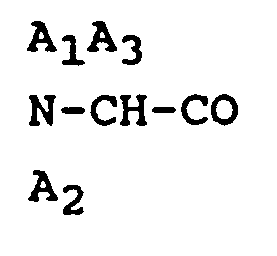
is D- β-naphthylalanine
is D- β-naphthylalanine
3. An octapeptide or a pharmaceutically acceptable salt thereof according to Claim
1, wherein
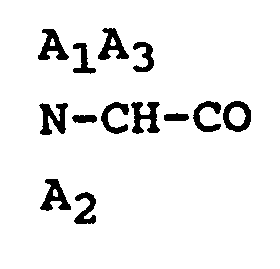
is D-Phe and A₅ is α-aminobutyric acid.
is D-Phe and A₅ is α-aminobutyric acid.
4. An octapeptide or a pharmaceutically acceptable salt thereof according to Claim
1, wherein R₁ is CH₃ or C₂H₅.
5. Octapeptides of the formulae D-β-Nal-Cys-Tyr(I)-D-Trp-Lys-Val-Cys-Thr-NH₂, pentafluoro-D-Phe-Cys-Tyr(I)-D-Trp-Lys-Val-Cys-Thr-NH₂,
D-Phe-Cys-Tyr(I)-D-Trp-Lys-α-aminobutyric acid-Cys-Thr-NH₂, N-Ac-D-β-Nal-Cys-Tyr(I)-D-Trp-Lys-Val-Cys-Thr-NH₂,
D-β-Nal-Cys-Tyr(I)-D-Trp-Lys-Val-Cys-β-Nal-NH₂, D-Phe-Cys-Tyr(I)-D-Trp-Lys-Val-Cys-β-Nal-NH₂,
D-β-Nal-Cys-Tyr(I)-D-Trp-Lys-α-aminobutyric acid-Cys-Thr-NH₂, D-p-Cl-Phe-Cys-Tyr(I)-D-Trp-Lys-α-aminobutyric
acid-Cys-Thr-NH₂, or acetyl-D-p-C1-Phe-Cys-Tyr(I)-D-Trp-Cys-α-aminobutyric acid-Cys-Thr-NH₂,
or pharmaceutically acceptable salts thereof.
6. An octapeptide having a biological activity of somatostatin, having at amino acid
position 3 a tyrosine residue, said tyrosine comprising an iodine atom at its 3 or
5 carbon positions, or a pharmaceutically acceptable salt thereof.
7. A pharmaceutical composition comprising a therapeutically effective amount of an
octapeptide or a pharmaceutically acceptable salt thereof as claimed in any of Claims
1 to 6 together with a pharmaceutically acceptable carrier substance.
8. A composition according to Claim 7, wherein said composition is in the form of
a pill, tablet, or capsule for oral administration to a human or animal patient, or
in the form of a liquid for oral administration to a human or animal patient, or is
coated with a substance capable of protecting said composition from the gastric acid
in the stomach of a human or animal patient for a period of time sufficient to allow
said composition to pass undisintegrated into the small intestine of said patient,
or is in the form of a cream, gel, spray, or ointment for application to the skin
of a human or animal patient, or is in the form of a liquid capable of being adminstered
nasally as drops or spray to a human or animal patient, or is in the form of a liquid
for intravenous, subcutaneous, parenteral, or intraperitioneal administration to a
human or animal patient, or is in the form of a biodegradable sustained release composition
for intramuscular administration to a human or animal patient.
9. An octapeptide or a pharmaceutically acceptable salt thereof according to any of
Claims 1 to 6 for use in therapy for reducing or for inhibiting the release of or
of antagonizing growth hormone, insulin, glucagon, or of pancreatic exocrine secretion,
for the management of diabetes, to protect the livers of patients suffering from cirrhosis
or hepatitis, for the treatment of Alzheimer's disease, of mushroom poisoning, or
of diabetes-related retinopathy, or for the treatment of cancer, particularly growth
hormone dependent cancer such as cancer of the bone, cartilage, pancreas, prostate
or breast, or acromelagy and related hypersecretory endocrine states, of bleeding
ulcers in emergency patients, of disorders of the central nervous system, or of patients
suffering from pancreatitis or diarrhoea.
10. Use of an octapeptide or a pharmaceutically acceptable salt thereof according
to any of Claims 1 to 6 for the manufacture of a medicament for use in therapy for
reducing or for inhibiting the release of or of antagonizing growth hormone, insulin,
glucagon, or of pancreatic exocrine secretion, for the management of diabetes, to
protect the livers of patients suffering from cirrhosis or hepatitis, for the treatment
of Alzheimer's disease, of mushroom poisoning, or of diabetes-related retinopathy,
or for the treatment of cancer, particularly growth hormone dependent cancer such
as cancer of the bone, cartilage, pancreas, prostate or breast, of acromelagy and
related hypersecretory endocrine states, of bleeding ulcers in emergency patients,
of disorders of the central nervous system, or of patients suffering from pancreatitis
or diarrhoea.