(57) The nature of hydrogenous fluids filling the pore spaces in formations surrounding
a well bore are determined by irradiating the formations with bursts of high energy
neutrons and using the ratio of time-dependent parameters related to the decay of
epithermal neutron populations above two different energy levels to provide values
indicative of the kind of fluid present, independent of porosity. The measurement
above the higher of these energy levels, approximately 0.4eV, indicates the existence
of hydrogenous fluid, water and hydrocarbons, in the formations; the lower threshold
measurement, above approximately 0.15eV, is indicative of the structure of the molecule
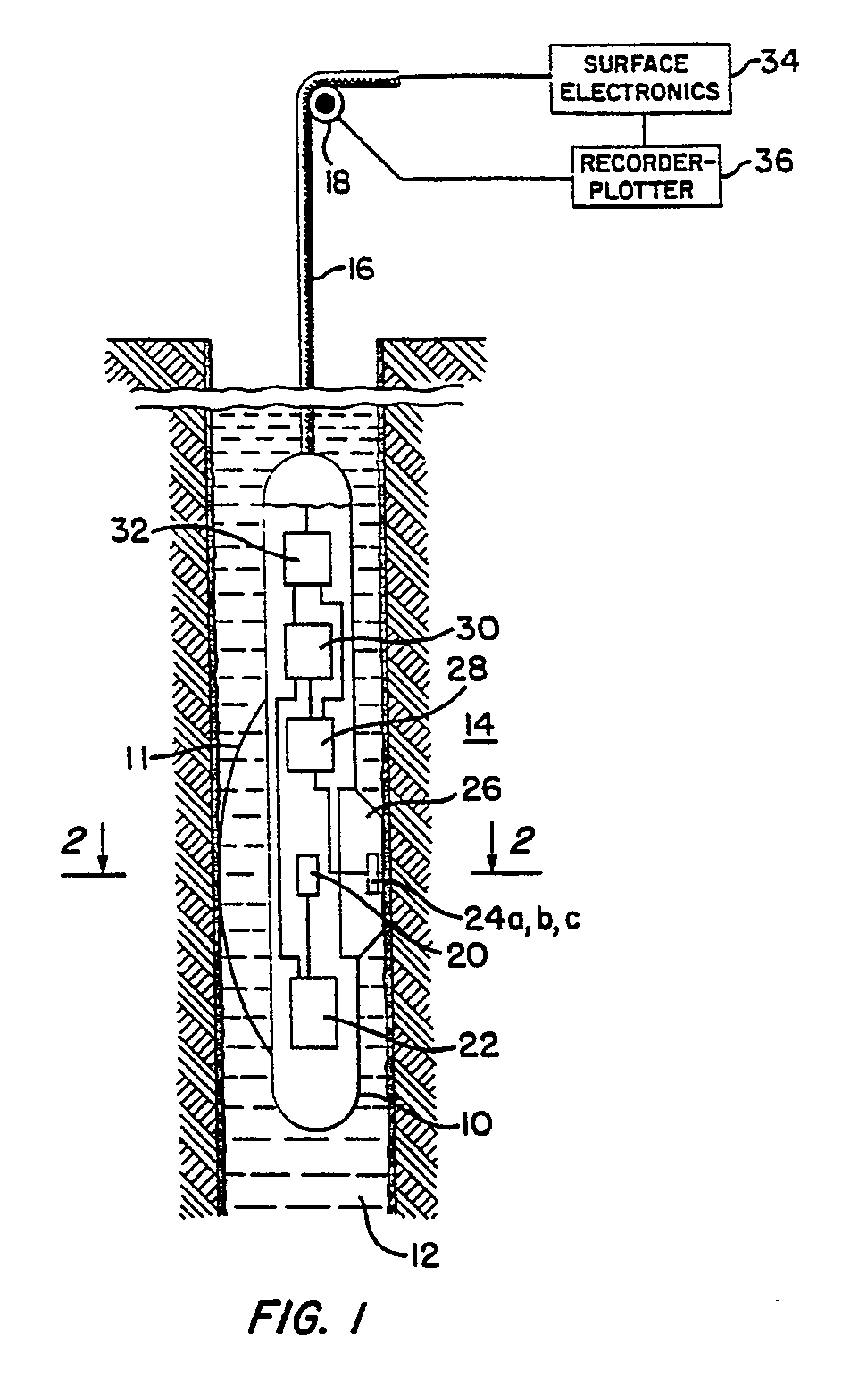
in which the hydrogen molecule is bound and the porosity. A pulsed neutron generator
in a sonde irradiates the formations with 14meV neutrons and a pair of detectors,
one shielded by cadmium to establish the 0.4eV threshold energy level and the other,
shielded by gadolinium to establish the 0.15eV threshold energy level, respond to
epithermal neutron populations created by irradiation to provide count rate information.
Time related parameters of the count rate information, e.g. the decay constants, provided
by each detector are derived. The ratio of the respective parameters is used to identify
the type of fluid in the formation, independent of porosity. The method and apparatus
can determine water saturation, i.e. percentage of water in the formation fluid and
can identify specific types of hydrocarbons under 100% hydrocarbon saturation conditions.
|
|
