| (19) |
 |
|
(11) |
EP 0 389 462 A1 |
| (12) |
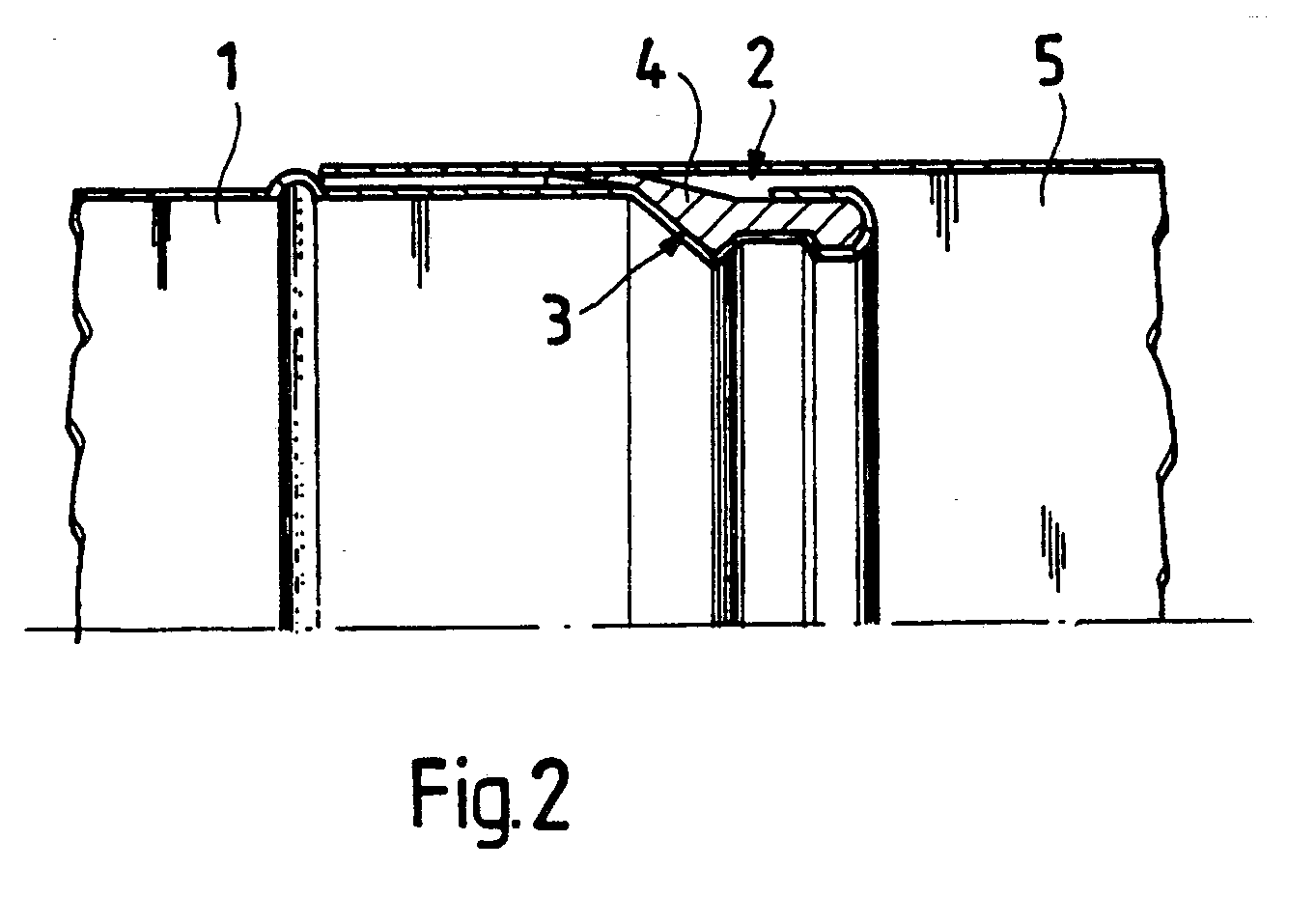
EUROPEAN PATENT APPLICATION |
| (43) |
Date of publication: |
|
26.09.1990 Bulletin 1990/39 |
| (22) |
Date of filing: 20.03.1990 |
|
| (51) |
International Patent Classification (IPC)5: F16L 21/02 |
|
| (84) |
Designated Contracting States: |
|
AT BE CH DE DK ES FR GB GR IT LI LU NL SE |
| (30) |
Priority: |
21.03.1989 FI 891341
|
| (71) |
Applicant: PAAVO RANNILA OY |
|
62800 Vimpeli (FI) |
|
| (72) |
Inventors: |
|
- Pelander, Markku
SF-62800 Vimpeli (FI)
- Rannila, Kari
SF-62800 Vimpeli (FI)
|
| (74) |
Representative: Örtenblad, Bertil Tore |
|
Noréns Patentbyra AB
P.O. Box 10198
100 55 Stockholm
100 55 Stockholm (SE) |
|
| |
|
| (54) |
Pipe joint for air conditioners |
(57) A pipe joint for air conditioners, whose joint portion (1) is equipped with an annular
recess (2), from where a perpendicular or inclined surface portion (3) rises to the
surface of the joint portion and to the recess a flexible sealing ring (4) is fixed,
whose sealing flange in the unloaded state extends approximately perpendicularly
from the joint portion, and in the loaded state, when the pipe element (5) is pushed
on top of the joint portion, bends against the surface portion (3). The radial length
of the sealing flange (4) is essentially longer than the length of the surface portion
so that its end gets between the outer surface of the joint portion and the inner
surface of the pipe element (5).
|
|
[0001] This invention relates to a pipe joint for air conditioners comprising an annular
recess, from which a perpendicular or tilted surface portion rises to the surface
of the joint, a flexible sealing ring having been fixed to the recess, and the sealing
flange of this ring extends in the unloaded state approximately perpendicularly from
the joint, and in the loaded state, the pipe element having been pushed on top of
the joint, is bent towards the surface portion.
[0002] Pipe joints of this kind are disclosed e.g. by the US patent specification 1 819
007, the SE patent specification 360 451 and the SE patent specification 337 146.
Practice has revealed that thin-walled pipes do not always maintain the shape that
was produced at the factory. On construction sites pipes are being roughly handled;
they are thrown about and frequently are submitted to pressure before being put to
use in air conditioner installations. Since the cross-section of the pipes is no
longer circular, but the pipe has been damaged and the cross-section has become oval,
leakages easily arise at the joints. The greater the diameter of the jointed pipes,
the greater the risk of leakage. These leakages are not perceptible at once during
installation.
[0003] The purpose of the invention is to eliminate the above inconvenients. The pipe joint
according to the invention is characterized by that the radial length of the sealing
flange is essentially longer than the length of the surface portion, and that its
end gets between the outer surface of the joint and the pipe element. By means of
the invention, a sealing pipe joint is obtained although the cross-section of the
pipe element would not be perfectly circular. The radial length of the sealing flange
is noticeably longer than that of known sealing flanges, thus naturally allowing greater
tolerances at the joints.
[0004] The joint is retained in position remarkably better than in known solutions, since
the pipe element, when installed on top, will be supported by the sealing flange,
providing a far better friction than when posing metal sheets against each other.
[0005] One embodiment of the invention is characterized by that the radial length of the
sealing flange is approx. one and a half times the length of the surface portion.
Thus, about one third of the length of the sealing flange will get between the joint
and the pipe element.
[0006] The invention is described below by means of an example and referring to the enclosed
drawing, in which
figure 1 shows the joint before the installation of the pipe element.
figure 2 shows the joint equipped with the pipe element.
[0007] The joint is intended for air conditioners. In the joint portion 1 of the pipe joint
an annular recess 2 is provided, from where an inclined surface portion 3 rises to
the surface of the joint portion. To the recess 2 a flexible sealing ring 4 is attached,
whose sealing flange in the unloaded state extends approximately perpendicularly
from the joint portion, and in the loaded state, when the pipe element 5 is pushed
on top of the joint portion, bends against the inclined surface portion 3. The radial
length of the sealing flange 4 is essentially longer than the length of the inclined
surface portion 3 so that its end gets between the outer surface of the joint portion
1 and the inner surface of the pipe element 5. The radial length of the sealing flange
4 is about one and a half times the length of the inclined surface 3. Especially in
large pipes having a diameter in the range of 350-400 mm, the pipe joint of the invention
provides reliable and tight joints.
1. A pipe joint for air conditioners, whose joint portion (1) is equipped with an
annular recess (2), from where a perpendicular or inclined surface portion (3) rises
to the surface of the joint portion, and to the recess a flexible sealing ring (4)
is fixed, whose sealing flange in the unloaded state extends approximately perpendicularly
from the joint portion, and in the loaded state, when the pipe element (5) is pushed
on top of the joint portion, bends against the surface portion (3), characterized in that the radial length of the sealing flange (4) is essentially longer than the
length of the surface portion (3) so that its end gets between the outer suface of
the joint portion and the inner portion of the pipe element (5).
2. A pipe joint according to claim 1, characterized in that the radial length of the sealing flange (4) is about one and half times the
length of the surface portion (3).