|
(11) | EP 0 392 409 A1 |

| (12) | EUROPEAN PATENT APPLICATION |
|
|
|
|
|||||||||||||||||||||||||||
| (54) | Photoresist composition |
| (57) A photoresist composition which comprises a compound of the general formula:
wherein R₁, R₂ and R₃ are the same or different and represent a hydrogen atom, a hydroxyl group, -OCOR₄, -O-R₅, -OSi(R₆)₃, a halogen atom, an optionally substituted alkyl group, an optionally substituted alkenyl group, an optionally substituted phenyl group or an optionally substituted aralkyl group; R₄, R₅ and R₆ represent an optionally substituted lower alkyl group or an optionally substituted phenyl group; X and Y are the same or different and represent -CN, -COOR₇, -CONR₈R₉, R₇ represents an alkyl group; R₈ and R₉ are the same or different and represent a hydrogen atom, an optionally substituted alkyl or phenyl group; R₁₀ represents a hydrogen atom, an optionally substituted alkyl group or a hydroxyl group; and a is a number of 1 to 2, which is suitable for forming fine patterns having high resolution on a substrate having high reflectance. |
[0001] The present invention relates to a photoresist composition which can preferably be used to form fine patterns on a substrate having high reflectance in the production of semiconductors.
[0002] A photoresist which comprises a sensitizing compound having a quinone diazide group and a novolak resin, or which comprises a bisazide sensitizer and a cyclized rubber is used in the production of integrated circuits such as LSI.
[0003] In a process for producing the integrated circuits, fine patterns are formed on various substrates through photoresists. However, when conventional photoresists are used on substrates having high reflectance such as those made of aluminum, aluminum-silicon, polysilicon and the like, various problems arise. For example, a region which should not be exposed may be exposed because of reflection on a surface of the substrate and/or side walls of steps. This phenomenon is generally referred to as notching or halation.
[0004] To solve these problems and prevent deterioration of resolution, Japanese Patent Publication No. 37562/1976 proposes a photoresist composition which comprises, as a light absorber, a dye represented by the formula:
having characteristic absorptions in the ultraviolet range (Oil Yellow [C.I. 11020]). This photoresist composition can decrease light transmission through the photoresist layer and reduce the undesirable exposure of the substrate.
[0005] In the context of the present specification, a "photoresist" is intended to mean a composition which comprises a sensitizer and a resin, e.g. novolak, and a "photoresist composition" is intended to mean a composition which comprises a "photoresist" and a light absorber.
[0006] In general, if the light absorber is added to the photoresist, undesirable problems may arise. For example, photoresist drastically loses its sensitivity and productivity of the semiconductors is decreased.
[0007] The photoresist layer is usually formed by applying the photoresist composition containing a solvent on a wafer and prebaking the wafer with the applied photoresist composition to evaporate off the solvent. However, some light absorbers may precipitate during storage of the photoresist composition, or sublimate during prebaking so that a concentration of the light absorber in the photoresist layer formed on the wafer may be lowered, which leads to unsatisfactory results or variation in the quality of the produced semiconductors.
[0008] To solve these problems, phenylazobenzene derivatives are proposed in Japanese Patent Kokai (Laid-open) Publication Nos. 368358/1980 and 174941/1983. But, the use of such derivatives creates some problems. For example, the phenylazobenzene derivatives should be used in a large amount in order to obtain sufficient absorption at the desired wavelength, especially when the prebaking temperature is raised, or such derivatives have inferior anti-sublimation, a broad absorption range, low absorbing performance and undesirable absorption at certain wavelength. Japanese Patent Kokai Publication No. 93445/1986 discloses a photoresist composition comprising, as a light absorber, a certain styryl compound. Although the disclosed styryl compound can solve the problems associated with the prebaking, it greatly decreases the sensitivity of the photoresist.
[0009] An object of the present invention is to provide a photoresist composition suitable for forming fine patterns having high resolution on a substrate having high reflectance without causing any halation or notching.
[0010] Another object of the present invention is to provide a photoresist composition which is stable against the prebaking of the substrate and suffers from less sensitivity deterioration caused by the addition of a light absorber.
Figs. 1A and lB are a cross sectional view and a plan view of a pattern having steps for estimation, respectively,
Fig. 2 is a plane view of a substrate after a photoresist is coated, exposed and developed, in which the hatched part indicates the photoresist, and
Figs. 3 and 4 show absorbance curves of the absorbers synthesized in Reference Example 1 and 3, respectively.
[0011] As a result of the extensive study, it has been found that a photoresist composition which comprises a specific compound as a light absorber accomplishes the above objects and solves the problems associated with the prior arts. The present invention has been completed based on this finding.
[0012] According to the present invention, there is provided a photoresist composition which comprises a compound of the general formula:
wherein R₁, R₂ and R₃ are the same or different and represent a hydrogen atom, a hydroxyl group, -OCOR₄, -O-R₅, -OSi(R₆)₃, a halogen atom, an optionally substituted alkyl group, an optionally substituted alkenyl group, an optio nally substituted phenyl group or an optionally substituted aralkyl group; R₄, R₅ and R₆ represent an optionally substituted lower alkyl group or an optionally substituted phenyl group; X and Y are the same or different and represent -CN,
-COOR₇,
-CONR₈R₉,
R₇ represents an alkyl group; R₈ and R₉ are the same or different and represent a hydrogen atom, an optionally substituted alkyl or phenyl group; R₁₀ represents a hydrogen atom, an optionally substituted alkyl group or a hydroxyl group; and a is a number of 1 to 2.
[0013] In the general formula (I), an alkyl group as R₁, R₂, R₃, R₇, R₈, R₉ or R₁₀ preferably has up to 4 carbon atoms. A lower alkyl group as R₄, R₅ or R₆ preferably has up to 6 carbon atoms, more preferably up to 4 carbon atoms. Examples of the substituent include a hydroxyl group and the like.
[0014] A photoresist which comprises a novolak resin and a naphthoquinone diazide compound is preferably used. The novolak resin is obtained through the addition condensation reaction of a phenol compound with formaldehyde.
[0015] Also, a photoresist which comprises a cresol novolak resin and an ester of polyhydroxybenzophenone with naphthoquinone-1,2-diazide sulfonic acid is preferably used. The cresol novolak resin can be prepared by reactions of meta-cresol and/or para-cresol with formalin, or a reaction of meta-cresol, para-cresol and 3,5-xylenol with formalin. Examples of the polyhydroxybenzophenone are 2,3,4-trihydroxybenzophenone, 2,3,4,4′-tetrahydroxybenzophenone, 2,2′,4,4′-tetrahydroxybenzophenone, 2,3,3′,4-tetrahydroxybenzophenone, 2,2′,3,4,5-pentahydroxybenzophenone, 2,3,3′,4,5-pentahydroxybenzophenone, 2,3,3′,4,4′-pentahydroxybenzophenone, 2,2′,3,4,4′-pentahydroxybenzophenone, 2,2′,3,3′,4-pentahydroxybenzophenone, and the like.
[0016] Preferred examples of the compounds (I) which are suitable as the light absorber in the photoresist composition according to the present invention are as follows. These examples should not limit the scope of the present invention.
[0017] Among the compounds of the formula (I), those having absorption in a wavelength range not longer than 550 nm, particularly between 300 to 450 nm are preferably used in the photoresist composition.
[0018] The amount of compound (I) to be added to the photoresist composition is from 0.1 to 20 % by weight, preferably from 0.2 to 10 % by weight based on the weight of the solid component in the photoresist.
[0019] When the amount of compound (I) is in the above range, the photoresist composition sufficiently prevents the halation and has excellent profile and sensitivity.
[0021] With the photoresist compositions according to the present invention, the problems associated with the prior arts can be solved, and patterns with high resolution can be formed on the substrate having high reflectance.
[0022] The present invention will be illustrated more in detail with the following examples, but should not be construed to be limited to these examples.
Reference Example 1
[0023] In a 300 ml four-necked flask with a stirring bar, a condenser and a thermometer, 13.8 g of 2,4-dihydroxybenzaldehyde, 25.2 g of diethyl malonate, and 100 g of ethanol were charged and stirred to obtain a homogeneous solution. 0.5 Gram of piperidine was added to the solution and stirred for 20 hours at 20-25°C. Ethanol was distilled off from a resulting solution by an evaporator to obtain 42.1 g of a tar-like yellow compound. To the resulting compound, 84 g of toluene was added and stirred for one hour at 70-75°C and cooled down to room temperature to precipitate the compound. The precipitated compound was filterated and dried to obtain 15.1 g of a crude cake. Then, in a 200 ml four-necked flaske, 15.1 g of the crude cake and 90 g of toluene were charged and sintered for 2 hours at 70-75°C to obtain a dispersion. After cooling down to room temperature, the cake was filterated and washed with 30 g of toluene. This was repeated twice to obtain 11.7 g of the compound of the following formula (I-a). The purity measured by HPLC was 98.8 %, and the structure of the compound was confirmed by NMR and mass spectrum.
Absorbance of the compound (I-a) in methanol:
λmax: 352 nm
ε: 2.58 x 10⁴ M⁻¹.cm⁻¹
Reference Example 2
[0024] In a 200 ml four-necked flask with a stirring bar, a condenser and a thermometer, 12.2 g of parahydroxybenzaldehyde, 9.9 g of malonitrile and 50 g of ethanol were charged and stirred to obtain a homogeneous solution. 0.5 Gram of piperidine was added to the solution, stirred for 16 hours at 20-25°C and filterated to obtain a crystal. 60 Grams of toluene was added to the crystal and stirred for 2 hours, filterated and dried under vacuum to obtain a crude cake. 12.8 Grams of the crude cake was recrystallized from 32 g of ethyl acetate and dried under vacuum to obtain 4.8 g of the pale yellow compound of the following formula (I-b). The purity measured by HPLC was 98.2 % and the structure of the compound was confirmed by NMR and mass spectrum.
Absorbance of the compound (I-b) in methanol:
λmax: 535 nm
ε: 2.91 x 10⁴ M⁻¹.cm⁻¹
Reference Example 3
[0026] In a 200 ml four-necked flask with a stirring bar, a condenser and a thermometer, 13.8 g of 2,4-dihydroxybenzaldehyde, 80 g of ethanol and 13.6 g of ethyl cyanoacetate were charged and stirred to obtain a homogeneous solution. 0.3 Gram of piperidine was added to the solution, stirred for 20 hours at 20-25°C and filterated to obtain a crystal. 100 Grams of ethanol was added to the crystal and stirred for 2 hours and filterated to obtain a cake. The cake was sinsed with 50 g of ethanol and dried under vacuum to obtain 18.4 g of the pale yellow compound of the formula (I-c). The purity measured by HPLC was 97.8 % and the structure of the compound was confirmed by NMR and mass spectrum.
Absorbance of the compound (I-c) in methanol:
λmax: 438 nm
ε: 3.46 x 10⁴ M⁻¹.cm⁻¹
Reference Example 4
[0027] In a 200 ml four-necked flask with a stirring bar, a condenser and a thermometer, 4.20 g of the compound obtained in Reference Example 1, 84 g of tetrahydrofuran and 1.59 g of triethylamine were charged and stirred to obtain a homogeneous solution. 1.18 Grams of acetic chloride was diluted with 6.0 g of tetrahydrofuran (the molar ratio of the hydroxyl group to acetic chloride being 1:1) and dropwise added to the above homogeneous solution over 30 minutes at 20-25°C. After stirring for further 2 hours, the solution was poured into 500 ml of water and stirred for one hour. The mixture was filterated, sinsed with 300 ml of water and dried under vacuum at 50-60°C to obtain 4.65 g of a partially acetylated compound of the compound (I-a).
Absorption of the partially acetylated compound in methanol:
λmax: 343 nm
ε: 1.44 x 10⁴ M⁻¹.cm⁻¹
Reference Example 5
[0028] The same procedures of Reference Example 4 were repeated except that the compound (I-c) obtained in Reference Example 3 was used instead of the compound (I-a) to obtain a partially acetylated compound of the compound (I-c).
Absorbance of the partially acetylated compound in methanol:
λ1 max: 350 nm
ε₁: 1.01 x 10⁴ M⁻¹.cm⁻¹
λ2 max: 438 nm
ε₂: 7.70 x 10⁴ M⁻¹.cm⁻¹
Examples 1-4 and Comparative Example 2
[0029] Photoresist compositions were prepared by adding each dye compound shown in Table to a positive photoresist PF-6200 (manufactured by Sumitomo Chemical Company, Limited; a solid content of 31.0 % by weight), which comprises a novolak resin and at least one compound having o-quinone diazide groups. The amount of each dye compound added was determined to have the same absorbance as that in Comparative Example 2 (the amount of dye compound was 10 % by weight).
[0030] Each of the photoresist compositions was coated on a 4 inch square silicon wafer with an aluminum film on its surface by means of a spinner so as to form a resist film of 1.80 µm in thickness. Subsequently, the silicon wafer was baked for one minute on a hot plate kept at 100°C, and exposed to light (i-line of 365 nm) through a test reticule while varying the exposure value stepwise by means of a reduced projection exposing apparatus. Thereafter, the silicon wafer was developed by a static paddle method for 60 seconds at 23°C in a developing solution SOPD (manufactured by Sumitomo Chemical Company, Limited) by means of an automatic developing machine. The results are shown in Table.
The method of estimation of a preventive effect of halation
1. Making a substrate having steps for estimation
[0032] On a silicon substrate having a SiO₂ film of 1 µm in thickness, a pattern having steps a shape of which is shown in Figs. 1A and 1B was formed by photolithography, etching and aluminum spattering. Typical pattern sizes are a = 4 µm, b = 2 µm, c = 1 µm and d = 1 µm.
2. Estimation of anti-halation effect
[0033] On the above substrate having high reflectance and the steps, a resist film of 2 µm in thickness was coated by the spin coat method.
[0034] The resist film was exposed to light and developed to make a resist line with a line width of 1.2 µm across the center concave part of the above pattern (see Fig. 2).
[0035] A decreasing ratio (R)) of the resist line width in the concave center of the step (y) to a line width in the part having no step (x) was calculated according to the following equation:
[0036] In estimating the preventive effect, the exposure dose was settled 1.3 times of the exposure dose at which the remaining film thickness becomes zero.
[0037] The anti-halation effect is evaluated according to the following criteria:
Very good: The decreasing ratio of the line width is within 10 %.
Good: The decreasing rate of the line width is from 11 to 20 %.
No good: The decreasing rate of the line width is more than 20 %.
Comparative Example 1
[0038] The same procedures as in Comparative Example 2 were repeated except that no absorber was used.
[0039] The anti-halation effect was estimated in the same method as in Comparative Example 2 and the results are summarized in Table.
[0040] As understood from the results in Table, patterns with high sensitivity were formed in Examples of the present invention.
1. A photoresist composition which comprises a compound of the general formula:

wherein R₁, R₂ and R₃ are the same or different and represent a hydrogen atom, a hydroxyl group, -OCOR₄, -O-R₅, -OSi(R₆)₃, a halogen atom, an optionally substituted alkyl group, an optionally substituted alkenyl group, an optionally substituted phenyl group or an optionally substituted aralkyl group; R₄, R₅ and R₆ represent an optionally substituted lower alkyl group or an optionally substituted phenyl group; X and Y are the same or different and represent -CN,
-COOR₇,
-CONR₈R₉,
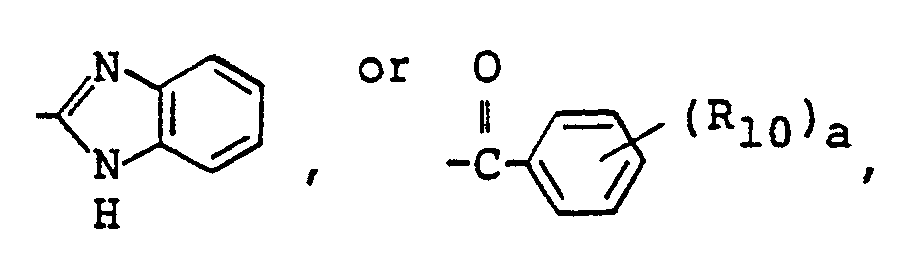
R₇ represents an alkyl group; R₈ and R₉ are the same or different and represent a hydrogen atom, an optionally substituted alkyl or phenyl group; R₁₀ represents a hydrogen atom, an optionally substituted alkyl group or a hydroxyl group; and a is a number of 1 to 2.
wherein R₁, R₂ and R₃ are the same or different and represent a hydrogen atom, a hydroxyl group, -OCOR₄, -O-R₅, -OSi(R₆)₃, a halogen atom, an optionally substituted alkyl group, an optionally substituted alkenyl group, an optionally substituted phenyl group or an optionally substituted aralkyl group; R₄, R₅ and R₆ represent an optionally substituted lower alkyl group or an optionally substituted phenyl group; X and Y are the same or different and represent -CN,
-COOR₇,
-CONR₈R₉,
R₇ represents an alkyl group; R₈ and R₉ are the same or different and represent a hydrogen atom, an optionally substituted alkyl or phenyl group; R₁₀ represents a hydrogen atom, an optionally substituted alkyl group or a hydroxyl group; and a is a number of 1 to 2.
2. The photoresist composition according to claim 1, which comprises an alkali-soluble
resin and a quinone diazide compound.
3. The photoresist composition according to claim 1, which comprises a novolak resin
and a naphthoquinone diazide compound.
4. The photoresist composition according to claim 1, which comprises a cresol novolak
resin and an ester of polyhydroxybenzophenone with naphthoquinone-1,2-diazide sulfonic
acid.