|
(11) | EP 0 393 580 A1 |

| (12) | EUROPEAN PATENT APPLICATION |
|
|
|
|
|||||||||||||||||||||||||||
| (54) | Mixture of yellow and magenta dyes to form a red hue for color filter array element |
| (57) A thermally-transferred color filter array element comprising a transparent support
having thereon a thermally-transferred image comprising a repeating mosaic pattern
of colorants in a receiving layer, one of the colorants being a mixture of a yellow
dye and a magenta dye to form a red hue, said yellow dye having the formula:
wherein R is a substituted or unsubstituted alkyl group of from 1 to 10 carbon atoms; a cycloalkyl group of from 5 to 7 carbon atoms; or represents the atoms which when taken together with Z forms a 5- or 6-membered ring; R¹ is an alkylene or substituted alkylene group; X is -OJO-, -OJ-, -JO-, -OJNR³-, -NR³J-, -NR³JNR³, -JNR³- or -NR³JO-; J is CO or SO₂; R³ is hydrogen; a substituted or unsubstituted alkyl group of from 1 to 10 carbon atoms; a substituted or unsubstituted aryl group of from 6 to 10 carbon atoms; or represents the atoms which when taken together with R² forms a 5- or 6-membered ring; R² is a substituted or unsubstituted alkyl group of from 1 to 10 carbon atoms; a cycloalkyl group of from 5 to 7 carbon atoms; a substituted or unsubstituted aryl group of from 6 to 10 carbon atoms; or represents the atoms which when taken together with R³ forms a 5- or 6-membered ring; Z is hydrogen or represents the atoms which when taken together with R forms a 5- or 6-membered ring; Y is a substituted or unsubstituted alkyl or alkoxy group of from 1 to 6 carbon atoms or halogen; and n is a positive integer from 1 to 4; and said magenta dye having the formula: wherein R⁴ and R⁵ may each independently be hydrogen, substituted or unsubstituted alkyl or allyl of from 1 to 6 carbon atoms, substituted or unsubstituted cycloalkyl of from 5 to 7 carbon atoms, substituted or unsubstituted aryl of from 5 to 10 carbon atoms; or R⁴ and R⁵ may be taken together to form a ring; or a 5- or 6-membered heterocyclic ring may be formed with R⁴ or R⁵, the nitrogen to which R⁴ or R⁵ is attached, and either carbon atom ortho to the carbon attached to said nitrogen atom; R⁶ may be hydrogen, substituted or unsubstituted alkyl of from 1 to 6 carbon atoms, substituted or unsubstituted aryl of from 5 to 10 carbon atoms, alkylthio or halogen; B may be substituted or unsubstituted alkyl of from 1 to 6 carbon atoms, substituted or unsubstituted aryl of from 5 to 10 carbon atoms or NHA, where A is an acyl or sulfonyl radical; and Q may be cyano, thiocyanato, alkylthio or alkoxycarbonyl. |
[0001] This invention relates to the use of a mixture of a yellow dye and a magenta dye to form a red hue for a thermally-transferred color filter array element which is used in various applications such as a liquid crystal display device.
[0002] In recent years, thermal transfer systems have been developed to obtain prints from pictures which have been generated electronically from a color video camera. According to one way of obtaining such prints, an electronic picture is first subjected to color separation by color filters. The respective color-separated images are then converted into electrical signals. These signals are then operated on to produce cyan, magenta and yellow electrical signals. These signals are then transmitted to a thermal printer. To obtain the print, a cyan, magenta or yellow dye-donor element is placed face-to-face with a dye-receiving element. The two are then inserted between a thermal printing head and a platen roller. A line-type thermal printing head is used to apply heat from the back of the dye-donor sheet. The thermal printing head has many heating elements and is heated up sequentially in response to the cyan, magenta and yellow signals. The process is then repeated for the other two colors. A color hard copy is thus obtained which corresponds to the original picture viewed on a screen. Further details of this process and an apparatus for carrying it out are contained in U.S. Patent No. 4,621,271 by Brownstein entitled "Apparatus and Method For Controlling A Thermal Printer Apparatus," issued November 4, 1986.
[0003] Another way to thermally obtain a print using the electronic signals described above is to use a laser instead of a thermal printing head. In such a system, the donor sheet includes a material which strongly absorbs at the wavelength of the laser. When the donor is irradiated, this absorbing material converts light energy to thermal energy and transfers the heat to the dye in the immediate vicinity, thereby heating the dye to its vaporization temperature for transfer to the receiver. The absorbing material may be present in a layer beneath the dye and/or it may be admixed with the dye. The laser beam is modulated by electronic signals which are representative of the shape and color of the original image, so that each dye is heated to cause volatilization only in those areas in which its presence is required on the receiver to reconstruct the color of the original object. Further details of this process are found in GB 2,083,726A.
[0004] Liquid crystal display devices are known for digital display in electronic calculators, clocks, household appliances, audio equipment, etc. There has been a need to incorporate a color display capability into such monochrome display devices, particularly in such applications as peripheral terminals using various kinds of equipment involving phototube display, mounted electronic display, or TV-image display. Various attempts have been made to incorporate a color display using a color filter array into these devices. However, none of the color array systems for liquid crystal display devices so far proposed have been successful in meeting all the users needs.
[0005] One commercially-available type of color filter array which has been used in liquid crystal display devices for color display capability is a transparent support having a gelatin layer thereon which contains dyes having the additive primary colors red, green and blue in a mosaic pattern obtained by using a photolithographic technique. To prepare such a color filter array element, a gelatin layer is sensitized, exposed to a mask for one of the colors of the mosaic pattern, developed to harden the gelatin in the exposed areas, and washed to remove the unexposed (uncrosslinked) gelatin, thus producing a pattern of gelatin which is then dyed with dye of the desired color. The element is then recoated and the above steps are repeated to obtain the other two colors. This method contains many labor-intensive steps, requires careful alignment, is time-consuming and very costly.
[0006] In addition, a color filter array element to be used in a liquid crystal display device may have to undergo rather severe heating and treatment steps during manufacture. For example, a transparent electrode layer, such as indium tin oxide, is usually vacuum sputtered onto the color filter array element. This may take place at temperatures elevated as high as 200°C for times which may be one hour or more. This is followed by coating with a thin alignment layer for the liquid crystals, such as a polyimide. Regardless of the alignment layer used, the surface finish of this layer in contact with the liquid crystals is very important and may require rubbing or may require curing for several hours at an elevated temperature. These treatment steps can be very harmful to many color filter array elements, especially those with a gelatin matrix.
[0007] It is thus apparent that dyes used in color filter arrays for liquid crystal displays must have a high degree of heat and light stability above the requirements desired for dyes used in conventional thermal dye transfer imaging.
[0008] While a red dye may be formed from a mixture of one or more magenta and one or more yellow dyes, not all such combinations will produce a dye mixture with the correct hue for a color filter array. Further, when a dye mixture with the correct hue is found, it may not have the requisite stability to light. An additional requirement is that no single dye of the mixture can have an adverse effect on the stability to light or crystallinity of any of the other dye components.
[0009] U.S. Patent 4,701,439 describes yellow dyes useful in thermal printing. There is no disclosure in that patent, however, that it may be mixed with a particular magenta dye to form a red dye useful in a color filter array.
[0010] U.S. Patent 4,698,651 describes magenta dyes useful in thermal printing. There is no disclosure in that patent, however, that it may be mixed with a particular yellow dye to form a red dye useful in a color filter array.
[0011] It is an object of this invention to provide a color filter array element having high quality, good sharpness and which could be obtained easily and at a lower price than those of the prior art. It is another object of this invention to provide such a color filter array element having a red dye of the correct hue and which would have good stability to light.
[0012] These and other objects are achieved in accordance with this invention which comprises a thermally-transferred color filter array element comprising a transparent support having thereon a thermally-transferred image comprising a repeating mosaic pattern of colorants in a receiving layer, one of the colorants being a mixture of a yellow dye and a magenta dye to form a red hue, said yellow dye having the formula:
wherein R is a substituted or unsubstituted alkyl group of from 1 to 10 carbon atoms, such as methyl, ethyl, propyl, isopropyl, butyl, pentyl, hexyl or such alkyl groups substituted with hydroxy, acyloxy, alkoxy, aryl, cyano, acylamido, halogen, etc.; a cycloalkyl group of from 5 to 7 carbon atoms such as cyclopentyl, cyclohexyl, p-methylcyclohexyl, etc.; or represents the atoms which when taken together with Z forms a 5- or 6-membered ring;
R¹ is an alkylene or substituted alkylene group such as methylene, ethylene, hexylene, etc. or alkylene substituted with hydroxy, alkoxy, aryl, cyano, halogen, etc.;
X is -OJO-, -OJ-, -JO-, -OJNR³-, -NR³J-, -NR³JNR³, -JNR³- or -NR³JO-;
J is CO or SO₂;
R³ is hydrogen; a substituted or unsubstituted alkyl group of from 1 to 10 carbon atoms such as those listed above for R; a substituted or unsubstituted aryl group of from 6 to 10 carbon atoms such as phenyl, p-tolyl, m-chlorophenyl, p-methoxyphenyl, m-bromophenyl, o-tolyl, etc.; or represents the atoms which when taken together with R² forms a 5- or 6-membered ring;
R² is a substituted or unsubstituted alkyl group of from 1 to 10 carbon atoms, such as those listed above for R; a cycloalkyl group of from 5 to 7 carbon atoms, such as those listed above for R; a substituted or unsubstituted aryl group of from 6 to 10 carbon atoms, such as those listed above for R³; or represents the atoms which when taken together with R³ forms a 5- or 6-membered ring;
Z is hydrogen or represents the atoms which when taken together with R forms a 5- or 6-membered ring;
Y is a substituted or unsubstituted alkyl or alkoxy group of from 1 to 6 carbon atoms, such as those listed above for R, methoxy, ethoxy, etc., or halogen such as chloro, bromo or fluoro; and
n is a positive integer from 1 to 4; and
said magenta dye having the formula:
wherein:
R⁴ and R⁵ may each independently be hydrogen; substituted or unsubstituted alkyl or allyl of from 1 to 6 carbon atoms such as methyl, ethyl, propyl, isopropyl, butyl, pentyl, hexyl or such alkyl groups substituted with hydroxy, acyloxy, alkoxy, aryl, cyano, acylamido, halogen, etc.; substituted or unsubstituted cycloalkyl of from 5 to 7 carbon atoms such as cyclopentyl, cyclohexyl, p-methylcyclohexyl, etc.; or substituted or unsubstituted aryl of from 5 to 10 carbon atoms such as phenyl, p-tolyl, m-chlorophenyl, p-methoxyphenyl, m-bromophenyl, o-tolyl, etc.; or R⁴ and R⁵ may be taken together to form a ring such as pentamethylene, hexamethylene, etc.; or a 5- or 6-membered heterocyclic ring may be formed with R⁴ or R⁵, the nitrogen to which R⁴ or R⁵ is attached, and either carbon atom ortho to the carbon attached to the nitrogen atom;
R⁶ may be hydrogen; substituted or unsubstituted alkyl of from 1 to 6 carbon atoms such as those listed above for R⁴ and R⁵; substituted or unsubstituted aryl of from 5 to 10 carbon atoms such as phenyl, p-tolyl, m-chlorophenyl, p-methoxyphenyl, m-bromophenyl, o-tolyl, etc.; alkylthio or halogen;
B may be substituted or unsubstituted alkyl of from 1 to 6 carbon atoms or substituted or unsubstituted aryl of from 5 to 10 carbon atoms such as such as those listed above for R₃; or NHA, where A is an acyl or sulfonyl radical such as formyl, lower alkanoyl, aroyl, cyclohexylcarbonyl, lower alkoxycarbonyl, aryloxycarbonyl, lower alkylsulfonyl, cyclohexylsulfonyl, arylsulfonyl, carbamoyl, lower alkylcarbamoyl, arylcarbamoyl, sulfamoyl, lower alkylsulfamoyl, furoyl, etc; and
Q may be cyano, thiocyanato, alkylthio or alkoxycarbonyl.
[0013] Yellow dyes according to formula I useful in the invention are described in U.S. Patent 4,701,439.
[0014] In a preferred embodiment of the invention, R in the above structural formula I represents the atoms which are taken together with Z to form a 6-membered ring. In another preferred embodiment of the invention, X is -OCONH- or -OCO-. In yet another preferred embodiment of the invention, R¹ is ethylene. In yet still another preferred embodiment of the invention, X is -NCH₃SO₂- or -NR³J-, wherein J is CO and R³ is combined with R² to form a 5- or 6-membered ring. In yet still another preferred embodiment of the invention, R² is a substituted aryl group of from 6 to 10 carbon atoms or C₆H₅.
[0015] The compounds according to formula I of the invention may be prepared by any of the processes disclosed in U.S. Patents 3,917,604, 4,180,663 and 3,247,211.
[0017] Magenta dyes according to formula II useful in the invention are described in U.S. Patent 4,698,651. The compounds of formula II of the invention may be prepared by established synthetic procedures such as are described in Example 2 of U.S. Patent 3,770,370 of Weaver et al.
[0018] In a preferred embodiment of the invention, R⁶ in formula II is methyl and Q is CN. In another preferred embodiment of the invention, B is -NHCOCH₃. In still another preferred embodiment of the invention, R⁴ is C₂H₅ and R⁵ is CH₂C₆H₅, cyclohexyl or CH₂CH₂O₂CCH₃. In yet another preferred embodiment of the invention, R⁴ and R⁵ are each n-C₃H₇ or C₂H₅.
[0020] The dye-receiving layer of the color filter array element of the invention may comprise, for example, sucrose acetate or polymers such as a polycarbonate, a polyurethane, a polyester, a polyvinyl chloride, a polyamide, a polystyrene, an acrylonitrile, a polycaprolactone or mixtures thereof. The dye-receiving layer may be present in any amount which is effective for the intended purpose. In general, good results have been obtained at a concentration of from 0.25 to 5 g/m².
[0021] In a preferred embodiment of the invention, the receiving layer comprises a polycarbonate binder having a Tg greater than 200°C. as described in EPA of Harrison et al., filed of even date herewith and entitled "Color Filter Array Element With Polycarbonate Receiving Layer". The term "polycarbonate" as used herein means a polyester of carbonic acid and one or more glycols or dihydric phenols. In another preferred embodiment, the polycarbonate is derived from a bisphenol component comprising a diphenyl methane moiety. Examples of such polycarbonates include those derived from 4,4′-(hexahydro-4,7-methanoindene-5-ylidene)bisphenol, 2,2′,6,6′-tetrachlorobisphenol-A and 4,4′-(2-norbornylidene)bisphenol.
[0022] In another preferred embodiment of the invention, the mosaic pattern which is obtained by the thermal transfer process consists of a set of red, green and blue additive primaries.
[0023] In another preferred embodiment of the invention, each area of primary color and each set of primary colors are separated from each other by an opaque area, e.g., black grid lines. This has been found to give improved color reproduction and reduce flare in the displayed image.
[0024] The size of the mosaic set is normally not critical since it depends on the viewing distance. In general, the individual pixels of the set are from 50 to 300 µm. They do not have to be of the same size.
[0025] In a preferred embodiment of the invention, the repeating mosaic pattern of dye to form the color filter array consists of uniform, square, linear repeating areas, with one color diagonal displacement as follows:
[0027] As noted above, the color filter array elements of the invention are used in various display devices such as a liquid crystal display device. Such liquid crystal display devices are described, for example, in UK Patents 2,154,355; 2,130,781; 2,162,674 and 2,161,971.
[0028] A process of forming a color filter array element employing the invention comprises
a) imagewise-heating a dye-donor element comprising a support having thereon a dye layer as described above, and
b) transferring portions of the dye layer to a dye-receiving element comprising a transparent support having thereon a dye-receiving layer,
the imagewise-heating being done in such a way as to produce a repeating mosaic pattern of dyes to form the color filter array element.[0029] Various methods can be used to supply energy to transfer dye from the dye donor to the transparent support to form the color filter array of the invention. There may be used, for example, a thermal print head. A high intensity light flash technique with a dye-donor containing an energy absorptive material such as carbon black or a non-subliming light-absorbing dye may also be used. This method is described more fully in EPA 89 310 494.3.
[0030] Another method of transferring dye from the dye-donor to the transparent support to form the color filter array of the invention is to use a heated embossed roller as described more fully in EPA 89 310 488.5.
[0031] In a preferred embodiment of the invention, a laser is used to supply energy to transfer dye from the dye-donor to the receiver.
[0032] When a laser or high-intensity light flash is used to transfer dye from the dye-donor to the receiver, then an additional absorptive material is used in the dye-donor. Any material that absorbs the laser or light energy may be used such as carbon black or non-volatile infrared-absorbing dyes or pigments which are well known to those skilled in the art. Cyanine infrared absorbing dyes may also be employed with infrared diode lasers as described in EPA 88 121 298.9.
[0033] A dye-donor element that is used to form the color filter array element of the invention comprises a support having thereon a mixture of dyes to form a red hue as described above along with other colorants such as imaging dyes or pigments to form the green and blue areas. Other imaging dyes can be used in such a layer provided they are transferable to the dye-receiving layer of the color array element of the invention by the action of heat. Especially good results have been obtained with sublimable dyes such as
or any of the dyes disclosed in U.S. Patent 4,541,830. The above cyan, magenta, and yellow subtractive dyes may be employed in various combinations, either in the dye-donor itself or by being sequentially transferred to the dye image-receiving element, to obtain the other desired blue and green additive primary colors. The dyes may be mixed within the dye layer or transferred sequentially if coated in separate dye layers. The dyes may be used at a coverage of from 0.05 to 1 g/m².
[0034] The imaging dye, and an infrared-absorbing material if one is present, are dispersed in the dye-donor element in a polymeric binder such as a cellulose derivative, e.g., cellulose acetate hydrogen phthalate, cellulose acetate, cellulose acetate propionate, cellulose acetate butyrate, cellulose triacetate; a polycarbonate; poly(styrene-co-acrylonitrile), a poly(sulfone) or a poly(phenylene oxide). The binder may be used at a coverage of from 0.1 to 5 g/m².
[0035] The dye layer of the dye-donor element may be coated on the support or printed thereon by a printing technique such as a gravure process.
[0036] Any material can be used as the support for the dye-donor element provided it is dimensionally stable and can withstand the heat generated by the thermal transfer device such as a laser beam. Such materials include polyesters such as poly(ethylene terephthalate); polyamides; polycarbonates; glassine paper; condenser paper; cellulose esters; fluorine polymers; polyethers; polyacetals; polyolefins; and polyimides. The support generally has a thickness of from 2 to 250 µm. It may also be coated with a subbing layer, if desired.
[0037] The support for the dye image-receiving element or color filter array element of the invention may be any transparent material such as polycarbonate, poly(ethylene terephthalate), cellulose acetate, polystyrene, etc. In a preferred embodiment, the support is glass.
[0038] After the dyes are transferred to the receiver, the image may be treated to further diffuse the dye into the dye-receiving layer in order stabilize the image. This may be done by radiant heating, solvent vapor, or by contact with heated rollers. The fusing step aids in preventing fading upon exposure to light and surface abrasion of the image and also tends to prevent crystallization of the dyes. Solvent vapor fusing may also be used instead of thermal fusing.
Example
[0040] A red dye-donor was prepared by coating on a gelatin subbed transparent 175 µm poly(ethylene terephthalate) support a dye layer containing magenta dye 1 illustrated above (0.21 g/m²) and yellow dye A illustrated above (0.23 g/m²) in a cellulose acetate propionate (2.5% acetyl, 46% propionyl) binder (0.26 g/m²) coated from a 1-propanol, 2-butanone, toluene and cyclopentanone solvent mixture. The dye layer also contained Raven Black No. 1255® (Columbia Carbon Co.) (0.21 g/m²) ball-milled to submicron particle size, FC-431® dispersing agent (3M Company) (0.01 g/m²) and Solsperse® 2400 dispersing agent (ICI Corp.) (0.03 g/m²).
[0041] A control red dye-donor was prepared as described above except that it contained the following merocyanine yellow dye (0.21 g/m²) as described in U.S. Patent 4,743,528 instead of yellow dye A:
[0042] A dye-receiver was prepared by spin-coating the following layers on a 53 µ thick flat-surfaced borosilicate glass:
1) Subbing layer of duPont VM-651 Adhesion Promoter as a 1% solution in a methanol-water solvent mixture (0.5 µm thick layer equivalent to 0.54 g/m²), and
2) Receiver layer of a polycarbonate of 4,4′-(hexahydro-4,7-methanoindene-5-ylidene)bisphenol from methylene chloride solvent (2.5 g/m²).
[0043] The dye-donor was placed face down upon the dye-receiver. A Mecablitz® Model 45 (Metz AG Company) electronic flash unit was used as a thermal energy source. It was placed 40 mm above the dye-donor using a 45-degree mirror box to concentrate the energy from the flash unit to a 25x50 mm area. The dye transfer area was masked to 12x42 mm. The flash unit was flashed once to produce a transferred transmission density of 1.4 at the maximum absorption of the dye mixture.
[0044] The same flash transfer procedure was used for the control coating producing a transferred transmission density of 1.4 at the maximum density of the dye mixture.
[0045] Each transferred area was then treated with a stream of air saturated with methylene chloride vapor at 22°C for 10 minutes to further diffuse the dyes into the dye-receiving layer.
[0046] The Blue and Green Status A densities of the transferred area were read. Each transferred area was then subjected to exposure for 4 days, 50 kLux, 5400°K, approximately 25% RH. The densities were then re-read to determine the percent dye loss due to light fade. The following results were obtained:
| Blue Status A Density | Green Status A Density | |||||
| Receiver | Init. | Faded | % Loss | Init. | Faded | % Loss |
| Control | 1.43 | 0.91 | 36 | 1.35 | 1.19 | 12 |
| Invention | 1.25 | 1.12 | 10 | 1.43 | 1.28 | 10 |
1. A thermally-transferred color filter array element comprising a transparent support
having thereon a thermally-transferred image comprising a repeating mosaic pattern
of colorants in a receiving layer, characterized in that one of said colorants is
a mixture of a yellow dye and a magenta dye to form a red hue, said yellow dye having
the formula:
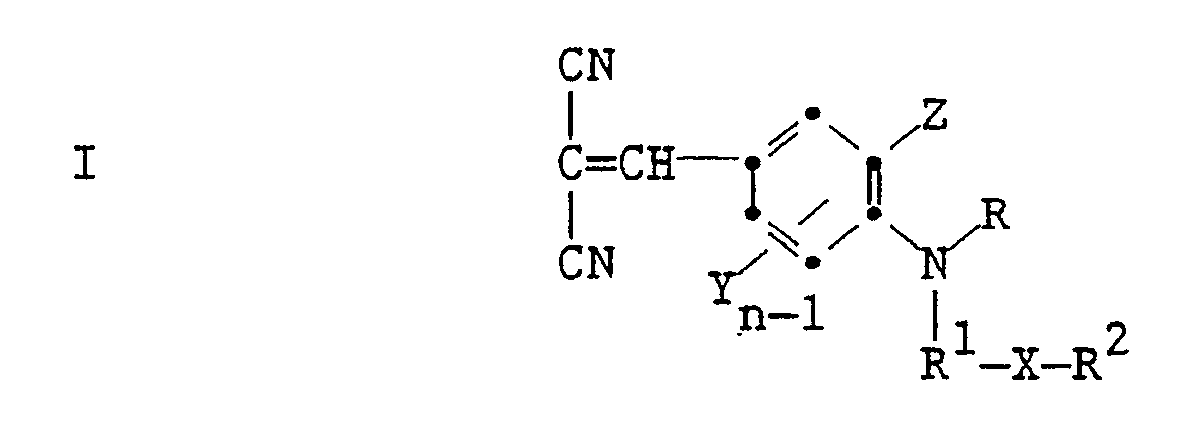
wherein R is a substituted or unsubstituted alkyl group of from 1 to 10 carbon atoms; a cycloalkyl group of from 5 to 7 carbon atoms; or represents the atoms which when taken together with Z forms a 5- or 6-membered ring;
R¹ is an alkylene or substituted alkylene group;
X is -OJO-, -OJ-, -JO-, -OJNR³-, -NR³J-, -NR³JNR³, -JNR³- or -NR³JO-;
J is CO or SO₂;
R³ is hydrogen; a substituted or unsubstituted alkyl group of from 1 to 10 carbon atoms; a substituted or unsubstituted aryl group of from 6 to 10 carbon atoms; or represents the atoms which when taken together with R² forms a 5- or 6-membered ring;
R² is a substituted or unsubstituted alkyl group of from 1 to 10 carbon atoms; a cycloalkyl group of from 5 to 7 carbon atoms; a substituted or unsubstituted aryl group of from 6 to 10 carbon atoms; or represents the atoms which when taken together with R³ forms a 5- or 6-membered ring;
Z is hydrogen or represents the atoms which when taken together with R forms a 5- or 6-membered ring;
Y is a substituted or unsubstituted alkyl or alkoxy group of from 1 to 6 carbon atoms or halogen; and
n is a positive integer from 1 to 4; and
said magenta dye having the formula:

wherein R⁴ and R⁵ may each independently be hydrogen, substituted or unsubstituted alkyl or allyl of from 1 to 6 carbon atoms, substituted or unsubstituted cycloalkyl of from 5 to 7 carbon atoms, substituted or unsubstituted aryl of from 5 to 10 carbon atoms; or R⁴ and R⁵ may be taken together to form a ring; or a 5- or 6-membered heterocyclic ring may be formed with R⁴ or R⁵, the nitrogen to which R⁴ or R⁵ is attached, and either carbon atom ortho to the carbon attached to said nitrogen atom;
R⁶ may be hydrogen, substituted or unsubstituted alkyl of from 1 to 6 carbon atoms, substituted or unsubstituted aryl of from 5 to 10 carbon atoms, alkylthio or halogen;
B may be substituted or unsubstituted alkyl of from 1 to 6 carbon atoms, substituted or unsubstituted aryl of from 5 to 10 carbon atoms or NHA, where A is an acyl or sulfonyl radical; and
Q may be cyano, thiocyanato, alkylthio or alkoxycarbonyl.
wherein R is a substituted or unsubstituted alkyl group of from 1 to 10 carbon atoms; a cycloalkyl group of from 5 to 7 carbon atoms; or represents the atoms which when taken together with Z forms a 5- or 6-membered ring;
R¹ is an alkylene or substituted alkylene group;
X is -OJO-, -OJ-, -JO-, -OJNR³-, -NR³J-, -NR³JNR³, -JNR³- or -NR³JO-;
J is CO or SO₂;
R³ is hydrogen; a substituted or unsubstituted alkyl group of from 1 to 10 carbon atoms; a substituted or unsubstituted aryl group of from 6 to 10 carbon atoms; or represents the atoms which when taken together with R² forms a 5- or 6-membered ring;
R² is a substituted or unsubstituted alkyl group of from 1 to 10 carbon atoms; a cycloalkyl group of from 5 to 7 carbon atoms; a substituted or unsubstituted aryl group of from 6 to 10 carbon atoms; or represents the atoms which when taken together with R³ forms a 5- or 6-membered ring;
Z is hydrogen or represents the atoms which when taken together with R forms a 5- or 6-membered ring;
Y is a substituted or unsubstituted alkyl or alkoxy group of from 1 to 6 carbon atoms or halogen; and
n is a positive integer from 1 to 4; and
said magenta dye having the formula:
wherein R⁴ and R⁵ may each independently be hydrogen, substituted or unsubstituted alkyl or allyl of from 1 to 6 carbon atoms, substituted or unsubstituted cycloalkyl of from 5 to 7 carbon atoms, substituted or unsubstituted aryl of from 5 to 10 carbon atoms; or R⁴ and R⁵ may be taken together to form a ring; or a 5- or 6-membered heterocyclic ring may be formed with R⁴ or R⁵, the nitrogen to which R⁴ or R⁵ is attached, and either carbon atom ortho to the carbon attached to said nitrogen atom;
R⁶ may be hydrogen, substituted or unsubstituted alkyl of from 1 to 6 carbon atoms, substituted or unsubstituted aryl of from 5 to 10 carbon atoms, alkylthio or halogen;
B may be substituted or unsubstituted alkyl of from 1 to 6 carbon atoms, substituted or unsubstituted aryl of from 5 to 10 carbon atoms or NHA, where A is an acyl or sulfonyl radical; and
Q may be cyano, thiocyanato, alkylthio or alkoxycarbonyl.
2. The element of Claim 1 characterized in that said receiving layer comprises a polycarbonate
binder having a Tg greater than 200°C.
3. The element of Claim 2 characterized in that said polycarbonate is derived from
a bisphenol component comprising a diphenyl methane moiety.
4. The element of Claim 1 characterized in that said R in said structural formula
I represents the atoms which are taken together with Z to form a 6-membered ring.
5. The element of Claim 1 characterized in that said R⁶ in said structural formula
II is methyl and Z is CN.
6. The element of Claim 1 characterized in that said pattern consists of a set of
red, green and blue additive primaries.
7. The element of Claim 7 characterized in that each area of said primary color and
each said set of primary colors are separated from each other by an opaque area.
8. The element of Claim 1 characterized in that said thermally-transferred image is
obtained using laser induction.
9. The element of Claim 1 characterized in that said thermally transferred image is
obtained using a high intensity light flash.
10. The element of Claim 1 characterized in that said support is glass.