|
(11) | EP 0 393 742 B1 |

| (12) | EUROPEAN PATENT SPECIFICATION |
|
|
| (54) |
Process for the preparation of alkyl substituted tetralins and indanes Verfahren zur Herstellung von alkylsubstituierten Tetralinen und Indanen Procédé pour la fabrication de tétralines et indanes alkylsubstitués |
|
|
|||||||||||||||||||||||||||||||
| Note: Within nine months from the publication of the mention of the grant of the European patent, any person may give notice to the European Patent Office of opposition to the European patent granted. Notice of opposition shall be filed in a written reasoned statement. It shall not be deemed to have been filed until the opposition fee has been paid. (Art. 99(1) European Patent Convention). |
[0001] The invention relates to a process for the preparation of alkyl substituted tetralins and indanes
[0002] Alkyl substituted tetralins and indanes are important in the fragrance industry as intermediates for the preparation of well known musk fragrances of the acetylated tetralin, acetylated indane and the isochroman type. Many routes have therefore been developed to synthesize these intermediates and the majority of these routes are focused on the preparation of a benzylic cation to react with a suitable alkene followed by ring closure. These cations have been prepared either from the corresponding hydrocarbon by hydride abstraction, from a suitably substituted styrene by protonation or from a benzyl halide by halide abstraction. Many of these routes were reviewed in: T.F. Wood, the chemistry of the Aromatic Musks, edited by Givaudan Corporation, Clifton. New Jersey, especially pages 10-29. More recent examples are given in US 3,856,875, JP-A-54/125647 (1979), JP-A-56/043221 (1981), JP-A-56/039026 (1981) and EP-A-089207. However, there is a need for a process which gives higher yields and/or uses cheaper starting materials.
[0003] A process was found for the preparation of alkyl substituted tetralins and indanes using a tertiary benzyl alcohol having formula I:
wherein R₁ - R₄ represent hydrogen atoms or alkyl groups having 1-3 carbon atoms and R₅ and R₆ are alkyl groups having 1-3 carbon atoms, which is reacted with an alkene having 4-7 carbon atoms under the influence of a Lewis acid catalyst whereby a tetralin having formula II and/or an indane having formula III is obtained:
wherein R₁ - R₆ have the meaning indicated above and R₇ - R₁₁ represent hydrogen atoms or alkyl groups having 1-4 carbon atoms, with the proviso that the total number of carbon atoms in R₇ - R₁₁ does not exceed 4 in formula II or in R₈ - R₁₁ does not exceed 5 in formula III.
[0004] In G.A. Olah, "Friedel-Crafts and Related Reactions", Vol. II, Part 2; Interscience Publishers, New York, 1964, pp. 816-822 it is disclosed that unlike other phenyl-substituted alkanols, 1-phenyl-alkan-1-ols (alpha-alkyl-substituted benzyl alcohols) do not react with strong acids to yield tetralin- or indane-type products, but instead give intractable polymers. A passing reference to the reaction of 2-methyl-1-(p-methylphenyl)-propan-1-ol, which is a secondary benzyl alcohol, with 2-methylbut-2-ene or 2,3-dimethylbut-2-ene to obtain the corresponding 1-isopropyl-indane was made in US patent nr. 4,352,748, however without giving any further details. The at first sight more cumbersome route of first converting the alcohol into the corresponding chloride before reaction with the alkene is given in Example 1 of this patent and is apparently preferred.
[0005] The process according to the present invention generally provides the substituted tetralins or indanes in high yield starting from relatively cheap and easily available benzyl alcohols. These alcohols are the starting materials for the preparation of the styrene or benzyl chloride substrates used in prior art processes for preparing the tetralins and indanes. Thus the process according to the invention provides an appreciable simplification of the reaction route leading to these products.
[0006] The preferred benzyl alcohols according to formula I are those wherein R₁, R₃ and R₄ are hydrogen atoms and R₂ is either a hydrogen atom or a methyl group. Especially preferred are benzyl alcohols wherein also R₅ and R₆ are both methyl groups. Preferred alkenes for the process according to the invention are 2,3-dimethylbut-1-ene, 3,3-dimethylbut-1-ene and 2-methylbut-2-ene. These alkenes will lead to tetralins of formula II wherein R₇ and R₈ are both hydrogen atoms and R₉ - R₁₁ are all methyl groups or indanes of formula III wherein R₈ is a hydrogen atom and R₉ - R₁₁ are all methyl groups. Alternatively the reaction with the above mentioned dimethylbutenes may be so directed, e.g. as described in US 4,493,790 as to produce predominantly the indane of formula III wherein R₈ and R₉ are hydrogen atoms, R₁₀ is a methyl group and R₁₁ is an isopropyl group. Instead of pure alkenes, commercially available alkene mixtures which are rich in one or more of the above mentioned alkenes are also very suitably for the purpose of the invention.
[0007] The usual Lewis acid catalysts may be used for the reaction according to the invention. Particularly suitable are AlCl₃, FeCl₃ and TiCl₄. Optionally known complexing agents, such as nitroalkanes, may be used, especially in combination with AlCl₃. The catalyst is used in an amount of at least 0.1 mol, and preferably between 0.5 and 1.0 mol per mol of benzyl alcohol. Equimolar amounts of alkene and benzyl alcohol or even an excess of the alcohol may be used, however the use of an excess of alkene is preferred. A molar ratio of alkene/alcohol of 1:1 to 5:1 is very suitable.
[0008] The usual solvents for Friedel-Crafts alkylation reactions may be used e.g. hydrocarbons, such as hexane and cyclohexane, chlorinated hydrocarbons, such as dichloromethane, 1,1- and 1,2-dichloroethane, 1,1,1-trichloroethane and carbon tetrachloride, nitroalkanes, such as nitromethane, nitroethane and nitropropane, liquid sulphur dioxide and sulpholane and mixtures of such solvents. Preferably a minimum volume of 150 ml per mol of alcohol is used. The temperature at which the reaction is carried out is not critical, although temperatures below ambient tend to increase the selectivity of the reaction. Temperatures between -80 and +80 °C and preferably between -30 and +10 °C, but above the freezing point of the solvent, are generally suitable. It is recommended that the reaction be carried out in the absence of water and oxygen.
[0009] The tetralins and indanes provided by the process according to the invention are highly suitable for the preparation of well known musk fragrances. This preparation often involves acylation of said tetralins and indanes with an acyl halide, more particularly an acetylation with acetyl halide, also under the influence of a Lewis acid catalyst. Furthermore, the tetralins and indanes may be reacted with a suitable alkylene epoxide, especially propylene oxide, to form precursors for isochroman compounds. All the aforesaid reactions may be carried out after isolation of the tetralin or indane from the initial reaction mixture. However, they may also be carried out without such prior isolation. Thus, the process according to the invention also comprises a further reaction with an acyl halide or an epoxide, using if necessary additional Lewis acid catalyst, without prior isolation of the tetralin or indane from the initial reaction mixture.
[0010] The following examples illustrate how to perform the process according to the invention. However, the invention is not limited thereto.
Example 1
[0011] To a stirred solution of 10 ml titanium tetrachloride in 120 ml dichloromethane which had been cooled to -5 °C under nitrogen, was added a mixture of 15.0 g (0.1 mol) p-cymen-8-ol and 16.8 g (0.2 mol) 2,3-dimethylbut-1-ene over a two hour period. The reaction mixture was stirred for a further 30 minutes at -5 °C. Thereafter it was poured into a mixture of 200 ml water and 100 ml of concentrated hydrochloric acid and stirred for 15 minutes. The organic phase was separated and the aqueous phase washed twice with 50 ml dichloromethane. The combined organic phase was washed twice with 100 ml 10% hydrochloric acid solution, once with 100 ml water twice with 100 ml 5% sodium carbonate solution and finally once again with water. After removal of the solvent 25.3 g of a crude reaction product was obtained, containing 71.1% (17.9 g) of the desired 1,1,3,4,4,6-hexamethyltetralin, equivalent to a 83.3% yield based on p-cymenol used. The hexamethyltetralin was purified by crystallisation from an equal weight of iso-propanol; m.p. 66-67 °C. The reaction was repeated and the crude hexamethyltetralin thus produced was purified by fractional distillation under reduced pressure; b.p. 98-102 °C / 0.7 kPa.
Example 2
[0012] The procedure of Example 1 was repeated except that the solvent used was cyclohexane instead of dichloromethane. The yield of hexamethyltetralin was 66.4% based on p-cymen-8-ol.
Example 3
[0013] A mixture of 66.8 g of aluminium chloride and 400 ml of dichloromethane was cooled to -10 °C and kept under nitrogen. A mixture of 75 g (0.5 mol) p-cymen-8-ol and 63 g (0.75 mol) 2,3-dimethylbut-1-ene was added over a two hour period while maintaining the temperature of the reaction mixture at -10 °C. The mixture was stirred at this temperature for another 30 minutes, poured into 1200 ml of a 10% aqueous solution of hydrochloric acid and further worked up as in Example 1. The desired hexamethyltetralin was obtained in 35.3% yield based on p-cymenol.
Example 4
[0014] A mixture of 6.7 g aluminium chloride and 30 ml dichloromethane was cooled to -5 °C and 5.6 g of nitroethane added. Thereafter a mixture of 7.6 g p-cymen-8-ol and 8.4 g 2,3-dimethylbut-1-ene was added over a period of 35 minutes, while keeping the temperature at -5 °C. After stirring at this temperature for another 10 minutes the reaction mixture was worked up at in Example 1. The yield of hexamethyltetralin was 69% based on p-cymenol.
Example 5
[0015] The procedure of Example 4 was repeated except that the reaction was carried out using 30 ml of nitroethane alone as the solvent. the yield of the desired tetralin was 90% based on p-cymenol.
Example 6
[0016] To 60 ml of 1,2-dichloroethane, cooled to -10°C and kept under nitrogen, was gradually added whilst stirring a mixture of 30 g p-cymen-8-ol and 26 g 2,3-dimethylbut-1-ene over a period of 90 minutes. Separately, but simultaneously, a mixture of 10 ml titanium tetrachloride and 40 ml 1,2-dichloroethane was added over a period of 80 minutes. The reaction temperature was kept at -10°C during the addition of the reagents and thereafter for 30 minutes whilst stirring. The reaction mixture was worked up as described in Example 1. The yield of tetralin was 81.4% of the theoretical.
1. Process for the preparation of alkyl substituted tetralins and indanes by reacting
an alkene under the influence of a Lewis acid catalyst characterized in that a tertiary
benzyl alcohol having formula I:
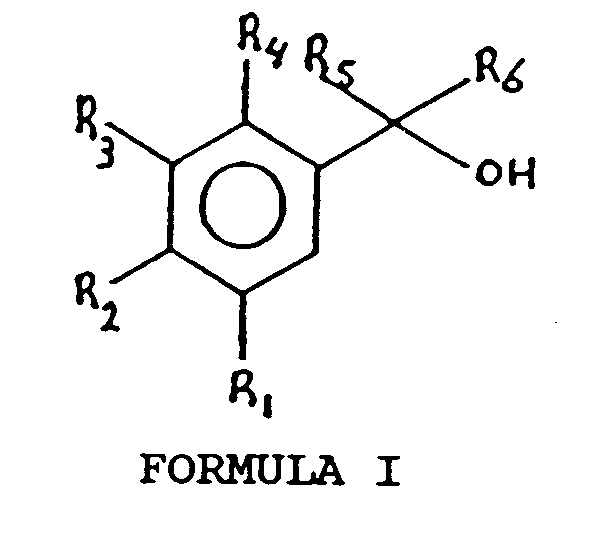
wherein R₁ - R₄ represent hydrogen atoms or alkyl groups having 1-3 carbon atoms and R₅ and R₆ are alkyl groups having 1-3 carbon atoms, is reacted with an alkene having 4-7 carbon atoms.
wherein R₁ - R₄ represent hydrogen atoms or alkyl groups having 1-3 carbon atoms and R₅ and R₆ are alkyl groups having 1-3 carbon atoms, is reacted with an alkene having 4-7 carbon atoms.
2. Process according to claim 1 wherein a benzyl alcohol is used, having formula I wherein
R₁, R₃ and R₄ are hydrogen atoms and R₂ is a hydrogen atom or a methyl group.
3. Process according to claim 1 or 2 wherein the alkene is chosen from 2,3-dimethylbut-1-ene,
3,3-dimethylbut-1-ene and 2-methyl-but-2-ene
4. Process according to claim 2 or 3 wherein a benzyl alcohol is used, having formula
I wherein R₅ and R₆ are both methyl groups.
5. Process according to any one of claims 1-4 wherein the Lewis acid is chosen from AlCl₃,
FeCl₃ and TiCl₄.
6. Process according to claim 5 wherein a complexing agent is added to the reaction mixture.
7. Process according to claim 6 wherein the complexing agent is a nitroalkane.
8. Process according to any one of claims 1-7 wherein the tetralin or the indane obtained
is further reacted with an acyl halide or an alkylene epoxide under the influence
of a Lewis acid catalyst, without prior isolation from the initial reaction mixture.
9. Process according to claim 8 wherein the acyl halide is acetyl halide.
10. Process according to claim 8 wherein the alkylene epoxide is propylene epoxide.
11. Process according to any one of claims 8-10 wherein an additional amount of Lewis
acid chosen from AlCl₃, FeCl₃ and TiCl₄ is added between the alkylation step and the
reaction with the acylhalide or alkylene epoxide.
1. Verfahren zur Herstellung von alkylsubstituierten Tetralinen und Indanen durch Reaktion
eines Alkens unter dem Einfluß einer Lewis-Säure als Katalysator, dadurch gekennzeichnet,
daß ein tertiärer Benzylalkohol mit der Formel I:
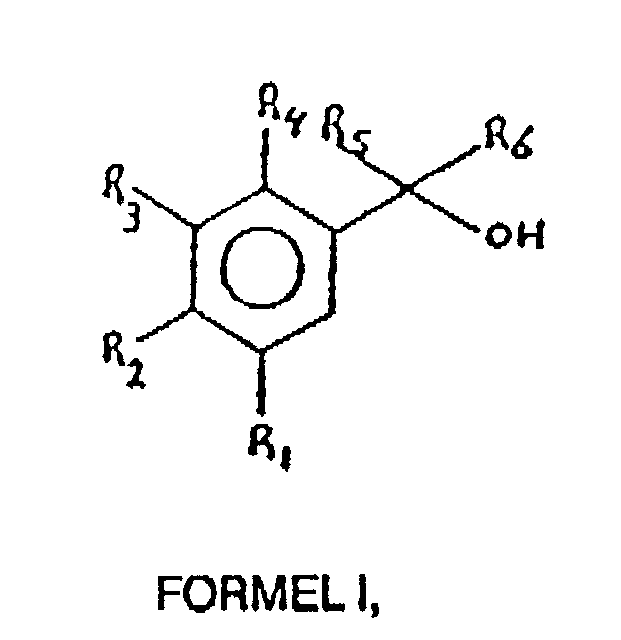
wobei R₁ - R₄ Wasserstoffatome oder Alkylgruppen mit 1 bis 3 Kohlenstoffatomen und R₅ und R₆ Alkylgruppen mit 1 bis 3 Kohlenstoffatomen sind, mit einem Alken mit 4 bis 7 Kohlenstoffatomen zur Reaktion gebracht wird.
wobei R₁ - R₄ Wasserstoffatome oder Alkylgruppen mit 1 bis 3 Kohlenstoffatomen und R₅ und R₆ Alkylgruppen mit 1 bis 3 Kohlenstoffatomen sind, mit einem Alken mit 4 bis 7 Kohlenstoffatomen zur Reaktion gebracht wird.
2. Verfahren nach Anspruch 1, dadurch gekennzeichnet, daß ein Benzylalkohol der Formel
I verwendet wird, wobei R₁, R₃ und R₄ Wasserstoffatome sind und R₂ ein Wasserstoffatom
oder eine Methylgruppe ist.
3. Verfahren nach Anspruch 1 oder 2, dadurch gekennzeichnet, daß das Alken aus 2,3-Dimethylbut-1-en,
3,3-Dimethylbut-1-en und 2-Methylbut-2-en ausgewählt ist.
4. Verfahren nach Anspruch 2 oder 3, dadurch gekennzeichnet, daß ein Benzylalkohol mit
der Formel I verwendet wird, wobei R₅ und R₆ beide Methylgruppen sind.
5. Verfahren nach einem der Ansprüche 1 bis 4, dadurch gekennzeichnet, daß die Lewis-Säure
aus AlCl₃, FeCl₃, und TiCl₄ ausgewählt ist.
6. Verfahren nach Anspruch 5, dadurch gekennzeichnet, daß dem Reaktionsgemisch ein Komplexbildner
zugefügt wird.
7. Verfahren nach Anspruch 6, dadurch gekennzeichnet, daß der Komplexbildner ein Nitroalkan
ist.
8. Verfahran nach einem der Ansprüche 1 bis 7, dadurch gekennzeichnet, daß das erhaltene
Tetralin oder Indan ohne vorherige Isolierung aus dem anfänglichen Reaktionsgemisch
unter dem Einfluß eines Lewis-Säuren-Katalysators in weitere Reaktion mit einem Acylhalogenid
oder einem Alkylenepoxid gebracht wird.
9. Verfahren nach Anspruch 8, dadurch gekennzeichnet, daß das Acylhalogenid Acetylhalogenid
ist.
10. Verfahren nach Anspruch 8, dadurch gekennzeichnet, daß das Alkylenepoxid Propylenepoxid
ist.
11. Verfahren nach einem der Ansprüche 8 bis 10, dadurch gekennzeichnet, daß zwischen
dem Alkylierungsschritt und der Reaktion mit dem Acylhalogenid oder dem Alkylenepoxid
eine zusätzliche Menge einer Lewis-Säure, ausgewählt aus AlCl₃, FeCl₃ und TiCl₄, zugefügt
wird.
1. Procédé de préparation de tétralines et d'indanes alkyl-substitués en faisant réagir
un alkylène sous l'influence d'un catalyseur acide de Lewis, caractérisé en ce qu'un
alcool benzylique tertiaire ayant la formule I :
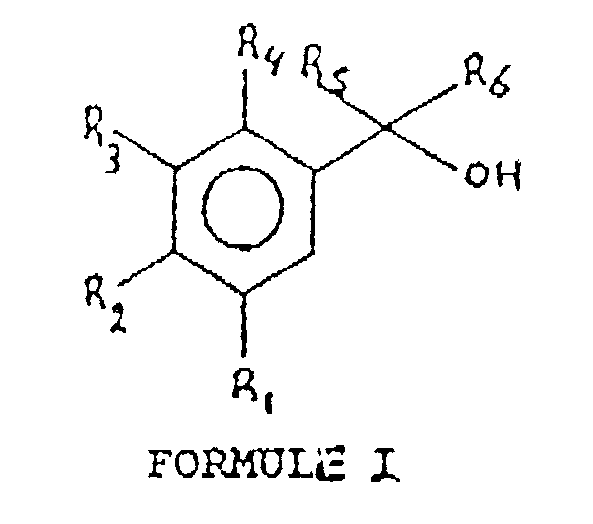
dans laquelle R₁ a R₄ représentent des atomes d'hydrogène ou des groupes alkyle ayant 1 à 3 atomes de carbone, et R₅ et R₆ sont des groupes alkyle ayant 1 à 3 atomes de carbone, est mis en réaction avec un alkylène ayant 4 à 7 atomes de carbone.
dans laquelle R₁ a R₄ représentent des atomes d'hydrogène ou des groupes alkyle ayant 1 à 3 atomes de carbone, et R₅ et R₆ sont des groupes alkyle ayant 1 à 3 atomes de carbone, est mis en réaction avec un alkylène ayant 4 à 7 atomes de carbone.
2. Procédé selon la revendication 1, dans lequel un alcool benzylique est utilisé, ayant
la formule I dans laquelle R₁, R₃ et R₄ sont des atomes d'hydrogène et R₂ est un atome
d'hydrogène ou un groupe méthyle.
3. Procédé selon la revendication 1 ou 2, dans lequel l'alkylène est sélectionné parmi
le 2,3-diméthylbut-1-ène, le 3,3-diméthylbut-1-ène et le 2-méthylbut-2-ène.
4. Procédé selon la revendication 2 ou 3, dans lequel un alcool benzylique est utilisé,
ayant la formule I, dans laquelle R₅ et R₆ sont tous les deux des groupes méthyle.
5. Procédé selon l'une quelconque des revendications 1 à 4, dans lequel l'acide Lewis
est sélectionné parmi AlCl₃, FeCl₃ et TiCL₄.
6. Procédé selon la revendication 5, dans lequel un agent complexant est ajouté au mélange
réactionnel.
7. Procédé selon la revendication 6, dans lequel l'agent complexant est un nitroalcane.
8. Procédé selon l'une quelconque des revendications 1 à 7, dans lequel la réaction de
la tétraline ou de l'indane obtenu, est poursuivie avec un halogénure d'acyle ou un
époxyde d'alkylène sous l'influence d'un catalyseur acide de Lewis, sans isolation
préalable du mélange réactionnel initial.
9. Procédé selon la revendication 8, dans lequel l'halogénure d'acyle est l'halogénure
d'acétyle.
10. Procédé selon la revendication 8, dans lequel l'époxyde d'alkylène est l'époxyde de
propylène.
11. Procédé selon l'une quelconque des revendications 8 à 10, dans lequel une quantité
supplémentaire d'acide Lewis sélectionné parmi AlCl₃, FeCl₃ et TiCl₄, est ajoutée
entre l'étape d'alkylation et la mise en réaction avec l'halogénure d'acyle ou l'époxyde
d'alkylène.