|
(11) | EP 0 395 185 A1 |

| (12) | EUROPEAN PATENT APPLICATION |
|
|
|
|
|||||||||||||||||||||||
| (54) | Curing catalyst for application in powder coatings |
| (57) The invention relates to a curing catalyst on the basis of a benzotriazole. The benzotriazole
is substituted at a nitrogen atom with an organic group with less than 20 carbon atoms.
The catalyst is used in powder coatings on the basis of epoxyfunctional compounds.
|
[0001] The invention relates to a curing catalyst for application in powder coatings on the basis of epoxyfunctional compounds, the catalyst being based on a benzotriazole.
[0002] Such a catalyst for the reaction of an epoxy resin with a polyester is known from EP-B-125906, in which the benzotriazole at the aromatic ring may be substituted with an alkyl group with 1-4 carbon atoms.
[0003] Although the use of the catalysts according to EP-B-125906 results in reasonable powder coatings with respect to the combination of impact deformation, flow time and curing time properties there is a need for better catalysts.
[0004] The object of the invention is to provide a curing catalyst for application in powder coatings which improves the aforesaid combination of properties.
[0005] The invention is characterized in that the benzotriazole, at a nitrogen atom, is substituted with an organic group, with less than 20 carbon atoms.
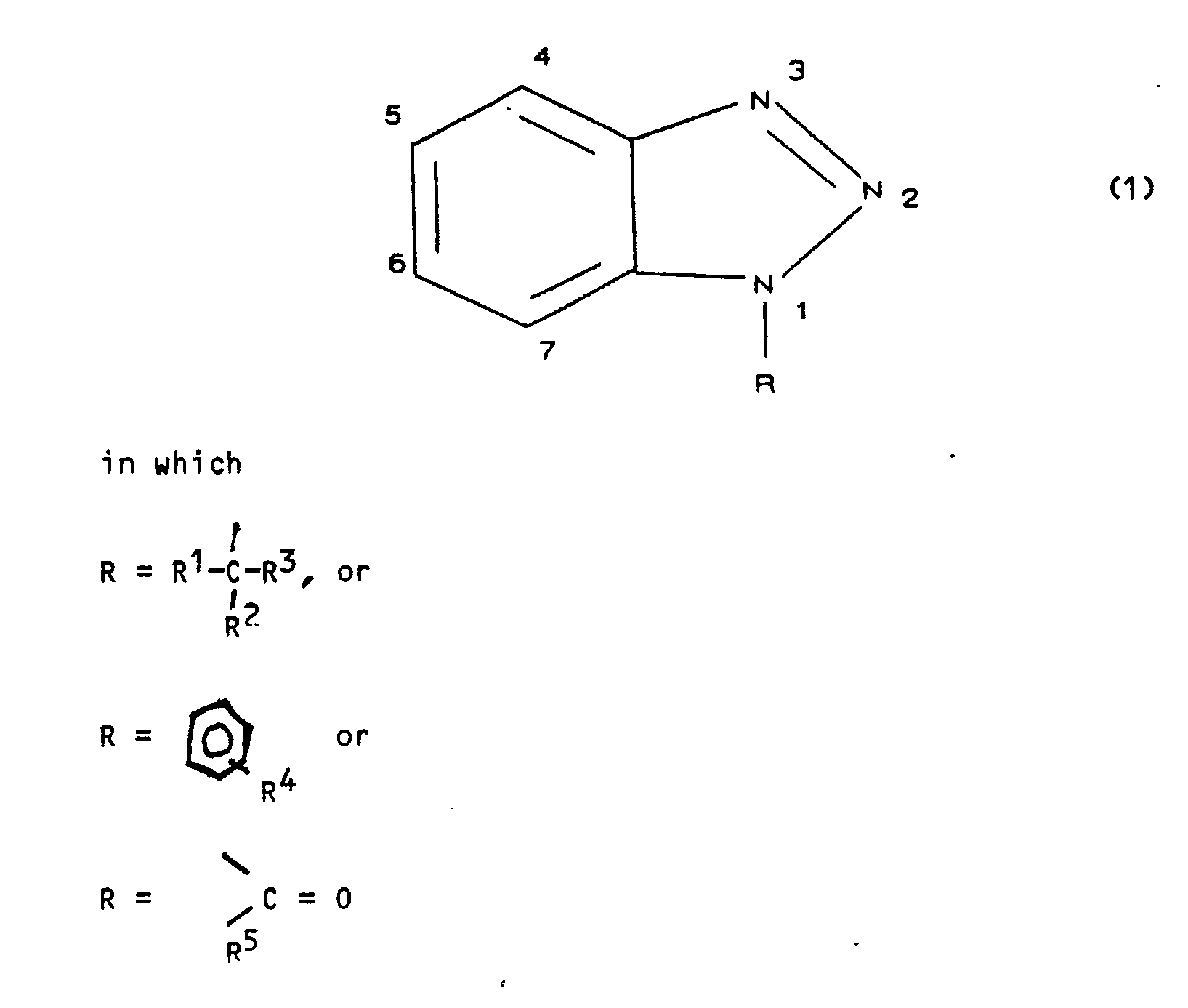
[0006] According to a preferred embodiment of the invention, the substituted benzotriazole is characterized by formula (1):
in which R¹ = H, (C₁-C₄) alkyl, halogen, OH, NR⁶R⁷, COOR⁸ or phenyl,
in which R⁶ = H or (C₁-C₄) alkyl and
R⁷ = (C₁-C₄) alkyl, or in which
R⁶ and R⁷ together form a ring with 3-8 carbon atoms which may contain a group selected from the group consisting of an ether, thioether and amino groups and
R⁸ = H or (C₁-C₄) alkyl,
R² = H, (C₁-C₄) alkyl or halogen,
R³ = H, halogen or (C₁-C₄) alkyl, or in which R² and R³ together form a ring with 3-8 carbon atoms which may contain a group selected from the group consisting of an ether, thioether and amino groups
R⁴ = H, (C₁-C₄) alkyl, halogen or OR⁹, where
R⁹ = (C₁-C₄) alkyl, and
R⁵ = (C₁-C₄) alkyl.
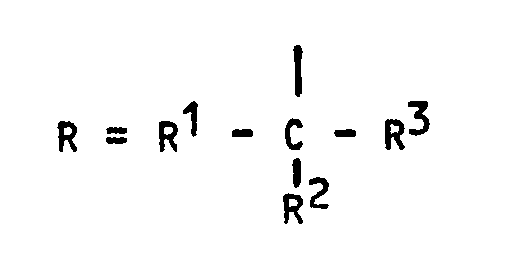
[0007] According to another preferred embodiment of the invention the substituted benzotriazole used is a compound with formula (1), in which
and in which
R¹ = H, (C₁-C₄) alkyl, phenyl or NR⁶R⁷, where R⁶ = R⁷ = (C₁-C₄) alkyl, or where R⁶ and R⁷ together form a ring with 3-8 carbon atoms which may contain an ether, thioether or amino group,
R² = H or (C₁-C₄) alkyl, and
R³ = H or (C₁-C₄) alkyl.
[0008] Examples of suitable compounds according to formula (1) in which
are N-methylbenzotriazole, N-methylmorpholinobenzotriazole, N-benzylbenzotriazole, N-methylpyperidinobenzotriazole, N-methylolbenzotriazole, N-pivalic acid benzotriazole and/or N-tertiary butylbenzotriazole.
[0009] Examples of suitable compounds according to formula (1) in which
are 1-phenylbenzotriazole, (methyl)phenylbenzotriazole and methoxyphenylbenzotriazole.
[0010] Examples of suitable compounds according to formula (1) in which
are acetylbenzotriazole and pivaloylbenzotriazole.
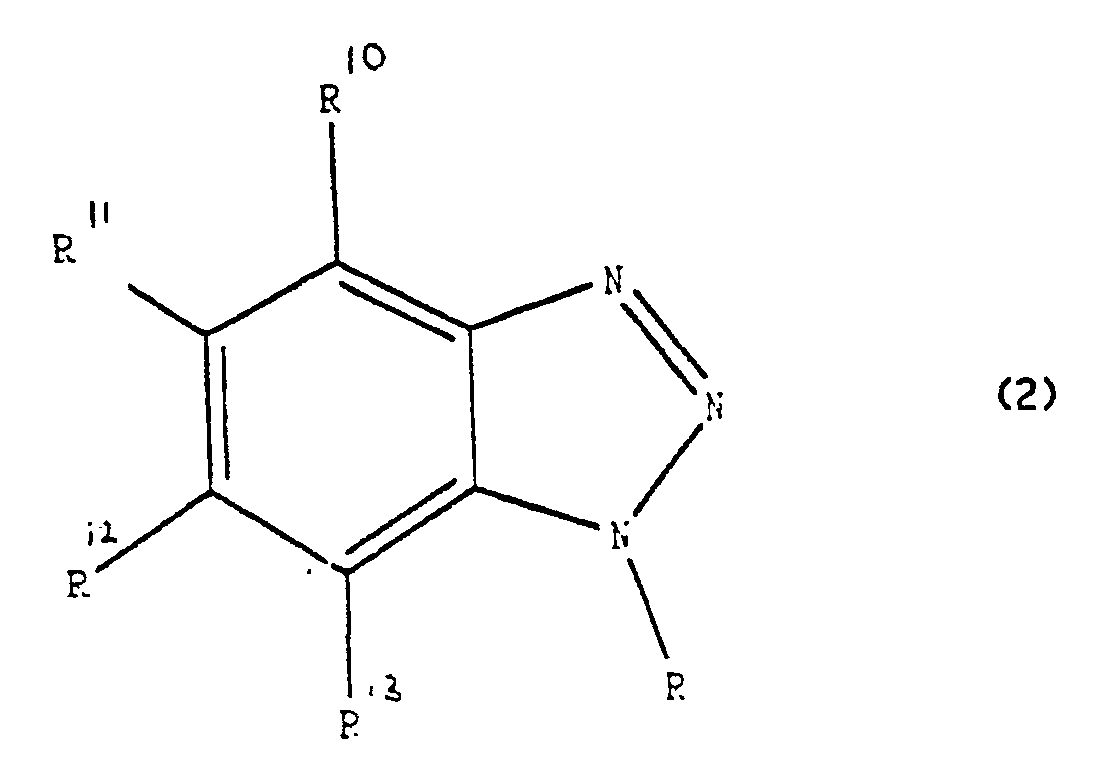
[0011] The invention also relates to curing catalysts for application in powder coatings on the basis of epoxyfunctional compounds with the catalyst substituted according to formula (2). The benzotriazole is substituted at a nitrogen with an organic group with less than 20 carbon atoms, and is also substituted at the aromatic ring:
where R¹⁰, R¹¹, R¹² and R¹³ simultaneously or separately are (C₁-C₇) alkyl, H, OR¹⁴ or halogen,
or where R¹⁰ and R¹¹ or R¹¹ and R¹² or R¹² and R¹³ together form a ring with 4-10 carbon atoms or form one or more aromatic rings, and
where R¹⁴ = H or (C₁-C₆) alkyl.
[0013] Suitable examples of such catalysts are 1-phenyl-5,6-dimethylbenzotriazole, 1-phenyl-tolyltriazole,1-acetyl-5,6-dimethylbenzotriazole and 1-acetyltolyltriazole.
[0014] Suitable halogen substituents in the formula according to the invention are fluorine, chlorine and bromine.
[0015] Powder coatings have gained much in popularity in the past decade due to their low environmental impact, ease of application and good quality. Coating systems on the basis of polyesters take an important place in this area. Here distinction can be made between several systems for instance. One of those systems consists of, for instance, an acid terminated polyester and triglycidylisocyanurate (TGIC) in a ratio of 93:7 and is used where good weather resistance is required (facade cladding, garden furniture, bicycles). Another system consists of an acid terminated polyester in combination with an epoxy resin on the basis of bisphenol A and is only suitable for indoor applications (refrigerators) on account of, among other reasons, its discolouration when exposed to outdoor light (UV). Curing in these two systems is based on the reaction between the carboxyl groups of the polyester and the epoxide groups of the second component. This takes place at an elevated temperature (180-200oC) and mostly under the influence of catalysts.
[0016] The catalyst according to the invention is by preference suitable for producing powder coatings employing acid-terminated polyester resins and epoxy compounds. At a temperature of about 110-130oC the acid terminated polyester resins are mixed, by means of extrusion for instance, with a polyfunctional epoxide, pigments and other additives and, after having been sprayed electrostatically, they are cured under the influence of a catalyst at temperatures from 160oC to 200oC. During the curing process the powder melts and then flows out to form a smooth closed coating film before the curing reaction really starts. The catalyst should ensure rapid curing, but should be virtually inactive during the mixing of the polyester and the epoxy compound. After the polyester has been prepared at temperatures of from 200¤C to 280¤C and subsequently cooled to 190-200oC, the curing catalyst according to the invention is added. The catalyst according to the invention may also be added during the mixing of the polyester and the epoxy compound, however. The requirements that have to be met by such a catalyst, viz. virtual absence of reaction at temperatures from 80¤C up to 130oC, but a fast reaction at temperatures from 160oC to 240¤C, imply a very strong temperature dependence.
[0017] The catalyst according to the invention is preferably applied in quantities between 0.01 wt.% and 2.0 wt.%, inclusive, relative to the polyester resin, preferably in quantities between 0.1 and 1.0 wt.%, inclusive, relative to the polyester resin.
[0018] Suitable polyesters can be obtained by the usual methods of preparation, starting from substantially aromatic polycarboxylic acids, such as phthalic acid, isophthalic acid, terephthalic acid, pyromellitic acid, trimellitic acid, 3,6-dichlorophthalic acid, tetrachlorophthalic acid, or, in so far as available, the anhydrides, acid chlorides or lower alkyl esters thereof. Mostly the carboxylic acid component contains at least 50 wt.%, preferably at least 70 mole % isophthalic acid and/or terephthalic acid.
[0019] One may also use, in particular, aliphatic diols, such as ethylene glycol, propane-1,2-diol, propane-1,3-diol, butane-1,2-diol, butane-1,4-diol, butane-1,3-diol, 2,2-dimethylpropanediol-1,3 (= neopentylglycol), hexane-2,5-diol, hexane-1,6-diol, 2,2-[bis-(4-hydroxycyclohexyl)]-propane, 1,4-dimethylolcyclohexane, diethyleneglycol, dipropyleneglycol and 2,2-bis-[4-(2-hydroxylethoxy)]-phenylpropane and smaller quantities of polyols, such as glycerol, hexanetriol, pentaerytritol, sorbitol, trimethylolethane, trimethylolpropane and tri-(2-hydroxy)-isocyanurate. Instead of diols or polyols, epoxy compounds can also be used. The alcohol component preferably contains 50 mole % neopentylglycol and/or propylene glycol.
[0020] As polycarboxylic acids can also be used cycloaliphatic and/or acyclic polycarboxylic acids, such as for example tetrahydrophthalic acid, hexahydroendomethylenetetrahydrophthalic acid, azelaic acid, sebacic acid, decanecarboxylic acid, dimeric fatty acid, adipic acid, succinic acid, maleic acid, in quantities of up to 30 mole %, preferably up to 20 mole % of the total of carboxylic acids. Hydroxyl carboxylic acids and/or lactones can also be used, e.g. 12-hydroxystearic acid, epsilon caprolactone, hydroxypivalic acid ester of neopentylglycol. In minor quantities, monocarboxylic acids, such as benzoic acid, tertiary butylbenzoic acid, hexahydrobenzoic acid and saturated aliphatic monocarboxylic acids can also be added during the preparation.
[0021] The polyesters are prepared, by methods known per se, by esterification or transesterification, if required in the presence of usual catalysts, such as for example dibutyl tin oxide or tetrabutyl titanate, correct choice of the preparation conditions and of the COOH/OH ratio enabling end products with an acid number between 5 and 150 to be obtained.
[0022] As epoxy compound can be used for instance triglycidylisocyanurate or a related heterocyclic triepoxy compound, such as methyl-substituted triglycidylisocyanurate or 1,2,4-triglycidyltriazolidine-3,5-dione or diglycidylterephthalate or diglycidylhexahydroterephthalate or an epoxy resin on the basis of bisphenol A and epichlorohydrin. The quantity of epoxy compound used in the binding agent with the polyester resin depends on the acid number and on the epoxy equivalent weight of the epoxy compound with which the polyester is combined, and is in general between 0.8 and 1.2 epoxy equivalent per carboxyl equivalent.
[0023] The catalyst according to the invention can also be used in powder coating systems on the basis of for instance acrylates, oxazolidones or polyurethanes with epoxy compounds or oxazolines.
[0024] Besides application in powder coating systems, the catalyst according to the invention can also be used in liquid coating systems on the basis of acid-terminated polyesters, acrylates or oxazolidones with epoxy compounds.
[0025] All customary additives, such as for instance pigments, filling agents, flow agents and stabilizers, may of course be added to the coating systems. Suitable pigments are for instance inorganic pigments such as titanium dioxide, zinc sulphide, iron oxide and chromium oxide and inorganic pigments such as azo compounds. Suitable filling agents are for instance metal oxides, silanes, carbonates and sulphates.
[0026] The invention will now be elucidated with the following examples, without however being restricted thereto.
Examples
Example I
[0027] 420 parts by weight of a carboxylic acid terminated polyester (Uralac P 3500™; DSM Resins B.V.) with an acid number of 30 mg KOH/g were mixed in an extruder (Werner and Pfleiderer, ZSK 30) at 120oC with 180 parts by weight of solid epoxy resin (Araldite GT 7004™, Ciba Geigy) with an epoxy equivalent weight of 725, with 400 parts of titanium dioxide pigment (CL 310 ™, Kronos), with 9 parts by weight of flow agent (Resiflow PV-5, Worlée), with 4.5 parts by weight of benzoin and 2.1 parts by weight of N-morpholinomethylbenzotriazole. After cooling the extrudate was comminuted, pulverized and sieved to a particle size of 90 µm. The powder obtained was applied electrostatically onto Bonder plates with a coat thickness (after curing) of 50-60 µm. Next the powder coating was cured for 25 minutes at 200oC.
Example II
[0028] Example I was repeated, except that instead of N-morpholinomethylbenzotriazole, N-methylpyperidinobenzotriazole was used as catalyst.
Example III
[0029] Example I was repeated, except that instead of N-morpholinomethylbenzotriazole, N-benzylbenzotriazole was used as catalyst.
Example IV
[0030] Example I was repeated, except that instead of N-morpholinomethylbenzotriazole, N-methylolbenzotriazole was used as catalyst.
Example V
[0031] Example I was repeated, except that instead of N-morpholinomethylbenzotriazole, acetylbenzotriazole was used as catalyst.
Comparative Example A
[0032] Example I was repeated, except that instead of 2.1 parts by weight of N-morpholinomethylbenzotriazole, 2.1 parts by weight of benzotriazole.
Example VI
[0033] The coatings obtained in accordance with Examples I-IV and Comparative Example A were tested for impact deformation (reversed impact, ASTM-D-2794-69) and flow. The flow of the surface was assessed visually. The results are given in Table 1.
TABLE 1
| Coating according to example | Impact deformation | Flow |
| I | G | 1 |
| II | G | 1 |
| III | G | 1 |
| IV | G | 1 |
| V | G | 1 |
| A | I | 2 |
| where: | ||
| G = good | ||
| I = insufficient | ||
| 1 = excellent | ||
| 2 = reasonable | ||
1. Curing catalyst based on a benzotriazole, for application in powder coatings on
the basis of epoxyfunctional compounds, characterized in that the substituted benzotriazole
is substituted at a nitrogen atom, with an organic group, with less than 20 carbon
atoms.
2. Catalyst according to claim 1, characterized in that the benzotriazole used is
a benzotriazole of formula (1)
in which
R¹ = H, (C₁-C₄) alkyl, halogen, OH, NR⁶R⁷, COOR⁸ or phenyl, in which
R⁶ = H or C₁-C₄) alkyl and
R⁷ = (C₁-C₄) alkyl, or in which
R⁶ and R⁷ together form a ring with 3-8 carbon atoms which may contain a group selected from the group consisting of an ether, thioether and amino groups and
R⁸ = H or (C₁-C₄) alkyl,
R² = H, (C₁-C₄) alkyl or halogen,
R³ = H, halogen or (C₁-C₄) alkyl, or in which R² and R³ together form a ring with 3-8 carbon atoms which may contain a group selected from the group consisting of an ether,
thioether and amino groups
R⁴ = H, (C₁-C₄) alkyl, halogen or OR⁹, where
R⁹ = (C₁-C₄) alkyl, and
R⁵ = (C₁-C₄) alkyl.
in which
R¹ = H, (C₁-C₄) alkyl, halogen, OH, NR⁶R⁷, COOR⁸ or phenyl, in which
R⁶ = H or C₁-C₄) alkyl and
R⁷ = (C₁-C₄) alkyl, or in which
R⁶ and R⁷ together form a ring with 3-8 carbon atoms which may contain a group selected from the group consisting of an ether, thioether and amino groups and
R⁸ = H or (C₁-C₄) alkyl,
R² = H, (C₁-C₄) alkyl or halogen,
R³ = H, halogen or (C₁-C₄) alkyl, or in which R² and R³ together form a ring with 3-8 carbon atoms which may contain a group selected from the group consisting of an ether,
thioether and amino groups
R⁴ = H, (C₁-C₄) alkyl, halogen or OR⁹, where
R⁹ = (C₁-C₄) alkyl, and
R⁵ = (C₁-C₄) alkyl.
3. Catalyst according to any one of the claims 1-2, characterized in that the benzotriazole
used is a compound of formula (1), in which
and in which
R¹ = H, (C₁-C₄) alkyl, phenyl or NR⁶R⁷, where R⁶ = R⁷ = (C₁-C₄) alkyl, or where R⁶ and R⁷ together form a ring with 3-8 carbon atoms which may contain a group selected from the group consisting of an ether, thioether and amino groups,
R² = H or (C₁-C₄) alkyl, and
R³ = H or (C₁-C₄) alkyl.
and in which
R¹ = H, (C₁-C₄) alkyl, phenyl or NR⁶R⁷, where R⁶ = R⁷ = (C₁-C₄) alkyl, or where R⁶ and R⁷ together form a ring with 3-8 carbon atoms which may contain a group selected from the group consisting of an ether, thioether and amino groups,
R² = H or (C₁-C₄) alkyl, and
R³ = H or (C₁-C₄) alkyl.
4. Catalyst according to any one of the claims 1-3, characterized in that the benzotriazole
is also substituted at the aromatic ring according to formula (2):
where R¹⁰, R¹¹, R¹² and R¹³ simultaneously or separately are (C₁-C₇) alkyl, H, OR¹⁴ or halogen,
or where R¹⁰ and R¹¹ or R¹¹ and R¹² or R¹² and R¹³ together form a ring with 4-10 carbon atoms or form one or more aromatic rings, and
where R¹⁴ = H or (C₁-C₆) alkyl.
where R¹⁰, R¹¹, R¹² and R¹³ simultaneously or separately are (C₁-C₇) alkyl, H, OR¹⁴ or halogen,
or where R¹⁰ and R¹¹ or R¹¹ and R¹² or R¹² and R¹³ together form a ring with 4-10 carbon atoms or form one or more aromatic rings, and
where R¹⁴ = H or (C₁-C₆) alkyl.
5. Process for the preparation of powder coatings on the basis of epoxyfunctional
compounds and a benzotriazole being used as curing catalyst, characterized in that
the benzotriazole at a nitrogen atom is substituted with an organic group, with less
than 20 carbon atoms.
6. Process according to claim 5, characterized in that the benzotriazole is a benzotriazole
of formula (1)
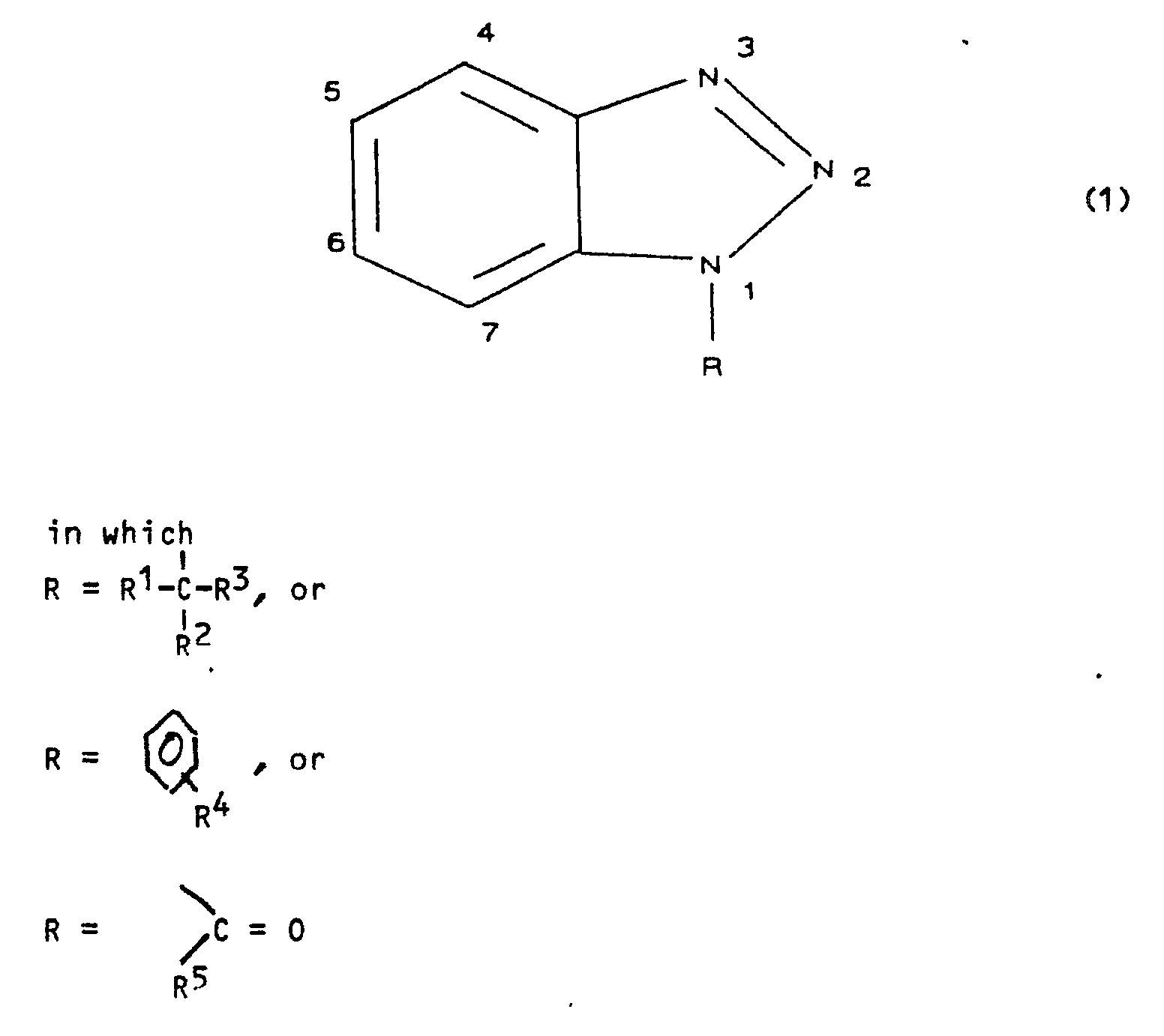
in which
R¹ = H, (C₁-C₄) alkyl, halogen, OH, NR⁶R⁷, COOR⁸ or phenyl, in which
R⁶ = H or C₁-C₄) alkyl and
R⁷ = (C₁-C₄) alkyl, or in which
R⁶ and R⁷ together form a ring with 3-8 carbon atoms which may contain an ether, thioether or amino group, and
R⁸ = H, (C₁-C₄) alkyl,
R² = H or (C₁-C₄) alkyl or halogen,
R³ = H, halogen or (C₁-C₄) alkyl, or in which R² and R³ together form a ring with 3-8 carbon atoms which may contain an ether, thioether or amino group,
R⁴ = H, (C₁-C₄) alkyl, halogen or OR⁹, where
R⁹ = (C₁-C₄) alkyl, and
R⁵ = (C₁-C₄) alkyl.
in which
R¹ = H, (C₁-C₄) alkyl, halogen, OH, NR⁶R⁷, COOR⁸ or phenyl, in which
R⁶ = H or C₁-C₄) alkyl and
R⁷ = (C₁-C₄) alkyl, or in which
R⁶ and R⁷ together form a ring with 3-8 carbon atoms which may contain an ether, thioether or amino group, and
R⁸ = H, (C₁-C₄) alkyl,
R² = H or (C₁-C₄) alkyl or halogen,
R³ = H, halogen or (C₁-C₄) alkyl, or in which R² and R³ together form a ring with 3-8 carbon atoms which may contain an ether, thioether or amino group,
R⁴ = H, (C₁-C₄) alkyl, halogen or OR⁹, where
R⁹ = (C₁-C₄) alkyl, and
R⁵ = (C₁-C₄) alkyl.
7. Process according to any one of the claims 5-6, characterized in that as substituted
benzotriazole a compound of formula (1) is used, in which
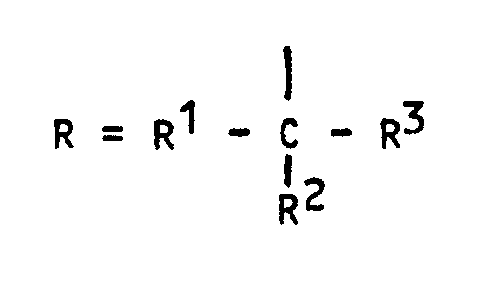
and in which
R¹ = H, (C₁-C₄) alkyl, phenyl or NR⁶R⁷, where R⁶ = R⁷ = (C₁-C₄) alkyl, or where R⁶ and R⁷ together form a ring with 3-8 carbon atoms which may contain an ether, thioether or amino group,
R² = H or (C₁-C₄) alkyl, and
R³ = H or (C₁-C₄) alkyl.
and in which
R¹ = H, (C₁-C₄) alkyl, phenyl or NR⁶R⁷, where R⁶ = R⁷ = (C₁-C₄) alkyl, or where R⁶ and R⁷ together form a ring with 3-8 carbon atoms which may contain an ether, thioether or amino group,
R² = H or (C₁-C₄) alkyl, and
R³ = H or (C₁-C₄) alkyl.
8. Process according to any one of the claims 5-7, characterized in that the benzotriazole
used is a benzotriazole substituted with an organic group with less than 20 carbon
atoms at a nitrogen atom and also at the aromatic ring, in accordance with formula
(2)
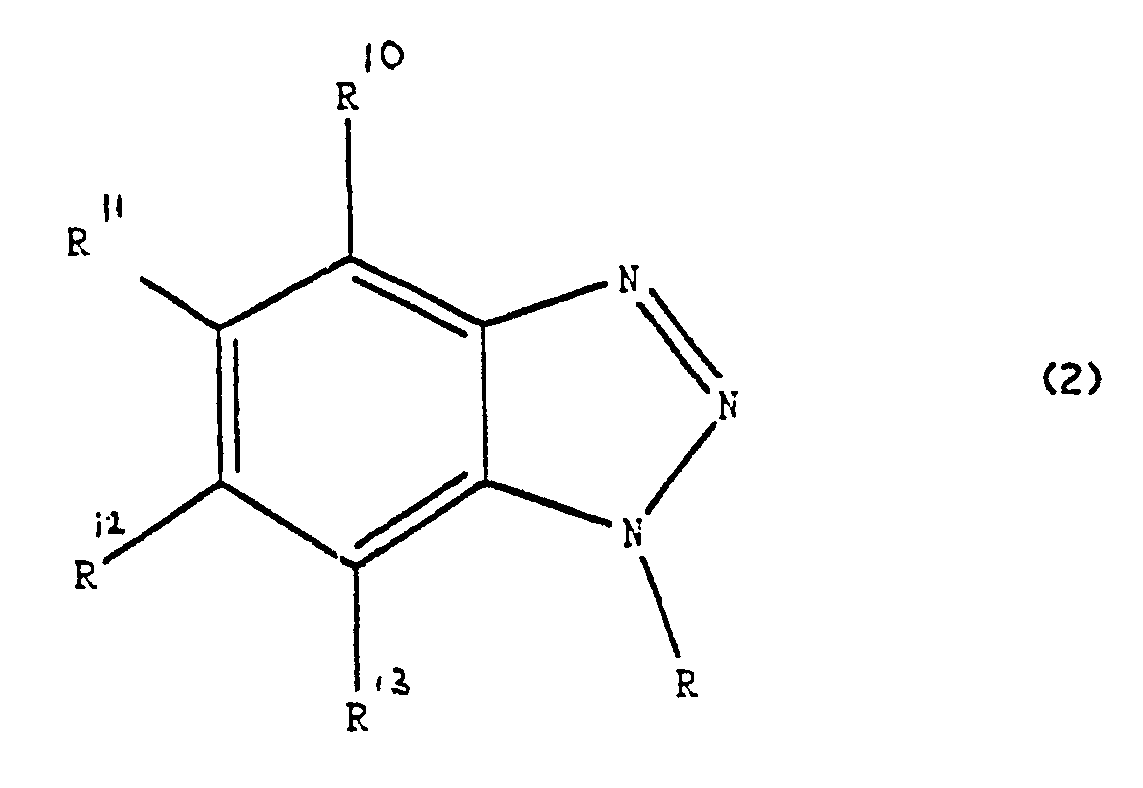
where R¹⁰, R¹¹, R¹² and R¹³ simultaneously or separately are (C₁-C₇) alkyl, H, OR¹⁴ or halogen,
or where R¹⁰ and R¹¹ or R¹¹ and R¹² or R¹² and R¹³ together form a ring with 4-10 carbon atoms or form one or more aromatic rings, and
where R¹⁴ = H or (C₁-C₆) alkyl.
where R¹⁰, R¹¹, R¹² and R¹³ simultaneously or separately are (C₁-C₇) alkyl, H, OR¹⁴ or halogen,
or where R¹⁰ and R¹¹ or R¹¹ and R¹² or R¹² and R¹³ together form a ring with 4-10 carbon atoms or form one or more aromatic rings, and
where R¹⁴ = H or (C₁-C₆) alkyl.
9. Powder coating on the basis of a curing catalyst according to any one of the claims
1-4 or produced by the process to any of the claims 5-8.
10. Application of a benzotriazole in accordance with any one of the claims 1-4 as
curing catalyst in powder coatings on the basis of epoxy functional compounds.