|
(11) | EP 0 395 207 A1 |

| (12) | EUROPEAN PATENT APPLICATION |
|
|
|
|
|||||||||||||||||||||||||||
| (54) | New reactive dyes |
| (57) A reactive dye which in the free acid form has the formula:
wherein: A is the residue of a diazo component; the -NRY group is attached to the naphthalene nucleus in the 6- or 7-position relative to the -OH group; n is 0 or 1, the SO₃H group, when n is 1, being attached to the 5-position or to whichever is free of the 6- and 7-positions; R is optionally substituted alkyl or alkenyl containing up to 10 carbon atoms; Q is H or optionally substituted alkyl or alkenyl containing up to 10 carbon atoms; Z is an optionally substituted aryl group; D is H, chloro, C₁₋₄-alkoxy, SO₃H or C₁₋₄-alkyl; B is OH or NR¹R²; and R¹ and R¹ are independently selected from H and optionally substituted alkyl or alkenyl containing up to 10 carbon atoms. |
[0001] This invention relates to new reactive dyes and more particularly to water soluble reactive dyes of the azo series, their manufacture and application to textile substrates.
[0002] In French Specification No.2319689 there are described and claimed dyestuffs of the formula (A):
wherein D is a chromophore, R represents H or a lower alkyl, R¹ and R² represent H or alkyl, or R¹ and R² are joined together as -(CH₂)₄-, -(CH₂)₅- or -(CH₂CO₂OCH₂CH₂)- to form a ring, n is 1 or 2 and L⁻ represents a negatively charged counterion.
[0003] British Patent No. 946998 describes and claims new dyestuffs of the formula (B):
wherein D is a monoazo chromophore, R and Q independently represent H or lower alkyl, and Z is a phenyl radical containing at least one sulphonic acid or carboxylic acid group.
[0004] According to the present invention, there is provided a reactive dye which, in the free acid form, is represented by the formula (I):
wherein:
A is the residue of a diazo component;
the -NRY group is attached to the naphthalene nucleus in the 6- or 7-position relative to the -OH group;
n is 0 or 1, the SO₃H group, when n is 1, being attached to the 5-position or to whichever is free of the 6- and 7-positions;
R is optionally substituted alkyl or alkenyl containing up to 10 carbon atoms;
Y is a group of the formula (II):
wherein
Q is H or optionally substituted alkyl, cycloalkyl or alkenyl containing up to 10 carbon atoms;
Z is an optionally substituted aryl group;
D is H, chloro, C₁₋₄-alkoxy, SO₃H or C₁₋₄-alkyl;
B is OH or NR¹R²; and
R¹ and R² are independently selected from H and optionally substituted alkyl or alkenyl containing up to 10 carbon atoms.
[0005] A is preferably optionally substituted phenyl or naphthyl and the optional substituents are preferably selected from nitro, C₁₋₄-alkyl, C₁₋₄-alkoxy, sulpho, carboxyl, acetylamino and halo. It is especially preferred that A is phenyl or naphthyl carrying at least 1 and preferably from 1 to 3 substituents and especially from 1 to 3 sulphonic acid groups. As specific examples of groups represented by A there may be mentioned:
2, 3 or 4-sulphophenyl,
4-carboxy-2-sulphophenyl,
6-sulphonaphth-1-yl,
7-sulphonaphth-1-yl,
2,5-disulphophenyl,
2,4-disulphophenyl,
3,5-disulphophenyl,
3,8-disulphonaphth-1-yl,
4,8-disulphonaphth-1-yl,
3,6,8-trisulphonaphth-1-yl,
4,6,8-trisulphonaphth-1-yl,
3,6,8-trisulphonaphth-2-yl,
1,5-disulphonaphth-2-yl,
1-sulphonaphth-2-yl,
6-sulphonaphth-2-yl,
2,5,7-trisulphonaphth-1-yl,
5,7-disulphonaphth-2-yl,
2-sulpho-4-methoxyphenyl,
2-sulpho-4-methylphenyl,
2-methoxy-4-sulphophenyl,
2-methyl-4-sulphophenyl,
2-chloro-4-sulphophenyl,
4-chloro-2-sulphophenyl, and
2,5-dichloro-4-sulphophenyl.
[0006] It is preferred that R is C₃₋₄-alkenyl, especially allyl, or C₁₋₄-alkyl, especially methyl, and optional substituents on R are preferably selected from hydroxyl, methoxy, amino and halo, especially chloro.
[0007] Alkyl or alkenyl groups referred to herein having 3 or more carbon atoms may have either straight chain or branched chain structures.
[0008] Z is preferably phenyl or naphthyl optionally substituted by from 1 to 3, especially 1 or 2, groups selected from nitro, chloro, C₁₋₄-alkyl, C₁₋₄-alkoxy, acetylamino and especially sulpho and carboxyl. As specific examples of groups represented by Z there may be mentioned:
phenyl,
2, 3 or 4-nitrophenyl,
2, 3 or 4-methoxyphenyl,
2,4-dinitrophenyl,
2, 3 or 4-sulphophenyl,
3-carboxyphenyl,
2,4 or 2,5-disulphophenyl,
4-acetylaminophenyl,
6, 7 or 8-sulphonaphth-2-yl,
6,8 or 4,8 or 5,7-disulphonaphth-2-yl.
[0009] When n is 1, the preferred positions for the sulpho group are the 5 position when -NRY is in the 6 position and the 6 position when -NRY is at position 7.
[0011] It is preferred that the optionally substituted groups R¹, R² and Q are independently selected from H, C₁₋₄-alkyl and C₃₋₄-alkenyl. Any optional substituents on R¹, R² and Q are preferably selected from hydroxy, C₁₋₄-alkoxy and halo, especially chloro. It is more preferable that R¹, R² and Q are H, unsubstituted C₁₋₄-alkyl or unsubstituted C₃₋₄-alkenyl. It is especially preferred that R¹, R² and Q are independently selected from H and methyl.
[0012] It is preferred that the optional substituents on Q are not acidic or ionic groups such as -SO₃H or -SO₃Na.
[0013] As specific examples of the quaternary pyridinium substituent in formula (II) there may be mentioned:
4-carboxypyridinium,
4-aminocarbonylpyridinium, and
4-di-N-(methyl, ethyl or propyl)aminocarbonylpyridinium.
[0014] The dyes, having a quaternary pyridinium group, may be in the form of a salt with an independent anion, preferably a monovalent anion selected from the group F⁻, Cl⁻, Br⁻, I⁻, HCO₃⁻, HSO₄⁻ especially Cl⁻. The dyes may also exist in zwitterionic form involving the quaternary pyridinium group and one of the acidic groups.
[0015] The new dyestuffs of the present invention may be obtained by methods which are described in British Patent No. 937182, for example by treating azo compounds of formula (III) with iso-nicotinic acid derivatives of formula (IV), in aqueous medium.
wherein A, B, D, n, Q, R and Z have the meanings stated above.
[0016] The monoazo compounds of formula (III) may themselves be obtained by diazotising an amine of the formula (V)
A - NH₂ (V)
wherein A is defined above, and coupling with a naphthol sulphonic acid of the formula (VI) or (VII):
wherein R and n are defined above, hydrolysing off the N-acetyl group when present, condensing the resulting aminoazo compound with one molecular proportion of cyanuric chloride and finally condensing with an aromatic amine of the formula (VIII):
Z -
H (VIII)
where Z and Q are as defined above.
[0017] The naphthol sulphonic acids of Formula VI are, specifically, the N-(C₁₋₁₀-alkyl) and N-(C₂₋₁₀-alkenyl) derivatives especially the N-(C₁₋₄-alkyl) and more especially the N-methyl derivatives, of
1-hydroxy-6-aminonaphthalene-3-sulphonic acid,
1-hydroxy-7-aminonaphthalene-3-sulphonic acid,
1-hydroxy-6-aminonaphthalene-3,5-disulphonic acid,
1-hydroxy-6-aminonaphthalene-3,7-disulphonic acid,
1-hydroxy-7-aminonaphthalene-3,5-disulphonic acid,
1-hydroxy-7-aminonaphthalene-3,6-disulphonic acid.
[0018] The compounds of Formula VII are the N-acetyl derivatives of the above-mentioned compounds of Formula VI.
[0019] The dyes may be isolated by known methods, for example spray drying or precipitation and filtration. As in the case of other dyes containing sulphonic acid groups, it is often convenient to isolate and use the dyes in the form of their water-soluble salts, particularly their alkali metal (especially sodium) or ammonium salts. It is to be understood that the invention relates to both the free acids and their salts.
[0020] It is surprising that the combination of the substituted pyridinium leaving group from formula A with the optionally substituted aryl group Z of formula B gives dyes with superior build up and wash-off.
[0021] The dyes may be used for colouring a wide range of textile materials containing hydroxyl or amino groups, for example wool, silk, synthetic polyamides and natural or regenerated cellulose, for example cotton or viscose rayon materials, by conventional methods used for colouring such materials with water-soluble reactive dyes. Thus, in the case of cellulose they are preferably applied in conjunction with a treatment with an acid binding agent such as caustic soda, sodium carbonate, phosphate, silicate or bicarbonate, which may be applied to the cellulose textile materials before, during or after the application of the dyestuff.
[0023] Some of the dyes of the present invention are also valuable in printing and when used as mixtures with disperse dyes under neutral conditions in single bath systems.
[0024] The invention is illustrated but not limited by the following examples in which all parts and percentages are by weight unless otherwise indicated.
Example 1
1-Hydroxy-2-(1,5-disulphonaphth-2-ylazo)-6-N-[(4-chloro-6-(N-methyl-N-phenylamino)-s-triazin-2-yl)methylamino]-naphthalene-3-sulphonic acid
[0025] To an ice cold solution of 1-hydroxy-2-(1,5-disulphonaphth-2-ylazo)-6-N-methylamino-naphthalene-3-sulphonic acid (166.6g; 70.3% strength; 0.19M) in water (1250ml) was added, calsolene oil (0.5ml) and then dropwise with stirring, a solution of cyanuric chloride (40g; 0.22M) dissolved in acetone (40ml). The solution was maintained at pH 6-7 and after 1 hour N-methylaniline (12ml; mol wt 107) was added and the reaction mixture heated to 35° for a further 2 hours. The volume was reduced to approximatley 750ml under reduced pressure and ethanol added to give a precipitate. The resultant solid was collected by filtration and dried to give the crude product 175g.
Quaternisation
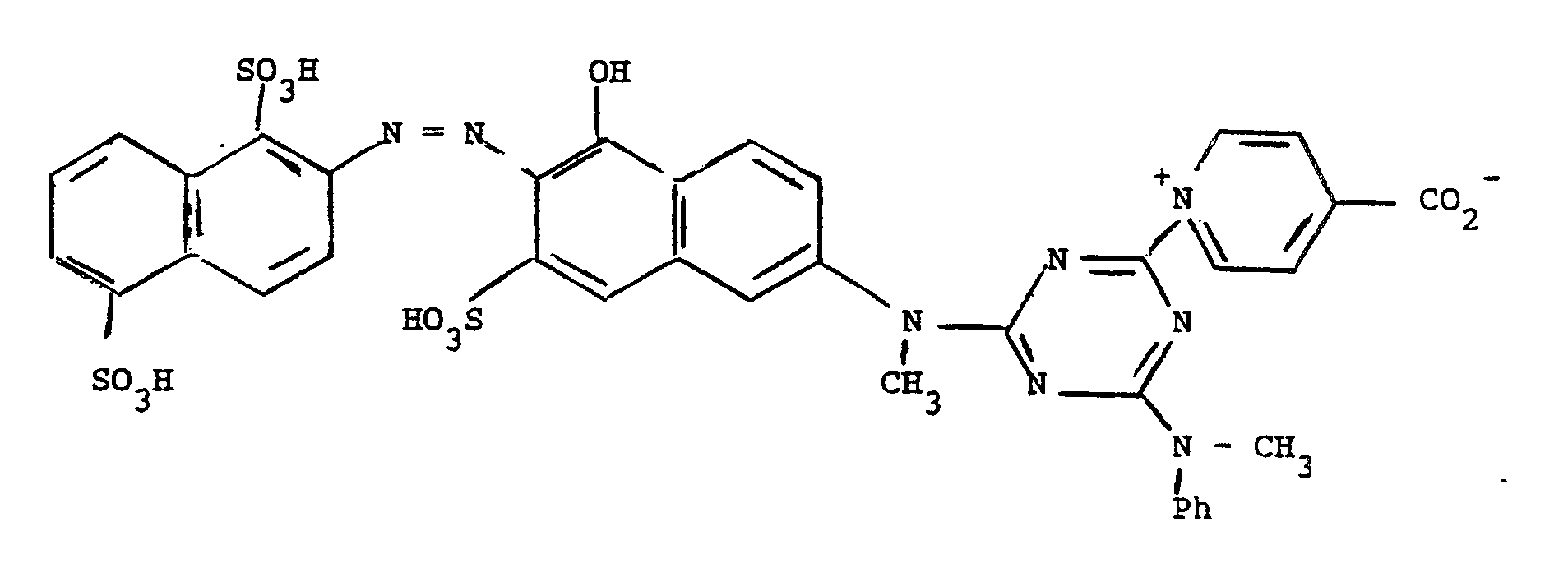
1-Hydroxy-2-(1,5-disulphonaphth-2-ylazo)-6-N-[(4-[4-carboxypyridinium]-6-N-methyl-N-phenylamino-s-triazin-2-yl)-N-methylamino]-naphthalene-3-sulphonic acid
[0026] To 80 parts of water was added 6 parts of 1-hydroxy-2-(1,5-disulphonaphth-2-ylazo)-6-N-[(4-chloro-6-N-methyl-N-phenylamino-s-triazin-2-yl)-N-methylamino]-naphthalene-3-sulphonic acid and 2.6 parts of iso-nicotinic acid. The reaction mixture was adjusted to pH 7.0 and heated with stirring for 10 hours at 80°C. The product was isolated by salting to 20% with sodium chloride and by filtration of the resultant suspension, to give the product 5.8g.
[0027] When applied to cellulosic materials in conjunction with an acid binding agent the dyestuff yields orange shades possessing excellent wash fastness, build up and wash off.
Example 2
[0028] A solution of 2-chloro-4-(N-isopropyl-N-3-sulphophenylamino)-6-(N-methyl-1-hydroxy-2-[1,5-disulphonaphth-2-ylazo]-3-sulphonaphth-6-ylamino)-s-triazine (33.0g, 57.3% strength, 0.02m) and iso-nicotinic acid (17.22g, 0.14m) in water (350ml) was stirred at 80°C for 14 hours. On cooling, potassium chloride (70g, 20% w/v) was added and the resulting precipitated dye collected. Yield 10g. The product dyed cotton a bright orange shade.
Example 3
[0029] A solution of 2-chloro-4-(N-isopropyl-N-phenylamino)-6-(N-methyl-1-hydroxy-2-[1,5-disulphonaphth-2-ylazo]-3-sulphonaphth-6-ylamino)-s-triazine (18.86g, 44.7% strength, 0.01m) and iso-nicotinic acid (8.61g, 0.07m) in water (250ml) was stirred at 80°C for 24 hours. On cooling, potassium chloride (37.5g, 15% w/v) was added and the precipitated dye collected. Yield 14.5g.
1. A reactive dye which in the free acid form has the formula:

wherein:
A is the residue of a diazo component;
the -NRY group is attached to the naphthalene nucleus in the 6- or 7-position relative to the -OH group;
n is 0 or 1, the SO₃H group, when n is 1, being attached to the 5-position or to whichever is free of the 6- and 7-positions;
R is optionally substituted alkyl or alkenyl containing up to 10 carbon atoms;
Q is H or optionally substituted alkyl or alkenyl containing up to 10 carbon atoms;
Z is an optionally substituted aryl group;
D is H, chloro, C₁₋₄-alkoxy, SO₃H or C₁₋₄-alkyl;
B is OH or NR¹R² ; and
R¹ and R² are independently selected from H and optionally substituted alkyl or alkenyl containing up to 10 carbon atoms.
wherein:
A is the residue of a diazo component;
the -NRY group is attached to the naphthalene nucleus in the 6- or 7-position relative to the -OH group;
n is 0 or 1, the SO₃H group, when n is 1, being attached to the 5-position or to whichever is free of the 6- and 7-positions;
R is optionally substituted alkyl or alkenyl containing up to 10 carbon atoms;
Q is H or optionally substituted alkyl or alkenyl containing up to 10 carbon atoms;
Z is an optionally substituted aryl group;
D is H, chloro, C₁₋₄-alkoxy, SO₃H or C₁₋₄-alkyl;
B is OH or NR¹R² ; and
R¹ and R² are independently selected from H and optionally substituted alkyl or alkenyl containing up to 10 carbon atoms.
2. A reactive dye according to claim 1 wherein A is phenyl or naphthyl carrying from
one to three sulphonic acid groups.
3. A reactive dye according to claim 1 or claim 2 wherein A is C₁₋₄-alkyl or C₃₋₄-alkenyl.
4. A reactive dye according to any preceding claim wherein Z is phenyl or naphthyl
optionally substituted by one or two groups selected from sulpho and carboxy.
5. A reactive dye according to any preceding claim wherein Q is H, C₁₋₄-alkyl or C₃₋₄-alkenyl.
6. A reactive dye according to any preceding claim wherein each of R¹ and R²,independently,
is H, C₁₋₄-alkyl or C₃₋₄-alkenyl.
7. The reactive dye according to claim 1 which in the zwitterion form has the formula:
8. A method for the preparation of the reactive dye defined in claim 1 which comprises
reacting an azo compound of the formula:

with an iso-nicotinic acid derivative of the formula:

wherein A, B, D, n, Q, R and Z have the meanings given in claim 1.
with an iso-nicotinic acid derivative of the formula:
wherein A, B, D, n, Q, R and Z have the meanings given in claim 1.
9. A method of colouring textile materials which comprises applying thereto a reactive
dye as defined in any of claims 1 to 7.
10. A method of colouring textile materials by applying thereto mixtures comprising
a disperse dye and a reactive dye defined in any of claims 1 to 7.