| (19) |
 |
|
(11) |
EP 0 395 397 B1 |
| (12) |
EUROPEAN PATENT SPECIFICATION |
| (45) |
Mention of the grant of the patent: |
|
30.06.1993 Bulletin 1993/26 |
| (22) |
Date of filing: 26.04.1990 |
|
|
| (54) |
Process and apparatus for treatment of excavated landfill material in a plasma fired
cupola
Verfahren und Vorrichtung zur Behandlung von ausgegrabenen Deponiematerialien in einem
plasmabeheizten Kupolofen
Procédé et appareil pour le traitement des matières de décharge creusées dans une
coupole chauffée par un plasma
|
| (84) |
Designated Contracting States: |
|
BE DE FR GB IT NL |
| (30) |
Priority: |
27.04.1989 US 343694
|
| (43) |
Date of publication of application: |
|
31.10.1990 Bulletin 1990/44 |
| (73) |
Proprietor: WESTINGHOUSE ELECTRIC CORPORATION |
|
Pittsburgh
Pennsylvania 15222 (US) |
|
| (72) |
Inventors: |
|
- Dighe, Shyam Vasant
N. Huntington, PA 15642 (US)
- Taylor, Raymond Francis, Jr.
Irwin, PA 15642 (US)
- Steffen, Robert Jules
Whitehall, PA 15236 (US)
- Rohaus, David Michael
Jeanette, PA 15644 (US)
|
| (74) |
Representative: van Berlyn, Ronald Gilbert |
|
23, Centre Heights
London NW3 6JG
London NW3 6JG (GB) |
| (56) |
References cited: :
DE-B- 2 904 855
GB-A- 2 174 691
US-A- 4 078 914
US-A- 4 780 132
|
GB-A- 2 113 815
US-A- 3 697 256
US-A- 4 346 661
|
|
| |
|
|
- PATENT ABSTRACTS OF JAPAN vol. 6, no. 74 (M-127)(952) May 11, 1982 & JP-A-57 12 216
(OSAKA GAS K.K. ) January 22, 1982
|
|
| |
|
| Note: Within nine months from the publication of the mention of the grant of the European
patent, any person may give notice to the European Patent Office of opposition to
the European patent
granted. Notice of opposition shall be filed in a written reasoned statement. It shall
not be deemed to
have been filed until the opposition fee has been paid. (Art. 99(1) European Patent
Convention).
|
[0001] The present invention relates to treating excavated landfill materials so that hazardous
and toxic materials contained in them are either destroyed or made safe.
[0002] Landfills have in the past been collection sites for a wide variety of discarded
objects and materials. Some contain substantial levels of toxic and hazardous chemicals
whose clean-up is being required by government regulation. Of concern are, for example,
materials containing heavy metals such as lead, nickel and chromium or toxic halogen
containing chemicals such as polychlorinated biphenyls (PCB's).
[0003] For convenience, excavated landfill material will be referred to as ELM.
[0004] Incineration processes have been used or proposed to treat the ELM by burning it
along with other combustible material, typically municipal garbage. Such incineration
processes are feasible but may involve large flow rates of potentially harmful materials
and the incinerator ash that results as an end product may not be environmentally
benign; potential for leaching of toxic heavy metals may still exist.
[0005] One type of system for treating ELM is a pyrolyzer such as that disclosed in the
specification of U.S. Patent Application Serial No. 027,775. Such a pyrolyzer produces
vitreous, i.e., glass like, material by electrical heating in a chamber operated in
a substantially closed or pyrolitic manner. Such a system incurs high energy costs
which it is desirable to minimize. It is however successful in producing vitrified
material in which the heavy metals can be trapped in the glass matrix of the slag.
[0006] A plasma fired cupola is a known apparatus previously disclosed for such purposes
as metal recovery as in the specification of U.S. Patent No. 4,530,101, Dighe et al.,
"Plasma Fired Cupola and Innovation in Iron Foundry Melting", AFS transaction paper,
1986; U.S. Patents Nos. 4,761,793, 4,780,132, 4,769,065, 4,828,607, 4,853,033 and
4,778,556.
[0007] In US-A-4,780,132 a method of operating a plasma-fired cupola is disclosed wherein
a scrap metal charge is processed with coke and a fluxing material while controlling
the gas flow rate within the cupola to prevent metal trimmings from being picked up
by the gas flow. Such a disclosure does not address the desire to process a landfill
material containing diverse constituents including volatile toxic and hazardous materials
in a manner so that, among other benefits, the volatile materials are destroyed.
[0008] Cupolas, not plasma-fired, are presently known for metal and mineral melting that
utilize a shaft with coke and blown air, sometimes enriched with oxygen, through tuyeres
near the bottom. These units require such amounts of air that fine particles of charged
material and even, in some instances, vitrified material, may be blown upward. Additionally,
they normally achieve maximum temperatures of only about 3000°F.
[0009] An object of the present invention is to provide an effective and economical treatment
for excavated landfill material (ELM) containing toxic and hazardous materials. In
the process of the present invention, a plasma fired cupola is used for treatment
of ELM. The cupola is a vertical shaft with a charge door proximate the top thereof.
A plasma torch is provided and located in a tuyere proximate the bottom of the cupola
and the plasma torch has a feed nozzle. The plasma torch is electrically energized
and produces a plasma from air. Air is fed through the nozzle and is heated to a high
temperature by the plasma torch and supplied into the cupola.
[0010] The present invention includes a process for treatment of excavated landfill material
contaminated with toxic and hazardous substances comprising a plasma-fired cupola
having a vertical shaft cupola with an upwardly located charge door and a plasma torch
located proximate the bottom of said cupola, heating air to a high temperature by
said plasma torch and supplying the heated air into said cupola, forming a bed of
carbonaceous fuel in said cupola heated to combustion by the heated air, supplying
material to be processed and reactive agents through said charge door of said cupola,
said reactive agents comprising additional carbonaceous fuel, including coke and coal,
melting the material in the cupola to form a vitreous slag, tapping the cupola to
take out vitreous slag allowing vitreous slag from the cupola to cool and produce
non-hazardous solid material, with said coke in the carbonaceous fuel providing a
fuel bed with a substantial degree of porosity to the material in the cupola to allow
gas flow therethrough and solidity to support additionally added material, and in
which the supply of material and reactive agents is performed in a manner to provide
separate or distinct layers of material and reactive agents; characterized by said
material to be processed comprising excavated landfill material and the process further
including drawing off-gases from said cupola to an afterburner for destruction of
any volatile toxic and hazardous materials contained in the off-gas.
[0011] The invention also includes a plasma-fired cupola system arranged for treatment of
excavated landfill material comprising a vertical shaft, a charge door located in
the upward part of said shaft, a tuyere proximate the bottom of said shaft, at least
one plasma torch and a shroud nozzle arranged colinearly with said tuyere, air feed
lines into said plasma torch and said shroud nozzle respectively, means to energize
said torch and reduce a plasma of the air supplied therein which then heats air supplied
in said nozzle, a bed of carbon fuel characterized by at least about 25% coke in said
shaft extending from the bottom thereof to a level proximate to and above said tuyere
so as to provide a degree of porosity to the material in the cupola, said shaft containing
a charge material on said bed of carbon fuel, said charge material comprising material
to be processed, additional carbon fuel, and a fluxing agent, said shaft having a
spout in its lowermost region for yielding molten slag and metal produced from said
charge material; characterized by said material to be processed comprising excavated
landfill material and said shaft having an afterburner chamber in its uppermost region
with a stack igniter therein, said charge material on said bed of carbon fuel producing
off-gases burned in said afterburner.
[0012] Conveniently, in starting operation of the system, the cupola is partly filled with
a carbonaceous fuel, such as coke or a mixture of coke and coal, which is ignited.
When adequate operating temperature is reached, the charge material is feed through
the charge door. The ELM is normally supplied along with reactive agents such as additional
coke and a fluxing agent, such as limestone.
[0013] Conditions are maintained for melting the ELM in the cupola to form a vitreous slag.
In addition, metal supplied with the ELM, such as iron and copper becomes molten and
will separate from the slag gravimetrically. The coke reduces oxides of such metals
to yield the metal itself. The cupola is tapped to take out the vitreous slag and
the molten metal.
[0014] The off gases from the cupola are allowed to rise to an afterburner located above
the cupola for destruction of any toxic and hazardous materials contained in the off
gases. The vitreous slag from the cupola is allowed to cool and produce non-hazardous
solid material from which heavy metals such as chromium, lead and nickel, occurring
as oxides, are substantially non-leachable.
[0015] In accordance with the present invention, preferably about 6% of a charge is fuel.
The fuel is sufficient to supply all of the combustion gases for the afterburner in
which PCB's or the like are burned.
[0016] A layering technique is employed for the material supplied into the cupola through
the charge door. That is, a distinct layer of fuel is provided between layers of limestone,
ELM or mixtures thereof. The layering helps reduce back pressure in the system. The
gas flow rate is reduced to a lower level than that employed for foundry melting,
such as preferably about 0.6 cubic feet per minute per square inch of cupola cross-section
as compared to about 0.9 cubic feet per minute. Further, the amount of limestone supplied
is adjustable for optimizing the basicity of the slag to achieve a desired flow rate.
[0017] The invention will now be described, by way of example, with reference to the accompanying
drawings in which:
Figure 1 is a schematic diagram of an example of a plasma-fired cupola;
Figure 2 is an enlarged view of the spout portion of the plasma fired cupola of Figure
1;
Figure 3 is a plasma fired cupola with a recycle loop for gases produced; and
Figure 4 is a modified plasma fired cupola in accordance with a further embodiment
of the invention.
[0018] Figure 1 illustrates a plasma fired cupola 10 which bears many common aspects to
the apparatus employed for the iron foundry melting and recycling of steel belted
tires. The cupola itself is a vertical shaft 12 with a refractory lining 13. In the
vertically upward part of the cupola 12 is a charge door 14 for charging excavated
landfill material (ELM) as well as reactive agents such as a carbonaceous fuel which
may be coke or a mixture of coke and coal, normally the latter, and a fluxing agent
such as limestone. Air also enters through the charge door 14.
[0019] Proximate the bottom of the cupola 12 are disposed plasma torches 16 each within
a tuyere 17 extending into the cupola and having a shroud nozzle 18. Each torch 16
is supplied with a gas such as air through line 16a that is introduced in an arc between
energized, spaced, electrodes to be ionized and form a plasma. Blast air tangentially
enters just in front of the torch 16 through line 18a and nozzle 18. The blast air
is added to the plasma and is heated and then enters into the cupola 12 in its heated
state. The air entering through line 18a may be at ambient temperature or preheated
up to about 1200°F.
[0020] Above the cupola 12 is an afterburner chamber 20 into which the off gases from the
cupola 12 rise. The afterburner is provided with a stack igniter 22 but it is not
necessary to supply fuel in addition to the off gases themselves.
[0021] The ELM can be fed directly into the charge door 14 such as by using a skip bucket
carried by a skip hoist or by a feeder belt. The ELM does not have to be preprocessed
to any appreciable degree in terms of sizing or drying and is generally used on an
as received basis. The cupola shaft diameter is sized to accept the biggest size of
ELM which might, for example, be an engine block or refrigerator. In other respects,
it is of course suitable if desired to subject the ELM to a pretreatment through a
shredder or the like to reduce the size of individual pieces; preferably the cupola
is designed so that this is not necessary. An economical mix of coke and coal is also
fed into the skip bucket which is then elevated and dumped into the charge door by
means of a skip hoist.
[0022] In general, coke is the preferred fuel and reducing agent and will be referred to
herein. As opposed to coal, it provides more firm support for the other solid materials
added in a charge and ensures adequate gas flow. For economy, varying amounts of coal
may be mixed with the coke. In general, the fuel should be at least about 25% coke.
[0023] In start-up, the cupola 12 filled with coke up to several inches above tuyere 17.
The coke bed 30 is ignited by the plasma heated air which is fed at the bottom of
the cupola through the tuyere 17. When the coke bed is burning and the cupola refractory
is sufficiently heated, the charge material consisting of ELM, coke (which may include
some coal), and the fluxing agent is fed through the charge door. This system start-up
normally takes only about 2 to 3 hours. The coke, besides providing the energy of
combustion, also provides a porous matrix inside the cupola shaft so that the ELM
does not form a mat and cause plugging. Also both coal and coke provide carbon monoxide
to the off gas which upon ignition in the afterburner completely destroys the PCB's.
No supplemental fuel is required to provide heat in the afterburner 20. However, if
a fuel such as natural gas is readily available and economical it may be burned to
supply heat and allow a corresponding reduction in the amount of coke in the cupola.
[0024] The ELM, as it travels down the cupola shaft 12, is first heated by the hot gases
rising from the melt zone at the bottom of the cupola. This countercurrent heat exchange
is one of the primary reasons for the energy efficiency of the plasma fired cupola.
The PCB's are evaporated from the ELM and exit the cupola along with the other off
gases, typically CO, CO₂, N₂.
[0025] The top gases rise to the afterburner unit 20 where they are mixed with the combustion
air entering through the charge door 14 and ignited by the stack igniter 22 to produce
sufficient temperature for destruction of PCB's. The standard requirement is that
such materials be subjected to a temperature of at least about 2200°F for a time of
at least about 2 seconds and these conditions can be adequately, readily met in the
present process.
[0026] Upon traveling down the cupola shaft 12, the ELM enters the melt zone (in coke bed
30 proximate to and above tuyere 17) where the temperatures are in the range of from
about 3000°F to about 4500°F. All constituents of the ELM melt at this temperature
and form a vitreous slag plus the metallic portion of the ELM that also melts.
[0027] The temperature and chemistry of the melt zone are controlled (by air and coke supplied)
to achieve desired performance. In general, most oxides, e.g., iron and copper are
reduced to provide the metal itself in a molten state. The heavy metal oxides of metal
such as chromium and nickel may not be reduced but instead are dissolved in the slag.
Some metals, such as zinc and lead, are likely to have their oxides reduced and the
metals vaporized. Such latter metals are reoxidized in the afterburner 20 and will
be collected from the afterburner discharge.
[0028] The plasma torch power is preferably adjusted so that silica (SiO₂), contained within
the ELM is reduced to produce silicon. The silicon dissolves in the molten metal and
forms, with molten iron, a useful and valuable ferrous alloy that can be sold on the
foundry market. The vitrified ELM and the metal is continuously tapped through a spout
24 at the bottom of the cupola using a skimmer 24a and dam 24b arrangement. The molten
stream from the spout 24 is about 2500°-2800°F. The slag is separated from the metal
by this arrangement to produce blocks of slag and metal ingots.
[0029] Fig. 2 shows an enlarged view of a spout 24. Molten slag 40 and molten metal 42 collect
at the bottom of the cupola shaft 12. On the outside of the cupola the lighter slag
40' is confined by a skimmer 24a and is tapped off.
[0030] The heavier metal flows under the skimmer 24a and over the dam 24b into whatever
mold collects it. The instances where fly ash or the like is injected into the slag
it would be introduced into the slag 40'.
[0031] The gases exiting the afterburner 20 may be exhausted to the atmosphere, preferably
only after going through a scrubber or other air pollution control equipment with
collection of flyash.
[0032] According to an optional form of the invention, the hot combustion gases exiting
the afterburner 20 are sent to a recuperator to preheat the blast air and also the
combustion air of the afterburner. According to another optional form of the invention,
the hot gases from the afterburner are sent to a boiler to generate steam which may
be used for process requirements or to generate power.
[0033] Still a further variation is to supply fine waste material, such as fly ash from
the afterburner 20 or elsewhere, such as utility boilers and incinerators, through
the nozzle 18 installed in the tuyere region at the base of the cupola. Bin 18b and
line 18c is shown for this purpose. This material is simultaneously vitrified along
with the ELM for convenient disposal. In addition or alternatively, flyash containing,
for example, oxides of lead or zinc, may be fed directly into the molten slag at the
bottom of the cupola 12 proximate the spout 24 or in the spout itself before the material
solidifies. This helps to ensure such oxides are dissolved in the slag for safe disposal.
[0034] While using the apparatus for the process for treatment of ELM, it is also possible
to add other waste material, both combustible and non-combustible through the charge
door. The plasma fired cupola is a flexible apparatus suitable for use with a wide
range of feed compositions.
[0035] The fuel supplied with a charge of ELM provides carbon to produce sufficient amounts
of carbon monoxide to serve as the fuel in the afterburner 20 for assured destruction
of PCB's and the like. For this purpose it is preferred that the carbon fuel (coke)
in the charge make up about 6% or more, by weight, of the process material supplied
into the cupola.
[0036] It has been found desirable for the ELM, the coke or other carbonaceous fuel, and
the limestone or other fluxing agent to be layered rather than mixed in the cupola
in order to reduce back pressure. For example, after initially starting operation
with coke 30 supplied in the cupola, a first layer of ELM 32 can be fed into the cupola,
followed by a coke layer 33, then a limestone layer 34 followed by a coke layer 35.
Then the sequence may be repeated up to near the charge door 14. A coke layer separates
layers of the ELM and limestone materials, which may, if desired, be mixed together
in a single layer.
[0037] For improved operation of the plasma fired cupola for treating ELM the coke (or carbon
fuel) bed height is well regulated. The initial coke charge 30 fills the cupola up
to a level above the tuyere 17 (essentially a hollow tube) through which the blast
air heated by the torch 16 enters the cupola. A level of about five inches to about
10 inches above the top of the tuyere 17 is normally preferred to give a desirable
ratio of CO to CO₂.
[0038] Greater depths, in the range up to about three feet above the tuyere 17, for charge
30 are suitable if the intent is to produce grater quantities of CO for use as fuel
in the afterburner 20. The process that occurs is that the blast air enters the cupola
and reacts with the coke in an exothermic reaction to form largely CO₂. The CO₂, if
exposed to reducing effects of more coke in a relatively greater depth of coke, will
react to form CO in an endothermic reaction: CO₂ → 2CO, called the Boudard reaction.
Therefore, the available choices involve operating in a range from maximizing the
heat produced in the coke bed by using a coke charge sufficient for high CO₂ off gas
production to maximizing the CO available in the afterburner by use of increased coke.
[0039] The initial coke bed height is maintained, with normal variations up and down, around
that level of the charge material.
[0040] It is suitable and preferred to employ a range of from about 6% to about 25% of carbon
bearing fuel and about 10% to about 45% of limestone relative to the total charge
of supplied material in the cupola. The coke ratio blast rate and torch power is adjusted
based on melt rate requirement such that the CO/CO₂ molar ratio in the top gas is
in the range of 0.2 to 3.0.
[0041] The amount of limestone is preferably adjusted for optimum basicity to yield good
flow characteristics in the slag at the moderate temperatures which are easily attained.
Basicity is defined as the ratio:

At a value below about 0.3 the slag is highly viscous and flows very slowly. Above
about 0.7, the slag very friable so it serves less well a an encapsulator of hazardous
materials that may be contained in it. Therefore, it is preferred to have a basicity
within the range from about 0.3 to about 0.7.
[0042] The gas flow rate (through 18) is reduced to an even lower level than the case of
foundry melting for awarding slag elutriation in the melt zone. The flow rate in the
cupola is about 0.5 cubic feet per minute (per sq. in. of cupola cross-section) or
less and preferably about 0.2 to about 1.0.
[0043] In Fig. 3, the system of Fig. 1 is shown with the addition of a recycle loop 50 that
includes a draft fan 52 for recycling some of the off gases from the cupola 12 back
to the torch nozzle 18. The recycle loop 50 also includes a trap 54 for particles
(fly ash) that can be reinjected through bin 18b or can be injected into the slag,
in addition to other forms of disposition.
[0044] The recycle loop 50 is an option that is more beneficial if the ELM contains relatively
larger quantities of oxides of valuable metals desired to be recovered. Oxides in
the charge tend to be reduced by the carbon fuel but if excess air is present the
reaction will tend to reverse and reform the metal oxides. To create a more strongly
reducing atmosphere one may draw off some of CO and N and have it re-enter the nozzle
to lower the relative amount of oxygen. Typically the gases exiting the cupola are
at about 800°F and re-enter at about 200°F. The recycled off gases help promote the
reduction reaction while permitting use of less coke than may be necessary if it alone
were counted on to take care of the oxygen in the blast air.
[0045] Fig. 4 shows a further variation referred to as a plasma-fired cupola with a "below
charge take-off". As compared with Fig. 1, the top of the cupola 12 is changed so
the afterburner 20 receives off gases from a point below the charge level. A fan and
air pollution control equipment, not shown, would be provided after the afterburner.
[0046] In Fig. 4, a change door 14' is provided at the top that minimizes air entry. The
door 14' is supported by a hoist cable 60 that in the closed position holds the door
14' against the door frame 62. A charge 64 of material is applied on the upper surface
of the door. When the door is lowered, the material enters the cupola and becomes
part of charge 64' which extends up past the gas take-off. The door 14' can be promptly
closed so a highly reducing atmosphere is maintained.
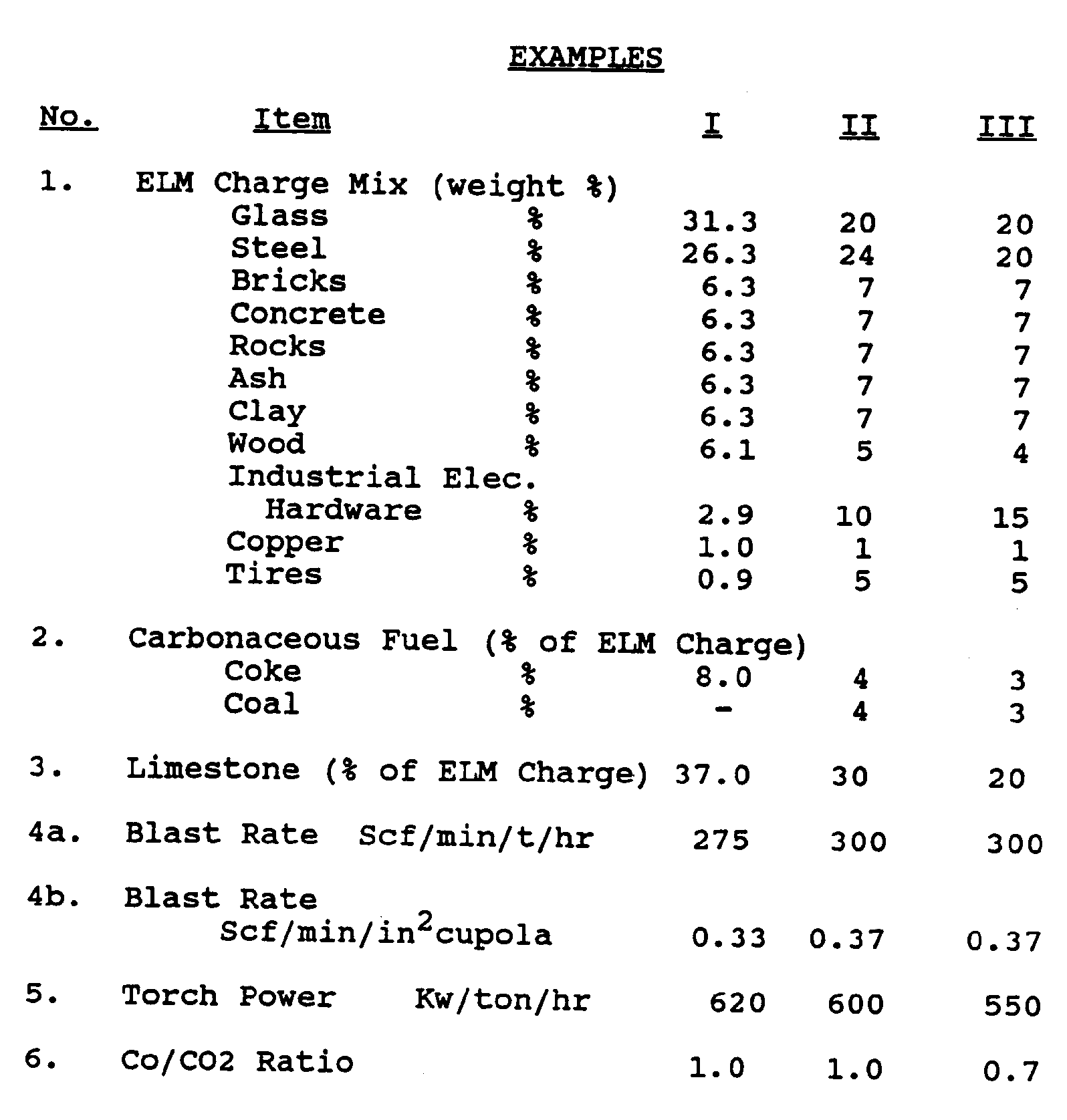
[0047] The table below gives examples of representative ELM compositions and other conditions
for their treatment in the plasma fired cupola substantially in accordance with Fig.
1, for example. Example I has been actually performed and verified to process the
material into a stream of lag and a stream of metal, essentially a ferrous alloy containing
about 4% silicon. The off gases produced afterburner temperatures in excess of 2200°F.
1. A process for treatment of excavated landfill material contaminated with toxic and
hazardous substances comprising a plasma-fired cupola having a vertical shaft cupola
with an upwardly located charge door and a plasma torch located proximate the bottom
of said cupola, heating air to a high temperature by said plasma torch and supplying
the heated air into said cupola, forming a bed of carbonaceous fuel in said cupola
heated to combustion by the heated air, supplying material to be processed and reactive
agents through said charge door of said cupola, said reactive agents comprising additional
carbonaceous fuel, including coke and coal, melting the material in the cupola to
form a vitreous slag, tapping the cupola to take out vitreous slag allowing vitreous
slag from the cupola to cool and produce non-hazardous solid material, with said coke
in the carbonaceous fuel providing a fuel bed with a substantial degree of porosity
to the material in the cupola to allow gas flow therethrough and solidity to support
additionally added material, and in which the supply of material and reactive agents
is performed in a manner to provide separate or distinct layers of material and reactive
agents; characterized by said material to be processed comprising excavated landfill
material and the process further including drawing off-gases from said cupola to an
afterburner for destruction of any volatile toxic and hazardous materials contained
in the off-gas.
2. A process as claimed in claim 1 characterized in that said carbonaceous fuel results
in formation of carbon monoxide sufficient to fuel the afterburner, so that the afterburner
attains a temperature sufficient for the off-gas to be exposed to a temperature of
at least about 2200°F for a time of at least about 2 seconds for satisfactory destruction
of any PCB's therein.
3. A process as claimed in claim 1 or 2 characterized in that said reactive agents further
comprise a fluxing agent, in which a substantial part of the fluxing agent supplied
is limestone.
4. A process as claimed in any one of claims 1 to 3, characterized in that the plasma
torch supplies sufficient heated air into said cupola for producing a melt zone having
a temperature in the range of at least 3000°F to 4000°F.
5. A process as claimed in claim 1, characterized in that the melting of the excavated
landfill material forms molten metal in addition to vitreous slag, with the excavated
landfill material including one or more silicon compounds that are reduced within
the cupola to provide a silicon dissolved in the melted metal, thus forming a ferro-silicon
alloy.
6. A process as claimed in claim 5, characterized in that the process further includes
tapping the cupola to derive molten metal and vitreous slag therefrom, the cupola
having a spout with a skimmer and dam for such tapping.
7. A process as claimed in claim 2 characterized in that hot combustion gases exiting
the afterburner are supplied to a heat exchanger to heat a fluid used in the process
for treatment of excavated landfill material or for another process.
8. A process as claimed in claim 1 characterized in that in addition to heated blast
air, a fine waste material is introduced in the cupola and is vitrified in the cupola
along with the excavated landfill material.
9. A process as claimed in claim 6 characterized in that additional waste material is
supplied through the charge door of the cupola in addition to the landfill material
and the reactive agents.
10. A process as claimed in any one of claims 1 to 9 characterized in that the additional
carbonaceous fuel supplied along with excavated landfill material is in an amount
of at least about 6% of the total charge in order to provide sufficient carbon to
produce carbon monoxide utilized as fuel in the afterburner.
11. A process as claimed in claim 1 characterized in that said reactive agents include
coke and limestone which are supplied along with landfill material to provide alternate
or differing layers of said materials in a predetermined sequence so that a layer
of coke is provided to separate layers of other materials.
12. A process as claimed in any one of claims 1 to 11 characterized in that gas flow in
the cupola is controlled to a level of about 0.6 cubic feet per minute or less.
13. A process as claimed in any one of claims 3 to 12 characterized in that the amount
of fluxing agent provided is controlled to produce a basicity in the vitrified slag
of about 0.3 to about 0.7.
14. A process as claimed in any one of claims 1 to 13 characterized by a hot bed of carbon
fuel in the cupola to a level above and proximate a tuyere from which plasma heated
air enters the cupola to form a melt zone near the top of the hot bed at a temperature
range of from 3000°F to 4500°F and evolving carbon monoxide, feeding a charge of excavated
landfill material, fluxing agent and additional carbon fuel onto the hot bed to evolve
material that vaporizes at the melt zone temperature including any PCB's therein,
to reduce compounds of one or more metals of the group of iron, copper, zinc and lead
and without reducing compounds of any metals of the group of chromium and nickel,
and to produce molten metal and vitreous slag.
15. A process as claimed in claim 14 characterized in that the evolved vapors and carbon
monoxide are allowed to rise to an afterburner where conditions produce combustion
and exposure of the vapors to a temperature of at least about 2200°F for a time of
at least about 2 seconds.
16. A process as claimed in claim 14 wherein the molten metal includes metal resulting
from the reduction of compounds of metals from the group including iron and copper.
17. A process as claimed in claim 14 wherein reduction of compounds of metals from the
group consisting of zinc, cadmium and lead in the melt zone results in vaporization
of such metals which rise with other evolved vapors and carbon monoxide to an afterburner
to where oxides of such metals are formed and are subsequently collected.
18. A plasma-fired cupola system arranged for treatment of excavated landfill material
comprising a vertical shaft, a charge door located in the upward part of said shaft,
a tuyere proximate the bottom of said shaft, at least one plasma torch and a shroud
nozzle arranged colinearly with said tuyere, air feed lines into said plasma torch
and said shroud nozzle respectively, means to energize said torch and reduce a plasma
of the air supplied therein which then heats air supplied in said nozzle, a bed of
carbon fuel characterized by at least about 25% coke in said shaft extending from
the bottom thereof to a level proximate to and above said tuyere so as to provide
a degree of porosity to the material in the cupola, said shaft containing a charge
material on said bed of carbon fuel, said charge material comprising material to be
processed, additional carbon fuel, and a fluxing agent, said shaft having a spout
in its lowermost region for yielding molten slag and metal produced from said charge
material; characterized by said material to be processed comprising excavated landfill
material and said shaft having an afterburner chamber in its uppermost region with
a stack igniter therein, said charge material on said bed of carbon fuel producing
off-gases burned in said afterburner.
1. Ein Prozeß zur Behandlung von ausgegrabenem Landfüllmaterial, kontaminiert mit toxischen
und gefährlichen Substanzen, umfassend einen plasma-befeuerten Kupolofen, der einen
vertikalen Kupolschaft mit einer oben angeordnetem Chargentür und einem Plasmabrenner,
angeordnet nahe dem Boden des Kupolofens, aufweist, Erhitzen von Luft auf eine hohe
Temperatur durch den Plasmabrenner und Liefern der erhitzten Luft in den Kupolofen,
Bilden eines Bettes von kohlenstoffartigem Brennstoff in dem Kupolofen, erhitzt zur
Verbrennung durch die erhitzte Luft, Liefern von Material, das verarbeitet werden
soll, und reaktive Mittel durch die Chargentür des Kupolofens, wobei die reaktiven
Mittel zusätzlichen kohlenstoffartigen Brennstoff, einschließlich Koks und Kohle,
umfassen, Schmelzen des Materials in dem Kupolofen zur Bildung einer vitrösen Schlacke,
Abziehen des Kupolofens, um die vitröse Schlacke herauszunehmen, der vitrösen Schlacke
aus dem Kupolofen ermöglichen, abzukühlen und ein nicht gefährliches-festes Material
zu erzeugen, wobei der Koks in dem kohlenstoffartigen Brennstoff ein Brennstoffbett
mit einem wesentlichen Maß an Porosität für das Material in dem Kupolofen liefert,
um eine Gasströmung hindurch sowie Solidität zur Stützung von zusätzlich zugefügtem
Material zu ermöglichen, und in welchem die Versorgung von Material und reaktiven
Mitteln in einer solchen Weise durchgeführt wird, um getrennte oder unterschiedliche
Schichten vom Material und reaktiven Mitteln zu liefern; gekennzeichnet durch zu verarbeitendes
Material, bestehend aus ausgegrabenem Landfüllmaterial, und daß der Prozeß weiterhin
das Abziehen von Abgasen von dem Kupolofen zu einem Nachbrenner zur Zerstörung von
irgendwelchen flüchtigen toxischen und gefährlichen Materialien, die in den Abgasen
enthalten sind, umfaßt.
2. Ein Prozeß nach Anspruch 1, dadurch gekennzeichnet, daß der kohlenstoffhaltige Brennstoff
zur Bildung von Kohlenmonaxid führt, ausreichend, um den Nachbrenner mit Brennstoff
zu versorgen, so daß der Nachbrenner eine Temperatur erreicht, ausreichend um die
Abgase einer Temperatur von zumindest etwa 2200°F auszusetzen für eine Zeit von zumindest
etwa 2 Sekunden zur ausreichenden Zerstörung von irgendwelchen darin enthaltenen PCB's.
3. Ein Prozeß nach Anspruch 1 oder 2, dadurch gekennzeichnet, daß die reaktiven Mittel
weiterhin ein Flußmittel umfassen, in welchem ein wesentlicher Teil des gelieferten
Flußmittels Kalkstein ist.
4. Ein Prozeß nach einem der Ansprüche 1 bis 3, dadurch gekennzeichnet, daß der Plasmabrenner
ausreichend erhitzte Luft in den Kupolofen liefert, um eine Schmelzzone zu erzeugen,
die eine Temperatur im Bereich von zumindest 3000°F bis 4000°F besitzt.
5. Ein Prozeß nach Anspruch 1, dadurch gekennzeichnet, daß das Schmelzen des ausgegrabenen
Landfüllmaterials eingeschmolzenes Metall zusätzlich zu der vitrösen Schlacke bildet,
wobei das ausgegrabene Landfüllmaterial eine oder mehrere Siliziumverbindungen enthält,
die innerhalb des Kupolofens reduziert werden, um Silizium zu liefern, gelöst in dem
geschmolzenem Metall, wodurch eine Eisen-Silizium-Legierung gebildet wird.
6. Ein Prozeß nach Anspruch 5, dadurch gekennzeichnet, daß der Prozeß weiterhin das Anzapfen
des Kupolofens umfaßt, um geschmolzenes Metall und vitröse Schlacke davon abzuleiten,
wobei der Kupolofen einen Schnabel mit einem Abstreifer und einem Damm für ein derartiges
Abziehen aufweist.
7. Ein Prozeß nach Anspruch 2, dadurch gekennzeichnet, daß die heißen Verbrennungsgase,
die den Nachbrenner verlassen, einem Wärmeaustauscher zugeführt werden, um eine Flüssigkeit
zu erhitzen, welche in dem Prozeß zur Behandlung von ausgegrabenem Landfüllmaterial
oder für andere Zwecke verwendet wird.
8. Ein Prozeß nach Anspruch 1, dadurch gekennzeichnet, daß zusätzlich zu erhitzter Blasluft
ein feines Abfallmaterial in den Kupolofen eingeführt wird und in dem Kupolofen zusammen
mit dem ausgegrabenem Landfüllmateril vitrifiziert wird.
9. Ein Prozeß nach Anspruch 6, dadurch gekennzeichnet, daß zusätzlich Abfallmaterial
durch die Zufuhrtür des Kupolofens zusätzlich zudem Landfüllmaterial und dem reaktiven
Mittel geliefert wird.
10. Ein Prozeß nach einem der Ansprüche 1 bis 9, dadurch gekennzeichnet, daß der zusätzlich
kohlenstoffartige Brennstoff, geliefert zusammen mit dem ausgegrabenem Landfüllmaterial,
in einer Menge von zumindest 6% der Gesamtcharge ist, um einen ausreichenden Kohlenstoff
zu liefern, um Kohlenmonoxid zu erzeugen, verwendet als Brennstoff in dem Nachbrenner.
11. Ein Prozeß nach Anspruch 1, dadurch gekennzeichnet, daß das reaktive Mittel Koks und
Kalkstein umfaßt, welches zusammen mit Landfüllmaterial geliefert wird, um alternierende
und unterschiedliche Schichten von den Materialien in einer vorbestimmten Aufeinanderfolge
zu liefern, so daß eine Schicht von Koks vorgesehen wird, um Schichten der anderen
Materialien zu trennen.
12. Ein Prozeß nach einem der Ansprüche 1 bis 11, dadurch gekennzeichnet, daß die Gasströmung
in dem Kupolofen gesteuert wird zu einer Höhe von etwa 0,6 Kubikfuß pro Minute oder
weniger.
13. Ein Prozeß nach einem der Ansprüche 3 bis 12, dadurch gekennzeichnet, daß die gelieferte
Menge des Flußmittels gesteuert wird, um eine Basizität in der vitrifizierten Schlacke
von etwa 0,3 bis etwa 0,7 zu erzeugen.
14. Ein Prozeß nach einem der Ansprüche 1 bis 13, gekennzeichnet durch ein heißes Bett
von Kohlenstoffbrennstoff in dem Kupolofen bis zu einer Höhe oberhalb und nahe eines
Blasrohrs, von dem plasma-erhitzte Luft in den Kupolofen eintritt, um eine Schmelzzone
nahe der Oberseite des heißen Bettes zu bilden, bei einem Temperaturbereich von 3000°F
bis 4500°F, und Kohlenmonoxid zu erzeugen, Zuführen einer Charge von ausgegrabenem
Landfüllmaterial, Flußmittel und zusätzlichen Kohlenstoffbrennstoff auf das heiße
Bett, um Material zu entwickeln, das an der Schmelzzonentemperatur verdampft, einschließlich
irgendwelchen darin enthaltenden PCB's, um die Verbindungen von einem oder mehreren
Metallen der Gruppe von Eisen, Kupfer, Zink und Blei zu reduzieren, und Verbindungen
von irgendwelchen Metallen der Gruppe von Chrom und Nickel zu reduzieren, und um geschmolzenes
Metall und vitröse Schlacke zu erzeugen.
15. Ein Prozeß nach Anspruch 14, dadurch gekennzeichnet, daß den entwickelten Dämpfen
und dem Kohlenmonoxid erlaubt wird, zu einem Nachbrenner aufzusteigen, wo Bedingungen
eine Verbrennung und eine Aussetzung der Dämpfe einer Temperatur von zumindest etwa
2200°F für eine Zeitdauer von zumindest etwa 2 Sekunden erzeugen.
16. Ein Prozeß nach Anspruch 14, wobei das geschmolzene Metall ein Metall umfaßt, das
aus der Reduktion von Verbindungen von Metallen aus der Gruppe einschließlich Eisen
und Kupfer resultiert.
17. Ein Verfahren nach Anspruch 14, wobei die Reduktion von Verbindungen von Metallen
von der Gruppe bestehend aus Zink, Kadium und Blei in der Schmelzzone zu der Verdampfung
derartiger Metalle führt, welche mit anderen entwickelten Dämpfen und Kohlenmonoxid
zu einem Nachbrenner aufsteigen, wo die Oxide dieser Metalle gebildet und nachfolgend
gesammelt werden.
18. Ein plasma-befeuertes Kupolofensystem, angeordnet zur Behandlung von ausgegrabenem
Landfüllmaterial, bestehend aus einem vertikalen Schaft, einer an dem oberen Teil
des Schaftes angeordneten Zufuhrtür, einem Blasrohr nahe dem Boden des Schaftes, zumindest
einem Plasmabrenner und einer Manteldüse, angeordnet kolinear mit dem Blasrohr, Luftzufuhrleitungen
in den Plasmabrenner bzw. die Manteldüse, Einrichtungen zur Erregung des Brenners
und zur Reduzierung eines Plasmas von darin enthaltener Luft, die dann Luft erhitzt,
welche in der Düse geliefert wird, einem Bett von Kohlenstoffbrennstoff, gekennzeichnet
durch zumindest etwa 25% Koks in dem Schaft, der sich von dem Boden davon bis zu einer
Höhe nahe und oberhalb der Blasdüse erstreckt, um so ein Ausmaß von Porosität zu dem
Material in dem Kupolofen zu liefern, wobei der Schaft ein Chargenmaterial auf dem
Bett von Kohlenstoffbrennstoff enthält, wobei das Chargenmaterial Material umfaßt,
das zu verarbeiten ist, zusätzlich Kohlenstoffbrennstoff, und ein Flußmittel, wobei
der Schaft einen Schnabel an seinem untersten Bereich zur Lieferung von geschmolzener
Schlacke und erzeugten Metall von dem Chargenmaterial besitzt; dadurch gekennzeichnet,
daß das Material, das verarbeitet werden soll, ausgegrabenes Landfüllmaterial umfaßt,
und daß der Schaft eine Nachbrennkammer in seinem obersten Bereich mit einem Schornsteinzünder
darin aufweist, wobei das Chargenmaterial auf dem Bett von Kohlenstoffbrennstoff Abgase
erzeugt, die in dem Nachbrenner verbrannt werden.
1. Procédé de traitement de matière de remblai excavée contaminée par des substances
toxiques et dangereuses, comprenant un cubilot chauffé au plasma, ayant une cuve verticale
comportant une porte de chargement située vers le haut et une torche à plasma située
à proximité du fond dudit cubilot, procédé consistant à chauffer l'air jusqu'à une
température élevée par ladite torche à plasma et à fournir l'air chauffé à l'intérieur
dudit cubilot, à former un lit de combustible carboné dans ledit cubilot chauffé jusqu'à
la combustion par l'air chauffé, à fournir une matière à traiter et des agents réactifs
par l'intermédiaire de ladite porte de chargement dudit cubilot, lesdits agents réactifs
comportant un combustible carboné additionnel, comprenant du coke et du charbon, à
faire fondre la matière se trouvant dans le cubilot pour former une scorie vitreuse,
à soutirer du cubilot la scorie vitreuse, à laisser refroidir la scorie vitreuse en
provenance du cubilot pour produire une matière solide non dangereuse, ledit coke
du combustible carboné fournissant un lit de combustible ayant un degré important
de porosité à la matière se trouvant dans le cubilot pour permettre le passage de
gaz, et une solidité pour supporter l'adjonction de matière additionnelle, et dans
lequel la fourniture de matière et d'agents réactifs est effectuée de manière à former
des couches distinctes ou séparées de matière et d'agents réactifs; caractérisé en
ce que la matière à traiter contient de la matière de remblai excavée, le procédé
comprenant en outre l'extraction de gaz d'échappement en provenance du cubilot pour
les acheminer vers un brûleur de post-combustion en vue de la destruction de toutes
matières volatiles toxiques et dangereuses contenues dans les gaz d'échappement.
2. Procédé selon la revendication 1, caractérisé en ce que ledit combustible carboné
conduit à la formation de monoxyde de carbone en quantité suffisante pour alimenter
le brûleur de post-combustion, de sorte que le brûleur de post-combustion atteint
une température suffisante pour que les gaz d'échappement soient exposés à une température
d'au moins environ 2200°F pendant une période d'au moins environ 2 secondes en vue
de la destruction satisfaisante de tous les biphényls polychlorés (PCB) qu'ils contiennent.
3. Procédé selon la revendication 1 ou la revendication 2, caractérisé en ce que lesdits
agents réactifs comprennent en outre un fondant, une partie importante du fondant
fourni étant du calcaire.
4. Procédé selon l'une quelconque des revendications 1 à 3, caractérisé en ce que la
torche à plasma fournit suffisamment d'air chauffé audit cubilot pour produire une
zone de fusion ayant une température allant d'au moins 3000°F à 4000°F.
5. Procédé selon la revendication 1, caractérisé en ce que la fusion de la matière de
remblai excavée forme du métal fondu en plus de la scorie vitreuse, la matière de
remblai excavée comprenant un ou plusieurs composés de silicium qui sont réduits à
l'intérieur du cubilot afin de produire du silicium dissous dans le métal fondu et
de former ainsi un alliage de ferro-silicium.
6. Procédé selon la revendication 5, caractérisé en ce que le procédé comporte en outre
le fait de soutirer du cubilot du métal fondu et de la scorie vitreuse, le cubilot
comportant une goulotte de décharge ayant une écumoire et une digue pour effectuer
ce soutirage.
7. Procédé selon la revendication 2, caractérisé en ce que les gaz de combustion chauds
sortant du brûleur de post-combustion sont fournis à un échangeur de chaleur pour
chauffer un fluide utilisé dans le procédé de traitement de matière de remblai excavée
ou pour un autre procédé.
8. Procédé selon la revendication 1, caractérisé en ce que, en plus de l'air soufflé
et chauffé, une matière de déchet en fines particules est introduite dans le cubilot
et vitrifiée dans le cubilot en même temps que la matière de remblai excavée.
9. Procédé selon la revendication 6, caractérisé en ce qu'une matière de déchet additionnelle
est fournie par l'intermédiaire de la porte de chargement du cubilot, en plus de la
matière de remblai et des agents réactifs.
10. Procédé selon l'une quelconque des revendications 1 à 9, caractérisé en ce que la
quantité de combustible carboné additionnel fourni conjointement avec la matière de
remblai excavée est égale à au moins environ 6% de la charge totale afin de fournir
suffisamment de carbone pour produire du monoxyde de carbone utilisé comme combustible
dans le brûleur de post-combustion.
11. Procédé selon la revendication 1, caractérisé en ce que lesdits agents réactifs comprennent
du coke et du calcaire qui sont fournis conjointement avec la matière de remblai pour
former des couches alternantes, ou différentes, desdites matières suivant une séquence
prédéterminée, de sorte qu'une couche de coke est formée pour séparer des couches
d'autres matières.
12. Procédé selon l'une quelconque des revendications 1 à 11, caractérisé en ce que l'écoulement
de gaz dans le cubilot est régulé de façon à ce que son niveau soit égal à environ
1,70 x 10⁻² mètre cube par minute (environ 0,6 pied cube par minute), ou moins.
13. Procédé selon l'une quelconque des revendications 3 à 12, caractérisé en ce que la
quantité de fondant fourni est régulée afin d'obtenir, dans la scorie vitrifiée, une
basicité allant d'environ 0,3 à environ 0,7.
14. Procédé selon l'une quelconque des revendications 1 à 13, caractérisé par le fait
de prévoir un lit chaud de combustible carboné dans le cubilot jusqu'à un niveau situé
au-dessus et à proximité d'une tuyère par laquelle de l'air chauffé par plasma pénètre
dans le cubilot pour former une zone de fusion à proximité de la partie supérieure
du lit chaud dans une gamme de températures allant de 3000°F à 4500°F, et dégager
du monoxyde de carbone, d'introduire une charge de matière de remblai excavée, de
fondant et de combustible carboné additionnel sur le lit chaud pour dégager une matière
qui se vaporise à la température de la zone de fusion, y compris tous biphényls polychlorés
qu'il contient, afin de réduire les composés d'un ou plusieurs métaux du groupe comprenant
le fer, le cuivre, le zinc et le plomb, et sans réduire les composés de tous métaux
appartenant au groupe du chrome et du nickel, et afin de produire du métal fondu et
de la scorie vitreuse.
15. Procédé selon la revendication 14, caractérisé en ce que les vapeurs et le monoxyde
de carbone dégagés peuvent monter jusqu'à un brûleur de post-combustion dans lequel
les conditions qui règnent donnent lieu à la combustion et à l'exposition des vapeurs
à une température d'au moins environ 2200°F pendant une période d'au moins environ
2 secondes.
16. Procédé selon la revendication 14, dans lequel le métal fondu comprend du métal résultant
de la réduction de composés de métaux appartenant au groupe comprenant le fer et le
cuivre.
17. Procédé selon la revendication 14, dans lequel la réduction de composés de métaux
appartenant au groupe du zinc, du cadmium et du plomb dans la zone de fusion donne
lieu à la vaporisation de ces métaux qui s'élèvent, avec d'autres vapeurs et le monoxyde
de carbone dégagés, jusqu'à un brûleur de post-combustion où des oxydes de ces métaux
sont formés et sont ensuite recueillis.
18. Système de cubilot chauffé au plasma, conçu en vue du traitement de matière de remblai
excavée, comprenant une cuve verticale, une porte de chargement située dans la partie
supérieure de ladite cuve, une tuyère à proximité du fond de ladite cuve, au moins
une torche à plasma et une buse carénée disposées de façon colinéaire avec ladite
tuyère, des conduites d'alimentation en air débouchant dans ladite torche à plasma
et dans ladite buse carénée, respectivement, des moyens pour activer ladite torche
et réduire un plasma de l'air qui lui est fourni, lequel chauffe ensuite l'air envoyé
dans ladite buse, un lit de combustible carboné caractérisé en ce qu'il comprend au
moins 25% de coke dans ladite cuve, s'étendant depuis le fond de ladite cuve jusqu'à
un niveau situé à proximité et au-dessus de ladite tuyère de façon à conférer un certain
degré de porosité à la matière se trouvant dans le cubilot, ladite cuve contenant
une matière de départ sur ledit lit de combustible carboné, ladite matière de départ
se composant de matière à traiter, de combustible carboné additionnel et d'un fondant,
ladite cuve comportant une goulotte de décharge dans sa région la plus basse pour
soutirer de la scorie et du métal fondus produits à partir de ladite matière de départ;
caractérisé en ce que ladite matière à traiter comprend une matière de remblai excavée
et ladite cuve comprend une chambre de post-combustion dans sa région la plus haute
dans laquelle est situé un dispositif d'inflammation des gaz d'échappement, ladite
matière de départ se trouvant sur ledit lit de combustible carboné produisant des
gaz d'échappement brûlés dans ledit brûleur de post-combustion.