|
(11) | EP 0 395 434 B1 |

| (12) | EUROPEAN PATENT SPECIFICATION |
|
|
| (54) |
Organosilicon compound Organosilicium-Verbindungen Composés organosiliciés |
|
|
|||||||||||||||||||||||||||||||
|
||||||||||||||||||||||||||||||||
| Note: Within nine months from the publication of the mention of the grant of the European patent, any person may give notice to the European Patent Office of opposition to the European patent granted. Notice of opposition shall be filed in a written reasoned statement. It shall not be deemed to have been filed until the opposition fee has been paid. (Art. 99(1) European Patent Convention). |
1. Field of the invention
[0001] The present invention relates to a novel organosilicon compound, and in particular to an organosilicon compound useful as a curing agent for room temperature organopolysiloxane composition.
2. Description of the Prior art
[0002] Room temperature vulcanizable (RTV) organopolysiloxane compositions used widely as one-pack type adhesives are prepared by adding a curing agent to an organopolysiloxane. The organopolysiloxane composition can be cured at room temperature only by discharging it in the air out of a tube or a cartridge; therefore it has the advantage of ease of handling, and is used favorably in extensive fields including electrical/electronics, automotive and construction industries.
[0003] The RTV organopolysiloxane compositions are classified into addition-type ones and condensation-type ones according to their curing mechanism. For adhesives, condensation-type ones are mostly used. The condensation-type RTV organopolysiloxane composition is cured and adhered to a substrate while releasing a condensation by-product inherent in the individual curing agent contained. That is, when a condensation-type RTV organopolysiloxane composition is exposed to the air, condensation takes place by moisture in the air to be cured, releasing a gas of e.g, acetic acid, butanoxime, methanol, butylamine, etc. These RTV organopolysiloxane compositions are known as deacetic acid type, deoximation type, dealcoholation type and deamination type, respectively, according to the condensation by-product.
[0004] Among the condensation-type RTV organopolysiloxane compositions, those of the deacetic acid type, deamination type and deoximation type have the disadvantage that toxic or corrosive smelly gas is released on curing. On the other hand, the those of the dealcoholation type have neither corrosiveness nor smell but have the disadvantage of poor storage stability.
[0005] In order to solve these problems, there has been developed an organosilicon compound containing an alkenyloxy group excellent in hydrolyzability, having the general formula:
wherein R³ represents a monovalent hydrocarbon group; R⁴ and R⁵ are each a hydrogen atom or a monovalent hydrocarbon group and m represents an integer of from 1 to 4, and there has been disclosed an RTV organopolysiloxane composition containing said organosilicon compound as a curing agent (Japanese Patent Publication (KOKOKU) No. 54-44699(1979)).
[0006] There has also been developed an organosilicon compound having both a ketene acetal group and an alkenyloxy group as a curing agent, and an RTV organopolysiloxane composition containing this organosilicon compound has been proposed (Japanese Patent Publication (KOKOKU) No. 63-20464(1988)).
[0007] However, said organosilicon compound containing the alkenyloxy group disclosed in Japanese Patent Publication (KOKOKU) No. 54-44699(1979) has the disadvantages that it requires a long time in synthesis and is itself expensive and that the compositions containing the organosilicon compound are susceptible to color change.
[0008] In the case of the composition disclosed in Japanese Patent publication (KOKOKU) No:63-20464(1988), because a silylketeneacetal is synthesized by 1,4-addition of the Si-H group to an α,β-unsaturated ester, a smelly carboxylate ester having 2 or more carbon atoms, such as propionates, is released as a condensation by-product on curing.
[0009] Specification DE-A-2904220 discloses organosilicon compounds such as that of the formula
Specification DD-A-238976 discloses organosilicon compounds of general formula
in which R¹ is alkyl or aryl, R² is methyl, ethyl or propyl, and R³ is alkyl.
SUMMARY OF THE INVENTION
[0010] Accordingly, an object of the present invention is to provide a novel organosilicon compound useful as a curing agent for RTV organopolysiloxane compositions and capable of giving RTV organopolysiloxane compositions that release no smelly or corrosive gas on curing and have good storage stability.
[0011] Thus, the present invention provides an organosilicon compound having the general formula (I):
wherein R¹ represents the methyl group or the ethyl group, R² represents an alkyl group having from 1 to 4 carbon atoms, and n represents an integer of from 1 to 3.
[0012] The organosilicon compound of the present invention is a novel substance. Since this compound has high hydrolyzability, and reacts with the terminal hydroxyl groups of an organopolysiloxane terminated with hydroxyl groups to release an acetate ester having neither smell nor corrosiveness, it is markedly useful as a curing agent for RTV organopolysiloxane compositions. The composition obtained is not attended by smell or corrosiveness and has good storage stability; hence the composition can be used in extensive fields including the electrical/electronics, construction and automotive industries.
BRIEF DESCRIPTION OF DRAWINGS
[0013] Figs. 1 to 4 show IR spectra of organosilicon compounds of the present invention obtained in Examples 1 to 4, respectively.
DETAILED DESCRIPTION OF PREFERRED EMBODIMENTS
Organosilicon compound
[0014] In the general formula (I) representing the organosilicon compound of the present invention, R¹ represents the methyl group or the ethyl group, R² represents an alkyl group having from 1 to 4 carbon atoms, such as methyl, ethyl, propyl and butyl, and n represents an integer of from 1 to 3. Among the compounds of the general formula (I), as a curing agent for one-pack type RTV organopolysiloxane compositions, preferred are the compounds of the general formula wherein R¹ is the methyl group or the ethyl group. In view of readiness in isolation by distillation, R² in the general formula (I) is preferably the methyl group, ethyl group or isopropyl group. From viewpoint of readiness in synthesis, n in the general formula is preferably 1 or 2.
[0015] The compound of the general formula includes, for example, the compounds represented by the following formulas.
Production process
[0016] The organosilicon compound of the present invention can be produced as described below, for example. That is, it can be produced by reacting a compound of the general formula (II):
wherein R¹ and n are as defined above, with a compound having the general formula (III):
wherein R² is as defined above, thereby lithium chloride being eliminated. This reaction is normally carried out at -80° to -50°C in an anhydrous aprotic non-polar solvent such as tetrahydrofuran, 1,4-dioxane and diethyl ether, under a dry inert gas atmosphere such as nitrogen and argon.
[0017] The compound of the general formula (III) used in the process can be prepared, for example, by reacting a secondary amine such as diisopropylamine with n-butyl lithium at -20° to 0°C in an anhydrous aprotic non-polar solvent such as tetrahydrofuran, 1,4-dioxane and diethyl ether under dry inert atmosphere such as nitrogen and argon, to form a lithium salt of the secondary amine, which is then allowed to react with an acetate ester: CH₃COOR², where R² is as defined above, at -80° to -50°C.
Properties and uses
[0018] The organosilicon compound of the general formula (I) exhibits a high hydrolyzability by virtue of the group Si-CH₂COOR² contained in the molecule. Therefore, in an one-pack type adhesive composition prepared by mixing the organosilicon compound as a curing agent with an organopolysiloxane terminated with hydroxyl groups at its both ends, etc., deacetate esterification proceeds by action of moisture in the air as expressed by the following equation:
so that the composition is cured. The acetate ester released by this condensation has no smell or corrosiveness, the organosilicon compound of the general formula (I) is markedly useful as a curing agent for RTV organopolysiloxane compositions.
EXAMPLES
Example 1
[0019] In a 1 liter four-necked flask fitted with a stirring rod, dropping funnel, low temperature thermometer and condenser with a drying tube, were charged 266 g of anhydrous terahydrofuran and 40.4 g of diisopropylamine, and then the reaction mixture was cooled to 0°C. While the temperature of the reaction mixture was maintained at -10° to 0°C, 170.8 g of 15% n-butyl lithium solution in hexane was added dropwise thereto. After the addition, the reaction mixture was stirred at 0°C for 15 minutes, followed by cooling to -78°C with dry ice/acetone. Subsequently, after addition of 29.6 g of methyl acetate, the reaction mixture was stirred at -70°C for 30 minutes, and then 126.0 g of methyldimethoxychlorosilane was added dropwise to the reaction mixture, while the temperature was being maintained at -70°C or lower. The temperature of the reaction mixture was raised gradually to room temperature, and then the reaction mixture was subjected to filtration, followed by distillation to give 10.7 g of a distillate with a boiling point of 116°C/140 mmHg and a refractive index of 1.4134 at 25°C (yield: 15.0%). The above procedure was conducted under dry nitrogen atmosphere. The distillate was subjected to measurement of ¹H-NMR spectrum and IR spectrum, and GC/MS analysis; the results obtained are given below.
¹H-NMR spectrum
[0021] Solvent: CCl₄;
Internal standard: TMS (tetramethylsilane)
- δ(ppm) :
- 0.06 (s, Si-CH₃, 3H)
1.28 (s, Si-CH₂, 2H)
3.52 (s, SiO-CH₃, 6H)
3.54 (s, CO-CH₃, 3H)
IR spectrum
[0022] As shown in Fig. 1. The absorption band due to carbonyl group (C=O) was recognized at 1,740 cm⁻¹.
GC/MS
Example 2
[0024] In a 1 liter four-necked flask fitted with a stirring rod, dropping funnel, low temperature thermometer and condenser with a drying tube, were charged 178 g of anhydrous terahydrofuran and 30.4 g of diisopropylamine, and then the reaction mixture was cooled to 0°C. While the temperature of the reaction mixture was maintained at -10° to 0°C, 128.0 g of 15% n-butyl lithium solution in hexane was added dropwise thereto. After the addition, the reaction mixture was stirred at 0°C for 15 minutes, followed by cooling to -78°C with dry ice/acetone. Subsequently, after addition of 26.5 g of ethyl acetate, the reaction mixture was stirred at -70°C for 30 minutes, and then 90.0 g of methyldimethoxychlorosilane was added dropwise to the reaction mixture, while the temperature was being maintained at -70°C or lower. The temperature of the reaction mixture was raised gradually to room temperature, and then the reaction mixture was subjected to filtration, followed by distillation to give 7.1 g of a distillate with a boiling point of 95°C/49 mmHg and a refractive index of 1.4156 at 25°C (yield: 12.3%). The above procedure was conducted under dry nitrogen atmosphere. The distillate was subjected to measurement of ¹H-NMR spectrum and IR spectrum, and GC/MS analysis; the results obtained are given below.
¹H-NMR spectrum
[0026] Solvent: CCl₄;
Internal standard: TMS (tetramethylsilane)
- δ(ppm) :
- 0.05 (s, Si-CH₃, 3H)
1.11 (s, C-CH₃, 3H)
1.70 (s, Si-CH₂, 2H)
3.56 (s, SiO-CH₃, 6H)
3.96 (s, CO-CH₂, 2H)
IR spectrum
[0027] As shown in Fig. 2. The absorption band due to carbonyl group (C=O) was recognized at 1,740 cm⁻¹.
GC/MS
Example 3
[0029] In a 2 liter four-necked flask fitted with a stirring rod, dropping funnel, low temperature thermometer and condenser with a drying tube, were charged 655.5 g of anhydrous terahydrofuran and 101.2 g of diisopropylamine, and then the reaction mixture was cooled to 0°C. While the temperature of the reaction mixture was maintained at -10° to 0°C, 343.8 g of 15% n-butyl lithium solution in hexane was added dropwise thereto. After the addition, the reaction mixture was stirred at 0°C for 15 minutes, followed by cooling to -78°C with dry ice/acetone. Subsequently, after addition of 88.1 g of ethyl acetate, the reaction mixture was stirred at -70°C for 30 minutes, and then 72.5 g of methylmethoxydichlorosilane was added dropwise to the reaction mixture, while the temperature was being maintained at -70°C or lower, followed by stirring for 1 hour. Then, 168.2 g of trimethylchlorosilane was added thereto. Thereafter, the temperature of the reaction mixture was raised gradually to room temperature, and then the reaction mixture was subjected to filtration, followed by distillation to give 31.7 g of a distillate with a boiling point of 105°C/4 mmHg and a refractive index of 1.4332 at 25°C (yield: 12.8%). The above procedure was conducted under dry nitrogen atmosphere. The distillate was subjected to measurement of ¹H-NMR spectrum and IR spectrum, and GC/MS analysis; the results obtained are given below.
¹H-NMR spectrum
[0031] Solvent: CCl₄;
Internal standard: TMS (tetramethylsilane)
- δ(ppm) :
- 0.06 (s, Si-CH₃, 3H)
1.16 (t, C-CH₃, 6H)
1.89 (s, Si-CH₂, 4H)
3.50 (s, SiO-CH₃, 3H)
3.71 (q, CO-CH₂, 4H)
IR spectrum
[0032] As shown in Fig. 3. The absorption band due to carbonyl group (C=O) was recognized at 1,721 cm⁻¹.
GC/MS
Example 4
[0034] In a 2 liter four-necked flask fitted with a stirring rod, dropping funnel, low temperature thermometer and condenser with a drying tube, were charged 667.0 g of anhydrous terahydrofuran and 101.2 g of diisopropylamine, and then the reaction mixture was cooled to 0°C. While the temperature of the reaction mixture was maintained at -10° to 0°C, 427.0 g of 15% n-butyl lithium solution in hexane was added dropwise thereto. After the addition, the reaction mixture was stirred at 0°C for 15 minutes, followed by cooling to -78°C with dry ice/acetone. Subsequently, after addition of 88.0 g of ethyl acetate, the reaction mixture was stirred at -70°C for 30 minutes, and then 119.4 g of methyltrichlorosilane was added dropwise with the temperature of the reaction mixture being maintained at -70°C or lower. Thereafter, 119.4 g of trimethylchlorosilane was added dropwise to the reaction mixture. The temperature of the reaction mixture was raised gradually to room temperature, and then the reaction mixture was subjected to filtration, followed by distillation to give 22.5 g of a distillate with a boiling point of 115°C/1 mmHg and a refractive index of 1.4298 at 25°C (yield: 8.6%). The above procedure was conducted under dry nitrogen atmosphere. The distillate was subjected to measurement of ¹H-NMR spectrum and IR spectrum, and GC/MS analysis; the results obtained are given below.
¹H-NMR spectrum
[0036] Solvent: CCl₄;
Internal standard: TMS (tetramethylsilane)
- δ(ppm) :
- 0.28 (s, Si-CH₃, 3H)
1.26 (t, C-CH₃, 9H)
2.00 (s, Si-CH₂, 4H)
4.07 (q, O-CH₂, 6H)
IR spectrum
[0037] As shown in Fig. 4. The absorption band due to carbonyl group (C=O) was recognized at 1,720 cm⁻¹.
GC/MS
1. An organosilicon compound having the general formula (I):

wherein R¹ represents the methyl group or the ethyl group, R² represents an alkyl group having from 1 to 4 carbon atoms, and n represents an integer of from 1 to 3.
wherein R¹ represents the methyl group or the ethyl group, R² represents an alkyl group having from 1 to 4 carbon atoms, and n represents an integer of from 1 to 3.
2. The compound according to Claim 1, wherein in the general formula (I) R¹ represents
the methyl group or the ethyl group, R² represents the methyl group, the ethyl group
or the isopropyl group, and n represents an integer of 1 or 2.
3. A process for producing an organosilicon compound having the general formula (I):

wherein R¹ represents the methyl group or the ethyl group, R² represents an alkyl group having from 1 to 4 carbon atoms, and n represents an integer of from 1 to 3, which comprises reacting a compound of the general formula (II):

wherein R¹ and n are as defined above, with a compound having the general formula (III):

wherein R² is as defined above, thereby lithium chloride being eliminated.
wherein R¹ represents the methyl group or the ethyl group, R² represents an alkyl group having from 1 to 4 carbon atoms, and n represents an integer of from 1 to 3, which comprises reacting a compound of the general formula (II):
wherein R¹ and n are as defined above, with a compound having the general formula (III):
wherein R² is as defined above, thereby lithium chloride being eliminated.
1. Organosiliziumverbindung mit der allgemeinen Formel (I):

worin R¹ für die Methylgruppe oder die Ethylgruppe steht, R² für eine Alkylgruppe mit 1 bis 4 Kohlenstoffatomen steht, und n für eine ganze Zahl von 1 bis 3 steht.
worin R¹ für die Methylgruppe oder die Ethylgruppe steht, R² für eine Alkylgruppe mit 1 bis 4 Kohlenstoffatomen steht, und n für eine ganze Zahl von 1 bis 3 steht.
2. Verbindung gemäß Anspruch 1, wobei in der allgemeinen Formel (I) R¹ für die Methylgruppe
oder die Ethylgruppe steht, R² für die Methylgruppe, die Ethylgruppe oder die Isopropylgruppe
steht, und n für eine ganze Zahl 1 oder 2 steht.
3. Verfahren zur Herstellung einer Organosiliziumverbindung mit der allgemeinen Formel
(I):

worin R¹ für die Methylgruppe oder die Ethylgruppe steht, R² für eine Alkylgruppe mit 1 bis 4 Kohlenstoffatomen steht, und n für eine ganze Zahl von 1 bis 3 steht, welches Verfahren ein Umsetzen einer Verbindung der allgemeinen Formel (II):

worin R¹ und n wie oben definiert sind, mit einer Verbindung mit der allgemeinen Formel (III):

worin R² wie oben definiert ist, wodurch Lithiumchlorid eliminiert wird, umfaßt.
worin R¹ für die Methylgruppe oder die Ethylgruppe steht, R² für eine Alkylgruppe mit 1 bis 4 Kohlenstoffatomen steht, und n für eine ganze Zahl von 1 bis 3 steht, welches Verfahren ein Umsetzen einer Verbindung der allgemeinen Formel (II):
worin R¹ und n wie oben definiert sind, mit einer Verbindung mit der allgemeinen Formel (III):
worin R² wie oben definiert ist, wodurch Lithiumchlorid eliminiert wird, umfaßt.
1. Composé organosilicié de formule générale (I) :
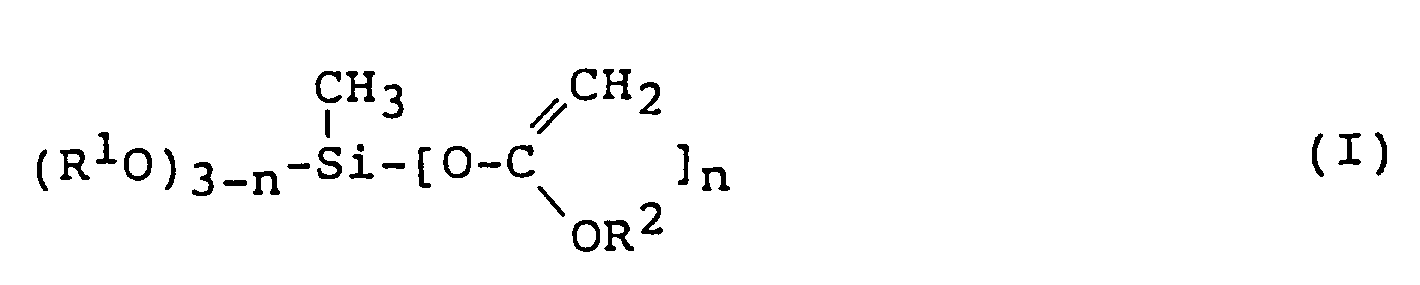
dans laquelle R¹ représente le groupe méthyle ou le groupe éthyle, R₂ représente un groupe alkyle ayant 1 à 4 atomes de carbone et n représente un nombre entier de 1 à 3.
dans laquelle R¹ représente le groupe méthyle ou le groupe éthyle, R₂ représente un groupe alkyle ayant 1 à 4 atomes de carbone et n représente un nombre entier de 1 à 3.
2. Composé selon la revendication 1, dans lequel, dans la formule générale (I), R¹ représente
le groupe méthyle ou le groupe éthyle, R² représente le groupe méthyle, le groupe
éthyle ou le groupe isopropyle, et n représente un nombre entier de 1 ou de 2.
3. Procédé de production d'un composé organosilicié de formule générale (I) :

dans la laquelle R¹ représente le groupe méthyle ou le groupe éthyle, R² représente un groupe alkyle ayant 1 à 4 atomes de carbone et n représente un nombre entier de 1 à 3, ledit procédé consistant à faire réagir un composé de formule générale (II) :

dans laquelle R¹ et n sont tels que définis ci-dessus, avec un composé de formule générale (III) :

dans laquelle R² est tel que défini ci-dessus, en sorte d'éliminer le chlorure de lithium.
dans la laquelle R¹ représente le groupe méthyle ou le groupe éthyle, R² représente un groupe alkyle ayant 1 à 4 atomes de carbone et n représente un nombre entier de 1 à 3, ledit procédé consistant à faire réagir un composé de formule générale (II) :
dans laquelle R¹ et n sont tels que définis ci-dessus, avec un composé de formule générale (III) :
dans laquelle R² est tel que défini ci-dessus, en sorte d'éliminer le chlorure de lithium.