|
(11) | EP 0 397 307 B1 |

| (12) | EUROPEAN PATENT SPECIFICATION |
|
|
| (54) |
Water soluble high molecular polymerized drug preparation Wasserlösliche hochmolekulare polymere Arzneistoffzubereitung Préparation hydrosoluble d'un médicament macromoléculaire polymère |
|
|
|||||||||||||||||||||||||||||||
| Note: Within nine months from the publication of the mention of the grant of the European patent, any person may give notice to the European Patent Office of opposition to the European patent granted. Notice of opposition shall be filed in a written reasoned statement. It shall not be deemed to have been filed until the opposition fee has been paid. (Art. 99(1) European Patent Convention). |
[0001] The present invention relates to a water-soluble high molecular polymerized drug comprising a water-soluble block copolymer consisting of a hydrophilic segment and a hydrophobic pharmacological-functioning segment to side chain of which a drug is bonded.
[0002] In the past, several attempts had been performed for coupling a low molecular weight chemical drug with a large molecule, in order to give desirable distribution of the drug in the body so as to increase a drug half-life in the body. However, high-molecular weight compounds used in these attempts were copolymers consisting of one component, or polymers in which two components were polymerized alternately or randomly.
[0003] In the cases of polymers above described, when the amount of carried drug is increased to improve efficacy, the water-solubility decreases owing to the hydrophobic nature of the drug. The task of the present invention is to provide a water-soluble polymer/drug conjugate which does not decrease in water-solubility even if the amounts of carried drug is increased.
[0004] Yokoyama et al (Makromol. Chem., Rapid Commun. 8, 431-435 (1987)) discloses an adriamycin-conjugated PEG-block-poly(aspartic acid) end-capped with a 3-(2-pyridyldithio)propionyl (PDP) group.
[0005] The present inventors sought to develop a high molecular weight polymerized drug, which would overcome the problem. They introduced a drug selectively to the second segment of a block copolymer comprising a first segment and a second segment, to give it hydrophobic nature, and they succeeded in preventing the decrease of water-solubility accompanied by introduction of a drug and preventing precipitate formation, by means of micelle formation in which the second segment is the inner-core and the first segment the outer shell. The high molecular weight polymerized drug developed by the present inventors possesses good water-solubility, as well as attains, as a drug, stability in an aqueous solution higher than its original drug, by use of the micelle formation.
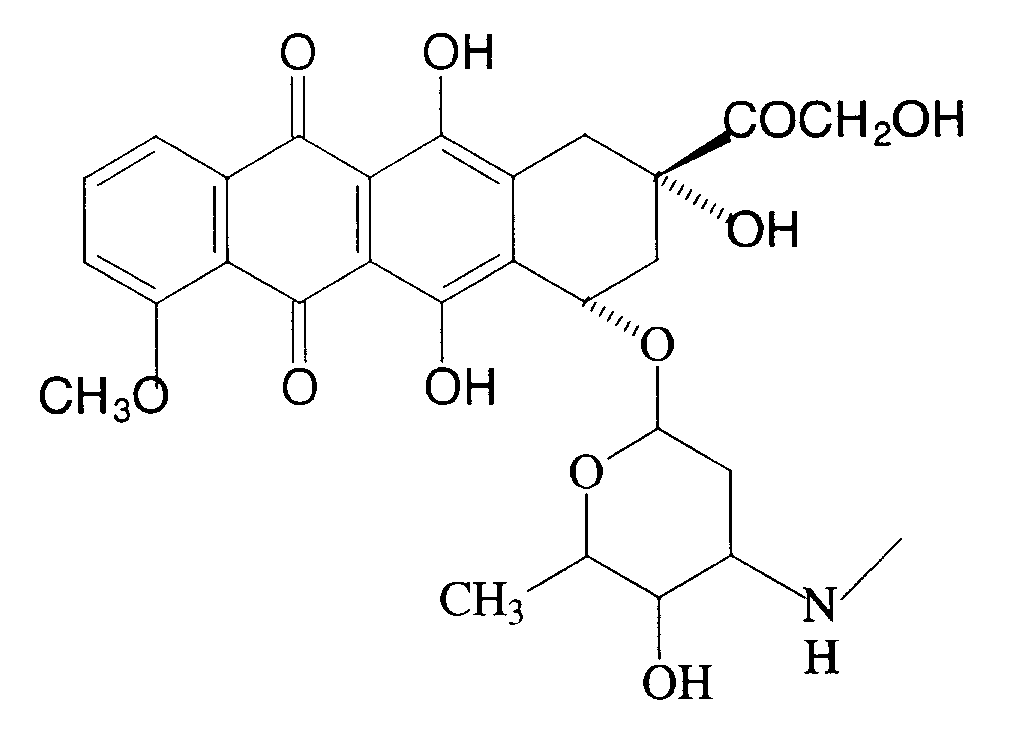
[0006] The present invention provides a water-soluble block copolymer comprising a hydrophilic segment and a hydrophobic segment which contains adriamycin, wherein the copolymer is of formula I:
wherein R is OH, or
R1 is -CH3, -CH2CH3 or other alkyl group, n is an integer of from 5 to 400, m is an integer from 1 to 300, and x is an integer of from 0 to 300, wherein at least one of R is
[0007] According to one embodiment the copolymer forms micelles in an aqueous medium wherein the hydrophobic segment is the inner-core and the hydrophilic segment the outer-shell.
[0008] The present invention further provides a pharmaceutical carrier or diluent and as active ingredient, a copolymer according to the invention.
[0009] The present invention also provides the use of a copolymer according to the invention in the manufacture of a medicament for use in the treatment of cancer.
BRIEF EXPLANATION OF THE DRAWINGS
[0010] Fig. 1 shows the outline of the structure of the high molecular weight polymerized drug PEG-P (Asp(ADR)) of the present invention, Fig. 2 shows change of absorbance at 485 nm, with time, of adriamycin (ADR) and of the high molecular weight polymerized drug preparation of PEG-P (Asp(ADR)) according to the present invention, Fig. 3 shows analysis by gel filtration HPLC, of the high molecular weight polymerized drug preparation PEG-P(Asp(ADR)) and of said preparation where a surface-active agent SDS was added, Fig. 4 shows results of fluorescence analysis of the high molecular weight polymerised drug preparation PEG-P(Asp(ADR)) and of said preparation where a surface-active agent SDS was added, and Fig. 5 shows distribution state of micelle diameter of the high molecular weight polymerized drug preparation of PEG-P (Asp(ADR)) of the present invention, by laser scattering measurement.
[0011] The hydrophilic first segment of the present invention, is polyethylene glycol. The second segment, which turns hydrophobic upon being attached to a drug is polyaspartic acid.
[0013] Fig. 1 shows the outline of the structure of the high molecular weight polymerized drug of the present invention, which is a block copolymer comprising two components consisting of polyethylene glycol and polyaspartic acid wherein an anti-cancer drug, adriamycin, is bound to the carboxyl group in the side chain of the polyaspartic acid through an amide bond capable of being hydrolyzed in the body.
[0014] The synthesis of a high molecular polymerized drug, as shown in the reaction pathway below, is as follows: β-benzyl L-aspartate N-carboxy anhydride (BLA-NCA) was polymerized with an initiator of polyethylene glycol (M.W.: 250 to 18,000) having, at the terminal, an alkoxy group such as a methoxy group and having, at another terminal, a primary amino group, to prepare polyethylene glycol-poly (β-benzyl L-aspartate) block copolymer (PEG-PBLA), followed by subjecting the PEG-PBLA to alkali hydrolysis, to obtain a drug-bearing carrier of the present invention, i.e. polyethylene glycol-polyaspartic acid block copolymer (PEG-P(Asp)). Eighty % of the resultant PEG-P(Asp) received β-amidation on the hydrolysis. By adding adriamycin of an anti-cancer drug and water-soluble carbodiimide (EDC) to the PEG-P(Asp), an amide bond was formed between primary amino group of the adriamycin and carboxyl group in the side chain of the polyaspartic acid segment, to obtain a high molecular polymerized PEG-P(Asp(ADR)).
wherein R stands for OH or
n stands for an integer of from 5 to 400, m stands for an integer of from 1 to 300, and x stands for an integer of from 0 to 300, whereupon at least one of R stands for
[0015] The molecular weight of the polyaspartic acids (P(Asp)) part is variable from 116 to 35,000. Substitution ratio of adriamycin (based on asparpartic acid residues) obtained is 12 to 33 mol % when the molecular weight of the P(Asp) is 1,900, and 3 to 37 mol % when the molecular weight is 10,000.
[0016] The synthesized high molecular weight drug, despite the high adriamycin-substitution ratio, demonstrates good water-solubility, and keeps its water-solubility even when lyophilized or concentrated (calculated amounts: 20 mg of adriamycin/ml).
[0017] The high molecular weight polymerized drug possesses high stability as a medicine as compared with the original adriamycin (ADR). In addition, the high molecular weight polymerized drug forms micelles in an aqueous solution. The sizes of the micelles are about 30 to 200 nm in diameter. It has been found that it is necessary to add a surface-active agent, such as SDS to destroy the micelles, thus illustrating the stability of the present high molecular weight micelles in water. Furthermore, no change in the micelle-forming ability was recognized even after exposure to ultrasonic or by lyophilization.
[0018] As shown in Table 1, the anti-cancer activity of the synthesized polymerized high molecular chemical drug was higher than that of the original adriamycin. Furthermore, the high anti-cancer activity was achieved with less side effects than the original adriamycin.
[0019] The high-molecular polymerized drug according to the present invention possesses high stability as drug, as well as having good water-solubility with reduced side effects, even when the amounts of the drug carried are increased.
EXAMPLES
Example 1
[0020] β-Benzyl L-aspartate N-carboxy anhydride (BLA-NCA, 7.21 g) was dissolved in 12 ml of N,N'-dimethylformamide (DMF), followed by addition of 60 ml of chloroform. 6.00 g of polyethylene glycol (M.W. 4,300) bearing, at one terminal, methoxy group and, at the other terminal, amino group was dissolved in 60 ml of chloroform, and the solution was added to the BLA-NCA solution. After 70 hrs., the reaction mixture was dropped into 2 l of diethyl ether, and precipitated polymers were recovered by filtration, washed with diethyl ether, and dried in a vacuum, to obtain polyethylene glycol-poly (β-benzyl L-aspartate) block copolymer (PEG-PBLA). Yield was 10.09 g (84%).
[0021] 10.03 g of PEG-PBLA was dissolved in 100 ml of chloroform. Alkaline solution, in which 0.43 N sodium hydroxide was dissolved in a mixture (water:methanol: 1-propanol=1:1:2 (volume ratio)), was added to the PEG-PBLA. The alkali was 1.5 times equivalent to the benzyl ester part of the PBLA. After being stirred for 10 min. at 0°C, the mixture was dropped into 2 l of diethyl ether. Polymers precipitated were separated by filtration, dissolved in 20 ml of distilled water and dialyzed in water for 39 hrs, by use of Spectrapor 7 membrane (molecular weight cut-off = 1,000). Then, the solution in the membrane was lyophilized to obtain polyethylene glycol-polyaspartic acid block copolymer (PEG-P(Asp)). Yield was 3.94 g (49%).
[0022] Proton NMR measurements showed the presence of 17 aspartic acid residues per block copolymer chain.
[0023] 230.3 mg of the (PEG-P(Asp)) was dissolved in 1 ml of distilled water. 349.2 mg of adriamycin hydrochloride was dissolved in 260 ml of DMF, followed by addition of 1.3 times equivalent triethylamine. To the adriamycin solution was added the aqueous (PEG-P(Asp)) solution, and further 886 ml of water-soluble carbodiimide (EDC) was added. The mixture was stirred for 4 hrs. at 0°C. Then, another 886 ml of water-soluble carbodiimide was added and stirred for 19 hrs. at room temperature. By use of Spectrapor 7 membrane (molecular weight cut-off = 1,000), the reaction mixture was dialysed against 0.1 M sodium acetate buffer (pH 4.5) for 3 hrs. After the dialysis, non-reacted adriamycin and other low molecular compounds were removed by ultrafiltration with Amicon YM30 membrane. Adriamycin contents in the resultant block copolymer of PEG-P(Asp(ADR)) were 31 mol % with respect to aspartic acid residues (from absorbance at 485 nm). In the same manner, the compound with a molecular weight of polyethylene glycol of 4,000 to 6,000 and 17 to 92 aspartic acid residues per block copolymer chain, and adriamycin contents of 9 to 37 mol % could be synthesized, all of which showed good water-solubility.
Example 2
[0024] Laser scattering measurements showed that the micelles of PEG-P(Asp(ADR)) (with a molecular weight of PEG of 4,300, 17 aspartic acid residues per block copolymer chain, 31 mol % adriamycin) in an isotonic solution of phosphoric acid (pH 7.4) are 57 nm in weight-average diameter and 49 nm in number-average diameter (see Fig. 6). As shown in Fig. 3, the gel-filtration HPLC showed that most parts of the original peak move toward the side of small molecular weight by addition of a surface-active agent, sodium dodecyl sulfate (SDS), and that is, destruction of high-molecular micelles by the SDS was observed. The PEG-P(Asp(ADR)) of other proportions formed micelles from 30 to 80 nm in diameter.
[0025] Fig. 3 shows absorbance change with time at 485 nm characteristic of adriamycin in a phosphate buffer at pH 7.4 (37°C). Absorbance of adriamycin reduced to one-half within 100 hrs., whereas the synthesized high weight polymerized drug kept about 90% absorbance even after 168 hrs., to demonstrate that it is very stable.
Example 3
[0026] 106 cells of P 388 mouse leukemia were intraperitoneally administered to female CDF1 mouse, and 24 hrs. after the administration, PEG-P(Asp(ADR)) (of the PEG with a molecular weight of 4,300, 17 aspartic acid residues per block copolymer chain and 31 mol % adriamycin) dissolved in physiological saline was intraperitoneally administered to the mouse. The ratio of survival days to that of controls (physiological saline was administered one day after administration of the leukemia cells) and body weight change were measured. Six mice were one group. Results are shown in Table 1. Adriamycin (ADR) showed that the maximum of T/C was 381%, whereas the high molecular polymerized drug demonstrated that it was 490% or higher, by a calculated amount of 200 mg of ADR/kg. In addition, ADR showed that, by the amount where 381% T/C was obtained, decrease of body weight (which indicates the degree of its side effect) was 12.5%, whereas the high molecular polymerized drug showed that it was only 7.4% at the maximum of T/C. From these observations, it was found that the synthesized high molecular weight chemical drug demonstrated higher anti-tumor activity with less side effect as compared with ADR.
Table 1
| Anti-tumor activity against P 388 mouse leukemia | ||||
| Sample | Administered amount (mg/kg) | Median survival day | TC(%) | Change of body weight (5th day) |
| ADR | 7.5 | 15.3 | 191 | + 4.4 |
| ADR | 15 | 30.5 | 381 | -12.5 |
| ADR | 30 | 6.5 | 81 | -17.1 |
| PEG-P(Asp(ADR)) | 80 | 18.0 | 225 | + 6.1 |
| PEG-P(Asp(ADR)) | 120 | 32.5 | 382 | - 5.5 |
| PEG-P(Asp(ADR)) | 200 | >42.0 | >490 | - 7.4 |
| 1) Control: 8.0 ∼ 8.6 days | ||||
Claims for the following Contracting State(s): CH, DE, FR, GB, IT, LI, SE
1. A water-soluble block copolymer comprising a hydrophillic segment and a hydrophobic
segment which contains adriamycin, wherein the copolymer is of formula I:

wherein R is OH, or
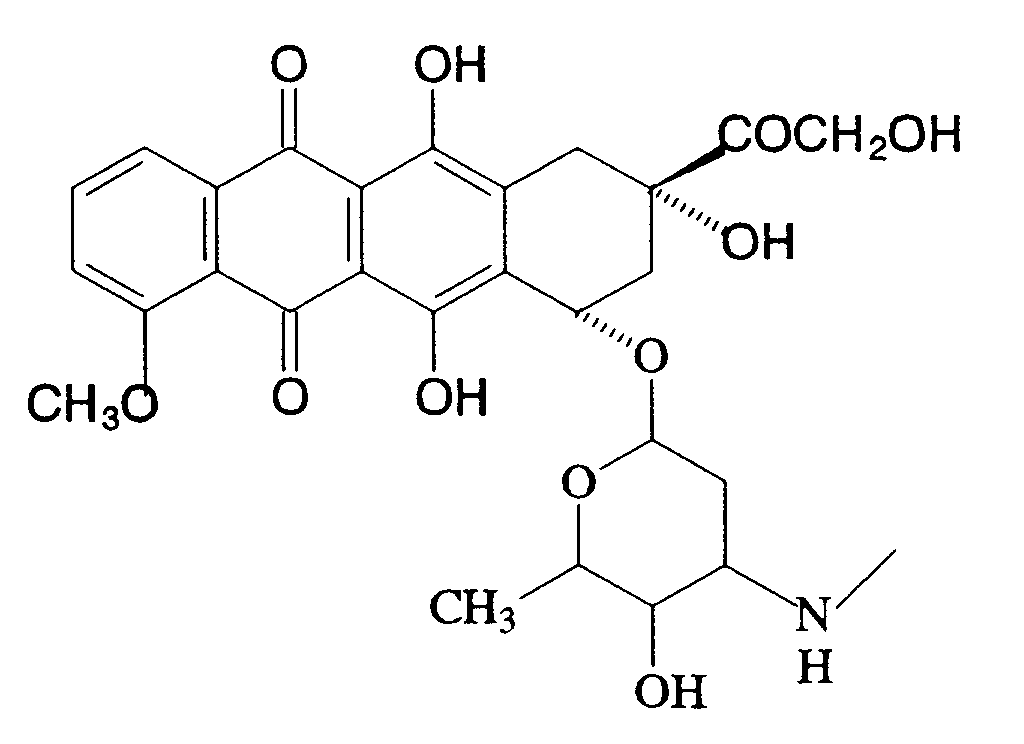
R1 is -CH3, -CH2CH3 or other alkyl group, n is an integer of from 5 to 400, m is an integer from 1 to 300, and x is an integer of from 0 to 300, wherein at least one of R is
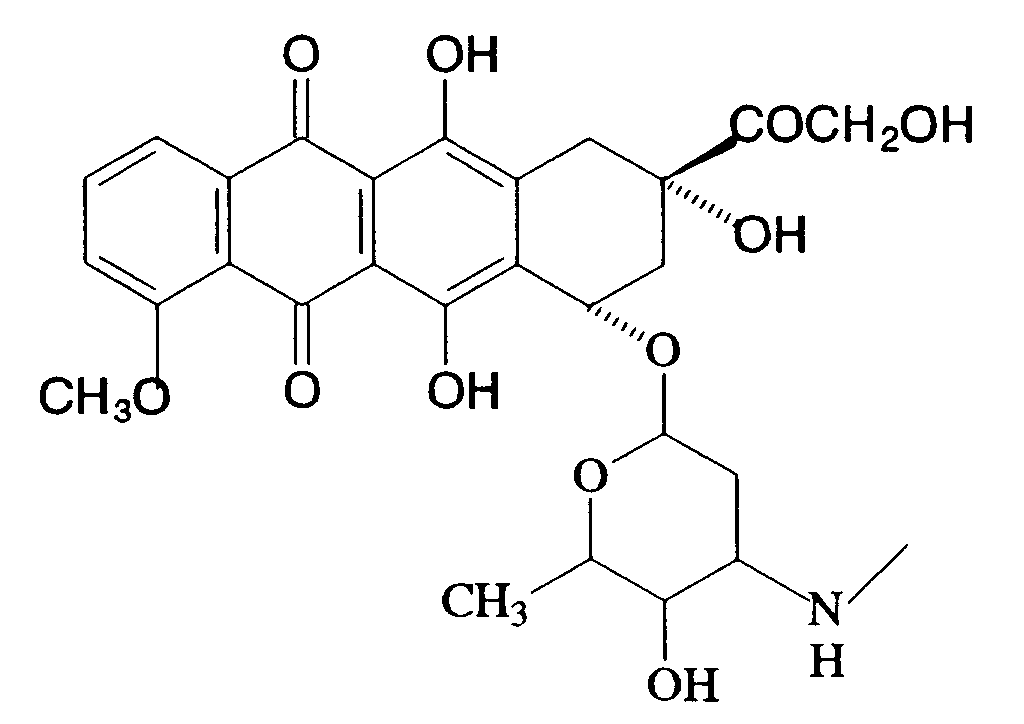
wherein R is OH, or
R1 is -CH3, -CH2CH3 or other alkyl group, n is an integer of from 5 to 400, m is an integer from 1 to 300, and x is an integer of from 0 to 300, wherein at least one of R is
2. A copolymer according to claim 1, which forms micelles in an aqueous medium wherein
the hydrophobic segment is the inner-core and the hydrophilic segment the outer-shell.
3. A pharmaceutical composition comprising a pharmacologically acceptable carrier or
diluent and as active ingredient, a copolymer as claimed in claim 1 or 2.
4. Use of a copolymer according to claim 1 or 2 in the manufacture of a medicament for
use in the treatment of cancer.
5. A process for producing a copolymer as claimed in claim 1 which process comprises
reacting a block copolymer of formula
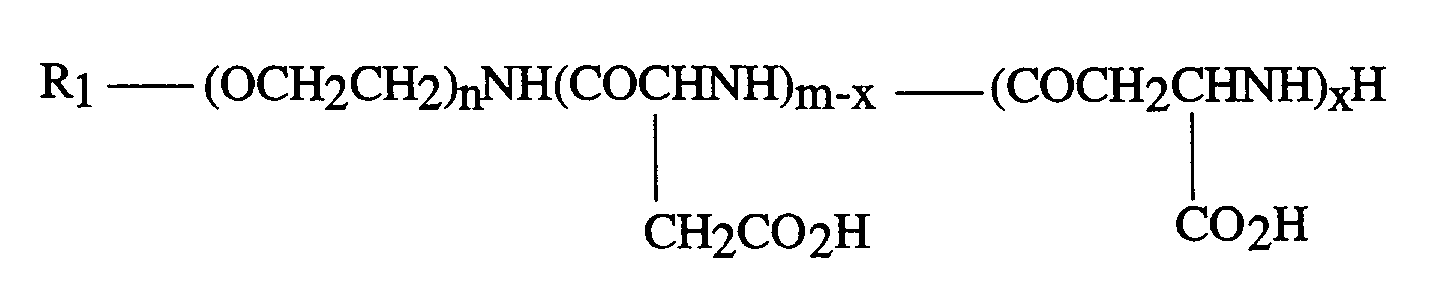
with adriamycin.
with adriamycin.
6. A process according to claim 5 wherein the copolymer is formed into micelles in an
aqueous medium wherein the hydrophobic segment is the inner-core and the hydrophilic
segment the outer-shell.
7. A process according to claim 5 or 6 which further comprises contacting the copolymer
with a pharmacologically acceptable carrier or diluent.
Claims for the following Contracting State(s): ES
1. A process for producing a water-soluble block copolymer comprising a hydrophillic
segment and a hydrophobic segment which contains adriamycin, wherein the copolymer
is of formula I:

wherein R is OH or
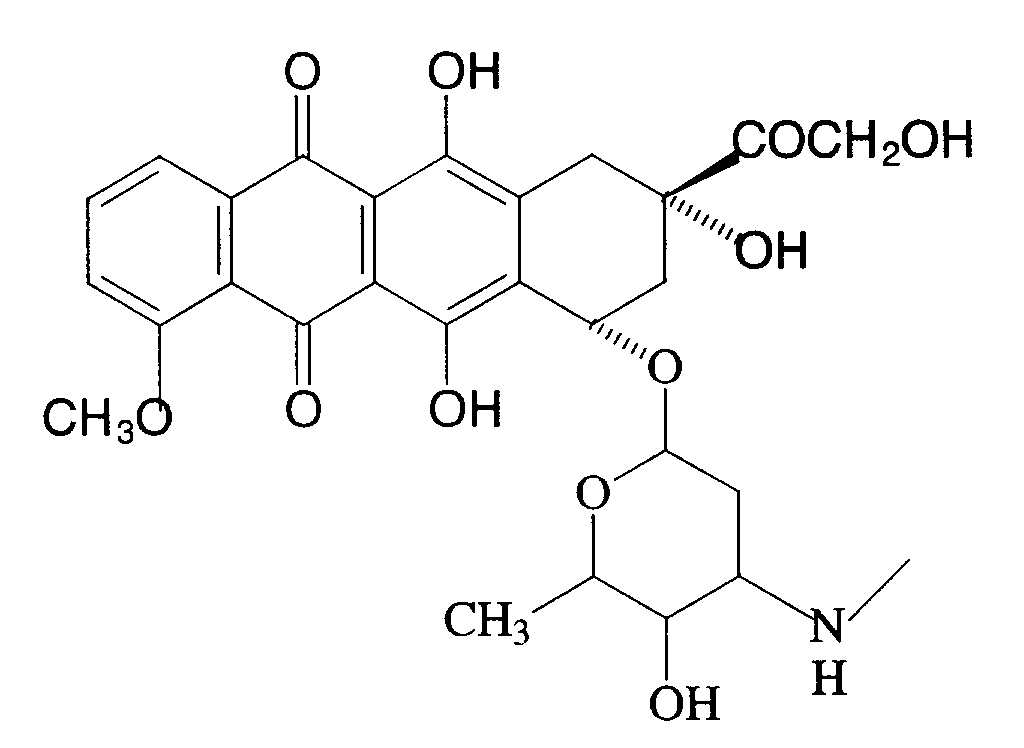
R1 is -CH3, -CH2CH3 or another alkyl group, n is an integer of from 5 to 400, m is an integer from 1 to 300; and x is an integer of from 0 to 300; wherein at least one R is
which process comprises reacting a block copolymer of formula
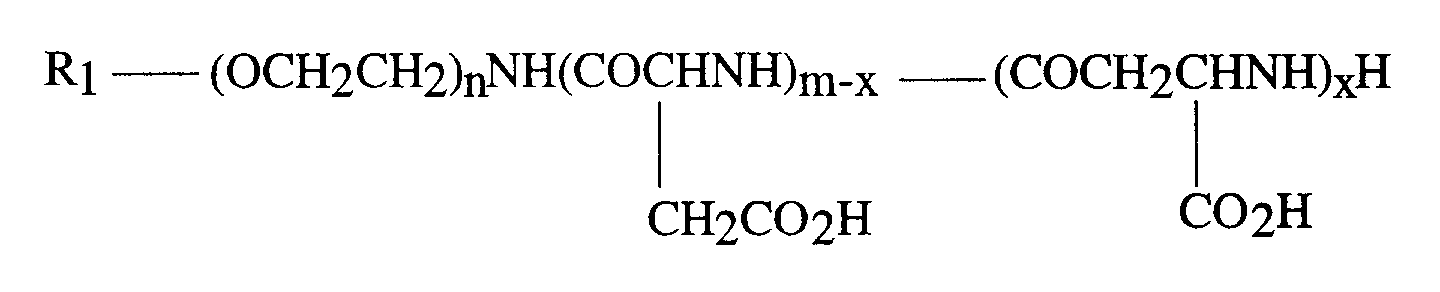
wherein R1, m, n, and x are as defined above, with adriamycin.
wherein R is OH or
R1 is -CH3, -CH2CH3 or another alkyl group, n is an integer of from 5 to 400, m is an integer from 1 to 300; and x is an integer of from 0 to 300; wherein at least one R is
which process comprises reacting a block copolymer of formula
wherein R1, m, n, and x are as defined above, with adriamycin.
2. A process according to claim 1 wherein the copolymer is formed into micelles in an
aqueous medium wherein the hydrophobic segment is the inner-core and the hydrophilic
segment is the outer-shell.
3. A process according to claim 1 or 2 which further comprises contacting the copolymer
with a pharmacologically acceptable carrier or diluent.
Patentansprüche für folgende(n) Vertragsstaat(en): CH, DE, FR, GB, IT, LI, SE
1. Wasserlösliches Block-Copolymer, umfassend ein hydrophiles Segment und ein Adriamycin
enthaltendes hydrophobes Segment, wobei das Copolymer die Formel I hat:

worin R OH oder
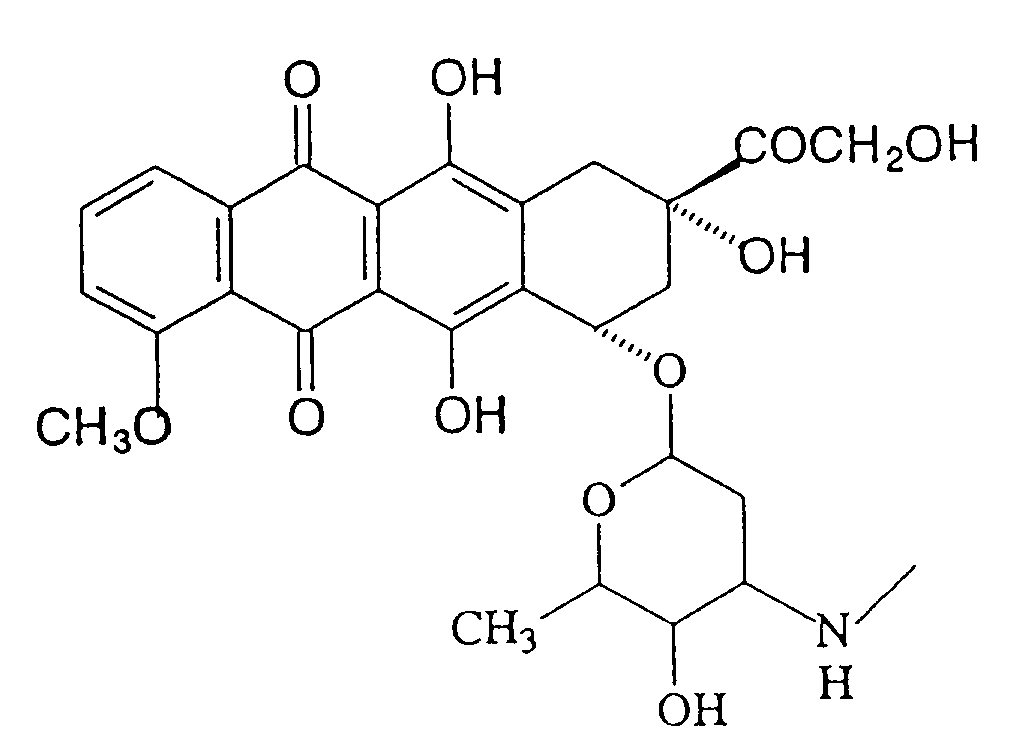
ist, R1 -CH3, -CH2CH3 oder eine andere Alkyl-Gruppe ist, n eine ganze Zahl von 5 bis 400 ist, m eine ganze Zahl von 1 bis 300 ist, und x eine ganze Zahl von 0 bis 300 ist, worin mindestens ein Rest R
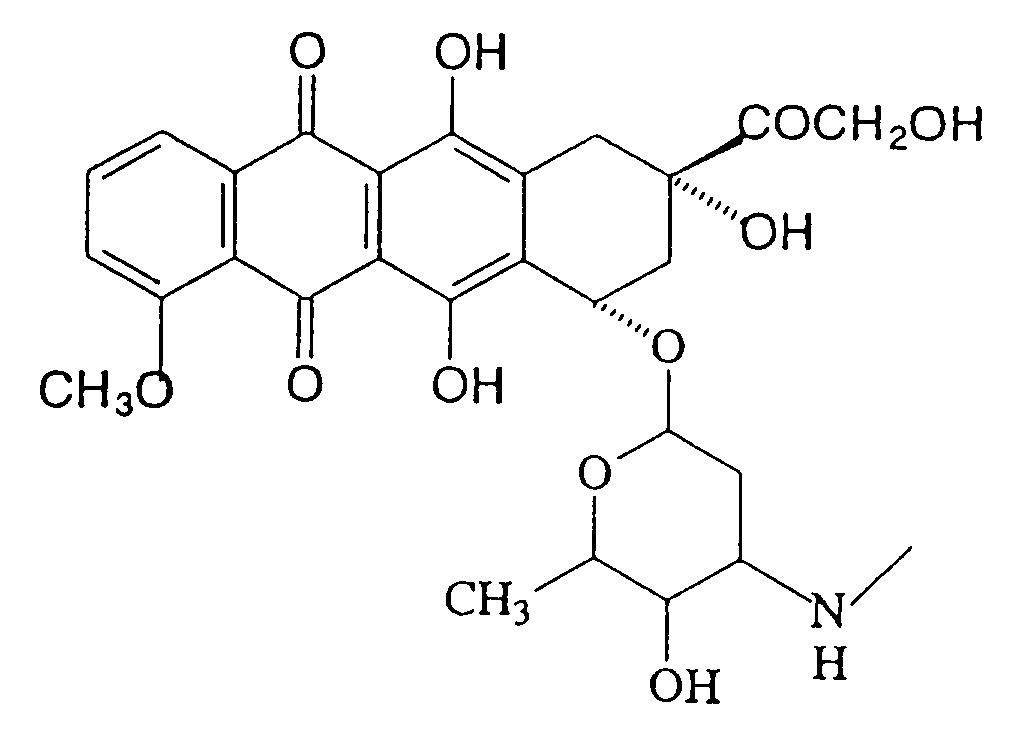
ist.
worin R OH oder
ist, R1 -CH3, -CH2CH3 oder eine andere Alkyl-Gruppe ist, n eine ganze Zahl von 5 bis 400 ist, m eine ganze Zahl von 1 bis 300 ist, und x eine ganze Zahl von 0 bis 300 ist, worin mindestens ein Rest R
ist.
2. Copolymer gemäß Anspruch 1, welches in einem wäßrigen Medium Micellen bildet, worin
das hydrophobe Segment den inneren Kern und das hydrophile Segment die äußere Schale
bildet.
3. Pharmazeutische Zusammensetzung, umfassend einen pharmazeutisch verträglichen Träger
oder ein pharmazeutisch verträgliches Verdünnungsmittel und als aktiven Bestandteil
ein Copolymer gemäß Anspruch 1 oder 2.
4. Verwendung eines Copolymers gemäß Anspruch 1 oder 2, bei der Herstellung eines Medikaments
zur Verwendung bei der Behandlung von Krebs.
5. Verfahren zur Herstellung eines Copolymers gemäß Anspruch 1, wobei dieses Verfahren
die Umsetzung eines Block-Copolymers der Formel

mit Adriamycin umfaßt.
mit Adriamycin umfaßt.
6. Verfahren gemäß Anspruch 5, worin das Copolymer in einem wäßrigen Medium zu Micellen
gebildet wird, worin das hydrophobe Segment den inneren Kern und das hydrophile Segement
die äußere Schale bildet.
7. Verfahren gemäß Anspruch 5 oder 6, welches ferner das Zusammenbringen des Copolymers
mit einem pharmazeutisch verträglichen Träger oder einem pharmazeutisch verträglichen
Verdünnungsmittel umfaßt.
Patentansprüche für folgende(n) Vertragsstaat(en): ES
1. Verfahren zur Herstellung eines wasserlöslichen Block-Copolymers, umfassend ein hydrophiles
Segment und ein Adriamycin enthaltendes hydrophobes Segment, wobei das Copolymer die
Formel I hat:

worin R OH oder
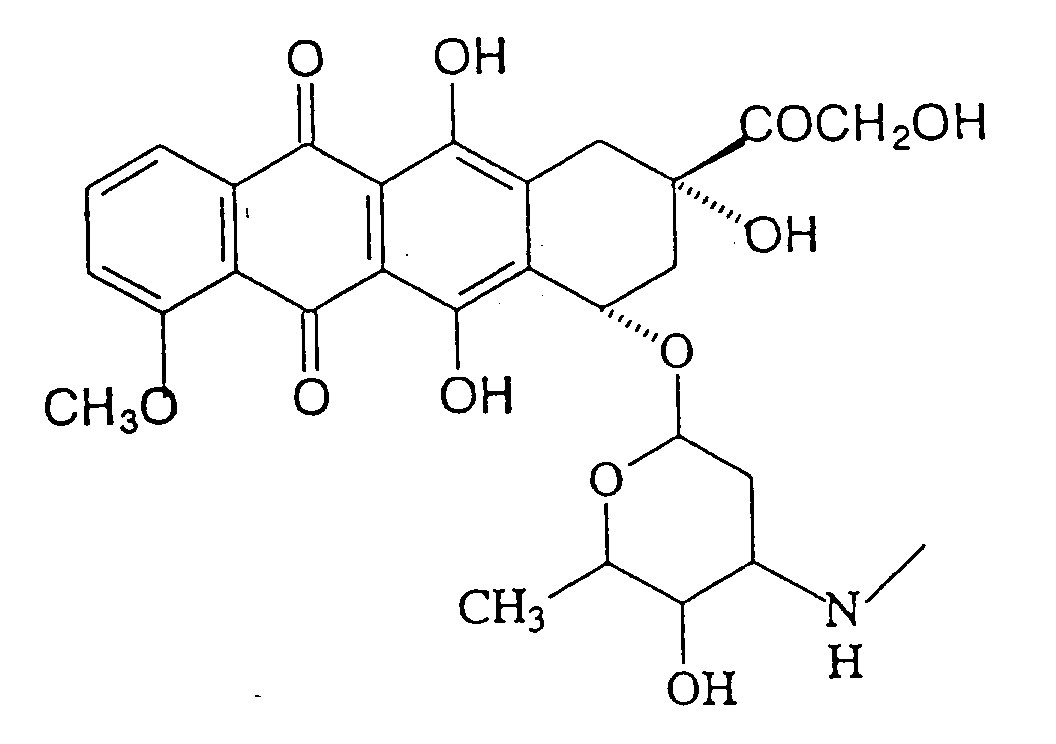
ist, R1 -CH3, -CH2CH3 oder eine andere Alkyl-Gruppe ist, n eine ganze Zahl von 5 bis 400 ist, m eine ganze Zahl von 1 bis 300 ist, und x eine ganze Zahl von 0 bis 300 ist, worin mindestens ein Rest R
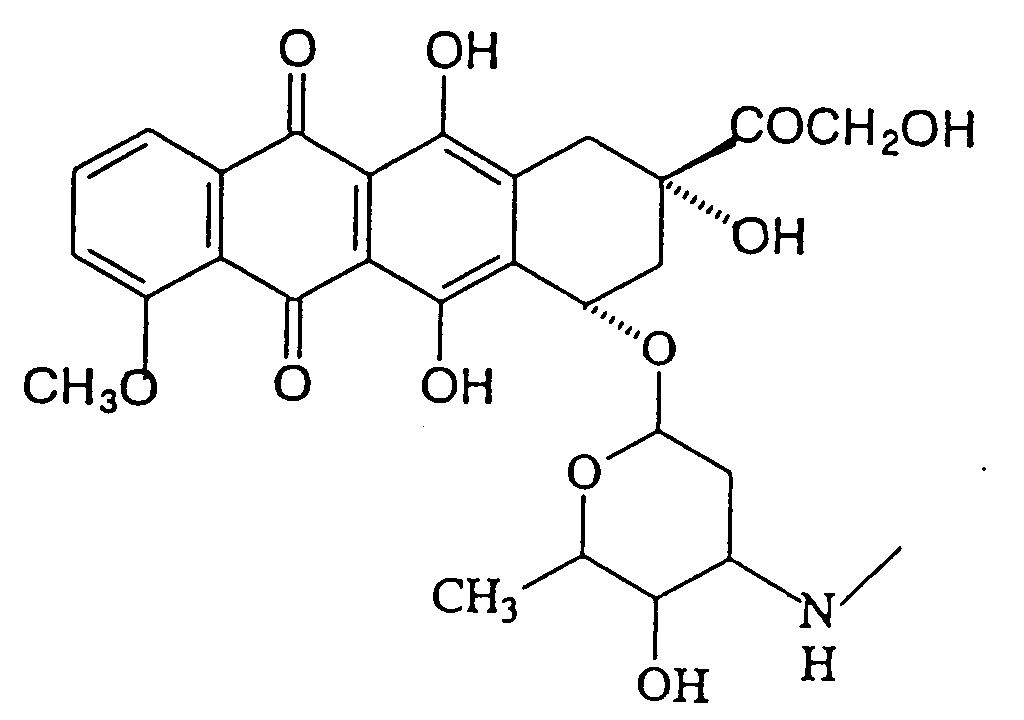
ist,
wobei dieses Verfahren die Umsetzung eines Block-Copolymers der Formel

worin R1, m, n und x wie oben definiert sind, mit Adriamycin umfaßt.
worin R OH oder
ist, R1 -CH3, -CH2CH3 oder eine andere Alkyl-Gruppe ist, n eine ganze Zahl von 5 bis 400 ist, m eine ganze Zahl von 1 bis 300 ist, und x eine ganze Zahl von 0 bis 300 ist, worin mindestens ein Rest R
ist,
wobei dieses Verfahren die Umsetzung eines Block-Copolymers der Formel
worin R1, m, n und x wie oben definiert sind, mit Adriamycin umfaßt.
2. Verfahren gemäß Anspruch 1, worin das Copolymer in einem wäßrigen Medium zu Micellen
gebildet wird, worin das hydrophobe Segment den inneren Kern und das hydrophile Segment
die äußere Schale bildet.
3. Verfahren gemäß Anspruch 1 oder 2, welches ferner das Zusammenbringen des Copolymers
mit einem pharmazeutisch verträglichen Träger oder einem pharmazeutisch verträglichen
Verdünnungsmittel umfaßt.
Revendications pour l'(les) Etat(s) contractant(s) suivant(s): CH, DE, FR, GB, IT,
LI, SE
1. Copolymère séquencé soluble dans l'eau comprenant un segment hydrophile et un segment
hydrophobe qui contient une adriamycine, dans lequel le copolymère correspond à la
formule I :

dans laquelle :
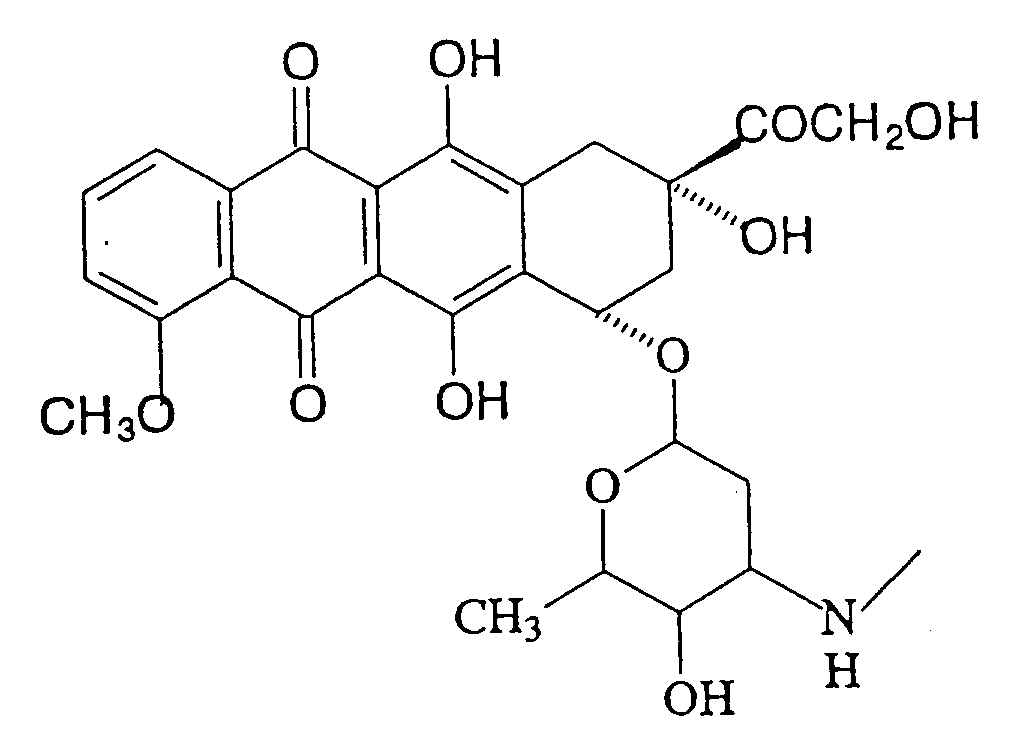
dans laquelle :
R représente OH, ou
R1 représente -CH3, -CH2CH3 ou un autre groupe alkyle,
n est un nombre entier de 5 à 400,
m est un nombre entier de 1 à 300, et
x est un nombre entier de 0 à 300,
dans laquelle au moins l'un des R représente2. Copolymère conforme à la revendication 1, qui forme des micelles dans un milieu aqueux,
dans lequel le segment hydrophobe constitue le noyau interne et le segment hydrophile
constitue l'enveloppe externe.
3. Composition pharmaceutique comprenant un porteur ou diluant pharmacologiquement acceptable,
et en tant qu'ingrédient actif, un copolymère conforme à la revendication 1 ou 2.
4. Utilisation d'un copolymère conforme à la revendication 1 ou 2 dans la production
d'un médicament destiné à être utilisé dans le traitement du cancer.
5. Procédé de préparation d'un copolymère conforme à la revendication 1, lequel procédé
comprend le fait de faire réagir un copolymère séquencé de formule

avec une adriamycine.
avec une adriamycine.
6. Procédé conforme à la revendication 5, dans lequel le copolymère se met sous la forme
de micelles dans un milieu aqueux dans lequel le segment hydrophobe est le noyau interne
et le segment hydrophile est l'enveloppe externe.
7. Procédé conforme à la revendication 5 ou 6 qui comprend en outre le fait de mettre
en contact le copolymère avec un porteur ou diluant pharmacologiquement acceptable.
Revendications pour l'(les) Etat(s) contractant(s) suivant(s): ES
1. Procédé de préparation d'un copolymère séquencé soluble dans l'eau comprenant un segment
hydrophile et un segment hydrophobe qui contient une adriamycine, sachant que le copolymère
correspond à la formule I :

dans laquelle :
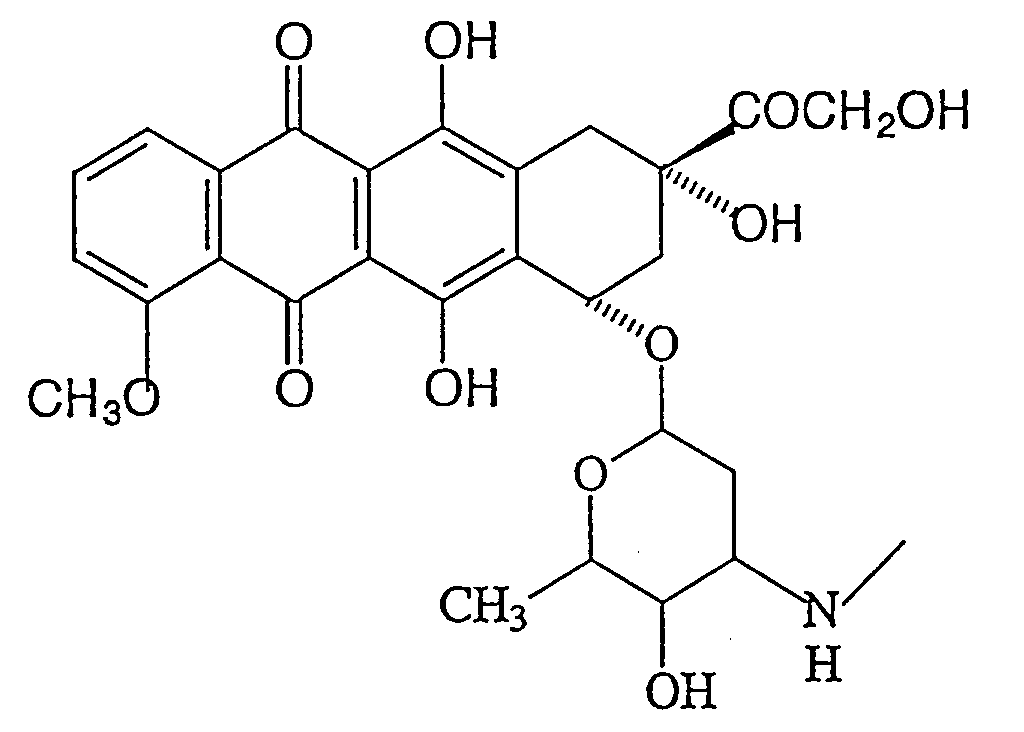
lequel procédé comprend le fait de faire réagir un copolymère séquencé de formule

dans laquelle R1, m, n et x sont tels que définis précédemment, avec une adriamycine.
dans laquelle :
R représente OH, ou
R1 représente -CH3, -CH2CH3 ou un autre groupe alkyle,
n est un nombre entier de 5 à 400,
m est un nombre entier de 1 à 300, et
x est un nombre entier de 0 à 300,
dans laquelle au moins l'un des R représentelequel procédé comprend le fait de faire réagir un copolymère séquencé de formule
dans laquelle R1, m, n et x sont tels que définis précédemment, avec une adriamycine.
2. Procédé conforme à la revendication 1, dans lequel le copolymère se met sous la forme
de micelles dans un milieu aqueux dans lequel le segment hydrophobe est le noyau interne
et le segment hydrophile est l'enveloppe externe.
3. Procédé conforme à la revendication 1 ou 2 qui comprend en outre le fait de mettre
en contact le copolymère avec un porteur ou diluant pharmacologiquement acceptable.