|
(11) | EP 0 397 418 A1 |

| (12) | EUROPEAN PATENT APPLICATION |
|
|
|
|
|||||||||||||||||||||||||||
| (54) | 9,10-dihydrophenanthrene-2,7-dicarboxylic acid diesters, 7-Bromo-9,10-dihydrophenanthrene-2-carboxylic acid esters and a process for producing the same |
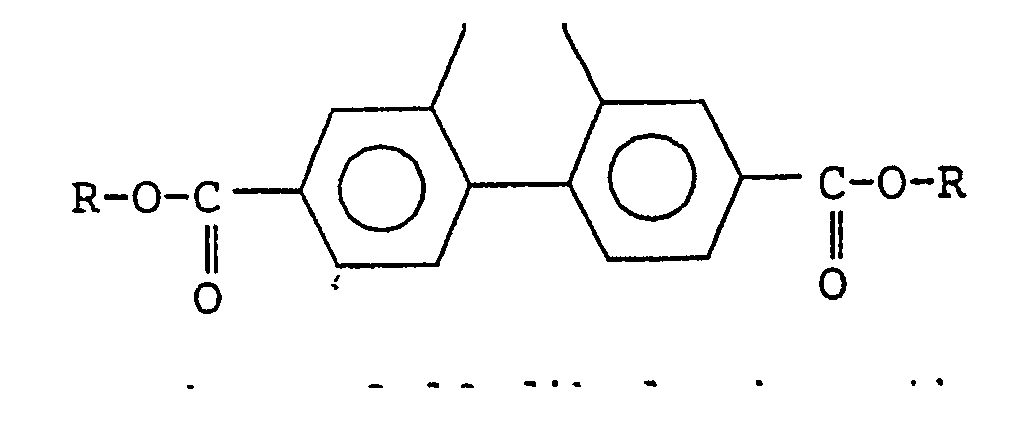
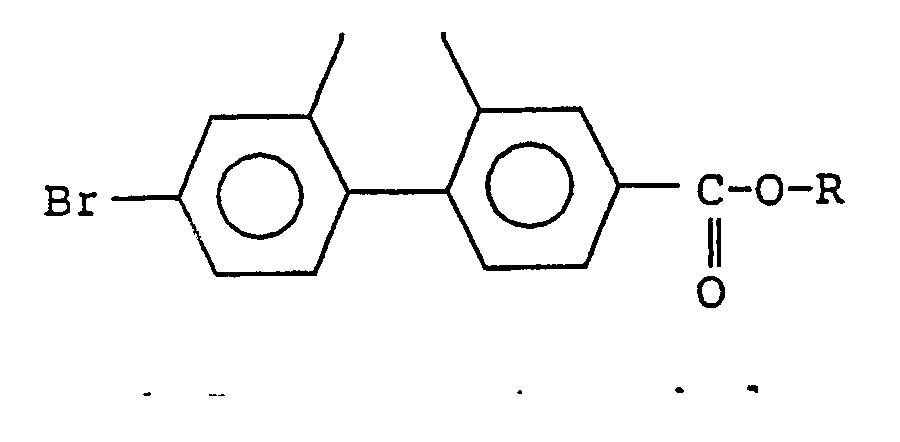
| (57) A novel 9,10-dihydrophenanthrene2,7-dicarboxylic acid diester represented by the
general formula (I):
and a novel 7-bromo-9,10-dihydrophenanthrene-2-carboxylic acid monoester represented by the general formula (II): wherein each R represents a hydrocarbon group containing from 1 to 20 carbon atoms. A process for selectively synthesizing the compound of the general formula (I) and the compound of the general formula (II) comprising reacting 2,7-dibromo-9,10-dihydrophenanthrene with carbon monoxide and an alcohol of the general formula (III) R-OH in the presence of a base and a palladium-phosphine catalyst. Such novel compounds of the general formula (I) and (II) can be produced in a high yield and selectivity from inexpensive raw materials by simple reaction steps. |
BACKGROUND OF THE INVENTION
[0001] This invention relates to novel 9,10-dihydrophenanthrene-2,7-dicarboxylic acid diesters and 7-bromo-9,10-dihydrophenanthrene-2-carboxylic acid esters and a process for producing the same. More particularly, it relates to a process for producing 9,10-dihydrophenanthrene-2,7-dicarboxylic acid diesters or 7-bromo-9,10-dihydrophenanthrene-2-carboxylic acid esters wherein 2,7-dibromo-9,10-dihydrophenanthrene is reacted with carbon monoxide and an alcohol in the presence of a base and a palladium-phosphine catalyst.
[0002] Heretofore, there have been proposed various processes for carrying out the carbonylation reaction of aromatic compounds. Examples of such processes include a process for producing a diphenyl carboxylic acid wherein an iodinated or brominated diphenyl is reacted with carbon monoxide in an aqueous solvent in the presence of a catalyst (Japanese Patent Laid-Open Publication No. 185055/1987); a process for producing a hydroxy aromatic carboxylic ester wherein a halogenated aromatic hydroxy compound is reacted with carbon monoxide in an alcohol solvent in the presence of a catalyst (Japanese Patent Laid-Open Publication No. 187435/1987); a process for producing an aromatic carboxylic acid wherein an aromatic iodine compound is reacted with carbon monoxide in the presence of a base and water without using any catalyst (Japanese Patent Laid-Open Publication No. 5052/1988); and a process for producing an; aromatic carboxylic acid ester wherein a halogenated aromatic compound is reacted with carbon monoxide at a high temperature under a high pressure in the presence of a catalyst (U.S. Patent No. 3,636,082).
[0003] We have carried out studies with respect to carbonylation reaction of aromatic compounds. In particular, we have carried out extensive reviews with respect to effects of raw materials, catalysts and reaction conditions on the yield and selectivity of products. We have reviewed the carbonylation reaction of 2,7-dibromodihydrophenanthrene in detail. We have now found that 9,10-dihydrophenanthrene-2,7-dicarboxylic acid diesters and 7-bromo-9,10-dihydrophenanthrene carboxylic acid esters which have never been known in the prior art processes described above can be synthesized in a good yield under specific conditions.
SUMMARY OF THE INVENTION
[0004] Thus, the present invention provides a 9,10-dihydrophenanthrene-2,7-dicarboxylic acid diester represented by the general formula (I):
or a 7-bromo-9,10-dihydrophenanthrene-2-carboxylic acid ester represented by the general formula (II):
wherein each R represents a hydrocarbon group containing from 1 to 20 carbon atoms.
[0005] The present invention also provides a process for producing compounds of the general formulae (I) and (II) described above by reacting a 2,7-dibromo-9,10-dihydrophenanthrene with carbon monoxide and an alcohol of the general formula (III) R-OH wherein R is as defined above, in the presence of a base and a palladium-phosphine catalyst.
BRIEF DESCRIPTION OF THE DRAWINGS
[0006]
FIG. 1 is an IR spectrum of diethyl 9,10-dihydrophenanthrene-2,7-dicarboxylate obtained in Example 1 as a chief product;
FIG. 2 is a mass spectrum of diethyl 9,10-dihydrophenanthrene-2,7-dicarboxylate obtained in Example 1 as a chief product;
FIG. 3 is an IR spectrum of ethyl 7-bromo-9,10-dihydrophenanthrene-2-carboxylate obtained in Example 3 as a chief product; and
FIG. 4 is a mass spectrum of ethyl 7-bromo-9,10-dihydrophenanthrene-2-carboxylate obtained in Example 3 as a chief product.
DETAILED DESCRIPTION OF THE INVENTION
[0008] The present invention relates to a 9,10-dihydrophenanthrene-2,7-dicarboxylic acid diester represented by the general formula (I):
or a 7-bromo-9,10-dihydrophenanthrene-2-carboxylic acid ester represented by the general formula (II):
[0009] R in the formulae (I) and (II) described above is a hydrocarbon group containing from 1 to 20 carbon atoms. R represents an aliphatic, alicyclic or aromatic hydrocarbon group including alkyl groups such as methyl and ethyl; cycloalkyl groups such as cyclopentyl and cyclohexyl; and aryl groups such as benzyl and phenyl. Thus, representative examples of such novel compounds according to the present invention represented by the general formulae (I) and (II) include diethyl 9,10- dihydrophenanthrene-2,7-dicarboxylate and ethyl 7-bromo-9,10-dihydrophenanthrene-2-carboxylate.
[0010] These compounds can be utilized as raw materials for heat-resistant or liquid crystal polymers. Further, the compounds can be utilized as raw materials for various drugs and agricultural chemicals.
[0011] According to the present invention, such compounds can be produced by reacting a 2,7-dibromo-9,10-dihydrophenanthrene with carbon monoxide and an alcohol of the general formula (III) R-OH wherein R is as defined above in the presence of a base and a palladium-phosphine catalyst.
[0012] The 2,7-dibromo-9,10-dihydrophenanthrenes from which the desired product is produced can be readily obtained by various methods. For example, the 2,7-dibromo-9,10-dihydrophenanthrenes are obtained in a high yield by reacting 9,10-dihydrophenanthrene in a trimethylphosphate solvent in the presence of bromine (D.E. Pearson, U.S. Patent No. 3,988,369 (1976)).
[0013] The base used in the present invention has such an effect that it remarkably accelerates the reaction. The addition of such a base reduces the reaction time and reaction temperature. Both organic bases and inorganic bases can be used as the base. That is, any bases can be used so long as they can capture hydrogen bromide which forms in the course of the reaction. Examples of such bases include aliphatic amines, aromatic amines, quaternary ammonium hydroxide, alkali metal alcoholates, alkali metal hydroxides, alkali metal carbonates, alkaline earth metal alcoholates, alkaline earth metal hydroxides and alkaline earth metal carbonates. Of these, aliphatic amines such as triethylamine, ethyldiisopropylamine and butyldimethylamine are preferred. The amount of the base used is from 0.01 to 10 molar equivalents, preferably from 0.3 to 5 molar equivalents based on the amount of bromine in the 2,7-dibromo-9,10-dihydrophenanthrene to be reacted.
[0014] The catalyst used in the present invention is a palladium-phosphine catalyst. Palladium compounds which are a source of palladium include palladium chloride and palladium sulfate. The phosphines include aromatic phosphines such as triphenylphosphine, tritolylphosphine and trianisylphosphine; alkylphosphines such as tributylphosphine, tripropylphosphine and triisopropylphosphine; and diphosphines such as 1,2-bisdiphenylphosphinomethane and 1,3-bisdiphenylphosphinopropane. Of these, a preferred palladium compound is palladium chloride, and preferred phosphines are aromatic phosphines such as triphenylphosphine. These phosphines may be added to a reaction system as a palladium complex. Alternatively, the phosphines may be charged into a reactor together with salts such as palladium chloride to form their complex in a system. The amount of the palladium compound used is from 1/10 to 1/1000 molar equivalent, preferably from 1/20 to 1/200 molar equivalent based on the 2,7-dibromo-9,10-dihydrophenanthrene to be reacted. The amount of the phosphine compound is from 0.5 to 30 molar equivalents, preferably from 1 to 25 molar equivalents based on palladium. When the amount of the phosphine compound added is small, a 7-bromo-9,10-dihydrophenanthrene-2-carboxylic acid ester is a chief product. When the amount of the phosphine compound added is large, a 9,10-dihydrophenanthrene-2,7-dicarboxylic acid diester is a chief product.
[0015] The alcohols used in the present invention are represented by the general formula (III) R-OH wherein R is as defined above. The alcohols used may vary depending upon purposes. Aliphatic alcohols, alicyclic alcohols and aromatic alcohols can be used herein. Preferred aliphatic alcohols are methanol, ethanol and propanol. Preferred alicyclic alcohols are cyclopentanol and cyclohexanol. Preferred aromatic alcohols are benzyl alcohol and phenol The amount of the alcohol used is at least one molar equivalent based on bromine in 2,7-dibromo-9,10-dihydrophenanthrene to be reacted.
[0016] Suitable reaction apparatuses are continuous or batch high-pressure reaction apparatuses conventionally used. The reaction apparatuses are not limited thereto. The reaction is carried out under a carbon monoxide pressure. The pressure of a carbon monoxide gas is a gauge pressure of from 5 to 200 kg/cm², preferably from 50 to 150 kg/cm². A considerably excess amount of carbon monoxide is generally used. The reaction temperature is from 50° to 200°C, preferably from 100° to 180°C from the standpoint of reaction rate. If the reaction temperature is above 200°C, side reaction may occur in a considerable extent.
[0017] While the novel compounds represented by the general formulae (I) and (II) which can be utilized as raw materials for liquid crystal polymers are obtained in this manner, various by-products tend to be simultaneously formed. Accordingly, various conditions can be adjusted in the present invention. The formation of various by-products is inhibited by adjusting various conditions when the amount of the base is relatively small, when the pressure of carbon monoxide is low or when the temperature is low, while other conditions are constant and thus the compounds described above can be in a high yield and selectivity as a chief product. However, when all of these conditions are satisfied, a reduction in reaction rate is caused, contrary to expectation. Therefore, it is necessary to make adjustments in order to prevent this reduction in reaction rate.
EXAMPLE 1
[0019] An autoclave was charged with 8.45 grams (25 mmol) of 2,7-dibromo-9,10-dihydrophenanthrene, 6.07 grams (60 mmol) of triethylamine, 44.3 milligrams (0.25 mmol) of palladium chloride, 656 milligrams (2.5 mmol) of triphenylphosphine, 20 milliliters of ethanol and 20 milliliters of benzene. Carbon monoxide was then charged into the autoclave at a level of 50 kg/cm². The reaction mixture was heated to 120°C to carry out the reaction for 5 hours. After reaction, unreacted carbon monoxide was purged and the reaction solution was then withdrawn. The analysis was carried out by gas chromatography. As a result, 99.7% of the charged 2,7-dibromo-9,10-dihydrophenanthrene reacted. 7.84 grams (24.2 mmol) of diethyl 9,10-dihydrophenanthrene-2,7-dicarboxylate were obtained as a chief product (selectivity of 97%). (Melting point of 65.0°C - 67.0°C; elemental analysis C = 74.0%, H = 6.1%, 0 = 19.9%) The IR spectrum and mass spectrum of the product are shown in FIGS. 1 and 2, respectively. Besides, 82 milligrams (6 mmol) of ethyl 7-bromo-9,10-dihydrophenanthrene-2-carboxylate were obtained as a by-product (selectivity of 1%).
EXAMPLE 2
[0020] Anautoclave was charged with 8.45 grams (25 mmol) of 2,7-dibromo-9,10-dihydrophenanthrene, 6.07 grams (60 mmol) of triethylamine, 44.3 milligrams (0.25 mmol) of palladium chloride, 262.4 milligrams (1 mmol) of triphenylphosphine, 20 milliliters of ethanol and 20 milliliters of benzene. Carbon monoxide was then charged into the autoclave at a level of 50 kg/cm². The reaction mixture was heated to 180°C to carry out the reaction for 5 hours. After reaction, unreacted carbon monoxide was purged and the reaction solution was then withdrawn. The analysis was carried out by gas chromatography. As a result, 98.5% of the charged 2,7-dibromo-9,10-dihydrophenanthrene reacted. 7.22 grams (22.3 mmol) of diethyl 9,10-dihydrophenanthrene-2,7-dicarboxylate were obtained as a chief product (selectivity of 90.4%). Besides, 363 milligrams (1.1 mmol) of ethyl 7-bromo-9,10-dihydrophenanthrene-2-carboxylate were obtained as a by-product (selectivity of 4.5%).
EXAMPLE 3
[0021] An autoclave was charged with 8.45 grams (25 mmol) of 2,7-dibromo-9,10-dihydrophenanthrene, 6.07 grams (60 mmol) of triethylamine, 44.3 milligrams (0.25 mmol) of palladium chloride, 65.6 milligrams (0.25 mmol) of triphenylphosphine, 20 milliliters of ethanol and 20 milliliters of benzene. Carbon monoxide was then charged into the autoclave at a level of 50 kg/cm². The reaction mixture was heated to 180°C to carry out the reaction for 5 hours. After reaction, unreacted carbon monoxide was purged, and the reaction solution ,was withdrawn. The analysis was carried out by gas chromatography. As a result, 72% of the charged 2,7-dibromo-9,10-dihydrophenanthrene reacted. 3.64 grams (11 mmol) of ethyl 7-bromo-9,10-dihydrophenanthrene-2-carboxylate were obtained as a chief product (selectivity of 59%). (Melting point of 75.3°C - 77.3°C; elemental analysis C = 61.5%, H = 4.4%, 0 = 9.8%, Br = 24.3%) The IR spectrum and mass spectrum of the chief product are shown in FIGS. 3 and 4, respectively. Besides, 1.95 gram (6 mmol) of diethyl 9,10-dihydrophenanthrene-2,7-dicarboxylate was obtained as a by-product (selectivity of 33%).
EXAMPLE 4
[0022] An autoclave was charged with 4.23 grams (12.5 mmol) of 2,7-dibromo-9,10-dihydrophenanthrene, 1.52 gram (15 mmol) of triethylamine, 22.2 milligrams (0.125 mmol) of palladium chloride, 65.6 milligrams (0.25 mmol) of triphenylphosphine, 10 milliliters of ethanol and 20 milliliters of benzene. The reaction was carried out for 3 hours at a temperature of 150°C under a carbon monoxide pressure of 50 kg/cm² as in Example 1. As a result, 70% of the charged 2,7-dibromo-9,10-dihydrophenanthrene reacted. 1.85 gram (5.6 mmol) of ethyl 7-bromo-9,10-dihydrophenanthrene-2-carboxylate was obtained as a chief product (selectivity of 64%). Besides, 0.58 gram (1.8 mmol) of diethyl 9,10-dihydrophenanthrene-2,7- dicarboxylate was obtained as a by-product (selectivity of 20%).
EXAMPLE 5
[0023] An autoclave was charged with 4.23 grams (12.5 mmol) of 2,7-dibromo-9,10-dihydrophenanthrene, 3.87 grams (30 mmol) of ethyldiisopropylamine, 22.2 milligrams (0.125 mmol) of palladium chloride, 65.6 milligrams (0.25 mmol) of triphenylphosphine, 10 milliliters of ethanol and 20 milliliters of benzene. The reaction was carried out for 3 hours at a temperature of 150°C under a carbon monoxide pressure of 50 kg/cm² as in Example 1. As a result, 41% of the charged 2,7-dibromo-9,10-dihydrophenanthrene reacted. 1.39 gram (4.2 mmol) of ethyl 7-bromo-9,10-dihydrophenanthrene-2-carboxylate was obtained as a chief product (selectivity of 80.5%). Besides, 3 milligrams (0.01 mmol) of diethyl 9,10-dihydrophenanthrene-2,7-dicarboxylate were obtained as a by-product (selectivity of 0.2%).
EXAMPLE 6
[0024] An autoclave was charged with 4.23 grams (12.5 mmol) of 2,7-dibromo-9,10-dihydrophenanthrene, 3.03 grams (30 mmol) of ethyldimethylamine, 22.2 milligrams (0.125 mmol) of palladium chloride, 65.6 milligrams (0.25 mmol) of triphenylphosphine, 10 milliliters of ethanol and 20 milliliters of benzene. The reaction was carried out for 3 hours at a temperature of 150°C under a carbon monoxide pressure of 50 kg/cm² as in Example 1. 64% of the charged 2,7-dibromo-9,10-dihydrophenanthrene reacted. 2.09 grams (6.3 mmol) of ethyl 7-bromo-9,10-dihydrophenanthrene-2-carboxylate were obtained as a chief product (selectivity of 78%). Besides, 0.52 gram (1.6 mmol) of diethyl 9,10-dihydrophenanthrene-2,7-dicarboxylate was obtained as a by-product (selectivity of 19%).
[0025] As can be seen from the foregoing, according to the present invention, the useful and novel compounds represented by the general formulae (I) and (II) can be obtained in a high yield and selectivity from inexpensive raw materials by simple reaction steps and therefore the present invention is extremely effective.
1 . A 9, 10-dihydrophenanthrene-2,7-dicarboxylic acid diester represented by the general
formula (I):
or a 7-bromo-9,10-dihydrophenanthrene-2-carboxylic acid ester represented by the general formula (II):
wherein each R represents a hydrocarbon group containing from 1 to 20 carbon atoms.
or a 7-bromo-9,10-dihydrophenanthrene-2-carboxylic acid ester represented by the general formula (II):
wherein each R represents a hydrocarbon group containing from 1 to 20 carbon atoms.
2. The compound according to claim 1 wherein R in the general formulae is selected
from the group consisting of aliphatic, alicyclic and aromatic groups.
3. The compound according to claim 2 wherein R in the general formulae is selected
from the group consisting of alkyl, cycloalkyl and aryl groups.
4. A process for selectively synthesizing the 9,10-dihydrophenanthrene-2,7-dicarboxylic
acid diester and the 7-bromo-9,10-dihydrophenanthrene-2-carboxylic acid ester according
to claim 1 which comprises the step of reacting a 2,7-dibromo-9,10-dihydrophenanthrene
with carbon monoxide and an alcohol of the general formula (III) R-OH wherein R is
a hydrocarbon group containing from 1 to 20 carbon atoms in the presence of a base
and a palladium-phosphine catalyst.
5. The process according to claim 4 wherein the base is selected from the group consisting
of aliphatic amines, aromatic amines, quaternary ammonium hydroxide, alkali metal
alcoholates, alkali metal hydroxides, alkali metal carbonates, alkaline earth metal
alcoholates, alkaline earth metal hydroxides and alkaline earth metal carbonates.
6. The process according to claim 4 wherein the base is used in an amount of from
0.01 to 10 molar equivalents, preferably from 0.3 to 5 molar equivalents based on
the amount of bromine in the 2,7-dibromo-9,10-dihydrophenanthrene to be reacted.
7. The process according to claim 4 wherein palladium in the palladium-phosphine catalyst
is derived from a compound selected from the group consisting of palladium chloride
and palladium sulfate.
8. The process according to claim 4 wherein phosphine in the palladium-phosphine catalyst
is selected from the group consisting of aromatic phosphines, alkyl phosphines and
diphosphines.
9. The process according to claim 4 wherein palladium is used in an amount of from
1/10 to 1/1000 molar equivalents, preferably from 1/20 to 1/200 molar equivalents
based on 2,7-dibromo-9,10-dihydrophenanthrene to be reacted.
10. The process according to claim 4 wherein phosphine is used in an amount of from
0.5 to 30 molar equivalents, preferably from 0.5 to 30 molar equivalents based on
palladium.
11. The process according to claim 4 wherein the alcohol is selected from the group
consisting of aliphatic alcohols, alicyclic alcohols and aromatic alcohols.
12. The process according to claim 4 wherein the alcohol is used in an amount of at
least one molar equivalent based on bromine in the 2,7-dibromo-9,10-dihydrophenanthrene
to be reacted.